Within AI Medicine
AI Discovered Drugs
AI can generate promising drug candidates faster, but clinical trials still decide whether they are safe and useful in people.
On this page
- What AI speeds up before trials
- Why biology still defeats predictions
- What early human tests can prove
Page outline Jump by section
Introduction
AI can now help scientists identify drug targets, design molecules, and narrow down promising compounds far faster than older trial-and-error methods. That has fuelled a powerful version of the “AI bloom” argument in medicine: if intelligence itself becomes cheaper and more abundant, perhaps medical discovery could accelerate dramatically, leading to healthier and longer lives. But the decisive question is not whether AI can generate candidate drugs on a screen. It is whether those drugs survive human trials.
 So far, the answer is mixed but increasingly serious. AI-designed medicines are reaching Phase I and Phase II trials faster than many traditional programmes, and some early results are genuinely encouraging. Yet no fully AI-discovered drug has completed the entire regulatory journey to broad approval. Human biology remains vastly more complex than the datasets on which these systems train. Clinical trials still expose hidden toxicity, weak efficacy, manufacturing problems, and biological surprises that algorithms fail to predict. The current evidence suggests AI is becoming a powerful accelerator for drug discovery, but not a replacement for the slow, expensive, uncertain reality of testing medicines in real people. Nature 3Nature [PubMed]pubmed.ncbi.nlm.nih.govAI-discovered or AI-designed drugs have reached human clinical trials. Here we present the results of the first phase 2a multicenter, double…
What AI speeds up before trials
Traditional drug discovery is painfully inefficient. Researchers may spend years identifying a biological target, screening millions of compounds, and refining molecules before a single human receives the drug. Most candidates fail long before clinical testing.
AI systems promise speed at several stages:
- predicting protein structures and molecular interactions
- identifying possible disease targets from huge biological datasets
- generating candidate molecules computationally
- estimating toxicity or side effects earlier
- reducing the number of compounds that need expensive lab testing
This matters because drug development timelines are not merely an inconvenience. Slow discovery means patients wait longer for treatments, research costs rise, and many diseases remain commercially neglected.
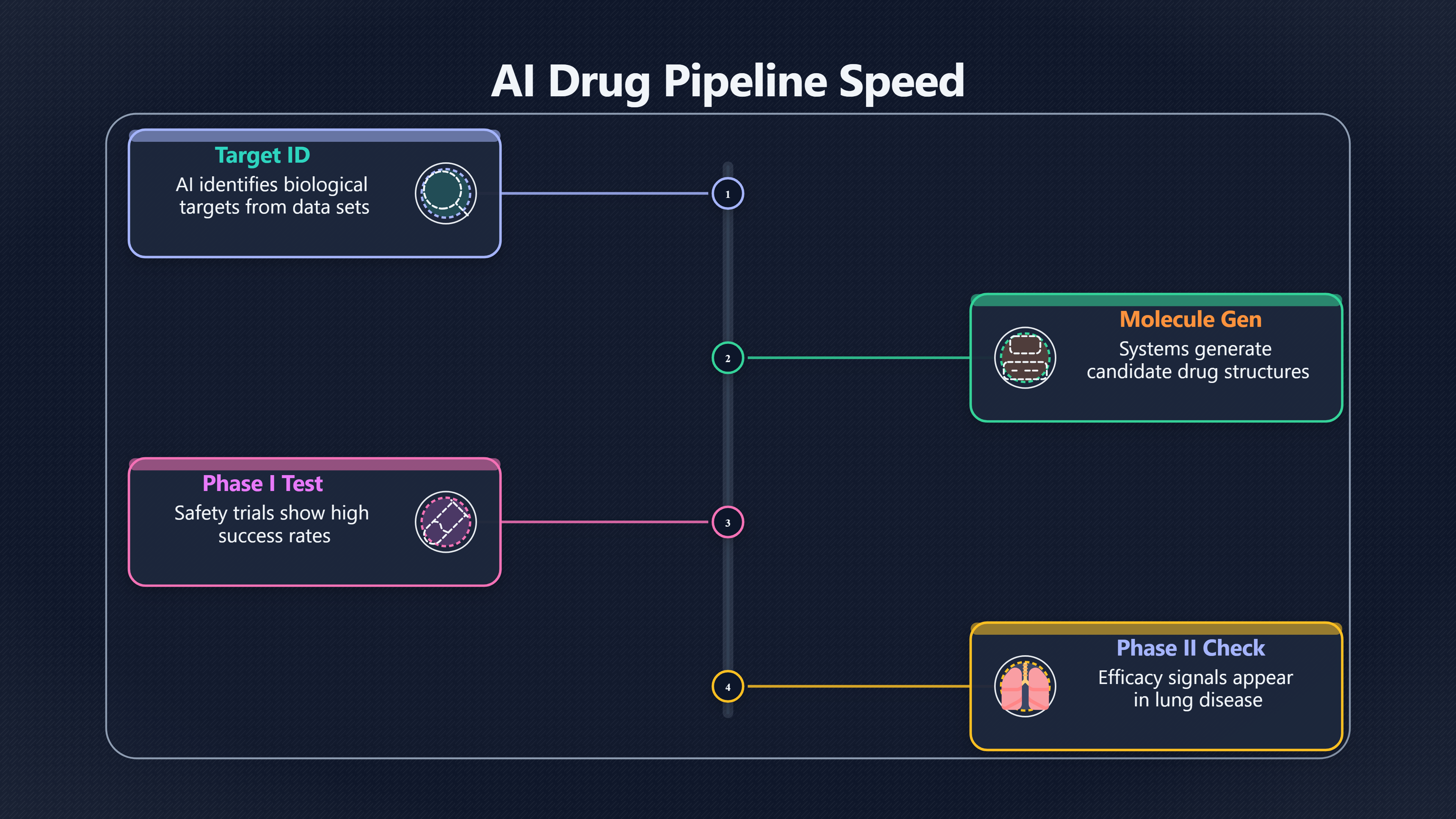
One of the strongest examples is the fibrosis drug rentosertib, formerly INS018_055, developed by Insilico Medicine. The company says it moved from target identification to Phase I trials in under 30 months, much faster than conventional timelines. [insilico.com]insilico.comFrom Start to Phase 1 in 30 MonthsFrom Start to Phase 1 in 30 Months: AI-discovered and AI-designed Anti-fibrotic Drug Enters Phase I Cli…
The programme became a widely watched test case because AI was used both to identify the biological target and to design the molecule itself. In 2025, researchers published Phase IIa trial results in Nature Medicine showing safety, tolerability, target engagement, and signals that the drug might slow decline in idiopathic pulmonary fibrosis, a serious lung disease with limited treatment options. [PubMed]pubmed.ncbi.nlm.nih.govAI-discovered or AI-designed drugs have reached human clinical trials. Here we present the results of the first phase 2a multicenter, double…
That does not prove AI can reliably invent successful medicines. But it does show that AI-generated compounds can survive the transition from computer models into real human testing — something critics once doubted would happen at all.
Large pharmaceutical firms are treating this possibility seriously. Eli Lilly expanded its collaboration with Insilico Medicine in a deal potentially worth billions, while Takeda deepened partnerships with AI-focused drug firms such as Iambic. [Reuters]reuters.comThis agreement builds upon a prior partnership that began with an AI-based software licensing deal in 2023 and a research collaboration i…
The significance goes beyond faster corporate pipelines. If AI substantially lowers the cost and time required to explore biological possibilities, the long-term effect could be a world where many more diseases become economically viable to study. Rare diseases, ageing biology, antibiotic resistance, and personalised treatments could all benefit from cheaper scientific search.
Why biology still defeats predictions
The hardest part of medicine is not generating hypotheses. It is discovering which hypotheses survive contact with the human body.
A molecule can look elegant in simulation, bind neatly to a protein in a lab assay, and still fail completely in humans. That failure often has little to do with coding quality or computational power. Biology itself is the problem.
Human bodies are layered systems shaped by evolution rather than clean engineering principles. Genes interact with metabolism, immune signalling, microbiomes, ageing, environment, behaviour, and random variation. Diseases that appear simple in theory often turn out to involve many overlapping pathways.
This is why clinical failure rates remain extremely high across the pharmaceutical industry. Even conventional drug programmes backed by enormous datasets and expert teams fail most of the time. A 2025 analysis in Nature Communications noted that estimates for overall clinical success rates across the industry often range only from about 7% to 20%. [Nature]nature.comNaturelessons from AI-driven drug discovery and clinical translationby W Yoo · 2026 — This study showed that AI-derived molecules can adv…
AI may improve the early filtering process without solving the deeper biological uncertainty.
There are already signs of this distinction appearing in the data. Several analyses suggest AI-derived drug candidates may perform unusually well in Phase I safety trials. Some reports place Phase I success rates for AI-native biotech firms around 80–90%, compared with historical industry averages closer to roughly 40–65%. Nature [Fortune That sounds dramatic]fortune.comWill AI ever cure cancer?The multibillion-dollar raceApr 3, 2025 — The firm reviewed the pipelines of more than 100 AI-native biotech companies and found these co…, but Phase I trials mainly test whether a drug is tolerably safe in humans. The far harder challenge arrives in Phase II and Phase III trials, where drugs must actually improve disease outcomes in diverse patient populations.
Here the advantage becomes much less clear.
Several industry analyses argue that AI-designed compounds still fail in Phase II at roughly conventional rates. [DeepCeutix]deepceutix.comDeep Ceutix Your AI Can Design a MoleculeIt Can't Formulate a Drug.23 Feb 2026 — AI-discovered compounds show 80-90% Phase I success rates but only ~40% Phase II success, indisti… This is important because Phase II is often where researchers discover that a disease mechanism was misunderstood, that benefits are too small, or that apparently promising biology does not translate into meaningful patient improvement.
In other words, AI may already be good at producing cleaner molecules. It is less certain that it yet understands disease deeply enough to transform clinical success rates.
The gap between molecule design and medicine
One reason the public conversation becomes misleading is that “drug discovery” sounds like the whole process. In reality, designing a molecule is only one component of creating a usable medicine.
Researchers still need to answer difficult practical questions:
- Can the drug reach the right tissue?
- Does the body break it down too quickly?
- Is it stable enough to manufacture?
- Does it interact badly with other medications?
- Can patients tolerate the dose required for efficacy?
- Will effects differ across age groups or genetic backgrounds?
An AI system may optimise for one target while missing problems elsewhere.
Some critics call this the “formulation gap”: the distance between generating a promising compound and producing a real-world therapy patients can safely take. [DeepCeutix]deepceutix.comDeep Ceutix Your AI Can Design a MoleculeIt Can't Formulate a Drug.23 Feb 2026 — AI-discovered compounds show 80-90% Phase I success rates but only ~40% Phase II success, indisti…
This is one reason why headlines about “AI-designed drugs” can overstate current reality. Most successful medicines depend on years of chemistry refinement, manufacturing work, dosing studies, biomarker analysis, regulatory negotiation, and large-scale trial logistics.
Even companies strongly associated with AI discovery still rely heavily on conventional biomedical infrastructure once compounds enter human testing.
The recent delay to clinical timelines at Google-backed Isomorphic Labs illustrates the point. The company emerged from DeepMind’s protein-structure breakthroughs and attracted major investment, yet moving from powerful prediction systems to actual human trials has still proved slower and harder than early enthusiasm suggested. [Reuters]reuters.comThe collaboration will focus on using artificial intelligence (AI) to design small-molecule drugs for cancer and gastrointestinal disease…
What early human tests can prove
The strongest evidence for AI medicine is no longer hypothetical. The field has moved beyond slide decks and benchmark demonstrations into real patient studies.
But the evidence remains early-stage.
The rentosertib fibrosis programme matters because it crossed several difficult thresholds:
- AI identified a novel target
- AI generated the molecule
- the drug entered human trials [nature.com]nature.comNaturelessons from AI-driven drug discovery and clinical translationby W Yoo · 2026 — This study showed that AI-derived molecules can adv…
- Phase IIa data showed signs of clinical activity
That is a meaningful milestone for computational drug discovery. Nature [PubMed Recursion Pharmaceuticals has also reported encouraging Phase II data for REC-994]pubmed.ncbi.nlm.nih.govAI-discovered or AI-designed drugs have reached human clinical trials. Here we present the results of the first phase 2a multicenter, double…, an AI-derived candidate for cerebral cavernous malformation, a rare vascular brain disease. [Genetic Engineering & Biotechnology News]genengnews.comGenetic Engineering & Biotechnology NewsRecursion Announces Promising Clinical Data on Lead AI-…Feb 5, 2025 — Recursion announced favo…
Still, readers should be careful not to confuse “promising early data” with proven therapies. Biomedical history is full of drugs that looked impressive in early studies before failing in larger trials.
Phase III remains the great filter.
Large late-stage trials involve broader patient populations, longer timelines, more rigorous statistical thresholds, and closer scrutiny of side effects. This is where many drugs collapse — including many developed through traditional methods.
No AI-discovered medicine has yet definitively demonstrated that AI can consistently beat these historical odds across multiple diseases and large populations. [Medium]medium.comhow ai is transforming drug discovery in 2026 0d8c7c600428MediumHow AI is Transforming Drug Discovery in 2026No AI-discovered drug has received FDA approval as of April 2026. Phase IIa data is pr…
That uncertainty matters for the broader AI bloom thesis. Faster scientific search is valuable, but the deepest hope is not simply accelerating experiments. It is improving humanity’s ability to understand and control biology itself.
The current evidence suggests AI is beginning to compress the “search” part of medicine. It has not yet shown that it can reliably solve the underlying complexity of human disease.

Why this still matters for the long-term future
Even if AI does not magically eliminate clinical failure, modest improvements could still transform medicine over decades.
Suppose AI systems eventually:
- halve early discovery timelines [appliedclinicaltrialsonline.com]appliedclinicaltrialsonline.comthe evolving role of ai in shifting the bottleneck in early drug discoveryThe Evolving Role of AI in Shifting the Bottleneck in Early…26 Jan 2024 — For AI to play a significant role in breaking the molecular…
- reduce the cost of failed compounds
- improve molecular quality modestly
- identify better biological targets
- automate more laboratory work
- personalise therapies more effectively
Each gain alone might seem incremental. Together they could dramatically increase the amount of biomedical exploration civilisation can afford.
That matters because modern medicine is constrained not just by intelligence, but by the scarcity of expert time, laboratory capacity, and capital. AI potentially changes the economics of scientific exploration itself.
A world where researchers can investigate ten times more therapeutic hypotheses for the same cost is a world where neglected diseases, longevity science, and preventative medicine become more tractable.
This is where the subtopic connects back to the wider AI bloom vision. The optimistic argument is not merely that AI will invent a few blockbuster drugs faster. It is that advanced AI could eventually expand humanity’s total scientific capacity — helping civilisation learn about ageing, regeneration, neurodegeneration, immune dysfunction, and rare disease at a pace previously impossible.
But the current evidence also supports a more cautious conclusion: biology remains stubbornly resistant to easy prediction. Human trials are not a bureaucratic obstacle that smarter models simply sweep aside. They are reality checks against the complexity of living systems.
The future of AI medicine therefore depends not only on larger models or faster computation, but on whether AI can genuinely deepen scientific understanding rather than merely accelerate molecular guessing.
Endnotes
-
Source: nature.com
Link: https://www.nature.com/articles/s44276-026-00221-1Source snippet
Naturelessons from AI-driven drug discovery and clinical translationby W Yoo · 2026 — This study showed that AI-derived molecules can adv...
-
Source: medium.com
Title: how ai is transforming drug discovery in 2026 0d8c7c600428
Link: https://medium.com/%40unicodeveloper/how-ai-is-transforming-drug-discovery-in-2026-0d8c7c600428Source snippet
MediumHow AI is Transforming Drug Discovery in 2026No AI-discovered drug has received FDA approval as of April 2026. Phase IIa data is pr...
Published: April 2026
-
Source: nature.com
Link: https://www.nature.com/articles/d43747-022-00112-7Source snippet
The total time from target discovery to the start of...
-
Source: insilico.com
Link: https://insilico.com/phase1Source snippet
From Start to Phase 1 in 30 MonthsFrom Start to Phase 1 in 30 Months: AI-discovered and AI-designed Anti-fibrotic Drug Enters Phase I Cli...
-
Source: insilico.com
Link: https://insilico.com/casestudySource snippet
trial" – this Nature Medicine paper presents the...Read more...
-
Source: reuters.com
Link: https://www.reuters.com/business/healthcare-pharmaceuticals/eli-lilly-extends-partnership-with-insilico-medicine-ai-powered-drug-discovery-2026-03-30/Source snippet
This agreement builds upon a prior partnership that began with an AI-based software licensing deal in 2023 and a research collaboration i...
-
Source: reuters.com
Link: https://www.reuters.com/business/healthcare-pharmaceuticals/takeda-deepens-ai-drug-discovery-push-with-17-billion-iambic-deal-2026-02-09/Source snippet
The collaboration will focus on using artificial intelligence (AI) to design small-molecule drugs for cancer and gastrointestinal disease...
-
Source: nature.com
Link: https://www.nature.com/articles/s41467-025-64552-2Source snippet
NatureDynamic clinical trial success rates for drugs in the 21st...by Y Zhou · 2025 · Cited by 7 — However, there is huge variation, ran...
-
Source: nature.com
Link: https://www.nature.com/articles/s41587-025-02754-1Source snippet
NatureClinical trials gain intelligence | Nature BiotechnologyJul 15, 2025 — AI accelerates the drug discovery pipeline, reducing the tra...
-
Source: fortune.com
Title: Will AI ever cure cancer?
Link: https://fortune.com/2025/04/03/recursion-pharmaceuticals-ai-drug-discovery/Source snippet
The multibillion-dollar raceApr 3, 2025 — The firm reviewed the pipelines of more than 100 AI-native biotech companies and found these co...
-
Source: deepceutix.com
Title: Deep Ceutix Your AI Can Design a Molecule
Link: https://deepceutix.com/insights/ai-formulation-gapSource snippet
It Can't Formulate a Drug.23 Feb 2026 — AI-discovered compounds show 80-90% Phase I success rates but only ~40% Phase II success, indisti...
-
Source: reuters.com
Title: Google-backed Isomorphic Labs delays clinical trial timeline
Link: https://www.reuters.com/business/healthcare-pharmaceuticals/google-backed-ai-drug-discovery-startup-isomorphic-labs-delays-clinical-trial-2026-01-20/Source snippet
This update was shared by founder and CEO Demis Hassabis during the World Economic Forum in Davos, Switzerland. The company, established...
-
Source: insilico.com
Link: https://insilico.com/news/yxenmllx01-generative-ai-leap-insilico-medicine-nomSource snippet
April 23, 2026, Insilico Medicine (“Insilico”, HKEX:3696), a clinical-stage, generative AI–driven drug discovery company, announced a...
Published: April 23, 2026
-
Source: insilico.com
Title: first phase2
Link: https://insilico.com/blog/first_phase2Source snippet
First Generative AI Drug Begins Phase II Trials with Patients1 Jul 2023 — Insilico Medicine has achieved a new milestone in artificial in...
-
Source: insilico.com
Link: https://insilico.com/Source snippet
Insilico Medicine: MainNow, says Dr. Levitt, Insilico Medicine is using AI to create an entirely new AI-driven drug discovery pipeline fr...
-
Source: insilico.com
Title: 8tx5ducrx1 insilico medicine featured in harvard bu
Link: https://insilico.com/news/8tx5ducrx1-insilico-medicine-featured-in-harvard-buSource snippet
Insilico Medicine Featured in Harvard Business School...10 Feb 2026 — The case describes Rentosertib as the world's first drug with both...
-
Source: insilico.com
Link: https://insilico.com/blog/ipf-phase1Source snippet
IPF – Phase 1The Company had brought its novel AI-discovered and AI-designed IPF drug to Phase 1 trials in record time, advancing from st...
-
Source: recursion.com
Link: https://www.recursion.com/pressSource snippet
Press Releases & Recursion NewsNature Reviews Drug Discovery · InnovationRx: Recursion's CEO talks clinical trial data for AI-designed dr...
-
Source: pubmed.ncbi.nlm.nih.gov
Link: https://pubmed.ncbi.nlm.nih.gov/40461817/Source snippet
AI-discovered or AI-designed drugs have reached human clinical trials. Here we present the results of the first phase 2a multicenter, double...
-
Source: genengnews.com
Link: https://www.genengnews.com/gen-edge/recursion-announces-promising-clinical-data-on-lead-ai-based-drug-candidate-for-brain-disease/Source snippet
Genetic Engineering & Biotechnology NewsRecursion Announces Promising Clinical Data on Lead AI-...Feb 5, 2025 — Recursion announced favo...
-
Source: Wikipedia
Title: Artificial intelligence
Link: https://en.wikipedia.org/wiki/Artificial_intelligenceSource snippet
Artificial intelligenceArtificial intelligence (AI) is the capability of computational systems to perform tasks typically associated w...
Additional References
-
Source: intuitionlabs.ai
Link: https://intuitionlabs.ai/articles/ins018-055-phase-2a-results-ai-designed-drug -
Source: pulmonaryfibrosis.org
Link: https://www.pulmonaryfibrosis.org/patients-caregivers/medical-and-support-resources/clinical-trials-education-center/pipeline/drug/idiopathic-pulmonary-fibrosis/ism001-055-%28ins018_055%29Source snippet
INS018_055INS018_055 is a first-in-class small molecule targeting TNIK (Traf2- and Nck-interacting kinase) and was designed utilizing gen...
-
Source: scientific-computing.com
Link: https://www.scientific-computing.com/article/why-ai-drug-revolution-hasnt-deliveredSource snippet
Why the AI drug revolution has yet to deliverHe said AI may have accelerated the selection of a new candidate drug or preclinical develop...
-
Source: facebook.com
Link: https://www.facebook.com/worldeconomicforum/posts/new-medicines-are-critical-to-fight-disease-but-there-is-a-bottleneck-in-getting/1427072572794310/Source snippet
World Economic ForumIn the past 10 years, firms that utilize AI drug discovery have advanced 75 drug candidates in clinical trials. No ph...
-
Source: infiuss.com
Title: ai in drug discovery the illusion of speed and the reality of clinical failure
Link: https://infiuss.com/insights/ai-in-drug-discovery-the-illusion-of-speed-and-the-reality-of-clinical-failureSource snippet
AI in Drug Discovery: The Illusion of Speed and the Reality...9 Dec 2025 — The "Biology" Failure (Phase II/III) · The Statistic: AI-disc...
-
Source: tipranks.com
Title: ai discovered ipf drug candidate puts insilico medicines platform in focus
Link: https://www.tipranks.com/news/private-companies/ai-discovered-ipf-drug-candidate-puts-insilico-medicines-platform-in-focusSource snippet
AI-Discovered IPF Drug Candidate Puts Insilico Medicine's...5 days ago — The post highlights Insilico's AI-enabled discovery of Rentoser...
-
Source: statnews.com
Title: recursion pharmaceuticals front runner ai in medicine new drug development
Link: https://www.statnews.com/2024/08/19/recursion-pharmaceuticals-front-runner-ai-in-medicine-new-drug-development/Source snippet
AI drug firm Recursion seeks to move from survival to industry...Aug 19, 2024 — Recursion will release proof-of-concept clinical trial d...
-
Source: appliedclinicaltrialsonline.com
Title: the evolving role of ai in shifting the bottleneck in early drug discovery
Link: https://www.appliedclinicaltrialsonline.com/view/the-evolving-role-of-ai-in-shifting-the-bottleneck-in-early-drug-discoverySource snippet
The Evolving Role of AI in Shifting the Bottleneck in Early...26 Jan 2024 — For AI to play a significant role in breaking the molecular...
-
Source: faculty.ai
Title: todays bottleneck isnt science its execution under real world constraints
Link: https://faculty.ai/insights/articles/todays-bottleneck-isnt-science-its-execution-under-real-world-constraintsSource snippet
Today's bottleneck isn't science. It's execution under real...17 Feb 2026 — Steph Skeet, Solutions Director for Faculty Frontier™, expla...
-
Source: pharmaphorum.com
Link: https://pharmaphorum.com/deep-dive/why-drugs-fail-unrelenting-challenge-finding-new-drugSource snippet
allenges like target identification, compound interaction modelling, and screening...Read more...
Amazon book picks
Further Reading
Books and field guides related to AI Discovered Drugs. Use these as the next step if you want deeper reading beyond the article.
Drug Discovery and Evaluation: Pharmacological Assays
The new edition of this successful reference offers both cutting-edge and classic pharmacological methods. Thoroughly revised and expande...
Drug Discovery and Evaluation
First published 2006. Subjects: Experimental Pharmacology, Drug development, Pharmacology, Medicine, Toxicology.
Molecular Biology and Biotechnology
Rating: 3.5/5 from 6 Google Books ratings
This work features 250 articles covering topics in molecular biology, molecular medicine and biotechnology. Each article has been careful...
eBay marketplace picks
Marketplace Samples
Example marketplace items related to this page. Use the search link to explore similar finds on eBay.
Example eBay listing
A.I. Artificial Intelligence Original Movie Poster Signed By Jude Law
USD 125.00 | Shipping USD 25.00 | US
Example eBay listing
Artificial Intelligence D/S Original Movie Poster - 27 x 40"
USD 19.50 | Shipping USD 13.65 | US

Example eBay listing
612388 Artificial Intelligence Movie Science Fiction Drama Wall Print Poster
USD 22.95 | Shipping USD 12.95 | JP

Example eBay listing
Companion - Artificial Intelligence Dark Comedy Cinema Film - POSTER 20"x30"
USD 23.99 | Free shipping | US

Example eBay listing
A.I. Artificial Intelligence Movie Film Poster Art Print
GBP 4.99 | Free shipping | GB

Example eBay listing
A I Artificial Intelligence 6 Movie Poster Art Print Print Classic Rare Gallery
GBP 49.00 | Free shipping | GB

Example eBay listing
AI - Artificial Intelligence (Poster + Slipcase) Blu-Ray
GBP 10.49 | Free shipping | GB
Example eBay listing
A. I. Artificial Intelligence. Jude Law. Original UK Video Poster.
GBP 8.11 | Shipping GBP 3.38 | GB
Topic Tree