Within Worker Gains
Keeping human judgement
AI is more likely to raise wages when people retain responsibility for judgement, trust, coordination, and final decisions.
On this page
- Which parts of work AI can safely draft or summarise
- Why accountability and trust remain valuable
- How roles avoid becoming low paid AI supervision
Page outline Jump by section
Introduction
AI is more likely to raise wages and expand human capability when workers keep responsibility for judgement while software handles repetitive or information-heavy tasks. That distinction sounds subtle, but it changes the economics of work. A radiologist who uses AI to flag suspicious scans still exercises medical judgement, communicates uncertainty, and carries legal and ethical responsibility. A customer-support worker who uses AI suggestions while deciding how to handle a difficult case still performs trust, negotiation, and contextual reasoning. In those settings, AI acts as a capability multiplier rather than a direct substitute for labour.
 This matters to the broader idea of AI-enabled abundance because long-term prosperity depends not only on how much work machines can do, but on whether humans remain valuable participants in economic and social life. If AI strips jobs down into low-autonomy monitoring roles, the gains may concentrate around software owners. If AI instead removes drudgery while preserving human discretion, workers may become more productive, more trusted, and harder to replace. Early evidence suggests both futures are possible. [OUP Academic]academic.oup.comOUP AcademicGenerative AI at Work* | The Quarterly Journal of Economicsby E Brynjolfsson · 2025 · Cited by 3143 — We study the effect of… [NBER]nber.orgIt starts from a task-based model of AI's effects, working through…Read more…
Which parts of work AI can safely draft or summarise
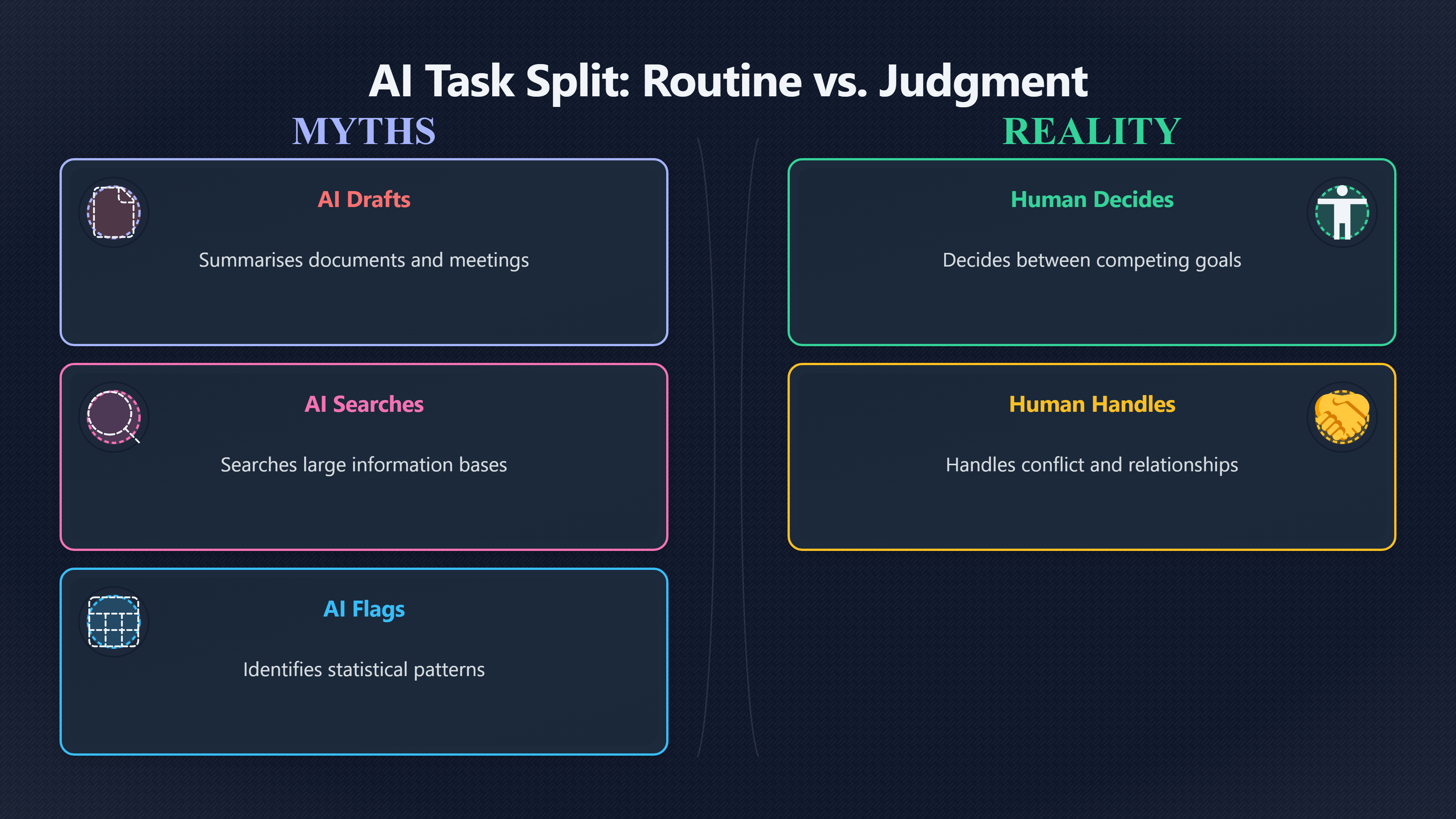
Many occupations contain a mix of routine and non-routine tasks. AI systems are strongest where work is repetitive, heavily documented, pattern-based, or language-intensive. Humans remain strongest where work depends on responsibility, tacit understanding, social trust, or handling unusual situations.
That division explains why some AI deployments increase worker value instead of hollowing out jobs.
In practice, AI often performs well at:
- summarising documents and meetings;
- drafting emails, reports, or code;
- searching large information bases;
- identifying statistical patterns;
- generating first-pass analyses;
- automating form-filling and classification;
- surfacing likely next steps.
Humans still tend to dominate at:
- deciding between competing goals;
- interpreting ambiguity;
- handling edge cases and exceptions;
- managing conflict and relationships;
- taking legal or ethical responsibility;
- persuading, reassuring, or negotiating;
- coordinating across teams and institutions.
The most economically important point is that these two categories can reinforce each other. Workers become more productive when AI removes cognitive overhead while leaving them in charge of interpretation and final decisions.
A widely discussed study by Erik Brynjolfsson, Danielle Li, and Lindsey Raymond examined more than 5,000 customer-support agents using a generative AI assistant. Productivity rose by roughly 14–15%, with especially large gains among newer and lower-skilled workers. The AI system effectively spread the tacit knowledge of stronger workers across the organisation. But humans still handled the customer relationship, exercised judgement, and remained accountable for outcomes. [OUP Academic]academic.oup.comOUP AcademicGenerative AI at Work* | The Quarterly Journal of Economicsby E Brynjolfsson · 2025 · Cited by 3143 — We study the effect of… [NBER]nber.orgGenerative AI at Workby E Brynjolfsson · 2023 · Cited by 3306 — Access to the tool increases productivity, as measured by issues resolved…
That mechanism matters beyond call centres. It suggests AI can compress learning curves without fully automating professions away.
In software engineering, for example, coding assistants can generate boilerplate functions, autocomplete syntax, or search documentation quickly. Yet senior engineers still decide system architecture, security trade-offs, product goals, and integration across large systems. Daron Acemoglu has argued that coding demonstrates both sides of AI simultaneously: routine portions become easier to automate, while higher-level judgement and coordination remain difficult and valuable. [Financial Times]ft.comFinancial Times Transcript: Rethinking the AI boom, with Daron AcemoğluAcemoğlu argues that AI's influence will be modest without significant breakthroughs and expects only a minor increase in productivity an…
Medicine shows the same pattern. AI can classify medical images, draft clinical notes, or highlight possible abnormalities. But clinicians still carry responsibility for diagnosis, patient communication, informed consent, and treatment planning. The more medicine involves uncertainty, trade-offs, or emotional judgement, the harder it becomes to reduce the job to software outputs alone. [ScienceDirect]sciencedirect.comScienceDirectHuman in the loop artificial intelligence in healthcareby DB Olawade · 2026 · Cited by 8 — This review synthesizes current e…
This “human plus AI” structure is one plausible route toward broader prosperity in an AI-rich economy. If advanced systems increasingly handle memory, search, routine analysis, and administrative burden, humans may spend more time on synthesis, strategy, care, creativity, and coordination.
Why accountability and trust remain valuable
One reason human judgement retains economic value is that responsibility cannot be automated away as easily as computation.
When things go wrong, organisations still need identifiable humans who can explain decisions, justify trade-offs, and absorb legal or reputational accountability. AI systems can generate outputs, but they do not carry moral or institutional responsibility in the way people do.
That is especially visible in professions built around trust.
A lawyer using AI to summarise case law still signs filings and advises clients. A financial adviser using AI forecasting tools still carries fiduciary duties. A nurse using AI-supported triage tools still reassures patients and notices contextual details software may miss. In aviation, autopilot systems handle enormous amounts of routine control, yet pilots remain essential precisely because rare emergencies and conflicting signals require human judgement under uncertainty.
The economic consequence is important. Workers who remain the accountable layer above automation often become more valuable because they can supervise larger flows of information and activity.
This differs from older industrial automation, where machines often displaced manual labour directly. In many knowledge professions, AI increases the scale of what one person can oversee rather than eliminating the need for oversight entirely.
Researchers and regulators increasingly describe this as “human in the loop” AI. But the phrase can hide major differences between meaningful judgement and superficial oversight. A worker who genuinely evaluates outputs, overrides mistakes, and applies contextual knowledge retains agency. A worker forced to rubber-stamp machine outputs at impossible speed may only carry liability without real control. [Trilateral Research]trilateralresearch.comhuman in the loop ai balances automation and accountabilityTrilateral ResearchHuman-in-the-loop AI balances automation and…4 Jun 2025 — Learn how Human-in-the-loop AI combines automated process…
If workers retain real authority, firms often still depend on their expertise and judgement. If humans become nominal supervisors of systems they barely control, work can degrade into lower-paid exception handling while strategic authority migrates upward to software designers and managers.
The design choices matter enormously.
How roles avoid becoming low-paid AI supervision
The same AI system can either deepen expertise or deskill workers depending on how organisations deploy it.
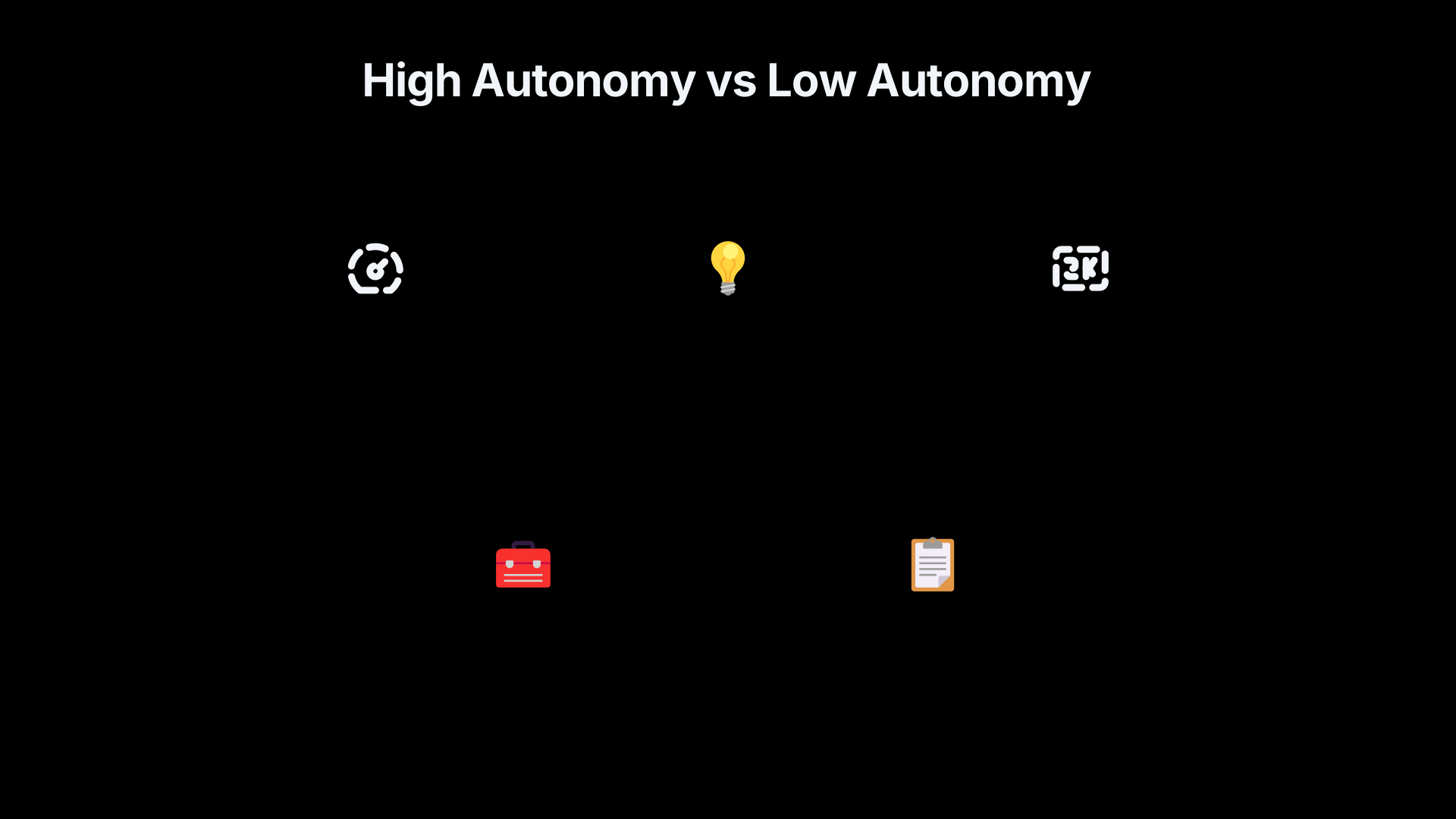
A high-autonomy model usually has several features:
- workers can question or override AI outputs;
- AI explains reasoning or evidence;
- humans remain responsible for final decisions;
- employees continue developing expertise;
- performance metrics reward judgement, not blind speed;
- organisations invest in training rather than replacement.
A low-autonomy model looks different:
- workers mainly monitor machine outputs;
- productivity pressure discourages independent thinking;
- software determines workflows rigidly;
- employees lose opportunities to practise expertise;
- managers use AI primarily for labour reduction;
- workers become interchangeable operators.
This is not a theoretical concern. Economists including Daron Acemoglu argue that the direction of technological deployment is shaped by incentives, institutions, and organisational choices, not by technology alone. AI can complement labour or substitute for it depending on which tasks firms automate and which human capabilities they preserve. [Financial Times]ft.comFinancial Times Transcript: Rethinking the AI boom, with Daron AcemoğluAcemoğlu argues that AI's influence will be modest without significant breakthroughs and expects only a minor increase in productivity an… [NBER]nber.orgErik Brynjolfsson The Economics of Transformative AI. BookErik BrynjolfssonThe Economics of Transformative AI. Book - Conference Volume. editors - Ajay K. Agrawal, Erik Brynjolfsson & Anton Korin… [Cicero Institute]ciceroinstitute.orgAI complements workers or substitutes for them. In the task-based framework developed by Daron Acemoglu and Pascual Restrepo, AI is not…
One risk is “judgement atrophy”. If workers rely too heavily on AI recommendations, they may gradually lose the ability to evaluate outputs independently. In medicine or aviation, this danger has been discussed for years: automation can weaken human skill precisely because people intervene less often.
Another risk is asymmetric monitoring. AI systems can track keystrokes, conversation timing, delivery routes, or customer interactions in fine detail. Used aggressively, this can push workers into highly standardised workflows optimised for measurable output rather than thoughtful judgement. In that model, AI increases managerial control more than worker capability.
The opposite approach treats AI as infrastructure for professional empowerment.
In customer support, AI systems may help junior workers sound more experienced while still allowing them discretion in difficult interactions. In education, AI tutoring tools may help teachers personalise lessons while teachers remain responsible for motivation, discipline, and emotional understanding. In science, AI may analyse huge datasets while researchers decide which hypotheses matter and which discoveries deserve follow-up.
Those arrangements are more likely to support wage growth because workers remain central to value creation rather than peripheral to machine processes.
Why judgement may become more valuable in an AI-rich economy
Paradoxically, more automation can increase the importance of specifically human judgement.
As routine tasks become cheaper, scarce capabilities become more economically valuable. If AI systems can generate endless drafts, summaries, analyses, and recommendations, then selecting the right goals and interpreting the results becomes more important.
This may shift labour markets toward what economists sometimes call complementary tasks: work where human and machine capabilities reinforce each other instead of competing directly. [NBER]nber.orgIt starts from a task-based model of AI's effects, working through…Read more…
Several forms of judgement may grow in importance:
- deciding which objectives matter;
- balancing competing human interests;
- evaluating reliability and risk;
- integrating knowledge across domains;
- building trust with other humans;
- handling novel or ambiguous situations;
- exercising moral and political responsibility.
These capabilities are harder to commodify because they depend heavily on context and social legitimacy.
That does not guarantee a positive outcome. AI could still concentrate wealth and power while reducing many middle-income jobs. Some researchers argue that newer “agentic” systems capable of handling multi-step workflows may expand automation pressure significantly. [arXiv]arxiv.orgarXiv Generative AI at WorkarXiv Generative AI at Work
But the optimistic case for AI-enabled human flourishing depends partly on preserving meaningful human roles even as machine capability rises. A civilisation where advanced AI removes dangerous, repetitive, or degrading labour while amplifying human creativity and judgement looks very different from one where most people become passive overseers of systems they do not control.
The near-term workplace decisions already visible today may influence which path becomes dominant.

Endnotes
-
Source: academic.oup.com
Link: https://academic.oup.com/qje/article/140/2/889/7990658Source snippet
OUP AcademicGenerative AI at Work* | The Quarterly Journal of Economicsby E Brynjolfsson · 2025 · Cited by 3143 — We study the effect of...
-
Source: nber.org
Link: https://www.nber.org/system/files/working_papers/w32487/w32487.pdfSource snippet
It starts from a task-based model of AI's effects, working through...Read more...
-
Source: nber.org
Link: https://www.nber.org/papers/w31161Source snippet
Generative AI at Workby E Brynjolfsson · 2023 · Cited by 3306 — Access to the tool increases productivity, as measured by issues resolved...
-
Source: arxiv.org
Title: arXiv Generative AI at Work
Link: https://arxiv.org/abs/2304.11771 -
Source: sciencedirect.com
Link: https://www.sciencedirect.com/science/article/pii/S1386505626001024Source snippet
ScienceDirectHuman in the loop artificial intelligence in healthcareby DB Olawade · 2026 · Cited by 8 — This review synthesizes current e...
-
Source: arxiv.org
Link: https://arxiv.org/abs/2505.10426 -
Source: arxiv.org
Link: https://arxiv.org/abs/2604.00186Source snippet
arXivAgentic AI and Occupational Displacement: A Multi-Regional Task Exposure Analysis of Emerging Labor Market DisruptionMarch 31, 2026...
Published: March 31, 2026
-
Source: brynjolfsson.com
Link: https://www.brynjolfsson.com/Source snippet
Erik BrynjolfssonErik Brynjolfsson is the Jerry Yang and Akiko Yamazaki Professor and Senior Fellow at the Stanford Institute for Human-C...
-
Source: brynjolfsson.com
Link: https://www.brynjolfsson.com/booksSource snippet
BooksIn The Second Machine Age, Andrew McAfee and Erik Brynjolfsson predicted some of the far-reaching effects of digital technologies on...
-
Source: nber.org
Title: Erik Brynjolfsson The Economics of Transformative AI. Book
Link: https://www.nber.org/people/erik_brynjolfssonSource snippet
Erik BrynjolfssonThe Economics of Transformative AI. Book - Conference Volume. editors - Ajay K. Agrawal, Erik Brynjolfsson & Anton Korin...
-
Source: sciencedirect.com
Link: https://www.sciencedirect.com/science/article/pii/S0954349X26000512Source snippet
The effect of AI on labour demand: A critical assessment of '...by J Aldred · 2026 — Acemoglu and Johnson contrast the mass production s...
-
Source: sciencedirect.com
Link: https://www.sciencedirect.com/science/article/pii/S2773032824000154Source snippet
AI-induced job impact: Complementary or substitution...by KH Wang · 2025 · Cited by 76 — This study utilizes 3,682 full-time workers to...
-
Source: institute.global
Title: the impact of ai on the labour market
Link: https://institute.global/insights/economic-prosperity/the-impact-of-ai-on-the-labour-marketSource snippet
Nov 8, 2024 — Our literature review drew on work from world-renowned economists and AI experts such as Erik Brynjolfsson, David Autor and...
-
Source: arxiv.org
Link: https://arxiv.org/pdf/2304.11771Source snippet
Generative AI at Workby E Brynjolfsson · 2023 · Cited by 2995 — In this paper, we study the adoption of a generative AI tool that provide...
-
Source: arxiv.org
Title: Complementarity, Augmentation, or Substitutivity?
Link: https://arxiv.org/pdf/2503.09637Source snippet
WG Resh · 2025 · Cited by 10 — Acemoglu and Restrepo (2019) discuss the “task content” of production, emphasizing that automati...
-
Source: academic.oup.com
Link: https://academic.oup.com/ooec/article/3/Supplement_1/i906/7708121Source snippet
This article reviews recent work on how automation and task displacement have contributed to labour share declines and inequality in the...
-
Source: ft.com
Title: Financial Times Transcript: Rethinking the AI boom, with Daron Acemoğlu
Link: https://www.ft.com/content/780559a8-f699-4c1b-878e-f9899c8e0d8bSource snippet
Acemoğlu argues that AI's influence will be modest without significant breakthroughs and expects only a minor increase in productivity an...
-
Source: trilateralresearch.com
Title: human in the loop ai balances automation and accountability
Link: https://trilateralresearch.com/responsible-ai/human-in-the-loop-ai-balances-automation-and-accountabilitySource snippet
Trilateral ResearchHuman-in-the-loop AI balances automation and...4 Jun 2025 — Learn how Human-in-the-loop AI combines automated process...
-
Source: ciceroinstitute.org
Link: https://ciceroinstitute.org/blog/ai-and-the-future-of-work-policy-lessons-from-acemoglu-and-restrepo/Source snippet
AI complements workers or substitutes for them. In the task-based framework developed by Daron Acemoglu and Pascual Restrepo, AI is not...
-
Source: Wikipedia
Title: Erik Brynjolfsson
Link: https://en.wikipedia.org/wiki/Erik_BrynjolfssonSource snippet
Erik BrynjolfssonErik Brynjolfsson is an American academic, author and inventor. He is the Jerry Yang and Akiko Yamazaki Professor and...
-
Source: economics.stanford.edu
Title: erik brynjolfsson
Link: https://economics.stanford.edu/people/erik-brynjolfssonSource snippet
is the Jerry Yang and Akiko Yamazaki Professor and Senior Fellow at the Stanford Institute for Human-Centered AI (HAI), and Director of...
-
Source: ubs.com
Link: https://www.ubs.com/global/en/investment-bank/insights-and-data/articles/ai-and-robots.htmlSource snippet
AI and robotsCurrently, AI can automate or augment about 20% of tasks in the US economy, according to Acemoglu, “primarily office and kno...
-
Source: linkedin.com
Title: Erik Brynjolfsson
Link: https://www.linkedin.com/in/erikbrynjolfssonSource snippet
Professor, Writer, Speaker, InventorErik Brynjolfsson is the Jerry Yang and Akiko Yamazaki Professor and Senior Fellow at the Stanford In...
Additional References
-
Source: imf.org
Link: https://www.imf.org/en/publications/fandd/issues/2023/12/rebalancing-ai-acemoglu-johnsonSource snippet
Rebalancing AI-Daron Acemoglu Simon JohnsonThe drive toward automation is perilous—to support shared prosperity, AI must complement worke...
-
Source: verifywise.ai
Link: https://verifywise.ai/lexicon/human-in-the-loop-safeguards -
Source: clinicalleader.com
Title: human in the loop in ai validation and control from principle to practice 0001
Link: https://www.clinicalleader.com/doc/human-in-the-loop-in-ai-validation-and-control-from-principle-to-practice-0001Source snippet
Human-In-The-Loop In AI Validation And Control28 Apr 2026 — Explores how human-in-the-loop oversight can move from principle to practice...
-
Source: lawrence-emenike.medium.com
Title: the economics of ai from labor substitution to complementarities 531f235780bc
Link: https://lawrence-emenike.medium.com/the-economics-of-ai-from-labor-substitution-to-complementarities-531f235780bcSource snippet
Economics of AI: From Labor Substitution to...U-shaped complementarity curve: Empirical labor data reveal that AI most strongly compleme...
-
Source: laweconcenter.org
Title: ai productivity and labor markets a review of the empirical evidence
Link: https://laweconcenter.org/resources/ai-productivity-and-labor-markets-a-review-of-the-empirical-evidence/Source snippet
AI, Productivity, and Labor Markets: A Review of the...5 Feb 2026 — Erik Brynjolfsson, Danielle Li, and Lindsey Raymond (2025) examine a...
-
Source: economics.mit.edu
Title: Tasks at Work Comparative Advantage, Technology and Labor Demand 0
Link: https://economics.mit.edu/sites/default/files/2024-08/Tasks%20at%20Work%20-%20Comparative%20Advantage%2C%20Technology%20and%20Labor%20Demand_0.pdfSource snippet
MIT EconomicsComparative Advantage, Technology and Labor Demandby D Acemoglu · 2024 · Cited by 45 — This chapter reviews recent advances...
-
Source: cream-migration.org
Link: https://www.cream-migration.org/publ_uploads/25035.pdfSource snippet
s have distinct effects on labor demand, factor shares, and productivity and their full...Read more...
-
Source: x.com
Title: Erik Brynjolfsson (@erikbryn) / Posts / XErik Brynjolfsson (@erikbryn)
Link: https://x.com/erikbrynSource snippet
Posts - Director @DigEconLab Co-founder, @Workhelix @StanfordHAI @SIEPR @Stanford amazon.com/Sec... | X (formerly Twitter)...
-
Source: resetdoc.org
Link: https://www.resetdoc.org/story/nobel-laureate-acemoglu-automation-inequality-future-society/Source snippet
Nobel Laureate Acemoglu on Automation, Inequality, and...14 Oct 2024 — I am going to discuss the question of automation and the prospect...
-
Source: leadershipinstitute.wsj.com
Title: erik brynjolfsson productivity is much higher due to ai
Link: https://leadershipinstitute.wsj.com/technology/video/erik-brynjolfsson-productivity-is-much-higher-due-to-ai/Source snippet
Brynjolfsson: Productivity is 'Much Higher' Due to AIThe Stanford economist argues that the "J Curve" of AI adoption is turning upward. B...
Amazon book picks
Further Reading
Books and field guides related to Keeping human judgement. Use these as the next step if you want deeper reading beyond the article.

Artificial Intelligence in Economics and Finance Theories
As Artificial Intelligence (AI) seizes all aspects of human life, there is a fundamental shift in the way in which humans are thinking of...

Partnering with Al
Partnering with Al: A Practical Guide to Human-Machine Collaboration focuses on fostering effective human-AI collaboration by providing p...

Augmented Intelligence
The AI revolution is moving at a breakneck speed. Organizations are beginning to invest in innovative ways to monetize their data through...
AI on The Job
This book is a practical guide to using artificial intelligence with motivated employees in companies and organizations. You will learn w...
eBay marketplace picks
Marketplace Samples
Example marketplace items related to this page. Use the search link to explore similar finds on eBay.

Example eBay listing
A.I. Artificial Intelligence Original Movie Poster Signed By Jude Law
USD 125.00 | Shipping USD 25.00 | US

Example eBay listing
Artificial Intelligence D/S Original Movie Poster - 27 x 40"
USD 19.50 | Shipping USD 13.65 | US

Example eBay listing
612388 Artificial Intelligence Movie Science Fiction Drama Wall Print Poster
USD 22.95 | Shipping USD 12.95 | JP

Example eBay listing
Companion - Artificial Intelligence Dark Comedy Cinema Film - POSTER 20"x30"
USD 23.99 | Free shipping | US

Example eBay listing
A.I. Artificial Intelligence Movie Film Poster Art Print
GBP 4.99 | Free shipping | GB

Example eBay listing
A I Artificial Intelligence 6 Movie Poster Art Print Print Classic Rare Gallery
GBP 49.00 | Free shipping | GB

Example eBay listing
AI - Artificial Intelligence (Poster + Slipcase) Blu-Ray
GBP 10.49 | Free shipping | GB

Example eBay listing
A. I. Artificial Intelligence. Jude Law. Original UK Video Poster.
GBP 8.11 | Shipping GBP 3.38 | GB
Topic Tree