Within Efficiency Rebound
Governing Wasteful AI Use
If cheap computation encourages disposable or marginal AI features, governance may need to separate useful abundance from waste.
On this page
- Which AI uses may deliver little social value
- Possible rules, prices and disclosure tools
- Risks of blocking beneficial experimentation
Page outline Jump by section
Introduction
As AI becomes cheaper and more efficient, one difficult question moves from theory into policy: should societies govern AI uses that consume large amounts of electricity while delivering little clear public value?
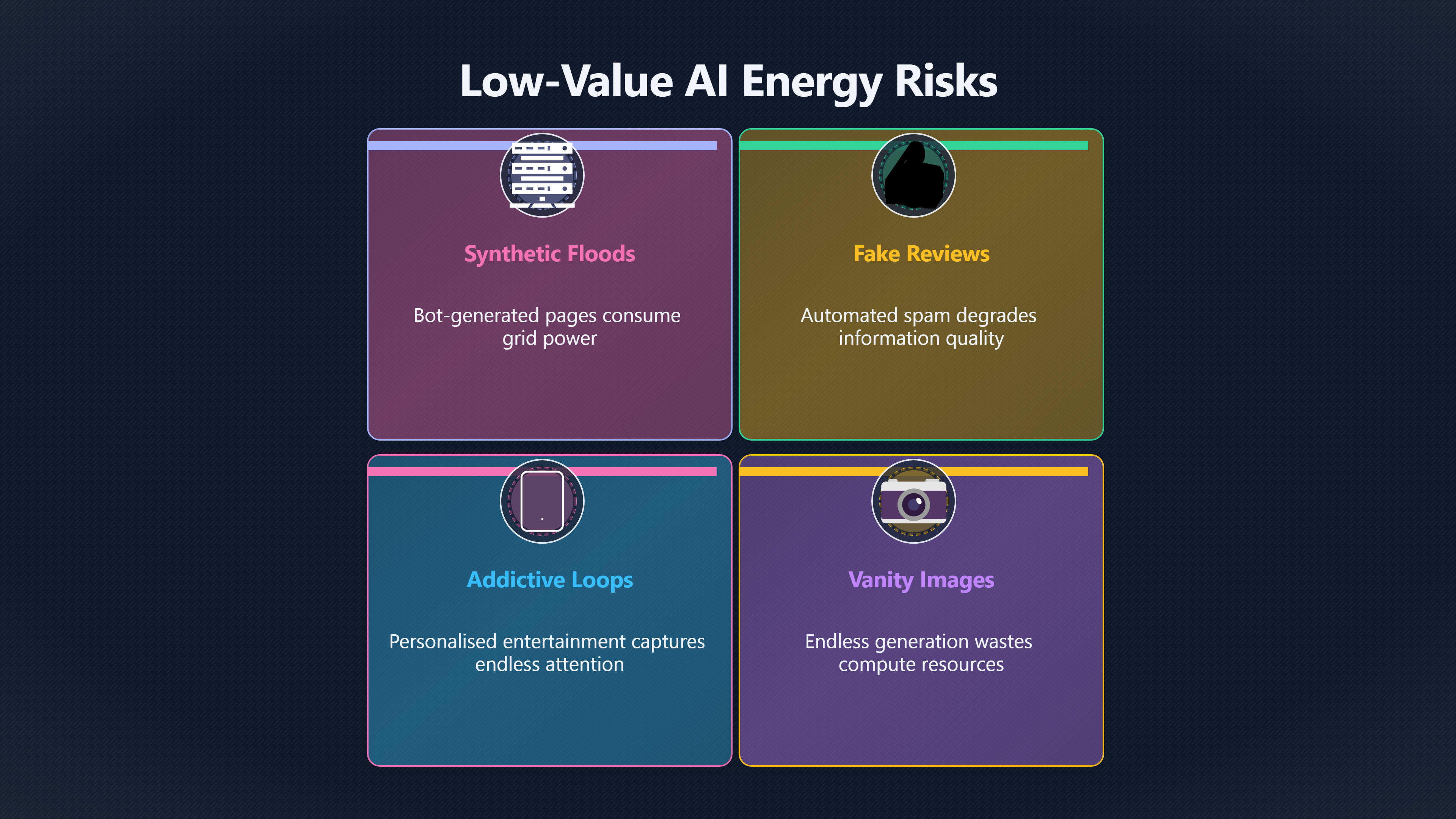
 This is not mainly about banning chatbots or stopping experimentation. The deeper issue is that efficiency gains can make computation so cheap that AI spreads into thousands of marginal applications: endlessly generated advertising, synthetic click-farms, spam content, addictive engagement systems, vanity image generation, or automated services that replace small human tasks without creating much wider social benefit. If these low-value uses expand faster than clean electricity supply, AI efficiency gains may not reduce total energy demand at all. [IEA]iea.orgIEAExecutive summary – Energy and AI – AnalysisBy 2035, the range of data centre electricity demand across our cases spans from 700 to 1… [IEA]iea.orgAI is set to drive surging electricity demand from data…10 Apr 2025 — In advanced economies more broadly, data centres are projected t…
The governance challenge is therefore subtle. An AI-enabled future of abundance may require enormous amounts of computation for medicine, science, robotics and education. But the same infrastructure can also power disposable or extractive uses. The goal is not simply “less AI”. It is deciding which kinds of AI civilisation most wants to subsidise with scarce energy, land, water and grid capacity.
Why “low-value” AI is hard to define
The phrase “wasteful AI” sounds simpler than it is. Many technologies initially dismissed as frivolous later became economically or culturally important. Early video games, social media, streaming video and consumer internet services were all once criticised as bandwidth waste. Some eventually generated major industries.
The same uncertainty applies to AI. A synthetic image generator used for memes today may become part of tomorrow’s design workflow. Consumer chatbots sometimes look trivial, yet language models may also become educational tutors, scientific assistants or accessibility tools.
This creates a genuine governance dilemma:
- Restrict too little, and cheap computation may flood grids with low-value demand.
- Restrict too aggressively, and societies may suppress experimentation that produces future breakthroughs.
That tension matters especially in the broader AI bloom debate. A future of scientific acceleration and abundance depends partly on keeping room for exploration and unexpected discovery. Historically, many transformative technologies emerged from uses that originally appeared recreational, niche or commercially dubious.
Still, uncertainty does not mean all uses are equally valuable. Policymakers already distinguish between socially beneficial and socially harmful activity in other sectors through taxes, standards, pricing systems and infrastructure rules. Electricity-intensive AI may eventually face similar distinctions.
Which AI uses may deliver little social value
The strongest case for governance usually focuses not on ordinary consumer use, but on large-scale automated systems whose benefits appear narrow compared with their infrastructure costs.
Engagement maximisation and synthetic content floods
One concern is that AI could massively expand low-quality digital content because generation becomes almost free. Automated advertising copy, synthetic search-engine pages, fake reviews, bot-generated social media and endless personalised entertainment may consume enormous compute resources while degrading the information environment.
Inference — the continuous running of AI models for billions of users — may account for most long-term AI energy demand rather than one-off model training. [Data Innovation]www2.datainnovation.orgData Innovation Rethinking Concerns About AI's Energy UseData InnovationRethinking Concerns About AI's Energy UseJanuary 25, 2024 — 29 Jan 2024 — 90 percent of the cost of an AI model comes from…
That matters because low-value consumer engagement systems can scale indefinitely. A frontier model trained once may support trillions of lightweight interactions afterwards. If platforms optimise mainly for attention capture, AI efficiency gains could increase total electricity demand precisely because the cost per interaction collapses.
AI systems designed to manipulate consumption
Another controversial category involves systems whose main purpose is behavioural manipulation rather than productive assistance. Examples include hyper-personalised advertising, algorithmic gambling optimisation, compulsive recommendation systems or AI-generated persuasion targeted at vulnerable users.
Critics argue these systems create a poor trade: high electricity and infrastructure use in exchange for marginal gains in advertising efficiency or user retention.
The concern becomes sharper if AI data-centre growth forces wider energy-system consequences, such as delaying coal and gas plant retirements or increasing local pollution. Reporting has already documented cases where growing data-centre demand contributed to keeping older fossil-fuel “peaker” plants online in some regions. [Reuters]reuters.comAI data centers are forcing dirty 'peaker' power plants back into serviceThese plants, like the eight-unit petroleum-fired Fisk plant in Chicago, are designed to operate only during high demand but are now bein…
Disposable AI embedded everywhere
Efficiency improvements may encourage companies to insert AI into products that do not substantially benefit from it simply because computation becomes cheap enough to include by default.
This can create an “AI everywhere” dynamic:
- AI summaries attached to every search.
- Constant background model queries in apps.
- Always-on assistants in household devices.
- Continuous synthetic media generation.
- Automated customer interactions where simpler systems would suffice.
Individually, each feature may use little power. Collectively, billions of unnecessary inferences can become substantial infrastructure demand.
The International Energy Agency projects a very wide range for future data-centre electricity consumption partly because future AI deployment intensity remains deeply uncertain. [IEA]iea.orgEnergy demand from AIToday, electricity consumption from data centres is estimated to amount to around 415 terawatt hours (TWh), or about…
The strongest argument against heavy restrictions
The main objection to aggressive governance is straightforward: nobody reliably knows in advance which uses are “low value”.
Many apparently trivial technologies later became economically transformative. Search engines, video streaming, smartphones and social platforms were once criticised as distractions. Open-ended experimentation also produces unexpected spillovers. Consumer AI tools may indirectly finance research infrastructure later used for medicine, materials science or education.
There is also a political concern. Governments deciding which forms of computation are socially worthwhile could create systems vulnerable to lobbying, censorship or industrial favouritism. Large incumbents might support restrictive rules that lock out smaller competitors and open-source experimentation.
Some critics therefore argue that the cleaner solution is not to suppress demand but to expand energy supply aggressively:
- Build more clean electricity generation. [lse.ac.uk]lse.ac.ukwhat direct risks does ai pose to the climate and environmentWhat direct risks does AI pose to the climate and…12 Sept 2025 — With fossil fuels still providing over 60% of total global electricit…
- Improve grid infrastructure.
- Accelerate nuclear, geothermal and renewables deployment.
- Increase data-centre efficiency standards. [iea.org]iea.orgIEAExecutive summary – Energy and AI – AnalysisBy 2035, the range of data centre electricity demand across our cases spans from 700 to 1…
- Reduce carbon intensity rather than ration computation.
From this perspective, the long-term promise of AI abundance depends on making energy abundant too.
Pricing electricity instead of banning uses
Because “usefulness” is subjective, many economists prefer indirect governance tools over explicit content restrictions.
Carbon pricing and energy pricing
The most common proposal is simple: if electricity prices reflect environmental and infrastructure costs properly, wasteful uses become less attractive automatically.
Under this approach:
- AI firms would pay more during grid stress periods.
- Carbon-intensive electricity would become more expensive.
- Heavy users would internalise more infrastructure costs.
- Efficient systems would gain competitive advantages.
This approach tries to avoid governments deciding directly which AI outputs deserve to exist.
Some regions are already debating whether hyperscale data centres should bear more of the grid-upgrade costs associated with their electricity demand. [Canary Media]canarymedia.comhow states are trying keep ai offCanary MediaHow states are trying to keep AI data centers off your…Mar 4, 2026 — Essentially everyone agrees: Americans shouldn't pay hig…
Dynamic pricing and interruptible compute
Another possibility is treating some AI workloads as flexible demand rather than constant demand.
Not all computation is equally time-sensitive:
- Scientific batch processing can often wait hours.
- Large model training can shift geographically.
- Non-urgent generative tasks can run during periods of abundant renewable power.
Dynamic electricity pricing could encourage AI systems to consume more energy when grids have excess solar, wind or nuclear output and less during shortages.
This may matter more than many public debates about single chatbot prompts. The large system-level issue is not one user query, but whether AI demand aligns intelligently with energy-system constraints.
Transparency may matter more than prohibition
One of the largest current problems is that AI energy use remains surprisingly opaque.
Researchers repeatedly note that major technology companies disclose limited information about:
- AI-specific electricity consumption. [iea.org]iea.orgEnergy demand from AIToday, electricity consumption from data centres is estimated to amount to around 415 terawatt hours (TWh), or about…
- Water usage.
- Carbon intensity by workload.
- Training versus inference energy use.
- Regional grid impacts. [ScienceDirect]sciencedirect.comScienceDirectThe carbon and water footprints of data centers and what…by A de Vries-Gao · 2025 · Cited by 7 — The International Energy…
Without disclosure, policymakers cannot distinguish between:
- high-value scientific workloads,
- profitable but socially mixed uses,
- and genuinely wasteful activity.
Possible disclosure rules
Governments could require large AI operators to publish:
- Energy use per model family.
- Carbon intensity by region. [* Water consumption for cooling.]brookings.eduglobal energy demands within the ai regulatory landscape10 Apr 2026 — The dialogue examined how rapid AI-driven growth in data centers is impacting increasing electricity and water consumption… [* Peak grid demand impacts.]researchgate.netElectricity Demand and Grid Impacts of AI Data Centers6 Sept 2025 — The rapid growth of artificial intelligence (AI) is driving an unprec…
- Renewable-energy sourcing practices.
- Estimated inference volumes.
This would not directly prohibit any use, but it would make trade-offs visible to regulators, investors and the public.
Transparency may also improve market pressure. If one company provides useful educational or medical systems at far lower energy cost than another focused on addictive engagement loops, disclosure could shape public expectations and procurement decisions.
Should some AI uses face priority rules?
As AI demand grows, electricity systems may eventually confront allocation questions similar to those seen during droughts or energy shortages.
Not all compute may deserve equal treatment during constrained periods.
In principle, governments or utilities could prioritise:
- hospitals,
- scientific research,
- public-interest computing,
- grid management,
- education,
- and critical infrastructure
over less socially valuable AI workloads.
That idea already exists indirectly in other infrastructure systems. During energy shortages, grids often prioritise essential services over discretionary industrial demand.
The political difficulty is deciding where to draw boundaries. Scientific simulation and entertainment rendering may use similar hardware. A system generating video-game dialogue might look trivial to one observer and culturally valuable to another.
For this reason, most realistic governance proposals focus less on censorship-style classification and more on:
- pricing,
- disclosure,
- efficiency standards,
- environmental permitting,
- and infrastructure cost allocation.

Local communities may bear costs without sharing benefits
The governance debate is not only about global emissions. It is also about geography and political fairness.
[Data centres create concentrated local effects:]techradar.comTech Radar The disproportionate effects of AI data centers on local communitiesWhile individual AI prompts use minimal energy, the large-scale infrastructure needed to support AI workloads—particularly those focused…
[* high electricity demand,]iea.orgIEAExecutive summary – Energy and AI – AnalysisBy 2035, the range of data centre electricity demand across our cases spans from 700 to 1… [* heavy water consumption,]brookings.eduglobal energy demands within the ai regulatory landscape10 Apr 2026 — The dialogue examined how rapid AI-driven growth in data centers is impacting increasing electricity and water consumption…
- land use pressures,
- diesel backup generation,
- and transmission infrastructure expansion. [TechRadar]techradar.comTech Radar The disproportionate effects of AI data centers on local communitiesWhile individual AI prompts use minimal energy, the large-scale infrastructure needed to support AI workloads—particularly those focused… [Lincoln Institute of Land Policy]lincolninst.eduland water impacts data centersLincoln Institute of Land PolicyData Drain: The Land and Water Impacts of the AI Boom17 Oct 2025 — Early in the AI boom, in 2023, US data…
The benefits, however, may flow elsewhere — especially to global technology firms and distant users.
This creates a political legitimacy problem. Communities may reasonably ask why they should absorb environmental and infrastructure burdens for AI workloads they see as low-value or extractive.
That does not imply all data centres are harmful. Some regions actively seek them for tax revenue and investment. But it strengthens the argument that governance should distinguish between socially productive AI growth and purely speculative or manipulative demand.
A useful principle: govern externalities, not curiosity
A balanced approach may ultimately rely on a simple distinction.
Societies generally benefit from preserving freedom to experiment with new forms of intelligence, creativity and discovery. Many genuinely transformative uses of AI may initially look unimportant or playful.
But experimentation should not imply unlimited ability to externalise costs onto grids, communities or the climate.
That points toward a governance model centred on:
- transparent reporting,
- carbon-aware electricity pricing,
- efficiency standards,
- clean-energy requirements, [energy.gov]energy.govClean Energy Resources to Meet Data Center Electricity…Data center deployment, partly driven by the need to power new AI applications…
- infrastructure cost sharing,
- and local environmental protections.
Such a system would not require governments to decide which AI conversations, artworks or applications are meaningful enough to exist. Instead, it would ensure that large-scale computation pays more of its real physical costs.
The deeper AI bloom question
The broader AI bloom vision assumes that advanced intelligence could eventually help humanity overcome scarcity, accelerate science and expand human flourishing on a civilisational scale. But abundance is not the same as unlimited consumption without trade-offs.
If AI becomes extraordinarily capable, the world may gain the ability to direct immense computational resources toward medicine, climate repair, education, robotics and scientific discovery. Yet the same systems could also generate infinite distraction, persuasion and synthetic noise.
The governance challenge is therefore not merely technical. It is civilisational. As intelligence becomes cheaper and more abundant, societies may need better ways to decide which forms of abundance genuinely enlarge human flourishing and which merely consume energy while competing for attention.
Efficiency alone cannot answer that question.
Endnotes
-
Source: iea.org
Link: https://www.iea.org/reports/energy-and-ai/executive-summarySource snippet
IEAExecutive summary – Energy and AI – AnalysisBy 2035, the range of data centre electricity demand across our cases spans from 700 to 1...
-
Source: iea.org
Link: https://www.iea.org/news/ai-is-set-to-drive-surging-electricity-demand-from-data-centres-while-offering-the-potential-to-transform-how-the-energy-sector-worksSource snippet
AI is set to drive surging electricity demand from data...10 Apr 2025 — In advanced economies more broadly, data centres are projected t...
-
Source: iea.org
Link: https://www.iea.org/reports/energy-and-ai/energy-demand-from-aiSource snippet
Energy demand from AIToday, electricity consumption from data centres is estimated to amount to around 415 terawatt hours (TWh), or about...
-
Source: reuters.com
Title: AI data centers are forcing dirty ‘peaker’ power plants back into service
Link: https://www.reuters.com/business/energy/ai-data-centers-are-forcing-obsolete-peaker-power-plants-back-into-service-2025-12-23/Source snippet
These plants, like the eight-unit petroleum-fired Fisk plant in Chicago, are designed to operate only during high demand but are now bein...
-
Source: sciencedirect.com
Link: https://www.sciencedirect.com/science/article/pii/S2666389925002788Source snippet
ScienceDirectThe carbon and water footprints of data centers and what...by A de Vries-Gao · 2025 · Cited by 7 — The International Energy...
-
Source: sciencedirect.com
Link: https://www.sciencedirect.com/science/article/pii/S1364032126001607Source snippet
Reviewing the socio-technical dynamics of AI, data centers...by J Kim · 2026 — This review addresses three questions: What low- and zero...
-
Source: techradar.com
Title: Tech Radar The disproportionate effects of AI data centers on local communities
Link: https://www.techradar.com/ai-platforms-assistants/the-disproportionate-effects-of-ai-data-centers-on-local-communitiesSource snippet
While individual AI prompts use minimal energy, the large-scale infrastructure needed to support AI workloads—particularly those focused...
-
Source: energy.gov
Link: https://www.energy.gov/oe/clean-energy-resources-meet-data-center-electricity-demandSource snippet
Clean Energy Resources to Meet Data Center Electricity...Data center deployment, partly driven by the need to power new AI applications...
-
Source: www2.datainnovation.org
Title: Data Innovation Rethinking Concerns About AI’s Energy Use
Link: https://www2.datainnovation.org/2024-ai-energy-use.pdfSource snippet
Data InnovationRethinking Concerns About AI's Energy UseJanuary 25, 2024 — 29 Jan 2024 — 90 percent of the cost of an AI model comes from...
Published: January 25, 2024
-
Source: canarymedia.com
Title: how states are trying keep ai off
Link: https://www.canarymedia.com/articles/data-centers/how-states-are-trying-keep-ai-offSource snippet
Canary MediaHow states are trying to keep AI data centers off your…Mar 4, 2026 — Essentially everyone agrees: Americans shouldn't pay hig...
-
Source: lincolninst.edu
Title: land water impacts data centers
Link: https://www.lincolninst.edu/publications/land-lines-magazine/articles/land-water-impacts-data-centers/Source snippet
Lincoln Institute of Land PolicyData Drain: The Land and Water Impacts of the AI Boom17 Oct 2025 — Early in the AI boom, in 2023, US data...
Additional References
-
Source: aimultiple.com
Link: https://aimultiple.com/ai-energy-consumptionSource snippet
AI Energy Consumption Statistics3 days ago — AI and machine learning accounted for <0.2% of global electricity use and <0.1% of global em...
-
Source: campaigncc.org
Link: https://www.campaigncc.org/ai_data_centres_climateSource snippet
AI and datacentres: a new climate threatThe greatest climate harm is caused by AI enabling fossil fuel extraction: While most of the disc...
-
Source: theguardian.com
Link: https://www.theguardian.com/technology/2026/mar/01/datacentre-developers-energy-greenhouse-gas-emissionsSource snippet
Datacentre developers face calls to disclose effect on UK's...2 days ago — The letter calls for a framework for calculating the environm...
-
Source: researchgate.net
Link: https://www.researchgate.net/publication/395352695_Electricity_Demand_and_Grid_Impacts_of_AI_Data_Centers_Challenges_and_ProspectsSource snippet
Electricity Demand and Grid Impacts of AI Data Centers6 Sept 2025 — The rapid growth of artificial intelligence (AI) is driving an unprec...
-
Source: blog.ucs.org
Link: https://blog.ucs.org/steve-clemmer/powering-data-centers-with-clean-energy-could-avoid-trillions-in-climate-and-health-costs/Source snippet
Data Centers with Clean Energy Could Avoid...21 Jan 2026 — Restoring the tax credits and adopting more ambitious climate and clean energ...
-
Source: carbonbrief.org
Title: ai five charts that put data centre energy use and emissions into context
Link: https://www.carbonbrief.org/ai-five-charts-that-put-data-centre-energy-use-and-emissions-into-context/Source snippet
AI: Five charts that put data-centre energy use15 Sept 2025 — As it stands, AI has been responsible for around 5-15% of data-centre power...
-
Source: lse.ac.uk
Title: what direct risks does ai pose to the climate and environment
Link: https://www.lse.ac.uk/granthaminstitute/explainers/what-direct-risks-does-ai-pose-to-the-climate-and-environment/Source snippet
What direct risks does AI pose to the climate and...12 Sept 2025 — With fossil fuels still providing over 60% of total global electricit...
-
Source: mitsloan.mit.edu
Title: ai has high data center energy costs there are solutions
Link: https://mitsloan.mit.edu/ideas-made-to-matter/ai-has-high-data-center-energy-costs-there-are-solutionsSource snippet
has high data center energy costs — but there are...7 Jan 2025 — Data centers could account for up to 21% of overall global energy deman...
-
Source: brownadvisory.com
Title: data center balancing act powering sustainable ai growth
Link: https://www.brownadvisory.com/us/insights/data-center-balancing-act-powering-sustainable-ai-growthSource snippet
The Data Center Balancing Act: Powering Sustainable AI...18 Sept 2025 — As GenAI workloads increase, some experts project that electrici...
-
Source: brookings.edu
Title: global energy demands within the ai regulatory landscape
Link: https://www.brookings.edu/articles/global-energy-demands-within-the-ai-regulatory-landscape/Source snippet
10 Apr 2026 — The dialogue examined how rapid AI-driven growth in data centers is impacting increasing electricity and water consumption...
Amazon book picks
Further Reading
Books and field guides related to Governing Wasteful AI Use. Use these as the next step if you want deeper reading beyond the article.

The Oxford Handbook of AI Governance
As the capabilities of Artificial Intelligence (AI) have increased over recent years, so have the challenges of how to govern its usage....

AI Governance and Ethics
How do we ensure that AI systems remain accountable, fair, and aligned with human values? As artificial intelligence becomes embedded in...

Architectures of Global AI Governance
The impacts of artificial intelligence (AI) are often framed as an uncontrollable wave of technological change. But AI's trajectory is no...

eBay marketplace picks
Marketplace Samples
Example marketplace items related to this page. Use the search link to explore similar finds on eBay.

Example eBay listing
A.I. Artificial Intelligence Original Movie Poster Signed By Jude Law
USD 125.00 | Shipping USD 25.00 | US

Example eBay listing
Artificial Intelligence D/S Original Movie Poster - 27 x 40"
USD 19.50 | Shipping USD 13.65 | US

Example eBay listing
612388 Artificial Intelligence Movie Science Fiction Drama Wall Print Poster
USD 22.95 | Shipping USD 12.95 | JP

Example eBay listing
Companion - Artificial Intelligence Dark Comedy Cinema Film - POSTER 20"x30"
USD 23.99 | Free shipping | US

Example eBay listing
A.I. Artificial Intelligence Movie Film Poster Art Print
GBP 4.99 | Free shipping | GB

Example eBay listing
A I Artificial Intelligence 6 Movie Poster Art Print Print Classic Rare Gallery
GBP 49.00 | Free shipping | GB

Example eBay listing
AI - Artificial Intelligence (Poster + Slipcase) Blu-Ray
GBP 10.49 | Free shipping | GB

Example eBay listing
A. I. Artificial Intelligence. Jude Law. Original UK Video Poster.
GBP 8.11 | Shipping GBP 3.38 | GB
Topic Tree