Within Clean Power
Renewable PPAs and AI emissions
Renewable power contracts can fund new clean energy, but annual matching may hide fossil-heavy local electricity use.
On this page
- How corporate renewable contracts work
- Annual matching versus hourly local power
- What stronger clean energy claims would require
Page outline Jump by section
Introduction
Renewable power purchase agreements, usually called PPAs, probably do reduce AI data-centre emissions overall — but often less cleanly and less directly than public claims imply. The key issue is not whether wind and solar projects are being built. Many are. The harder question is whether those projects actually reduce the fossil-fuel electricity used by AI systems at the specific hours and locations where data centres consume power.
 That distinction matters because advanced AI could become one of the largest new electricity demands of the century. If AI eventually helps drive scientific acceleration, clean manufacturing, medical breakthroughs and broader human flourishing, its environmental footprint will matter politically as well as physically. A future of AI-enabled abundance is easier to sustain if the energy system decarbonises alongside computation rather than after it.
The debate around renewable PPAs is therefore not a technical accounting dispute alone. It is about whether the AI industry’s clean-energy strategy is genuinely accelerating a lower-carbon civilisation, or whether some emissions reductions exist mostly on paper.
How corporate renewable contracts work
Most large AI firms do not usually power data centres by building a solar farm directly beside every server campus. Instead, they sign long-term contracts with renewable developers. These agreements guarantee revenue for wind, solar or battery projects and help developers secure financing.
In practice, this system has become one of the main engines of global corporate renewable investment. The International Energy Agency notes that data-centre electricity demand increasingly overlaps with large-scale renewable procurement, with hyperscale firms becoming major drivers of new clean-energy capacity. [IEA]iea.orgtotal data centre electricity demand covered by renewables ppasIEATotal data centre electricity demand covered by…15 Apr 2026 — Total data centre electricity demand covered by renewables PPAs - Cha…
The strongest argument in favour of PPAs is therefore straightforward: without guaranteed long-term buyers, many renewable projects would be harder or slower to build. Google argues that its PPAs “directly led to the addition” of carbon-free electricity to the grid. [Sustainability]sustainability.googleSustainabilityClean Energy: 24x7—Carbon-free InternetIn calculating a data center's hourly match with regional carbon-free energy, we fir…
This is why many climate analysts distinguish between two separate questions:
- Did the company help finance more renewable generation?
- Did the company’s own computing actually run on clean electricity at the moment it consumed power?
A firm can plausibly answer “yes” to the first while still relying heavily on fossil-heavy grids during many operating hours.
That gap sits at the centre of the current criticism.
Why annual renewable matching can hide fossil dependence
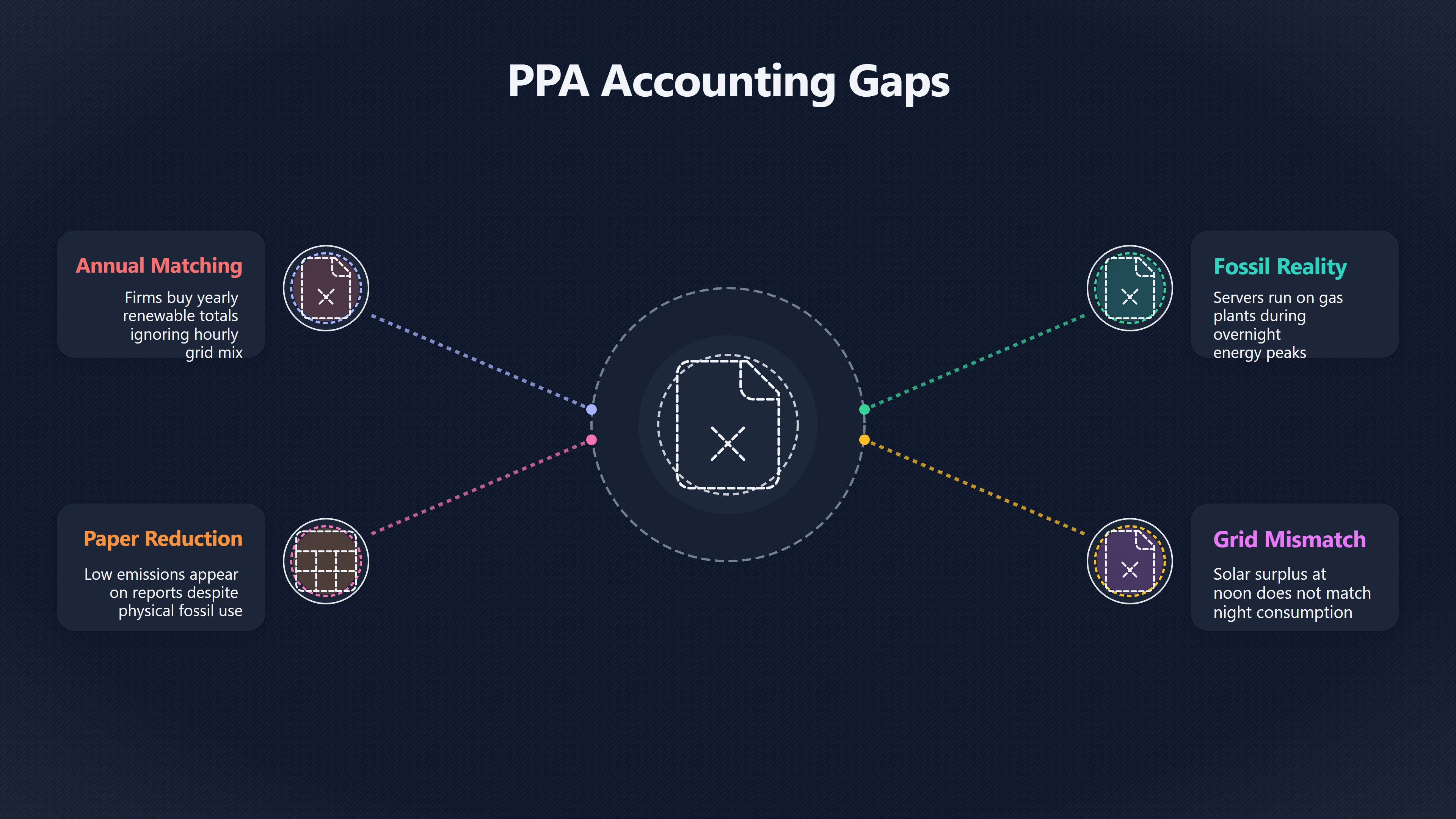
For years, many companies used an “annual matching” model. If a data centre consumed 1 terawatt-hour of electricity over a year, the company bought enough renewable energy certificates or renewable generation contracts somewhere on the grid system to match that amount annually.
But electricity grids operate hour by hour, not year by year.
A solar farm may produce large surpluses at midday while an AI data centre draws heavy electricity overnight when gas plants dominate the local grid. Under annual accounting, those differences can disappear into yearly averages.
Critics argue that this allows companies to report low “market-based” emissions while the physical electricity actually powering computation may still come from fossil generation. Academic work in Energy Policy described this as a form of “creative accounting”, arguing that contractual renewable claims often fail to reflect real operational emissions. [ScienceDirect]sciencedirect.comIt fails to provide accurate and relevant GHG information to decisionScienceDirectCreative accounting: A critical perspective on the market…by M Brander · 2018 · Cited by 246 — The 'market-based' method…
Research published in Nature Climate Change similarly warned that renewable energy certificates, or RECs, can exaggerate real-world emissions reductions if they do not cause additional clean generation to be built. [Nature]nature.comNatureRenewable energy certificates threaten the integrity of…by A Bjørn · 2022 · Cited by 189 — Here we show that the widespread use…
The distinction between “market-based” and “location-based” accounting has become increasingly controversial in the AI era:
- Market-based accounting lets firms count renewable contracts and certificates toward emissions reductions.
- Location-based accounting reflects the average emissions intensity of the actual regional grid supplying electricity.
For AI data centres, the two numbers can diverge sharply.
A Virginia data centre running overnight on a gas-heavy grid may still claim renewable matching through a distant wind contract signed elsewhere. The servers consume real local electricity in real time, but the accounting system treats the annual renewable purchase as compensating for that consumption.
This does not necessarily mean the renewable project was worthless. It means the emissions claim may overstate how clean the computing operation itself currently is.
The rise of “24/7 carbon-free energy”
The strongest response to these criticisms has come from the push toward hourly or “24/7” carbon-free energy matching.
Instead of matching electricity use annually, the idea is to match every hour of electricity consumption with carbon-free generation on the same grid. Google became the highest-profile advocate of this model after concluding that annual renewable matching was not equivalent to genuinely fossil-free operation. [Axios]axios.comGoogle's 24-7 carbon-free goalThough Google already matches its annual power consumption with renewable energy purchases, it recognizes this as different from exclusiv…
Under a 24/7 framework, a company cannot simply overbuy solar power at noon and claim success while using fossil-heavy electricity overnight. It must increasingly solve the harder problem of clean power availability across all hours.
That changes the economics and infrastructure requirements substantially.
What hourly matching pushes companies to build
Annual matching mainly rewards large quantities of cheap renewable generation. Hourly matching creates incentives for a broader clean-energy system, including:
- battery storage
- long-duration storage
- geothermal power
- advanced nuclear
- flexible computing loads
- transmission upgrades
- geographically diversified renewable portfolios
This matters because AI data centres are unusually constant electricity users. Unlike many industrial loads, they often run around the clock.
The Eurelectric 24/7 carbon-free energy framework describes hourly matching as an “end state” for deeply decarbonised electricity systems. [Eurelectric - Powering People]eurelectric.orgEurelectric - Powering PeopleExploring the 24/7 carbon-free energy (CFE) ecosystem22 Nov 2024 — 24/7 carbon-free energy (CFE) matching is…
Several studies suggest that hourly matching can reduce system-wide emissions more effectively than annual matching. A 2024 review in the Journal of Cleaner Production found that hourly matching tied to local and newly built renewables can achieve substantially larger emissions reductions than looser certificate-based systems. [ScienceDirect]sciencedirect.comIt fails to provide accurate and relevant GHG information to decisionScienceDirectCreative accounting: A critical perspective on the market…by M Brander · 2018 · Cited by 246 — The 'market-based' method…
A separate modelling paper examining 24/7 procurement found that hourly matching can accelerate deployment of advanced clean-energy technologies while reducing overall power-system emissions. [arXiv]arxiv.orgarXivOn the means, costs, and system-level impacts of 24/7 carbon-free energy procurementDecember 6, 2023…
The broader significance is easy to miss. The argument is not simply about better accounting. It is about whether AI companies help push grids toward genuinely high-clean-energy reliability rather than merely higher renewable totals on paper.
The “additionality” problem
Another major dispute concerns “additionality”.
A renewable purchase is considered additional if it causes new clean generation to exist that probably would not otherwise have been built. Critics argue that some renewable certificates fail this test because they come from projects that already exist or would have operated anyway.
This matters because the climate benefit of a PPA depends heavily on counterfactuals:
- Did the contract accelerate construction?
- Did it improve financing enough to unlock the project?
- Would the wind or solar farm have been built regardless?
- Did the renewable generation displace fossil electricity or simply add supply during already-clean periods?
The answers vary by region and market structure.
In some places, corporate procurement clearly helped scale renewable industries earlier and faster than governments alone might have achieved. In others, critics argue that cheap unbundled certificates increasingly provide reputational benefits without major real-world decarbonisation effects. [Nature]nature.comNatureRenewable energy certificates threaten the integrity of…by A Bjørn · 2022 · Cited by 189 — Here we show that the widespread use…
This does not make all PPAs equivalent. There is a large difference between:
- financing a new local renewable project connected to the same constrained grid as the data centre
- buying low-cost certificates from existing hydroelectric dams hundreds or thousands of miles away
Yet both can sometimes contribute similarly to headline emissions reporting.
Why AI makes the accounting fight more important
The scale of future AI electricity demand raises the stakes dramatically.
If AI remained a modest computational industry, imperfect renewable accounting might matter less politically. But many projections now expect large increases in electricity demand from AI training and inference systems over the next decade. The IEA projects data-centre electricity demand could exceed 1,000 terawatt-hours annually by 2030 in its base case. [IEA]iea.orgData centre electricity use surged in 2025, even with…16 Apr 2026 — New IEA report explores AI's growing energy footprint, options for…
As demand rises, weak accounting standards could create several problems simultaneously:
- rising real emissions despite cleaner public reporting
- delayed investment in firm low-carbon power
- increased dependence on new gas generation
- public distrust toward AI sustainability claims
- backlash against AI expansion itself
The tension is especially visible in regions where AI growth is faster than grid expansion.
A company may sign enormous renewable contracts globally while still depending locally on fossil-heavy electricity because transmission lines, storage capacity or dispatchable clean generation are insufficient nearby.
This is why critics increasingly focus on “deliverability” and “locality” rather than annual renewable totals alone.
The criticism is real — but so is the progress
The strongest critiques of renewable PPAs sometimes imply they are largely meaningless. That goes too far.
Corporate renewable procurement has helped scale global wind and solar deployment substantially. Reuters reported that corporate PPAs accounted for roughly a quarter of global wind and solar capacity additions outside China in 2023. [Reuters]reuters.comWhy corporates are getting real on renewables purchasingCorporate power purchase agreements (PPAs) have been pivotal, accounting for 25% of global wind and solar capacity in 2023 outside China…
Even imperfect procurement systems can accelerate renewable investment, reduce financing costs and normalise large-scale clean-energy demand.
The more balanced interpretation is that annual matching was an important transitional mechanism rather than a final solution.
It succeeded at increasing renewable capacity quickly during a period when many grids were still heavily fossil dependent. But AI-scale electricity demand exposes the limits of that approach more clearly than earlier corporate sustainability programmes did.
An AI system running continuously requires more than annual renewable averages. It ultimately requires grids capable of delivering low-carbon electricity continuously.
That is a much harder challenge.
What stronger clean-energy claims would require
If AI companies want stronger claims that their systems genuinely operate on clean electricity, several conditions matter increasingly.
Hourly and local matching
Matching electricity use hour by hour on the same regional grid reduces the gap between accounting claims and physical reality. This approach also creates stronger incentives for storage and firm low-carbon generation.
New clean generation
Additionality matters most where grids remain carbon-intensive. Financing genuinely new low-carbon capacity is more credible than relying heavily on legacy renewable assets or cheap certificates disconnected from local demand.
Transparent reporting
Many critics argue companies should report both:
- market-based emissions [sciencedirect.com]sciencedirect.comIt fails to provide accurate and relevant GHG information to decisionScienceDirectCreative accounting: A critical perspective on the market…by M Brander · 2018 · Cited by 246 — The 'market-based' method…
- location-based emissions
Showing both figures makes trade-offs clearer and reduces the temptation to treat accounting metrics as physical reality.
Flexible AI workloads
Some AI tasks may eventually shift toward periods of abundant renewable generation. Training runs, non-urgent computation and geographically distributed inference could become partially responsive to clean-energy availability.
That would not eliminate the need for firm power, but it could reduce peak fossil dependence.
Faster grid build-out
Ultimately, cleaner AI depends heavily on transmission, storage and generation infrastructure outside the tech sector itself.
Even the most ambitious procurement strategies cannot fully decarbonise computation if regional grids remain constrained or politically blocked from expansion.
The deeper implication for an AI-enabled future
The dispute around renewable PPAs reflects a larger question about AI and abundance.
Optimists argue that advanced AI could help civilisation escape many present constraints: accelerating science, improving energy systems, reducing material waste and helping build a richer and cleaner world. But those outcomes depend partly on whether physical infrastructure scales alongside intelligence.
Energy is one of the clearest tests.
If AI firms merely purchase accounting instruments while real emissions continue climbing, the technology risks becoming associated with ecological strain and elite image management. But if AI demand helps finance cleaner grids, storage systems, advanced reactors, better forecasting and more efficient infrastructure, the same expansion could accelerate wider decarbonisation.
The important point is that renewable PPAs are neither pure greenwashing nor a complete solution.
They are an intermediate mechanism inside a larger transition: from a world where companies buy annual renewable offsets toward one where energy systems themselves become reliably low-carbon across all hours. For AI data centres, that distinction increasingly determines whether “clean AI” is mainly a branding category or a meaningful physical reality.
Endnotes
-
Source: iea.org
Title: total data centre electricity demand covered by renewables ppas
Link: https://www.iea.org/data-and-statistics/charts/total-data-centre-electricity-demand-covered-by-renewables-ppasSource snippet
IEATotal data centre electricity demand covered by...15 Apr 2026 — Total data centre electricity demand covered by renewables PPAs - Cha...
-
Source: iea.org
Link: [https://www.iea.org/news/data-centre-electricity-use-surged-in-2025-even-with-tightening-bottlenecksSource snippet
Data centre electricity use surged in 2025, even with...16 Apr 2026 — New IEA report explores AI's growing energy footprint, options for...
-
Source: sustainability.google
Link: https://sustainability.google/stories/24x7/Source snippet
SustainabilityClean Energy: 24x7—Carbon-free InternetIn calculating a data center's hourly match with regional carbon-free energy, we fir...
-
Source: sciencedirect.com
Title: It fails to provide accurate and relevant GHG information to decision
Link: https://www.sciencedirect.com/science/article/pii/S0301421517306213Source snippet
ScienceDirectCreative accounting: A critical perspective on the market...by M Brander · 2018 · Cited by 246 — The 'market-based' method...
-
Source: nature.com
Link: https://www.nature.com/articles/s41558-022-01379-5Source snippet
NatureRenewable energy certificates threaten the integrity of...by A Bjørn · 2022 · Cited by 189 — Here we show that the widespread use...
-
Source: axios.com
Title: Google’s 24-7 carbon-free goal
Link: https://www.axios.com/2018/10/11/google-electricity-carbon-free-climate-changeSource snippet
Though Google already matches its annual power consumption with renewable energy purchases, it recognizes this as different from exclusiv...
-
Source: eurelectric.org
Link: https://www.eurelectric.org/in-detail/exploring-the-24-7-carbon-free-energy-cfe-ecosystem-the-future-of-corporate-procurement/Source snippet
Eurelectric - Powering PeopleExploring the 24/7 carbon-free energy (CFE) ecosystem22 Nov 2024 — 24/7 carbon-free energy (CFE) matching is...
-
Source: eurelectric.org
Link: https://www.eurelectric.org/in-detail/247-2/Source snippet
To guarantee this timely match...Read more...
-
Source: sciencedirect.com
Link: https://www.sciencedirect.com/science/article/pii/S0959652624032402Source snippet
He et al. (2021). 3) Proxies...Read more...
-
Source: arxiv.org
Link: https://arxiv.org/abs/2403.07876Source snippet
arXivOn the means, costs, and system-level impacts of 24/7 carbon-free energy procurementDecember 6, 2023...
Published: December 6, 2023
-
Source: iea.org
Link: https://www.iea.org/reports/energy-and-ai/energy-supply-for-aiSource snippet
IEAEnergy supply for AI – Energy and AI – AnalysisGlobal electricity generation to supply data centres is projected to grow from 460 TWh...
-
Source: reuters.com
Title: Why corporates are getting real on renewables purchasing
Link: https://www.reuters.com/sustainability/climate-energy/why-corporates-are-getting-real-renewables-purchasing–ecmii-2025-12-10/Source snippet
Corporate power purchase agreements (PPAs) have been pivotal, accounting for 25% of global wind and solar capacity in 2023 outside China...
-
Source: google.com
Link: https://www.google.com/Source snippet
GoogleSearch the world's information, including webpages, images, videos and more. Google has many special features to help you find exac...
-
Source: sciencedirect.com
Link: https://www.sciencedirect.com/science/article/pii/S2666389925002788Source snippet
The carbon and water footprints of data centers and what...by A de Vries-Gao · 2025 · Cited by 19 — Overall, the IEA's estimated carbon...
-
Source: sciencedirect.com
Link: https://www.sciencedirect.com/science/article/abs/pii/S2214629618306388Source snippet
Setting right misrepresentations in Google and Apple's...by CG Monyei · 2018 · Cited by 29 — We zero in on Apple's claim to be 100% rene...
-
Source: sciencedirect.com
Link: https://www.sciencedirect.com/science/article/pii/S0301421526002296Source snippet
Renewable hydrogen: The system-wide impact of PPAs...by L Langer · 2026 — However, by 2030, electricity sector emissions need to decreas...
-
Source: sciencedirect.com
Link: https://www.sciencedirect.com/science/article/pii/S2211467X24001950Source snippet
On the means, costs, and system-level impacts of 24/7...by I Riepin · 2024 · Cited by 29 — One approach is called 24/7 Carbon-Free Energ...
-
Source: iea.org
Link: https://www.iea.org/Source snippet
IEA – International Energy AgencyWe provide authoritative analysis, data, policy recommendations and solutions to ensure energy security...
-
Source: iea.org
Title: Energy Efficiency
Link: https://www.iea.org/energy-system/energy-efficiency-and-demand/energy-efficiencySource snippet
Energy System - IEA17 Dec 2024 — Energy efficiency is called the “first fuel” in clean energy transitions, as it provides some of the qui...
-
Source: iea.org
Link: https://www.iea.org/data-and-statistics/charts/co2-emissions-associated-with-electricity-generation-for-data-centres-by-case-2030Source snippet
CO2 emissions associated with electricity generation for...10 Apr 2025 — CO2 emissions associated with electricity generation for data c...
-
Source: eurelectric.org
Title: enabling 24 7 carbon free energy solutions
Link: https://www.eurelectric.org/stories/enabling-24-7-carbon-free-energy-solutions/Source snippet
Google and Engie: Enabling 24/7 Carbon-Free Energy...In 2021, ENGIE and Google signed a set of innovative agreements to supply Google's...
-
Source: sustainability.google
Link: https://sustainability.google/reports/24x7-carbon-free-energy-data-centers/Source snippet
rk for evaluating how well a given data center is matched with...
-
Source: Wikipedia
Title: Renewable energy
Link: https://en.wikipedia.org/wiki/Renewable_energySource snippet
Renewable energyRenewable energy (also called green energy) is energy made from renewable natural resources that are replenished on a...
-
Source: energy.sustainability-directory.com
Title: why is additionality controversial in recs
Link: https://energy.sustainability-directory.com/question/why-is-additionality-controversial-in-recs/Source snippet
→ Question3 Dec 2025 — Additionality in RECs is controversial because it's incredibly difficult to definitively prove a renewable energy...
Additional References
-
Source: energytag.org
Link: https://energytag.org/case-studies/Source snippet
Case StudiesDigital Realty announced that it has adopted PPC's 24/7 hourly renewable energy matching program to power its three data cent...
-
Source: linkedin.com
Link: https://www.linkedin.com/posts/leeps_ai-five-charts-that-put-data-centre-energy-activity-7375122454131691520-4ZvLSource snippet
Data centres' growing electricity demand and emissionsA recent study found that the electricity powering U.S. data centers emits about 48...
-
Source: datacenters.google
Link: https://datacenters.google/operating-sustainablySource snippet
Google Data CentersOperating sustainablyWe have set a moonshot to reach net-zero emissions across all of our operations and value chain b...
-
Source: linkedin.com
Link: https://www.linkedin.com/posts/killianpdaly_iea-report-shows-hourly-matching-is-the-key-activity-7316489024225857538-VTIP -
Source: linkedin.com
Link: https://www.linkedin.com/posts/paczyzak_european-renewable-ppas-for-data-centers-activity-7450792802902274049-v9NwSource snippet
Paweł Czyżak, PhD's PostEuropean renewable PPAs for data centers grew 10x in 4 years. They're now 30% of total PPA volume. Should we cele...
-
Source: carbonmarketwatch.org
Link: https://carbonmarketwatch.org/2025/06/26/logic-errors-energy-hungry-tech-sector-veers-off-sustainable-climate-path-despite-its-claims-report/Source snippet
Logic errors: Energy-hungry tech sector veers off...26 Jun 2025 — Some of the world's best-known tech giants are emitting more while pre...
-
Source: researchgate.net
Link: https://www.researchgate.net/publication/398789093_The_carbon_and_water_footprints_of_data_centers_and_what_this_could_mean_for_artificial_intelligenceSource snippet
The carbon and water footprints of data centers and what...17 Dec 2025 — The carbon footprint of AI systems alone could be between 32.6...
-
Source: latitudemedia.com
Link: https://www.latitudemedia.com/news/what-the-financial-times-gets-wrong-about-corporate-renewable-energy-and-carbon-emissions/Source snippet
What the Financial Times gets wrong about corporate...29 Aug 2024 — The article helped raise awareness of some serious flaws in the litt...
-
Source: spglobal.com
Title: problematic corporate purchases of clean energy credits threaten net zero goals
Link: https://www.spglobal.com/sustainable1/en/insights/problematic-corporate-purchases-of-clean-energy-credits-threaten-net-zero-goalsSource snippet
Problematic corporate purchases of clean energy credits...5 May 2021 — The purchase of unbundled credits "can make it look as if a compa...
Published: May 2021
-
Source: carbonbrief.org
Title: ai five charts that put data centre energy use and emissions into context
Link: https://www.carbonbrief.org/ai-five-charts-that-put-data-centre-energy-use-and-emissions-into-context/Source snippet
AI: Five charts that put data-centre energy use15 Sept 2025 — As shown in the chart below, data centres are currently responsible for jus...
Amazon book picks
Further Reading
Books and field guides related to Renewable PPAs and AI emissions. Use these as the next step if you want deeper reading beyond the article.
Artificial Intelligence in Energy and Renewable Energy Systems
This book presents state of the art applications of artificial intelligence in energy and renewable energy systems design and modelling....
Artificial Intelligence for Renewable Energy Systems
ARTIFICIAL INTELLIGENCE FOR RENEWABLE ENERGY SYSTEMS Renewable energy systems, including solar, wind, biodiesel, hybrid energy, and other...

Urban Energy Transition
This compendium of 29 chapters from 18 countries contains both fundamental and advanced insight into the inevitable shift from cities dom...
eBay marketplace picks
Marketplace Samples
Example marketplace items related to this page. Use the search link to explore similar finds on eBay.

Example eBay listing
artificial intelligence Framed Wall Art Poster Canvas Print Picture
USD 40.12 | GB

Example eBay listing
artificial intelligence Framed Wall Art Poster Canvas Print Picture
USD 40.12 | GB

Example eBay listing
Artificial intelligence Framed Wall Art Poster Canvas Print Picture
USD 40.12 | GB

Example eBay listing
A.I. Artificial Intelligence Movie Poster Print, Wall Art - Unframed
USD 17.95 | Free shipping | US

Example eBay listing
A.I. Artificial Intelligence Movie Film Poster Art Print
GBP 4.99 | Free shipping | GB

Example eBay listing
A I Artificial Intelligence 6 Movie Poster Art Print Print Classic Rare Gallery
GBP 49.00 | Free shipping | GB

Example eBay listing
AI - Artificial Intelligence (Poster + Slipcase) Blu-Ray
GBP 10.49 | Free shipping | GB

Example eBay listing
A. I. Artificial Intelligence. Jude Law. Original UK Video Poster.
GBP 8.11 | Shipping GBP 3.38 | GB
Topic Tree