Within AI Drugs
The Phase II test
AI-designed drugs may clear early safety checks, but Phase II trials reveal whether the biology actually helps patients.
On this page
- Why Phase I success can mislead
- What Phase II reveals about disease biology
- How AI drug candidates compare with conventional programmes
Page outline Jump by section
Introduction
AI drug discovery often looks most convincing before patients enter the picture. Algorithms can identify biological targets, generate promising molecules, and help researchers move from computer models to human testing faster than older methods. That matters for the broader “AI bloom” vision of scientific acceleration: if intelligence becomes cheaper and more scalable, medicine could advance far more quickly than it does today.
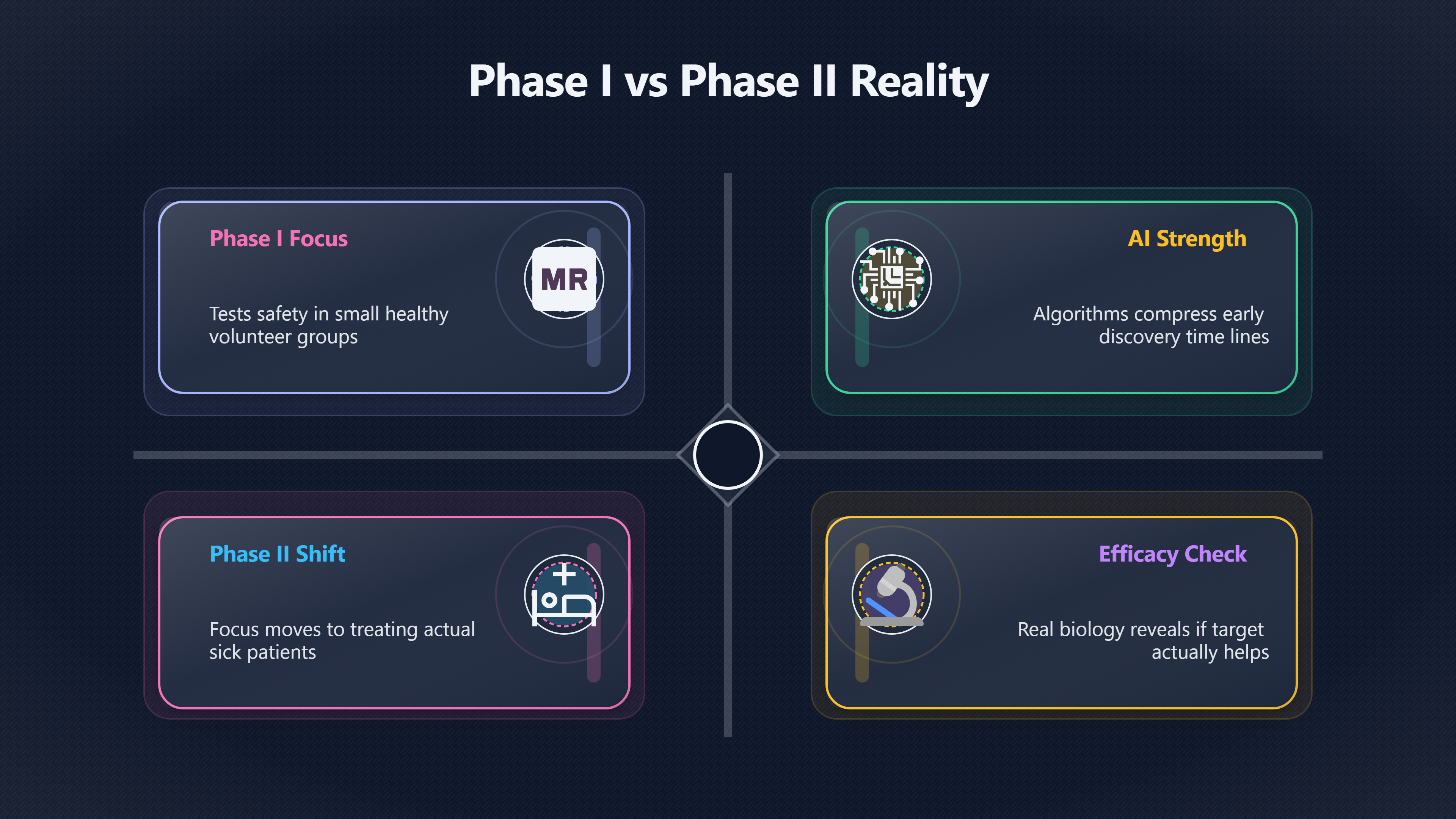
 But the decisive moment is usually Phase II clinical trials. Phase I mainly asks whether a drug appears safe enough to continue. Phase II asks the harder question: does the biology actually help sick people? This is where many AI-designed drugs encounter the same brutal reality as conventional medicines. A molecule may bind beautifully to a target in simulations and still fail to improve symptoms, slow disease, or outperform placebo in real patients. So far, AI-discovered drugs appear capable of reaching human trials more quickly, but there is little evidence yet that they consistently beat the industry’s long-standing efficacy problem. Nature [PMC]pmc.ncbi.nlm.nih.govPMCby D Sun · 2022 · Cited by 2011 — Ninety percent of clinical drug development fails despite implementation of many successful strategi…
Why Phase I success can mislead
Phase I trials are important, but they are often misunderstood by investors, journalists, and the public.
A Phase I trial usually involves a small number of healthy volunteers or patients. The main goal is to test safety, dosage, and basic pharmacology: whether the drug can be tolerated by the human body at different doses. A candidate that clears Phase I has crossed a meaningful threshold, but it has not yet demonstrated that it meaningfully treats disease. [Health]health.comThe 4 Phases of Clinical Trials and How They WorkPhase 1 focuses on safety and side effects, involving 20-80 healthy volunteers or sometimes patients with the targeted condition. It…
This distinction matters especially for AI drug discovery because AI systems are often strongest at the earlier parts of the pipeline:
- finding statistical patterns in biological data
- predicting molecular structures
- generating candidate compounds
- optimising chemical properties
- narrowing huge search spaces quickly
Those capabilities can genuinely compress the early discovery timeline. But they do not remove the underlying uncertainty of disease biology.
A drug can appear promising for years before Phase II reveals that the target itself was poorly understood. This has happened repeatedly across the pharmaceutical industry, especially in areas such as Alzheimer’s disease, psychiatric illness, inflammatory disease, and cancer. The problem is not always that the molecule was badly designed. Sometimes the deeper biological theory was incomplete from the start.
That is why impressive AI metrics before Phase II can be deceptive. A model may correctly predict that a molecule binds to a protein without answering the larger question: was that protein truly central to the disease in living humans?
Researchers reviewing AI drug discovery have repeatedly noted that no AI-discovered medicine has yet completed Phase III trials and reached broad regulatory approval. Early optimism therefore rests heavily on preclinical and early-stage data rather than proven clinical outcomes. [Nature]nature.comNatureA generative AI-discovered TNIK inhibitor for idiopathic…by Z Xu · 2025 · Cited by 105 — AI-discovered drugs have experienced si… [Nature]nature.comAI drugs to face the same failures in the clinic as traditionally developed molecules…. How successful are AI-discovered drugs in clin…
What Phase II reveals about disease biology
Phase II is where drug development stops being mainly a chemistry problem and becomes a human biology problem.
These trials typically involve people who actually have the disease being targeted. Researchers now look for evidence that the treatment changes meaningful outcomes: tumour shrinkage, lung function, symptom reduction, survival, or slowed progression. Safety still matters, but efficacy becomes central. [Health]health.comThe 4 Phases of Clinical Trials and How They WorkPhase 1 focuses on safety and side effects, involving 20-80 healthy volunteers or sometimes patients with the targeted condition. It…
This stage exposes several weaknesses that AI systems cannot easily solve.
Human diseases are messier than training data
Many AI drug systems are trained on historical biological datasets: protein structures, gene expression patterns, chemical libraries, published studies, and clinical databases. But diseases in real patients are often more heterogeneous than the underlying data suggests.
Two patients diagnosed with the same illness may have different molecular drivers, immune responses, co-existing conditions, or genetic risk factors. A target that looks compelling in averaged datasets may matter only for a subset of patients.
This is especially important in chronic diseases associated with ageing, where multiple biological systems interact at once. The long-term AI bloom vision often imagines rapid progress against ageing and degenerative disease. Yet Phase II repeatedly demonstrates how incomplete current biological understanding still is.
Biomarkers are not the same as patient benefit
AI systems are often evaluated against measurable biological signals because those are easier to model computationally. But a drug changing a biomarker does not guarantee real clinical improvement.
Alzheimer’s research provides a famous example. Many drugs successfully altered biological markers such as amyloid plaques while failing to produce convincing cognitive benefits. Even today, debates continue about whether some biomarker changes translate into meaningful patient outcomes. [Barron's]barrons.comBarron's Biogen Moves Alzheimer's Drug to Late-Stage TrialsWall Street Thinks It's a Mistake.May 14, 2026 — Biogen has announced that it will advance its experimental Alzheimer’s drug, diranersen…
AI-generated drugs face the same challenge. Predicting target engagement is easier than predicting whether altering that target meaningfully changes disease progression over years.
The body adapts
Human biology is dynamic rather than static. Cells compensate, immune systems react, signalling pathways reroute, and diseases evolve.
A drug may inhibit one pathway exactly as designed, only for the body to activate alternative mechanisms that reduce the treatment effect. Cancer is especially notorious for this. Tumours evolve under selective pressure, often developing resistance to initially effective therapies.
This is difficult for both conventional and AI-assisted drug discovery because the challenge is not merely computational scale. It is the adaptive complexity of living systems.
The high attrition problem has not disappeared
One reason Phase II matters so much is that this is where failure rates surge.
Across the pharmaceutical industry, roughly 90% of drug candidates entering clinical development ultimately fail before approval. Lack of efficacy is one of the biggest reasons. [PMC]pmc.ncbi.nlm.nih.govPMCby D Sun · 2022 · Cited by 2011 — Ninety percent of clinical drug development fails despite implementation of many successful strategi… [PMC AI has not yet clearly changed this pattern.]pmc.ncbi.nlm.nih.govPMCby D Sun · 2022 · Cited by 2011 — Ninety percent of clinical drug development fails despite implementation of many successful strategi…
A 2025 Nature Medicine paper discussing the AI-designed fibrosis drug rentosertib explicitly acknowledged that AI-discovered drugs have so far experienced Phase II failure rates similar to conventional programmes. [Nature]nature.comAnalysis of phase II and phase III clinical trial terminations…Dec 18, 2025 — Discover the world's best science and medicine | Nature…
That point is easy to miss amid headlines about “AI-designed medicines”. Faster discovery does not automatically produce higher clinical success rates.
One revealing example was BEN-2293, an eczema drug developed using AI methods. The treatment reportedly appeared safe and well tolerated in Phase IIa testing but failed to show meaningful efficacy against eczema severity or itch compared with placebo. [ScienceDirect]sciencedirect.comfailure of an AI-derived drug in clinical trials. It failed to show efficacy… drug discovery but also improving clinical success rates…
This kind of result is common across medicine. A drug can succeed chemically yet fail clinically.
That distinction matters enormously for the larger AI abundance narrative. If advanced AI only accelerates the production of unsuccessful hypotheses, the economic and medical gains may be modest. The transformative scenario requires not just faster discovery but substantially better understanding of disease itself.

Rentosertib and the first serious Phase II signal
The most important AI-drug case so far is probably rentosertib, formerly known as INS018_055, developed by Insilico Medicine for idiopathic pulmonary fibrosis (IPF), a severe lung disease.
The programme attracted attention because AI tools were reportedly used both to identify the biological target and to design the molecule. The company also claimed dramatically faster timelines than conventional discovery pipelines. [Research Communities by Springer Nature]communities.springernature.comai meets ipf taking an ai designed drug from target discovery to phase iiaResearch Communities by Springer NatureTaking an AI-Designed Drug from Target Discovery to Phase IIaJun 3, 2025 — Results from the GENESI…
The significance of the subsequent Phase IIa trial was not merely that the drug appeared safe. It was that researchers reported signs of efficacy and target engagement in actual patients. [Nature]nature.comlessons from AI-driven drug discovery and clinical translationby W Yoo · 2026 — A recent phase 2a randomized, placebo-controlled clinical…
That does not prove AI drug discovery works broadly. The study was still relatively small, and Phase IIa trials are exploratory rather than definitive. Many drugs have shown encouraging Phase II signals before failing later.
But the result mattered because it demonstrated something stronger than theoretical promise: an AI-generated candidate surviving the transition from computational design into meaningful patient data.
For supporters of the AI bloom thesis, this is the more important milestone. The larger promise of AI in medicine is not simply automation of laboratory work. It is the possibility that machine intelligence could help humans navigate biological complexity more effectively than we can now.
Phase II is where the first real evidence for that claim begins to emerge.
How AI drug candidates compare with conventional programmes
So far, AI-assisted drug development looks strongest in speed and search efficiency rather than proven clinical superiority.
Several AI-focused biotech firms claim they can:
- identify targets faster
- generate fewer but more promising compounds
- reduce costly laboratory screening
- shorten the time from discovery to clinical trials [nature.com]nature.comClinical trials gain intelligence | Nature Biotechnology15 Jul 2025 — AI accelerates the drug discovery pipeline, reducing the traditiona…
Some early evidence suggests these claims are partly real. AI-native firms have reported unusually strong Phase I progression rates, although the datasets remain small and highly selective. [2 Minute Medicine]2minutemedicine.com2 Minute MedicineArtificial intelligence designed drugs Hit 90% Phase I…Feb 19, 2026 — Artificial intelligence designed drugs Hit 90%…
But Phase II is where comparisons become more meaningful.
Traditional pharmaceutical development already contains sophisticated statistical modelling, computational chemistry, and machine learning. Modern drug discovery was not “non-AI” to begin with. The question is whether newer generative and foundation-model approaches materially improve the probability that a hypothesis survives real patient testing.
At present, the evidence remains uncertain.
Some analysts argue AI could improve success rates by identifying better biological targets earlier and filtering out weak candidates before expensive trials begin. Others warn that many companies are using AI mainly to accelerate chemistry while leaving the deeper biological uncertainty unchanged. [Nature]nature.comClinical trials gain intelligence | Nature Biotechnology15 Jul 2025 — AI accelerates the drug discovery pipeline, reducing the traditiona…
That distinction is critical.
If AI mostly improves molecule optimisation, the gains may be incremental: cheaper pipelines, somewhat faster development, lower costs. Useful, but not civilisation-transforming.
If AI eventually helps researchers understand disease mechanisms at a much deeper systems level — integrating genomics, proteomics, clinical records, imaging, and longitudinal patient data — then Phase II failure rates could genuinely fall over time. That would represent something closer to a scientific acceleration effect capable of supporting the broader abundance argument around AI-enabled medicine and longevity.
Why this matters for the long-term AI bloom case
The excitement around AI-discovered drugs is partly about near-term pharmaceutical economics. But underneath lies a larger civilisational question.
Modern medicine is constrained not only by funding or regulation, but by the sheer difficulty of understanding biology. Humans can run only so many experiments, process only so much literature, and reason across only so many interacting variables at once.
The optimistic AI bloom scenario imagines systems that dramatically expand humanity’s scientific capacity. In medicine, that could eventually mean:
- much faster hypothesis generation
- better biological models
- personalised treatments
- lower-cost drug development [pmc.ncbi.nlm.nih.gov]pmc.ncbi.nlm.nih.govPMCby D Sun · 2022 · Cited by 2011 — Ninety percent of clinical drug development fails despite implementation of many successful strategi…
- earlier intervention in ageing and chronic disease
- therapies for currently neglected conditions
Yet Phase II remains the reality check against technological optimism.
If AI-designed drugs repeatedly fail once exposed to patient biology, it would suggest that the core bottleneck is not merely computational search. It would imply that human disease is fundamentally harder to model than current AI narratives assume.
On the other hand, if AI-assisted programmes begin consistently outperforming conventional pipelines in Phase II over the next decade, the implications could be profound. Drug development timelines, costs, and scientific throughput might all shift. More diseases could become economically viable to study. Longevity research could accelerate. Scientific progress itself could become less bottlenecked by limited human cognitive capacity.
That is why investors, regulators, and researchers watch Phase II data so closely. It is the first place where claims about AI-driven medical acceleration face sustained contact with reality.
Endnotes
-
Source: nature.com
Link: https://www.nature.com/articles/s41591-025-03743-2Source snippet
NatureA generative AI-discovered TNIK inhibitor for idiopathic...by Z Xu · 2025 · Cited by 105 — AI-discovered drugs have experienced si...
-
Source: pmc.ncbi.nlm.nih.gov
Link: https://pmc.ncbi.nlm.nih.gov/articles/PMC9293739/Source snippet
PMCby D Sun · 2022 · Cited by 2011 — Ninety percent of clinical drug development fails despite implementation of many successful strategi...
-
Source: nature.com
Link: https://www.nature.com/articles/s44386-025-00013-6Source snippet
AI drugs to face the same failures in the clinic as traditionally developed molecules.... How successful are AI-discovered drugs in clin...
-
Source: health.com
Title: The 4 Phases of Clinical Trials and How They Work
Link: https://www.health.com/phases-of-clinical-trials-11733851Source snippet
**Phase 1** focuses on safety and side effects, involving 20-80 healthy volunteers or sometimes patients with the targeted condition. It...
-
Source: insilico.com
Link: https://insilico.com/casestudySource snippet
Case Study: Insilico's TransformationApproximately 90% of drug candidates that enter clinical trials fail to reach the market...
-
Source: sciencedirect.com
Link: https://www.sciencedirect.com/science/article/abs/pii/S0031699725075118Source snippet
failure of an AI-derived drug in clinical trials. It failed to show efficacy... drug discovery but also improving clinical success rates...
-
Source: 2minutemedicine.com
Link: https://www.2minutemedicine.com/ai-designed-drugs-hit-90-phase-i-success-rate-in-trials/Source snippet
2 Minute MedicineArtificial intelligence designed drugs Hit 90% Phase I...Feb 19, 2026 — Artificial intelligence designed drugs Hit 90%...
-
Source: nature.com
Link: https://www.nature.com/articles/d41573-025-00208-6Source snippet
Analysis of phase II and phase III clinical trial terminations...Dec 18, 2025 — Discover the world's best science and medicine | Nature...
-
Source: nature.com
Link: https://www.nature.com/articles/s44276-026-00221-1Source snippet
lessons from AI-driven drug discovery and clinical translationby W Yoo · 2026 — A recent phase 2a randomized, placebo-controlled clinical...
-
Source: nature.com
Link: https://www.nature.com/articles/s41587-025-02754-1Source snippet
Clinical trials gain intelligence | Nature Biotechnology15 Jul 2025 — AI accelerates the drug discovery pipeline, reducing the traditiona...
-
Source: nature.com
Link: https://www.nature.com/subjects/drug-discovery/nmSource snippet
A foundation model leverages large-scale medical knowledge to repurpose drugs...Read more...
-
Source: nature.com
Link: https://www.nature.com/articles/d41586-025-00602-5Source snippet
Four ways to power-up AI for drug discoveryFeb 27, 2025 — Insights from artificial intelligence could eventually transform drug developme...
-
Source: nature.com
Link: https://www.nature.com/articles/s41467-025-64552-2Source snippet
Phase 2 of CDP-1 would not be viewed as 'Failures'.... 2 remained the largest driver of the clinical failure for anticancer drug develop...
-
Source: link.springer.com
Link: https://link.springer.com/article/10.1007/s44272-026-00060-8Source snippet
research status and trends in the AI-driven anticancer...by M Sun · 2026 — In addition to issues surrounding data availability, the rela...
-
Source: barrons.com
Title: Barron’s Biogen Moves Alzheimer’s Drug to Late-Stage Trials
Link: https://www.barrons.com/articles/biogen-stock-alzheimers-drug-trial-c3793ea8Source snippet
Wall Street Thinks It's a Mistake.May 14, 2026 — Biogen has announced that it will advance its experimental Alzheimer’s drug, diranersen...
Published: May 14, 2026
-
Source: communities.springernature.com
Title: ai meets ipf taking an ai designed drug from target discovery to phase iia
Link: https://communities.springernature.com/posts/ai-meets-ipf-taking-an-ai-designed-drug-from-target-discovery-to-phase-iiaSource snippet
Research Communities by Springer NatureTaking an AI-Designed Drug from Target Discovery to Phase IIaJun 3, 2025 — Results from the GENESI...
-
Source: linkedin.com
Link: https://www.linkedin.com/posts/stefanopacifico_nature-reviews-drug-discovery-why-are-50-activity-7415033656865538048-DX_NSource snippet
Nature Reviews Drug Discovery: Why are $50-250M Phase 3 trials failing? The answer...Read more...
-
Source: linkedin.com
Link: https://www.linkedin.com/posts/maxjaderberg_an-alphafold-4-scientists-marvel-at-deepmind-activity-7433195145161965569-0IkrSource snippet
now public markets are backing the approach with real capital...Read more...
-
Source: prnewswire.com
Link: https://www.prnewswire.com/news-releases/nature-reviews-drug-discovery–target-identification-and-assessment-in-the-era-of-ai-302750304.htmlSource snippet
approved drugs to date act on only 716 distinct targets. The... Insilico Medicine Announces Industry's First Longevity Board to Accelera...
Additional References
-
Source: linkedin.com
Link: https://www.linkedin.com/posts/jay-desai-477739242_an-ai-driven-monte-carlo-prediction-system-activity-7444758176266194945-9VUkSource snippet
AI Predicts Clinical Trial Outcomes with 41% Return PotentialAI-discovered molecules still clear Phase 2 at roughly the same rate as conv...
-
Source: linkedin.com
Link: https://www.linkedin.com/posts/chemistry-ai_first-drug-discovered-and-designed-by-ai-activity-7420332061145817088-ZbJjSource snippet
AI-designed drug Rentosertib passes Phase 2a trials in...First drug discovered and designed by AI! Rentosertib passed Phase 2a trials. P...
-
Source: intuitionlabs.ai
Link: https://intuitionlabs.ai/articles/ins018-055-phase-2a-results-ai-designed-drug -
Source: allucent.com
Link: https://www.allucent.com/resources/blog/why-do-clinical-trials-failSource snippet
Why Do Clinical Trials Fail? Tips for a Successful TrialMost of the time they arise due to poor planning or a misunderstanding of key bio...
-
Source: reuters.com
Link: https://www.reuters.com/business/healthcare-pharmaceuticals/google-backed-ai-drug-discovery-startup-isomorphic-labs-delays-clinical-trial-2026-01-20/Source snippet
Google-backed Isomorphic Labs delays clinical trial timelineJan 20, 2026 — Isomorphic Labs, which uses artificial intelligence for drug d...
-
Source: reuters.com
Title: ai driven drug discovery picks up fda pushes reduce animal testing 2025 09 02
Link: https://www.reuters.com/business/healthcare-pharmaceuticals/ai-driven-drug-discovery-picks-up-fda-pushes-reduce-animal-testing-2025-09-02/Source snippet
AI-driven drug discovery picks up as FDA pushes to reduce...Sep 2, 2025 — Drug developers are increasing adoption of AI technologies for...
-
Source: reuters.com
Title: amazon launches ai research tool speed early stage drug discovery 2026 04 14
Link: https://www.reuters.com/business/healthcare-pharmaceuticals/amazon-launches-ai-research-tool-speed-early-stage-drug-discovery-2026-04-14/Source snippet
Amazon launches AI research tool to speed early-stage...14 Apr 2026 — Amazon's cloud unit on Tuesday launched Amazon Bio Discovery, an a...
-
Source: gmdpacademy.org
Link: https://gmdpacademy.org/news/a-new-milestone-in-medicines-ai-discovered-rentosertib-advances-to-phase-2a/Source snippet
AI-Discovered Rentosertib Advances to Phase 2aJun 10, 2025 — Rentosertib, the fastest AI-discovered drug, enters phase 2a for idiopathic...
-
Source: quantilus.com
Title: ai pushes deeper into life sciences and what it means for drug discovery
Link: https://quantilus.com/article/ai-pushes-deeper-into-life-sciences-and-what-it-means-for-drug-discovery/Source snippet
AI pushes deeper into life sciences and what it means for...Apr 18, 2026 — A Nature Medicine paper referenced in the Axios piece notes t...
-
Source: pmc.ncbi.nlm.nih.gov
Title: PMCAI-Driven Drug Discovery: A Comprehensive Review
Link: https://pmc.ncbi.nlm.nih.gov/articles/PMC12177741/Source snippet
nih.govAI-Driven Drug Discovery: A Comprehensive Review - PMCby FJN Ferreira · 2025 · Cited by 117 — Critically, the process suffers from...
Amazon book picks
Further Reading
Books and field guides related to The Phase II test. Use these as the next step if you want deeper reading beyond the article.
Drug Discovery and Evaluation: Pharmacological Assays
The new edition of this successful reference offers both cutting-edge and classic pharmacological methods. Thoroughly revised and expande...
Translational medicine and drug discovery
First published 2011. Subjects: Drug development, Drug Discovery, Translational Research, Methods, Molelcular pharmacology.
eBay marketplace picks
Marketplace Samples
Example marketplace items related to this page. Use the search link to explore similar finds on eBay.
Example eBay listing
A.I. Artificial Intelligence Original Movie Poster Signed By Jude Law
USD 125.00 | Shipping USD 25.00 | US
Example eBay listing
Artificial Intelligence D/S Original Movie Poster - 27 x 40"
USD 19.50 | Shipping USD 13.65 | US
Example eBay listing
612388 Artificial Intelligence Movie Science Fiction Drama Wall Print Poster
USD 22.95 | Shipping USD 12.95 | JP

Example eBay listing
Companion - Artificial Intelligence Dark Comedy Cinema Film - POSTER 20"x30"
USD 23.99 | Free shipping | US
Example eBay listing
A.I. Artificial Intelligence Movie Film Poster Art Print
GBP 4.99 | Free shipping | GB

Example eBay listing
A I Artificial Intelligence 6 Movie Poster Art Print Print Classic Rare Gallery
GBP 49.00 | Free shipping | GB

Example eBay listing
AI - Artificial Intelligence (Poster + Slipcase) Blu-Ray
GBP 10.49 | Free shipping | GB
Example eBay listing
A. I. Artificial Intelligence. Jude Law. Original UK Video Poster.
GBP 8.11 | Shipping GBP 3.38 | GB
Topic Tree