Within Abundant Intelligence
AI for Novice Workers
Workplace AI may matter most when it transfers practical know-how from experienced staff to people still learning the job.
On this page
- The customer support productivity evidence
- Why beginners often gain more than experts
- Risks of dependency, monitoring, and deskilling
Page outline Jump by section
Introduction
Do AI assistants really help novice workers? The strongest evidence so far suggests that they often do — but in a narrower and more conditional way than the marketing implies. In several workplace studies, the biggest gains from generative AI have appeared not among top experts, but among newer, lower-skilled, or less confident workers. The reason is simple: many jobs contain large amounts of hidden practical knowledge that beginners struggle to access quickly. AI systems can sometimes surface that knowledge in real time, turning scattered experience into on-demand guidance.
 This matters far beyond customer support desks. If AI can reliably transfer know-how from experienced workers to people still learning the job, it could make useful expertise far more widely available. That is one of the clearest near-term pathways toward the broader idea of “intelligence abundance”: not machines replacing all human judgement, but systems that help ordinary people perform tasks that previously required years of accumulated experience. At the same time, the same tools can create dependency, reduce genuine learning, intensify surveillance, and even shrink entry-level career ladders if firms use them mainly to cut costs.
The customer-support study that shaped the debate
The best-known evidence comes from a large study by Erik Brynjolfsson, Danielle Li, and Lindsey Raymond examining more than 5,000 customer-support agents at a Fortune 500 software company. The researchers studied the staggered rollout of a generative AI assistant that suggested replies, troubleshooting steps, and conversational guidance during live customer chats. OUP Academic [NBER]nber.orgNBERGenerative AI at Workby E Brynjolfsson · 2023 · Cited by 3306 — Access to the tool increases productivity, as measured by issues reso…
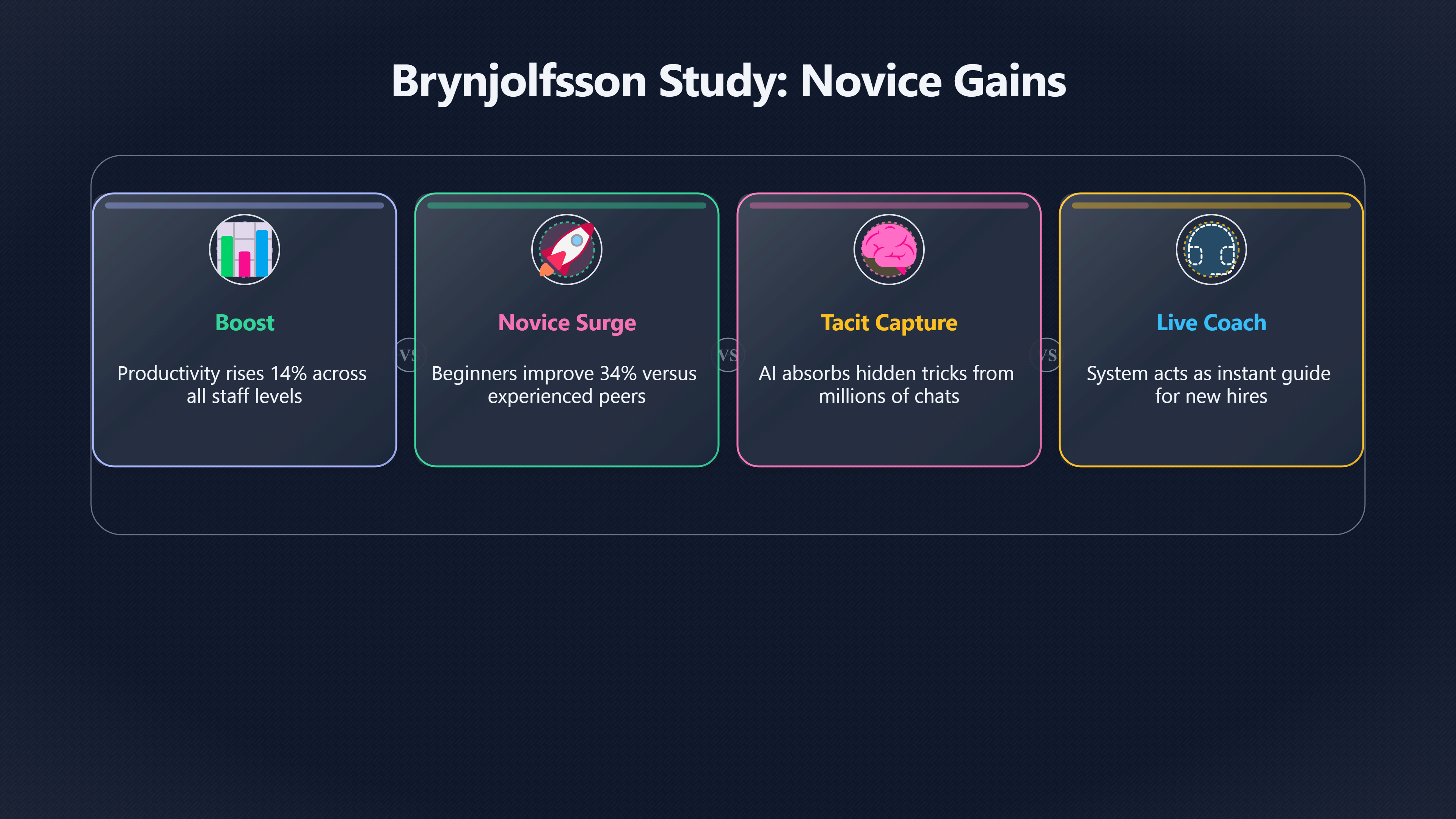
The headline finding was striking: access to the AI assistant increased productivity by around 14% overall. But the average concealed a much bigger effect for beginners. Novice and lower-skilled workers improved by roughly 34%, while experienced high-performing workers saw little benefit. [NBER]nber.orgNBERGenerative AI at Workby E Brynjolfsson · 2023 · Cited by 3306 — Access to the tool increases productivity, as measured by issues reso…
That asymmetry matters. If AI merely made elite workers slightly faster, the technology would mostly reinforce existing advantages. Instead, the study suggested that AI could compress parts of the skill gap between newcomers and veterans.
The mechanism was also revealing. The AI system had effectively absorbed patterns from millions of previous customer interactions and learned which responses tended to resolve problems successfully. It then offered those patterns back to less experienced staff in real time. Brynjolfsson described this as capturing tacit knowledge — the practical tricks, phrasing habits, and situational judgement that strong workers often use instinctively but rarely document formally. [Time]time.comHow to Make AI Work for You, at WorkShe pursued this interest by taking the Elements of AI, an online course by MinnaLearn and the University of Helsinki, which enhanced her…
In practice, this meant newer workers no longer depended entirely on finding the right colleague, searching old documents, or learning through repeated mistakes. The AI system functioned partly as a live coach.
The study also found improvements in customer sentiment. Customers interacting with AI-assisted workers were less likely to ask for managers and tended to behave more politely. [arXiv]arxiv.orgarXiv Generative AI at WorkarXiv Generative AI at Work That suggests the gains were not merely about speed; some interactions genuinely became smoother.
Why beginners often gain more than experts
The pattern seen in the customer-support study fits a broader economic intuition. In many professions, beginners are constrained less by raw intelligence than by missing context.
A new employee often knows the formal rules of a job but lacks:
- recognition of common patterns
- awareness of edge cases
- familiarity with internal systems
- confidence in communication
- shortcuts developed through repetition
- knowledge of which problems matter most
Experienced workers accumulate these gradually. AI assistants can sometimes accelerate that process by making hidden institutional memory easier to access.
This is especially important in workplaces where expertise is fragmented. Large organisations often contain thousands of useful documents, transcripts, manuals, and prior decisions, but finding the relevant information at the right moment is difficult. A well-designed AI assistant can reduce that search burden dramatically.
The technology may therefore matter most in occupations where:
- procedures are partly standardised
- good historical examples exist
- workers face recurring problems
- response speed matters
- beginners frequently become stuck
Customer support fits this pattern well. So do some administrative, coding, legal-review, and technical-support tasks.
The broader implication for the “AI bloom” argument is subtle but important. The immediate value may not come from AI becoming universally superhuman. It may come from reducing the scarcity of usable guidance. Civilisations often waste enormous amounts of human potential because people cannot easily access accumulated expertise. If AI lowers that friction, capability can spread faster through the population.
AI as a distribution system for tacit knowledge
One reason this evidence attracted so much attention is that it changed the framing of workplace AI.
Earlier waves of automation often focused on replacing repetitive labour. The newer argument is different: AI may partly act as a transmission layer for expertise.
Historically, many skills spread slowly because they depended on apprenticeship. New workers learned by observing experienced colleagues over long periods. That process remains effective, but it scales poorly. A senior employee can mentor only a limited number of people.
Generative AI systems change the economics of this transfer. Once a model captures recurring patterns from high-performing workers, the guidance can potentially be distributed simultaneously across thousands of employees.
This does not mean the system truly “understands” expertise in the human sense. But even imperfect pattern extraction can matter economically if it improves the baseline performance of large numbers of workers.
Economist David Autor has argued that technology sometimes creates value not by eliminating human labour but by enabling people with less formal expertise to perform more sophisticated work. AI assistance may fit this pattern in some industries. [Financial Times]ft.comFinancial Times The manicure economyThis transformation, epitomized by people like Tia Lee who transitioned from a make-up counter to a successful career in TV make-up artis…
That possibility matters for the larger abundance question. A civilisation where high-quality cognitive support becomes cheap and widely available could unlock capability in people who currently lack elite training, strong educational institutions, or access to expert networks.
The evidence is real, but narrower than the hype
The optimistic interpretation of these findings often runs too far ahead of the evidence.
The customer-support studies examined a relatively structured environment:
- conversations followed recognisable patterns
- historical examples were abundant
- success metrics were measurable
- workers handled many similar cases repeatedly
That is not the same as proving AI reliably upgrades novice performance across the entire economy.
Many jobs depend heavily on:
- physical judgement
- social trust
- long-term responsibility
- ambiguous goals
- ethical trade-offs
- deep contextual understanding
In these environments, AI assistance may help only marginally or sometimes create new risks.
Even within knowledge work, performance gains vary widely. Some studies find substantial improvements for routine tasks but little benefit for highly complex reasoning. Others show that workers often over-trust plausible but incorrect AI outputs.
The strongest interpretation of the current evidence is therefore not “AI makes everyone an expert”. It is closer to this: AI can sometimes narrow the practical gap between beginners and experienced workers in domains where good examples and feedback loops already exist.
That is still economically significant. Small improvements applied across millions of workers can compound into large productivity gains. But it falls short of the more extravagant claims about instant universal expertise.

The hidden risk: dependency instead of learning
The same systems that help beginners perform better may also weaken genuine skill formation.
A 2026 experimental study on programmers learning a new software library found that heavy reliance on AI assistance often reduced conceptual understanding, debugging ability, and long-term mastery. Some participants completed tasks faster by delegating work to AI, but they learned less in the process. [arXiv]arxiv.orgarXiv Generative AI at WorkarXiv Generative AI at Work
This tension is central to the future of AI-assisted work.
A novice worker can appear highly capable while using AI tools continuously. But if the worker never develops independent judgement, the apparent productivity gain may conceal fragility. Problems emerge when:
- the AI fails unexpectedly
- unusual edge cases appear
- systems change
- outputs require verification
- workers must supervise automation directly
The distinction between assistance and substitution therefore matters enormously.
Used well, AI can function like scaffolding:
- helping workers learn faster
- exposing them to strong examples
- reducing confusion during early training
- increasing confidence
Used badly, it can become a crutch that weakens the development of durable expertise.
This creates an important institutional question for an AI-rich future: will organisations optimise for immediate output or for long-term human capability?
The answer may shape whether AI expands human flourishing or gradually hollows out human competence beneath a layer of machine-generated support.
Monitoring, pressure, and the politics of AI management
Workplace AI is not only a productivity technology. It is also a management technology.
The same systems that guide workers can monitor them continuously:
- tracking response speed
- analysing tone
- scoring interactions
- predicting performance
- comparing workers against algorithmic benchmarks
That creates new power asymmetries inside organisations.
Some workers already report that AI systems increase pressure rather than reducing drudgery. Managers may use AI-generated metrics to intensify workloads or justify leaner staffing. Recent reporting has described employees spending large amounts of time correcting low-quality AI output while simultaneously being told that the technology is improving productivity. [The Guardian]theguardian.comThe Guardian Bosses say AI boosts productivityWorkers like Ken, a copywriter at a cybersecurity firm, report that AI-generated content often requires extensive editing due to its supe…
Experimental evidence also suggests workers may react differently to AI authority than to human authority. One 2025 study found that workers tolerated lower pay and harsher evaluations from AI managers with surprisingly limited emotional resistance, potentially because algorithmic systems appear impersonal or objective. [arXiv]arxiv.orgarXiv Generative AI at WorkarXiv Generative AI at Work
This complicates the optimistic story about abundance. AI may distribute capability more widely while simultaneously increasing managerial control.
The same tool can therefore produce both empowerment and dependency:
- a junior worker gains access to expertise
- but loses autonomy over pace and evaluation
- a beginner becomes more productive
- but may become easier to monitor and replace
Whether AI produces broadly shared flourishing or merely tighter labour optimisation depends heavily on governance, bargaining power, and institutional design.

Could AI shrink the ladder for future experts?
A deeper concern is that AI may weaken the career pathways through which people become experts in the first place.
Many professions rely on junior roles as training grounds:
- junior programmers
- paralegals
- support agents
- research assistants
- administrative analysts
If AI systems absorb enough routine work, firms may hire fewer entry-level staff. Some recent labour-market evidence already suggests declines in postings for certain junior roles exposed to generative AI. [Windows Central]windowscentral.comAnalyzing data from the largest U.S. payroll provider, researchers Brynjolfsson, Chandar, and Chen found that employment among 22- to 25…
That creates a paradox.
The technology may help current novices perform better while simultaneously reducing the number of opportunities for future novices to enter the profession at all.
Historically, expertise formation required years of lower-level practice:
- handling routine cases
- observing failures
- building intuition gradually
- learning organisational culture
If AI removes too much of that apprenticeship layer, societies could eventually face shortages of genuinely experienced humans capable of handling rare or critical situations.
This is one reason the long-term “AI bloom” vision depends on institutional choices, not merely technical capability. A flourishing future would require systems that expand access to competence while still preserving meaningful human development.
What the evidence probably means for intelligence abundance
The evidence around novice workers is one of the clearest real-world signs that AI can make some forms of intelligence more abundant.
Not because machines have become universally wise.
Not because expertise no longer matters.
And not because humans stop needing training.
Rather, the evidence suggests that AI can sometimes compress the distance between “I do not know how to do this” and “I can perform this competently enough to contribute”.
That compression could matter enormously at civilisational scale.
If millions of people gain:
- faster access to practical guidance
- better explanations
- real-time troubleshooting
- language support
- workflow coaching
- institutional memory
then societies may become more capable overall, even without dramatic breakthroughs in artificial general intelligence.
But the same evidence also points toward hard constraints.
AI assistance does not automatically create wisdom, judgement, or deep understanding. It can flatten skill differences while also weakening skill formation. It can democratise access to expertise while concentrating power in the organisations that own the systems. It can empower workers while making them easier to monitor and standardise.
The optimistic case for AI-enabled human flourishing therefore rests on more than productivity graphs. It depends on whether societies use AI to enlarge human capability broadly — helping more people become competent, creative, and autonomous — rather than merely extracting more output from increasingly supervised workers.
Endnotes
-
Source: academic.oup.com
Link: https://academic.oup.com/qje/article/140/2/889/7990658Source snippet
OUP AcademicGenerative AI at Work* | The Quarterly Journal of Economicsby E Brynjolfsson · 2025 · Cited by 3360 — We study the effect of...
-
Source: nber.org
Link: https://www.nber.org/papers/w31161Source snippet
NBERGenerative AI at Workby E Brynjolfsson · 2023 · Cited by 3306 — Access to the tool increases productivity, as measured by issues reso...
-
Source: arxiv.org
Title: arXiv Generative AI at Work
Link: https://arxiv.org/abs/2304.11771 -
Source: gsb.stanford.edu
Title: Generative AI at Work
Link: https://www.gsb.stanford.edu/faculty-research/working-papers/generative-ai-workSource snippet
Stanford Graduate School of BusinessAccess to the tool increases productivity, as measured by issues resolved per hour, by 14% on average...
-
Source: time.com
Title: How to Make AI Work for You, at Work
Link: https://time.com/6302984/ai-jobs-career/Source snippet
She pursued this interest by taking the Elements of AI, an online course by MinnaLearn and the University of Helsinki, which enhanced her...
-
Source: gsb.stanford.edu
Title: generative ai can boost productivity without replacing workers
Link: https://www.gsb.stanford.edu/insights/generative-ai-can-boost-productivity-without-replacing-workersSource snippet
Generative AI Can Boost Productivity Without Replacing...11 Dec 2023 — The first large-scale study of a ChatGPT-like assistant in the wo...
-
Source: arxiv.org
Title: arXiv How AI Impacts Skill Formation
Link: https://arxiv.org/abs/2601.20245Source snippet
arXivHow AI Impacts Skill FormationJanuary 28, 2026...
Published: January 28, 2026
-
Source: arxiv.org
Link: https://arxiv.org/abs/2505.21752Source snippet
arXivExperimental Evidence That AI-Managed Workers Tolerate Lower Pay Without DemotivationMay 27, 2025...
Published: May 27, 2025
-
Source: ft.com
Title: Financial Times The manicure economy
Link: https://www.ft.com/content/f3cc3767-b0c3-4dd1-983a-6f158799b6c4Source snippet
This transformation, epitomized by people like Tia Lee who transitioned from a make-up counter to a successful career in TV make-up artis...
-
Source: theguardian.com
Title: The Guardian Bosses say AI boosts productivity
Link: https://www.theguardian.com/technology/2026/apr/14/ai-productivity-workplace-errorsSource snippet
Workers like Ken, a copywriter at a cybersecurity firm, report that AI-generated content often requires extensive editing due to its supe...
-
Source: windowscentral.com
Link: https://www.windowscentral.com/artificial-intelligence/stanford-study-ai-stealing-jobs-22-25Source snippet
Analyzing data from the largest U.S. payroll provider, researchers Brynjolfsson, Chandar, and Chen found that employment among 22- to 25...
Additional References
-
Source: tomshardware.com
Link: https://www.tomshardware.com/tech-industry/artificial-intelligence/ai-is-eating-entry-level-coding-and-customer-service-roles-according-to-a-new-stanford-study-junior-job-listings-drop-13-percent-in-three-years-in-fields-vulnerable-to-aiSource snippet
Over the past three years, job listings in these AI-susceptible fields have dropped by 13%, especially affecting workers aged 22-25. Cond...
-
Source: youtube.com
Title: The Impact of AI Assistants on Workplace Performance
Link: https://www.youtube.com/watch?v=Xh0Yp894P_wSource snippet
Why AI Helps Newer Employees More Than Experts...
-
Source: youtube.com
Title: Why AI Helps Newer Employees More Than Experts
Link: https://www.youtube.com/watch?v=aG4o-18p4uESource snippet
The Future of Skill Development in the AI Era...
-
Source: youtube.com
Title: Can AI Tools Bridge the Experience Gap?
Link: https://www.youtube.com/watch?v=k9XzG0V4MhYSource snippet
The Impact of AI Assistants on Workplace Performance...
-
Source: youtube.com
Title: How Generative AI Boosts Novice Worker Productivity
Link: https://www.youtube.com/watch?v=F3a19Y_T1YwSource snippet
Can AI Tools Bridge the Experience Gap?...
-
Source: youtube.com
Title: The Future of Skill Development in the AI Era
Link: https://www.youtube.com/watch?v=Zt_4k7z5J4k
Amazon book picks
Further Reading
Books and field guides related to AI for Novice Workers. Use these as the next step if you want deeper reading beyond the article.
The Shift: The Future of Work is Already Here
An unhysterical look at the future of employment.
Automation and the Future of Work
First published 2020. Subjects: Economic history, Automation, Social aspects, Economic aspects, Technological innovations.

Future of Work Technology and Basic Income
First published 2019. Subjects: Economics, Information society, Economic aspects, Work, Technological innovations.
The Future of Work in the United States
This book presents and analyzes how restructuring processes due to technological change are reflected and processed in political and publ...
Topic Tree