Within Discovery
Autonomous Materials Labs
The A-Lab shows how robotics can close the gap between predicted materials and tested compounds, one experiment loop at a time.
On this page
- How prediction connects to robotic testing
- What the A Lab achieved in continuous operation
- Why synthesis and usefulness remain bottlenecks
Page outline Jump by section
Introduction
One of the biggest promises in AI-driven science is not simply predicting new materials on a computer, but turning those predictions into real substances that can be made, measured and eventually manufactured. That gap has long slowed progress in batteries, solar cells, catalysts, semiconductors and cleaner industrial processes. Researchers can now generate huge numbers of hypothetical compounds using machine learning, but physically creating and testing them remains difficult, slow and labour-intensive.
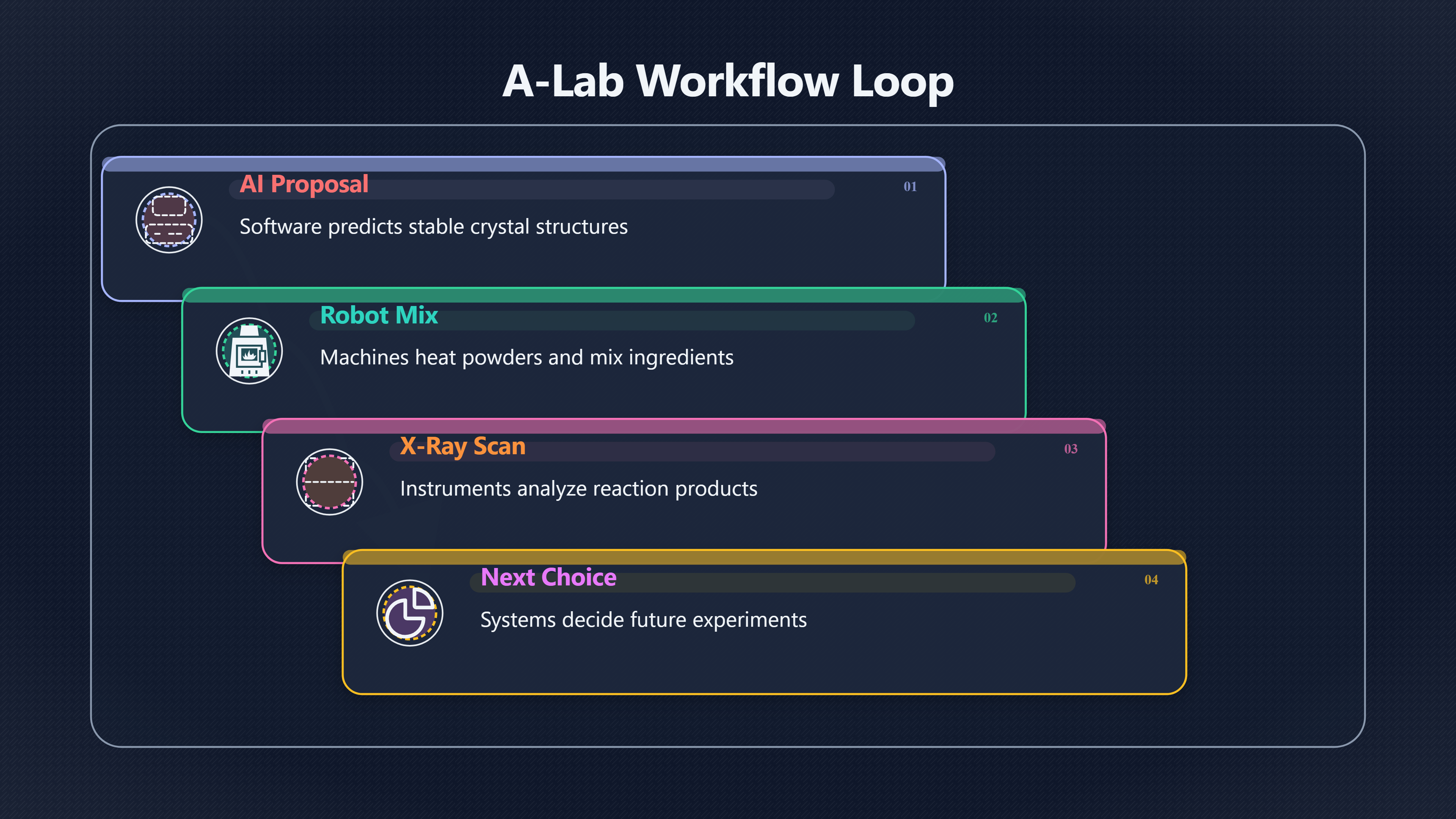
 Autonomous materials laboratories — sometimes called “self-driving labs” — are an attempt to close that gap. These systems combine AI models, robotics, scientific databases and automated measurement tools into a continuous experimental loop. Instead of a human researcher manually planning and running every synthesis step, software proposes candidates, robots mix and heat ingredients, instruments analyse the results, and machine-learning systems decide what to try next. The most discussed example so far is the A-Lab at Lawrence Berkeley National Laboratory, which demonstrated that AI-guided robotics can move from computational prediction to experimentally realised compounds with far less human intervention than traditional materials science. Nature [PubMed The broader significance for the AI bloom idea is straightforward: if science can iterate much faster]youtube.comRobots and AI hunt for new materials at A-Labceder.berkeley.edu…, then technologies that depend on better materials — from energy storage to climate mitigation to advanced computing — may also accelerate. But the evidence so far suggests a more measured conclusion than some headlines implied. Autonomous labs appear genuinely useful for speeding up experimentation, yet synthesis, verification, scaling and practical usefulness remain major bottlenecks.
How prediction connects to robotic testing
Modern AI systems can search chemical possibility spaces vastly larger than humans can explore manually. In materials science, this often begins with computational screening: software predicts which combinations of elements might form stable crystal structures with useful properties.
Google DeepMind’s GNoME system became one of the best-known examples after researchers reported that it had identified hundreds of thousands of candidate stable materials using graph neural networks and physics-based calculations. [Nature]nature.comNatureAn autonomous laboratory for the accelerated synthesis of…29 Nov 2023 — We introduce the A-Lab, an autonomous laboratory for the… But a predicted crystal structure on a computer is not automatically a real material. Some compounds cannot actually be synthesised under practical conditions. Others require temperatures, pressures or precursor chemicals that are hard to achieve. Many may exist only fleetingly or in impure forms.
Autonomous labs try to solve this by creating a closed experimental loop:
- AI systems propose promising materials.
- Software plans synthesis recipes using prior scientific literature and thermodynamic models.
- Robotic systems mix powders, heat samples and carry out reactions.
- Instruments such as X-ray diffraction systems analyse the products.
- Machine-learning models interpret the results and decide the next experiments.
The important shift is not merely automation of laboratory labour. It is the creation of a feedback cycle in which experiments continuously improve future decisions. In principle, this lets scientific exploration proceed around the clock and at much larger scale than traditional workflows. Nature [ACS Publications]pubs.acs.orgACS PublicationsSelf-Driving Laboratories for Chemistry and Materials Scienceby G Tom · 2024 · Cited by 701 — High quality large datasets…
For AI abundance arguments, the attraction is obvious. Better materials sit underneath many civilisation-scale constraints:
- batteries for energy storage and electrified transport
- catalysts for fertiliser, chemicals and cleaner industry
- solar materials for cheaper power
- superconductors and semiconductors for computing
- corrosion-resistant materials for infrastructure
- membranes and absorbents for carbon capture and water purification
Progress in these areas is often constrained less by theory than by the sheer difficulty of experimentally exploring chemical space.
What the A-Lab achieved in continuous operation
The A-Lab project at Lawrence Berkeley National Laboratory became a landmark demonstration because it showed an autonomous materials workflow operating continuously rather than merely assisting human researchers occasionally. In a 2023 Nature paper, researchers described a robotic laboratory system for synthesising inorganic powder materials. Over 17 days of largely autonomous operation, the system attempted 57 target compounds and reported successful synthesis of 36 of them. [Nature]nature.comNatureGoogle AI and robots join forces to build new materials29 Nov 2023 — Tool from Google DeepMind predicts nearly 400,000 stable subst…
The workflow integrated several layers of computation and automation:
- candidate materials drawn from large computational databases such as the Materials Project
- synthesis planning informed by machine learning and text-mined scientific literature
- robotic handling of powders and furnace operations
- automated characterisation of reaction products
- active learning systems that updated future experimental choices based on previous outcomes
This mattered because the traditional pipeline from theoretical prediction to experimentally verified material is often painfully slow. Human researchers may spend months or years iterating through failed synthesis attempts, especially for unfamiliar compounds. The A-Lab demonstrated that autonomous systems can compress part of that cycle dramatically. [ceder.berkeley.edu]ceder.berkeley.eduthe A-Lab, an autonomous platform that integrates computations with…Read more…
The demonstration also highlighted an emerging division of labour between AI and human scientists. AI systems excel at searching enormous candidate spaces and detecting statistical patterns. Robotics excels at repetitive and precise experimentation. Human researchers still frame the goals, interpret broader significance and decide which directions are worth pursuing.
That distinction matters because the strongest version of the “scientific discovery at machine speed” argument is not that laboratories become fully independent robot scientists overnight. It is that the expensive and slow parts of experimentation become increasingly automated, allowing human researchers to explore far larger scientific spaces than before.
Why the results triggered debate
The A-Lab announcement also exposed an important tension in AI-for-science reporting: what counts as a real discovery?
Early coverage sometimes described the project as having created dozens of “new materials”. Later critiques argued that several compounds were not actually novel to science, but merely new relative to the prediction system’s database. Critics also questioned whether some materials had been identified with enough certainty to justify strong novelty claims. Nature [2chemistryworld.com]chemistryworld.comNew analysis raises doubts over autonomous lab's…16 Jan 2024 — A critique of a paper published in Nature last year, which reported the…
In 2026, Nature published a correction clarifying that the original paper’s novelty claims could be misunderstood and that the materials were not necessarily previously unknown to science. [Nature]nature.comNatureRobot chemist sparks row with claim it created new materials12 Dec 2023 — Researchers question whether an AI-controlled lab assista…
This dispute is important because it illustrates both the promise and the limits of autonomous science systems.
The strongest interpretation of the A-Lab work is still significant:
- the system autonomously executed complex experimental loops
- it successfully synthesised many target compounds
- it reduced the human labour required for iterative experimentation
- it demonstrated integration between AI prediction and robotic validation
But the weaker interpretation is also true:
- generating candidate compounds is easier than proving practical value
- synthesis success does not equal industrial usefulness
- novelty claims in materials science can be subtle and contested
- automated systems still rely heavily on human-designed infrastructure and datasets
The episode became a reminder that scientific acceleration should not be confused with instant technological transformation. Autonomous labs may shorten experimental cycles substantially without automatically delivering revolutionary products.

Why synthesis and usefulness remain bottlenecks
Even if AI systems become dramatically better at proposing materials, the hard part may still be turning promising compounds into technologies that matter economically or socially.
Several bottlenecks remain stubbornly physical.
Making a material is not enough
A compound that can be synthesised in milligram quantities inside a research lab may still be commercially useless. Industrial deployment often requires:
- stable large-scale manufacturing
- cheap and abundant precursor materials
- long-term durability
- safety testing
- compatibility with existing industrial systems
- predictable performance outside ideal laboratory conditions
A battery material that performs well once under tightly controlled conditions may fail after repeated charge cycles or prove impossible to manufacture economically.
Researchers quoted in reporting on GNoME and A-Lab stressed that prediction is scaling far faster than experimental validation. AI can now generate candidate materials at a pace laboratories cannot remotely match. [WIRED]wired.comGoogle Deep Mind's AI Dreamed Up 380,000 New MaterialsThe Next Challenge Is Making ThemGoogle DeepMind developed an AI program, GNoME, which has predicted 380,000 new stable materials, expand…
Real chemistry is messy
Autonomous labs work best in constrained environments with repeatable procedures. Much of chemistry is not like that.
Solid-state powder synthesis — the A-Lab’s main focus — is comparatively structured. Other areas involve:
- unstable intermediates
- moisture-sensitive reactions
- biological contamination
- multi-step synthesis chains
- delicate handling requirements
- extreme temperatures or pressures
Researchers working on next-generation systems increasingly focus on extending automation into harder environments, including air-sensitive chemistry performed inside gloveboxes. A 2026 study on lithium halide conductors described an upgraded A-Lab platform capable of handling air-free synthesis conditions while integrating more advanced AI reasoning systems. [arXiv]arxiv.orgarXivAgentic LLM Reasoning in a Self-Driving Laboratory for Air-Sensitive Lithium Halide Spinel ConductorsApril 13, 2026…
That progression hints at where autonomous science may head next: not merely automating repetitive tasks, but handling increasingly complex experimental judgement.
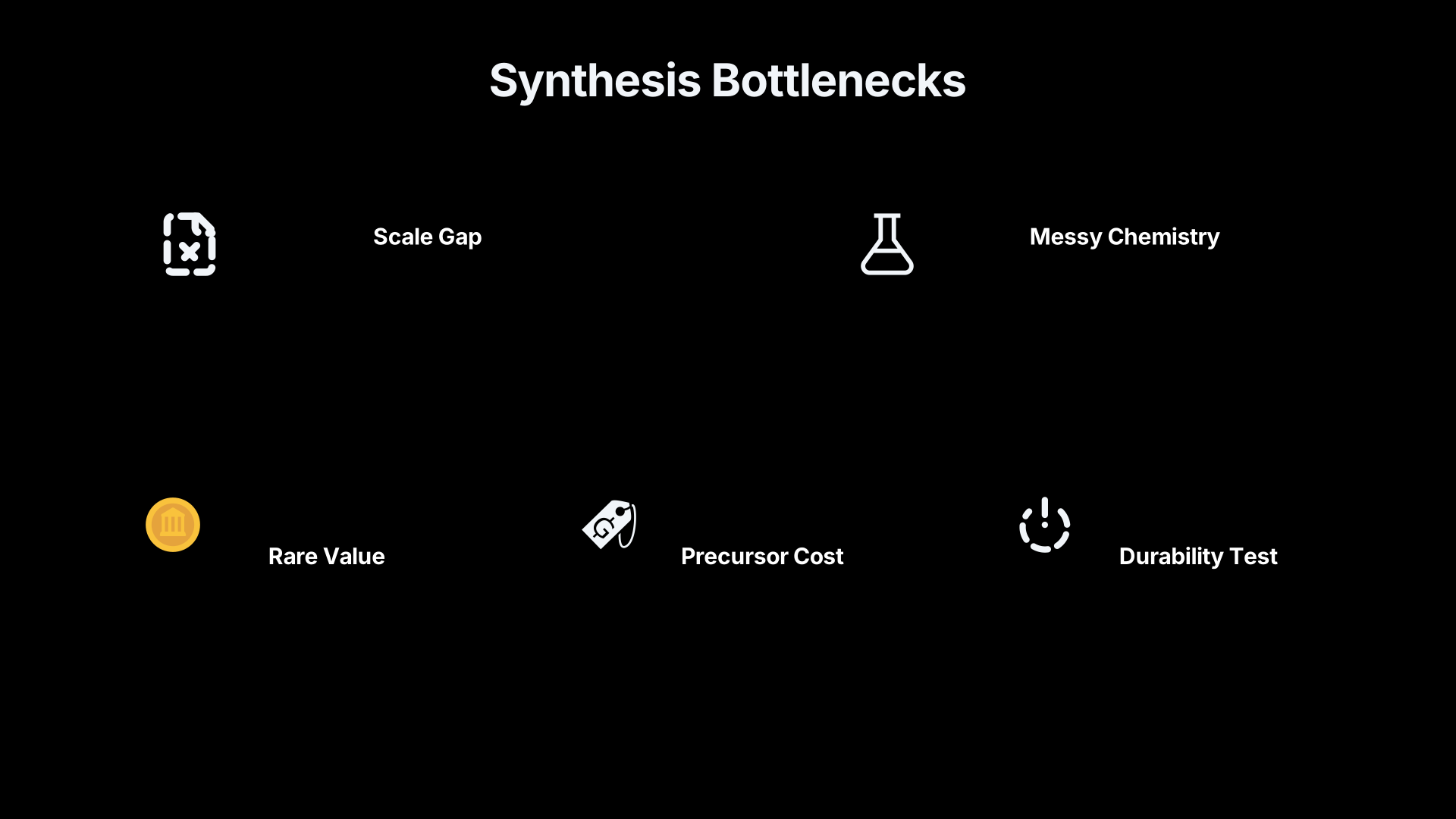
Useful properties are rare
Many predicted materials may simply not matter much.
The space of theoretically stable compounds is enormous, but only a tiny fraction may possess properties valuable enough for batteries, catalysts, photovoltaics or electronics. Materials scientists have long known that discovering a chemically valid material is easier than discovering one that is economically transformative.
This is why autonomous labs are likely to matter most when tightly linked to clear optimisation targets:
- higher ionic conductivity for batteries
- lower-cost catalysts
- improved thermal stability
- reduced dependence on scarce minerals
- greater solar conversion efficiency
Without strong target criteria, AI systems risk generating endless chemically plausible but practically irrelevant compounds.
Could autonomous labs change the pace of civilisation-scale innovation?
The strongest long-term argument for autonomous laboratories is cumulative rather than spectacular. Even modest improvements in the speed of materials discovery could compound across many sectors over decades.
Materials innovations often unlock broader technological shifts:
- cheaper batteries can accelerate electrification
- better catalysts can reduce industrial energy use
- improved semiconductors can enable more powerful computing
- advanced membranes can improve desalination and carbon capture
- stronger lightweight materials can reshape transport and infrastructure
Historically, such advances have taken decades because experimentation is slow, expensive and dependent on specialised expertise. Autonomous labs potentially change the economics of exploration itself. Instead of carefully testing a handful of ideas, researchers may be able to explore thousands or millions of possibilities systematically.
For the broader AI bloom perspective, this matters because civilisation’s constraints are often physical as much as informational. Faster scientific iteration could help loosen some of those limits: energy scarcity, material inefficiency, environmental damage and manufacturing constraints.
But the evidence so far supports a narrower and more credible claim than full techno-utopian narratives. Autonomous labs appear likely to become valuable scientific infrastructure rather than magical discovery machines. They may accelerate parts of science substantially while still depending on human institutions, industrial capacity, regulation and economic incentives.
The most plausible near-term future is therefore not fully autonomous science replacing researchers, but increasingly automated scientific flywheels in which AI systems propose ideas, robotic labs test them continuously, and humans steer the broader direction. If that process keeps improving, the cumulative effect on scientific progress could still be enormous.
Endnotes
-
Source: nature.com
Link: https://www.nature.com/articles/s41586-023-06734-wSource snippet
NatureAn autonomous laboratory for the accelerated synthesis of...29 Nov 2023 — We introduce the A-Lab, an autonomous laboratory for the...
-
Source: nature.com
Link: https://www.nature.com/articles/d41586-023-03745-5Source snippet
NatureGoogle AI and robots join forces to build new materials29 Nov 2023 — Tool from Google DeepMind predicts nearly 400,000 stable subst...
-
Source: wired.com
Title: Google Deep Mind’s AI Dreamed Up 380,000 New Materials
Link: https://www.wired.com/story/an-ai-dreamed-up-380000-new-materials-the-next-challenge-is-making-themSource snippet
The Next Challenge Is Making ThemGoogle DeepMind developed an AI program, GNoME, which has predicted 380,000 new stable materials, expand...
-
Source: pubs.acs.org
Link: https://pubs.acs.org/doi/10.1021/acs.chemrev.4c00055Source snippet
ACS PublicationsSelf-Driving Laboratories for Chemistry and Materials Scienceby G Tom · 2024 · Cited by 701 — High quality large datasets...
-
Source: ceder.berkeley.edu
Link: https://ceder.berkeley.edu/research-areas/autonomous-experimentation-for-accelerated-materials-discovery/Source snippet
the A-Lab, an autonomous platform that integrates computations with...Read more...
-
Source: ceder.berkeley.edu
Title: a lab paper published in nature featured in news story
Link: https://ceder.berkeley.edu/news/a-lab-paper-published-in-nature-featured-in-news-story/Source snippet
A-Lab paper published in Nature, featured in news storiesNov 29, 2023 — Nature published a journal article written by Mark Peplow featuri...
-
Source: nature.com
Link: https://www.nature.com/articles/d41586-023-03956-wSource snippet
NatureRobot chemist sparks row with claim it created new materials12 Dec 2023 — Researchers question whether an AI-controlled lab assista...
-
Source: chemistryworld.com
Link: https://www.chemistryworld.com/news/new-analysis-raises-doubts-over-autonomous-labs-materials-discoveries/4018791.articleSource snippet
New analysis raises doubts over autonomous lab's...16 Jan 2024 — A critique of a paper published in Nature last year, which reported the...
-
Source: nature.com
Link: https://www.nature.com/articles/s41586-025-09992-ySource snippet
NatureAuthor Correction: An autonomous laboratory for the...by NJ Szymanski · 2026 · Cited by 1 — Following publication of this article...
-
Source: arxiv.org
Link: https://arxiv.org/abs/2604.11957Source snippet
arXivAgentic LLM Reasoning in a Self-Driving Laboratory for Air-Sensitive Lithium Halide Spinel ConductorsApril 13, 2026...
Published: April 13, 2026
-
Source: cen.acs.org
Link: https://cen.acs.org/research-integrity/Nature-robot-chemist-paper-corrected/104/web/2026/01Source snippet
acs.org'Nature' robot chemist paper corrected, but some... - C&EN29 Jan 2026 — The original study claimed the robot had discovered 43 ne...
-
Source: youtube.com
Title: Robots and AI hunt for new materials at A-Lab
Link: https://www.youtube.com/watch?v=RLO4sfK37w4Source snippet
ceder.berkeley.edu...
Additional References
-
Source: newscenter.lbl.gov
Link: https://newscenter.lbl.gov/2026/01/13/accelerating-discovery-how-the-materials-project-is-helping-to-usher-in-the-ai-revolution-for-materials-science/Source snippet
Discovery: How the Materials Project Is Helping...13 Jan 2026 — The open-access materials database managed by Berkeley Lab has surpassed...
-
Source: linkedin.com
Link: https://www.linkedin.com/pulse/ai-powered-labs-discovering-materials-10x-faster-brightbeam-ai-dfvleSource snippet
AI-Powered Labs: Discovering Materials 10x FasterBy allowing artificial intelligence to plan and conduct chemical experiments in real-tim...
-
Source: reddit.com
Link: https://www.reddit.com/r/slatestarcodex/comments/1923p07/autonomous_lab_did_not_synthesize_any_new/Source snippet
Autonomous lab did not synthesize any new materialsThis is a reanalysis of Nature paper An autonomous laboratory for the accelerated synt...
-
Source: instagram.com
Link: [https://www.instagram.com/microsoftSource snippet
Microsoft (@microsoft) · Redmond, WACorporate can be hard, but you've never shied away from a challenge. #MakinaMode. In a time when AI i...
-
Source: facebook.com
Link: https://www.facebook.com/groups/1572893699951268/posts/1913394545901180/Source snippet
Self-driving labs accelerate materials discoveryThese AI- powered labs leverage machine learning and robotics to accelerate the discovery...
-
Source: axios.com
Link: https://www.axios.com/2024/08/09/ai-self-driving-science-labs-researchSource snippet
These labs autonomously conduct experiments in a closed-loop system, learning from outcomes to refine future experimentation. The goal is...
-
Source: anl.gov
Link: https://www.anl.gov/autonomous-discovery/building-a-mobile-robotic-scientist-to-speed-materials-discoverySource snippet
r a potential solution for this bottleneck, allowing scientists to use robotic...Read more...
-
Source: microsoft.com
Title: Shop Microsoft 365, Copilot, Teams, Xbox, Windows, Azure, Surface and more
Link: https://www.microsoft.com/en-gbSource snippet
Microsoft – AI, Cloud, Productivity, Computing, Gaming & AppsExplore Microsoft products and services and support for your home or business...
-
Source: youtube.com
Link: https://www.youtube.com/microsoft -
Source: iom3.org
Title: ai driven robotics laboratory to discover new materials
Link: https://www.iom3.org/events-awards/ems-event-calendar/ai-driven-robotics-laboratory-to-discover-new-materials.htmlSource snippet
AI-driven Robotics Laboratory to Discover New Materials3 Jul 2025 — By enabling autonomous laboratories, AI allows robotic systems to ind...
Amazon book picks
Further Reading
Books and field guides related to Autonomous Materials Labs. Use these as the next step if you want deeper reading beyond the article.

Advanced Materials
This book provides a thorough introduction to the essential topics in modern materials science. It brings together the spectrum of materi...

Concepts of Materials Science
This book provides an expert perspective and a unique insight into the essence of the science of materials, introducing the reader to ten...

Ceramic Materials
Ceramic Materials: Science and Engineering is an up-to-date treatment of ceramic science, engineering, and applications in a single, inte...
eBay marketplace picks
Marketplace Samples
Example marketplace items related to this page. Use the search link to explore similar finds on eBay.

Example eBay listing
A.I. Artificial Intelligence Original Movie Poster Signed By Jude Law
USD 125.00 | Shipping USD 25.00 | US

Example eBay listing
Artificial Intelligence D/S Original Movie Poster - 27 x 40"
USD 19.50 | Shipping USD 13.65 | US

Example eBay listing
612388 Artificial Intelligence Movie Science Fiction Drama Wall Print Poster
USD 22.95 | Shipping USD 12.95 | JP

Example eBay listing
Companion - Artificial Intelligence Dark Comedy Cinema Film - POSTER 20"x30"
USD 23.99 | Free shipping | US

Example eBay listing
A.I. Artificial Intelligence Movie Film Poster Art Print
GBP 4.99 | Free shipping | GB

Example eBay listing
A I Artificial Intelligence 6 Movie Poster Art Print Print Classic Rare Gallery
GBP 49.00 | Free shipping | GB

Example eBay listing
AI - Artificial Intelligence (Poster + Slipcase) Blu-Ray
GBP 10.49 | Free shipping | GB

Example eBay listing
A. I. Artificial Intelligence. Jude Law. Original UK Video Poster.
GBP 8.11 | Shipping GBP 3.38 | GB
Topic Tree