Within Novice Workers
AI dependency risk
AI assistance can make novices faster in the moment while weakening the deeper judgement they need when the tool is wrong or unavailable.
On this page
- Why faster task completion can hide weaker learning
- Programming evidence on reduced mastery
- How workplaces can use AI as scaffolding rather than substitution
Page outline Jump by section
Introduction
AI assistants can make beginners look competent long before they become competent. That is both the attraction and the risk. A novice worker using ChatGPT, Copilot, Claude, or similar tools can often complete tasks faster, write more polished text, produce usable code, and navigate unfamiliar systems with far less frustration than before. In the short term, this can widen access to skilled work and reduce barriers to entry. In the longer term, though, the same systems can weaken the slow process through which people build judgement, error detection, and independent understanding.
 This matters far beyond education. If AI is to contribute to a broader future of human flourishing and “intelligence abundance”, societies will need more people with real competence, not merely more people who can operate AI interfaces. The central question is not whether AI can help novices perform. It clearly can. The harder question is whether beginners using AI are actually learning the underlying craft, or merely borrowing competence from systems they cannot reliably evaluate.
Why faster task completion can hide weaker learning
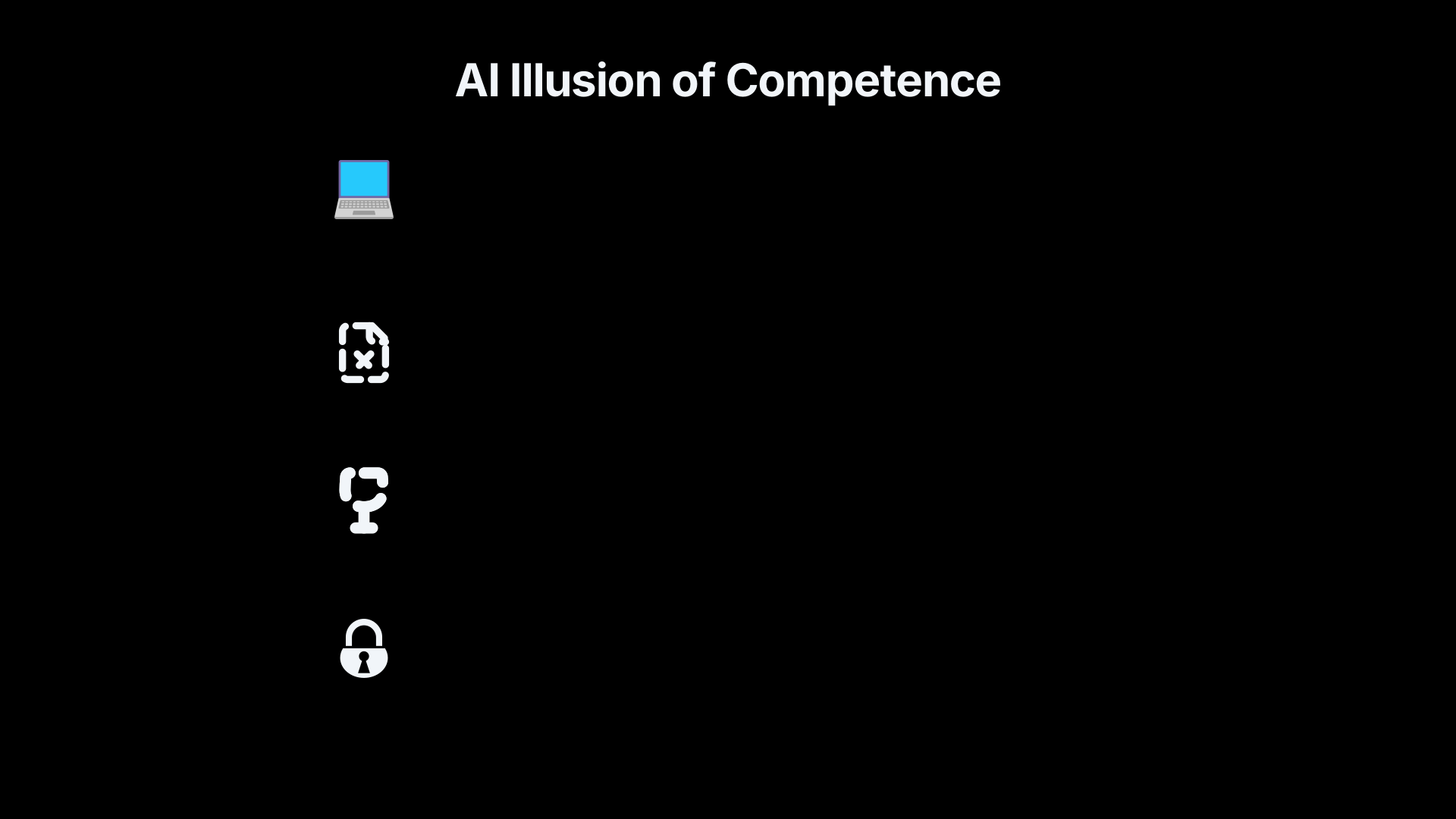
The core danger is not laziness. It is misplaced fluency.
Many beginners judge their understanding by whether they can complete a task. AI systems are extremely good at creating that feeling. A novice programmer can produce a working app. A junior analyst can generate a convincing report. A trainee marketer can draft campaign copy in minutes. The immediate feedback is rewarding: the output looks professional, the task gets done, and the user feels capable.
But learning normally depends on struggle, debugging, revision, and repeated exposure to mistakes. Those processes are cognitively expensive, yet they are often how people build durable mental models. When AI removes too much friction, it can also remove the conditions that produce expertise.
Researchers studying novice programmers have repeatedly found this tension. A 2024 study on generative AI and beginner coders found that struggling students often completed assignments successfully while developing an “illusion of competence” about their actual understanding. The strongest students used AI selectively, checking and modifying outputs they already partly understood. Weaker students were more likely to accept generated solutions without recognising errors or gaps in reasoning. [arXiv]arxiv.orgarXivThe Widening Gap: The Benefits and Harms of Generative AI for Novice ProgrammersMay 28, 2024…
That distinction matters because expertise is not mainly the ability to produce correct outputs under ideal conditions. It is the ability to recognise when something is wrong, incomplete, misleading, or dangerous. AI can temporarily mask the absence of that deeper judgement.
The pattern resembles the difference between using a calculator after understanding arithmetic and using one before understanding arithmetic. In the first case, the tool extends human capability. In the second, it can prevent foundational skills from forming properly.
This does not mean AI always harms learning. In many cases it clearly helps. Beginners often gain confidence, receive immediate explanations, and avoid getting stuck on trivial obstacles. The danger appears when assistance quietly becomes substitution.
Programming evidence on reduced mastery
Programming has become one of the clearest testing grounds for AI dependency because coding tools generate highly visible outputs and because mistakes eventually become difficult to ignore.
Several recent studies suggest that AI coding assistants improve short-term productivity while sometimes weakening long-term mastery, especially among beginners.
A 2025 study of university programming students found that frequent use of AI assistants correlated negatively with academic performance in an object-oriented programming course. The researchers cautioned that weaker students may naturally rely more heavily on AI, but the findings reinforced concerns that some learners were bypassing the reasoning process rather than strengthening it. [ScienceDirect]sciencedirect.comWhile this could be explained by weaker…Read more…
Another influential study, “The Widening Gap”, examined how novice programmers interacted with generative AI tools. The researchers observed two diverging patterns. Some students used AI as a collaborative aid: checking ideas, generating small code fragments, and exploring alternatives. Others effectively outsourced problem-solving altogether. Those students often believed they understood the task better than they actually did and struggled to explain or modify the resulting code independently. [arXiv]arxiv.orgarXivThe Widening Gap: The Benefits and Harms of Generative AI for Novice ProgrammersMay 28, 2024…
The distinction became even clearer in follow-up experiments on “AI blackout” conditions. One 2026 study described a phenomenon the authors called “epistemic debt”: learners accumulated hidden weaknesses because AI compensated for gaps they never properly repaired. Participants using unrestricted AI assistance performed well during assisted tasks but failed dramatically when later required to maintain or debug systems without AI support. The study argued that some users had become “fragile experts” — operationally productive but unable to recover when automation failed. [arXiv]arxiv.orgarXivThe Widening Gap: The Benefits and Harms of Generative AI for Novice ProgrammersMay 28, 2024…
This problem is especially important because large language models are persuasive even when wrong. Beginner programmers often lack the background knowledge needed to detect hallucinated APIs, insecure code, or subtle logic errors. Security researchers have repeatedly warned that AI-generated code can appear polished while containing hidden vulnerabilities. [TechRadar]techradar.comTech Radar AI models can't fully understand securityAI models like those from OpenAI, Anthropic, Google, and xAI can only generate secure code roughly 55% of the time, due to their inabilit…
There is also evidence that users systematically overestimate the gains AI provides. In a 2025 METR study, experienced developers believed AI tools had made them substantially faster even when measurements showed the opposite. Developers spent significant time reviewing, correcting, and steering generated code while still feeling more productive. [Reuters]reuters.comAI slows down some experienced software developers, study findsDespite initially believing AI would speed up their work by 24%, developers took 19% longer to complete tasks with AI assistance. The res…
For beginners, that perception gap may be even larger because they have less ability to distinguish genuine understanding from successful output generation.
Dependency changes how people think about expertise
The deeper issue is cultural as much as technical.
In many professions, beginners historically learned by gradually internalising standards: what good work looks like, which shortcuts fail, how edge cases emerge, and why experienced practitioners distrust easy answers. AI systems can compress access to outputs without necessarily transmitting the tacit judgement underneath.
This creates a strange asymmetry. AI may democratise access to professional-looking work while simultaneously concentrating real expertise among a smaller group capable of evaluating AI outputs critically.
Researchers from Microsoft and Carnegie Mellon University found evidence that greater confidence in generative AI corresponded with reduced critical-thinking effort among knowledge workers. Participants frequently shifted from producing answers themselves toward monitoring and editing AI-generated responses instead. [Microsoft]microsoft.comlee 2025 ai critical thinking surveyGenAI, and 2) when and why GenAI…
That shift is not automatically bad. In mature professions, delegation and abstraction are normal. Experienced architects do not calculate every load-bearing equation by hand. Senior software engineers rarely write machine code directly. Scientific progress itself depends on layers of abstraction that let humans build on previous work.
The risk appears when abstraction arrives before understanding.
A novice doctor using diagnostic AI without clinical intuition, a junior lawyer relying on AI-generated citations without verifying them, or an inexperienced analyst accepting plausible-looking summaries without checking the underlying evidence may become dependent on systems they are not yet qualified to supervise.
In effect, AI can allow people to operate above their true competence level. Sometimes that is empowering. Sometimes it is dangerous.
The labour-market problem beneath the learning problem
AI dependency also intersects with a structural workplace issue: many professions train people through low-level work that automation may eliminate.
Junior lawyers review documents. Entry-level coders fix bugs. Young analysts prepare drafts and presentations. These repetitive tasks are often tedious, but they historically functioned as apprenticeship systems through which workers built intuition.
If AI systems absorb more of that beginner work, firms may become more efficient in the short term while unintentionally weakening future expertise pipelines.
This creates a paradox. AI may raise average productivity while reducing opportunities for genuine skill formation.
Some economists and labour researchers worry that firms will increasingly prefer “AI supervisors” over deeply trained professionals. A smaller number of elite experts may oversee large volumes of AI-assisted output produced by relatively inexperienced workers. That could widen inequality between those who understand systems deeply and those who mainly operate interfaces.
In the optimistic AI bloom vision, intelligence becomes more abundant because more humans gain access to powerful cognitive tools. In the pessimistic version, real expertise becomes narrower and more centralised precisely because AI lets organisations operate with fewer deeply trained people.
Which future emerges may depend heavily on institutional choices about training, incentives, and professional standards.
How workplaces can use AI as scaffolding rather than substitution
The evidence so far does not support abandoning AI assistance for beginners. Used carefully, these systems can accelerate learning dramatically. The question is how to structure the relationship.
The most promising approaches treat AI as scaffolding rather than replacement.
In education and workplace training, this often means forcing some level of active reasoning instead of passive acceptance. Effective patterns include:
- requiring learners to explain AI-generated solutions in their own words
- asking users to predict outputs before revealing AI answers
- hiding complete solutions until intermediate reasoning steps are attempted
- using AI primarily for hints, debugging guidance, or feedback rather than full task completion
- evaluating people under occasional “AI blackout” conditions to test retained understanding
- training workers explicitly in verification, error detection, and adversarial checking
The strongest learners in several programming studies already behaved this way naturally. They treated AI as a consultant rather than an autopilot. [arXiv]arxiv.orgarXivThe Widening Gap: The Benefits and Harms of Generative AI for Novice ProgrammersMay 28, 2024…
This distinction may become one of the defining educational divides of the AI era. Some people will use AI to avoid thinking. Others will use it to think at a higher level.
The latter approach is closer to the historical pattern through which powerful tools expanded human capability. Calculators did not eliminate mathematics. Computer-aided design did not eliminate engineering. But those fields still required humans to understand enough fundamentals to detect failure modes.
The same principle is likely to apply to AI-assisted knowledge work.
The larger question for an AI-enabled civilisation
The dependency problem matters because the broader AI bloom vision depends on human capability growing alongside machine capability, not being replaced by it.
A future of scientific acceleration, abundant expertise, and civilisational flourishing requires large populations of humans who can reason independently, question systems critically, and develop new ideas rather than merely operate inherited tools. If AI systems become cognitive prosthetics that weaken those capacities, then some of the long-term promise of AI abundance could erode itself.
At the same time, it would be a mistake to romanticise older forms of learning. Traditional apprenticeship systems were often slow, exclusionary, and unequal. Many talented people never gained access to expertise because education and mentorship were scarce. AI systems genuinely can widen access to knowledge and capability at unprecedented scale.
The challenge is therefore not whether beginners should use AI. They almost certainly will. The challenge is whether societies can design educational norms, workplaces, and institutions that preserve the development of human judgement while still benefiting from radically expanded cognitive assistance.
The difference between augmentation and dependency may become one of the central educational and economic questions of the AI century.
Endnotes
-
Source: arxiv.org
Link: https://arxiv.org/abs/2405.17739Source snippet
arXivThe Widening Gap: The Benefits and Harms of Generative AI for Novice ProgrammersMay 28, 2024...
Published: May 28, 2024
-
Source: arxiv.org
Link: https://arxiv.org/abs/2309.14049 -
Source: sciencedirect.com
Link: https://www.sciencedirect.com/science/article/pii/S2451958825000570Source snippet
While this could be explained by weaker...Read more...
-
Source: arxiv.org
Link: https://arxiv.org/abs/2602.20206Source snippet
arXivMitigating "Epistemic Debt" in Generative AI-Scaffolded Novice Programming using Metacognitive ScriptsFebruary 22, 2026...
Published: February 22, 2026
-
Source: techradar.com
Title: Tech Radar AI models can’t fully understand security
Link: https://www.techradar.com/pro/ai-models-cant-fully-understand-security-and-they-never-willSource snippet
AI models like those from OpenAI, Anthropic, Google, and xAI can only generate secure code roughly 55% of the time, due to their inabilit...
-
Source: reuters.com
Title: AI slows down some experienced software developers, study finds
Link: https://www.reuters.com/business/ai-slows-down-some-experienced-software-developers-study-finds-2025-07-10/Source snippet
Despite initially believing AI would speed up their work by 24%, developers took 19% longer to complete tasks with AI assistance. The res...
-
Source: microsoft.com
Title: lee 2025 ai critical thinking survey
Link: https://www.microsoft.com/en-us/research/wp-content/uploads/2025/01/lee_2025_ai_critical_thinking_survey.pdfSource snippet
GenAI, and 2) when and why GenAI...
-
Source: microsoft.com
Link: https://www.microsoft.com/en-us/research/publication/the-impact-of-generative-ai-on-critical-thinking-self-reported-reductions-in-cognitive-effort-and-confidence-effects-from-a-survey-of-knowledge-workers/Source snippet
The Impact of Generative AI on Critical Thinking01 Apr 2025 — We survey 319 knowledge workers to investigate 1) when and how they perceiv...
-
Source: arxiv.org
Link: https://arxiv.org/abs/2507.22900Source snippet
Exploring Student Perceptions of AI Coding Assistantsby S Rojas-Galeano · 2025 · Cited by 2 — This exploratory study contributes to this...
-
Source: arxiv.org
Link: https://arxiv.org/html/2510.17894v2Source snippet
A Systematic Literature Review of the Use of GenAI...28 Oct 2025 — Despite their potential, GenAI assistants often yield inaccurate or u...
-
Source: sciencedirect.com
Link: https://www.sciencedirect.com/science/article/pii/S2666920X25001006Source snippet
Investigating the impact of generative AI integration on...by J Nathaniel · 2025 · Cited by 17 — This study investigates how integrating...
-
Source: dictionary.cambridge.org
Link: https://dictionary.cambridge.org/dictionary/english/noviceSource snippet
| English meaning - Cambridge Dictionarya person who is beginning to learn a job or an activity and has little or no experience or skill...
-
Source: anthropic.com
Title: AI assistance coding skills
Link: https://www.anthropic.com/research/AI-assistance-coding-skillsSource snippet
In an observational study of Claude.ai data, we found AI can speed up some...Read more...
-
Source: generativeai.net
Link: https://generativeai.net/Source snippet
ul form of this AI, generating...Read more...
-
Source: theregister.com
Title: microsoft study ai critical thinking
Link: https://www.theregister.com/2025/02/11/microsoft_study_ai_critical_thinking/Source snippet
Some workers are already outsourcing their brains to AIFeb 11, 2025 — Some knowledge workers risk becoming over-reliant on generative AI...
-
Source: 404media.co
Title: microsoft study finds ai makes human cognition atrophied and unprepared 3
Link: https://www.404media.co/microsoft-study-finds-ai-makes-human-cognition-atrophied-and-unprepared-3/Source snippet
Microsoft Study Finds AI Makes Human Cognition...Feb 10, 2025 — A new paper from researchers at Microsoft and Carnegie Mellon University...
-
Source: Wikipedia
Link: https://en.wikipedia.org/wiki/GenerativeSource snippet
GenerativeGenerative · Generative grammar, an approach to theoretical linguistics based on sets of rules that generate grammatically c...
-
Source: reddit.com
Link: https://www.reddit.com/r/Futurology/comments/1ipy16j/microsoft_study_finds_ai_makes_human_cognition/Source snippet
first-hand examples of using generative AI in their job...
Additional References
-
Source: businessinsider.com
Link: https://www.businessinsider.com/ai-coding-tools-may-decrease-productivity-experienced-software-engineers-study-2025-7Source snippet
Conducted with 16 seasoned developers familiar with open-source projects they had worked on for years, the study randomly assigned partic...
-
Source: merriam-webster.com
Link: https://www.merriam-webster.com/dictionary/generativeSource snippet
GENERATIVE Definition & Meaning4 days ago —: having the power or function of generating, originating, producing, or reproducing; Elizabe...
-
Source: axios.com
Link: https://www.axios.com/2024/06/13/genai-code-mistakes-copilot-gemini-chatgptSource snippet
While these tools, like ChatGPT and others, significantly enhance programmer productivity by assisting with tasks from simple edits to cr...
-
Source: the-decoder.com
Link: https://the-decoder.com/genai-turns-knowledge-workers-from-problem-solvers-to-ai-output-verifiers-says-microsoft-study/Source snippet
GenAI turns knowledge workers from problem solvers to AI...17 Feb 2025 — The research team surveyed 319 knowledge workers who shared 936...
-
Source: linkedin.com
Link: https://www.linkedin.com/posts/bethkanter_the-impact-of-generative-ai-on-critical-thinking-activity-7314367696857403393-kcvSSource snippet
AI may reduce critical thinking: studyMicrosoft and Carnegie Mellon University conducted a study revealing that reliance on AI tools may...
-
Source: linkedin.com
Link: https://www.linkedin.com/posts/brianjenney_shocking-and-not-so-shocking-takeaways-from-activity-7360671905319735296-GdF9Source snippet
2025 Stack Overflow Survey: Javascript, VS Code, and AI...Shocking and not so shocking takeaways from the 2025 Stack Overflow Developer...
-
Source: linkedin.com
Title: ai changing how new programmers learn better worse santhosh sundar bkiic
Link: https://www.linkedin.com/pulse/ai-changing-how-new-programmers-learn-better-worse-santhosh-sundar-bkiicSource snippet
AI Is Changing How New Programmers LearnThe 2024 study “The Widening Gap: The Benefits and Harms of Generative AI for Novice Programmers”...
-
Source: medium.com
Title: 5 takeaways from the 2025 stack overflow developer survey 332afe1d8af3
Link: https://medium.com/%40sumit_m/5-takeaways-from-the-2025-stack-overflow-developer-survey-332afe1d8af3Source snippet
5 takeaways from the 2025 Stack Overflow Developer SurveyThe 2025 Stack Overflow Developer Survey revealed an alarming paradox: AI adopti...
-
Source: forbes.com
Title: how ai changes critical thinking new microsoft research findings
Link: https://www.forbes.com/sites/charlestowersclark/2025/03/14/how-ai-changes-critical-thinking-new-microsoft-research-findings/Source snippet
How AI Changes Critical Thinking: New Microsoft...14 Mar 2025 — New Microsoft research reveals how AI reshapes critical thinking at work...
-
Source: forbes.com
Title: outsourcing our minds how generative ai is rewiring how we think
Link: https://www.forbes.com/sites/lisabodell/2025/11/13/outsourcing-our-minds-how-generative-ai-is-rewiring-how-we-think/Source snippet
How Cognitive Offloading to AI Is Weakening Our Critical...Nov 13, 2025 — A collaborative study by Carnegie Mellon University and Micros...
Amazon book picks
Further Reading
Books and field guides related to AI dependency risk. Use these as the next step if you want deeper reading beyond the article.
AI and the Future of Education
Clear away the fog surrounding AI in education—and regain your peace of mind Among teachers, there is a cloud of rumors, confusion, and f...
Generative AI in Education
As artificial intelligence (AI) rapidly transforms education, tools like ChatGPT and Claude are revolutionizing the way we teach and lear...

Artificial Intelligence in Education
"The landscape for education has been rapidly changing in the last years: demographic changes affecting the makeup of families, multiple...

Topic Tree