Within AI Drugs
The formulation gap
A molecule that looks strong in software still has to survive dosing, manufacturing, stability, delivery, and side-effect problems.
On this page
- Why binding a target is not enough
- Delivery, dosing, metabolism, and manufacturing hurdles
- Where conventional drug development still matters
Page outline Jump by section
Introduction
AI can now generate promising drug molecules far faster than earlier pharmaceutical workflows. Systems trained on chemical, genomic, and biological data can identify targets, propose compounds, and predict how molecules might bind to proteins in weeks or months rather than years. That progress has helped sustain a broader “AI bloom” vision in which scientific discovery accelerates dramatically and medicine advances faster than previous generations thought possible.
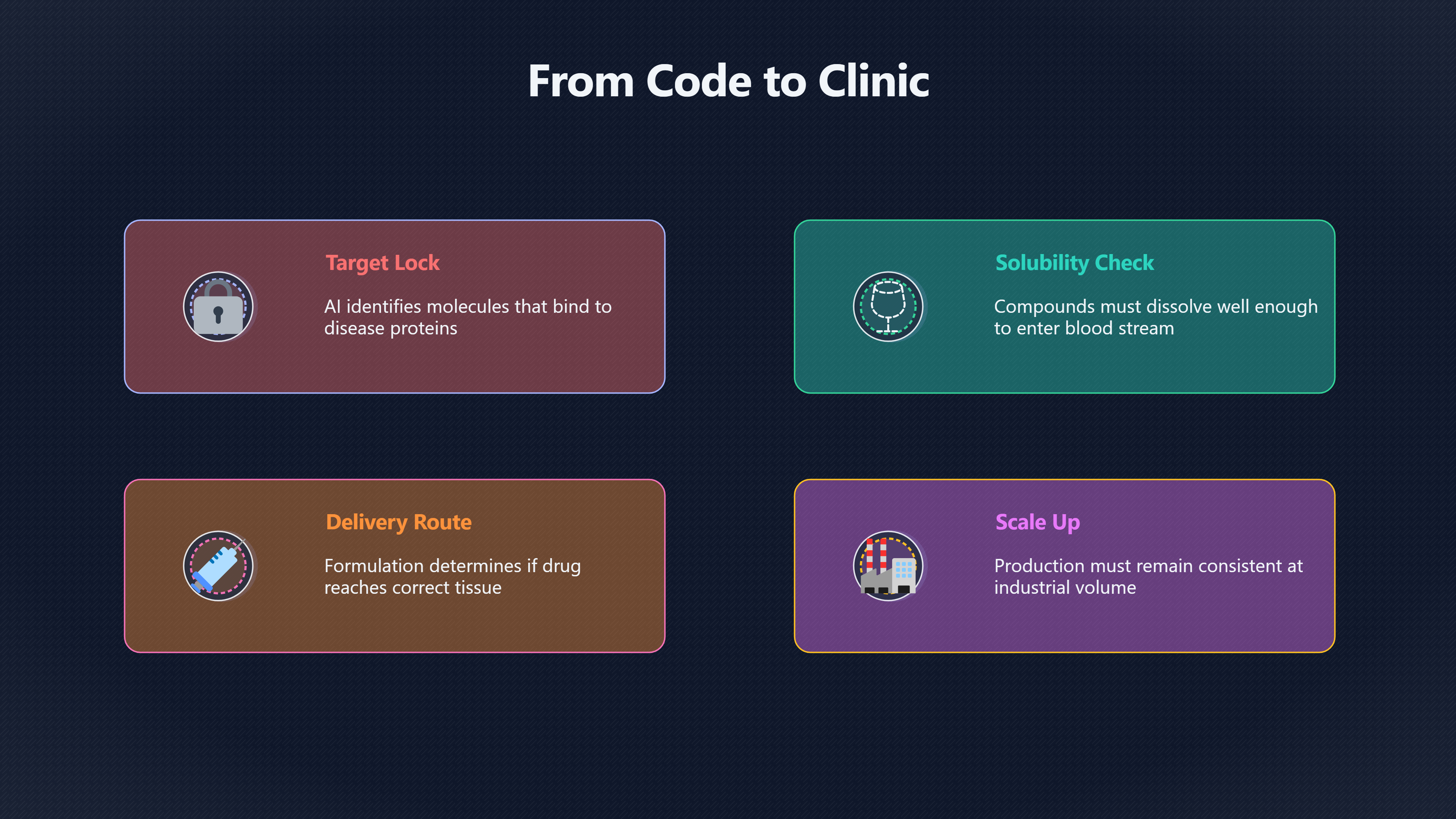
 But a molecule is not a medicine. Between a computer-generated compound and a treatment that reliably helps patients lies a difficult practical transition that drug developers often call formulation and development. A candidate may bind beautifully to a target in software or in a laboratory assay and still fail because it dissolves poorly, breaks down too quickly, cannot reach the right tissue, triggers side effects at useful doses, or proves impossible to manufacture consistently at scale. The central lesson is that AI may compress part of the search problem in medicine without removing the stubborn realities of chemistry, physiology, production, and human variability. [PMC]pmc.ncbi.nlm.nih.govPMCArtificial Intelligence (AI) Applications in Drug Discovery and…by DR Serrano · 2024 · Cited by 465 — For instance, AI algorithms c… 2arXiv
Why binding a target is not enough
Many public discussions of AI drug discovery focus on a dramatic image: an algorithm “inventing” a molecule that locks onto a disease-related protein. That step matters, but it is only one layer of a successful medicine.
Drug developers usually need a compound to satisfy multiple conditions simultaneously:
- bind strongly enough to the intended biological target
- avoid binding dangerously to other targets
- survive long enough in the body to have an effect
- reach the correct tissue or organ
- dissolve and absorb predictably
- remain chemically stable during storage
- be manufacturable at large scale
- maintain acceptable safety margins across different patients
These constraints are often summarised through ADME properties: absorption, distribution, metabolism, and excretion. A drug that performs well on one dimension can fail on another. Some compounds never reach useful concentrations in the bloodstream. Others are rapidly broken down by the liver. Some accumulate in unintended tissues and cause toxicity. [arXiv]arxiv.orgarXiv Artificial Intelligence for Drug Discovery: Are We There Yet?arXiv Artificial Intelligence for Drug Discovery: Are We There Yet?
This is one reason pharmaceutical failure rates remain extremely high. Historically, many compounds entering human trials have failed not because the original disease theory was absurd, but because the practical behaviour of the molecule inside real bodies proved disappointing or dangerous.
AI systems can help predict some of these properties, but the predictions remain incomplete. Biological systems contain interacting feedback loops, immune responses, microbiome effects, genetic variation, and long-term metabolic consequences that are difficult to infer from existing datasets alone. Human physiology is not merely a bigger version of a molecular simulation.
The gap becomes especially important in discussions of AI abundance and accelerated science. Faster molecule generation is valuable only if downstream stages can also improve. Otherwise, AI risks creating a bottleneck shift rather than a full medical revolution: thousands more candidate compounds entering pipelines that still depend on slow experimental validation and manufacturing reality.
Delivery changes the meaning of a drug
A medicine is partly defined by its active ingredient and partly by how that ingredient reaches the body.
The same molecule can behave very differently depending on whether it is delivered as:
- a tablet
- an injection
- a nanoparticle
- a slow-release implant
- an inhaled therapy
- a lipid-based carrier
- a biologic infusion
This is where formulation science becomes crucial. Developers often spend years adjusting excipients, coatings, particle sizes, release rates, and packaging conditions to create a stable and usable therapy. [MDPI]mdpi.comMDPIArtificial Intelligence in Pharmaceutical Technology and…by LK Vora · 2023 · Cited by 1164 — This comprehensive review explores th… [Cora]cora.ucc.ieCora Advancing algorithmic drug product developmentCoraAdvancing algorithmic drug product development - CORAby JD Murray · 2023 · Cited by 38 — Formulation decisions are made for ease of m…
For example, a compound may work in principle but dissolve too poorly in water to reach therapeutic concentrations. Another may degrade under heat or humidity before reaching pharmacies. Some promising molecules cannot cross biological barriers such as the blood-brain barrier, sharply limiting their usefulness for neurological diseases.
These problems are not cosmetic engineering details added after discovery. They can determine whether a treatment exists at all.
This distinction matters for evaluating optimistic claims around AI-driven medicine. Discovering candidate molecules computationally is becoming easier. Turning those molecules into robust products that physicians can prescribe safely at industrial scale remains difficult and expensive.
Even highly promising modalities illustrate the challenge:
- RNA therapies often require specialised lipid nanoparticle delivery systems.
- Gene therapies face manufacturing and dosing complexity.
- Protein-based medicines may trigger immune reactions or degrade rapidly.
- Cancer drugs can struggle to target tumours without harming healthy tissue.
In practice, the formulation problem frequently becomes a second discovery problem layered on top of the first.
Human bodies are not standardised platforms
One reason formulation remains difficult is that patients are biologically diverse.
A medicine that performs well in one group may behave differently in:
- older patients
- children
- people with liver or kidney impairment
- populations with different genetic backgrounds
- patients taking other medications
- people with inflammatory or autoimmune conditions
Even food intake can alter drug absorption. Some medicines require fatty meals for effective uptake. Others become dangerous when combined with common prescriptions.
AI systems trained on historical biomedical data may eventually improve personalised dosing and prediction. But many datasets remain incomplete, biased toward particular populations, or poorly standardised. Real-world clinical biology still contains substantial unknowns. [arXiv]arxiv.orgarXiv Artificial Intelligence for Drug Discovery: Are We There Yet?arXiv Artificial Intelligence for Drug Discovery: Are We There Yet?
This creates a tension at the heart of the AI bloom argument. Advanced AI could plausibly make scientific search vastly cheaper. Yet medicine is not only a search problem. It is also a measurement problem, a logistics problem, a regulatory problem, and a human-variability problem.
The result is that the path from “AI discovered a promising molecule” to “millions of people safely benefit” remains longer than headlines often imply.
Manufacturing is a hidden bottleneck
Drug manufacturing rarely receives the same public attention as molecule discovery, but it often determines whether treatments become globally accessible.
A compound may appear effective in small laboratory batches and still fail commercially because:
- synthesis requires rare materials
- impurities emerge during scaling
- production costs are too high
- shelf life is inadequate
- quality varies between manufacturing sites
Biologic medicines add further complexity because living cells may be involved in production. Small changes in manufacturing conditions can alter the final product.
Formulation decisions are therefore partly medical and partly industrial. Developers optimise not only for efficacy, but for reproducibility, transport stability, patient convenience, and regulatory compliance. [Cora]cora.ucc.ieCora Advancing algorithmic drug product developmentCoraAdvancing algorithmic drug product development - CORAby JD Murray · 2023 · Cited by 38 — Formulation decisions are made for ease of m…
This matters for long-term visions of AI-enabled abundance. A world with dramatically accelerated molecular discovery would still need:
- chemical manufacturing capacity
- cold-chain logistics
- regulatory infrastructure
- quality control systems
- large-scale clinical testing
- global healthcare distribution
Without those supporting systems, discovery alone does not guarantee broad human flourishing.
The political economy questions also become sharper. If AI accelerates early-stage discovery while manufacturing and clinical infrastructure remain concentrated in a few firms or countries, the gains may diffuse unevenly. Cheap intelligence does not automatically create cheap medicines.
AI may help close the formulation gap
The formulation gap is real, but it is not static. Increasingly, AI is being applied not only to target discovery, but also to formulation and pharmaceutical engineering itself.
[Researchers are using machine learning to:]pharmtech.comusing advanced algorithms to solve formulation challengesby C Challener · 2024 · Cited by 2 — Artificial intelligence and machine learning can help overcome poor solubility and bioavailability…
- predict solubility and stability
- optimise release profiles
- model pharmacokinetics
- improve nanoparticle delivery systems [ijtonline.com]ijtonline.comArtificial Intelligence in Drug Delivery SystemResearchers can analyze alternative situations and optimize drug delivery systems by model…
- reduce failed formulation experiments
- anticipate degradation risks during storage
- identify manufacturable compound variants [preprints.org]preprints.orgSmart Formulation: AI-Driven Web Platform for Optimization…24 Jun 2025 — These findings validate the robustness of Smart Formulation i… [PMC]pmc.ncbi.nlm.nih.govPMCArtificial Intelligence (AI) Applications in Drug Discovery and…by DR Serrano · 2024 · Cited by 465 — For instance, AI algorithms c… [3europeanpharmaceuticalreview.com]europeanpharmaceuticalreview.comBy combining predictive…Read more…
This may become one of the most important but least glamorous applications of AI in medicine. Public attention often focuses on dramatic molecule-generation systems, yet practical optimisation tools could produce equally large real-world benefits if they reduce late-stage failure rates.
The fibrosis drug rentosertib, formerly INS018_055, illustrates both the promise and the limitation. The programme became famous because AI contributed to target identification and molecular design, and the drug advanced into Phase II studies for idiopathic pulmonary fibrosis. [PubMed]pubmed.ncbi.nlm.nih.govPubMedA generative AI-discovered TNIK inhibitor for idiopathic…by Z Xu · 2025 · Cited by 124 — Here we present the results of the firs… [2insilico.com]insilico.comFirst Generative AI Drug Begins Phase II Trials with Patients1 Jul 2023 — With demonstrated potential against both fibrosis and inflammat…
But even in this widely cited example, success depended on extensive conventional pharmaceutical work:
- preclinical toxicology
- dosing studies
- manufacturing development
- clinical trial design
- regulatory coordination
- human safety testing
The achievement was not that AI bypassed pharmaceutical development. It was that AI-generated hypotheses survived enough of the traditional pipeline to become clinically credible.
That distinction is easy to miss in public narratives.

Where conventional drug development still matters
The formulation gap helps explain why experienced pharmaceutical scientists often respond cautiously to sweeping claims about AI replacing the drug industry.
Several conventional disciplines remain central:
Pharmacology
Researchers still need to understand how drugs behave in whole organisms over time, not merely in isolated molecular interactions.
Toxicology
Unexpected toxicity remains one of the main reasons compounds fail. Some side effects emerge only after prolonged exposure or in specific patient groups.
Clinical medicine
Human trials are not simply regulatory obstacles. They are the process through which medicine discovers whether theoretical benefits survive contact with real patients.
Chemical engineering
Manufacturing consistency is essential. A treatment that cannot be reliably produced at scale cannot become a broadly available therapy.
Regulatory science
Medicines must demonstrate not only efficacy, but reproducible safety and quality under real-world conditions.
In other words, AI may increasingly compress the front end of discovery while leaving substantial downstream complexity intact.
That does not make the technology unimportant. Even partial acceleration could matter enormously for diseases that currently receive too little attention. If AI lowers the cost of exploring biological possibilities, more rare diseases and neglected conditions may become economically tractable. Faster iteration could also improve resilience against pandemics, antibiotic resistance, and ageing-related disease. [ScienceDirect]sciencedirect.comScienceDirectArtificial intelligence-driven pharmaceutical industryby K Huanbutta · 2024 · Cited by 151 — This comprehensive review exami…
But the formulation gap is a reminder that medical progress depends on more than generating ideas. It depends on converting ideas into stable, manufacturable, safe, deliverable interventions that work across diverse human populations.
What this means for the broader AI bloom vision
The optimistic case for AI in medicine is still substantial. Advanced AI could help humanity discover therapies faster, personalise treatment more effectively, reduce scientific bottlenecks, and eventually extend healthy life expectancy. Even moderate improvements in the speed and cost of biomedical progress could produce enormous gains in human wellbeing over decades.
Yet the formulation gap exposes an important pattern likely to recur across many AI bloom debates.
AI often accelerates the generation of possibilities faster than the physical world can validate, manufacture, regulate, and distribute them.
That does not invalidate the larger vision of scientific acceleration. It suggests that flourishing futures depend not only on intelligence amplification, but also on the slower infrastructures that connect discovery to everyday life:
- laboratories
- hospitals
- supply chains
- manufacturing plants
- regulators
- clinical networks
- public trust
A superintelligent system might eventually model biology far more accurately than current tools. But today’s AI-discovered medicines still live inside the constraints of chemistry, physiology, and industrial production. The frontier is not simply whether AI can invent molecules. It is whether entire medical systems can evolve quickly enough to transform those molecules into reliable human treatments.
Endnotes
-
Source: pmc.ncbi.nlm.nih.gov
Link: https://pmc.ncbi.nlm.nih.gov/articles/PMC11510778/Source snippet
PMCArtificial Intelligence (AI) Applications in Drug Discovery and...by DR Serrano · 2024 · Cited by 465 — For instance, AI algorithms c...
-
Source: arxiv.org
Title: arXiv Artificial Intelligence for Drug Discovery: Are We There Yet?
Link: https://arxiv.org/abs/2307.06521 -
Source: arxiv.org
Link: https://arxiv.org/abs/2408.00421Source snippet
arXivTowards Evolutionary-based Automated Machine Learning for Small Molecule Pharmacokinetic PredictionAugust 1, 2024...
Published: August 1, 2024
-
Source: arxiv.org
Link: https://arxiv.org/abs/2404.10354 -
Source: mdpi.com
Link: https://www.mdpi.com/1999-4923/15/7/1916Source snippet
MDPIArtificial Intelligence in Pharmaceutical Technology and...by LK Vora · 2023 · Cited by 1164 — This comprehensive review explores th...
-
Source: sciencedirect.com
Link: https://www.sciencedirect.com/science/article/pii/S0928098724002513Source snippet
ScienceDirectArtificial intelligence-driven pharmaceutical industryby K Huanbutta · 2024 · Cited by 151 — This comprehensive review exami...
-
Source: europeanpharmaceuticalreview.com
Link: https://www.europeanpharmaceuticalreview.com/applying-ai-to-enhance-drug-formulation-and-development/1131637.articleSource snippet
By combining predictive...Read more...
-
Source: preprints.org
Link: https://www.preprints.org/manuscript/202506.2018/v1Source snippet
Smart Formulation: AI-Driven Web Platform for Optimization...24 Jun 2025 — These findings validate the robustness of Smart Formulation i...
-
Source: insilico.com
Link: https://insilico.com/blog/first_phase2Source snippet
First Generative AI Drug Begins Phase II Trials with Patients1 Jul 2023 — With demonstrated potential against both fibrosis and inflammat...
-
Source: pubmed.ncbi.nlm.nih.gov
Link: https://pubmed.ncbi.nlm.nih.gov/40461817/Source snippet
PubMedA generative AI-discovered TNIK inhibitor for idiopathic...by Z Xu · 2025 · Cited by 124 — Here we present the results of the firs...
-
Source: Wikipedia
Title: Artificial intelligence
Link: https://en.wikipedia.org/wiki/Artificial_intelligenceSource snippet
Artificial intelligenceArtificial intelligence (AI) is the capability of computational systems to perform tasks typically associated w...
Additional References
-
Source: communities.springernature.com
Link: https://communities.springernature.com/posts/preliminary-phase-2a-readout-for-a-novel-drug-discovered-and-designed-using-generative-ai-sets-a-major-milestone-in-ai-powered-drug-discoverySource snippet
Phase 2a Readout for a Novel Drug Discovered...23 Sept 2024 — Insilico Medicine's AI-designed small molecule inhibitor for the treatment...
-
Source: researchgate.net
Link: https://www.researchgate.net/publication/374410028_Artificial_Intelligence_in_Drug_Formulation_and_Development_Applications_and_Future_ProspectsSource snippet
Artificial Intelligence in Drug Formulation and Development19 Jan 2024 — This review article aims to provide an overview of the applicati...
-
Source: quillbot.com
Link: https://quillbot.com/ai-chatSource snippet
AI ChatUnlock your potential with QuillBot's free AI chat! Brainstorm, draft content, get instant research & overcome writer's block. Try...
-
Source: ijtonline.com
Link: https://www.ijtonline.com/HTML_Papers/International%20Journal%20of%20Technology__PID__2024-14-2-8.htmlSource snippet
Artificial Intelligence in Drug Delivery SystemResearchers can analyze alternative situations and optimize drug delivery systems by model...
-
Source: pulmonaryfibrosis.org
Link: https://www.pulmonaryfibrosis.org/patients-caregivers/medical-and-support-resources/clinical-trials-education-center/pipeline/drug/idiopathic-pulmonary-fibrosis/ism001-055-%28ins018_055%29Source snippet
INS018_055INS018_055 is a first-in-class small molecule targeting TNIK (Traf2- and Nck-interacting kinase) and was designed utilizing gen...
-
Source: prnewswire.com
Link: https://www.prnewswire.com/apac/news-releases/novel-molecules-from-generative-ai-to-phase-ii-first-novel-tnik-inhibitors-for-fibrotic-diseases-discovered-and-designed-using-generative-ai-302085115.htmlSource snippet
Novel Molecules From Generative AI to Phase II13 Mar 2024 — A study published in Nature Biotechnology presents the entire journey of INS0...
-
Source: worldpharmatoday.com
Link: https://www.worldpharmatoday.com/techno-trends/artificial-intelligence-in-drug-formulation-development/ -
Source: pharmtech.com
Title: using advanced algorithms to solve formulation challenges
Link: https://www.pharmtech.com/view/using-advanced-algorithms-to-solve-formulation-challengesSource snippet
by C Challener · 2024 · Cited by 2 — Artificial intelligence and machine learning can help overcome poor solubility and bioavailability...
-
Source: cora.ucc.ie
Title: Cora Advancing algorithmic drug product development
Link: https://cora.ucc.ie/bitstreams/c2148d12-31bd-4de7-9a82-177667858fe6/downloadSource snippet
CoraAdvancing algorithmic drug product development - CORAby JD Murray · 2023 · Cited by 38 — Formulation decisions are made for ease of m...
-
Source: britannica.com
Link: https://www.britannica.com/technology/artificial-intelligenceSource snippet
r-controlled robot to perform tasks commonly associated with intelligent beings...
Amazon book picks
Further Reading
Books and field guides related to The formulation gap. Use these as the next step if you want deeper reading beyond the article.

Absorption and drug development
First published 2003. Subjects: Absorption, Design, Drug development, Drugs, Metabolism.
Early drug development
First published 2010. Subjects: Research Design, Methods, Drug development, Organization & administration, Phase I as Topic Clinical Trials.
Social Aspects of Drug Discovery, Development and Commerciali...
Social Aspects of Drug Discovery, Development and Commercialization provides an insightful analysis of the drug discovery and development...
New drug development
First published 2007. Subjects: Chemical synthesis, Clinical trials, Drug Industry, Drug development, Methods.
eBay marketplace picks
Marketplace Samples
Example marketplace items related to this page. Use the search link to explore similar finds on eBay.

Example eBay listing
A.I. Artificial Intelligence Original Movie Poster Signed By Jude Law
USD 125.00 | Shipping USD 25.00 | US

Example eBay listing
Artificial Intelligence D/S Original Movie Poster - 27 x 40"
USD 19.50 | Shipping USD 13.65 | US

Example eBay listing
612388 Artificial Intelligence Movie Science Fiction Drama Wall Print Poster
USD 22.95 | Shipping USD 12.95 | JP

Example eBay listing
Companion - Artificial Intelligence Dark Comedy Cinema Film - POSTER 20"x30"
USD 23.99 | Free shipping | US

Example eBay listing
A.I. Artificial Intelligence Movie Film Poster Art Print
GBP 4.99 | Free shipping | GB

Example eBay listing
A I Artificial Intelligence 6 Movie Poster Art Print Print Classic Rare Gallery
GBP 49.00 | Free shipping | GB

Example eBay listing
AI - Artificial Intelligence (Poster + Slipcase) Blu-Ray
GBP 10.49 | Free shipping | GB

Example eBay listing
A. I. Artificial Intelligence. Jude Law. Original UK Video Poster.
GBP 8.11 | Shipping GBP 3.38 | GB
Topic Tree