Within Medicine Access
When Health Systems Cannot Deliver
Even cheap medicines can fail to save lives when clinics, transport, refrigeration, and staffing break down.
On this page
- How medicine stockouts happen in fragile systems
- Why refrigeration and transport failures matter
- Why AI discovery alone cannot solve healthcare access
Page outline Jump by section
Introduction
A medicine can exist, work brilliantly in clinical trials, and still fail to save lives. The reason is often not chemistry but delivery. Vaccines spoil when refrigerators lose power. Insulin disappears during transport disruptions. Rural clinics run out of antibiotics because roads flood, procurement systems fail, or trained staff leave. A breakthrough treatment only matters if it can move through warehouses, ports, clinics, fridges, pharmacies, and health workers to reach actual patients.
 This is one of the clearest limits of the optimistic “AI abundance” vision in healthcare. Advanced AI may accelerate drug discovery, protein modelling, diagnostics, and personalised medicine. But discovery alone cannot create universal access. Health systems depend on logistics, electricity, staffing, procurement, governance, refrigeration, and public trust. Weakness anywhere in that chain can turn a scientific success into a practical failure.
The result is a paradox already visible across global health: humanity can know how to prevent or treat many diseases while millions still die because the systems needed to deliver care are fragile, uneven, or absent.
How medicine stockouts happen in fragile systems
A medicine shortage is rarely caused by a single failure. Most stockouts emerge from chains of smaller problems that compound across transport, procurement, forecasting, storage, staffing, and financing.
The World Health Organization distinguishes between “shortages” and “stockouts”. A shortage occurs somewhere in the supply chain when demand exceeds supply. A stockout is what patients experience when a clinic or pharmacy shelf is empty. [World Health Organization]who.intmeeting report october shortagesWorld Health OrganizationMeeting Report: Technical Definitions of Shortages and…5 Oct 2016 — On the demand side: A “shortage” will occ…
In fragile health systems, even basic medicines can disappear for weeks or months because the chain between manufacturer and patient is brittle.
Several mechanisms recur repeatedly:
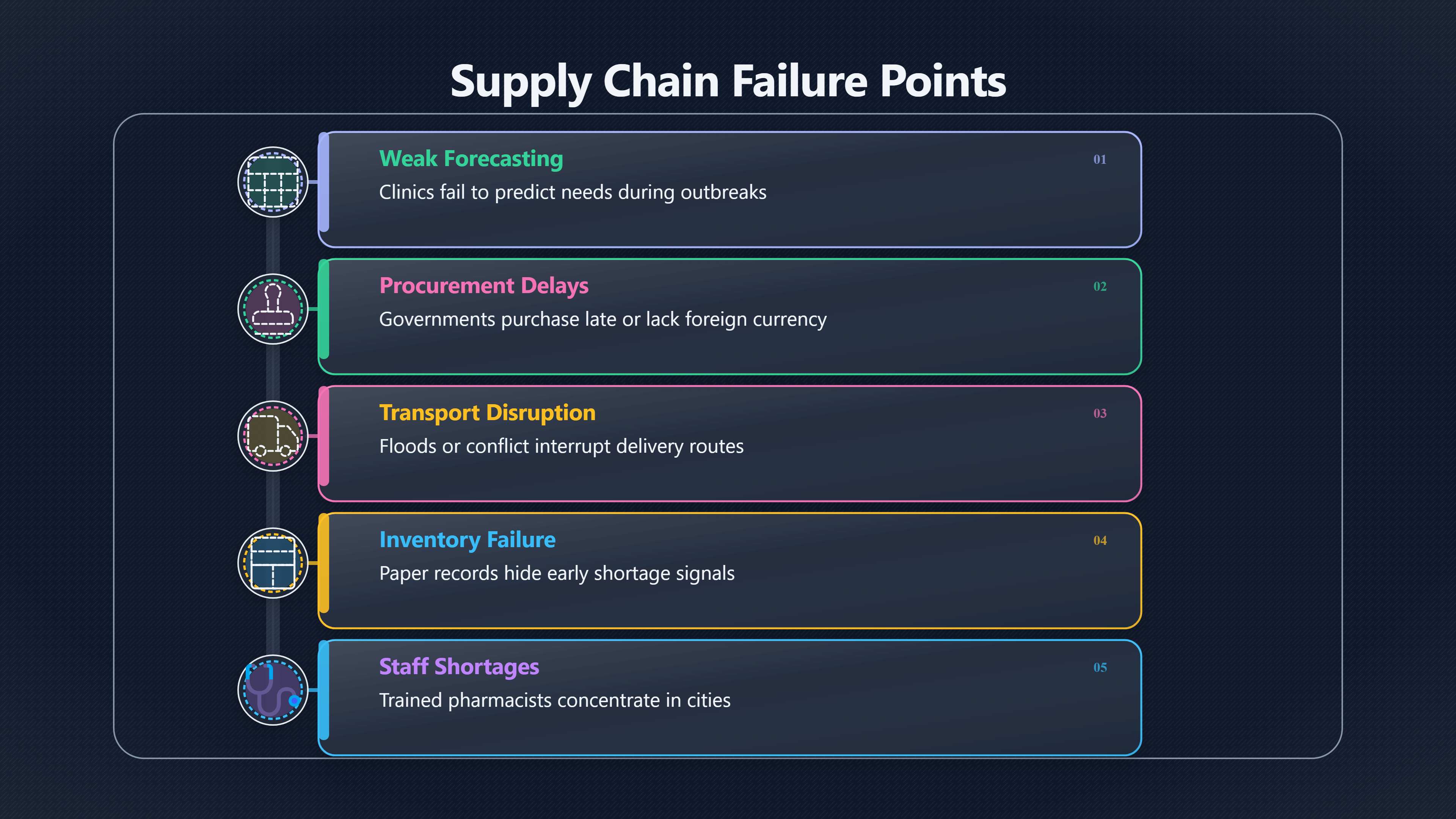
- Weak forecasting: Clinics may not know how much medicine they will need next month, especially during outbreaks or population displacement.
- Poor procurement systems: Governments sometimes purchase too late, lack foreign currency, or rely on slow centralised approvals.
- Transport disruption: Floods, conflict, fuel shortages, damaged roads, or customs delays interrupt deliveries.
- Inventory failures: Clinics may still use paper records or inconsistent reporting, making it difficult to detect shortages early.
- Staff shortages: Trained pharmacists, logistics workers, and technicians are often concentrated in cities rather than rural regions.
- Storage problems: Heat, humidity, pests, or power cuts can destroy stock before it reaches patients.
- Financing instability: Public systems may delay payments to suppliers, discouraging future deliveries.
These failures are not confined to very poor countries. Europe and the United Kingdom have also experienced repeated shortages of antibiotics, painkillers, medical equipment, and other essentials due to fragile global supply chains and dependence on concentrated manufacturing hubs. The Week [Reuters The difference is usually one of resilience. Wealthier systems often have backup suppliers]reuters.comThe primary causes are fragile supply chains and a heavy dependence on manufacturers in Asia, particularly China and India. Between Janua…, reserve stock, better warehousing, and stronger transport infrastructure. Fragile systems frequently do not.
This means scarcity can persist long after the scientific problem has been solved. Insulin is a classic example. The medicine itself has existed for over a century, yet many patients in low-income settings still face interruptions because of procurement failures, unreliable refrigeration, pricing pressures, and weak clinic infrastructure rather than lack of biomedical knowledge. [World Health Organization]who.intmeeting report october shortagesWorld Health OrganizationMeeting Report: Technical Definitions of Shortages and…5 Oct 2016 — On the demand side: A “shortage” will occ…
Why refrigeration and transport failures matter
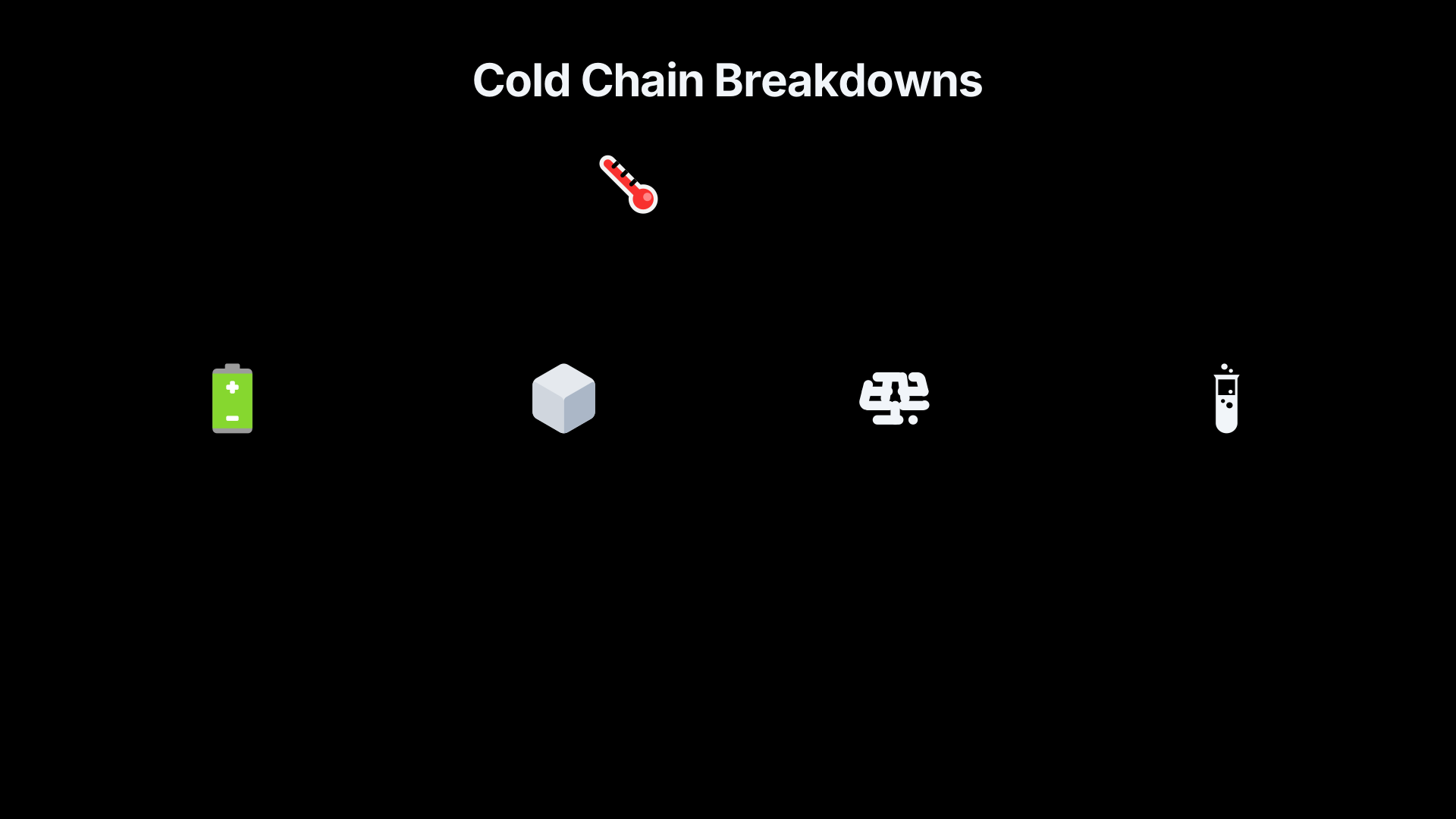
Many of the most valuable modern medicines are temperature-sensitive. Vaccines, insulin, blood products, biologic drugs, and some antibiotics require tightly controlled storage conditions from factory to patient. This “cold chain” is one of the least glamorous but most essential systems in modern medicine.
UNICEF describes vaccines as needing continuous storage within strict temperature ranges because excessive heat or freezing can permanently destroy their potency. Once potency is lost, it cannot be restored. [UNICEF]unicef.orgUNICEFWhat is a cold chain? | UNICEF Supply DivisionVaccines must be continuously stored in a limited temperature range – from the time t…
That creates enormous practical challenges in regions with unreliable electricity, conflict, poor roads, or extreme weather.
In some clinics, refrigerators fail for hours each day because electricity grids are unstable. In others, vaccines travel for days in insulated containers across mountains, deserts, flood zones, or conflict areas. Even when medicines physically arrive, damaged refrigeration can silently render them ineffective.
Sudan provided a stark example during the 2023 violence and power outages. Aid organisations reported that cold-chain failures destroyed vaccine supplies as well as national stocks of insulin and antibiotics. [Save the Children International]savethechildren.netsudan lifesaving vaccines children destroyed power outages amidst violenceSave the Children InternationalSudan: lifesaving vaccines for children destroyed in power…Apr 20, 2023 — Power outages across Sudan ha…
Power reliability alone can become a health bottleneck. UNICEF has supported solar refrigeration systems and long-duration vaccine refrigerators in several countries precisely because ordinary electrical infrastructure is too unstable for dependable vaccine storage. [UNICEF]unicef.orgVaccine carriers | UNICEF Supply DivisionMost of the heat-sensitive vaccines must be stored at 2oC to 8oC, and in health facilities with… [UNICEF]unicef.orgReaching the last mile through the Artek cold chain solutionUNICEFReaching the last mile through the Artek cold chain solutionMay 13, 2025 — In addition, UNICEF is helping to install solar power sy…
The logistics burden becomes even greater with advanced medicines. Some mRNA vaccines required ultra-cold storage far below standard refrigeration temperatures during the COVID-19 pandemic. UNICEF called cold-chain infrastructure “the backbone of all vaccination campaigns” while scaling equipment deployment worldwide. [UNICEF]unicef.orgUsing the Sun to Keep Vaccines CoolMost Sub-Saharan countries and middle and low income countries have been adversely affected by climati…
This exposed an uncomfortable reality about technological progress. The more advanced a treatment becomes, the more sophisticated the supporting delivery system may need to be. A breakthrough therapy is not automatically accessible if it depends on uninterrupted electricity, specialised transport, trained technicians, and expensive storage systems.
In practice, medical abundance often depends on mundane infrastructure: diesel supplies, road maintenance, warehouse management, refrigeration repair, and functioning customs systems.
The “last mile” is often the hardest part
Health systems frequently succeed at getting medicines into a country while failing to get them into remote communities.
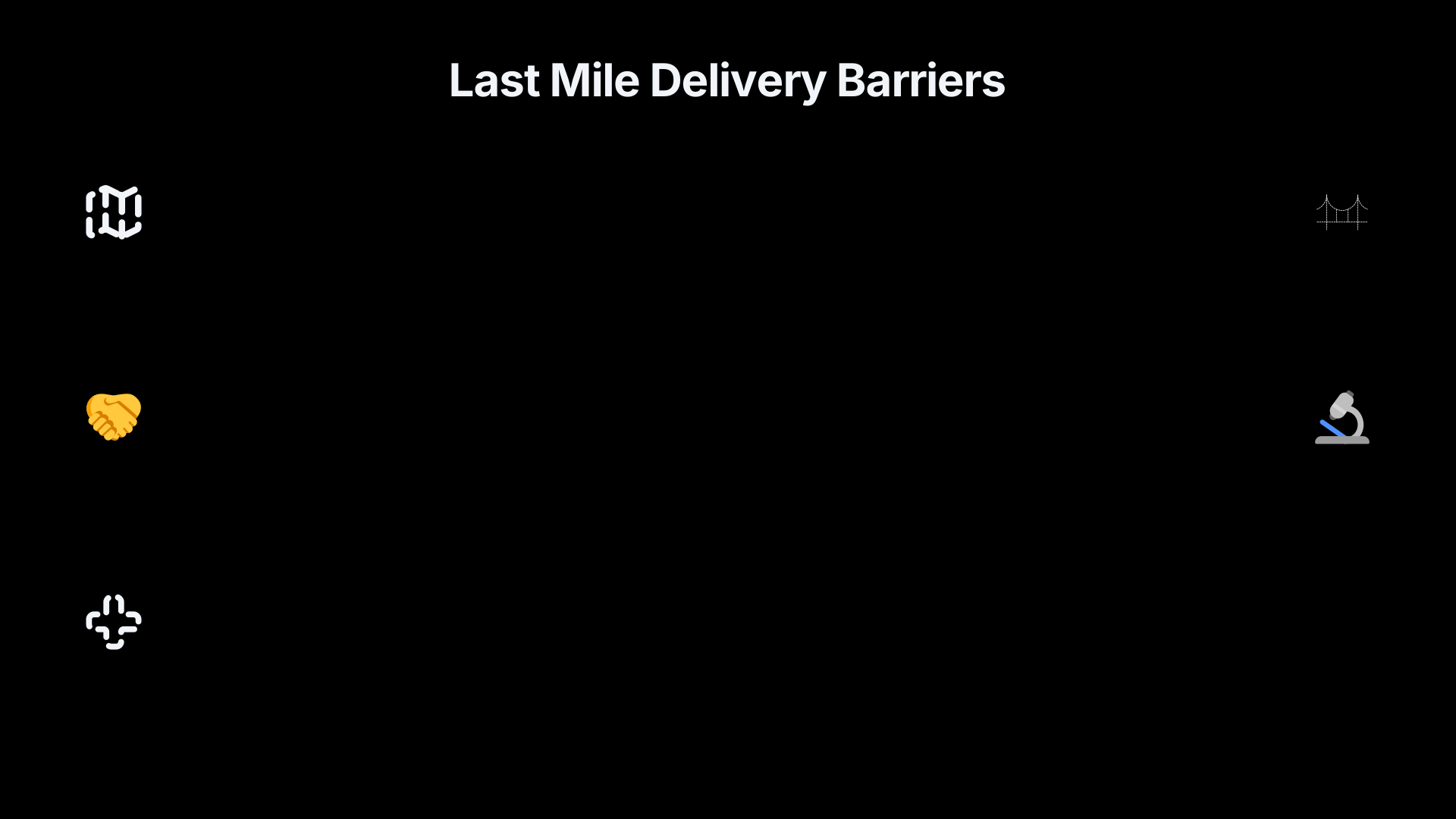
This “last mile” problem appears across global development. Urban hospitals may receive reliable deliveries while rural clinics experience repeated shortages because transport costs are high and infrastructure is weak.
The World Bank has highlighted how difficult emergency medical delivery becomes in isolated regions where floods, damaged roads, or geographic barriers interrupt ordinary transport. [World Bank Blogs]blogs.worldbank.orgBernard Harborne · Gregor EngelmannWorld Bank BlogsDrones can strengthen Timor-Leste's last-mile health…Oct 26, 2023 — Drones can strengthen Timor-Leste's last-mile heal…
The challenge is not merely distance. It is unpredictability.
A medicine shipment delayed by three days may still work for tablets stored at room temperature. It may fail entirely for blood products or vaccines. A rural clinic that misses one monthly delivery may suddenly lose treatment continuity for hundreds of patients with HIV, diabetes, tuberculosis, or chronic disease.
The consequences compound over time:
- Patients stop trusting clinics that repeatedly run out of medicines.
- Interrupted antibiotic treatment can contribute to antimicrobial resistance.
- Missed vaccinations create vulnerability to outbreaks years later.
- Chronic disease patients experience preventable complications because treatment is inconsistent rather than absent.
One reason these failures matter to the broader AI bloom debate is that they reveal how deeply civilisation depends on coordination capacity. Human flourishing is not produced by intelligence alone. It depends on institutions that can reliably translate knowledge into material outcomes.
A society may possess advanced biomedical science while still lacking the organisational competence to distribute its benefits widely.
Why AI discovery alone cannot solve healthcare access
AI systems may dramatically accelerate parts of medicine. Researchers already use machine learning in protein structure prediction, drug target identification, medical imaging, manufacturing optimisation, and clinical data analysis.
But healthcare access is constrained by far more than discovery speed.
An AI system might help invent a better malaria vaccine, yet that vaccine still requires factories, financing, regulators, refrigeration, distribution contracts, health workers, public communication, and stable clinics. If those systems fail, the underlying scientific breakthrough reaches far fewer people than it could.
This matters because discussions of technological abundance sometimes assume that once intelligence becomes cheap and scalable, scarcity largely disappears. Healthcare shows why that assumption is incomplete.
Many bottlenecks are physical and institutional rather than purely cognitive:
- Ports and roads still matter.
- Electricity grids still matter.
- Political stability still matters.
- Procurement competence still matters.
- Trust in vaccination campaigns still matters.
- Skilled nurses and technicians still matter.
AI may improve some of these systems. Predictive logistics software can forecast shortages earlier. Automated inventory systems can reduce waste. Route optimisation can improve delivery efficiency. Drones may help transport samples and medicines into hard-to-reach areas. [World Bank Blogs]blogs.worldbank.orgBernard Harborne · Gregor EngelmannWorld Bank BlogsDrones can strengthen Timor-Leste's last-mile health…Oct 26, 2023 — Drones can strengthen Timor-Leste's last-mile heal… [MDPI]mdpi.comMDPICurrent Advancements in Drone Technology for Medical…by N Stierlin · 2024 · Cited by 46 — The implementation of drone technology i…
But these are support layers on top of physical systems, not replacements for them.
A common mistake in technology forecasting is to imagine that invention alone determines outcomes. In reality, the benefits of innovation often depend on institutions capable of deploying it at scale. The COVID-19 era showed both extremes simultaneously: extraordinary scientific speed alongside unequal distribution, export restrictions, fragile supply chains, and deep gaps between countries’ delivery capacities. [PMC]pmc.ncbi.nlm.nih.govPMCWhat does the COVID-19 pandemic teach us about global…by G Gereffi · 2020 · Cited by 1028 — The COVID-19 pandemic has caused a dram… [UNICEF]unicef.orgMay 18, 2021 — Al-Aqary stresses the importance of UNICEF's role in overcoming the problem of power outages by supporting the central war…
What a genuine health abundance future would require
If AI eventually contributes to a world of far greater medical abundance, the transformation will likely require advances in delivery systems as well as discovery systems.
That means progress in areas often treated as secondary:
- resilient electrical grids
- local manufacturing capacity
- transparent procurement systems
- better warehouse and inventory management
- stronger public health institutions [cgdev.org]cgdev.orgFinancing of Healthcare Supply Chains in Low- and Middle…30 Sept 2025 — Development assistance for health is declining rapidly, and pu…
- reliable refrigeration
- trained community health workers
- decentralised diagnostics
- rapid transport infrastructure
- interoperable medical records
- stable financing mechanisms
Some of these improvements are technologically sophisticated. Others are organisational basics that many countries still struggle to maintain consistently.
The broader lesson is that flourishing societies are built not only from brilliant inventions but from dependable systems. A superintelligent civilisation that cannot distribute medicine equitably would still leave many forms of preventable suffering intact.
Healthcare therefore acts as a useful corrective to simplistic versions of techno-optimism. It shows that the path from discovery to flourishing runs through infrastructure, governance, logistics, and state capacity as much as through scientific insight itself.
The future of abundance may depend less on whether humanity can invent miraculous treatments than on whether it can build institutions capable of delivering them reliably to billions of people.
Endnotes
-
Source: reuters.com
Link: https://www.reuters.com/sustainability/boards-policy-regulation/europe-struggles-with-chronic-drug-shortages-auditors-warn-2025-09-17/Source snippet
The primary causes are fragile supply chains and a heavy dependence on manufacturers in Asia, particularly China and India. Between Janua...
-
Source: unicef.org
Link: https://www.unicef.org/supply/what-cold-chainSource snippet
UNICEFWhat is a cold chain? | UNICEF Supply DivisionVaccines must be continuously stored in a limited temperature range – from the time t...
-
Source: unicef.org
Link: https://www.unicef.org/supply/vaccine-carriersSource snippet
Vaccine carriers | UNICEF Supply DivisionMost of the heat-sensitive vaccines must be stored at 2oC to 8oC, and in health facilities with...
-
Source: unicef.org
Title: Reaching the last mile through the Artek cold chain solution
Link: https://www.unicef.org/png/stories/reaching-last-mile-through-artek-cold-chain-solutionSource snippet
UNICEFReaching the last mile through the Artek cold chain solutionMay 13, 2025 — In addition, UNICEF is helping to install solar power sy...
Published: May 13, 2025
-
Source: unicef.org
Link: https://www.unicef.org/innovation/stories/using-sun-keep-vaccines-coolSource snippet
Using the Sun to Keep Vaccines CoolMost Sub-Saharan countries and middle and low income countries have been adversely affected by climati...
-
Source: unicef.org
Link: https://www.unicef.org/yemen/stories/vaccines-protect-children-diseases-and-give-hope-futureSource snippet
May 18, 2021 — Al-Aqary stresses the importance of UNICEF's role in overcoming the problem of power outages by supporting the central war...
Published: May 18, 2021
-
Source: unicef.org
Title: going ultra cold how unicef supporting countries covid 19 vaccine roll out
Link: https://www.unicef.org/supply/stories/going-ultra-cold-how-unicef-supporting-countries-covid-19-vaccine-roll-outSource snippet
electricity is unreliable. “Cold chain is the backbone of all vaccination campaigns. UNICEF is delivering vital UCC equipment to store mR...
-
Source: mdpi.com
Link: https://www.mdpi.com/2305-6290/8/4/104Source snippet
MDPICurrent Advancements in Drone Technology for Medical...by N Stierlin · 2024 · Cited by 46 — The implementation of drone technology i...
-
Source: pmc.ncbi.nlm.nih.gov
Link: https://pmc.ncbi.nlm.nih.gov/articles/PMC7360894/Source snippet
PMCWhat does the COVID-19 pandemic teach us about global...by G Gereffi · 2020 · Cited by 1028 — The COVID-19 pandemic has caused a dram...
-
Source: unicef.org
Link: https://www.unicef.org/ukraine/en/press-release/new-refrigerated-vansSource snippet
New refrigerated vans for health facilities to improve...Dec 23, 2024 — Vaccine cold chain in Ukraine further strengthened with...
-
Source: unicef.org
Link: https://www.unicef.org/Source snippet
UNICEF, for every childUNICEF works in over 190 countries and territories to save children's lives, to defend their rights, and to help t...
-
Source: unicef.org
Link: https://www.unicef.org/iraq/stories/vaccines-save-childrens-lives-remote-areas-iraqSource snippet
Vaccines save children's lives in remote areas in IraqJun 1, 2023 — Though, like most areas in Iraq, the Center suffers from power outage...
-
Source: unicef.org
Link: https://www.unicef.org/supply/cold-chain-faq -
Source: unicef.org
Link: https://www.unicef.org/media/96611/file/Immunization%20supply%20chain%20interventions.pdfSource snippet
They could also be involved in reporting CCE failures or energy interruptions and cleaning solar...Read more...
-
Source: unicef.org
Title: Powering Health
Link: https://www.unicef.org/zambia/stories/powering-health-empowering-communitiesSource snippet
power outages when trying to save lives. By enabling the health facilities by electricity power 24/7, the HFSE is strengthening immunizat...
-
Source: mdpi.com
Link: https://www.mdpi.com/1660-4601/23/2/215Source snippet
Essential Medicines Availability, Pricing, and Stock-Outs for...by L Gonah · 2026 — Yet, consistent availability remains a major challen...
-
Source: who.int
Title: meeting report october shortages
Link: https://www.who.int/docs/default-source/medicines/meeting_report_october_shortages.pdf?sfvrsn=1a902eab_3Source snippet
World Health OrganizationMeeting Report: Technical Definitions of Shortages and...5 Oct 2016 — On the demand side: A “shortage” will occ...
-
Source: who.int
Link: https://www.who.int/our-work/access-to-medicines-and-health-productsSource snippet
World Health OrganizationAccess to Medicines and Health ProductsCountries face a range of obstacles to achieving this, including rising p...
-
Source: who.int
Title: essential medicines
Link: https://www.who.int/news-room/fact-sheets/detail/essential-medicinesSource snippet
World Health OrganizationEssential medicinesJan 26, 2026 —... low- and lower-middle-income countries ranged from 8% to 41%. Medicines ac...
-
Source: savethechildren.net
Title: sudan lifesaving vaccines children destroyed power outages amidst violence
Link: https://www.savethechildren.net/news/sudan-lifesaving-vaccines-children-destroyed-power-outages-amidst-violenceSource snippet
Save the Children InternationalSudan: lifesaving vaccines for children destroyed in power...Apr 20, 2023 — Power outages across Sudan ha...
-
Source: blogs.worldbank.org
Title: Bernard Harborne · Gregor Engelmann
Link: https://blogs.worldbank.org/en/eastasiapacific/drones-can-strengthen-timor-lestes-last-mile-health-service-delivery-duringSource snippet
World Bank BlogsDrones can strengthen Timor-Leste's last-mile health...Oct 26, 2023 — Drones can strengthen Timor-Leste's last-mile heal...
-
Source: openknowledge.worldbank.org
Link: https://openknowledge.worldbank.org/entities/publication/01cc8d3b-9341-53ed-b8a7-1344f6f5c40bSource snippet
Open Knowledge RepositoryPublication: The Challenge of Ensuring Adequate Stocks of...Zambia, the World Bank supported a project explorin...
-
Source: blogs.worldbank.org
Title: addressing digital divide and inequality road equitable covid 19 vaccine
Link: https://blogs.worldbank.org/en/digital-development/addressing-digital-divide-and-inequality-road-equitable-covid-19-vaccineSource snippet
World Bank BlogsA road to equitable COVID-19 vaccine deliveryJun 2, 2021 — The advantages of digital solutions are even more clear in the...
-
Source: who.int
Link: https://www.who.int/ -
Source: openknowledge.worldbank.org
Link: https://openknowledge.worldbank.org/entities/publication/908cfa7d-1163-480b-89b5-78c6fbe8ecf2Source snippet
worldbank.orgPublication: Tracking the Distribution of Medical Equipment...10 Dec 2024 — Argentina's COVID-19 Emergency Project was amon...
-
Source: openknowledge.worldbank.org
Link: https://openknowledge.worldbank.org/server/api/core/bitstreams/03231f70-3bc0-5645-a28d-19abd55c71b7/contentSource snippet
Last Mile to Quality Service Delivery in Jordanby TS Rabie · Cited by 5 — This was mir- rored in per capita health expenditures, which st...
-
Source: openknowledge.worldbank.org
Link: https://openknowledge.worldbank.org/entities/publication/e8f69337-a386-5489-b151-c92f80db3a9cSource snippet
Enterprise Business Models for Inclusive DevelopmentIt catalogues over 40 of the most effective market-based solutions for service delive...
-
Source: openknowledge.worldbank.org
Link: https://openknowledge.worldbank.org/entities/publication/2879797c-8f83-5453-be45-893bdcbe8d0cSource snippet
worldbank.orgPublication: Lowering Prices of Pharmaceuticals, Medical...by M Fazekas · 2021 — The case study reviews the development of...
-
Source: documents.worldbank.org
Title: 124302 WP 14 3 2018 16 120 bmibookMar
Link: https://documents.worldbank.org/curated/en/370641521094121368/pdf/124302-WP-14-3-2018-16-120-bmibookMar.pdfSource snippet
the Last MileThe costs of telemedicine are often high in low-income countries, because of low awareness among both patients and local hea...
-
Source: blogs.worldbank.org
Link: https://blogs.worldbank.org/en/transport/digital-technologies-will-support-supply-chains-covid-19-vaccines-and-medical-goodsSource snippet
technologies will support the supply chains for...Feb 17, 2021 — DSCMS can support the deployment of vaccines, but also set the groundwo...
-
Source: thedocs.worldbank.org
Title: National Health Compacts Uganda
Link: https://thedocs.worldbank.org/en/doc/0273f33ab6ee48c5d842108b9b55c789-0140022025/related/National-Health-Compacts-Uganda.pdfSource snippet
National Health Compact (2025-2030)We commit to tracking and reducing the number of individuals and households pushed into, or deeper int...
-
Source: blogs.worldbank.org
Title: how blockchain technology delivers vaccines saves lives
Link: https://blogs.worldbank.org/en/health/how-blockchain-technology-delivers-vaccines-saves-livesSource snippet
blockchain technology delivers vaccines, saves livesDec 6, 2017 — Stock-outs due to poor quantification, procurement, storage, and distri...
-
Source: documents1.worldbank.org
Link: https://documents1.worldbank.org/curated/en/099061324093516923/pdf/P1772381a3e15b0f71b3011a4610d50c4b0.pdfSource snippet
of Medical Distribution in MozambiqueSep 22, 2021 — 6 Full article: Improving Supply Chain for Essential Drugs in Low-Income Countries: R...
-
Source: blogs.worldbank.org
Title: tackling health care supply chain challenges through innovations measurement
Link: https://blogs.worldbank.org/en/health/tackling-health-care-supply-chain-challenges-through-innovations-measurementSource snippet
health care supply chain challenges through...17 Nov 2022 — The World Bank's Service Delivery Indicators (SDI) health team has a revampe...
-
Source: openknowledge.worldbank.org
Link: https://openknowledge.worldbank.org/entities/publication/e167e345-e591-5f87-806e-b7123aeb0c82Source snippet
worldbank.orgPublication: Micro Insurance Academy: Improving Health...Since 2006, Operation ASHA (OpASHA) has helped deliver the Last-mile...
-
Source: facebook.com
Link: https://www.facebook.com/UNICEFGuyanaSuriname/posts/official-handover-strengthening-health-services-in-the-hinterlandtoday-unicef-fo/1382561617242292/Source snippet
Unicef Guyana & SurinameMeanwhile, in Somalia, a country that experiences frequent interruptions in power supply, all vaccine refrigerato...
-
Source: Wikipedia
Link: https://en.wikipedia.org/wiki/WorldSource snippet
WorldThe world is the totality of entities, the whole of reality, or everything that exists. The nature of the world has been conceptu...
-
Source: unicefusa.org
Title: Using the Cold Chain to Safely Deliver COVID-19 Vaccines
Link: https://www.unicefusa.org/stories/using-cold-chain-safely-deliver-covid-19-vaccinesSource snippet
outages that affected the capacity to deliver services. Innovative technology allows UNICEF to extend the cold chain to the “last mile”...
Additional References
-
Source: who.int
Link: https://www.who.int/news-room/commentaries/detail/ensuring-equitable-access-to-essential-medicines-and-health-technologies-for-noncommunicable-diseasesSource snippet
Ensuring equitable access to essential medicines and...Mar 11, 2025 — Stockouts of essential medicines and health technologies to preven...
-
Source: emro.who.int
Link: https://www.emro.who.int/images/stories/rpc/Research_in_priority_areas_of_public_health/rpph-14-89.pdfSource snippet
factors to “stock out” of life- saving medicines, in...Its responsibility is to procure essential medicines, lifesaving medicines, medic...
-
Source: researchgate.net
Link: https://www.researchgate.net/publication/399326030_Availability_stock-outs_and_warehouse_facilities_of_essential_medicines_at_regional_medical_supplies_divisions_in_Sri_Lanka_A_multicentre_cross-sectional_studySource snippet
Availability, stock-outs and warehouse facilities of essential...Apr 23, 2026 — This study aimed to investigate the availability, record...
-
Source: merriam-webster.com
Link: https://www.merriam-webster.com/dictionary/worldSource snippet
WORLD Definition & Meaning1. a: the earthly state of human existence b: life after death used with a qualifier the next world 2. the ea...
-
Source: poliokit.org
Link: https://www.poliokit.org/news/behind-every-successful-campaign-cold-chains-vital-role-cameroons-polio-and-immunizationSource snippet
Behind Every Successful Campaign: The Cold Chain's...1 Oct 2024 — By maintaining the cold chain from factory to health facilities, UNICE...
-
Source: cgdev.org
Link: https://www.cgdev.org/publication/financing-healthcare-supply-chains-low-and-middle-income-countries-novel-conceptualSource snippet
Financing of Healthcare Supply Chains in Low- and Middle...30 Sept 2025 — Development assistance for health is declining rapidly, and pu...
-
Source: technet-21.org
Title: vaccine cold chain interruption in a primary care centre and economic evaluation
Link: https://www.technet-21.org/fr/ressources/article-de-revue/vaccine-cold-chain-interruption-in-a-primary-care-centre-and-economic-evaluationSource snippet
Total economic loss was 2098.10 € and 33,611.64 € were savings. The electrical failure was the disruption cause...Read more...
-
Source: researchgate.net
Link: https://www.researchgate.net/publication/363216017_Last_mile_cold_chain_distribution_challenges_for_self-owned_and_retail_pharmacies_in_Auckland_Park_and_surrounding_areasSource snippet
(PDF) Last mile cold chain distribution challenges for self...PDF | ABSTRACT Research objective: The primary research objective was to d...
-
Source: logupdateafrica.com
Title: how can ppps transform africas pharma logistics sector 1353191
Link: https://www.logupdateafrica.com/logistics/how-can-ppps-transform-africas-pharma-logistics-sector-1353191Source snippet
How can PPPs transform Africa's pharma logistics sector?14 Sept 2024 — Despite infrastructure challenges, Africa's pharma logistics secto...
-
Source: cidrap.umn.edu
Title: hidden supply chain risks threaten 100 essential us medicines
Link: https://www.cidrap.umn.edu/resilient-drug-supply/hidden-supply-chain-risks-threaten-100-essential-us-medicinesSource snippet
supply-chain risks threaten 100 essential US...Apr 16, 2026 — A new analysis from US Pharmacopeia (USP) suggests that vulnerabilities in...
Amazon book picks
Further Reading
Books and field guides related to When Health Systems Cannot Deliver. Use these as the next step if you want deeper reading beyond the article.
Sustainable Global Health Systems and Pharmaceutical Development
Strategic decision-making focusing on economics is the fundamental requirement to generate efficiency and improve productivity in any man...
Systems Thinking for Global Health
How can systems-thinking contribute to solving key challenges in Global Health? Global Health is an evolving field operating within a com...
Investing in Global Health Systems
The United States has been a generous sponsor of global health programs for the past 25 years or more. This investment has contributed to...
eBay marketplace picks
Marketplace Samples
Example marketplace items related to this page. Use the search link to explore similar finds on eBay.

Example eBay listing
artificial intelligence Framed Wall Art Poster Canvas Print Picture
USD 40.12 | GB

Example eBay listing
artificial intelligence Framed Wall Art Poster Canvas Print Picture
USD 40.12 | GB

Example eBay listing
Artificial intelligence Framed Wall Art Poster Canvas Print Picture
USD 40.12 | GB

Example eBay listing
A.I. Artificial Intelligence Movie Poster Print, Wall Art - Unframed
USD 17.95 | Free shipping | US

Example eBay listing
A.I. Artificial Intelligence Movie Film Poster Art Print
GBP 4.99 | Free shipping | GB

Example eBay listing
A I Artificial Intelligence 6 Movie Poster Art Print Print Classic Rare Gallery
GBP 49.00 | Free shipping | GB

Example eBay listing
AI - Artificial Intelligence (Poster + Slipcase) Blu-Ray
GBP 10.49 | Free shipping | GB

Example eBay listing
A. I. Artificial Intelligence. Jude Law. Original UK Video Poster.
GBP 8.11 | Shipping GBP 3.38 | GB
Topic Tree