Within AI Bloom Futures
Robots and Work
Robotics could remove dangerous and degrading work, but wages, ownership, and worker bargaining decide who gains.
On this page
- Work people most want to escape
- Why automation can help or harm workers
- Ownership, wages, and transition policy
Page outline Jump by section
Introduction
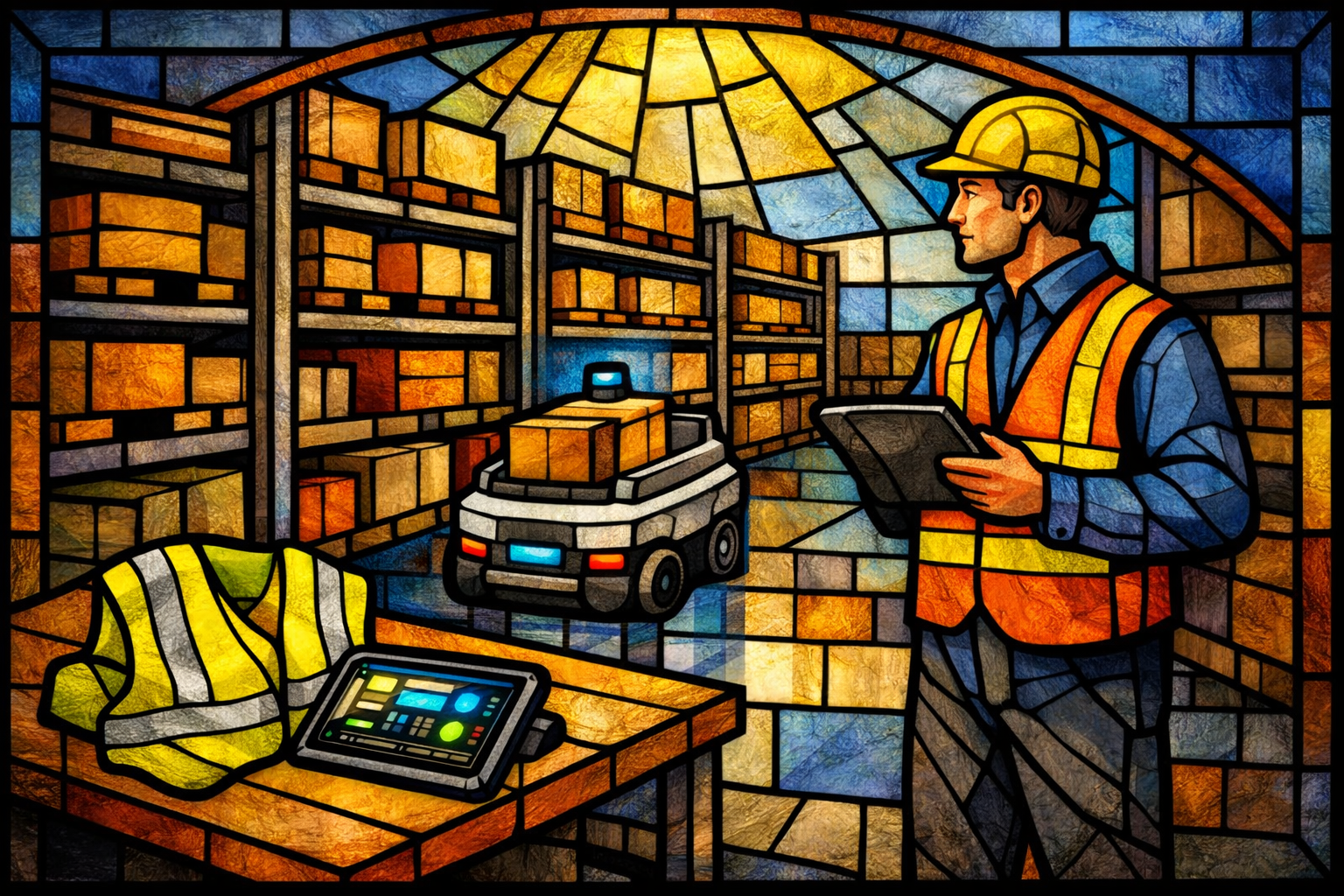
Robots could be one of the clearest ways AI helps humanity bloom: not by giving everyone a more impressive gadget, but by taking over work that is dangerous, exhausting, repetitive, humiliating, or simply not a good use of a human life. The optimistic case is powerful. Machines can weld in heat and fumes, move heavy loads, inspect hazardous sites, clean, sort, carry, spray, harvest, and eventually do more of the physical work that now wears bodies down.
But robots do not automatically liberate workers. Automation can remove drudgery, or it can intensify surveillance, weaken bargaining power, cut wages, and transfer the gains to owners of machines. The difference is not just technical. It depends on wages, ownership, worker voice, safety rules, training, transition support, and whether productivity gains are shared. A robot-rich future could mean less back-breaking labour and more human freedom. It could also mean faster warehouses, fewer secure jobs, and communities left behind. The bloom question is therefore not simply “can robots do the work?” It is “who gains power when they do?”
The work people most want to escape
The old robotics slogan is that machines should take on work that is “dull, dirty and dangerous”. That phrase can be vague, but it points to a real moral priority: some jobs damage bodies, shorten lives, expose people to toxins or heat, require monotonous movement for hours, or place workers under relentless speed targets. OSHA describes industrial robots as machines often used for unsafe, hazardous, highly repetitive and unpleasant tasks, including material handling, welding, loading, painting and spraying. [OSHA]osha.govOSHARobotics - Overview | Occupational Safety and Health Administration…
This is where robotics fits the larger AI bloom argument. If advanced AI makes robots more capable in messy real-world environments, physical abundance stops depending so heavily on human endurance. Food, housing, manufactured goods, elder care support, recycling, construction, logistics and disaster recovery all involve stubborn physical bottlenecks. A society with abundant machine labour could build, repair, clean, deliver and maintain more with fewer people forced into work they would gladly leave if they had a real choice.
The strongest examples are not glamorous humanoids. Many useful robots are boring by design: pallet movers, robotic arms, autonomous mobile robots, inspection drones, cleaning machines, surgical robots, mining vehicles, agricultural machines, and wearable assistive devices. NIOSH notes that robots can improve worker safety and wellbeing, but also warns that growing human-robot interaction creates new risks, including struck-by hazards, crushing and trapping, slips, electrical hazards, mental stress and job-loss anxiety. [CDC]cdc.govCDCRobotics in the Workplace: An Overview | Robotics | CDCFebruary 9, 2024…
That warning matters. A robot does not simply “remove” danger if the workplace is reorganised badly. It can move danger from production into maintenance, programming, emergency intervention or high-speed work beside machines. OSHA has long warned that many robot accidents happen during non-routine operations such as maintenance, testing, setup and adjustment, when workers may enter a robot’s operating area. [OSHA]osha.govGuidelines For Robotics Safety | Occupational Safety and Health AdministrationOSHAGuidelines For Robotics Safety | Occupational Safety and Health Administration…
A humane robotics agenda would therefore start with the jobs and tasks workers most want changed. It would ask: which parts of this job cause injuries, fatigue, boredom, fear, exposure, loss of dignity or loss of family life? Then it would design automation around those answers, rather than treating “replace labour” as the only measure of success.
Why robots can help workers — and still make work worse
Robots can improve working life in three main ways. They can remove workers from hazards, reduce repetitive strain, and raise productivity enough to support higher wages or shorter hours. In principle, this is exactly the kind of abundance that technological optimism promises: fewer people spending their lives doing physically punishing work because society has learned to produce more with machines.
The evidence, however, is mixed. Robot adoption has expanded rapidly. The International Federation of Robotics reported that 542,000 industrial robots were installed globally in 2024, more than double the number ten years earlier, and that 4.66 million industrial robots were operating worldwide. Asia accounted for nearly three quarters of new deployments. [IFR International Federation of Robotics]ifr.orgInternational Federation of RoboticsInternational Federation of Robotics
Yet labour-market effects depend on context. A major US study by Daron Acemoglu and Pascual Restrepo found that industrial robot exposure from 1990 to 2007 reduced employment and wages in affected local labour markets. Their published estimate was that one additional robot per thousand workers reduced the employment-to-population ratio by about 0.2 percentage points and wages by 0.42%. [Yale Department of Economics]economics.yale.eduSource details in endnotes.
That does not prove every robot harms workers. It does show that automation can reduce labour demand in particular places and sectors faster than new opportunities appear. If a factory becomes more productive but needs fewer production workers, the benefits may show up as profits, lower prices or higher output while the costs are concentrated among workers with specific skills, mortgages, families and local ties.
Job quality can also worsen even when jobs remain. OECD analysis of AI and job quality notes that AI can reduce tedious or dangerous tasks, but can also create faster-paced work and lower wages for workers squeezed into a diminished set of tasks. [OECD]oecd.orgartificial intelligence job quality and inclusiveness a713d0adartificial intelligence job quality and inclusiveness a713d0ad European research on robotisation and job quality found a negative effect on work intensity, with no clear improvement in physical environment, skills or discretion over the period studied. [arXiv]arxiv.orgSource details in endnotes.
Warehousing is the clearest everyday example. Robots can reduce walking, carrying and some heavy movements. But if automation mainly lets management raise targets, monitor every movement and compress idle time, workers may experience less walking but more pressure. Amazon says its recordable incident rate improved 34% over five years and its lost-time incident rate improved 65% over the same period in its worldwide operations. [Amazon News]aboutamazon.comAmazon News Amazon’s safety performance continues to improve year over yearAmazon News Amazon’s safety performance continues to improve year over year At the same time, US safety agencies, journalists and labour groups have repeatedly scrutinised Amazon’s warehouse injury record, with OSHA citations highlighting risks from repetitive bending, twisting and lifting at high speed. [AP News]apnews.comAP News OSHA cites 3 Amazon warehouses for high injury riskAP News OSHA cites 3 Amazon warehouses for high injury risk
The lesson is not that warehouse robotics is bad. It is that automation must be judged by the whole job, not by the robot demo. A machine that removes one painful task can still be part of a system that makes the remaining human work more intense, less autonomous and more insecure.
Labour power decides who captures the robot dividend
The central political economy question is simple: when robots make production cheaper, who owns the gain?
If robots are owned by firms and workers have weak bargaining power, the gains are likely to flow mainly to shareholders, executives, consumers through lower prices, and highly skilled technical workers. Some workers may get safer roles or higher pay, but others may face redundancy, deskilling, insecure agency work or lower local wages. IPPR described this as a possible “paradox of plenty”: society becomes richer overall, while many people become less secure because the dividends of automation are narrowly shared. [IPPR]ippr.orgownership and inequality in the robotic ageownership and inequality in the robotic age
This is why “labour power” belongs at the centre of any AI abundance story. Labour power means the practical ability of workers to negotiate over pay, conditions, technology, pace, data, training and job redesign. It includes unions, collective bargaining, works councils, employment law, sectoral standards, public procurement rules, occupational licensing, safety enforcement and the ability to refuse unsafe work without retaliation.
Robots change the balance of power because they alter the employer’s outside option. If a company can credibly threaten to automate a task, offshore it, or reorganise work around fewer people, workers may accept worse terms even before jobs disappear. Conversely, if workers have strong rights and institutions, automation can become a bargaining moment: dangerous tasks are removed, productivity gains fund higher pay or shorter hours, and affected workers receive training, redeployment or income support.
The OECD argues that social dialogue and collective bargaining can help decide which AI technologies are adopted, guide their introduction, define training needs, protect workers from automated decision-making without human oversight, and complement public policy in making workers more secure and adaptable. [OECD]oecd.orgOpen source on oecd.org. Eurofound similarly warns that digital workplace policy often fails to address the workplace dimension in enough detail, especially around data ethics, algorithmic management and surveillance, and says ethical considerations need to be embedded across the technology lifecycle. [Eurofound]eurofound.europa.euEurofound Ethical digitalisation at work: From theory to practice | EurofoundEurofound Ethical digitalisation at work: From theory to practice | Eurofound
This applies directly to robotics. Workers should not merely be told that robots are coming. They should have enforceable voice over:
- which tasks are automated first;
- whether automation reduces injuries or raises speed targets;
- what data machines collect about workers;
- how productivity gains are shared;
- whether displaced workers are retrained, redeployed or discarded;
- how safety is tested before deployment;
- whether human skill and judgement are preserved rather than stripped out of the job.
Without that voice, “robots doing the drudgery” can become a slogan for management power. With it, robotics can become a route to safer, better and less exhausting work.
The transition problem is not solved by retraining slogans
A common answer to automation anxiety is “workers can retrain”. Sometimes they can, and many will. Robotics creates work in installation, maintenance, supervision, safety, software, operations, process design and machine repair. Better technology can also expand demand by lowering prices and making new goods and services possible.
But retraining is not a magic bridge. A 55-year-old warehouse worker with caring responsibilities, a mortgage and a damaged back is not automatically helped by the existence of robotics engineering jobs in another city. Even when new jobs appear, they may require different credentials, be located elsewhere, pay less at first, or arrive years after the old jobs vanish.
This is why policy has to distinguish three cases.
First, some automation is genuinely worker-enhancing. It removes the worst task while leaving the worker with more control, skill and safety. Examples might include robotic lift assists, inspection robots that keep people out of confined spaces, or collaborative systems designed around human judgement.
Second, some automation is productivity-enhancing but disruptive. It raises output while reducing demand for a group of workers. This can still be socially valuable, but only if transition policy is serious: wage insurance, retraining with income, job placement, relocation help where appropriate, local investment, and a credible path into decent work.
Third, some automation is socially harmful because it mainly transfers power. If a system uses robotics and AI to intensify pace, expand surveillance, casualise employment and suppress wages, the fact that it is “innovative” does not make it part of human flourishing.
Collective bargaining can make transition policy less abstract. ILO work on just transitions highlights clauses on upskilling and retraining, consultation over redundancies and early retirement, and movement into new jobs. [ilo.org]ilo.orgOpen source on ilo.org. Although much of the “just transition” discussion began with climate policy, the same structure is needed for robotics and AI: anticipate change, negotiate it early, and make firms partly responsible for the human consequences of productivity gains.

Ownership is the hard edge of post-scarcity
The most optimistic AI bloom scenarios imagine a world where machine intelligence and machine labour make the basics of life far cheaper: food, energy, manufactured goods, housing components, logistics, care support and infrastructure. That is the route from robotics to post-scarcity.
But post-scarcity is not just a production problem. It is an ownership problem.
If robots, land, energy systems, AI models, supply chains and data are concentrated in a few firms or states, then abundance can coexist with dependence. People may live in a world capable of producing more than enough while still lacking income, bargaining power or access. The economy may be rich in output but poor in freedom.
There are several ways to broaden the robot dividend:
Stronger wage floors and sector standards. If automation raises productivity, minimum wages, sectoral bargaining and labour standards can prevent the lowest-paid workers from being forced to compete against machines by accepting degrading pay.
Worker ownership and profit-sharing. Employee ownership, cooperative models, broad-based equity, sovereign wealth funds or social wealth funds can give ordinary people a direct claim on capital income. This matters more as machine labour raises the share of output produced by capital.
Public investment with public return. If governments fund robotics research, infrastructure, procurement or tax incentives, they can attach conditions: safety, domestic capability, open standards, training, regional investment and shared returns.
Shorter working time. One of the clearest signs that robotics is serving human flourishing would be productivity gains converted into shorter hours, safer workloads or earlier retirement for those in physically demanding jobs, rather than only higher throughput.
Portable security. Workers who move between employers need benefits, pensions, training rights and income support that do not vanish when a job is automated.
None of these choices is anti-technology. They are the social machinery that determines whether technology becomes freedom. A robot-rich economy without shared claims on the gains may feel less like abundance and more like exclusion.
The safety test: fewer injuries, not faster injuries
Robotics should face a simple public test: does it reduce harm across the whole system?
That means counting more than immediate robot accidents. A serious assessment should include musculoskeletal injuries, fatigue, mental stress, surveillance pressure, heat, shift intensity, maintenance risks, near misses and the effects of speed targets. NIOSH explicitly warns that robots can create emerging risks when working near people, including unexpected contact, distraction, mental stress, distrust and concern about job loss. [CDC]cdc.govconstruction roboticsconstruction robotics
This is especially important as robots leave cages and enter shared human spaces. Traditional industrial robots often worked behind guards. Newer collaborative robots, mobile warehouse robots, exoskeletons and humanoids are designed to operate closer to people. That can be useful, but it requires more careful safety design, not less. OSHA notes that the US has no specific OSHA standard for the robotics industry, relying instead on broader machinery, hazard and safety rules. [OSHA]osha.govOpen source on osha.gov.
Wearable robots show the trade-off clearly. Exoskeletons may reduce strain in construction, agriculture and manufacturing, but reviews also identify possible new risks: discomfort, altered movement, overconfidence, pressure points, balance issues, and organisational misuse. Research on agricultural exoskeletons finds strong potential to reduce work-related musculoskeletal disorders, but also notes that adoption is limited because agricultural tasks are complex and performed in harsh environments. [MDPI]mdpi.comOpen source on mdpi.com.
A humane safety standard would ask whether robotics reduces total injury and strain, not whether it produces a good pilot result under ideal conditions. It would also protect workers from being used as experimental subjects in poorly tested systems. The right benchmark is not “a robot was deployed”. It is “workers are safer, healthier, less exhausted and less afraid”.
Robots should expand human agency, not shrink it
The best version of robotic abundance is not a world where humans are merely moved to the edge of automated systems to watch screens, clear jams and obey algorithmic instructions. It is a world where machines take on the worst physical burdens while humans retain judgement, skill, creativity, care, responsibility and social status.
This distinction is crucial. A worker can be “augmented” in a shallow sense while becoming less autonomous: the machine tells them where to stand, what to pick, how fast to move and when they are falling behind. That is not liberation from drudgery; it is drudgery with sensors.
Research on worker attitudes suggests people are not simply anti-automation. A 2024 survey of more than 9,000 workers across nine countries found that more workers reported potential benefits than costs from technologies such as robots and AI for safety, comfort, pay and autonomy. Positive views were stronger among workers who felt valued by employers, solved complex problems and saw career mobility. [arXiv]arxiv.orgSource details in endnotes.
That finding points to an important design principle. Workers are more likely to welcome robots when automation is part of a credible bargain: safer work, better tools, real progression, fair pay and respect. They are more likely to fear it when automation arrives as surveillance, deskilling or redundancy.
For AI bloom, this matters beyond economics. Human flourishing is not only consumption. People need agency, dignity, competence, belonging and the ability to shape their lives. A society that produces more goods by stripping many people of status and control would be materially richer but not necessarily more flourishing.
What good robotics policy would prioritise now
A serious robotics-and-work agenda would not try to freeze technology. Dangerous and degrading labour is not worth preserving for its own sake. The goal should be fast enough automation to remove needless harm, paired with strong enough institutions to share the gains and protect human agency.
The most important policy choices are practical.
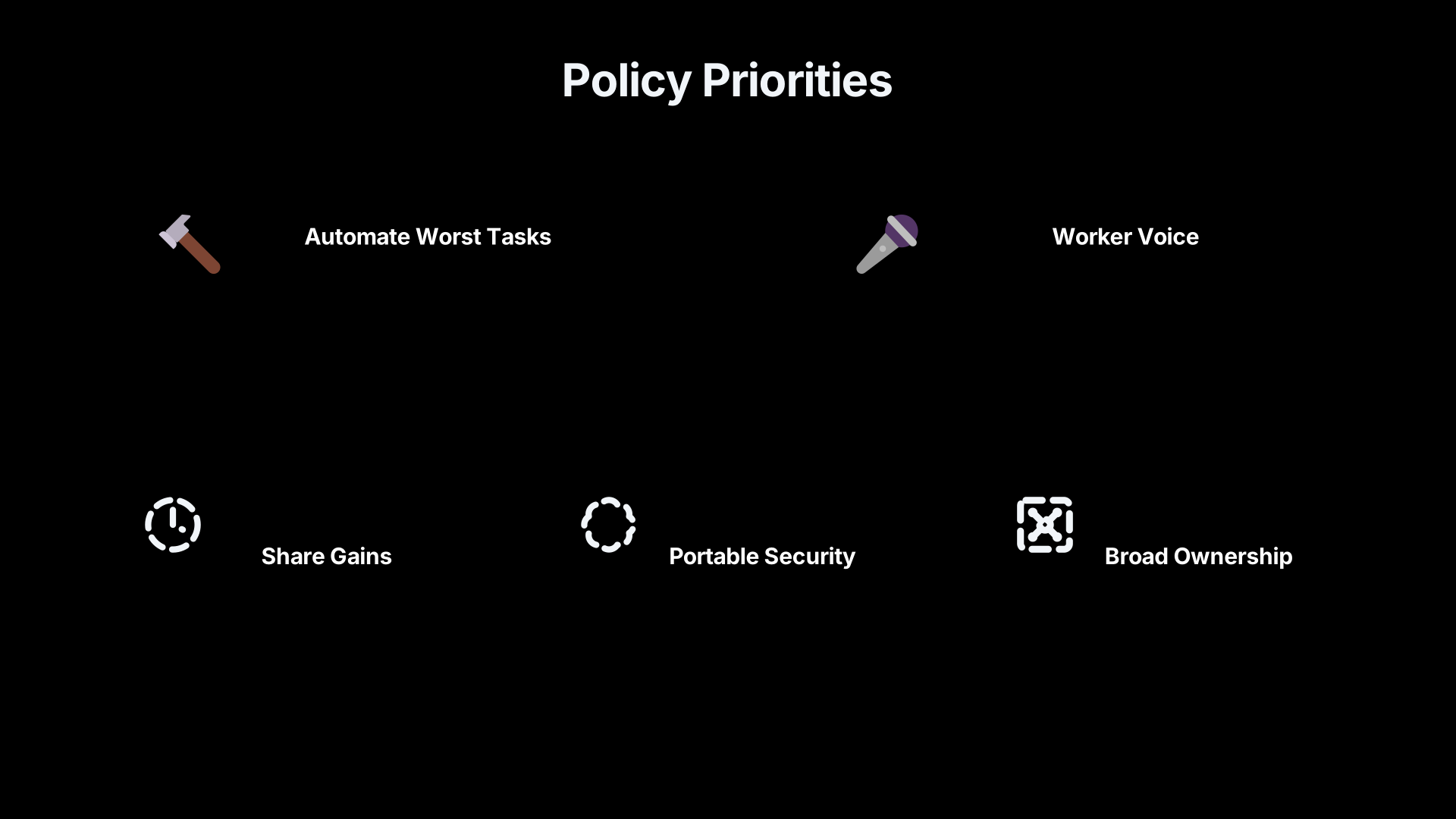
Automate the worst tasks first. Public funding, procurement and safety regulation should favour robotics that reduces injury, exposure, fatigue and genuinely unwanted work, not merely systems that intensify output.
Give workers a say before deployment. Workplaces should consult workers and their representatives on task design, safety, data collection, pace, training and transition plans before robots are introduced, not after the system is already locked in.
Share productivity gains. Higher output should translate into higher wages, shorter hours, safer staffing levels, profit-sharing or lower prices, rather than flowing only to capital owners.
Protect against algorithmic speed-up. Robotics policy should cover the management systems around machines: performance metrics, surveillance, automated discipline, shift design and injury reporting.
Fund real transition pathways. Training should be paid, local where possible, linked to actual jobs, and paired with income support. Workers should not be expected to carry the whole cost of a transition that benefits firms and society.
Build broad ownership of capital. If machine labour becomes a larger source of wealth, societies need wider access to capital income through pensions, public funds, worker ownership, shared equity or other institutional designs.
Update safety rules for human-robot workplaces. Regulators need expertise, data access and enforcement capacity for mobile robots, collaborative robots, exoskeletons, AI-controlled machinery and maintenance risks.
The deeper principle is that robots should be judged by their effect on human freedom. Do they give people more power over their time, health and future? Or do they make a smaller number of owners more powerful over everyone else?
The bloom case: ending drudgery without abandoning workers
Robotics is one of the places where the optimistic AI future becomes physically tangible. A civilisation with highly capable robots could build more homes, grow and distribute food more efficiently, clean up hazardous sites, support ageing populations, maintain infrastructure, respond to disasters, and remove millions of people from work that is unsafe, exhausting or degrading. In the long run, machine labour could help make abundance real rather than metaphorical.
But the politics cannot be postponed until robots are fully capable. The bargaining rules, ownership patterns, safety norms and transition systems built now will shape who benefits later. If early robotics teaches firms that automation means fewer workers, higher speed and weaker voice, more powerful AI-controlled robots may deepen that pattern. If early robotics teaches societies to share gains, reduce harm and expand human agency, more capable machines could become part of a genuine human bloom.
The most realistic hope is not that robots “end work” in one dramatic break. It is that they gradually make the worst work less necessary, while democratic institutions ensure that people do not lose income, dignity or power as machines take on more tasks. The promise is freedom from needless drudgery. The condition is labour power strong enough to make that freedom shared.
Endnotes
-
Source: osha.gov
Link: https://www.osha.gov/roboticsSource snippet
OSHARobotics - Overview | Occupational Safety and Health Administration...
-
Source: cdc.gov
Link: https://www.cdc.gov/niosh/robotics/index.htmlSource snippet
CDCRobotics in the Workplace: An Overview | Robotics | CDCFebruary 9, 2024...
Published: February 9, 2024
-
Source: osha.gov
Title: Guidelines For Robotics Safety | Occupational Safety and Health Administration
Link: https://www.osha.gov/enforcement/directives/std-01-12-002Source snippet
OSHAGuidelines For Robotics Safety | Occupational Safety and Health Administration...
-
Source: ifr.org
Link: https://ifr.org/worldrobotics/report-2025 -
Source: ifr.org
Title: global robot demand in factories doubles over 10 years
Link: https://ifr.org/ifr-press-releases/news/global-robot-demand-in-factories-doubles-over-10-years?stream=top -
Source: economics.yale.edu
Link: https://economics.yale.edu/research/cfp-1892-robots-and-jobs-evidence-us-labor-markets -
Source: oecd.org
Title: artificial intelligence job quality and inclusiveness a713d0ad
Link: https://www.oecd.org/en/publications/2023/07/oecd-employment-outlook-2023_904bcef3/full-report/artificial-intelligence-job-quality-and-inclusiveness_a713d0ad.html -
Source: arxiv.org
Link: https://arxiv.org/abs/2208.14248 -
Source: ippr.org
Title: ownership and inequality in the robotic age
Link: https://www.ippr.org/articles/ownership-and-inequality-in-the-robotic-age -
Source: oecd.org
Link: https://www.oecd.org/en/publications/2023/07/oecd-employment-outlook-2023_904bcef3/full-report/social-dialogue-and-collective-bargaining-in-the-age-of-artificial-intelligence_5828691a.html -
Source: oecd.org
Title: Shaping the transition | OECD
Link: https://www.oecd.org/en/publications/shaping-the-transition_f097c48a-en.html -
Source: ilo.org
Link: https://www.ilo.org/publications/role-collective-bargaining-promoting-just-transitions -
Source: mdpi.com
Link: https://www.mdpi.com/1424-8220/24/21/7026/html -
Source: arxiv.org
Title: arXiv Automation from the Worker’s Perspective
Link: https://arxiv.org/abs/2409.20387 -
Source: automation.com
Title: Global Robot Demand in Factories Doubles Over 10 Years
Link: https://www.automation.com/en-us/articles/september-2025/global-robot-demand-factories-doubles-10-years -
Source: ilo.org
Link: https://www.ilo.org/resource/news/ai-and-digitalization-are-transforming-safety-and-health-work -
Source: ilo.org
Link: https://www.ilo.org/resource/news/social-dialogue-key-economic-and-social-development-enabling-inclusive -
Source: oecd.org
Title: component 7
Link: https://www.oecd.org/en/publications/megatrends-and-the-future-of-social-protection_6c9202e8-en/full-report/component-7.html -
Source: cdc.gov
Title: construction robotics
Link: https://www.cdc.gov/niosh/bulletin/2024/construction-robotics.html -
Source: mdpi.com
Link: https://www.mdpi.com/1424-8220/24/21/7026 -
Source: ifr.org
Title: Record of 4 Million Robots in Factories Worldwide
Link: https://ifr.org/ifr-press-releases/news/record-of-4-million-robots-working-in-factories-worldwide?tap_cid=ca281bf0-034f-11ee-ae23-13384aaa20b9 -
Source: ifr.org
Title: Record of 4 Million Robots in Factories Worldwide
Link: https://ifr.org/ifr-press-releases/news/record-of-4-million-robots-working-in-factories-worldwide?like=twibbon -
Source: ifr.org
Title: International Federation of Robotics
Link: https://ifr.org/ifr-press-releases/record-of-4-million-robots-working-in-factories-worldwide -
Source: automation.com
Title: Record 4 Million Robots in Factories Worldwide
Link: https://www.automation.com/article/record-4-million-robots-factories-worldwide -
Source: live.ilo.org
Link: https://live.ilo.org/fr/evenements/negocier-lalgorithme-intelligence-artificielle-et-gestion-algorithmique-au-travail-2024 -
Source: stacks.cdc.gov
Link: https://stacks.cdc.gov/view/cdc/208153 -
Source: oecd.org
Title: using ai in the workplace 73d417f9 en
Link: https://www.oecd.org/en/publications/using-ai-in-the-workplace_73d417f9-en.html -
Source: ilo.org
Link: https://www.ilo.org/resource/news/algorithmic-management-practices-regular-workplaces-are-already-reality -
Source: ilo.org
Link: https://www.ilo.org/publications/algorithmic-management-practices-regular-workplaces-case-studies-logistics -
Source: ilo.org
Link: https://www.ilo.org/topics-and-sectors/just-transition-towards-environmentally-sustainable-economies-and-societies -
Source: oecd.org
Link: https://www.oecd.org/en/publications/oecd-employment-outlook-2023_08785bba-en/full-report/social-dialogue-and-collective-bargaining-in-the-age-of-artificial-intelligence_5828691a.html -
Source: oecd.org
Title: artificial intelligence job quality and inclusiveness a713d0ad
Link: https://www.oecd.org/en/publications/oecd-employment-outlook-2023_08785bba-en/full-report/artificial-intelligence-job-quality-and-inclusiveness_a713d0ad.html -
Source: oecd.org
Title: Artificial intelligence and the labour market
Link: https://www.oecd.org/en/publications/oecd-employment-outlook-2023_08785bba-en/full-report/artificial-intelligence-and-the-labour-market-introduction_ea35d1c5.html -
Source: oecd.org
Title: component 11
Link: https://www.oecd.org/fr/publications/perspectives-de-l-emploi-de-l-ocde-2023_aae5dba0-fr/full-report/component-11.html -
Source: ilo.org
Link: https://www.ilo.org/resource/news/collective-bargaining-vehicle-just-transition -
Source: archive.cdc.gov
Title: robotics workplace safety
Link: https://archive.cdc.gov/www_cdc_gov/niosh/newsroom/feature/robotics-workplace-safety.html -
Source: mdpi.com
Title: Robotic Development for the Nuclear Environment: Challenges and Strategy
Link: https://www.mdpi.com/2218-6581/9/4/94 -
Source: cdc.gov
Title: robot safety
Link: https://www.cdc.gov/niosh/bulletin/2019/robot-safety.html -
Source: ilo.org
Link: https://www.ilo.org/publications/robots-worldwide-impact-automation-employment-and-trade -
Source: ippr.org
Title: the forward march of robots halted automation employment and inequality
Link: https://www.ippr.org/articles/the-forward-march-of-robots-halted-automation-employment-and-inequality -
Source: ippr.org
Link: https://www.ippr.org/articles/without-the-right-policies-automation-risks-the-transfer-of-income-from-labour-to-capital -
Source: ippr.org
Title: managing automation
Link: https://www.ippr.org/articles/managing-automation -
Source: ippr.org
Title: greater inequality not mass job losses most likely outcome of automation
Link: https://www.ippr.org/media-office/greater-inequality-not-mass-job-losses-most-likely-outcome-of-automation -
Source: cdc.gov
Link: https://www.cdc.gov/niosh/bulletin/2017/robotics-conference.html -
Source: ippr.org
Title: the policy challenges of automation
Link: https://www.ippr.org/articles/the-policy-challenges-of-automation -
Source: robotics.ee
Link: https://robotics.ee/2016/06/03/mining-and-nuclear-decommissioning-robots-in-dangerous-and-dirty-areas/ -
Source: ilo.org
Title: Mining: a hazardous work | International Labour Organization
Link: https://www.ilo.org/resource/mining-hazardous-work -
Source: cdc.gov
Link: https://www.cdc.gov/niosh/docs/85-103/default.html -
Source: researchrepository.ilo.org
Title: Robots and employment a review
Link: https://researchrepository.ilo.org/esploro/outputs/journalArticle/Robots-and-employment-a-review/995374887802676 -
Source: researchrepository.ilo.org
Title: Robots et emploi revue de la
Link: https://researchrepository.ilo.org/esploro/outputs/journalArticle/Robots-et-emploi-revue-de-la/995376879202676 -
Source: osha.gov
Link: https://www.osha.gov/ords/imis/AccidentSearch.search?Fatal=fatal&acc_keyword=%22Robot%22&keyword_list=on -
Source: osha.gov
Link: https://www.osha.gov/ords/imis/AccidentSearch.search?acc_keyword=%22Robotics%22&keyword_list=on -
Source: osha.gov
Link: https://www.osha.gov/robotics/hazards -
Source: osha.gov
Link: https://www.osha.gov/robotics/hazard-evaluation-solutions -
Source: osha.gov
Title: OSH A Technical Manual (OTM)
Link: https://www.osha.gov/otm/section-4-safety-hazards/chapter-4 -
Source: ifr.org
Link: https://ifr.org/pages/www.ifr.org -
Source: ifr.org
Title: International Federation of Robotics DOWNLOADS * Market Presentation
Link: https://ifr.org/pages/about-us -
Source: ifr.org
Link: https://ifr.org/pages/ -
Source: researchrepository.ilo.org
Title: Negotiating the algorithm automation artificial intelligence
Link: https://researchrepository.ilo.org/esploro/outputs/encyclopediaEntry/Negotiating-the-algorithm-automation-artificial-intelligence/995219137602676 -
Source: researchrepository.ilo.org
Link: https://researchrepository.ilo.org/esploro/outputs/report/Mind-the-AI-divide-shaping-a/995378592502676 -
Source: webapps.ilo.org
Title: collective bargaining recovery
Link: https://webapps.ilo.org/digitalguides/en-gb/story/collective-bargaining-recovery -
Source: researchrepository.ilo.org
Link: https://researchrepository.ilo.org/esploro/outputs/report/The-future-of-work-in-the/995626056202676 -
Source: researchrepository.ilo.org
Title: ILO Social dialogue report 2024 peak level
Link: https://researchrepository.ilo.org/esploro/outputs/report/ILO-Social-dialogue-report-2024-peak-level/995625150602676 -
Source: researchrepository.ilo.org
Title: Global accelerator on jobs and social
Link: https://researchrepository.ilo.org/esploro/outputs/report/Global-accelerator-on-jobs-and-social/995376193502676 -
Source: researchrepository.ilo.org
Link: https://researchrepository.ilo.org/esploro/outputs/encyclopediaEntry/The-role-of-collective-bargaining-in/995659933502676 -
Source: stacks.cdc.gov
Link: https://stacks.cdc.gov/view/cdc/113263 -
Source: oecd.ai
Title: Labour markets
Link: https://oecd.ai/fr/work-innovation-productivity-skills/key-themes/labour-markets -
Source: oecd.ai
Title: Labour markets
Link: https://oecd.ai/en/work-innovation-productivity-skills/key-themes/labour-markets -
Source: oecd.ai
Title: The Future of Work
Link: https://oecd.ai/en/working-group-future-of-work -
Source: oecd.ai
Link: https://oecd.ai/en/dashboards/ai-principles/P13 -
Source: fair.work
Link: https://fair.work/en/fw/blog/new-report-reveals-how-ai-and-robotics-are-changing-the-experiences-and-conditions-of-amazon-warehouse-workers/ -
Source: aboutamazon.com
Title: Amazon News Amazon’s safety performance continues to improve year over year
Link: https://www.aboutamazon.com/news/workplace/amazon-workplace-safety-performance-2024 -
Source: apnews.com
Title: AP News OSHA cites 3 Amazon warehouses for high injury risk
Link: https://apnews.com/article/96411ea3ccb6d6292b552144fd27fe4d -
Source: eurofound.europa.eu
Title: Eurofound Ethical digitalisation at work: From theory to practice | Eurofound
Link: https://www.eurofound.europa.eu/en/publications/2023/ethical-digitalisation-work-theory-practice -
Source: eurofound.europa.eu
Title: eu Human–robot interaction: What changes in the workplace? | Eurofound
Link: https://www.eurofound.europa.eu/publications/all/human-robot-interaction-what-changes-workplace -
Source: eurofound.europa.eu
Link: https://www.eurofound.europa.eu/en/topics/digitalisation -
Source: eurofound.europa.eu
Link: https://www.eurofound.europa.eu/da/topics/digitalisation -
Source: eurofound.europa.eu
Link: https://www.eurofound.europa.eu/en/topic/digitalisation -
Source: eurofound.europa.eu
Link: https://www.eurofound.europa.eu/sv/topic/digitalisation -
Source: amazonworkers.org
Link: https://amazonworkers.org/tools/
Additional References
-
Source: youtube.com
Link: https://www.youtube.com/watch?v=BjqnbfG9kDYSource snippet
Will automation take away all our jobs? | David Autor...
-
Source: gao.gov
Link: https://www.gao.gov/products/gao-24-106413 -
Source: youtube.com
Title: Will automation take away all our jobs? | David Autor
Link: https://www.youtube.com/watch?v=th3nnEpITz0Source snippet
AI Is Not Improving Productivity: Nobel Laureate Daron Acemoglu...
-
Source: researchgate.net
Link: https://www.researchgate.net/publication/381119155_Use_of_robotics_to_coordinate_health_and_safety_on_the_construction_site -
Source: wired.com
Link: https://www.wired.com/story/a-damning-us-report-lays-bare-amazons-worker-injury-crisis -
Source: aboutamazon.com
Link: https://www.aboutamazon.com/news/workplace/amazon-workplace-safety-2025-injury-reduction/ -
Source: computing.co.uk
Link: https://www.computing.co.uk/news/4021130/amazon-warehouse-robots-causing-injuries-staff-internal-documents-show -
Source: aboutamazon.com
Link: https://www.aboutamazon.com/news/workplace/amazon-safety/ -
Source: econstor.eu
Link: https://www.econstor.eu/handle/10419/311983
Amazon book picks
Further Reading
Books and field guides related to Robots and Work. Use these as the next step if you want deeper reading beyond the article.

The Future of Work
Looking for ways to handle the transition to a digital economy Robots, artificial intelligence, and driverless cars are no longer things...

R.U.R. and The insect play
First published 1920. Subjects: Czech drama, Fiction, Science Fiction, Drama, Technological innovations.

Automation and Collaborative Robotics
Understand the current and future research into technologies that underpin the increasing capabilities of automation technologies and the...
eBay marketplace picks
Marketplace Samples
Example marketplace items related to this page. Use the search link to explore similar finds on eBay.

Example eBay listing
A.I. Artificial Intelligence Original Movie Poster Signed By Jude Law
USD 125.00 | Shipping USD 25.00 | US

Example eBay listing
Artificial Intelligence D/S Original Movie Poster - 27 x 40"
USD 19.50 | Shipping USD 13.65 | US

Example eBay listing
612388 Artificial Intelligence Movie Science Fiction Drama Wall Print Poster
USD 22.95 | Shipping USD 12.95 | JP

Example eBay listing
Companion - Artificial Intelligence Dark Comedy Cinema Film - POSTER 20"x30"
USD 23.99 | Free shipping | US
Topic Tree
Follow this branch
Parent topic
AI Bloom FuturesRelated pages 9
- Abundant Intelligence
- AI Medicine
- AI Tutors
- Coordination
- Discovery
- Energy Limits
- Long Future
- Shared Gains
- +1 more in sidebar