Within Platform Lock in
Hidden AI switching costs
AI lock-in often grows through everyday integrations, staff training, data pipelines, and compliance systems rather than obvious exclusivity clauses.
On this page
- Why formal choice can still leave firms practically stuck
- The workflow, data, security, and training barriers to moving models
- How invisible switching costs could shape medicine, education, and government
Page outline Jump by section
Introduction
AI lock-in rarely arrives as a dramatic monopoly contract. More often, it appears as convenience. A company adopts one AI assistant because it works well with its email system. A hospital adds AI tools that connect neatly to its existing patient records. A government department buys automated document analysis because it integrates with approved security software. Months later, the organisation discovers that leaving would require rebuilding workflows, retraining staff, migrating sensitive data, rechecking compliance, and risking operational disruption.
 That matters because advanced AI could eventually become part of the core infrastructure of modern civilisation: medicine, education, scientific research, logistics, public administration, and industrial production. If the systems that mediate intelligence become difficult to leave, the economic and political influence of a few platforms could deepen quietly over time. The concern is not simply higher prices. It is that the future benefits of AI abundance may end up flowing through tightly controlled ecosystems whose practical power grows stronger the more society depends on them.
The most important switching costs are often invisible until organisations try to move.
Why formal choice can still leave firms practically stuck
In theory, many organisations remain free to change AI suppliers. Most contracts are not literal exclusivity agreements. A business can often still sign up for rival tools. Yet practical dependence can become severe long before legal exclusivity exists.
The key mechanism is cumulative integration. AI systems increasingly sit inside ordinary work processes rather than operating as isolated software products. Once AI tools become embedded in customer support, scheduling, procurement, analytics, compliance review, coding workflows, medical records, or classroom systems, replacing them stops being a simple software decision and becomes an organisational upheaval.
The U.S. Federal Trade Commission warned in its 2025 report on major cloud-AI partnerships that agreements between cloud providers and AI developers may increase both contractual and technical switching costs, making it harder for AI developers to move between providers or use several providers simultaneously. [Federal Trade Commission]ftc.govFederal Trade CommissionFTC Issues Staff Report on AI Partnerships & Investments…January 17, 2025 — 17 Jan 2025 — The potential to inc… [Federal Trade Commission]ftc.govFederal Trade CommissionFTC Issues Staff Report on AI Partnerships & Investments…January 17, 2025 — 17 Jan 2025 — The potential to inc…
What makes this especially powerful in AI is that the lock-in is layered.
A large organisation may simultaneously depend on one vendor for:
- cloud infrastructure
- AI models
- productivity software
- identity management
- security tooling
- data storage
- workflow automation
- developer tools
- compliance reporting
Each layer reinforces the others. The more integrated the stack becomes, the more expensive departure feels.
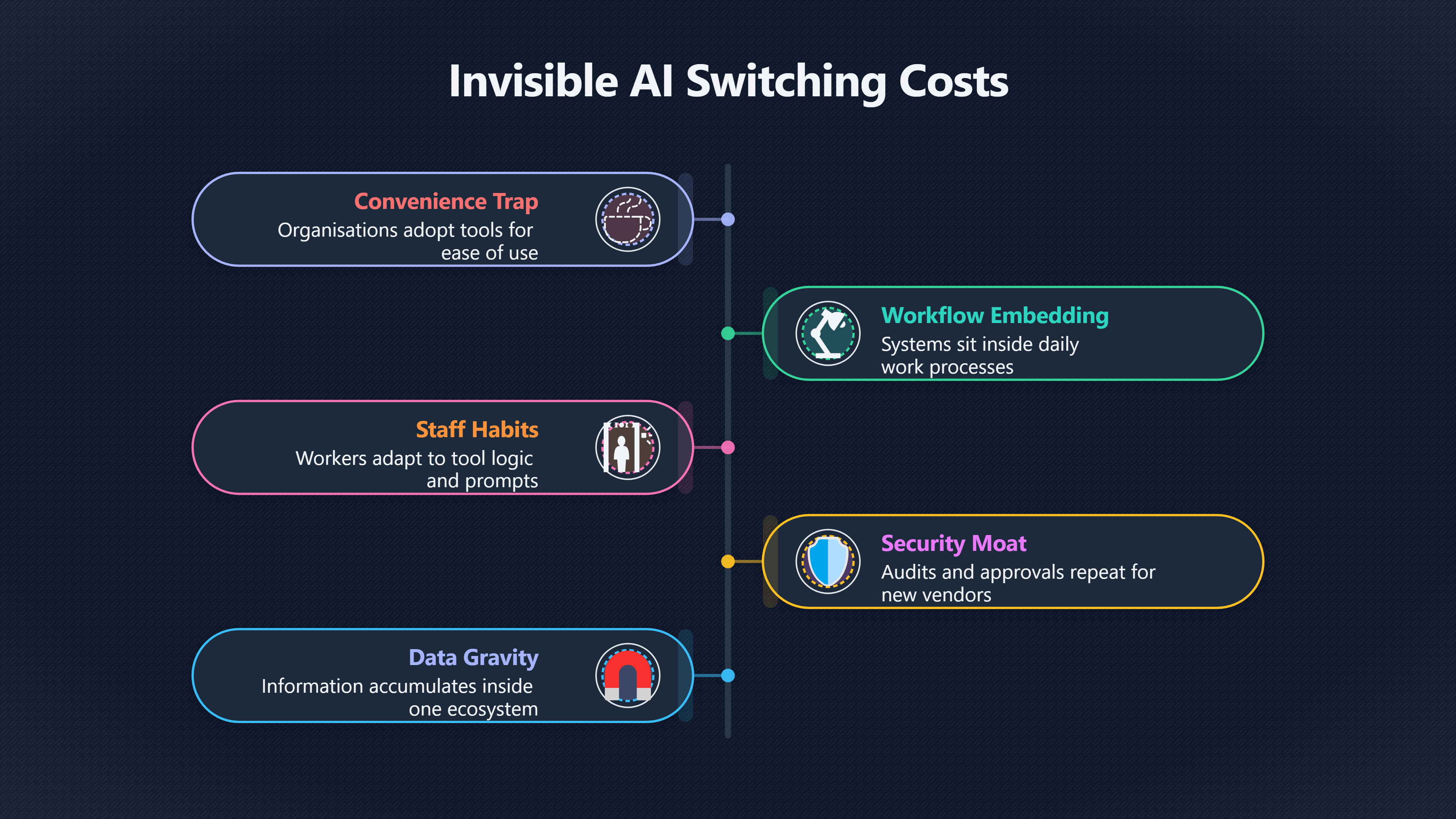
This is sometimes called “data gravity”: once enormous amounts of information, operational history, prompts, fine-tuning data, permissions, and workflows accumulate inside one ecosystem, moving them elsewhere becomes difficult and risky. [Business Reporter]business-reporter.co.ukvendor lock in and the challenge of data gravityBusiness ReporterVendor lock-in and the challenge of data gravity23 May 2023 — Ravi Mayuram at Couchbase argues that data gravity challen…
The trap therefore does not depend on a single overwhelming barrier. It depends on many medium-sized frictions accumulating together.
The workflow barriers that quietly harden over time
Most AI switching costs emerge after deployment rather than at the moment of purchase.
An organisation might initially compare several AI providers relatively easily. But once one system becomes deeply operational, the cost structure changes.
Staff habits become infrastructure
Workers adapt themselves to the logic of the tools they use every day. Prompt styles, approval chains, reporting structures, and internal procedures gradually align with one vendor’s interfaces and assumptions.
This creates what might be called behavioural lock-in. Even if a rival model performs slightly better, changing systems may temporarily reduce productivity because employees must relearn workflows.
Research and industry analysis on vendor lock-in repeatedly stress that retraining and operational disruption often become larger barriers than licensing costs alone. [TechTarget]techtarget.comTechTarget7 best practices to avoid AI vendor lock-inMarch 30, 2026 — 30 Mar 2026 — AI vendor lock-in is the undesirable dependence a bus… [ITLawCo This matters particularly for AI because modern systems are increasingly interactive collaborators rather than passive databases. Workers bui]itlawco.comavoiding vendor lock in in data protection and privacy management platformsAvoiding vendor lock-in in data protection and privacy-…22 Oct 2025 — Learn about avoiding vendor lock-in in data protection and priva… ld tacit habits around them. Those habits become organisational memory.
AI systems absorb local knowledge
Many enterprise AI deployments are customised over time using internal documents, user feedback, fine-tuning, retrieval systems, safety rules, and company-specific workflows.
At first glance, this appears beneficial. The AI becomes more useful because it understands local context. But it also means the organisation is steadily investing irreplaceable effort into one ecosystem.
A company may spend years refining:
- internal prompt libraries
- evaluation systems
- agent workflows
- safety filters
- API integrations
- domain-specific tuning
- automation pipelines
Rebuilding those systems elsewhere may be technically possible yet economically unattractive.
That is one reason why some analysts describe AI lock-in less as a technological prison than as exhaustion. Leaving becomes possible in theory but costly in accumulated effort. [Medium]medium.comAI Is Killing Vendor Lock-InMediumAI Is Killing Vendor Lock-InMarch 10, 2026 — AI Is Killing Vendor Lock-In When code, configs, and deployment logic can be rewritten…
Security approval becomes a moat
Large organisations cannot simply plug in new AI systems overnight. Security reviews, privacy audits, procurement checks, and legal approvals can take months or years.
Once one AI provider has already passed these hurdles, switching providers often means repeating the entire governance process.
This creates a subtle asymmetry. The incumbent vendor benefits from institutional inertia even if competitors improve faster.
In heavily regulated sectors, that inertia can become enormous.
Why healthcare may become especially vulnerable
Healthcare illustrates how AI abundance and AI lock-in can advance simultaneously.
Optimists argue that advanced AI could dramatically improve diagnosis, drug discovery, hospital logistics, personalised medicine, and medical research. There is real evidence that AI systems can improve parts of healthcare efficiency and decision support. [PMC]pmc.ncbi.nlm.nih.govPMCEconomics of Artificial Intelligence in Healthcare: Diagnosis vs…by NN Khanna · 2022 · Cited by 402 — This novel study aims to eval…
But the same forces that make AI valuable in medicine can also deepen dependence on dominant platforms.
Modern healthcare systems increasingly rely on tightly connected digital infrastructure:
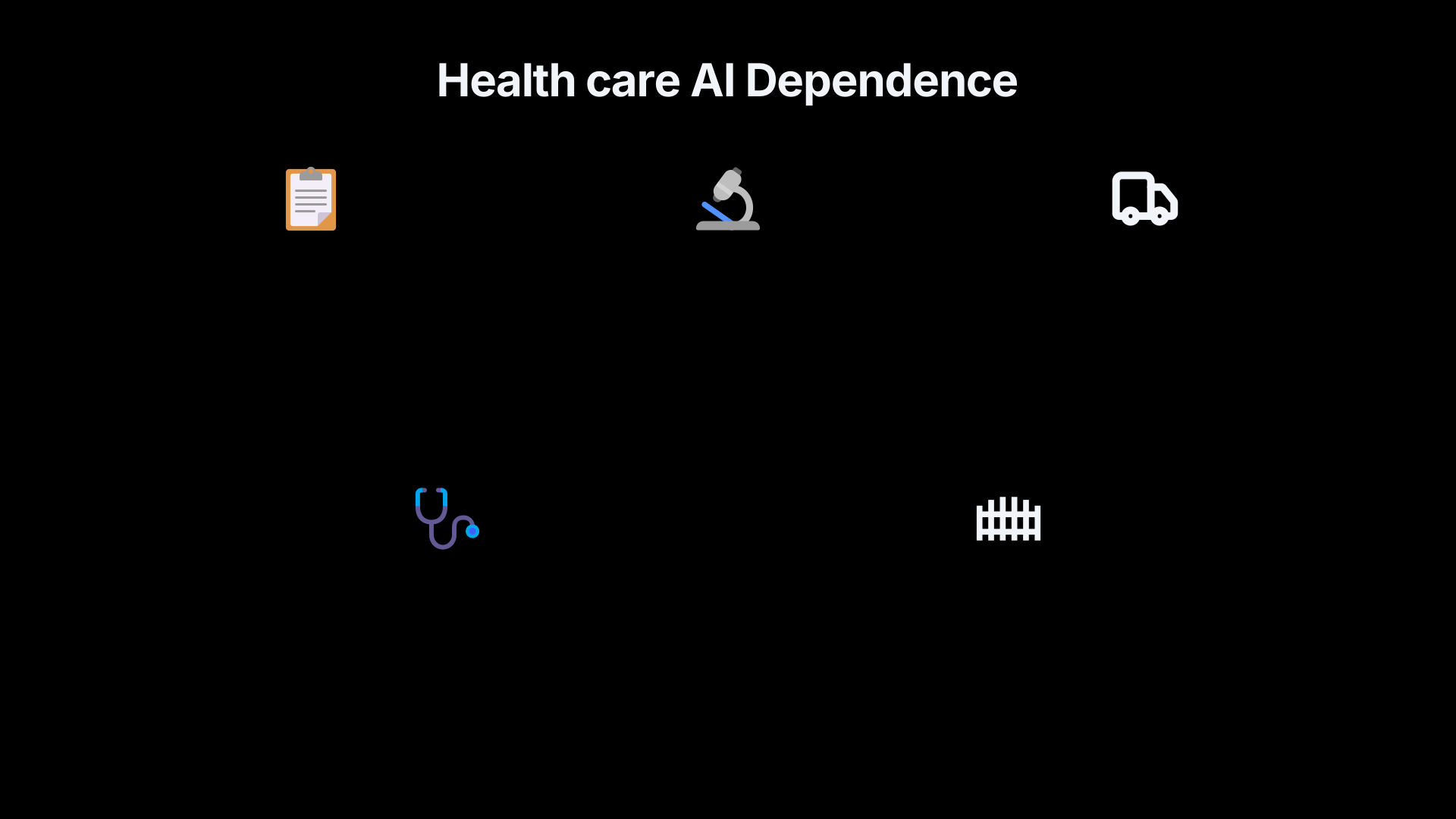
- electronic health records
- imaging archives
- billing systems
- scheduling systems
- procurement platforms
- diagnostic AI
- cloud analytics
- regulatory reporting tools
Once AI capabilities are integrated into these systems, switching vendors becomes extraordinarily difficult because patient safety and continuity of care are involved.
Accounts from healthcare IT migrations repeatedly describe multi-year transitions, massive costs, incomplete data portability, and operational disruption. [LinkedIn]linkedin.comLinkedInThe Hidden Dependency: Vendor Lock-In and the Strategic…February 23, 2026 — In 2019, a large NHS Trust attempted to switch fro…
That creates a dangerous possibility: hospitals may continue using inferior or expensive AI systems simply because migration risk appears too high.
The result could be a paradox. AI may greatly increase humanity’s ability to improve health and longevity while simultaneously concentrating infrastructural control over healthcare intelligence inside a few ecosystems.
This is especially important for the broader AI bloom debate. A future of radically accelerated medicine would matter far less if access to medical intelligence became bottlenecked through narrow commercial gatekeepers.
Education lock-in may shape how future generations think
Education systems face a similar dynamic.
AI tutors, automated grading systems, curriculum planners, accessibility tools, and personalised learning assistants could substantially expand educational access and cognitive empowerment. In optimistic scenarios, AI could help make high-quality education dramatically cheaper and more personalised across the world.
But schools and universities are also unusually sticky institutions. Once a platform becomes embedded into assignments, learning records, teacher workflows, safeguarding systems, and student authentication, switching becomes difficult.
The risk is not only economic dependence. It is cognitive standardisation.
If a handful of platforms mediate how students search, write, receive feedback, organise ideas, and interact with knowledge, those systems may quietly shape educational norms at enormous scale.
The deeper AI becomes integrated into ordinary educational routines, the more difficult institutional pluralism becomes.
This does not necessarily mean centralisation is inevitable. Open-source models, interoperable standards, and modular educational tooling could reduce dependence. But absent those counterweights, educational AI may naturally reward scale and ecosystem integration.
Governments can become locked in through procurement and compliance
Public-sector AI adoption creates another quiet lock-in pathway.
Governments often prefer large vendors because they can satisfy security requirements, provide long-term support, and survive procurement scrutiny. Smaller providers may struggle to navigate those systems even if their technology is competitive.
The UK government’s AI procurement guidance already warns that procurement structures influence competition and long-term market shape. [GOV.UK]GOV.UKGuidelines for AI procurementJune 8, 2020 — 8 Jun 2020 — Government spending can be used to create a fair, competitive market, which leads to better AI systems. Early…
Once governments build AI systems into welfare administration, tax systems, policing support, immigration processing, healthcare infrastructure, or education management, changing providers becomes politically and operationally risky.
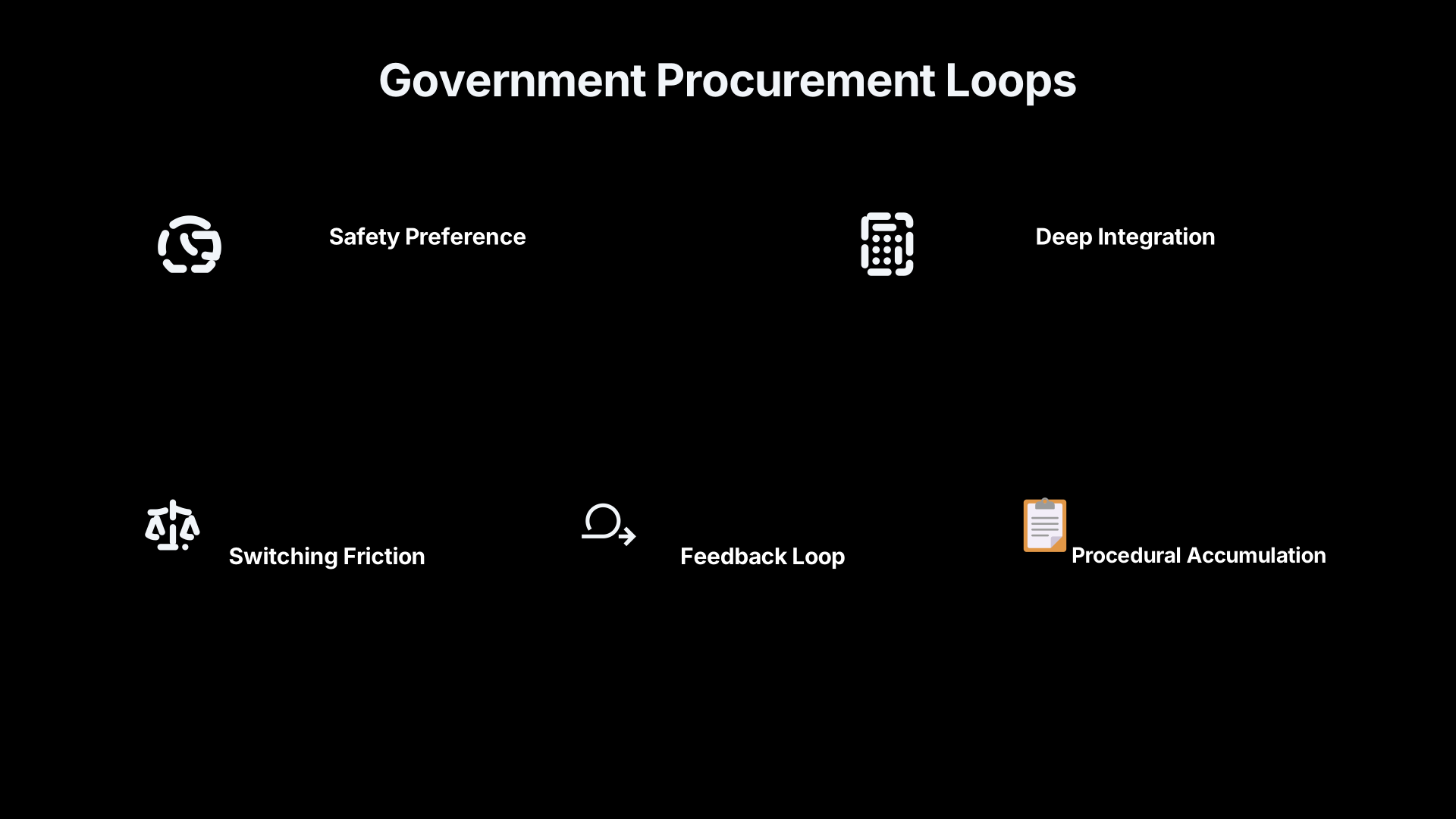
This can create a feedback loop:
- Large platforms win procurement because they appear safer.
- Their systems become deeply integrated.
- Integration increases switching costs.
- High switching costs strengthen incumbent advantage.
- Incumbents become even more attractive in future procurement rounds.
The lock-in therefore grows through procedural accumulation rather than explicit exclusion.
The cloud layer makes AI dependence harder to escape
AI switching costs become more severe because frontier AI increasingly depends on cloud infrastructure controlled by a small number of firms.
Training and deploying advanced models requires vast computing resources, specialised chips, networking systems, and data-centre capacity. As a result, AI developers often rely on partnerships with hyperscale cloud providers.
The FTC’s investigation into major AI partnerships specifically highlighted concerns that these arrangements could restrict multi-cloud flexibility and make migration between cloud providers lengthy and technically difficult. [Federal Trade Commission]ftc.govFederal Trade CommissionFTC Issues Staff Report on AI Partnerships & Investments…January 17, 2025 — 17 Jan 2025 — The potential to inc… [Federal Trade Commission]ftc.govFederal Trade CommissionFTC Issues Staff Report on AI Partnerships & Investments…January 17, 2025 — 17 Jan 2025 — The potential to inc…
This creates a deeper structural issue.
An organisation might believe it is merely choosing an AI model. In practice, it may also be choosing:
- a cloud architecture
- a security framework
- a developer ecosystem
- a compliance stack
- a billing structure
- a data pipeline
- a software ecosystem
AI lock-in therefore increasingly resembles operating-system lock-in at industrial scale.
The more intelligence becomes infrastructural, the more leverage infrastructure providers gain.
Why this matters for the long-term future
The optimistic AI bloom vision depends partly on intelligence becoming abundant and broadly usable. If advanced AI dramatically accelerates science, medicine, automation, and human creativity, humanity could enter a far wealthier and more capable era.
But abundance alone does not determine distribution.
Electricity became abundant without eliminating power utilities. The internet expanded access to knowledge while still concentrating influence inside major platforms. AI may follow a similar pattern: intelligence becomes cheaper overall while control over access pathways becomes more concentrated.
That concentration could matter profoundly if advanced AI eventually shapes:
- scientific research priorities
- medical infrastructure
- educational systems
- industrial automation
- state administration
- public communication
- defence systems
- economic coordination
The core concern is not merely commercial dominance. It is civilisational dependency.
If leaving dominant AI ecosystems becomes prohibitively difficult, then governance choices made by a small number of firms may quietly shape the practical conditions under which future societies think, learn, heal, coordinate, and create.
Lock-in is not inevitable
The existence of switching costs does not prove permanent monopoly.
There are countervailing forces.
Open-source AI models have reduced dependence in some areas by making high-quality systems portable across providers. Multi-cloud strategies can reduce infrastructural concentration. Standardised interfaces and interoperable data formats can make migration easier. Regulators may also pressure dominant firms to improve portability and compatibility.
Some analysts even argue that AI itself could weaken lock-in by helping automate software migration and code translation. [Medium]medium.comAI Is Killing Vendor Lock-InMediumAI Is Killing Vendor Lock-InMarch 10, 2026 — AI Is Killing Vendor Lock-In When code, configs, and deployment logic can be rewritten…
There are also legitimate reasons organisations sometimes prefer integrated ecosystems:
- lower operational complexity
- stronger security coordination
- unified support
- easier compliance
- reduced integration failures
- predictable performance
In hospitals, schools, or government agencies, excessive fragmentation can itself create risk.
The real policy question is therefore not whether all integration is bad. It is whether societies preserve enough interoperability, portability, and institutional flexibility that AI abundance remains contestable rather than quietly captured.
The distinction matters because the long-term promise of AI is extraordinarily large. If advanced AI genuinely helps humanity reduce disease, expand knowledge, automate dangerous labour, and widen human potential, then the structure of the AI ecosystem will influence whether those gains diffuse broadly across civilisation or remain tightly mediated through entrenched platforms.
Endnotes
-
Source: ftc.gov
Link: https://www.ftc.gov/news-events/news/press-releases/2025/01/ftc-issues-staff-report-ai-partnerships-investments-studySource snippet
Federal Trade CommissionFTC Issues Staff Report on AI Partnerships & Investments...January 17, 2025 — 17 Jan 2025 — The potential to inc...
Published: January 17, 2025
-
Source: ftc.gov
Link: https://www.ftc.gov/system/files/ftc_gov/pdf/p246201_aipartnerships6breport_redacted_0.pdfSource snippet
Federal Trade CommissionPartnerships Between Cloud Service Providers and AI...The partnerships might affect AI developer partners by inc...
-
Source: ftc.gov
Title: behind ftcs 6b report large ai partnerships investments
Link: https://www.ftc.gov/policy/advocacy-research/tech-at-ftc/2025/01/behind-ftcs-6b-report-large-ai-partnerships-investmentsSource snippet
Federal Trade CommissionBehind the FTC's 6(b) Report on Large AI Partnerships &...17 Jan 2025 — The partnerships could increase contract...
-
Source: techtarget.com
Link: https://www.techtarget.com/searchenterpriseai/tip/Best-practices-to-avoid-AI-vendor-lock-inSource snippet
TechTarget7 best practices to avoid AI vendor lock-inMarch 30, 2026 — 30 Mar 2026 — AI vendor lock-in is the undesirable dependence a bus...
Published: March 30, 2026
-
Source: itlawco.com
Title: avoiding vendor lock in in data protection and privacy management platforms
Link: https://itlawco.com/avoiding-vendor-lock-in-in-data-protection-and-privacy-management-platforms/Source snippet
Avoiding vendor lock-in in data protection and privacy-...22 Oct 2025 — Learn about avoiding vendor lock-in in data protection and priva...
-
Source: medium.com
Title: AI Is Killing Vendor Lock-In
Link: https://medium.com/design-bootcamp/ai-is-killing-vendor-lock-in-1eb928870540Source snippet
MediumAI Is Killing Vendor Lock-InMarch 10, 2026 — AI Is Killing Vendor Lock-In When code, configs, and deployment logic can be rewritten...
Published: March 10, 2026
-
Source: pmc.ncbi.nlm.nih.gov
Link: https://pmc.ncbi.nlm.nih.gov/articles/PMC9777836/Source snippet
PMCEconomics of Artificial Intelligence in Healthcare: Diagnosis vs...by NN Khanna · 2022 · Cited by 402 — This novel study aims to eval...
-
Source: linkedin.com
Link: https://www.linkedin.com/pulse/hidden-dependency-vendor-lock-in-strategic-tension-rowland-ys3geSource snippet
LinkedInThe Hidden Dependency: Vendor Lock-In and the Strategic...February 23, 2026 — In 2019, a large NHS Trust attempted to switch fro...
Published: February 23, 2026
-
Source: GOV.UK
Title: Guidelines for AI procurement
Link: https://www.gov.uk/government/publications/guidelines-for-ai-procurement/guidelines-for-ai-procurementSource snippet
June 8, 2020 — 8 Jun 2020 — Government spending can be used to create a fair, competitive market, which leads to better AI systems. Early...
Published: June 8, 2020
-
Source: linkedin.com
Link: https://www.linkedin.com/pulse/ai-vendor-lock-in-trap-how-caios-avoid-multi-year-dependency-1uczeSource snippet
top non-technical risks for organizations aiming to scale beyond...Read more...
-
Source: business-reporter.co.uk
Title: vendor lock in and the challenge of data gravity
Link: https://www.business-reporter.co.uk/digital-transformation/vendor-lock-in-and-the-challenge-of-data-gravitySource snippet
Business ReporterVendor lock-in and the challenge of data gravity23 May 2023 — Ravi Mayuram at Couchbase argues that data gravity challen...
Published: May 2023
Additional References
-
Source: institute.global
Title: preparing the nhs for the ai era a digital health record for every citizen
Link: https://institute.global/insights/public-services/preparing-the-nhs-for-the-ai-era-a-digital-health-record-for-every-citizenSource snippet
Preparing the NHS for the AI Era: A Digital Health Record...19 Aug 2024 — Here we propose a digital health record (DHR) to drive improve...
-
Source: pymnts.com
Title: ftc openai [microsoft]({{ ‘ai-bloom-abun/ai-bloom-abun-98d3a6-shared-ai-gai-89312d-ai-platform-l-e1f9a1-microsoft-ope-846027/’ | relative_url }}) pact could bring competition implications
Link: https://www.pymnts.com/artificial-intelligence-2/2025/ftc-openai-microsoft-pact-could-bring-competition-implications/Source snippet
FTC Issues Staff Report on AI Partnerships19 Jan 2025 — “The FTC's report sheds light on how partnerships by big tech firms can create lo...
-
Source: sparkco.ai
Title: enterprise guide to avoiding vendor lock in in ai development
Link: https://sparkco.ai/blog/enterprise-guide-to-avoiding-vendor-lock-in-in-ai-developmentSource snippet
Enterprise Guide to Avoiding Vendor Lock-In in AI...25 Oct 2025 — Learn strategies to prevent vendor lock-in in enterprise AI, focusing...
-
Source: techmonitor.ai
Title: ftc report warns ai partnerships could undermine competition
Link: https://www.techmonitor.ai/ai-and-automation/ftc-report-warns-ai-partnerships-could-undermine-competition/Source snippet
US FTC report warns AI partnerships could undermine...20 Jan 2025 — The FTC has released report analysing AI partnerships between leadin...
-
Source: globalpolicyjournal.com
Title: future ai healthcare will be built low resource environments
Link: https://www.globalpolicyjournal.com/blog/17/03/2026/future-ai-healthcare-will-be-built-low-resource-environmentsSource snippet
The Future of AI Healthcare will be Built in Low-Resource...17 Mar 2026 — A systematic review of EHRs for low-resource settings found th...
-
Source: ghx.com
Title: how cloud and ai are transforming healthcare procurement
Link: https://www.ghx.com/the-healthcare-hub/how-cloud-and-ai-are-transforming-healthcare-procurement/Source snippet
13 Aug 2025 — Discover how cloud computing and AI are reshaping healthcare procurement. Learn how these technologies improve efficiency...
-
Source: cio.com
Link: https://www.cio.com/article/1257417/cios-weigh-the-new-economics-and-risks-of-cloud-lock-in.htmlSource snippet
CIOs weigh the new economics and risks of [cloud lock]({{ 'ai-bloom-abun/ai-bloom-abun-98d3a6-shared-ai-gai-89312d-public-comput-1d5b91-cloud-lock-in-04416a/' | relative_url }})-in14 Dec 2023 — A new opportunity cost...
-
Source: intuitionlabs.ai
Link: https://intuitionlabs.ai/pdfs/ai-in-hospitals-2025-adoption-trends-statistics.pdfSource snippet
IntuitionLabsAI in Hospitals: 2025 Adoption Trends & Statistics17 Oct 2025 — Healthcare leaders have suggested AI could potentially trim...
-
Source: youtube.com
Title: Autodesk’s Secret: BIM Collapse & The Rise of AI Lock-in | Claude AI
Link: https://www.youtube.com/watch?v=Q4v1g_nQhggSource snippet
"AI switching costs" OR "AI lock-in" vendor lock-in cloud Future Tech Trap: Cloud & AI Lock-In Dangers Revealed! #shorts Third Stage Cons...
-
Source: skadden.com
Title: ftc opens inquiry into ai partnership
Link: https://www.skadden.com/insights/publications/2024/02/ftc-opens-inquiry-into-ai-partnershipSource snippet
s, Signaling...6 Feb 2024 — The Federal Trade Commission (FTC) launched an inquiry scrutinizing the investments and partnerships of Alph...
Amazon book picks
Further Reading
Books and field guides related to Hidden AI switching costs. Use these as the next step if you want deeper reading beyond the article.

Applied Artificial Intelligence in Business
This book offers students an introduction to the concepts of big data and artificial intelligence (AI) and their applications in the busi...

Artificial Intelligence in Economics and Finance Theories
As Artificial Intelligence (AI) seizes all aspects of human life, there is a fundamental shift in the way in which humans are thinking of...
Artificial Intelligence for Business
This book seeks to build a shared understanding of Artificial Intelligence (AI) within the global business scenario today and in the near...
Artificial Intelligence for Business
Artificial Intelligence for Business: A Roadmap for Getting Started with AI will provide the reader with an easy to understand roadmap fo...
eBay marketplace picks
Marketplace Samples
Example marketplace items related to this page. Use the search link to explore similar finds on eBay.

Example eBay listing
A.I. Artificial Intelligence Original Movie Poster Signed By Jude Law
USD 125.00 | Shipping USD 25.00 | US

Example eBay listing
Artificial Intelligence D/S Original Movie Poster - 27 x 40"
USD 19.50 | Shipping USD 13.65 | US

Example eBay listing
612388 Artificial Intelligence Movie Science Fiction Drama Wall Print Poster
USD 22.95 | Shipping USD 12.95 | JP

Example eBay listing
Companion - Artificial Intelligence Dark Comedy Cinema Film - POSTER 20"x30"
USD 23.99 | Free shipping | US

Example eBay listing
A.I. Artificial Intelligence Movie Film Poster Art Print
GBP 4.99 | Free shipping | GB

Example eBay listing
A I Artificial Intelligence 6 Movie Poster Art Print Print Classic Rare Gallery
GBP 49.00 | Free shipping | GB

Example eBay listing
AI - Artificial Intelligence (Poster + Slipcase) Blu-Ray
GBP 10.49 | Free shipping | GB

Example eBay listing
A. I. Artificial Intelligence. Jude Law. Original UK Video Poster.
GBP 8.11 | Shipping GBP 3.38 | GB
Topic Tree