Within Robots and Work
Warehouse Robots and Pace
Warehouse robots can cut walking and lifting, but the real test is whether they lower injury risk or simply make human work faster.
On this page
- What warehouse robots take over
- How targets and monitoring can intensify work
- What safer deployment would measure
Page outline Jump by section
Introduction
Warehouse robots are often presented as an early glimpse of an AI-enabled future with less physical drudgery. In many fulfilment centres, that promise is partly real. Autonomous carts now carry shelves instead of forcing workers to walk miles each shift. Robotic pallet systems reduce some heavy lifting. Computer vision can help route goods more efficiently. For workers with chronic back, shoulder, or knee strain, these changes can matter immediately.
 But warehouses also show why automation does not automatically produce humane work. In many facilities, the same systems that reduce walking and lifting also intensify monitoring, tighten productivity targets, and accelerate the pace of labour. Workers may spend less time carrying loads across a building, yet face more repetitive motions per hour, less control over their rhythm, and constant algorithmic measurement. The key question is therefore not simply whether robots can do warehouse work more efficiently. It is whether automation reduces human strain overall, or mainly reorganises labour into a faster and more tightly controlled system.
This tension matters far beyond logistics. Warehouses are one of the clearest real-world tests of the broader AI bloom argument: can advanced automation help remove degrading labour while expanding human flourishing, or will the gains mainly appear as higher output and stronger managerial control?
What warehouse robots take over
Modern warehouses increasingly rely on systems sometimes called “goods-to-person” automation. Instead of workers walking long distances to retrieve items, mobile robots bring shelves or containers to stationary pickers. Other machines handle pallet transport, sorting, scanning, packaging, or inventory movement.
The ergonomic advantages can be substantial. Warehousing has long involved some of the most common causes of musculoskeletal injury: repetitive lifting, awkward postures, pushing heavy loads, overhead reaching, and continuous walking on concrete floors. OSHA identifies repetitive movement and heavy manual handling as major warehouse hazards linked to strains, tendon injuries, and chronic back problems. [OSHA]osha.govOSHAWarehousing - Hazards and Solutions - OSHAWarehousing industry workers may be exposed to ergonomic risk factors in the workplace, suc…
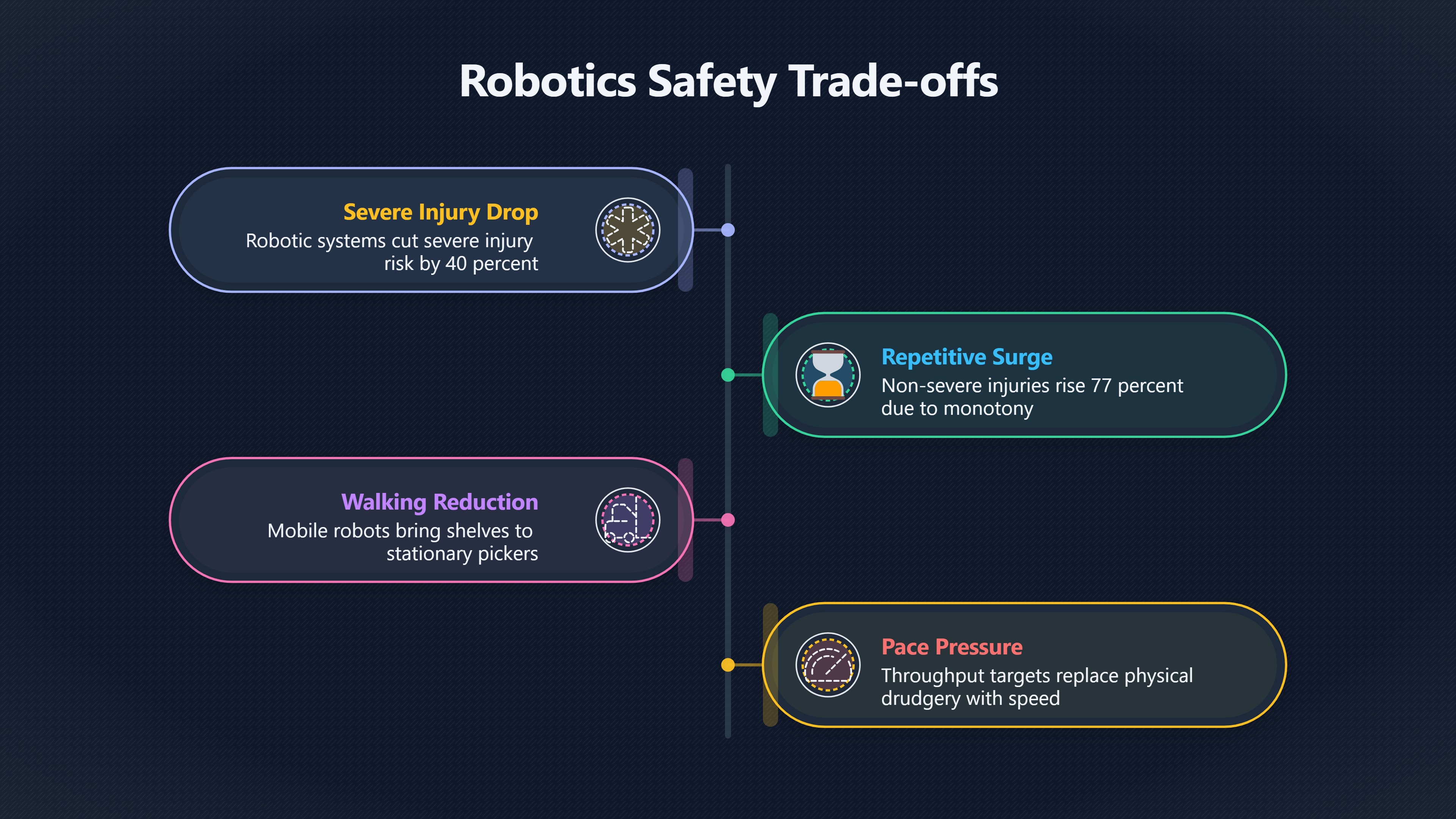
Reducing walking alone can change the physical character of a shift. In older fulfilment centres, workers sometimes covered many miles per day while carrying scanners, lifting products, and navigating large facilities. Robotic systems can cut that travel dramatically. Some workers describe automated warehouses as physically easier than earlier logistics jobs because shelves come to them rather than the reverse. Research and industry reporting also suggest that robotic systems can reduce certain severe injuries associated with lifting and transport tasks. [Sage Journals]journals.sagepub.comSage JournalsWarehouse Robotics and Worker SafetyApr 22, 2025 — Warehouse robotics are associated with a 40% decrease in severe injuries…
This is the strongest version of the optimistic case for robotics and AI-assisted labour. Machines absorb more of the exhausting transport and coordination work, while humans supervise, troubleshoot, inspect, or handle edge cases. In theory, this could become part of a broader transition away from labour organised around bodily wear and tear.
Warehouses matter because they are one of the first sectors where large-scale human-machine collaboration has already become economically normal rather than speculative. They therefore provide unusually concrete evidence about what happens when AI systems meet real labour markets.
Why reduced strain can still mean harsher work
The central problem is that warehouse automation often changes the bottleneck rather than removing pressure altogether.
When robots reduce walking time, companies frequently use the productivity gain to increase throughput expectations. Workers may perform fewer physically diverse tasks and instead repeat the same picking or packing motion at higher frequency for longer periods. Researchers studying warehouse robotics describe this as a trade-off between lower severe injury risk and higher exposure to repetitive strain and pace pressure. [Sage Journals]journals.sagepub.comSage JournalsWarehouse Robotics and Worker SafetyApr 22, 2025 — Warehouse robotics are associated with a 40% decrease in severe injuries…
A 2025 study in Industrial and Labor Relations Review found that warehouse robotics were associated with a roughly 40% decline in severe injuries but also a 77% increase in non-severe injuries. The authors argue that automation can remove some dangerous tasks while simultaneously intensifying repetitive work and speeding remaining tasks. [Sage Journals]journals.sagepub.comSage JournalsWarehouse Robotics and Worker SafetyApr 22, 2025 — Warehouse robotics are associated with a 40% decrease in severe injuries…
That distinction matters. Severe injuries are highly visible and costly. Smaller repetitive-strain injuries, exhaustion, tendon problems, and chronic pain can be less dramatic individually while still degrading workers’ health over time.
In practice, robotic systems often make labour more measurable. Every scan, pick, pause, and route can be tracked. Algorithmic management systems calculate expected rates in real time and compare workers against continuously updated targets. Warehouses have therefore become one of the clearest examples of AI-driven labour coordination.
Research on algorithmic management shows that these systems can increase stress, reduce worker autonomy, and intensify monitoring even outside gig work platforms. [ScienceDirect]sciencedirect.comScienceDirectAlgorithmic management and occupational healthby KH Nilsson · 2025 · Cited by 26 — This study seeks to deepen our understand… In warehouses specifically, ethnographic research has documented workers adapting their behaviour around metrics, timers, and automated performance scoring systems. [arXiv]arxiv.orgarXivFulfillment of the Work Games: Warehouse Workers…13 Aug 2025 — In warehouses, algorithms are used regularly to generate employees…
The result is a paradox familiar to many warehouse employees: the work may feel less brutally physical than older manual logistics, yet also more relentless.
Amazon as the defining case
No company has shaped this debate more than Amazon. Its fulfilment network combines large-scale robotics, dense performance measurement, and extremely fast delivery expectations.
Amazon argues that automation improves safety and efficiency. The company says it has invested billions in safety programmes and reports declines in some injury metrics over recent years. [The Guardian]theguardian.comA key case involves Juan Loera-Gomez, who claims he was injured on the job and eventually fired after advocating for safer conditions. Hi…
Critics, labour advocates, journalists, and some regulators have argued that the same systems also create extraordinary productivity pressure. Multiple reports have linked warehouse injury concerns to pace targets, constant monitoring, and high-output expectations. [U.S. Senate HELP Committee]help.senate.govamazon investigationSenate HELP CommitteeThe Injury-Productivity Trade-off HELP Committee Report12 Dec 2024 — As just one example, in 2022, OSHA reviewed the… [National Employment Law Project]nelp.orgAmazons Outsized Role 5 1 24National Employment Law ProjectAmazon's Outsized Role1 May 2024 — Indeed, within that category (warehousing facilities with 1000+ employe…
A US Senate committee investigation released in 2024 argued that Amazon’s emphasis on speed contributed to unusually high injury rates and accused the company of portraying warehouses as safer than they were. Amazon disputed the report’s conclusions and methodology. [U.S. Senate HELP Committee]help.senate.govamazon investigationSenate HELP CommitteeThe Injury-Productivity Trade-off HELP Committee Report12 Dec 2024 — As just one example, in 2022, OSHA reviewed the… [Business Insider]businessinsider.comAccording to a report by the Senate Committee on Health, Education, Labor, and Pensions (HELP) led by Sanders, Amazon's priority on speed…
California regulators separately fined Amazon over warehouse quota disclosure rules designed to reduce injuries linked to hidden productivity expectations. State officials argued that undisclosed quotas could pressure workers to skip breaks or work at unsafe speeds. Amazon denied using fixed quotas in the way critics described. [MarketWatch]marketwatch.comThis law requires operators to inform workers of any work-related quotas and potential punishments. According to the labor commissioner's…
The broader point is not that robotics inevitably harms workers. It is that robotics deployed inside a business model optimised around ever-faster fulfilment can convert ergonomic gains into throughput gains instead of leisure, recovery, or lower stress.
That distinction reaches beyond one company. Warehouses increasingly compete on delivery speed. Once one major firm achieves faster output through automation, competitors face pressure to match it. Workers can therefore experience a technological arms race in which every efficiency gain becomes a new baseline expectation.

How targets and monitoring can intensify work
The warehouse sector demonstrates how AI systems alter labour not only through machinery but through management.
Older industrial supervision depended heavily on human managers observing workers intermittently. Modern warehouse systems generate continuous streams of data: pick rates, idle time, route efficiency, error frequency, scan timing, and movement patterns. Algorithms can then optimise workflows minute by minute.
Supporters argue this reduces waste and improves consistency. Critics argue it can produce a workplace organised around machine pace rather than human rhythms.
Several patterns recur across reporting and research:
- Continuous pace pressure: Workers often describe pressure to maintain “rate” targets that can shift dynamically depending on demand and system expectations.
- Reduced task variety: Automation can remove some movement-heavy tasks while leaving workers repeating narrow motions thousands of times per shift.
- Less informal recovery time: If walking between shelves once created brief pauses or variation, robotic workflows may compress those gaps.
- Psychological strain: Constant measurement can create anxiety, fear of disciplinary action, or a sense of permanent evaluation.
- Skill narrowing: Some researchers worry that highly optimised workflows reduce opportunities for judgement, learning, or broader operational understanding. arXiv [ScienceDirect]sciencedirect.comScienceDirectAlgorithmic management and occupational healthby KH Nilsson · 2025 · Cited by 26 — This study seeks to deepen our understand… [PMC]pmc.ncbi.nlm.nih.govPMCWorkers' Health under Algorithmic ManagementPMC - NIHby EF Vignola · 2023 · Cited by 66 — New and expanded research is needed to better understand the role of algorithmic management…
This is one reason warehouse automation sits at the centre of debates about labour power in an AI economy. The issue is not only whether jobs disappear. It is whether remaining jobs become more humane or more machine-like.
The contrast is especially striking because the same technologies genuinely can improve physical conditions. A worker may no longer drag heavy carts across a warehouse floor, yet still experience work as exhausting because every second is tracked and optimised.
What safer deployment would actually measure
A warehouse genuinely designed around human flourishing would evaluate robotics differently from a warehouse designed only for maximum throughput.
Most firms primarily measure output: picks per hour, fulfilment speed, shipping accuracy, downtime, and labour cost per unit. Those metrics matter, but they do not fully capture whether automation improves life for workers.
Safer deployment would also measure:
- Total injury burden, not only catastrophic accidents. Repetitive strain, chronic pain, fatigue, and stress-related illness matter even if headline severe injury rates fall.
- Sustainable pace. Can workers maintain expected rates for years without burnout or physical deterioration?
- Worker autonomy. Do employees retain meaningful discretion over pacing, breaks, and task sequencing?
- Task diversity. Does automation eliminate drudgery while expanding higher-skill work, or merely compress labour into narrower repetitive motions?
- Mental wellbeing. Constant surveillance and optimisation can create stress even in physically safer environments.
- Distribution of gains. If robots dramatically increase productivity, do workers receive shorter hours, better pay, greater stability, or stronger bargaining power?
Some regulators are beginning to move in this direction. OSHA has increased attention to warehouse ergonomics and injury risks, while some jurisdictions have introduced rules around quotas and monitoring practices. [GAO]gao.govgao 24 106413GAO[PDF] GAO-24-106413, WORKPLACE SAFETY AND HEALTHSeptember 18, 2024 — In fiscal year 2024, OSHA implemented an inspection program to be… But regulation still largely trails the speed of technological change.
The broader AI bloom question is whether advanced automation will ultimately reduce the amount of human life spent under exhausting industrial discipline, or simply make that discipline more computationally efficient.
The larger lesson for AI and labour
Warehouse robotics reveal something important about the long-term future of AI-driven abundance.
Technology alone does not determine whether productivity gains translate into freedom. The same robotic system can support radically different social outcomes depending on incentives and institutions.
One future path is straightforwardly optimistic. Robots increasingly absorb dangerous transport and lifting tasks. Productivity rises enough to support shorter workweeks, higher wages, safer environments, and lower physical strain. Human workers move toward coordination, maintenance, judgement, and interpersonal roles while machines handle more repetitive labour. In that world, warehouse automation becomes one small part of a civilisation with less bodily exhaustion overall.
The other path is narrower and more extractive. Automation removes some of the worst physical burdens but simultaneously increases surveillance, work intensity, and managerial control. Output rises, delivery speeds improve, and consumers receive convenience, yet workers remain trapped in systems organised around relentless optimisation.
Warehouses matter because both futures are already partially visible. They are among the first large-scale environments where AI systems, robotics, algorithmic management, and human labour interact continuously at industrial scale. The lesson is not that automation fails. It is that abundance and flourishing are not the same thing.
A society can become more technologically capable while still leaving many people exhausted, monitored, and replaceable. The deeper promise of AI bloom is not merely more efficient production. It is the possibility that advanced intelligence and robotics could reduce the share of human life consumed by drudgery altogether. Whether warehouse automation becomes evidence for that future depends less on the robots themselves than on how economic power, workplace design, and productivity gains are ultimately governed.
Endnotes
-
Source: osha.gov
Link: https://www.osha.gov/warehousing/hazards-solutionsSource snippet
OSHAWarehousing - Hazards and Solutions - OSHAWarehousing industry workers may be exposed to ergonomic risk factors in the workplace, suc...
-
Source: sciencedirect.com
Link: https://www.sciencedirect.com/science/article/pii/S0925753525000888Source snippet
ScienceDirectAlgorithmic management and occupational healthby KH Nilsson · 2025 · Cited by 26 — This study seeks to deepen our understand...
-
Source: pmc.ncbi.nlm.nih.gov
Title: PMCWorkers’ Health under Algorithmic Management
Link: https://pmc.ncbi.nlm.nih.gov/articles/PMC9859016/Source snippet
PMC - NIHby EF Vignola · 2023 · Cited by 66 — New and expanded research is needed to better understand the role of algorithmic management...
-
Source: arxiv.org
Link: https://arxiv.org/html/2508.09438v1Source snippet
arXivFulfillment of the Work Games: Warehouse Workers...13 Aug 2025 — In warehouses, algorithms are used regularly to generate employees...
-
Source: arxiv.org
Link: https://arxiv.org/abs/2508.09438 -
Source: help.senate.gov
Title: amazon investigation
Link: https://www.help.senate.gov/imo/media/doc/amazon_investigation.pdfSource snippet
Senate HELP CommitteeThe Injury-Productivity Trade-off HELP Committee Report12 Dec 2024 — As just one example, in 2022, OSHA reviewed the...
-
Source: marketwatch.com
Link: https://www.marketwatch.com/story/amazon-hit-with-5-9-million-fine-as-california-says-it-failed-to-disclose-quotas-to-workers-db03d462Source snippet
This law requires operators to inform workers of any work-related quotas and potential punishments. According to the labor commissioner's...
-
Source: gao.gov
Title: gao 24 106413
Link: https://www.gao.gov/assets/gao-24-106413.pdfSource snippet
GAO[PDF] GAO-24-106413, WORKPLACE SAFETY AND HEALTHSeptember 18, 2024 — In fiscal year 2024, OSHA implemented an inspection program to be...
Published: September 18, 2024
-
Source: amazon.com
Link: https://www.amazon.com/Source snippet
Spend less. Smile more.Free shipping on millions of items. Get the best of Shopping and Entertainment with Prime. Enjoy low prices and gr...
-
Source: journals.sagepub.com
Link: https://journals.sagepub.com/doi/10.1177/00197939251333754Source snippet
Sage JournalsWarehouse Robotics and Worker SafetyApr 22, 2025 — Warehouse robotics are associated with a 40% decrease in severe injuries...
-
Source: theguardian.com
Link: https://www.theguardian.com/technology/2026/apr/22/amazon-workplace-safety-recordSource snippet
A key case involves Juan Loera-Gomez, who claims he was injured on the job and eventually fired after advocating for safer conditions. Hi...
-
Source: nelp.org
Title: Amazons Outsized Role 5 1 24
Link: https://www.nelp.org/app/uploads/2024/05/Amazons-Outsized-Role-5-1-24.pdfSource snippet
National Employment Law ProjectAmazon's Outsized Role1 May 2024 — Indeed, within that category (warehousing facilities with 1000+ employe...
Published: May 2024
-
Source: theguardian.com
Title: [amazon safety]({{ ‘ai-bloom-abun/ai-bloom-abun-98d3a6-robots-labour-66ae30-warehouse-rob-ae3eb8-amazon-safety-1d94d4/’ | relative_url }}) citations osha department of justice
Link: https://www.theguardian.com/technology/2023/mar/02/amazon-safety-citations-osha-department-of-justiceSource snippet
'They're more concerned about profit': Osha, DoJ take on...2 Mar 2023 — In 2021, Amazon warehouses had a rate of 7.7 injuries per 100 wo...
-
Source: businessinsider.com
Link: https://www.businessinsider.com/amazon-injury-rates-worse-than-it-lets-on-bernie-sanders-2024-12Source snippet
According to a report by the Senate Committee on Health, Education, Labor, and Pensions (HELP) led by Sanders, Amazon's priority on speed...
-
Source: humanoidliability.com
Title: warehouse robotics
Link: https://humanoidliability.com/industries/warehouse-robotics/Source snippet
Warehouse Robot Injuries & Liability9 Dec 2025 — Understanding your legal rights after warehouse robot injuries. Learn about Amazon fulfi...
Additional References
-
Source: reddit.com
Link: https://www.reddit.com/r/news/comments/1hgaa9e/amazon_aware_of_warehouse_injury_risk_senate/Source snippet
Amazon aware of warehouse injury risk, Senate report findsAmazon pushes its US warehouse workers to fulfill orders at speeds that could c...
-
Source: ft.com
Link: https://www.ft.com/content/528e3c25-22c7-4c83-b80a-dd07dae92c5dSource snippet
Jessica, an Amazon employee, found robot-assisted warehouse work less physically taxing but also monotonous and mentally draining, prompt...
-
Source: ergo-plus.com
Link: https://ergo-plus.com/wp-content/uploads/niosh-musculoskeletal-disorders-workplace-factors.pdf?x56667=Source snippet
[PDF] Musculoskeletal Disorders and Workplace Factors | Ergo plusThis document is the most comprehensive compilation to date of the epide...
-
Source: fair.work
Link: https://fair.work/en/fw/blog/new-report-reveals-how-ai-and-robotics-are-changing-the-experiences-and-conditions-of-amazon-warehouse-workers/Source snippet
New report reveals how AI and robotics are changing the...5 Jun 2024 — The report sheds light on the experiences of Amazon workers in th...
-
Source: youtube.com
Link: https://www.youtube.com/%40AmazonUKSource snippet
channel of Amazon.co.uk....more. Official YouTube channel of Amazon.co.uk....more...more. amazon.co.ukand 3 more links. Subscr...
-
Source: business.gmu.edu
Title: warehouse automation hasnt made workers safer its just reshuffled risk
Link: https://business.gmu.edu/news/2025-08/warehouse-automation-hasnt-made-workers-safer-its-just-reshuffled-riskSource snippet
Warehouse automation hasn't made workers safer26 Aug 2025 — The robotic fulfillment centers experienced a 40% decrease in severe injuries...
-
Source: aboutamazon.com
Title: amazon response to senator bernie sanders report on workplace safety
Link: https://www.aboutamazon.com/news/policy-news-views/amazon-response-to-senator-bernie-sanders-report-on-workplace-safetySource snippet
Senator Bernie Sanders continues to mislead the American...16 Dec 2024 — The senator makes these sweeping claims based on anonymous anec...
-
Source: onlabor.org
Title: amazons approach to robotics is seriously injuring warehouse workers
Link: https://onlabor.org/amazons-approach-to-robotics-is-seriously-injuring-warehouse-workers/Source snippet
Amazon's Approach to Robotics Is Seriously Injuring...5 May 2022 — The three reports suggest that the higher workplace injury rates in r...
Published: May 2022
-
Source: amazon.co.uk
Link: https://www.amazon.co.uk/Source snippet
Low prices at Amazon on digital cameras, MP3, sports, books, music, DVDs, video games, home & garden...
-
Source: hrgrapevine.com
Title: 2024 12 18 senate report blasts amazon workplace safety record
Link: https://www.hrgrapevine.com/us/content/article/2024-12-18-senate-report-blasts-amazon-workplace-safety-recordSource snippet
Senate report blasts Amazon workplace safety record18 Dec 2024 — The report alleges Amazon warehouses recorded injury rates significantly...
Amazon book picks
Further Reading
Books and field guides related to Warehouse Robots and Pace. Use these as the next step if you want deeper reading beyond the article.
Warehouse Automation and the Dehumanization of Labour
This book explores the automation of warehouse processes and the human-machine relationship, focusing on the impact of technology on the...

Robotization of Work?
In this timely book, Barbara Czarniawska and Bernward Joerges examine the hopes and fears around work and job security inspired by automa...
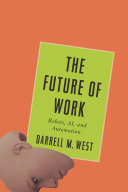
The Future of Work
Looking for ways to handle the transition to a digital economy Robots, artificial intelligence, and driverless cars are no longer things...

The Warehouse Revolution
This book is a must-read for technologists, retailers, and investors who seek to understand the warehouse automation industry and the tra...
Topic Tree