Within Second Eyes
AI stroke triage
Stroke AI can flag possible brain bleeds or vessel blockages faster, but hospitals still need clinicians to verify urgent alerts.
On this page
- What stroke AI tries to detect
- How faster alerts could change emergency care
- False alarms, missed cases, and human review
Page outline Jump by section
Introduction
Stroke treatment is one of the clearest real-world tests of whether AI can safely extend medical attention without replacing clinicians. In many strokes, every minute matters. Brain cells die rapidly when blood flow is blocked, and delays can mean the difference between recovery, permanent disability, or death. Hospitals therefore increasingly use AI systems not to diagnose stroke independently, but to spot possible emergencies faster and move scans to the front of the queue.
 This is a narrower and more practical vision of medical AI than the idea of an autonomous “robot doctor”. In stroke care, the most useful systems today act as rapid warning tools: scanning CT images for signs of bleeding or blocked arteries, alerting specialists on mobile devices, and helping hospitals coordinate emergency transfers. The promise is not perfection. It is faster attention in overloaded systems where specialist review may otherwise be delayed. That makes stroke triage an important early example of the wider “AI bloom” argument: advanced systems may create abundance not by replacing humans outright, but by making scarce expertise available more quickly and across larger populations.
What stroke AI tries to detect
Most current stroke-triage AI systems focus on a few specific emergencies visible on brain imaging.
The first is intracranial haemorrhage: bleeding inside the skull. These cases can deteriorate rapidly and often need immediate neurosurgical or intensive-care assessment. The second is large vessel occlusion (LVO), where a major artery supplying the brain becomes blocked. Patients with LVO strokes may benefit from mechanical thrombectomy, a specialised procedure that physically removes the clot, but treatment effectiveness falls sharply as delays increase. The phrase “time is brain” is widely used in stroke medicine because millions of neurons may die each minute during severe ischemic stroke. [ScienceDirect]ScienceDirectThe impact of artificial intelligence on large vessel…by E Zebrowitz · 2024 · Cited by 9 — The exclusion of MRI brain studies in the investigation of AI utilization for detecting and managing LVOs may have been influenced by several factors.. https://www.sciencedirect.com/science/article/pii/S2666521224000The study…Read more [2arXiv]2arXivMDPIA Scoping Review of Brainomix e-Stroke, Aidoc, RapidAI…by M Dorochowicz · 2026 — New Study Finds RapidAI Significantly Outperforms…. Source panel: Citations. Accessed May 19, 2026…
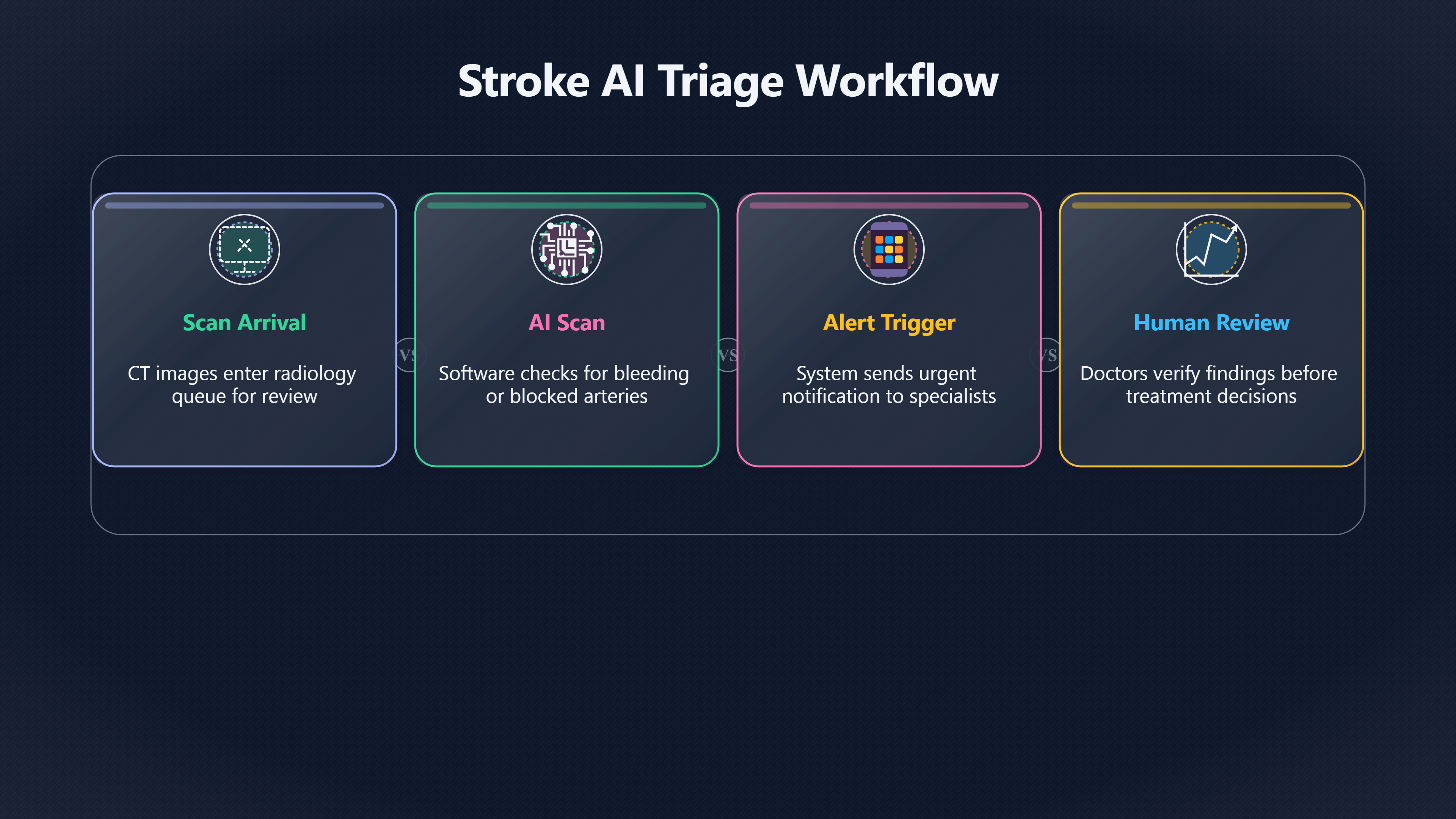
Modern stroke AI systems usually analyse CT or CT angiography scans immediately after imaging. If the software detects signs suggesting bleeding or vessel blockage, it can send alerts to radiologists, neurologists, or stroke teams, often through dedicated mobile platforms. Companies including [Viz.ai]viz.aiOpen source on viz.ai., [RapidAI]rapidai.comOpen source on rapidai.com., [Aidoc]aidoc.comOpen source on aidoc.com., and [Brainomix]brainomix.comOpen source on brainomix.com. have developed systems designed for this workflow. [ScienceDirect]ScienceDirectThe impact of artificial intelligence on large vessel…by E Zebrowitz · 2024 · Cited by 9 — The exclusion of MRI brain studies in the investigation of AI utilization for detecting and managing LVOs may have been influenced by several factors.. https://www.sciencedirect.com/science/article/pii/S2666521224000The study…Read more [2Aidoc | Clinical AI]2Aidoc | Clinical AI2 From Detection to Treatment: Stroke Technology That's Changing Lives. Source panel: Citations. Accessed May 19, 2026…
The systems are usually designed as triage software rather than autonomous diagnosis tools. That distinction matters. In practice, the software may reorder worklists, push urgent notifications to clinicians, or highlight suspicious scan regions for review. Final decisions remain with human clinicians.
How faster alerts could change emergency care
The strongest argument for stroke AI is operational rather than magical. Hospitals often already know how to treat stroke effectively. The problem is that emergency care is fragmented, time-pressured, and unevenly staffed.
A patient may arrive at a smaller hospital overnight with no stroke specialist immediately available. Radiologists may be reviewing many scans simultaneously. Neurologists may need to be contacted manually. In some regions, patients requiring thrombectomy must be transferred to another centre entirely. AI systems aim to compress these coordination delays.
Several studies suggest these tools can reduce “door-to-treatment” times. A 2020 prospective trial examining AI-assisted intracranial haemorrhage detection found that flagged urgent CT cases reached radiologist communication substantially faster than unflagged cases. The study reported median turnaround times dropping from roughly 132 minutes to 73 minutes for AI-flagged haemorrhage cases. [arXiv]arXivMDPIA Scoping Review of Brainomix e-Stroke, Aidoc, RapidAI…by M Dorochowicz · 2026 — New Study Finds RapidAI Significantly Outperforms…. Source panel: Citations. Accessed May 19, 2026…
Research on AI-assisted large vessel occlusion workflows has also suggested reductions in transfer and treatment delays. A retrospective study of Viz.ai-assisted stroke triage reported faster time-to-treatment metrics in transferred stroke patients after AI-supported alerting was introduced. [viz.ai]viz.aiViz.ai Receives FDA 510(k) Clearance for Artificial Intelligence…Feb 8, 2024 — New AI algorithm enables precise and reliable quantification of intracerebral hemorrhage to make accurate and timely treatment decis. https://www.viz.ai/news/viz-ai-receives-fda-510k-clearance-for-artificial-intelligence-algorithm-for-the-quantification-of-intracerebral-hemorrhageReceives FDA 510(k) Clearance for Artificial Intelligence…Feb 8, 2024 — New AI algorithm enables precise and reliable quantification o…. Source panel: Citations. Accessed May 19, 2026…
The gains may sound modest in ordinary terms — tens of minutes rather than revolutionary leaps — but stroke medicine is unusually sensitive to time. Even relatively small reductions in delay can affect disability outcomes across large populations.
This creates an important point for the broader AI flourishing debate. The value may not come from superhuman diagnosis alone. It may come from making healthcare systems respond with greater speed and coordination under pressure. In that sense, stroke AI resembles air-traffic control software or industrial monitoring systems more than a science-fiction replacement doctor. It amplifies responsiveness in environments where humans are overloaded.
Why stroke care is a particularly difficult AI environment
Stroke medicine is not an easy showcase for AI. Brain scans are messy, stroke symptoms vary enormously, and even specialists disagree on difficult cases.
Large vessel occlusion detection is especially challenging because some clots are subtle or appear in smaller arteries. A 2024 study comparing RapidAI with experienced human readers found that expert clinicians still outperformed the software in detecting vessel occlusions in real-world settings. [American Heart Association Journals]American Heart Association JournalsRapidAI Compared With Human Readers of Acute Stroke…23 Jan 2024 — Experienced readers of acute stroke imaging can identify LVOs and MVOs with higher accuracy than RapidAI software in. https://www.ahajournals.org/doi/10.1161/SVIN.123.001American Heart Association JournalsRapidAI Compared With Human Readers of Acute Stroke…23 Jan 2024 — Experienced readers of acute stro…
That matters because triage systems operate under asymmetric risks:
- A missed stroke can delay life-saving treatment.
- A false positive alert can flood clinicians with unnecessary alarms.
- Over-alerting may train staff to ignore notifications altogether.
- Under-detection may create false reassurance.
Recent reviews repeatedly warn that high benchmark accuracy does not automatically translate into clinical usefulness. A 2025 review on stroke AI pitfalls argued that impressive technical performance can still fail clinically if systems are poorly integrated into real medical workflows or trained on narrow datasets that do not generalise well. [j-nn.org]j-nn.orgStroke Sensitivity Calculation in Medical Emergency Calls…by E Iversen · 2025 · Cited by 2 — This study explored the ability of EMCCs…. Source panel: Citations. Accessed May 19, 2026…
A 2026 scoping review of stroke imaging AI similarly concluded that performance remains variable, particularly for more difficult medium vessel occlusions and perfusion analysis. [MDPI]Source panel: Citations. Accessed May 19, 2026MDPIA Scoping Review of Brainomix e-Stroke, Aidoc, RapidAI…by M Dorochowicz · 2026 — New Study Finds RapidAI Significantly Outperforms…
This is one reason stroke AI remains heavily supervised. In real hospitals, clinicians do not simply accept the software’s output as truth. They cross-check images, compare symptoms, examine patients directly, and weigh alternative explanations such as seizures, migraines, tumours, or old strokes that can confuse algorithms.
False alarms, missed cases, and human review
The central safety issue is not whether AI can detect some strokes. It clearly can. The harder question is whether clinicians can use these systems without becoming over-reliant on them.
Researchers sometimes call this “automation bias”: humans begin trusting computer suggestions too readily, especially in fast-moving environments. Emergency medicine is particularly vulnerable because staff are already under cognitive strain.
Evidence of this concern is emerging even in broader clinical AI research. A recent Harvard-linked emergency triage study found that AI systems sometimes improved diagnostic performance, but outside experts warned that clinicians might increasingly defer to machine outputs rather than independently reassessing patients. [The Guardian]The GuardianAI outperforms doctors in Harvard trial of emergency triage diagnosesApril 30, 2026 — A Harvard study published in Science reveals that artificial intelligence (AI), specifically OpenAI's o1 reasoning model, outperformed human doctors in emergency triage diagnoses.. https://www.theguardian.com/technology/2026/apr/30/ai-outperforms-doctors-in-harvard-trial-of-emergency-triage-diagnosesIn tests involving the review of 76 emergency room patient cases, AI correctly identified diagnoses in 67% of cases, surpassing human doc…. Source panel: Citations. Accessed May 19, 2026…
Stroke care magnifies this tension because the stakes are immediate. An incorrect “all clear” from AI could potentially delay escalation for a critically ill patient. Conversely, excessive false alarms can overwhelm already stressed stroke teams.
This is why many hospitals deploy these systems as prioritisation aids rather than replacements for expert reading. AI may move a scan higher in the queue or trigger a secondary review, but clinicians still verify the findings before treatment decisions are made.
In practice, the safest workflow often looks less like “AI diagnoses stroke” and more like:
- Imaging is performed.
- AI rapidly scans the images.
- Suspicious findings trigger alerts.
- Specialists review the images and clinical context.
- Humans make treatment decisions.
That layered model is slower than full automation but substantially safer.
The deeper significance for AI-enabled healthcare
Stroke triage matters beyond stroke itself because it tests a broader theory about how advanced AI could reshape medicine.
Many healthcare shortages are fundamentally shortages of attention. Specialist expertise is unevenly distributed, expensive to train, and difficult to scale quickly. AI systems may help by widening the effective reach of existing experts rather than replacing them entirely.
This is especially important for rural hospitals, lower-resource health systems, and overnight emergency care where immediate specialist review may not always be available. Some newer systems are explicitly marketed around this equity argument: helping smaller centres identify stroke emergencies earlier so patients can be transferred more quickly to thrombectomy-capable hospitals. [rapidai.com]“These real-world…Read more. https://www.rapidai.com/press-release/new-study-finds-rapidai-significantly-outperforms-viz.ai-in-detecting-medium-vessel-occlusions-in-stroke-patientsNew Study Finds RapidAI Significantly Outperforms Viz.ai…In addition, RapidAI is the only perfusion software with an FDA indication fo…. Source panel: Citations. Accessed May 19, 2026…
The larger “AI bloom” optimism rests partly on this idea. Human flourishing at scale may depend less on fully autonomous systems than on intelligence becoming more available throughout society: more medical review capacity, more rapid coordination, more specialist support, and fewer catastrophic oversights caused by overload.
Stroke AI does not prove that future vision. But it provides a grounded example of what the early stages might look like: machines acting as fast, tireless monitors inside human institutions, helping clinicians notice urgent problems sooner while humans retain responsibility for judgement.

What would count as real success
The strongest evidence for stroke AI will not be flashy benchmark scores. It will be measurable changes in patient outcomes across ordinary hospitals.
The key questions are practical:
- Are patients treated faster?
- Are more patients receiving thrombectomy in time?
- Are disability rates improving?
- Are smaller hospitals gaining access to specialist-level triage support?
- Do clinicians trust the systems appropriately without over-trusting them?
- Are benefits reaching overstretched health systems rather than only wealthy hospitals?
The field is still young enough that many of these answers remain incomplete. Some studies show promising workflow improvements, while others show meaningful limitations in real-world accuracy. [ScienceDirect]ScienceDirectThe impact of artificial intelligence on large vessel…by E Zebrowitz · 2024 · Cited by 9 — The exclusion of MRI brain studies in the investigation of AI utilization for detecting and managing LVOs may have been influenced by several factors.. https://www.sciencedirect.com/science/article/pii/S2666521224000The study…Read more [American Heart Association Journals]American Heart Association JournalsRapidAI Compared With Human Readers of Acute Stroke…23 Jan 2024 — Experienced readers of acute stroke imaging can identify LVOs and MVOs with higher accuracy than RapidAI software in. https://www.ahajournals.org/doi/10.1161/SVIN.123.001American Heart Association JournalsRapidAI Compared With Human Readers of Acute Stroke…23 Jan 2024 — Experienced readers of acute stro…
That uncertainty is important. Stroke AI is not yet a solved success story. But it is one of the clearest demonstrations of how AI may become useful in medicine before anything resembling artificial general intelligence arrives. The near-term opportunity is not omniscient machine doctors. It is safer escalation, earlier attention, and better coordination in moments where minutes matter most.
References
[- Viz.ai(https://www.viz.ai)](#endnote-10 “
Source snippet
Receives FDA 510(k) Clearance for Artificial Intelligence...Feb 8, 2024 — New AI algorithm enables precise and reliable quantification o...") [- RapidAI([https://www.rapidai.com](https://www.rapidai.com))](#endnote-18 "...
Source snippet
RapidAI Receives First and Only FDA 510(k) Clearance of...Apr 18, 2023 — Rapid NCCT Stroke uses artificial intelligence to analyze non-c...")...
Endnotes
Additional References
[1] ScienceDirectThe impact of artificial intelligence on large vessel…by E Zebrowitz · 2024 · Cited by 9 — The exclusion of MRI brain studies in the investigation of AI utilization for detecting and managing LVOs may have been influenced by several factors.. https://www.sciencedirect.com/science/article/pii/S2666521224000
2
8
0.
Source snippet
The study...Read more. Source panel: Citations. Accessed May 19, 2026...
[2] arXivA Prospective Randomized Clinical Trial for Measuring Radiology Study Reporting Time on Artificial Intelligence-Based Detection of Intracranial Hemorrhage in Emergent Care Head CT. https://arxiv.org/abs/2002.12
5
1
- Source panel: Citations. Accessed May 19, 2026.
[3] ScienceDirectAI in Acute Cerebrovascular Disorders: What can the…by Y Zhang · 2024 · Cited by 1 — For example, Aidoc, Avicenna.AI, RapidAI, and Viz.AI all include applications that identify large vessel occlusions on. https://www.sciencedirect.com/science/article/abs/pii/S0037198X24000
1
4
2.
Source snippet
CT angiograms, triage patients, and...Read more. Source panel: Citations. Accessed May 19, 2026...
| [4] Aidoc | Clinical AIStroke AI Package Receives FDA ClearanceOur FDA-cleared stroke AI solution for triage of ischemic and hemorrhagic strokes enables faster diagnosis, improves patient outcomes, and more.. https://www.aidoc.com/learn/blog/stroke-ai/. Source panel: Citations. Accessed May 19, 2026. |
[5] brainomix.comBrainomixThis study set out to explore the real-world impact of artificial intelligence-driven decision support imaging software for patients with acute ischemic stroke…Read more. https://www.brainomix.com/brain/.
<details class="endnote-snippet"><summary>Source snippet</summary><p>BrainomixThis study set out to explore the real-world impact of artificial intelligence-driven decision support imaging software for pati.... Source panel: Citations. Accessed May 19, 2026...</p></details>
[6] Methods. A retrospective…Read more. https://www.viz.ai/publications/ai-triage-transferred-lvo-stroke-patients.
<details class="endnote-snippet"><summary>Source snippet</summary><p>AI-Based Triage in Transferred LVO Stroke Patients - Viz.ai13 Apr 2021 — We hypothesize that the Viz application will decrease time-to-tr.... Source panel: Citations. Accessed May 19, 2026...</p></details>
[7] j-nn.orgRethinking Clinical AI Applications in Stroke - Pitfalls…by S Park · 2025 · Cited by 3 — This narrative review examines common pitfalls in developing and applying AI models in stroke care.. https://www.j-nn.org/journal/view.php?number=
2
0
6.
Source snippet
High performance alone does not ensure...Read more. Source panel: Citations. Accessed May 19, 2026...
[8]… intracranial hemorrhage detection…Read more. https://www.mdpi.com/1648-9144/62/3/
5
8
2.
Source snippet
MDPIA Scoping Review of Brainomix e-Stroke, Aidoc, RapidAI...by M Dorochowicz · 2026 — New Study Finds RapidAI Significantly Outperforms.... Source panel: Citations. Accessed May 19, 2026...
[9] rapidai.comAdvanced AI for Ischemic StrokeNCCT Stroke. Improve equity of care with the only FDA-cleared NCCT imaging solution for suspected LVO. Make early and time-sensitive treatment and transfer…Read more. https://www.rapidai.com/neurovascular/ischemic-stroke.
<details class="endnote-snippet"><summary>Source snippet</summary><p>Advanced AI for Ischemic StrokeNCCT Stroke. Improve equity of care with the only FDA-cleared NCCT imaging solution for suspected LVO. Mak.... Source panel: Citations. Accessed May 19, 2026...</p></details>
[10] viz.aiViz.ai Receives FDA 510(k) Clearance for Artificial Intelligence…Feb 8, 2024 — New AI algorithm enables precise and reliable quantification of intracerebral hemorrhage to make accurate and timely treatment decis. https://www.viz.ai/news/viz-ai-receives-fda-510k-clearance-for-artificial-intelligence-algorithm-for-the-quantification-of-intracerebral-hemorrhage.
<details class="endnote-snippet"><summary>Source snippet</summary><p>Receives FDA 510(k) Clearance for Artificial Intelligence...Feb 8, 2024 — New AI algorithm enables precise and reliable quantification o.... Source panel: Citations. Accessed May 19, 2026...</p></details>
[11] viz.aiViz.ai Closes 2025 with Record Scale and Patient Impact12 Jan 2026 — Viz.ai closed 2025 with record growth and patient impact, achieving profitability in its healthcare business, expanding to nearly 2000…. https://www.viz.ai/news/viz-ai-closes-2025-with-record-scale-and-patient-impact.
<details class="endnote-snippet"><summary>Source snippet</summary><p>Closes 2025 with Record Scale and Patient Impact12 Jan 2026 — Viz.ai closed 2025 with record growth and patient impact, achieving profita.... Source panel: Citations. Accessed May 19, 2026...</p></details>
[12] viz.aiViz.ai Receives FDA 510(k) Clearance for Viz™ SUBDURAL…AI-powered Viz SUBDURAL (SDH) automatically detects subdural hemorrhage, enables effective triage and optimal care.. https://www.viz.ai/news/viz-ai-receives-fda-510-k-clearance-for-viz-subdural-sdh.
<details class="endnote-snippet"><summary>Source snippet</summary><p>Receives FDA 510(k) Clearance for Viz™ SUBDURAL...AI-powered Viz SUBDURAL (SDH) automatically detects subdural hemorrhage, enables effec.... Source panel: Citations. Accessed May 19, 2026...</p></details>
| [13] viz.aiViz™ Hemorrhage | AI-Powered Neurovascular Care…Viz Hemorrhage harnesses the power of AI to provide precise and reliable detection and quantification of intracerebral hemorrhages.. https://www.viz.ai/hemorrhage. |
<details class="endnote-snippet"><summary>Source snippet</summary><p>Viz™ Hemorrhage | AI-Powered Neurovascular Care...Viz Hemorrhage harnesses the power of AI to provide precise and reliable detection and.... Source panel: Citations. Accessed May 19, 2026...</p></details>
[14] viz.aiNavigating Intracerebral Hemorrhage: AI-Powered Precision…Jul 22, 2025 — Automated Identification and Measurement: Viz.ai automatically identifies hemorrhages and provides consistent quantification of hemorrhage. https://www.viz.ai/blog/navigating-intracerebral-hemorrhage.
<details class="endnote-snippet"><summary>Source snippet</summary><p>Navigating Intracerebral Hemorrhage: AI-Powered Precision...Jul 22, 2025 — Automated Identification and Measurement: Viz.ai automaticall.... Source panel: Citations. Accessed May 19, 2026...</p></details>
[15] viz.aiAI-powered Stroke Triage System Performance in the WildLearn how Viz™ LVO become the first cleared artificial intelligence based software to detect large vessel occlusion (LVO) stroke and how you can achieve:…Re. https://www.viz.ai/clinical-validation/ai-powered-stroke-triage-system-peformance.
<details class="endnote-snippet"><summary>Source snippet</summary><p>AI-powered Stroke Triage System Performance in the WildLearn how Viz™ LVO become the first cleared artificial intelligence based software.... Source panel: Citations. Accessed May 19, 2026...</p></details>
[16] viz.aiAutomated Detection of Intracerebral Hemorrhage Using AIDec 22, 2021 — Viz ICH is an AI‐enhanced platform that may help in the diagnosis and detection of ICH, with a sensitivity of 89.3 and a specificity of 99.4% i. https://www.viz.ai/publications/ai-detection-intracerebral-hemorrhage.
<details class="endnote-snippet"><summary>Source snippet</summary><p>Automated Detection of Intracerebral Hemorrhage Using AIDec 22, 2021 — Viz ICH is an AI‐enhanced platform that may help in the diagnosis.... Source panel: Citations. Accessed May 19, 2026...</p></details>
[17] “These real-world…Read more. https://www.rapidai.com/press-release/new-study-finds-rapidai-significantly-outperforms-viz.ai-in-detecting-medium-vessel-occlusions-in-stroke-patients.
<details class="endnote-snippet"><summary>Source snippet</summary><p>New Study Finds RapidAI Significantly Outperforms Viz.ai...In addition, RapidAI is the only perfusion software with an FDA indication fo.... Source panel: Citations. Accessed May 19, 2026...</p></details>
[18] rapidai.comRapidAI Receives First and Only FDA 510(k) Clearance of…Apr 18, 2023 — Rapid NCCT Stroke uses artificial intelligence to analyze non-contrast CT (NCCT) images to determine suspicion of ICH and LVO.Read more. https://www.rapidai.com/press-release/ncct-stroke.
<details class="endnote-snippet"><summary>Source snippet</summary><p>RapidAI Receives First and Only FDA 510(k) Clearance of...Apr 18, 2023 — Rapid NCCT Stroke uses artificial intelligence to analyze non-c.... Source panel: Citations. Accessed May 19, 2026...</p></details>
[19] FDA-cleared ICH…Read more. https://www.aidoc.com/learn/clinical-studies/performance-comparison-of-two-ai-based-intracranial-hemorrhage-detection-tools-on-head-ct-in-a-real-world-clinical-setting/.
<details class="endnote-snippet"><summary>Source snippet</summary><p>Performance Comparison of Two AI-Based Intracranial...Feb 6, 2026 — Performance Comparison of Two AI-Based Intracranial Hemorrhage Detec.... Source panel: Citations. Accessed May 19, 2026...</p></details>
[20] sciencedirect.comStroke Sensitivity Calculation in Medical Emergency Calls…by E Iversen · 2025 · Cited by 2 — This study explored the ability of EMCCs to detect strokes in medical emergency calls using an alternative. https://www.sciencedirect.com/science/article/pii/S0196064425002
2
2
7.
Source snippet
Stroke Sensitivity Calculation in Medical Emergency Calls...by E Iversen · 2025 · Cited by 2 — This study explored the ability of EMCCs.... Source panel: Citations. Accessed May 19, 2026...
[21] American Heart Association JournalsRapidAI Compared With Human Readers of Acute Stroke…23 Jan 2024 — Experienced readers of acute stroke imaging can identify LVOs and MVOs with higher accuracy than RapidAI software in. https://www.ahajournals.org/doi/10.1161/SVIN.123.001
1
4
5.
Source snippet
a real‐world setting.Read more. Source panel: Citations. Accessed May 19, 2026...
[22] The GuardianAI outperforms doctors in Harvard trial of emergency triage diagnosesApril 30, 2026 — A Harvard study published in Science reveals that artificial intelligence (AI), specifically OpenAI’s o1 reasoning model, outperformed human doctors in emergency triage diagnoses.. https://www.theguardian.com/technology/2026/apr/30/ai-outperforms-doctors-in-harvard-trial-of-emergency-triage-diagnoses.
<details class="endnote-snippet"><summary>Source snippet</summary><p>In tests involving the review of 76 emergency room patient cases, AI correctly identified diagnoses in 67% of cases, surpassing human doc.... Source panel: Citations. Accessed May 19, 2026...</p></details>
[23] nih.govA retrospective analysis comparing AIDoc and RAPIDAI in the…by M Bankston · 2025 · Cited by 1 —…. https://pmc.ncbi.nlm.nih.gov/articles/PMC12164790/.
<details class="endnote-snippet"><summary>Source snippet</summary><p>RAPIDAI is another AI software that has been FDA approved for analysis of CTA scans for LVOs. Herein, we present a single-center...Read.... Source panel: Citations. Accessed May 19, 2026...</p></details>
[24] ClinicalTrialsAutomated Detection and Triage of Large Vessel…Viz uses artificial intelligence to automatically detect, triage and notify stroke specialists of suspected large vessel occlusion (LVOs) and computed…Re. https://clinicaltrials.gov/study/NCT04142
8
7
9.
Source snippet
Automated Detection and Triage of Large Vessel...Viz uses artificial intelligence to automatically detect, triage and notify stroke spec.... Source panel: More. Accessed May 19, 2026...
[25] nih.govAutomated Emergent Large Vessel Occlusion Detection Using…by K Sarhan · 2025 · Cited by 6 — Real-world experience with artificial intelligence-based triage in transferred large vessel occlusion stroke patients.. https://pmc.ncbi.nlm.nih.gov/articles/PMC12596299/.
<details class="endnote-snippet"><summary>Source snippet</summary><p>Cerebrovasc Dis. 2021;50(4):450–5...Read more. Source panel: More. Accessed May 19, 2026...</p></details>
[26] nih.govAssessing Risk in Implementing New Artificial Intelligence…by A Nord-Bronzyk · 2025 · Cited by 14 — This paper explores risk surrounding these issues in an analysis of a case study involving a machine learning. https://pmc.ncbi.nlm.nih.gov/articles/PMC11785855/.
<details class="endnote-snippet"><summary>Source snippet</summary><p>triage tool called the Score for Emergency Risk. Source panel: More. Accessed May 19, 2026...</p></details>
[27] Viz.ai: Improving Outcomes for Stroke Victims Using Artificial Intelligence (Special Episode). https://www.youtube.com/watch?v=jpewc52m4tg.
<details class="endnote-snippet"><summary>Source snippet</summary><p>4 AI in stroke care: risks and strategies for implementation. Source panel: Citations. Accessed May 19, 2026...</p></details>
[28] NBK610423. https://www.ncbi.nlm.nih.gov/books/NBK610423/.
<details class="endnote-snippet"><summary>Source snippet</summary><p>Review - RapidAI for Stroke Detection - NCBI - NIHRapidAI (iSchemaView, Inc., Menlo Park, California) is an AI-enabled software platform. Source panel: Citations. Accessed May 19, 2026...</p></details>
[29] U.S. Food and Drug Administration We Regulate Food Drugs, Medical Devices, Radiation-Emitting Products, Vaccines, Blood, and Biologics, A. https://www.fda.gov/.
<details class="endnote-snippet"><summary>Source snippet</summary><p>U.S. Food and Drug AdministrationWe Regulate Food Drugs, Medical Devices, Radiation-Emitting Products, Vaccines, Blood, and Biologics, An. Source panel: Citations. Accessed May 19, 2026...</p></details>
[30] K221240. https://www.accessdata.fda.gov/cdrh_docs/pdf22/K221240.pdf.
<details class="endnote-snippet"><summary>Source snippet</summary><p>fda.govK221240 Trade - accessdata.fda.govApr 18, 2022 — BriefCase is a radiological computer-assisted triage and notification software de. Source panel: Citations. Accessed May 19, 2026...</p></details>
[31] fda permits marketing clinical decision support software alerting providers potential stroke. https://www.fda.gov/news-events/press-announcements/fda-permits-marketing-clinical-decision-support-software-alerting-providers-potential-stroke.
<details class="endnote-snippet"><summary>Source snippet</summary><p>FDA permits marketing of clinical decision support software...Feb 13, 2018 — The Viz.AI Contact application is designed to analyze CT im. Source panel: Citations. Accessed May 19, 2026...</p></details>
[32] full. https://www.frontiersin.org/journals/neurology/articles/10.3389/fneur.2024.1389056/full.
<details class="endnote-snippet"><summary>Source snippet</summary><p>Artificial intelligence to enhance prehospital stroke...by ZC Wolcott · 2024 · Cited by 24 — We provide commentary to highlight potentia. Source panel: Citations. Accessed May 19, 2026...</p></details>
[33] How artificial intelligence is helping to speed up the diagnosis and treatment of stroke patients. https://www.youtube.com/watch?v=yaJ6HgGNzf
4.
Source snippet
2 From Detection to Treatment: Stroke Technology That's Changing Lives. Source panel: Citations. Accessed May 19, 2026...
[34] From Detection to Treatment: Stroke Technology That’s Changing Lives. https://www.youtube.com/watch?v=v2SDUeDvDv
0.
Source snippet
3 Viz.ai: Improving Outcomes for Stroke Victims Using Artificial Intelligence (Special Episode). Source panel: Citations. Accessed May 19, 2026...
[35] AI in stroke care: risks and strategies for implementation. https://www.youtube.com/watch?v=TIYNED-5l5w.
<details class="endnote-snippet"><summary>Source snippet</summary><p>5 Panel Discussion | AI, Tele-Stroke & Digital Health in Stroke Care. Source panel: Citations. Accessed May 19, 2026...</p></details>
| [36] Panel Discussion | AI, Tele-Stroke & Digital Health in Stroke Care. https://www.youtube.com/watch?v=OPp2sAuS8B |
- Source panel: Citations. Accessed May 19, 2026.
[37] nature.com. https://www.nature.com/articles/s41598-026-37069-x.
<details class="endnote-snippet"><summary>Source snippet</summary><p>Sci Rep 16, 7139 (2026)...Read more. Source panel: More. Accessed May 19, 2026...</p></details>
[38] 449.full. https://jnis.bmj.com/content/neurintsurg/17/5/449.full.pdf.
<details class="endnote-snippet"><summary>Source snippet</summary><p>emergent large vessel occlusion detection software...by AS Cruz · 2025 — As AI- ELVO detection becomes more ingrained in stroke workflow. Source panel: More. Accessed May 19, 2026...</p></details>
[39] Food and Drug…Read more. https://radiologybusiness.com/topics/healthcare-management/healthcare-policy/fda-clears-ai-triage-tool-detects-acute-infarcts-noncontrast-ct-scans.
<details class="endnote-snippet"><summary>Source snippet</summary><p>FDA clears AI triage tool that detects acute infarcts on...Mar 8, 2026 — A tool that targets a difficult-to-detect neurological finding. Source panel: More. Accessed May 19, 2026...</p></details>
Amazon book picks
Further Reading
Books and field guides related to AI stroke triage. Use these as the next step if you want deeper reading beyond the article.
Medical Applications Of Artificial Intelligence
First published 2013. Subjects: Artificial intelligence, Medical Informatics, Medicine, Data processing, Medical Informatics Applications.
Artificial Intelligence in Medical Imaging
First published 2019. Subjects: Diagnostic imaging, Artificial intelligence, Medical applications, Diagnostic Imaging, Artificial Intelli...
Clinical Decision Support
This book examines the nature of medical knowledge, how it is obtained, and how it can be used for decision support. It provides complete...
Stroke medicine
First published 2010. Subjects: Stroke, Cerebrovascular disease, Handbooks, manuals, Cerebrovascular Disorders.
eBay marketplace picks
Marketplace Samples
Example marketplace items related to this page. Use the search link to explore similar finds on eBay.

Example eBay listing
A.I. Artificial Intelligence Original Movie Poster Signed By Jude Law
USD 125.00 | Shipping USD 25.00 | US
Example eBay listing
Artificial Intelligence D/S Original Movie Poster - 27 x 40"
USD 19.50 | Shipping USD 13.65 | US

Example eBay listing
612388 Artificial Intelligence Movie Science Fiction Drama Wall Print Poster
USD 22.95 | Shipping USD 12.95 | JP

Example eBay listing
Companion - Artificial Intelligence Dark Comedy Cinema Film - POSTER 20"x30"
USD 23.99 | Free shipping | US

Example eBay listing
A.I. Artificial Intelligence Movie Film Poster Art Print
GBP 4.99 | Free shipping | GB

Example eBay listing
A I Artificial Intelligence 6 Movie Poster Art Print Print Classic Rare Gallery
GBP 49.00 | Free shipping | GB

Example eBay listing
AI - Artificial Intelligence (Poster + Slipcase) Blu-Ray
GBP 10.49 | Free shipping | GB

Example eBay listing
A. I. Artificial Intelligence. Jude Law. Original UK Video Poster.
GBP 8.11 | Shipping GBP 3.38 | GB
Topic Tree