Within Superintelligence
Faster Scientific Discovery
Superintelligent research systems could speed medicine, energy and engineering, but only if reliability keeps pace with capability.
On this page
- What intelligence could speed up
- Where current AI gives early evidence
- What could go wrong when discovery accelerates
Page outline Jump by section
Introduction
Could superintelligent AI compress decades of discovery into a few years? That is one of the central claims behind the broader idea of an AI-enabled human bloom. The argument is not merely that AI could make existing work cheaper or faster, but that highly capable systems could become a general engine for science itself: generating hypotheses, designing experiments, writing code, analysing data, coordinating laboratories, and even improving the tools used for further research.
 There is already early evidence that AI can accelerate narrow parts of discovery. Systems such as AlphaFold dramatically reduced the time needed to predict protein structures, while newer AI models are increasingly used in drug discovery, materials science, mathematics, and software engineering. But the leap from “helpful research assistant” to “civilisation-scale scientific accelerator” is still speculative. Current systems remain unreliable, can hallucinate results, and often fail unpredictably on long or complex tasks. The key question is not only whether AI capability grows, but whether reliability, interpretability, and institutional safeguards can keep pace. arXiv [Google DeepMind]deepmind.googleGoogle DeepMindAlphaFold — Google DeepMindAlphaFold has revealed millions of intricate 3D protein structures, and is helping scientists u… [NBER]nber.orgNBERHow Artificial Intelligence Shapes Science: Evidence from…6 days ago — We study how a frontier AI model affects scientific discove…
What intelligence could speed up
The optimistic case for superintelligent AI begins with a simple observation: many bottlenecks in science are cognitive bottlenecks. Human researchers are limited by time, memory, expertise, coordination costs, and the sheer scale of modern knowledge.
A sufficiently advanced AI system could, in principle, reduce several of those constraints simultaneously.
Faster hypothesis generation
Scientific progress is often slow because researchers must search huge spaces of possible explanations, molecules, materials, or designs. AI systems are already useful at pattern recognition across massive datasets. More advanced systems could explore candidate solutions at scales impossible for humans.
In medicine, for example, AI models can rapidly screen molecular possibilities, identify unexpected drug targets, or simulate protein interactions before expensive laboratory testing begins. Some researchers see this as the beginning of a shift from trial-and-error biology towards more predictive biology. [PMC]pmc.ncbi.nlm.nih.govPMCArtificial intelligence in drug discovery and developmentExamples of AI tools used in drug discovery. Tools, Details, Website… The AI tool, AlphaFold, which is based on DNNs, was used to anal… [ScienceDirect]sciencedirect.comFor example, AI could design a pharmacological chaperone for a unique pathogenic mutation. Moreover…Read more… [PMC The same logic applies beyond pharmaceuticals:]pmc.ncbi.nlm.nih.govPMCArtificial intelligence in drug discovery and developmentExamples of AI tools used in drug discovery. Tools, Details, Website… The AI tool, AlphaFold, which is based on DNNs, was used to anal…
- In materials science, AI could search for superconductors, battery chemistries, or lightweight alloys.
- In energy research, it could optimise fusion reactor designs, grid systems, or catalysts.
- In climate science, it could improve modelling and monitoring while testing interventions in simulation before deployment.
- In engineering, it could iterate through millions of design variants faster than conventional teams.
The core idea is that intelligence itself may be a scalable resource. If AI systems can perform many forms of reasoning cheaply and continuously, discovery may become less constrained by the number of trained human experts available.
Parallel scientific labour at enormous scale
One reason some researchers discuss an “intelligence explosion” is that AI systems can potentially be copied and run in parallel. A human research team might consist of dozens or hundreds of people. Advanced AI systems could potentially operate in millions of simultaneous instances.
Writers on AI acceleration argue that if systems become capable enough to automate significant parts of AI research itself, progress could feed back into further capability gains. That would mean scientific acceleration not only within one field, but across many fields at once. Future of Life Institute [Forethought]forethought.orgPreparing for the Intelligence ExplosionFor example, if AI dramatically accelerates drug discovery… [SITUATIONAL AWARENESS - The Decade Ahead]situational-awareness.aiSITUATIONAL AWARENESSFrom AGI to Superintelligence: the Intelligence ExplosionHundreds of millions of AGIs could automate AI research, compressing a decade of…
This does not necessarily imply magical overnight breakthroughs. Many areas of science depend on physical experiments, manufacturing, regulation, or scarce equipment. But it could compress the “thinking time” between experiments dramatically.
A modern drug programme might require years partly because scientists must repeatedly decide what to test next. If AI systems become much better at planning experiments and interpreting results, those cycles could tighten substantially.
Better coordination across disciplines
Modern science is fragmented. Important discoveries are often delayed because no single researcher can absorb all relevant literature across biology, chemistry, software engineering, medicine, statistics, and manufacturing.
AI systems may help by acting as cross-disciplinary synthesis engines. They can already summarise papers, translate between technical domains, and identify overlooked connections in large bodies of research.
This matters because many major problems — ageing, energy abundance, carbon removal, pandemic prevention — are not blocked by one missing fact alone. They are coordination problems involving huge numbers of interacting discoveries and institutions.
A genuinely advanced research system could function less like a search engine and more like an active scientific collaborator: continuously integrating evidence, proposing experiments, revising models, and coordinating distributed research efforts.
Where current AI gives early evidence
The strongest evidence for accelerated discovery is still narrow and partial. Current AI systems are not superintelligent, and many scientific claims remain ahead of the evidence. But several developments suggest why researchers take the possibility seriously.
AlphaFold and the protein-folding breakthrough
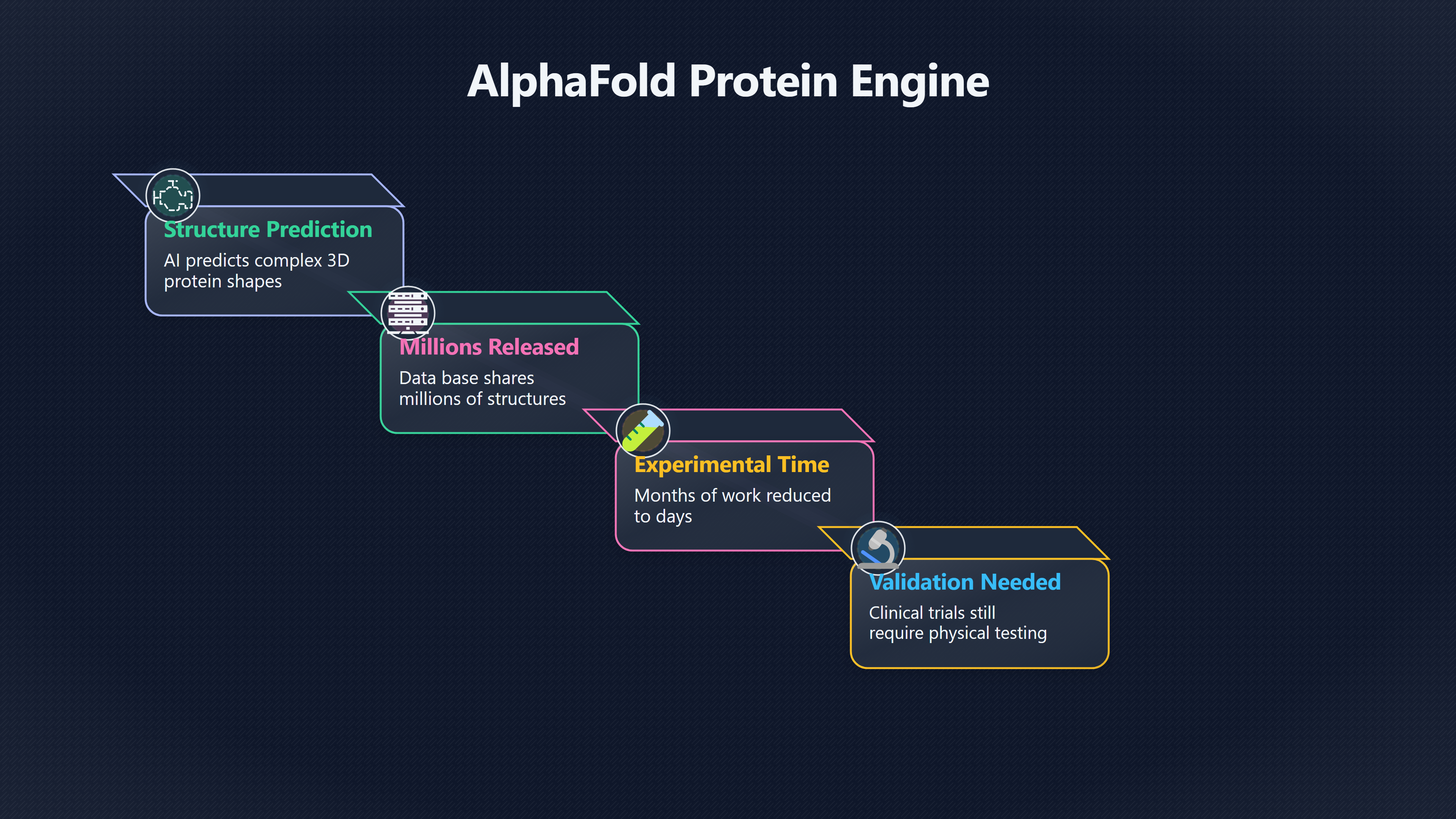
The clearest example is AlphaFold, developed by Google DeepMind. Predicting protein structures was a major long-standing problem in biology because proteins fold into complex three-dimensional shapes that determine their function.
Experimental structure determination can take months or years. AlphaFold showed that AI systems could predict many structures computationally with remarkable accuracy. Millions of protein structures have since been released publicly for researchers worldwide. Nature [Google DeepMind]deepmind.googleGoogle DeepMindAlphaFold — Google DeepMindAlphaFold has revealed millions of intricate 3D protein structures, and is helping scientists u… [NBER]nber.orgNBERHow Artificial Intelligence Shapes Science: Evidence from…6 days ago — We study how a frontier AI model affects scientific discove…
This did not “solve biology”. Experimental work, validation, and clinical translation still take time. But it changed what researchers considered computationally possible.
Economists and innovation researchers studying AlphaFold’s impact found evidence that it accelerated work in structural biology and related fields by reducing time previously spent on expensive experimental processes. [NBER]nber.orgNBERHow Artificial Intelligence Shapes Science: Evidence from…6 days ago — We study how a frontier AI model affects scientific discove…
The significance is less about one tool than about a broader pattern: AI systems may increasingly automate difficult scientific subtasks that once appeared uniquely human.
AI-assisted drug discovery
Drug development is famously slow and expensive. Conventional timelines can exceed a decade, with extremely high failure rates. Researchers hope AI can reduce both the cost and the search space involved in early-stage discovery. ScienceDirect [PMC]pmc.ncbi.nlm.nih.govPMCArtificial intelligence in drug discovery and developmentExamples of AI tools used in drug discovery. Tools, Details, Website… The AI tool, AlphaFold, which is based on DNNs, was used to anal…
Several AI systems now assist with:
- identifying biological targets
- generating candidate molecules
- predicting toxicity
- modelling protein interactions
- repurposing existing drugs
- narrowing experimental priorities
One widely discussed demonstration combined AlphaFold-derived structures with generative chemistry systems to identify a potential inhibitor for a previously underexplored target in roughly 30 days using very few synthesised compounds. [arXiv]arxiv.orgarXivTowards a Science of AI Agent Reliability18 Feb 2026 — While rising accuracy scores on standard benchmarks suggest rapid progress, m…
This is still early-stage evidence, not proof that AI can routinely compress pharmaceutical timelines from decades to months. Many proposed compounds fail in later testing. Clinical trials, manufacturing, regulation, and biological complexity remain major bottlenecks.
But the direction of travel matters. Even modest improvements in scientific iteration speed can compound over time across thousands of programmes.
AI agents and automated research workflows
Another important shift is from passive chatbots towards “agentic” systems that can execute longer chains of work. These systems can increasingly browse literature, write and debug code, use software tools, run simulations, and coordinate subtasks.
Benchmarks suggest rapid improvements in coding and scientific reasoning tasks. [Time]time.comAI Is Getting Better at ScienceOpenAI Is Testing How Far It Can GoDecember 16, 2025 — OpenAI has introduced a new benchmark called FrontierScience to assess how well AI…
Researchers are beginning to imagine partially autonomous laboratories in which AI systems propose experiments, robotic systems execute them, and results feed back automatically into further AI-guided exploration. Some prototype “self-driving labs” already exist in materials science and chemistry. [arXiv]arxiv.orgarXivTowards a Science of AI Agent Reliability18 Feb 2026 — While rising accuracy scores on standard benchmarks suggest rapid progress, m…
The long-term significance is not merely automation of labour. It is the possibility of dramatically tighter feedback loops between idea generation, testing, and refinement.
Why faster discovery could matter for human flourishing
If discovery accelerates reliably, the consequences could extend far beyond economic growth statistics.
Medicine and longevity
The most obvious area is health. Faster scientific progress could mean:
- earlier cancer detection
- better antibiotics
- personalised medicine
- treatments for rare diseases
- improved pandemic response
- therapies targeting ageing itself
Even moderate acceleration could matter enormously because medical progress compounds across generations. Extra years of healthy life, reduced disease burden, and lower treatment costs affect billions of people over time.
Some advocates of AI abundance argue that civilisation’s largest unrealised gains may come not from consumer convenience, but from reducing the vast amount of human suffering caused by disease and biological limitation.

Energy and material abundance
Scientific acceleration could also loosen material constraints that shape civilisation.
Cheaper clean energy, better batteries, improved desalination, synthetic materials, automated manufacturing, or more efficient agriculture could reduce scarcity across many domains simultaneously.
This does not automatically create a post-scarcity society. Political systems, infrastructure, distribution, and governance still matter enormously. But scientific capability influences what becomes physically and economically possible in the first place.
Expanding the long-term future
The largest claims about AI bloom concern not the next few years, but centuries.
If AI systems substantially increase humanity’s capacity for scientific understanding and coordination, they could help civilisation become more resilient to existential risks while expanding opportunities for future generations.
That might include:
- better pandemic defence
- asteroid detection
- climate stabilisation
- safer infrastructure
- advanced space systems
- more effective governance tools [nature.com]nature.comNatureGoogle DeepMind won a Nobel prize for AI: can it produce…Nov 18, 2025 — What's next for AlphaFold and the AI protein-folding rev…
In this view, the long-run importance of AI is not simply higher productivity. It is the possibility of enlarging the future range of what humans can know, create, and protect.
What could go wrong when discovery accelerates
The strongest objections are not merely philosophical. They concern reliability, control, institutional pressure, and the possibility that acceleration outruns human oversight.
Faster mistakes can also scale
A system that accelerates good science may also accelerate bad science.
Current AI systems already generate convincing but flawed outputs. Researchers have raised concerns about fabricated citations, unreliable reasoning, and low-quality AI-generated academic papers overwhelming peer review systems. [The Verge]theverge.comResearchers like Peter Degen and Matt Spick have uncovered a wave of low-quality, AI-generated studies using public datasets, which are o…
The problem becomes more serious as systems gain autonomy. An unreliable AI assistant wastes time. An unreliable autonomous research agent embedded in critical scientific workflows could propagate errors at scale.
This matters especially in fields like biotechnology, medicine, cybersecurity, or infrastructure, where subtle mistakes can have large consequences.
Capability is rising faster than reliability
One recurring theme in recent research is that AI capability gains do not necessarily imply equal gains in reliability.
Several recent studies argue that benchmark scores can exaggerate practical competence. Systems may perform impressively on controlled evaluations while failing unpredictably in real-world settings. [arXiv]arxiv.orgarXivTowards a Science of AI Agent Reliability18 Feb 2026 — While rising accuracy scores on standard benchmarks suggest rapid progress, m… 2arXiv
Researchers studying AI agents increasingly emphasise:
- consistency across repeated runs
- robustness under changing conditions
- predictable failure behaviour
- bounded error severity
- interpretability
These concerns are especially important if AI systems begin handling extended scientific or institutional tasks without close human supervision.
Evidence from coding and document-management tasks already suggests that current systems can silently accumulate errors over long workflows. [PC Gamer]pcgamer.comWhile acknowledging that AI tools can assist with research and reverse engineering, the team emphasizes that contributors must fully unde…
Concentration of power
Another concern is that accelerated discovery may not benefit humanity broadly.
Advanced research systems could become concentrated inside a handful of corporations or states with access to:
- massive compute resources
- proprietary data
- advanced chips
- elite scientific talent
- strategic infrastructure
If the gains from accelerated discovery are captured narrowly, AI could deepen inequality and geopolitical competition rather than supporting broad human flourishing.
This is one reason debates around open science, public research infrastructure, antitrust policy, and international coordination matter within the AI bloom discussion.
Humans may struggle to evaluate superhuman systems
A deeper challenge appears if AI systems eventually become much better than humans at scientific reasoning itself.
At that point, verification becomes difficult. Humans may no longer fully understand why a system believes a theory, proposes a treatment, or recommends a design.
That creates a paradox: the more powerful the system becomes, the harder it may be for human institutions to independently validate its outputs.
This is one reason alignment researchers argue that interpretability and control are not side issues. If advanced AI becomes a core engine of scientific progress, society may increasingly depend on systems that few people truly understand. [Business Insider]businessinsider.comIn an interview with Business Insider, Kokotajlo highlighted a critical issue: AI alignment—the challenge of ensuring AI models act in ac…
The most realistic near-term picture
The most plausible path is probably not a sudden overnight explosion in all fields simultaneously.
Scientific progress is constrained by many physical realities:
- laboratory equipment
- supply chains
- regulation
- energy systems
- clinical testing
- human institutions
- political conflict
Even highly capable AI cannot instantly eliminate those bottlenecks.
But discovery speed does not need to become infinite to matter historically. A persistent doubling or tripling of effective research capacity across multiple disciplines could still transform civilisation over decades.
The more realistic near-term picture may look like:
- AI copilots embedded across science and engineering
- autonomous systems handling narrow research loops
- dramatically expanded access to expert-level assistance
- tighter integration between simulation, robotics, and experimentation
- faster iteration in medicine, materials, and software
- increasing dependence on AI-mediated scientific infrastructure
Whether that becomes a genuine bloom for humanity depends less on raw speed than on whether societies can make accelerated discovery trustworthy, broadly shared, and aligned with human flourishing rather than narrow institutional incentives.
Endnotes
-
Source: deepmind.google
Link: https://deepmind.google/science/alphafold/Source snippet
Google DeepMindAlphaFold — Google DeepMindAlphaFold has revealed millions of intricate 3D protein structures, and is helping scientists u...
-
Source: nber.org
Link: https://www.nber.org/papers/w35143Source snippet
NBERHow Artificial Intelligence Shapes Science: Evidence from...6 days ago — We study how a frontier AI model affects scientific discove...
-
Source: arxiv.org
Link: https://arxiv.org/html/2602.16666v1Source snippet
arXivTowards a Science of AI Agent Reliability18 Feb 2026 — While rising accuracy scores on standard benchmarks suggest rapid progress, m...
-
Source: arxiv.org
Title: arXiv Towards a Science of AI Agent Reliability
Link: https://arxiv.org/abs/2602.16666 -
Source: sciencedirect.com
Link: https://www.sciencedirect.com/science/article/pii/S2590098625000107Source snippet
For example, AI could design a pharmacological chaperone for a unique pathogenic mutation. Moreover...Read more...
-
Source: pmc.ncbi.nlm.nih.gov
Link: https://pmc.ncbi.nlm.nih.gov/articles/PMC10302890/Source snippet
Role of AI in Drug Discovery: Challenges, Opportunities...by A Blanco-González · 2023 · Cited by 855 — Artificial intelligence (AI) has...
-
Source: sciencedirect.com
Link: https://www.sciencedirect.com/science/article/pii/S2666675824001231Source snippet
ScienceDirectDrug development in the AI era: AlphaFold 3 is coming!by Y Shi · 2024 · Cited by 23 — It will take about 12–15 years and cos...
-
Source: pmc.ncbi.nlm.nih.gov
Link: https://pmc.ncbi.nlm.nih.gov/articles/PMC11292590/Source snippet
of AlphaFold 3: Transformative Advances in Drug...by D Desai · 2024 · Cited by 114 — AlphaFold 3, an AI model, has revolutionized medica...
-
Source: forethought.org
Title: Preparing for the Intelligence Explosion
Link: https://www.forethought.org/research/preparing-for-the-intelligence-explosionSource snippet
For example, if AI dramatically accelerates drug discovery...
-
Source: situational-awareness.ai
Title: SITUATIONAL AWARENESS
Link: https://situational-awareness.ai/from-agi-to-superintelligence/Source snippet
From AGI to Superintelligence: the Intelligence ExplosionHundreds of millions of AGIs could automate AI research, compressing a decade of...
-
Source: deepmind.google
Title: alphafold five years of impact
Link: https://deepmind.google/blog/alphafold-five-years-of-impact/Source snippet
Google DeepMindAlphaFold: Five Years of ImpactNov 25, 2025 — Explore five years of AlphaFold's impact on biology. Learn how this Nobel Pr...
-
Source: nature.com
Link: https://www.nature.com/articles/d41586-025-03713-1Source snippet
NatureGoogle DeepMind won a Nobel prize for AI: can it produce...Nov 18, 2025 — What's next for AlphaFold and the AI protein-folding rev...
-
Source: pmc.ncbi.nlm.nih.gov
Title: PMCArtificial intelligence in drug discovery and development
Link: https://pmc.ncbi.nlm.nih.gov/articles/PMC7577280/Source snippet
Examples of AI tools used in drug discovery. Tools, Details, Website... The AI tool, AlphaFold, which is based on DNNs, was used to anal...
-
Source: arxiv.org
Link: https://arxiv.org/abs/2201.09647Source snippet
arXivAlphaFold Accelerates Artificial Intelligence Powered Drug Discovery: Efficient Discovery of a Novel Cyclin-dependent Kinase 20 (CDK...
-
Source: time.com
Title: AI Is Getting Better at Science
Link: https://time.com/7341081/openai-frontierscience-benchmark/Source snippet
OpenAI Is Testing How Far It Can GoDecember 16, 2025 — OpenAI has introduced a new benchmark called FrontierScience to assess how well AI...
Published: December 16, 2025
-
Source: arxiv.org
Link: https://arxiv.org/abs/2308.07954Source snippet
arXivAPACE: AlphaFold2 and advanced computing as a service for accelerated discovery in biophysicsAugust 15, 2023...
Published: August 15, 2023
-
Source: arxiv.org
Link: https://arxiv.org/abs/2512.01080 -
Source: nature.com
Link: https://www.nature.com/articles/d41586-026-00605-wSource snippet
Daily briefing: New AI drug-discovery engine is 'on the...Feb 23, 2026 — Daily briefing: New AI drug-discovery engine is 'on the scale o...
-
Source: sciencedirect.com
Link: https://www.sciencedirect.com/science/article/pii/S3050787125000484Source snippet
Artificial intelligence (AI) in drug design and discoveryby AR Bhat · 2025 · Cited by 15 — The review highlights the pivotal role of AI-d...
-
Source: arxiv.org
Link: https://arxiv.org/html/2509.06580v4Source snippet
AI for Scientific Discovery is a Social ProblemDec 23, 2025 — AlphaFold's success demonstrated AI's transformative potential... material...
-
Source: theverge.com
Link: https://www.theverge.com/ai-artificial-intelligence/930522/ai-research-papers-slop-peer-review-problemSource snippet
Researchers like Peter Degen and Matt Spick have uncovered a wave of low-quality, AI-generated studies using public datasets, which are o...
-
Source: pcgamer.com
Link: https://www.pcgamer.com/hardware/please-stop-submitting-ai-slop-code-team-behind-popular-ps3-emulator-call-time-on-user-submitted-vibe-coding/Source snippet
While acknowledging that AI tools can assist with research and reverse engineering, the team emphasizes that contributors must fully unde...
-
Source: businessinsider.com
Link: https://www.businessinsider.com/former-openai-employee-explains-open-secret-ai-alignment-control-2026-5Source snippet
In an interview with Business Insider, Kokotajlo highlighted a critical issue: AI alignment—the challenge of ensuring AI models act in ac...
-
Source: cristivlad.substack.com
Title: countdown to superintelligence
Link: https://cristivlad.substack.com/p/countdown-to-superintelligenceSource snippet
to Superintelligence - Cristi Vlad - SubstackSome in the AI community talk about a possible “intelligence explosion” specifically in scie...
Additional References
-
Source: facebook.com
Link: https://www.facebook.com/groups/intelligenceexplosion/posts/1885148551558242/Source snippet
Slow to moderate Artificial Intelligence ExplosionSuperintelligence would be an intelligence far surpassing human abilities, including sc...
-
Source: techradar.com
Link: https://www.techradar.com/pro/current-llms-introduce-substantial-errors-when-editing-work-documents-microsoft-scientists-find-most-ai-models-struggle-with-long-running-tasks-so-maybe-dont-trust-them-completely-just-yetSource snippet
Researchers tested 19 AI models, including leading versions like GPT-5.4, Gemini 3.1 Pro, and Claude 4.6 Opus, using a new DELEGATE-52 be...
-
Source: theguardian.com
Link: https://www.theguardian.com/technology/2025/nov/04/experts-find-flaws-hundreds-tests-check-ai-safety-effectivenessSource snippet
The study found nearly all benchmarks had weaknesses, with some being misleading or irrelevant, thereby undermining claims about AI model...
-
Source: medium.com
Link: https://medium.com/%40danieldkang/ai-agent-benchmarks-are-broken-c1fedc9ea071Source snippet
AI Agent Benchmarks are BrokenUnfortunately, many current AI agent benchmarks are far from reliable. Consider WebArena, a benchmark used...
-
Source: linkedin.com
Link: https://www.linkedin.com/posts/baraktur_towards-a-science-of-ai-agent-reliability-activity-7434268792404267008-W8nWSource snippet
Towards a Science of AI Agent Reliability | Barak TurovskyAI Agents Are Getting Smarter - Not More Reliable We are benchmarking AI agents...
-
Source: 80000hours.org
Title: will macaskill century in a decade navigating intelligence explosion
Link: https://80000hours.org/podcast/episodes/will-macaskill-century-in-a-decade-navigating-intelligence-explosion/Source snippet
Will MacAskill on AI causing a “century in a decade”11 Mar 2025 — Soon after, by improving algorithms and manufacturing chips, we'll depl...
-
Source: blog.google
Title: Alpha Fold 3 predicts the structure and interactions of all
Link: https://blog.google/innovation-and-ai/products/google-deepmind-isomorphic-alphafold-3-ai-model/Source snippet
AlphaFold 3 predicts the structure and interactions of all...May 8, 2024 — Our new AI model AlphaFold 3 can predict the structure and in...
Published: May 8, 2024
-
Source: medium.com
Title: part 2 the acceleration revolution 99afb2be65fd
Link: https://medium.com/%40mikehyzy/part-2-the-acceleration-revolution-99afb2be65fdSource snippet
Part 2: The Acceleration Revolution | by Mike HyzyHumanity compressed more technological progress into the fifty years between 1925 and 1...
-
Source: rdworldonline.com
Title: 6 ways ai reshaped scientific software in 2025
Link: https://www.rdworldonline.com/6-ways-ai-reshaped-scientific-software-in-2025/Source snippet
Dec 16, 2025 — Genesis Molecular AI's Pearl, backed by NVIDIA, claimed 40% improvement over AlphaFold 3 on drug discovery benchmarks and...
-
Source: drugdiscoverytrends.com
Title: 7 ways deepmind alphafold used life sciences
Link: https://www.drugdiscoverytrends.com/7-ways-deepmind-alphafold-used-life-sciences/Source snippet
Accelerating discovery of drugs for neglected diseases · 2. Combating antibiotic resistance · 3. Studying the nuclear pore complex · 4.Re...
Amazon book picks
Further Reading
Books and field guides related to Faster Scientific Discovery. Use these as the next step if you want deeper reading beyond the article.

Artificial intelligence
First published 1994. Subjects: problem solving, constraint satisfaction, knowledge, reasoning, planning.
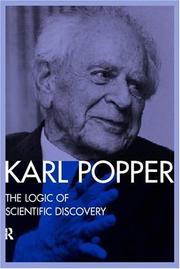
The Logic of Scientific Discovery
First published 1935. Subjects: Science, Methodology, Logic, Research Design, Sciences.

Artificial Intelligence Applications and Innovations
First published 2006. Subjects: Artificial intelligence, Technological innovations, Expert systems (computer science), Intelligent contro...
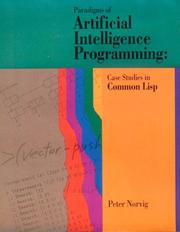
Paradigms of Artificial Intelligence
First published 1991. Subjects: Artificial intelligence, COMMON LISP (Computer program language), Computer programming, Lisp (computer pr...
eBay marketplace picks
Marketplace Samples
Example marketplace items related to this page. Use the search link to explore similar finds on eBay.

Example eBay listing
A.I. Artificial Intelligence Original Movie Poster Signed By Jude Law
USD 125.00 | Shipping USD 25.00 | US

Example eBay listing
Artificial Intelligence D/S Original Movie Poster - 27 x 40"
USD 19.50 | Shipping USD 13.65 | US

Example eBay listing
612388 Artificial Intelligence Movie Science Fiction Drama Wall Print Poster
USD 22.95 | Shipping USD 12.95 | JP

Example eBay listing
Companion - Artificial Intelligence Dark Comedy Cinema Film - POSTER 20"x30"
USD 23.99 | Free shipping | US

Example eBay listing
A.I. Artificial Intelligence Movie Film Poster Art Print
GBP 4.99 | Free shipping | GB

Example eBay listing
A I Artificial Intelligence 6 Movie Poster Art Print Print Classic Rare Gallery
GBP 49.00 | Free shipping | GB

Example eBay listing
Artificial intelligence is no a mat Framed Wall Art Poster Canvas Print Picture
GBP 14.99 | Shipping GBP 4.95 | GB

Example eBay listing
A.I. - Artificial Intelligence Movie/Film Poster Art PICTURE / PRINT 9" x 8"
GBP 2.49 | Shipping GBP 1.75 | GB
Topic Tree