Within Energy Limits
AI Efficiency and Rebound Effects
More efficient chips and models may cut energy per task, yet falling costs could still drive much higher total demand.
On this page
- How AI hardware efficiency is improving
- Why cheaper computation can increase demand
- Whether smarter scheduling can reduce peak loads
Page outline Jump by section
Introduction
More efficient AI systems do not automatically mean lower electricity use. In fact, the opposite may happen. The history of industrial technology shows that when a resource becomes cheaper and more efficient to use, people often use far more of it. Economists call this a rebound effect or, in stronger cases, the Jevons paradox. AI may become one of the clearest modern examples.
 The key distinction is between energy per task and total energy demand. AI hardware and software are improving rapidly. A single model query today can often be run using far less electricity than a comparable task a few years ago. But falling costs also make AI attractive in many more products, industries and daily activities. If demand grows faster than efficiency improves, total electricity use still rises.
For the broader idea of AI-enabled abundance, this matters enormously. A future of cheap intelligence depends partly on whether AI becomes dramatically more energy-efficient. Yet the same efficiency gains that make AI affordable and widespread could also accelerate electricity demand across data centres, robotics, manufacturing, science and consumer services. The central question is not whether efficiency improves. It clearly does. The question is whether efficiency outruns expansion.
How AI hardware efficiency is improving
Modern AI systems are already far more energy-efficient than earlier generations. This improvement comes from several overlapping trends.
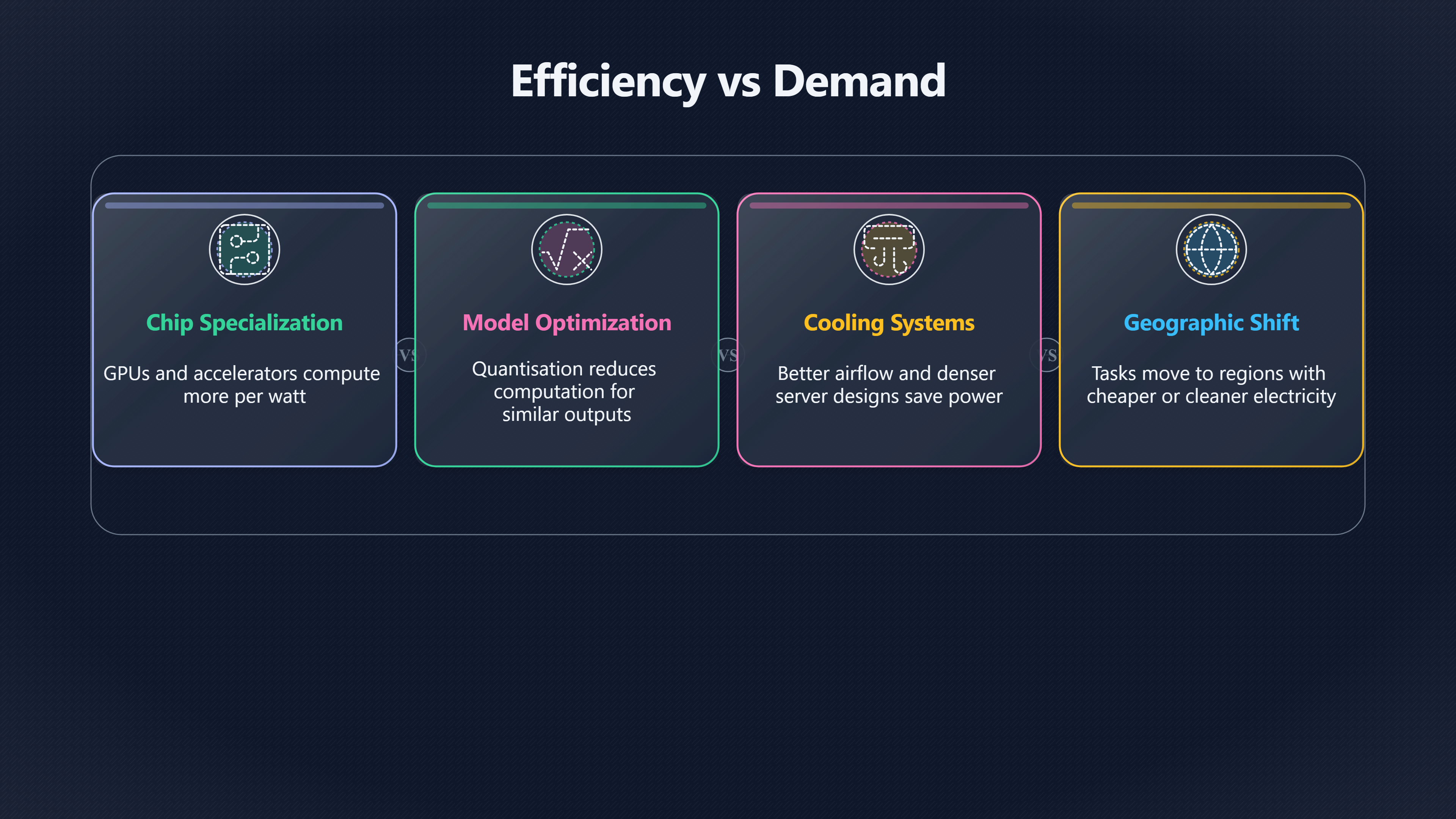
First, chips have become more specialised. General-purpose processors are increasingly replaced by graphics processing units (GPUs), tensor processors and custom AI accelerators designed specifically for machine learning workloads. These chips perform more computation per watt of electricity.
Second, models themselves are becoming more efficient. Researchers have improved methods such as quantisation, sparsity and distillation, which reduce the amount of computation needed for similar outputs. Smaller models can now sometimes achieve results once requiring much larger systems.
Third, data-centre engineering has improved. Better cooling systems, smarter workload management and denser server designs reduce wasted power. Some facilities also shift tasks geographically or temporally to take advantage of cheaper or cleaner electricity.
Historically, computing has shown astonishing efficiency gains. “Koomey’s Law”, named after researcher Jonathan Koomey, described a long-running trend in which the number of computations possible per joule of energy roughly doubled every 1.5 years for decades. More recent analysis suggests efficiency gains continue, though more slowly than during the earlier semiconductor era. [Springer]link.springer.comSpringerEvolution of computing energy efficiency: Koomey's law revisitedby A Prieto · 2025 · Cited by 27 — This article analyses the evol…
This matters because AI workloads would be almost impossible at today’s scale without these gains. Training frontier models or serving billions of AI queries daily on older hardware would require vastly larger power systems than currently exist.
The efficiency story is therefore real, not marketing spin. Without it, AI electricity demand would already be much higher.
Why cheaper computation can increase demand
The complication is that efficiency changes behaviour.
When AI becomes cheaper to run, more people and organisations use it. Existing users also use more of it. Companies add AI features to software products, automate more tasks, generate more media, run more simulations and process larger datasets because the cost per operation falls.
This is the core mechanism behind rebound effects.
Economist William Stanley Jevons observed a similar pattern with coal in the nineteenth century. More efficient steam engines did not reduce coal consumption in Britain. They made coal-powered industry economically attractive in many more sectors, increasing total use instead. [Wikipedia]WikipediaJevons paradoxJevons paradox
AI may follow a comparable path.
A cheaper AI model does not necessarily replace an older workload one-for-one. Instead, lower costs often unlock entirely new categories of demand:
- More businesses adopt AI tools.
- Consumers use AI more frequently.
- AI systems become embedded in search, office software and devices.
- Robotics and autonomous systems run continuously.
- Scientific simulations expand in scale.
- Video, gaming and synthetic media generation multiply.
This dynamic became highly visible after the release of cheaper and more efficient open-weight AI models in 2025. Rather than reducing enthusiasm for AI infrastructure, many investors argued that lower inference costs would expand total AI adoption and therefore sustain demand for chips and data centres. Reuters explicitly linked this reaction to the Jevons paradox. [Reuters]reuters.comEurope's AI bulls pin hopes on 'Jevons Paradox' after Deep Seek routThis paradox, formulated by economist William Stanley Jevons, suggests that increased efficiency in resource usage leads to higher overal…
The same logic appears repeatedly in digital technology. More efficient data compression increased total internet traffic. Faster processors encouraged heavier software. Cheaper storage led to much larger datasets. Efficiency reduced the cost of each unit of activity while increasing the total scale of activity.
AI is especially vulnerable to this effect because demand for intelligence appears highly elastic. Humans consistently find new uses for cheaper cognition.
AI may create new electricity demand outside data centres
The rebound effect is not limited to AI companies themselves.
If advanced AI significantly accelerates economic activity, electricity demand could rise across much of the economy. An AI-rich future might include:
- More automated factories.
- Vast fleets of robots.
- Expanded desalination and climate-control systems.
- More synthetic fuel production.
- Larger biotech and pharmaceutical computation.
- New consumer services running continuously in the background.
- Heavier use of virtual worlds and AI-generated media.
Some of these activities could improve human welfare enormously. A civilisation with abundant medical research, automated infrastructure and cleaner industry may use more electricity precisely because it is doing more useful things.
This creates an important distinction between “bad” and “good” energy growth. Rising electricity demand is not automatically evidence of waste. Historically, richer societies tend to use more energy because they perform more economically and technologically intensive activities.
For supporters of the AI bloom thesis, this is a double-edged reality. AI-driven abundance may require enormous energy expansion even if computation becomes radically more efficient. A flourishing civilisation with abundant intelligence, advanced medicine and large-scale automation may simply consume much more electricity than present civilisation.

Efficiency gains still matter enormously
Rebound effects do not mean efficiency is pointless.
Without rapid efficiency improvements, AI electricity demand could become far harder to sustain economically or physically. Better chips and smarter models slow the growth curve even if they do not reverse it.
Recent modelling work suggests that future outcomes depend heavily on the balance between efficiency gains and demand expansion. Some scenarios keep AI electricity use relatively manageable if compute efficiency continues improving rapidly. Others show demand overwhelming efficiency improvements once adoption accelerates. [arXiv]arxiv.orgarXiv Efficiency vs Demand in AI Electricity: Implications for Post-AGI ScalingarXivEfficiency vs Demand in AI Electricity: Implications for Post-AGI ScalingMarch 11, 2026…
Even partial efficiency gains matter because AI demand scales so quickly. If model efficiency improves by tenfold while usage grows one hundredfold, total electricity use still rises, but far less than it otherwise would.
Efficiency can also delay infrastructure bottlenecks. More efficient systems reduce pressure on grids, cooling systems and transmission networks, buying time for new clean-energy construction.
In practice, the most plausible outcome is neither “efficiency solves everything” nor “AI energy demand becomes uncontrollable”. The likely reality is simultaneous improvement in both efficiency and overall electricity consumption.
Why inference may matter more than training
Public discussion often focuses on the energy used to train frontier AI models. But over time, inference — the everyday use of AI systems by millions or billions of users — may dominate electricity demand.
Training a major model is expensive, but it happens occasionally. Inference happens continuously.
This is another reason rebound effects matter. If AI becomes integrated into search engines, digital assistants, customer support, coding tools, robotics and entertainment systems, the aggregate electricity use from billions of small interactions may exceed the cost of training the original models.
Cheaper inference can accelerate this cycle further. Once an AI interaction becomes inexpensive enough, developers stop treating it as scarce. Features proliferate throughout software ecosystems.
That does not mean every AI application is socially valuable. Some uses may generate substantial electricity demand for marginal benefit. Critics argue that rebound effects could encourage low-value or wasteful AI usage simply because computation becomes cheap enough to deploy everywhere. [arXiv]arxiv.orgarXiv Efficiency vs Demand in AI Electricity: Implications for Post-AGI ScalingarXivEfficiency vs Demand in AI Electricity: Implications for Post-AGI ScalingMarch 11, 2026…
This becomes partly a governance question rather than purely a technical one.
Whether smarter scheduling can reduce peak loads
Total electricity demand is only part of the issue. Timing also matters.
Many electricity systems struggle most during peak periods, when demand spikes exceed available generation or transmission capacity. AI workloads are unusually interesting because some can be shifted in time or location.
Not every AI task requires immediate execution. Model training, batch inference and some background processing can often be delayed by minutes or hours without affecting users significantly.
Researchers and grid operators increasingly see this as an opportunity. Data centres may become flexible electricity consumers rather than fixed loads. [ScienceDirect]sciencedirect.comLoad shifting. DCs can support power grid operations by reducing or increasing the power demand because of their flexible load characteri… [2EY]
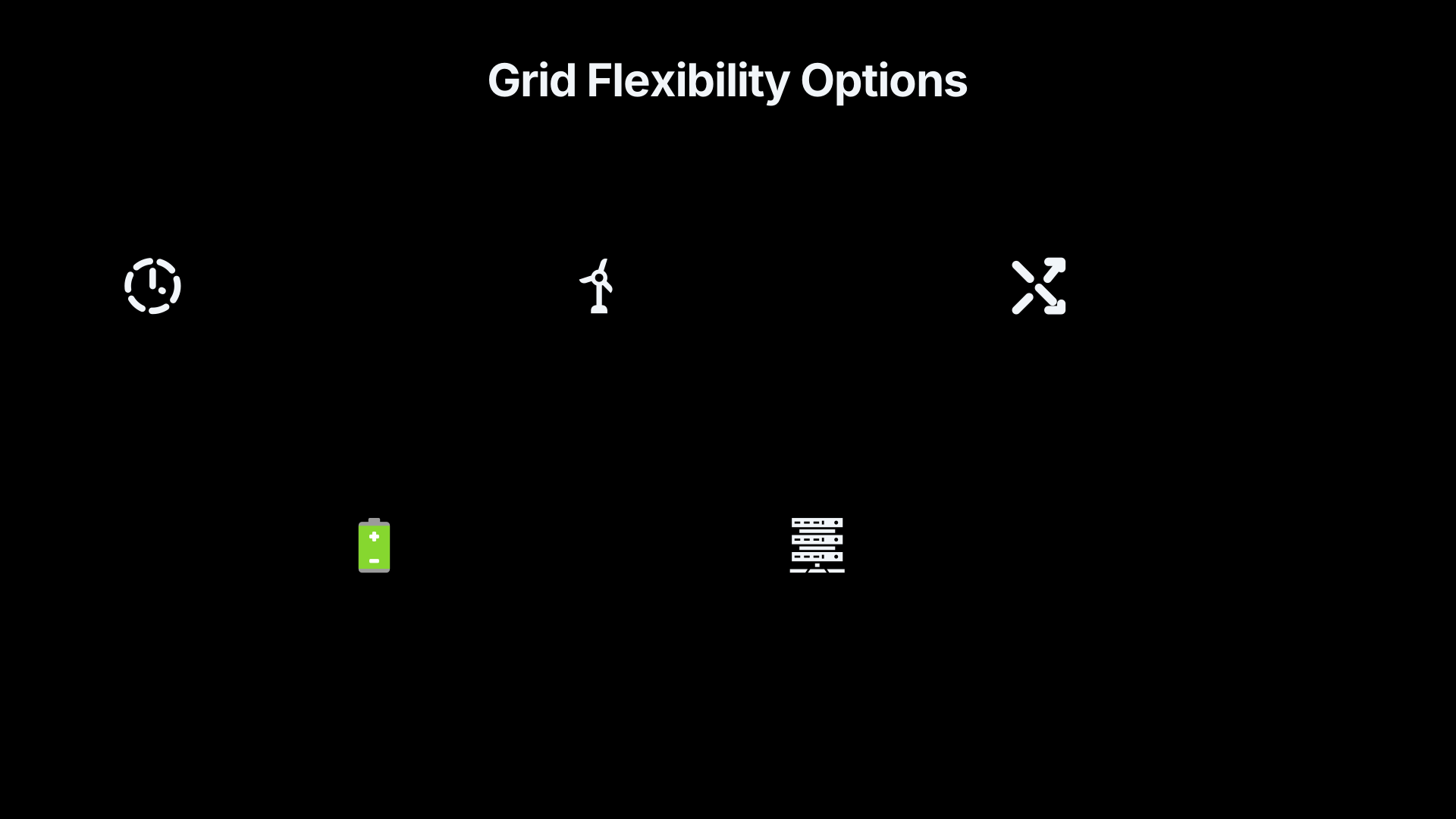
Several approaches are emerging:
- Load shifting: moving AI computation to off-peak hours. [sciencedirect.com]sciencedirect.comLoad shifting. DCs can support power grid operations by reducing or increasing the power demand because of their flexible load characteri…
- Geographic balancing: routing workloads to regions with spare electricity or high renewable output.
- Demand response: temporarily reducing data-centre consumption during grid stress. [ey.com]ey.comdemand response and data center growth6 Apr 2026 — Data center design and AI-deferred tasks. AI workloads offer a unique opportunity for demand response through software-based…
- Dynamic scheduling: timing energy-intensive tasks to coincide with abundant solar or wind generation.
Google has signed agreements with utilities allowing some AI workloads to be curtailed or shifted during peak demand periods. [blog.google]blog.googlehow were making data centers more flexible to benefit power gridsHow we're making data centers more flexible to benefit…4 Aug 2025 — With two new utility agreements, we're using demand response to su… [Reuters]reuters.comelectric utilities across states including Arkansas and Minnesota to reduce its electricity use at data centers during peak demand period…
Research literature increasingly treats AI data centres as potentially flexible grid participants rather than permanently rigid consumers. [arXiv]arxiv.orgarXiv Efficiency vs Demand in AI Electricity: Implications for Post-AGI ScalingarXivEfficiency vs Demand in AI Electricity: Implications for Post-AGI ScalingMarch 11, 2026…
This flexibility could matter greatly for renewable-heavy grids. Solar and wind generation fluctuate through the day. If AI computation can move toward periods of abundant clean power, it may reduce the need for expensive backup infrastructure.
However, there are limits.
Some AI services require instant responses and continuous uptime. Large cloud platforms cannot simply shut down during heatwaves or business hours. Frontier-model competition also creates economic pressure to keep expensive chips running constantly.
In practice, the most flexible workloads are likely to be background tasks rather than consumer-facing services.
The deeper question for AI abundance
The debate over AI efficiency ultimately reflects a broader question about abundance itself.
If advanced AI succeeds, humanity may gain the ability to perform vastly more intellectual and physical work than today. That future could include medical breakthroughs, automated infrastructure, scientific acceleration and new forms of prosperity. But abundance in one domain often increases demand in others.
Historically, richer and more technologically capable societies have not used less energy overall. They have used energy more productively while expanding the scale of civilisation.
AI could continue that pattern. More efficient intelligence may reduce the energy cost of each task while increasing the total amount of computation, production and economic activity humans choose to undertake.
For advocates of long-term human flourishing, this is not necessarily a contradiction. A civilisation supporting billions of people with advanced healthcare, automated industry, abundant digital services and large-scale scientific research may reasonably consume far more electricity than today’s world.
The crucial issue may therefore be less about suppressing energy demand and more about whether civilisation can build enough clean, reliable and politically acceptable energy infrastructure to support expanding intelligence safely. Efficiency improvements help. But they are unlikely, by themselves, to make AI electrically “lightweight” once deployed at civilisational scale.
Endnotes
-
Source: link.springer.com
Link: https://link.springer.com/article/10.1007/s10586-024-04767-ySource snippet
SpringerEvolution of computing energy efficiency: Koomey's law revisitedby A Prieto · 2025 · Cited by 27 — This article analyses the evol...
-
Source: Wikipedia
Title: Jevons paradox
Link: https://en.wikipedia.org/wiki/Jevons_paradox -
Source: reuters.com
Title: Europe’s AI bulls pin hopes on ‘Jevons Paradox’ after Deep Seek rout
Link: https://www.reuters.com/technology/artificial-intelligence/europes-ai-bulls-pin-hopes-jevons-paradox-after-deepseek-rout-2025-02-04/Source snippet
This paradox, formulated by economist William Stanley Jevons, suggests that increased efficiency in resource usage leads to higher overal...
-
Source: arxiv.org
Title: arXiv Efficiency vs Demand in AI Electricity: Implications for Post-AGI Scaling
Link: https://arxiv.org/abs/2603.10498Source snippet
arXivEfficiency vs Demand in AI Electricity: Implications for Post-AGI ScalingMarch 11, 2026...
Published: March 11, 2026
-
Source: arxiv.org
Link: https://arxiv.org/abs/2501.16548Source snippet
arXivFrom Efficiency Gains to Rebound Effects: The Problem of Jevons' Paradox in AI's Polarized Environmental DebateJanuary 27, 2025...
Published: January 27, 2025
-
Source: sciencedirect.com
Link: https://www.sciencedirect.com/science/article/pii/S2352484725001623Source snippet
Load shifting. DCs can support power grid operations by reducing or increasing the power demand because of their flexible load characteri...
-
Source: blog.google
Title: how were making data centers more flexible to benefit power grids
Link: https://blog.google/innovation-and-ai/infrastructure-and-cloud/global-network/how-were-making-data-centers-more-flexible-to-benefit-power-grids/Source snippet
How we're making data centers more flexible to benefit...4 Aug 2025 — With two new utility agreements, we're using demand response to su...
-
Source: reuters.com
Link: https://www.reuters.com/sustainability/boards-policy-regulation/google-expands-utility-deals-curb-datacenter-power-use-during-peak-demand-2026-03-19/Source snippet
electric utilities across states including Arkansas and Minnesota to reduce its electricity use at data centers during peak demand period...
-
Source: blog.google
Link: https://blog.google/innovation-and-ai/infrastructure-and-cloud/global-network/demand-response-data-center-milestone/Source snippet
A new milestone for smart, affordable electricity growth19 Mar 2026 — Google's demand response capability allows us to limit or shift a p...
-
Source: arxiv.org
Link: https://arxiv.org/abs/2604.05376Source snippet
arXivTo Defer or To Shift? The Role of AI Data Center Flexibility on Grid InterconnectionApril 7, 2026...
Published: April 7, 2026
-
Source: Wikipedia
Link: https://en.wikipedia.org/wiki/DataSource snippet
Dataa collection of discrete or continuous values that convey information, describing the quantity, quality, fact, statistics, other b...
-
Source: arxiv.org
Link: https://arxiv.org/html/2509.07218v1Source snippet
Electricity Demand and Grid Impacts of AI Data Centers8 Sept 2025 — AI computing load is highly energy-intensive, with each stage of the...
-
Source: arxiv.org
Link: https://arxiv.org/html/2410.06681v2Source snippet
AI, Climate, and Regulation: From Data Centers to the AI ActIn this paper, we aim to provide guidance on the climate-related regulation f...
-
Source: ey.com
Title: demand response and data center growth
Link: https://www.ey.com/en_us/insights/power-utilities/demand-response-and-data-center-growthSource snippet
6 Apr 2026 — Data center design and AI-deferred tasks. AI workloads offer a unique opportunity for demand response through software-based...
-
Source: iea.org
Link: https://www.iea.org/reports/electricity-2026/demandSource snippet
Electricity 2026 – AnalysisAmid robust growth, the next five years will add on average 50% more electricity demand per year than over the...
-
Source: dictionary.cambridge.org
Link: https://dictionary.cambridge.org/dictionary/english/dataSource snippet
| English meaning - Cambridge Dictionaryinformation, especially facts or numbers, collected to be examined and considered and used to hel...
-
Source: montel.energy
Link: https://montel.energy/resources/blog/data-centres-and-the-power-system-demand-location-and-flexibilitySource snippet
Montel | Blog - Data Centres and the Power System1 Oct 2025 — How data centres reshape power systems: rising demand, siting limits, cooli...
Additional References
-
Source: nationalacademies.org
Link: https://www.nationalacademies.org/read/29101/chapter/7Source snippet
Chapter: 5 Sustainability Analysis of Data CentersFor example, efficiency gains in hardware and software could inadvertently drive-up ele...
-
Source: merriam-webster.com
Link: https://www.merriam-webster.com/dictionary/dataSource snippet
DATA Definition & Meaning3 days ago — 1. factual information (such as measurements or statistics) used as a basis for reasoning, discussi...
-
Source: researchgate.net
Link: https://www.researchgate.net/publication/388460272_From_Efficiency_Gains_to_Rebound_Effects_The_Problem_of_Jevons%27_Paradox_in_AI%27s_Polarized_Environmental_DebateSource snippet
From Efficiency Gains to Rebound Effects: The Problem of...27 Jan 2025 — This paper examines how the problem of Jevons' Paradox applies...
-
Source: iea.org
Link: https://www.iea.org/news/data-centre-electricity-use-surged-in-2025-even-with-tightening-bottlenecks-driving-a-scramble-for-solutionsSource snippet
Data centre electricity use surged in 2025, even with...5 days ago — New IEA report explores AI's growing energy footprint, options for...
-
Source: news.lehigh.edu
Link: https://news.lehigh.edu/optimal-workload-scheduling-and-energy-management-of-ai-data-centers-with-demand-responseSource snippet
Workload Scheduling and Energy Management of...19 Dec 2025 — By participating in DR, a data center can shift its energy consumption to o...
-
Source: linkedin.com
Link: https://www.linkedin.com/posts/siddharth3_our-new-report-on-energy-and-ai-is-out-activity-7450550311842267137-neIKSource snippet
Siddharth Singh's PostGlobal electricity consumption from data centres surged in 2025, driven by AI. Unique new IEA analysis shows electr...
-
Source: carbon-direct.com
Title: the billion dollar case for enabling data center load flexibility
Link: https://www.carbon-direct.com/insights/the-billion-dollar-case-for-enabling-data-center-load-flexibilitySource snippet
The billion-dollar case for enabling data center load flexibility20 Mar 2026 — In our model, demand response functions as a “ghost batter...
-
Source: researchgate.net
Link: https://www.researchgate.net/figure/EAs-projected-annual-electricity-consumption-and-mean-power-demand-from-data-centers_fig1_382956072Source snippet
1 presents three possible IEA scenarios for the future electricity needs of the data center sector, with linear extrapolations from 2026...
-
Source: goldmansachs.com
Title: smart demand management can forestall the ai energy crisis
Link: https://www.goldmansachs.com/what-we-do/goldman-sachs-global-institute/articles/smart-demand-management-can-forestall-the-ai-energy-crisisSource snippet
Bridging the Gap: How Smart Demand Management Can...11 Aug 2025 — By aligning AI's computational flexibility with the grid's need for de...
-
Source: brookings.edu
Title: global energy demands within the ai regulatory landscape
Link: https://www.brookings.edu/articles/global-energy-demands-within-the-ai-regulatory-landscape/Source snippet
Apr 10, 2026 — By one estimate, the energy consumption of data centers could approach 1,050 TWh by 2026, which, if data centers were a co...
Amazon book picks
Further Reading
Books and field guides related to AI Efficiency and Rebound Effects. Use these as the next step if you want deeper reading beyond the article.

Energy Efficiency and Sustainable Consumption
This book challenges conventional wisdom by showing how, in some circumstances, improved energy efficiency may increase energy consumptio...
Energy efficiency and sustainable consumption
First published 2008. Subjects: Energy consumption.
eBay marketplace picks
Marketplace Samples
Example marketplace items related to this page. Use the search link to explore similar finds on eBay.

Example eBay listing
A.I. Artificial Intelligence Original Movie Poster Signed By Jude Law
USD 125.00 | Shipping USD 25.00 | US

Example eBay listing
Artificial Intelligence D/S Original Movie Poster - 27 x 40"
USD 19.50 | Shipping USD 13.65 | US

Example eBay listing
612388 Artificial Intelligence Movie Science Fiction Drama Wall Print Poster
USD 22.95 | Shipping USD 12.95 | JP

Example eBay listing
Companion - Artificial Intelligence Dark Comedy Cinema Film - POSTER 20"x30"
USD 23.99 | Free shipping | US

Example eBay listing
A.I. Artificial Intelligence Movie Film Poster Art Print
GBP 4.99 | Free shipping | GB

Example eBay listing
A I Artificial Intelligence 6 Movie Poster Art Print Print Classic Rare Gallery
GBP 49.00 | Free shipping | GB

Example eBay listing
AI - Artificial Intelligence (Poster + Slipcase) Blu-Ray
GBP 10.49 | Free shipping | GB

Example eBay listing
A. I. Artificial Intelligence. Jude Law. Original UK Video Poster.
GBP 8.11 | Shipping GBP 3.38 | GB
Topic Tree