Within Long Future
Limits After Abundance
Even extreme abundance would not remove rival goods such as land, attention, ecosystems, authority, and the limited time of a human life.
On this page
- Rival goods that do not disappear
- Why norms and rights still matter
- Better limits versus no limits
Page outline Jump by section
Introduction
A post-scarcity future does not mean a world with no limits. It means a world where many current shortages — food, energy, manufactured goods, routine labour, basic medical services, perhaps even some forms of expertise — become far less binding because advanced automation and AI make them cheap and abundant. But scarcity does not disappear. It moves.
 Even in the most optimistic AI bloom scenarios, some things remain rivalrous, finite, fragile, or socially contested. A person cannot simultaneously live in every beautiful coastal city. A forest cannot be both fully protected and endlessly developed. Human attention remains limited even if information becomes infinite. Political authority, social trust, cultural prestige, and meaningful relationships cannot simply be copied like software.
This matters because many future conflicts may centre less on basic survival and more on the governance of remaining scarce goods: land, ecosystems, legitimacy, status, time, and access to shared institutions. The challenge after abundance is not only how to produce enough, but how to decide what should remain limited, protected, shared, or earned.
Rival goods that do not disappear
Economists sometimes distinguish between goods that can be copied almost endlessly and goods that remain “rivalrous”: if one person uses them, others cannot use them in the same way at the same time. Post-scarcity mainly changes the first category. The second survives.
Fred Hirsch’s idea of “positional goods” remains especially important here. These are goods whose value depends partly on exclusivity or relative position rather than sheer quantity. A larger house overlooking a famous harbour, admission to a prestigious institution, or direct access to influential decision-makers all remain scarce even in wealthy societies. [Cambridge University Press & Assessment]cambridge.orgUniversity Press & Assessment What is a positional good?Recovering Hirsch's insightsby JJ Tyssedal · Cited by 4 — 'Positional goods', a term coined by Fred Hirsch, is an important concept in ec…
Several categories of scarcity are likely to persist.
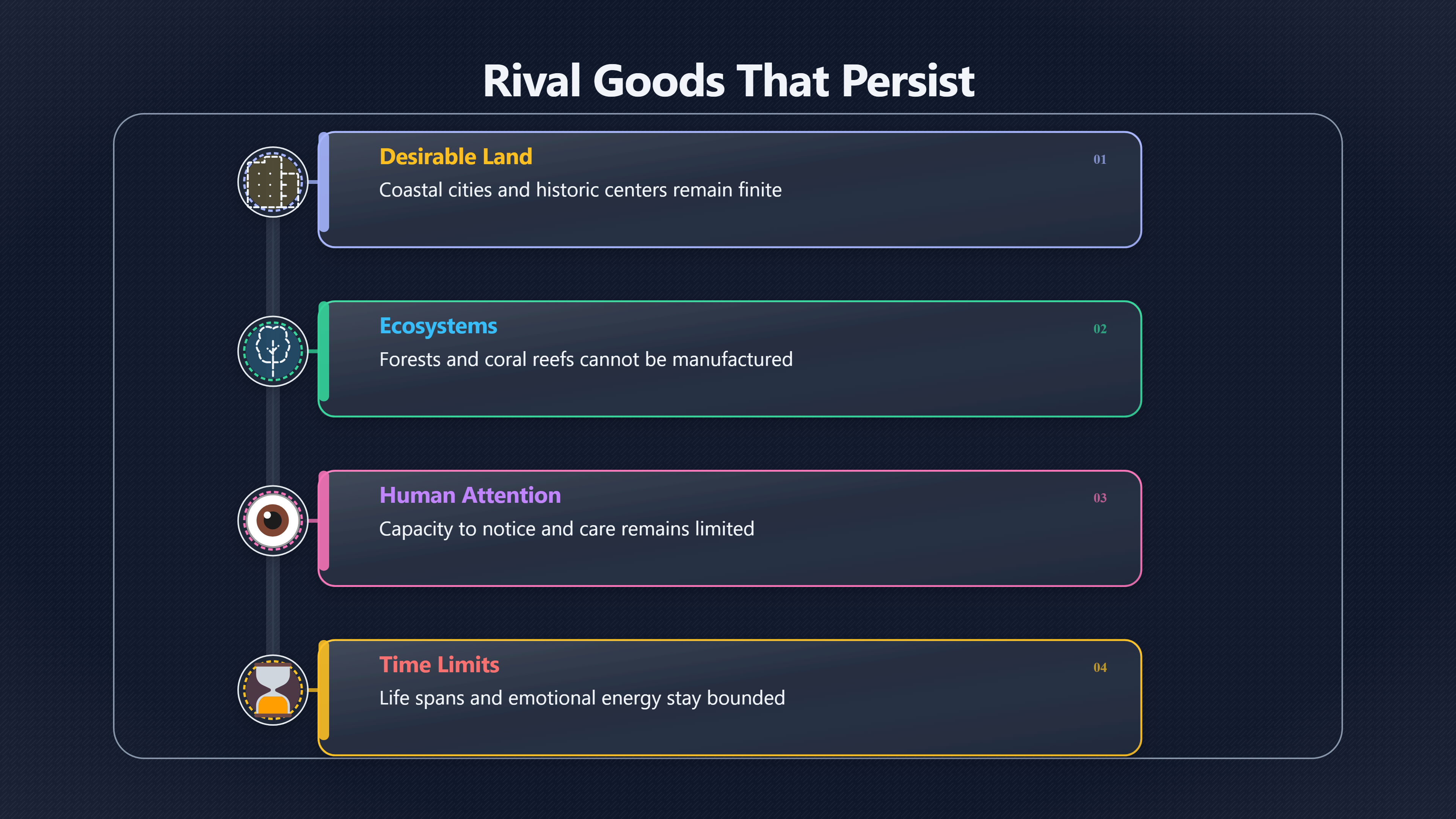
Desirable land and physical location
AI may dramatically reduce construction costs, improve urban planning, and enable new forms of energy abundance. Yet geography still matters.
Some places possess natural advantages that cannot be replicated at scale:
- Mild climates
- Coastal access
- Historic urban centres
- Scenic landscapes
- Ecologically stable regions
- Politically secure jurisdictions
London, Kyoto, Venice, Vancouver, or the Scottish Highlands cannot be infinitely duplicated. Even with advanced virtual reality and remote work, many people will still prefer specific physical places.
This means land prices and territorial politics may remain important long after basic material scarcity falls. In fact, some forms of abundance could intensify competition for high-quality environments. If people work less and live longer, location quality may matter more, not less.
Climate change could sharpen this further. Regions with stable water supplies, tolerable temperatures, and resilient infrastructure may become increasingly valuable. AI-assisted climate adaptation might reduce some pressures, but ecological constraints would still shape where flourishing is possible.
Ecosystems and natural beauty
A forest ecosystem takes centuries to mature. Coral reefs cannot be manufactured as easily as consumer electronics. Wild landscapes derive value partly from their rarity and integrity.
This creates a paradox of abundance: a civilisation rich enough to industrialise nearly everything may value the non-industrial more intensely.
Environmental economists and commons scholars have long noted that many ecological goods are difficult to price properly because they are shared, long-term, and vulnerable to overuse. Elinor Ostrom’s work on governing common-pool resources showed that successful stewardship usually depends on institutions, norms, monitoring, and collective restraint rather than unlimited extraction. [Actu Environnement]actu-environnement.comActu EnvironnementGOVERNING theCOMMONSPage 1. GOVERNING. theCOMMONS. ELINOR OSTROM. The Evolution of Institutions for Collective Action… [The Ted K Archive]thetedkarchive.comelanor ostrum et al governing the commonsThe Ted K ArchiveGoverning the Commonsby E Ostrum · 1990 · Cited by 64389 — Ostrom, by contrast, argues forcefully that other solutions e…
An AI-enabled civilisation could become vastly better at monitoring ecosystems and coordinating environmental protection. But this still requires political decisions about limits. A fully abundant society could still destroy fisheries, forests, biodiversity, or rivers if incentives reward short-term exploitation.
[Post-scarcity therefore does not eliminate environmental politics. It may elevate it.]thetedkarchive.comelanor ostrum et al governing the commonsThe Ted K ArchiveGoverning the Commonsby E Ostrum · 1990 · Cited by 64389 — Ostrom, by contrast, argues forcefully that other solutions e…
Human attention
One of the clearest examples of persistent scarcity is attention.
Herbert Simon observed decades ago that “a wealth of information creates a poverty of attention”. [The Convivial Society]theconvivialsociety.substack.comThe Convivial Society The Pathologies of the Attention EconomyM. SacasasSeptember 26, 2022 — As Citton noted, Herbert Simon is widely regarded as “the father of the attention economy. At a conference… [Mayday Group]act.maydaygroup.orgMayday GroupThe Model for Convivial Tools Applied to ChatGPT – ACTby DJ SHEVOCK · 2025 · Cited by 1 — In the well-known Herbert Simon quo… That insight becomes even more important in an AI-rich world.
If AI systems can generate infinite text, music, video, advertising, simulation, and personalised entertainment at near-zero cost, then the bottleneck shifts from production to selection. The scarce thing is no longer content. It is the human capacity to notice, evaluate, care, and remember.
This could produce several consequences:
- Competition for visibility may intensify.
- Reputation and trust may become more valuable.
- Authentic human connection may gain prestige.
- Curators, filters, and recommendation systems may gain enormous influence.
- Manipulation of attention could become a central political and economic battleground.
Recent work on the “attention economy” argues that attention increasingly functions almost like a currency. [OUP Academic]academic.oup.comAcademic The Second Wave of Attention EconomicsOxford Academicby M Heitmayer · 2025 · Cited by 50 — This paper connects the attention economy to the institutional foundations of modern… In a world where AI can produce endless persuasive media, verified signal and trusted provenance may become among the most valuable goods in society.
Ironically, informational abundance can make wisdom feel scarcer.
Time and mortality
Even radical longevity does not create infinite time.
A person living 150 healthy years still faces choices about how to spend those years. Human life remains bounded by attention, emotional energy, memory, and sequential experience. One cannot simultaneously master every discipline, maintain unlimited relationships, or pursue every possible path.
Opportunity cost survives abundance.
This matters because some utopian visions quietly assume that removing material scarcity removes tragedy or trade-offs. It does not. Human beings may still struggle with regret, meaning, boredom, rivalry, identity, and conflicting goals.
Indeed, if AI dramatically expands the number of possible careers, hobbies, experiences, and intellectual pursuits, the problem of choosing among them may become harder rather than easier.
Why status competition may survive abundance
Many societies already display forms of “relative scarcity” even amid material plenty. Rich countries often contain abundance of food, consumer goods, and entertainment while still generating intense competition over education, prestige, influence, and recognition.
That pattern may persist in AI-rich futures.
Relative advantage does not vanish
Some goods are valued precisely because not everyone can have them.
Examples include:
- Elite political power
- Cultural prestige
- Scientific fame
- Exclusive communities
- Romantic desirability
- Leadership positions
- Trusted authority
A world where everyone can generate competent art with AI may increase the value of exceptional originality, authenticity, or human story. If everyone has access to synthetic tutors, personalised education may cease to signal distinction, shifting status competition elsewhere.
This does not mean status competition is necessarily bad. Competition can drive excellence, discovery, and ambition. But it does mean post-scarcity does not automatically create social equality or psychological contentment.
Historically, rising prosperity has often shifted competition upward rather than ending it. As basic needs become easier to satisfy, societies frequently place greater emphasis on symbolic distinction, education, identity, and social ranking.
AI could intensify prestige inequality
Advanced AI may amplify winner-take-most dynamics in some domains.
A scientist with access to superior compute, datasets, robotics infrastructure, or AI collaborators might vastly outperform competitors. Creators with massive distribution networks may dominate attention markets even if creative tools become universal.
Some analysts already argue that AI may create new bottlenecks around compute, energy infrastructure, semiconductor supply chains, and institutional trust. [arXiv]arxiv.orgarXiv Institutions for the Post-Scarcity of JudgmentarXivInstitutions for the Post-Scarcity of JudgmentApril 24, 2026…
This raises a central political question for AI bloom: if intelligence becomes abundant, who controls the systems that channel it?
The answer shapes whether abundance broadens human capability or concentrates power.
Why norms and rights still matter
A common misunderstanding is that abundance automatically dissolves politics. In reality, societies still require rules even when resources are plentiful.
Sometimes abundance increases the importance of governance.
Shared resources still need coordination
Many scarce goods are not privately owned consumer products but shared systems:
- Atmosphere and climate
- Public spaces
- Water systems
- Open scientific knowledge
- Digital infrastructure
- Public trust
- Democratic legitimacy
These systems can be degraded even when material wealth is high.
Ostrom’s work challenged the simplistic idea that shared resources inevitably collapse into chaos. Communities often succeed when they establish trusted norms, monitoring, participation, and fair enforcement mechanisms. [Actu Environnement]actu-environnement.comActu EnvironnementGOVERNING theCOMMONSPage 1. GOVERNING. theCOMMONS. ELINOR OSTROM. The Evolution of Institutions for Collective Action… [Evonomics That insight becomes more important in technologically powerful societies. Advanced AI may give civilisation extraordinary productive capacit]evonomics.comir common pasture captured the essence of the problem that my thesis research was designed to solve.Read more… y while simultaneously increasing the destructive potential of bad coordination, misinformation, cyber conflict, or institutional capture.
Abundance therefore increases the need for governance capable of handling complexity at scale.
Rights protect people from abundance itself
Some limits exist not because production is impossible but because unrestricted optimisation would damage human life.
For example:
- Privacy limits surveillance.
- Labour rights limit exploitation.
- Environmental law limits extraction.
- Free speech norms constrain censorship.
- Intellectual freedom protects dissent.
- Democratic rules slow concentrated power.
An AI-rich civilisation might technically be capable of extreme behavioural manipulation, perfect monitoring, or hyper-efficient social control. The fact that something can be optimised does not mean it should be.
This is one reason critics of purely technocratic visions emphasise liberty, dignity, and self-determination. Ivan Illich argued that societies can become “counterproductive” when systems optimise efficiency while eroding autonomy and convivial human life. [Penn State Journals]journals.psu.eduPenn State JournalsThe International Journal of Illich StudiesIn his classic text, Tools for Conviviality, Ivan Illich offers a devastati… [IIED]iied.orgIIEDA Critique of Work: Between Ecology and SocialismI introduce some of Ivan Illich's thinking, especially how political ecology aims to…
The deepest question after scarcity may not be “How much can civilisation produce?” but “What kind of civilisation should abundance support?”
Better limits versus no limits
The strongest versions of the AI bloom argument do not imagine a future without constraints. They imagine better constraints.
There is a major difference between:
- limits imposed by famine, disease, ignorance, or degrading labour
- and limits chosen to preserve beauty, freedom, ecological stability, fairness, or human meaning
This distinction matters historically.
Civilisation already escaped older scarcities
Modern societies are far less constrained by many traditional shortages than earlier generations were:
- Agricultural productivity reduced famine risk in many regions.
- Vaccines and antibiotics reduced infectious disease mortality.
- Industrialisation reduced the share of life spent in physical subsistence labour.
- Digital networks reduced information scarcity.
Yet each breakthrough created new bottlenecks and new moral questions.
Industrial abundance produced pollution and mass warfare. Digital abundance produced information overload and attention capture. AI abundance may similarly solve some forms of scarcity while exposing others more sharply.
The relevant comparison is therefore not between “limits” and “no limits”. It is between destructive scarcity and humane constraint.
A flourishing civilisation may choose restraint
[A mature post-scarcity society might deliberately preserve some forms of scarcity:]thetedkarchive.comelanor ostrum et al governing the commonsThe Ted K ArchiveGoverning the Commonsby E Ostrum · 1990 · Cited by 64389 — Ostrom, by contrast, argues forcefully that other solutions e…
- protected wilderness areas
- limits on ecological extraction
- slower human-centred education
- privacy from constant optimisation
- cultural rituals tied to effort and mastery
- democratic procedures that resist pure automation
Not every friction is a failure.
Some constraints create meaning. A live concert differs from infinitely reproducible audio partly because it is bounded in time and place. Friendship matters partly because emotional commitment is limited and selective. Craft traditions derive value from patience, skill, and embodied practice.
A future with infinite digital generation may make these finite experiences feel more precious.
The long future is still shaped by choice
The phrase “post-scarcity” can imply inevitability, as if technology automatically carries civilisation into abundance. History suggests otherwise.
Industrial societies already possess enough productive capacity to eliminate much preventable suffering, yet billions still lack security, healthcare, education, or political voice. Scarcity is often institutional and political, not merely physical.
The same may hold true in more advanced futures.
AI could dramatically reduce the cost of energy, design, manufacturing, medicine, education, and scientific discovery. But societies would still need to decide:
- how to distribute gains
- which commons to protect
- who governs powerful systems
- how much surveillance to tolerate
- how to balance efficiency against freedom
- what kinds of human life deserve preservation
Post-scarcity is therefore not the end of economics, politics, or ethics. It is the beginning of a different civilisation-scale argument: not how to survive under permanent shortage, but how to live well amid unprecedented power.
Endnotes
-
Source: cambridge.org
Title: University Press & Assessment What is a positional good?
Link: https://www.cambridge.org/core/journals/economics-and-philosophy/article/what-is-a-positional-good-recovering-hirschs-insights/044344084B37556691445494C779EC33Source snippet
Recovering Hirsch's insightsby JJ Tyssedal · Cited by 4 — 'Positional goods', a term coined by Fred Hirsch, is an important concept in ec...
-
Source: actu-environnement.com
Link: https://www.actu-environnement.com/media/pdf/ostrom_1990.pdfSource snippet
Actu EnvironnementGOVERNING theCOMMONSPage 1. GOVERNING. theCOMMONS. ELINOR OSTROM. The Evolution of Institutions for Collective Action...
-
Source: academic.oup.com
Title: Academic The Second Wave of Attention Economics
Link: https://academic.oup.com/iwc/article/37/1/18/7733851Source snippet
Oxford Academicby M Heitmayer · 2025 · Cited by 50 — This paper connects the attention economy to the institutional foundations of modern...
-
Source: arxiv.org
Title: arXiv Institutions for the Post-Scarcity of Judgment
Link: https://arxiv.org/abs/2604.22966Source snippet
arXivInstitutions for the Post-Scarcity of JudgmentApril 24, 2026...
Published: April 24, 2026
-
Source: evonomics.com
Link: https://evonomics.com/tragedy-of-the-commons-elinor-ostrom/Source snippet
ir common pasture captured the essence of the problem that my thesis research was designed to solve.Read more...
-
Source: iied.org
Link: https://www.iied.org/sites/default/files/pdfs/migrate/9517IIED.pdfSource snippet
IIEDA Critique of Work: Between Ecology and SocialismI introduce some of Ivan Illich's thinking, especially how political ecology aims to...
-
Source: lifestyle.sustainability-directory.com
Link: https://lifestyle.sustainability-directory.com/area/scarcity-journalism/resource/5/Source snippet
Scarcity...
-
Source: thetedkarchive.com
Title: elanor ostrum et al governing the commons
Link: https://www.thetedkarchive.com/library/elanor-ostrum-et-al-governing-the-commonsSource snippet
The Ted K ArchiveGoverning the Commonsby E Ostrum · 1990 · Cited by 64389 — Ostrom, by contrast, argues forcefully that other solutions e...
-
Source: theconvivialsociety.substack.com
Title: The Convivial Society The Pathologies of the Attention Economy
Link: https://theconvivialsociety.substack.com/p/the-pathologies-of-the-attentionSource snippet
M. SacasasSeptember 26, 2022 — As Citton noted, Herbert Simon is widely regarded as “the father of the attention economy. At a conference...
Published: September 26, 2022
-
Source: act.maydaygroup.org
Link: https://act.maydaygroup.org/the-model-for-convivial-tools-applied-to-chatgpt/Source snippet
Mayday GroupThe Model for Convivial Tools Applied to ChatGPT – ACTby DJ SHEVOCK · 2025 · Cited by 1 — In the well-known Herbert Simon quo...
-
Source: journals.psu.edu
Link: https://journals.psu.edu/illichstudies/issue/download/2875/9Source snippet
Penn State JournalsThe International Journal of Illich StudiesIn his classic text, Tools for Conviviality, Ivan Illich offers a devastati...
-
Source: thetedkarchive.com
Link: https://www.thetedkarchive.com/library/ivan-illich-david-cayley-ivan-illich-in-conversationSource snippet
ive, and, in the matter of material survival...Read more...
-
Source: jstor.org
Link: https://www.jstor.org/stable/589692Source snippet
'non-conviviality' to refer to a situation in which the processes of industrialism have encouraged the development of organizational.Read mo...
Additional References
-
Source: reddit.com
Link: https://www.reddit.com/r/CapitalismVSocialism/comments/qznlio/what_postscarcity_is_and_how_to_reach_it/Source snippet
What post-scarcity is, and how to reach itYes, most goods and services would no more be in scarcity, and only a few goods will remain tha...
-
Source: vox.com
Title: economists post scarcity abundance industrial revolution socialism capitalism
Link: https://www.vox.com/the-highlight/24065976/economists-post-scarcity-abundance-industrial-revolution-socialism-capitalismSource snippet
A utopian strand of economic thought is making a surprising...11 Mar 2024 — A fully automated post-scarcity society would make most empl...
-
Source: thecgo.org
Link: https://www.thecgo.org/books/the-environmental-optimism-of-elinor-ostrom/chapter-4-population-growth-and-the-governance-of-complex-institutions-people-are-more-than-mouths-to-feed/Source snippet
Chapter 4: Population Growth and the Governance of...by P Desrochers · 2025 · Cited by 4 — Ostrom studied the management of shared envir...
-
Source: youtube.com
Title: Does Automation Lead To A Post-Scarcity Economy?
Link: https://www.youtube.com/watch?v=g8X-GyPpOCMSource snippet
Post scarcity economy limits positional goods scarcity ai future 🔥No One Took This 6-Year-Old Boy Seriously Until He Used Modern Knowledg...
-
Source: fortelabs.com
Title: trekonomics productivity in a post scarcity economy
Link: https://fortelabs.com/blog/trekonomics-productivity-in-a-post-scarcity-economy/Source snippet
Trekonomics: The Economics of Post-Scarcity11 Apr 2018 — Without scarcity, we no longer need the invisible hand optimizing the allocation...
-
Source: medium.com
Link: https://medium.com/predict/universal-basic-income-the-economic-singularity-and-the-post-scarcity-transition-09398437cee5Source snippet
ow do we govern scarcity where it persists, and how do we keep...Read more...
-
Source: reddit.com
Title: The Economics of a Post Scarcity Universe
Link: https://www.reddit.com/r/IsaacArthur/comments/1lqp0qa/the_economics_of_a_post_scarcity_universe_what/Source snippet
What Happens...Post scarcity doesn't kill economics it evolves it from the management of needs to negotiation of meaning incentives with...
-
Source: researchgate.net
Title: Research Gate What is a positional good?
Link: https://www.researchgate.net/publication/393670909_What_is_a_positional_good_Recovering_Hirsch%27s_insightsSource snippet
Recovering Hirsch's insightsJul 14, 2025 — This paper recovers Hirsch's concept of positional goods as scarce goods that are fixed or nea...
-
Source: facebook.com
Link: https://www.facebook.com/TheEconomist/posts/in-todays-economy-what-counts-as-scarce-and-rivalrous-has-changed-profoundly-the/1387211816770668/Source snippet
The rich are now spending on bigger and better things; things...
-
Source: ecoint.org
Title: profile of elinor ostrom 1933 2012
Link: https://www.ecoint.org/post/profile-of-elinor-ostrom-1933-2012Source snippet
Profile of Elinor Ostrom (1933-2012)Feb 26, 2024 — Elinor Ostrom (née Awan), was a neoliberal political scientist best known for her scho...
Amazon book picks
Further Reading
Books and field guides related to Limits After Abundance. Use these as the next step if you want deeper reading beyond the article.
Post-scarcity anarchism
First published 1971. Subjects: Radicalism, Anarchism, Ecology, Anarchism and anarchists, Social ecology.
eBay marketplace picks
Marketplace Samples
Example marketplace items related to this page. Use the search link to explore similar finds on eBay.

Example eBay listing
A.I. Artificial Intelligence Original Movie Poster Signed By Jude Law
USD 125.00 | Shipping USD 25.00 | US

Example eBay listing
Artificial Intelligence D/S Original Movie Poster - 27 x 40"
USD 19.50 | Shipping USD 13.65 | US

Example eBay listing
612388 Artificial Intelligence Movie Science Fiction Drama Wall Print Poster
USD 22.95 | Shipping USD 12.95 | JP

Example eBay listing
Companion - Artificial Intelligence Dark Comedy Cinema Film - POSTER 20"x30"
USD 23.99 | Free shipping | US

Example eBay listing
A.I. Artificial Intelligence Movie Film Poster Art Print
GBP 4.99 | Free shipping | GB

Example eBay listing
A I Artificial Intelligence 6 Movie Poster Art Print Print Classic Rare Gallery
GBP 49.00 | Free shipping | GB

Example eBay listing
AI - Artificial Intelligence (Poster + Slipcase) Blu-Ray
GBP 10.49 | Free shipping | GB

Example eBay listing
A. I. Artificial Intelligence. Jude Law. Original UK Video Poster.
GBP 8.11 | Shipping GBP 3.38 | GB
Topic Tree