Within Robot Dividend
German works councils
Germany’s works councils suggest worker voice can sometimes support automation when employees influence how technology is introduced and gains are shared.
On this page
- What works councils can negotiate over in automated workplaces
- Why worker voice may improve technology adoption
- Limits of the German model for sharing automation gains
Page outline Jump by section
Introduction
Germany is one of the world’s most heavily automated industrial economies, yet it has not followed the simple “robots versus workers” story often assumed in public debate. One reason is the country’s system of works councils: elected employee bodies inside workplaces that have legal rights to consultation and co-determination over many operational changes, including forms of digital monitoring, scheduling, training and workplace restructuring.
 For people interested in whether AI and robotics could support a broader human flourishing rather than simply concentrating wealth and power, Germany matters because it offers a real-world test of negotiated automation. The evidence suggests that worker voice does not always slow robot adoption. In many cases, works councils appear to help firms introduce automation more smoothly by increasing trust, organising retraining, and bargaining over how gains and disruptions are shared. At the same time, the German model also shows the limits of workplace bargaining alone. Even strong worker representation does not automatically guarantee that the long-term gains from AI and robotics will be distributed widely across society. [IDEAS]ideas.repec.orgSuggested Citation.Read moreIDEAS/RePEcDo German Works Councils Counter or Foster the…by G Sabrina · 2019 — Thus, this study highlights the importance of establis… [RePEc]ideas.repec.orgSuggested Citation.Read moreIDEAS/RePEcDo German Works Councils Counter or Foster the…by G Sabrina · 2019 — Thus, this study highlights the importance of establis…
Why Germany became a key automation test case
Germany combines three features that rarely coexist at large scale:
- Very high industrial robot use, especially in automotive and manufacturing sectors
- Strong export-oriented firms under pressure to automate
- Formal worker representation embedded in law
This combination makes Germany unusually useful for studying whether labour institutions obstruct or support technological change.
German works councils are workplace-level employee bodies established under the Works Constitution Act. They are separate from trade unions, although unions often support them. In firms above certain size thresholds, employees can elect councils with rights to information, consultation and, in some areas, co-determination.
That matters because robot adoption is rarely just a technical purchase. A new robot system changes staffing levels, workflow design, safety rules, data collection, shift patterns, skill requirements and managerial control. In many countries, those decisions are made almost entirely from the top down. In Germany, workers often gain a formal seat at the table.
Research on German digitalisation has repeatedly found that works councils do not consistently block technological upgrading. Some studies instead suggest that establishments with works councils are more likely to implement digital technologies in physically demanding workplaces, where automation can remove difficult or dangerous labour. [IDEAS]ideas.repec.orgSuggested Citation.Read moreIDEAS/RePEcDo German Works Councils Counter or Foster the…by G Sabrina · 2019 — Thus, this study highlights the importance of establis… [RePEc]ideas.repec.orgSuggested Citation.Read moreIDEAS/RePEcDo German Works Councils Counter or Foster the…by G Sabrina · 2019 — Thus, this study highlights the importance of establis…
This is important for the wider AI bloom debate because it weakens a common assumption: that worker protections and rapid technological progress must always be enemies.
What works councils can negotiate over in automated workplaces
German works councils do not usually possess an outright veto over whether a company automates. But they often have substantial influence over how automation happens.
In practice, negotiations commonly focus on several concrete issues.
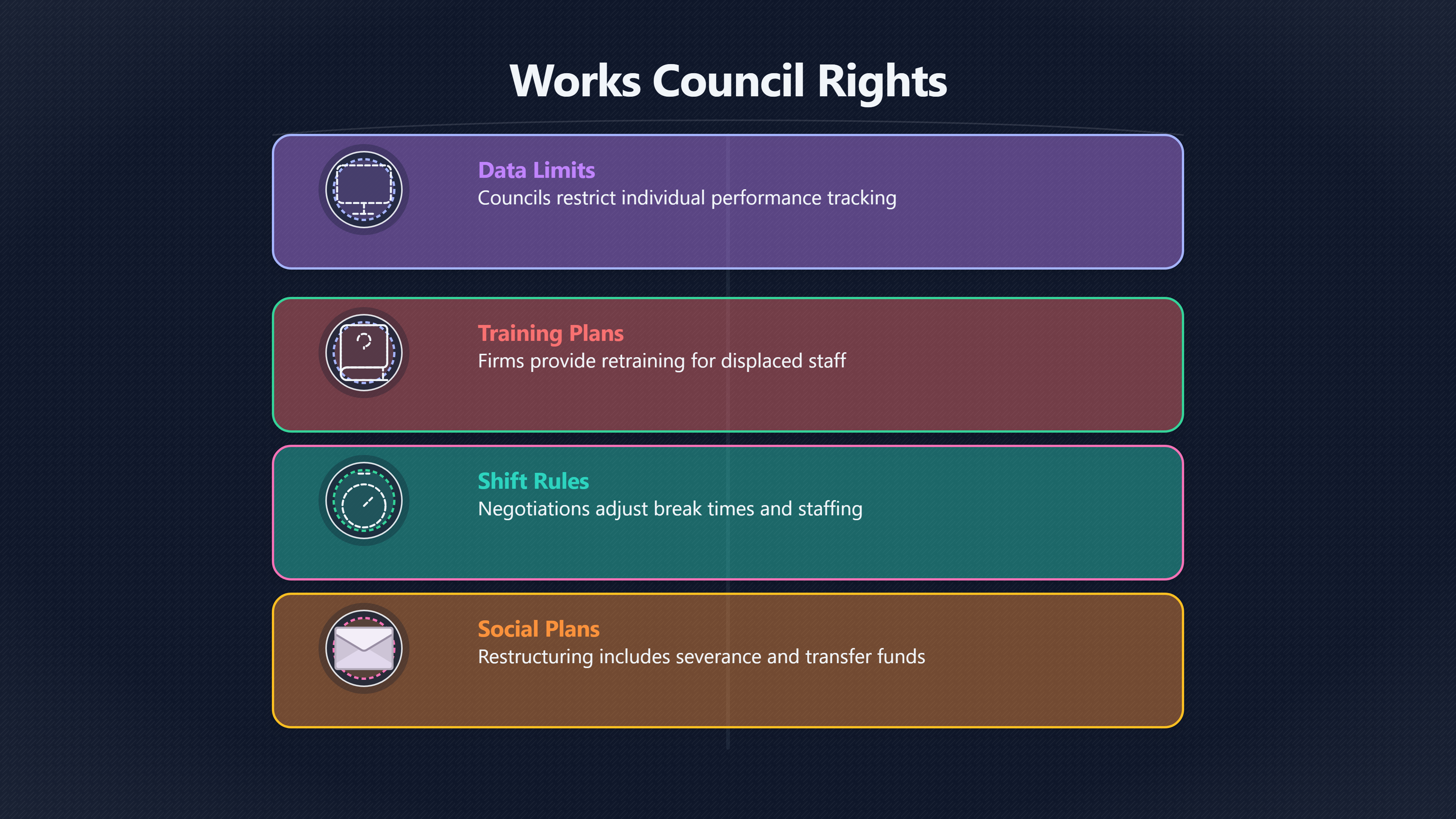
Monitoring and data collection
Modern automation systems often collect detailed worker data: machine pace, scanning speed, error rates, location tracking or AI-generated productivity metrics.
German law gives works councils important rights when technologies could monitor employee behaviour or performance. Legal analysis around AI systems increasingly centres on Section 87 of the Works Constitution Act, which covers technical systems capable of monitoring workers. [Bird & Bird]twobirds.comBird & BirdFirst Judgement on the Rights of Works Councils when…22 Mar 2024 — The works council has no right of co-determination when…
This matters because AI-driven management systems can quietly shift workplaces towards constant surveillance. Works councils can negotiate limits on:
- Individual performance tracking
- Data retention
- Automated scoring systems
- AI-assisted hiring or scheduling
- Monitoring through wearable devices or software
In the context of advanced AI, these protections may become more important rather than less important. As management systems gain the ability to analyse behaviour continuously and predict worker performance, workplace bargaining increasingly becomes a question about autonomy and dignity, not only wages.
Training and redeployment
Automation succeeds more easily when firms retain experienced workers who understand production systems.
Studies of German co-determination suggest that plants with works councils are more likely to accompany robot adoption with training and workforce adjustment measures. [ifo Institut]ifo.deInstitut Organized Labor Versus Robots?Co-Determination in…Among workers who are most prone to automation, works councils prevent wage and earnings losses when firms adopt r…
This changes the incentives around automation. Workers are less likely to resist new technology if they believe:
- They will receive retraining
- Internal redeployment is possible
- Productivity gains will partly return to labour
- Automation will remove dangerous or exhausting tasks rather than simply discard employees
In sectors such as automotive manufacturing, this can produce a more cooperative transition path than abrupt layoffs followed by external hiring.
Working time and job design
Robot adoption often changes labour intensity rather than eliminating labour altogether.
Works councils frequently negotiate over:
- Shift systems
- Break times
- Staffing levels
- Ergonomic standards
- Human-robot interaction rules
- Overtime arrangements
This matters because automation can either reduce drudgery or intensify it. A robot-assisted warehouse worker may perform safer lifting while simultaneously being pushed to meet machine-paced productivity targets. Worker representation affects which version emerges.
Social compensation during restructuring
German industrial relations often include “social plans” during major restructuring. These can include severance arrangements, phased retirement, retraining funds or internal transfer systems.
That does not eliminate disruption, but it can soften the political and human costs of technological change.
For advocates of a more abundant AI future, this is a critical point. Public resistance to automation often reflects fear of chaotic transition rather than hostility to technology itself. Institutions that reduce insecurity may therefore make societies more willing to adopt productivity-enhancing systems.
Why worker voice may improve technology adoption
The most surprising finding from German automation research is not that workers sometimes resist robots. It is that worker representation can actually support automation under some conditions.
Several mechanisms help explain this.
Trust reduces defensive resistance
Employees are more likely to cooperate with technological change when they expect transparency and negotiation instead of unilateral restructuring.
Without worker voice, management announcements about AI or robotics are often interpreted as hidden layoff plans. That creates incentives for sabotage, disengagement or political opposition.
Works councils can reduce this mistrust by forcing earlier consultation and clearer information sharing.
Research on German digitalisation argues that workplace representation can help establish legitimacy for technological transitions, especially in sectors with physically demanding work. [IDEAS]ideas.repec.orgSuggested Citation.Read moreIDEAS/RePEcDo German Works Councils Counter or Foster the…by G Sabrina · 2019 — Thus, this study highlights the importance of establis… [RePEc]ideas.repec.orgSuggested Citation.Read moreIDEAS/RePEcDo German Works Councils Counter or Foster the…by G Sabrina · 2019 — Thus, this study highlights the importance of establis…
In other words, negotiated automation may encounter less friction than imposed automation.
Tacit worker knowledge improves implementation
Workers often understand production bottlenecks, safety risks and workflow realities better than senior management or external consultants.
Robot deployment frequently fails not because the machines are technically incapable, but because organisations poorly integrate them into real workplaces.
German co-determination systems sometimes function as a mechanism for surfacing operational knowledge during technological transitions. This can improve implementation quality and productivity.
Some evidence suggests that plants with works councils experience stronger productivity gains after robot adoption while also reducing wage losses for vulnerable workers. [ifo Institut]ifo.deInstitut Organized Labor Versus Robots?Co-Determination in…Among workers who are most prone to automation, works councils prevent wage and earnings losses when firms adopt r…
That is highly relevant to the AI bloom question. If advanced AI systems eventually transform large parts of the economy, social systems that combine rapid adoption with institutional trust may outperform both rigid anti-technology politics and highly unequal winner-take-all systems.
Shared gains make automation politically sustainable
Automation becomes socially explosive when productivity rises while insecurity spreads.
Germany’s system does not fully solve this problem, but it partially moderates it. Recent research from the ifo Institute and associated researchers found that works councils reduced job separations and wage losses among production workers after robot adoption. [ifo Institut]ifo.deInstitut Organized Labor Versus Robots?Co-Determination in…Among workers who are most prone to automation, works councils prevent wage and earnings losses when firms adopt r…
This matters because the politics of AI may ultimately depend less on the existence of powerful technology than on whether ordinary people believe they benefit from it.
If workers experience AI mainly as:
- tighter surveillance,
- unstable employment,
- weaker bargaining power,
- and declining control over work,
then political backlash becomes more likely.
But if automation visibly improves safety, income stability, working conditions or leisure time, support for further technological progress may increase.
German co-determination and the broader AI future
The German experience also matters because the next wave of automation is likely to involve management and cognitive systems, not only factory robots.
Earlier industrial robots mainly replaced repetitive physical tasks such as welding or lifting. AI systems increasingly influence:
- scheduling,
- hiring,
- performance evaluation,
- logistics,
- customer service,
- software development,
- and administrative work.
That shifts the debate from machine replacement alone to machine governance.
Recent German discussions around AI and works councils increasingly focus on algorithmic management and human-centred AI. Researchers examining AI in German workplaces describe efforts by unions and works councils to shape “human-centred” deployment strategies rather than merely opposing the technology. [Sage Journals]journals.sagepub.comSage JournalsBuilding Worker Voice and Power in AI Decisions27 Jan 2026 — This article compares works council initiatives to influence th… [ResearchGate]researchgate.netPDF) Do German Works Councils Counter or Foster the…This paper adds the role of industrial relations to the existing literature by an…
This is a notable contrast with simplistic narratives portraying labour institutions as inherently anti-innovation.
Within the larger AI bloom framework, the deeper issue is whether advanced intelligence systems can expand human capability without hollowing out human agency. Germany’s institutions do not answer that question fully, but they show one possible mechanism for preserving democratic negotiation inside technologically advanced workplaces.
Limits of the German model for sharing automation gains
Germany’s experience is important, but it should not be romanticised.

Works councils cover only part of the economy
Large manufacturing firms are much more likely to have strong works councils than fragmented service sectors or gig-style employment.
Coverage has weakened over time in parts of the German economy, especially among smaller firms and newer digital sectors. [SHS Cairn.info]shs.cairn.inforevue entreprises et histoire 2023 4 page 32SHS Cairn.infoworks councils in the German ICT services industry29 Feb 2024 — At the same time, German works councils continue to have am…
That creates a divide between highly organised industrial workers and less protected workers elsewhere.
If future AI systems spread mainly through fragmented digital labour markets rather than traditional factories, the German model may become harder to sustain.
Worker voice does not equal worker ownership
Works councils influence implementation, but they do not generally own productive assets.
This means they can shape:
- deployment,
- training,
- monitoring rules,
- and compensation,
without fundamentally changing who owns the robots or AI systems.
As a result, broader inequality can still rise even if workplace outcomes improve locally.
This distinction matters for long-run AI abundance debates. A society could achieve extraordinary productive capacity while still concentrating wealth ownership heavily among shareholders, platform owners or AI infrastructure providers.
Global competition limits bargaining power
German firms still operate in intensely competitive global markets.
Even cooperative labour-management systems face pressure from:
- lower-cost regions,
- shareholder demands,
- and international supply chains.
That means negotiated automation often operates within constraints rather than outside them.
Worker representation can soften transitions and distribute gains more broadly, but it may not fully prevent:
- outsourcing,
- wage pressure,
- or labour displacement.
AI may move faster than existing institutions
Industrial relations systems evolved over decades around relatively stable factory structures.
Advanced AI may diffuse much faster across occupations, including professional and cognitive work traditionally considered secure.
[Works councils are now grappling with:]gbfinancemag.comped Germany to integrate AI more smoothly, with fewer psychological costs to workers…
- generative AI,
- automated decision systems,
- algorithmic monitoring,
- and AI-assisted management tools.
But institutions designed for twentieth-century industry may struggle if technological change accelerates dramatically.
That tension sits near the centre of the AI bloom question itself. If intelligence becomes abundant, can democratic institutions adapt quickly enough to ensure that abundance expands human flourishing rather than concentrating control?
Why the German case still matters
Germany does not prove that collective bargaining automatically shares the robot dividend fairly. But it does challenge a common assumption that worker protections necessarily block innovation.
The strongest lesson from the German case is more subtle: automation outcomes are politically and institutionally shaped.
Robots and AI systems are not introduced into a vacuum. They enter workplaces with existing power structures, legal rules and expectations about fairness. Germany’s works councils show that worker voice can sometimes make automation more acceptable, more productive and less socially destructive at the same time.
That matters well beyond manufacturing policy. If advanced AI eventually enables a world of far greater abundance, scientific acceleration and reduced drudgery, the transition will still depend on institutions capable of negotiating trust, distributing gains and preserving human agency during rapid change.
The German experience suggests that one path towards broader flourishing is not simply faster automation or slower automation, but more negotiated automation. [unric.org]unric.orgArtificial intelligence and the future of work: Will AI replace…30 Apr 2025 — The best approach is to integrate technology through soc… [IDEAS]ideas.repec.orgSuggested Citation.Read moreIDEAS/RePEcDo German Works Councils Counter or Foster the…by G Sabrina · 2019 — Thus, this study highlights the importance of establis… [RePEc]ideas.repec.orgSuggested Citation.Read moreIDEAS/RePEcDo German Works Councils Counter or Foster the…by G Sabrina · 2019 — Thus, this study highlights the importance of establis…
Endnotes
-
Source: ideas.repec.org
Title: Suggested Citation.Read more
Link: https://ideas.repec.org/a/jns/jbstat/v239y2019i3p523-564n3.htmlSource snippet
IDEAS/RePEcDo German Works Councils Counter or Foster the...by G Sabrina · 2019 — Thus, this study highlights the importance of establis...
-
Source: ifo.de
Title: Institut Organized Labor Versus Robots?
Link: https://www.ifo.de/en/econpol/publications/2025/article-journal/organized-labor-versus-robots-co-determination-times-automationSource snippet
Co-Determination in...Among workers who are most prone to automation, works councils prevent wage and earnings losses when firms adopt r...
-
Source: researchgate.net
Link: https://www.researchgate.net/publication/333752306_Do_German_Works_Councils_Counter_or_Foster_the_Implementation_of_Digital_TechnologiesSource snippet
(PDF) Do German Works Councils Counter or Foster the...This paper adds the role of industrial relations to the existing literature by an...
-
Source: researchgate.net
Link: https://www.researchgate.net/publication/365219283_The_German_Model_of_Industrial_Relations_Balancing_Flexibility_and_Collective_ActionSource snippet
The German Model of Industrial RelationsIn Germany, works councils possess co-determination rights concerning apprenticeship training, wh...
-
Source: ifo.de
Title: works councils prevent wage cuts through automation
Link: https://www.ifo.de/en/press-release/2025-11-04/works-councils-prevent-wage-cuts-through-automationSource snippet
ifo InstitutWorks Councils Prevent Wage Cuts Through Automation4 Nov 2025 — Production workers benefit from works councils when firms ado...
-
Source: researchgate.net
Title: Research Gate(PDF) Promoting human-centred AI in the workplace
Link: https://www.researchgate.net/publication/366563650_Promoting_human-centred_AI_in_the_workplace_Trade_unions_and_their_strategies_for_regulating_the_use_of_AI_in_GermanySource snippet
on Germany, this article addresses the following questions: (1) what areas of application and use cases for AI are rele...
-
Source: shs.cairn.info
Title: revue entreprises et histoire 2023 4 page 32
Link: https://shs.cairn.info/revue-entreprises-et-histoire-2023-4-page-32?lang=frSource snippet
SHS Cairn.infoworks councils in the German ICT services industry29 Feb 2024 — At the same time, German works councils continue to have am...
-
Source: shs.cairn.info
Title: journal entreprises et histoire 2023 4 page 32
Link: https://shs.cairn.info/journal-entreprises-et-histoire-2023-4-page-32?lang=enSource snippet
Traditionally, one union negotiates a sectoral agreement with an employers'...Read more...
-
Source: unric.org
Link: https://unric.org/en/artificial-intelligence-and-the-future-of-work-will-ai-replace-our-jobs/Source snippet
Artificial intelligence and the future of work: Will AI replace...30 Apr 2025 — The best approach is to integrate technology through soc...
-
Source: researchgate.net
Link: [https://www.researchgate.net/publication/380197199We_are_no_Luddites-CSCW_Co-Determination_and_Digital_Transformation_in_Germany](https://www.researchgate.net/publication/380197199_We_are_no_Luddites-_CSCW_Co-Determination_and_Digital_Transformation_in_Germany)Source snippet
(PDF) "We are no Luddites!" - CSCW, Co-Determination...This paper presents an ethnographic study of works councils in Small and Medium-s...
-
Source: researchgate.net
Title: 403754544 Automation and collective agreements
Link: https://www.researchgate.net/publication/403754544_Automation_and_collective_agreementsSource snippet
Automation and collective agreements13 Apr 2026 — In this paper, we empirically examine how collective bargaining agreements relate to fi...
-
Source: germany.travel
Link: https://www.germany.travel/en/home.htmlSource snippet
It offers a wide variety of attractions. Whether you are looking for history, culture, nature or just a good time...
-
Source: twobirds.com
Link: https://www.twobirds.com/en/insights/2024/germany/erstes-urteil-zu-rechten-des-betriebsrats-bei-einsatz-von-kuenstlicher-intelligenzSource snippet
Bird & BirdFirst Judgement on the Rights of Works Councils when...22 Mar 2024 — The works council has no right of co-determination when...
-
Source: journals.sagepub.com
Link: https://journals.sagepub.com/doi/10.1177/07308884251412886Source snippet
Sage JournalsBuilding Worker Voice and Power in AI Decisions27 Jan 2026 — This article compares works council initiatives to influence th...
-
Source: Wikipedia
Link: https://en.wikipedia.org/wiki/GermanySource snippet
GermanyGermany, officially the Federal Republic of Germany, is a country in Western and Central Europe. It lies between the Baltic Sea...
-
Source: britannica.com
Link: https://www.britannica.com/place/GermanySource snippet
Germany | Facts, Geography, Maps, & HistoryGermany is a country of north-central Europe. Although Germany existed as a loose polity of Ge...
-
Source: theguardian.com
Link: https://www.theguardian.com/world/germanySource snippet
May 2026 · Paediatrician in Germany charged with 130 counts of sexual abuse · Milka maker milked shoppers over size of chocolate bars, Ge...
Published: May 2026
-
Source: GOV.UK
Link: https://www.gov.uk/foreign-travel-advice/germanySource snippet
travel advice10 Apr 2026 — FCDO travel advice for Germany. Includes safety and security, insurance, entry requirements and legal differences...
-
Source: kids.nationalgeographic.com
Link: https://kids.nationalgeographic.com/geography/countries/article/germanySource snippet
Country ProfileGermany is a country of incredible variety. Germany's location at the heart of Europe has shaped its history both for good...
Additional References
-
Source: european-union.europa.eu
Link: https://european-union.europa.eu/principles-countries-history/eu-countries/germany_enSource snippet
– EU country | European UnionGermany is a federal parliamentary republic with a chancellor who is the head of government, and a president...
-
Source: orrick.com
Title: However, using AI tools such as Chat GPT does not fall under this
Link: https://www.orrick.com/en/Insights/2024/09/AI-and-German-Co-Determination-What-Employers-Need-to-KnowSource snippet
OrrickAI and German Co-Determination – What Employers Need...17 Sept 2024 — The works council must be involved, and a shop agreement mus...
-
Source: gbfinancemag.com
Link: https://gbfinancemag.com/artificial-intelligence-and-workers-wellbeing-lessons-from-germanys-early-experience/Source snippet
ped Germany to integrate AI more smoothly, with fewer psychological costs to workers...
-
Source: epi.org
Title: codetermination and power in the workplace
Link: https://www.epi.org/unequalpower/publications/codetermination-and-power-in-the-workplace/Source snippet
Mar 23, 2022 — There is even some evidence that German works councils raise productivity (Mueller and Stegmaier 2017). This is consistent...
-
Source: tatsachen-ueber-deutschland.de
Link: https://www.tatsachen-ueber-deutschland.de/enSource snippet
It is a cosmopolitan, democratic country with a rich heritage and a thriving present-day...Read more...
-
Source: countercurrents.org
Title: covid 19 changes work in germany
Link: https://countercurrents.org/2020/09/covid-19-changes-work-in-germany/Source snippet
COVID-19 Changes Work in GermanySep 13, 2020 —... Germany's trade unions and works councils, as well as extending Germany's well-known c...
-
Source: youtube.com
Title: “How automation is transforming the German labor market” | ESMT Open Lecture
Link: https://www.youtube.com/watch?v=i0nVRBdZdbQSource snippet
Regulating AI through collective bargaining...
-
Source: lonelyplanet.com
Title: Germany travel
Link: https://www.lonelyplanet.com/destinations/germanySource snippet
Lonely Planet | EuropeDiscover Germany's vibrant cities, fairytale castles and Alpine peaks in this travel guide. Plan your journey from...
-
Source: journals.sagepub.com
Link: https://journals.sagepub.com/doi/10.1177/09596801231188003Source snippet
unions, digitalisation and country effectsRutherford (2021) argues that greater union influence in Germany, compared with the US, reflect...
-
Source: youtube.com
Title: German Works Councils and Their Influence on IT Projects
Link: https://www.youtube.com/watch?v=JiI8cEKm1NISource snippet
The Strike in Germany and German Union Structure...
Amazon book picks
Further Reading
Books and field guides related to German works councils. Use these as the next step if you want deeper reading beyond the article.
Human resource management: Impact of changes in German labour...
Seminar paper from the year 2005 in the subject Leadership and Human Resources - Miscellaneous, grade: 1,7, Dongbei University of Finance...

The German labour management relations act
First published 1972. Subjects: Law and legislation, Works councils, Industrial management, Employee participation, Industrial management...
Workplace Democracy
Workplace democracy has a long history in scholarship and in practice, taking a wide variety of forms in different settings. It is inspir...

Meaningful Work and Workplace Democracy
This book is a timely revival of the social and political importance of meaningful work, which explores a philosophy of work based upon t...
eBay marketplace picks
Marketplace Samples
Example marketplace items related to this page. Use the search link to explore similar finds on eBay.

Example eBay listing
Artificial Intelligence Concept Vis Framed Wall Art Poster Canvas Print Picture
USD 12.04 | GB

Example eBay listing
Artificial Intelligence Concept Vis Framed Wall Art Poster Canvas Print Picture
USD 46.84 | GB

Example eBay listing
Artificial Intelligence Concept Vis Framed Wall Art Poster Canvas Print Picture
USD 12.04 | GB

Example eBay listing
Artificial Intelligence Concept Vis Framed Wall Art Poster Canvas Print Picture
USD 12.04 | GB

Example eBay listing
A.I. Artificial Intelligence Movie Film Poster Art Print
GBP 4.99 | Free shipping | GB

Example eBay listing
A I Artificial Intelligence 6 Movie Poster Art Print Print Classic Rare Gallery
GBP 49.00 | Free shipping | GB

Example eBay listing
AI - Artificial Intelligence (Poster + Slipcase) Blu-Ray
GBP 10.49 | Free shipping | GB

Example eBay listing
A. I. Artificial Intelligence. Jude Law. Original UK Video Poster.
GBP 8.11 | Shipping GBP 3.38 | GB
Topic Tree