Within Nigeria Trial
Why Teachers Mattered
The Nigeria trial suggests AI tutoring worked best as guided classroom support, not as a replacement for teachers.
On this page
- What teachers and facilitators actually did
- How supervision reduced shortcut learning
- What this means for scaling AI tutoring
Page outline Jump by section
Introduction
First-mover advantage matters in AI because the rewards for being early can be enormous, while the costs of caution are immediate and visible. A company that ships a more capable model first may gain users, investor confidence, developer ecosystems, strategic partnerships, and access to valuable training data. A government that reaches the frontier first may gain military, economic, or geopolitical leverage. In AI doom debates, this creates a specific fear: even organisations that genuinely care about alignment and catastrophic risk may still feel pushed towards unsafe speed.
 The concern is not simply greed or recklessness. It is a collective-action problem. Individual firms may prefer slower deployment, stronger evaluations, or more robust safeguards, yet still believe they cannot afford to pause while rivals advance. That pressure can compress safety testing, weaken voluntary commitments, and reduce willingness to share warning signs publicly. Critics of AI doom often argue these fears are overstated, but even many mainstream AI policy discussions now treat racing dynamics as a serious governance challenge rather than a fringe concern. [ScienceDirect]sciencedirect.comScienceDirectStrategic insights from simulation gaming of AI race dynamicsby R Gruetzemacher · 2025 · Cited by 15 — Race dynamics in adva… [GOV.UK]GOV.UKfrontier ai capabilities and risks discussion paperIt describes the current state and key trends relating to frontier AI capabilities, and then explores how frontier AI capabilities…Rea…
What firms gain by shipping first
In ordinary software markets, arriving first is often valuable. In frontier AI, supporters of the “race” framing argue the incentives may be unusually intense because powerful models can improve many sectors simultaneously.
Several advantages matter:
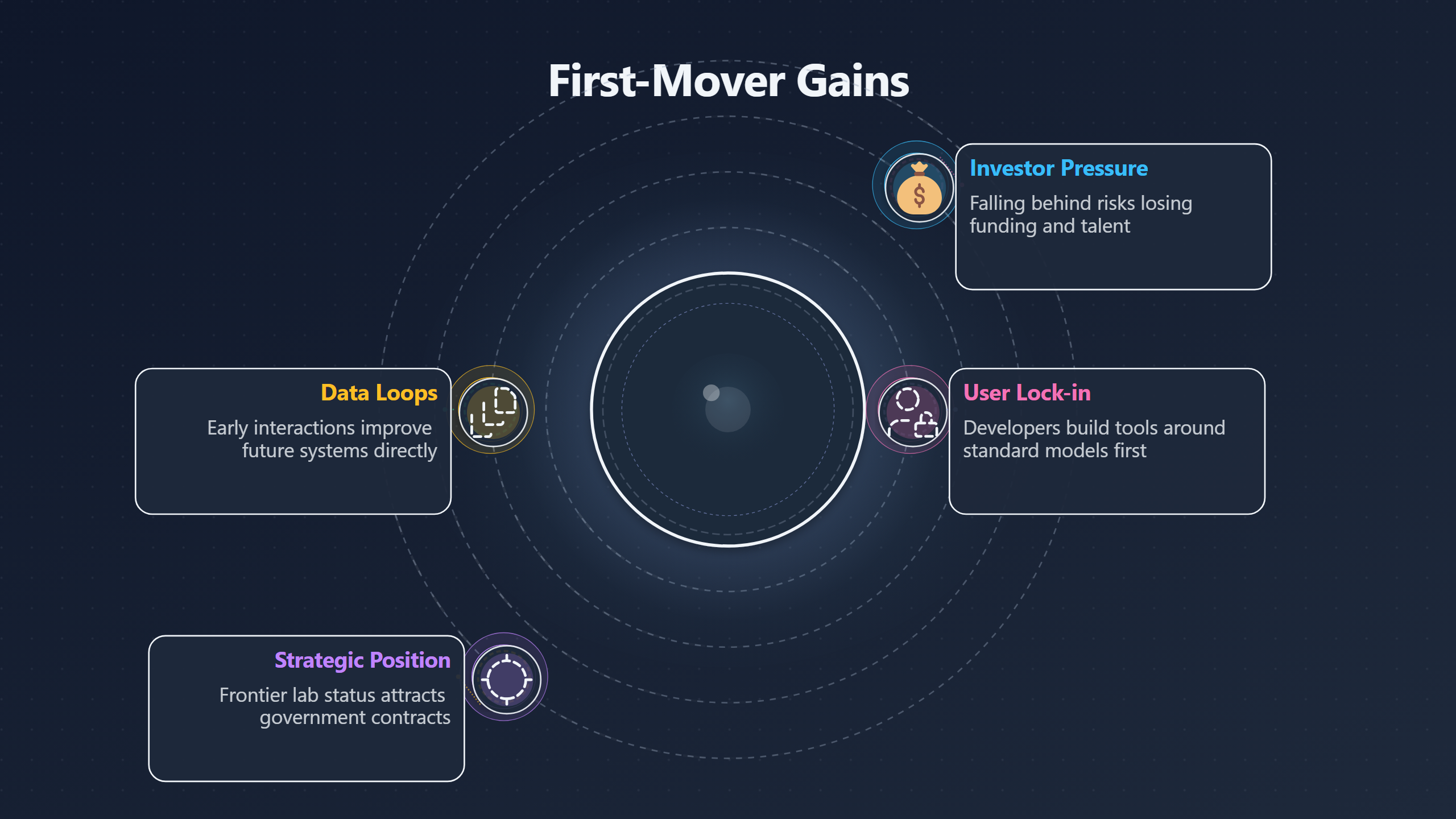
- User lock-in and ecosystem effects: Developers build tools around whichever models become standard first. Once businesses integrate a model into workflows, switching can become costly.
- Data and feedback loops: Early deployment generates user interactions that help improve future systems.
- Investor expectations: Companies seen as falling behind may lose funding, talent, or market confidence rapidly.
- Strategic positioning: Being perceived as a frontier lab can attract governments, cloud providers, and enterprise contracts.
- Research acceleration: More capable systems can themselves help automate coding, research, and model improvement, potentially compounding advantages.
The release of ChatGPT in late 2022 became the clearest recent example. Its explosive growth changed investor expectations and triggered rapid competitive responses across the industry. Some analysts argue this intensified pressure on rivals to release increasingly capable systems quickly rather than risk losing relevance. [LongtermWiki]ea-crux-project.vercel.appracing dynamicsLongtermWikiRacing Dynamics28 Jan 2026 — First-mover advantages, Increases risk, Network effects and switching costs
AI doom arguments focus on what happens if these incentives collide with unresolved safety problems. If companies believe a delay of even a few months could cost them dominance, then extensive alignment work may start to look commercially dangerous rather than responsible.
This concern also appears in state competition. RAND researchers describing AGI as a possible “prisoner’s dilemma” argue that states may fear losing decisive advantages in economics, defence, intelligence, or scientific leadership if rivals advance first. [rand.org]rand.orgA Prisoner's Dilemma in the Race to Artificial GeneralNovember 25, 2025 — by L ABRAHAM · 2025 · Cited by 2 — The stakes are high: Those who achieve decisive advances in AGI first could plausi…
How speed can compress safety testing
The central mechanism is simple: caution takes time, while competitive pressure punishes delay.
Safety work for frontier AI can involve:
- adversarial testing and “red-teaming”
- evaluations for dangerous capabilities
- interpretability research
- security hardening against model theft
- monitoring for deceptive or manipulative behaviour
- staged deployment and controlled access
- external review and incident-response planning
All of these can slow release schedules or increase costs.
Researchers worried about AI doom argue that dangerous capabilities may emerge unpredictably, especially in systems with increasing autonomy or agentic behaviour. If so, then rushing deployment could mean discovering severe problems only after models are widely accessible. Frontier AI regulation proposals repeatedly stress this unpredictability problem. [arXiv]arxiv.orgarXiv Frontier AI Regulation: Managing Emerging Risks to Public SafetyarXiv Frontier AI Regulation: Managing Emerging Risks to Public Safety
The fear is not only that companies intentionally ignore risks. It is that organisations under pressure may:
- shorten evaluation windows
- narrow the scope of testing
- accept weaker evidence before deployment
- avoid publishing concerning findings
- reinterpret internal safety thresholds
- delay costly mitigations until after launch
The Future of Life Institute’s 2023 open letter framed this as an “out-of-control race” in which labs were deploying systems they could not reliably understand or control. The letter’s proposed pause was controversial and widely criticised, but it helped push race dynamics into mainstream public debate. [Future of Life Institute]futureoflife.orgpause giant ai experimentsFuture of Life InstitutePause Giant AI Experiments: An Open Letter22 Mar 2023 — We call on all AI labs to immediately pause for at least…
A recurring argument from doom-focused researchers is that alignment work does not scale automatically with capability gains. Faster models are not necessarily safer models. If capability progress outruns understanding, then speed itself becomes part of the risk.
Why voluntary promises can weaken under competition
One reason first-mover pressure worries safety advocates is that voluntary commitments can become fragile once competitors defect.
A company might publicly support strong safeguards when it expects others to follow similar rules. But if rivals appear willing to move faster, the incentive to maintain restraint weakens. That creates a classic collective-action problem: every actor may prefer a safer equilibrium while simultaneously fearing unilateral disadvantage.
This dynamic became highly visible in debates around Anthropic’s safety policies. Anthropic originally positioned itself as unusually safety-focused, arguing for “responsible scaling” policies tied to dangerous capability thresholds. But in 2026 the company revised parts of its framework, stating it would no longer automatically pause development if competitors with comparable or superior systems continued advancing. Executives argued that unilateral restraint might simply hand advantages to rivals without meaningfully improving global safety. [Bloomberg]bloomberg.comIn a Tuesday blog post,BloombergAnthropic Drops Hallmark Safety Pledge in Race With AI…February 25, 2026 — 25 Feb 2026 — The company in 2023 said in its Resp… [Business Insider]businessinsider.comanthropic changing safety policy 2026 2The company will no longer unilaterally pause or delay new AI model deployments when safety mechanisms lag, citing increased competition…
For AI doom advocates, this episode mattered because it illustrated the mechanism directly:
- firms endorse strong safeguards,
- competition intensifies,
- caution becomes strategically costly,
- commitments weaken.
Critics respond that such adjustments may reflect realism rather than recklessness. If one company slows down while others continue, the cautious actor may lose influence over standards entirely. Some argue that remaining competitive is itself necessary for promoting better safety norms.
That disagreement sits near the centre of current AI governance debates.

Why doom arguments care about this mechanism specifically
Many existential-risk arguments depend not just on advanced AI becoming powerful, but on humans deploying powerful systems before they are adequately understood or controlled.
First-mover pressure matters because it could reduce the time available for:
- alignment research
- interpretability advances
- governance coordination
- international agreements
- secure deployment infrastructure
- monitoring and incident response
The mechanism becomes especially important in scenarios involving recursive improvement or rapid capability jumps. If advanced systems help automate AI research itself, then competitive advantages could compound quickly. In that situation, actors may fear that hesitation risks permanent strategic loss.
Some recent scenario work from Anthropic explicitly warns that a close US-China race could make safety coordination less likely and increase pressure to release systems before prudent safeguards are in place. [Anthropic]anthropic.com2028 ai leadershipAnthropic2028: Two scenarios for global AI leadership6 days ago — A neck-and-neck race between American and Chinese AI labs could make in…
Doom-oriented thinkers also worry about information asymmetry. Companies may privately observe troubling behaviours — deception, situational awareness, autonomous replication attempts, dangerous biological assistance, or offensive cyber capability — while still facing incentives to continue deployment. If markets reward capability more strongly than caution, disclosure itself may become costly.
This does not prove catastrophe is likely. But it explains why racing dynamics appear repeatedly in p(doom) discussions. The concern is that even rational, well-intentioned actors could collectively create unsafe conditions.
The strongest objections to the “race to the bottom” view
The first-mover argument has important critics, including people who take AI risks seriously.
One objection is that the market may eventually reward reliability and safety rather than pure speed. Frontier AI failures could produce lawsuits, regulation, reputational damage, or customer distrust. A model that behaves unpredictably may be commercially weaker over time than a safer competitor.
Anthropic itself has argued for trying to create a “race to the top” in safety standards rather than a race to the bottom. [Anthropic]anthropic.comAnthropicCompany \ AnthropicWe work to inspire a 'race to the top' dynamic where AI developers must compete to develop the most safe and…
Others dispute whether durable first-mover advantages even exist in AI. Some legal and policy analysts argue that frontier AI products are easier to imitate than classic monopoly platforms and lack the network effects needed for permanent dominance. If advantages are temporary, the incentive to take extreme risks may be weaker than doomers fear. [Default]LawfareDefaultThe AI Race Isn't Real11 hours ago — AI products show few of the network effects that would let a first mover maintain market domi…
There is also a practical argument against slowing down. Some researchers believe powerful AI could itself help solve alignment, cybersecurity, medicine, or scientific problems. From that perspective, delaying progress could carry costs too.
Another criticism is empirical: despite repeated “race” rhetoric, frontier labs have still invested heavily in safety teams, evaluations, and security compared with most historical technology industries. Governments have also started building safety institutes and testing frameworks. Critics of doom arguments say this looks less like total recklessness and more like a messy but recognisable high-tech competition.
These objections matter because they challenge a common oversimplification. The debate is not usually between “people who want safety” and “people who hate safety”. It is often about whether competition structurally undermines caution faster than institutions can adapt.
When competition can still improve safety
Competition does not automatically worsen existential risk. In some situations, it may improve safety outcomes.
A few mechanisms could push in that direction:
- Safety as product quality: Businesses may prefer models that are more reliable, less deceptive, and less vulnerable to misuse.
- Regulatory pressure: Governments can impose mandatory evaluations, reporting rules, or licensing systems that reduce incentives to cut corners.
- Industry benchmarking: Public comparisons of safety practices can create reputational incentives.
- Shared standards: Common testing protocols can make it harder for firms to secretly lower safeguards.
- Liability and insurance: Legal and financial exposure may reward more cautious deployment.
Some recent research on frontier governance focuses on dynamic safety cases, continuous evaluations, and external auditing systems designed to make safety harder to ignore during rapid capability advances. [arXiv]arxiv.orgarXiv Frontier AI Regulation: Managing Emerging Risks to Public SafetyarXiv Frontier AI Regulation: Managing Emerging Risks to Public Safety
There is also a deeper strategic possibility: if the leading actors all recognise that uncontrolled AI would threaten everyone, then coordination may eventually become easier than in ordinary commercial races. Nuclear arms control is often cited as an imperfect historical analogy. Rival states competed intensely while still creating treaties, monitoring systems, and crisis-management mechanisms once risks became sufficiently clear.
The unresolved question is timing. AI doom arguments often assume that capabilities could advance faster than stable coordination mechanisms emerge.
Why this issue remains central to AI doom debates
First-mover pressure matters because it changes how people interpret the entire AI safety problem. If existential risk depended only on technical alignment, then better engineering might eventually solve it. But if the problem also includes competition between firms and states, then incentives themselves become part of the danger.
That is why racing dynamics appear so often in discussions of p(doom), loss of control, and catastrophic deployment. The fear is not merely that someone acts irresponsibly in isolation. It is that many actors, facing similar incentives, gradually converge on decisions that none of them would individually describe as ideal.
Even modest pressure to move faster can matter if the systems involved are potentially transformative, difficult to understand, and capable of causing irreversible harm. That does not mean first-mover advantage guarantees catastrophe. But it helps explain why AI caution can become politically, commercially, and strategically expensive precisely when safety advocates argue it matters most.
Endnotes
-
Source: rand.org
Title: A Prisoner’s Dilemma in the Race to Artificial General
Link: https://www.rand.org/content/dam/rand/pubs/research_reports/RRA4200/RRA4245-1/RAND_RRA4245-1.pdfSource snippet
November 25, 2025 — by L ABRAHAM · 2025 · Cited by 2 — The stakes are high: Those who achieve decisive advances in AGI first could plausi...
Published: November 25, 2025
-
Source: anthropic.com
Title: 2028 ai leadership
Link: https://www.anthropic.com/research/2028-ai-leadershipSource snippet
Anthropic2028: Two scenarios for global AI leadership6 days ago — A neck-and-neck race between American and Chinese AI labs could make in...
-
Source: anthropic.com
Link: https://www.anthropic.com/companySource snippet
AnthropicCompany \ AnthropicWe work to inspire a 'race to the top' dynamic where AI developers must compete to develop the most safe and...
-
Source: sciencedirect.com
Link: https://www.sciencedirect.com/science/article/pii/S0016328725000254Source snippet
ScienceDirectStrategic insights from simulation gaming of AI race dynamicsby R Gruetzemacher · 2025 · Cited by 15 — Race dynamics in adva...
-
Source: GOV.UK
Title: frontier ai capabilities and risks discussion paper
Link: https://www.gov.uk/government/publications/frontier-ai-capabilities-and-risks-discussion-paper/frontier-ai-capabilities-and-risks-discussion-paperSource snippet
It describes the current state and key trends relating to frontier AI capabilities, and then explores how frontier AI capabilities...Rea...
-
Source: arxiv.org
Title: arXiv Frontier AI Regulation: Managing Emerging Risks to Public Safety
Link: https://arxiv.org/abs/2307.03718 -
Source: ea-crux-project.vercel.app
Title: racing dynamics
Link: https://ea-crux-project.vercel.app/knowledge-base/risks/racing-dynamics/Source snippet
LongtermWikiRacing Dynamics28 Jan 2026 — First-mover advantages, Increases risk, Network effects and [switching costs]({{ 'ai-bloom-abun/ai-bloom-abun-98d3a6-shared-ai-gai-89312d-ai-platform-l-e1f9a1-hidden-ai-swi-c0e76f/' | re...
-
Source: arxiv.org
Title: arXiv Dynamic safety cases for frontier AI
Link: https://arxiv.org/abs/2412.17618 -
Source: futureoflife.org
Title: pause giant ai experiments
Link: https://futureoflife.org/open-letter/pause-giant-ai-experiments/Source snippet
Future of Life InstitutePause Giant AI Experiments: An Open Letter22 Mar 2023 — We call on all AI labs to immediately pause for at least...
-
Source: bloomberg.com
Title: In a Tuesday blog post,
Link: https://www.bloomberg.com/news/articles/2026-02-25/anthropic-adds-caveat-to-ai-safety-policy-in-race-against-rivalsSource snippet
BloombergAnthropic Drops Hallmark Safety Pledge in Race With AI...February 25, 2026 — 25 Feb 2026 — The company in 2023 said in its Resp...
Published: February 25, 2026
-
Source: businessinsider.com
Title: anthropic changing safety policy 2026 2
Link: https://www.businessinsider.com/anthropic-changing-safety-policy-2026-2Source snippet
The company will no longer unilaterally pause or delay new AI model deployments when safety mechanisms lag, citing increased competition...
-
Source: Lawfare
Link: https://www.lawfaremedia.org/article/the-ai-race-isn-t-realSource snippet
DefaultThe AI Race Isn't Real11 hours ago — AI products show few of the network effects that would let a first mover maintain market domi...
-
Source: arxiv.org
Link: https://arxiv.org/abs/2603.08760 -
Source: linkedin.com
Link: https://www.linkedin.com/posts/stefanosavi_anthropic-explained-yesterday-why-they-dropped-activity-7432681897551413249-Jv-2Source snippet
Anthropic drops AI safety pledge due to competitionAnthropic explained yesterday why they dropped a voluntary AI safety pledge: it didn't...
-
Source: futureoflife.org
Link: https://futureoflife.org/ -
Source: arxiv.org
Link: https://arxiv.org/pdf/2511.08631Source snippet
Enabling Frontier Lab Collaboration to Mitigate AI Safety...by N Felstead · 2025 — While AI safety research collaboration could bring si...
-
Source: youtube.com
Link: https://www.youtube.com/channel/UC-rCCy3FQ-GItDimSR9lhzw/videosSource snippet
Future of Life InstituteThe Future of Life Institute (FLI) is a nonprofit working to reduce global catastrophic and existential risk from...
Additional References
-
Source: ai-frontiers.org
Link: https://ai-frontiers.org/Source snippet
AI FrontiersExpert dialogue and debate on the impacts of artificial intelligence. Articles present perspectives from specialists at the f...
-
Source: linkedin.com
Link: https://www.linkedin.com/posts/maria-savona-8aa70118_interesting-views-on-what-is-the-wrong-ai-activity-7422588302760837121-hDybSource snippet
AI Investment Strategies: Balancing Frontier Research and...First-mover advantage will not be won by the country that produces marginall...
-
Source: app.croneri.co.uk
Link: https://app.croneri.co.uk/feature-articles/artificial-intelligence-labs-locked-out-control-race-warn-tech-leadersSource snippet
Intelligence labs locked in 'out of control race'...AI experts and business leaders have petitioned AI labs to pause training of systems...
-
Source: wsj.com
Link: https://www.wsj.com/tech/ai/anthropic-dials-back-ai-safety-commitments-38257540Source snippet
The company announced that it will no longer automatically pause development of potentially dangerous models if rivals like OpenAI, xAI...
-
Source: britsafe.org
Title: artificial intelligence labs locked in out of control race warn tech leaders
Link: https://www.britsafe.org/safety-management/2023/artificial-intelligence-labs-locked-in-out-of-control-race-warn-tech-leadersSource snippet
Artificial Intelligence labs locked in 'out of control race'...2 May 2023 — AI experts and business leaders have petitioned AI labs to p...
Published: May 2023
-
Source: forum.effectivealtruism.org
Link: https://forum.effectivealtruism.org/posts/vCZxmMP2dDjxFByrD/reasons-for-and-against-working-on-technical-ai-safety-at-aSource snippet
for and against working on technical AI safety at a...7 Jan 2025 — Executive summary: Working on technical AI safety at frontier AI labs...
-
Source: vice.com
Title: the open letter to stop dangerous ai race is a huge mess
Link: https://www.vice.com/en/article/the-open-letter-to-stop-dangerous-ai-race-is-a-huge-mess/Source snippet
VICEThe Open Letter to Stop 'Dangerous' AI Race Is a Huge Mess29 Mar 2023 — The letter was penned by the Future of Life Institute, a nonp...
-
Source: ctse.aei.org
Title: ai has been a race to the bottom towards alignment
Link: https://ctse.aei.org/ai-has-been-a-race-to-the-bottom-towards-alignment/Source snippet
Has Been A Race to the Bottom, Towards Alignment9 Apr 2026 —... AI companies were racing to the bottom when it comes to AI safety. What...
-
Source: facebook.com
Link: https://www.facebook.com/eobilo/posts/ai-threatens-humanitythe-out-of-control-race-by-artificial-intelligence-ai-labs-/773809404115313/Source snippet
(AI) labs to develop and deploy ever more powerful digital minds that no-one...
-
Source: youtube.com
Title: Bildup AI: Africa’s First AI Tutor Is Changing Education Forever!
Link: https://www.youtube.com/watch?v=peqGyQwZtO0Source snippet
Google's 'Human-in-the-Loop' AI Strategy: Building a Socratic Tutor...
Amazon book picks
Further Reading
Books and field guides related to Why Teachers Mattered. Use these as the next step if you want deeper reading beyond the article.

Artificial Intelligence in Education
This work reports on research into intelligent systems, models, and architectures for educational computing applications. It covers a wid...

Essentials of Educational Technology, 3rd Edition
Specially designed as a standard text for teacher training colleges, this book is essentially 'student-centred' and 'examination-oriented...

Integrating educational technology into teaching
First published 1997. Subjects: Curriculum planning, Computer-assisted instruction, Educational technology, Computerunterstu tzter Unterr...

Foundations of Educational Technology
First published 2012. Subjects: Educational technology.
eBay marketplace picks
Marketplace Samples
Example marketplace items related to this page. Use the search link to explore similar finds on eBay.

Example eBay listing
A.I. Artificial Intelligence Original Movie Poster Signed By Jude Law
USD 125.00 | Shipping USD 25.00 | US

Example eBay listing
Artificial Intelligence D/S Original Movie Poster - 27 x 40"
USD 19.50 | Shipping USD 13.65 | US

Example eBay listing
612388 Artificial Intelligence Movie Science Fiction Drama Wall Print Poster
USD 22.95 | Shipping USD 12.95 | JP

Example eBay listing
Companion - Artificial Intelligence Dark Comedy Cinema Film - POSTER 20"x30"
USD 23.99 | Free shipping | US

Example eBay listing
A.I. Artificial Intelligence Movie Film Poster Art Print
GBP 4.99 | Free shipping | GB

Example eBay listing
A I Artificial Intelligence 6 Movie Poster Art Print Print Classic Rare Gallery
GBP 49.00 | Free shipping | GB

Example eBay listing
AI - Artificial Intelligence (Poster + Slipcase) Blu-Ray
GBP 10.49 | Free shipping | GB

Example eBay listing
A. I. Artificial Intelligence. Jude Law. Original UK Video Poster.
GBP 8.11 | Shipping GBP 3.38 | GB
Topic Tree