Within Beyond GDP
AI tutors and hidden value
Cheap AI tutoring could expand knowledge and opportunity far more than its market price suggests.
On this page
- Why education gains may barely show in GDP
- Capability gains from low cost expertise
- Risks of unequal access and platform dependence
Page outline Jump by section
Introduction
AI tutors reveal a strange feature of modern economic statistics: some of the most important gains in human capability may barely appear in GDP at all. If a student in a remote village gains access to high-quality maths instruction at almost zero cost, or a struggling pupil receives patient one-to-one feedback every evening through an AI assistant, society may become substantially more educated without much new spending taking place.
 That matters for the broader debate about AI abundance. The optimistic case for advanced AI is not only that economies become larger, but that intelligence itself becomes cheaper and more widely available. Education is one of the clearest early examples. Traditional tutoring is powerful but expensive. AI systems promise something closer to personalised instruction at software scale: available at any hour, adaptable to individual pace, and potentially accessible to billions of people. Yet if the service is free, subsidised, or dramatically cheaper than human tutoring, national income statistics may record only a small fraction of the real benefit. [Stanford Digital Economy Lab]digitaleconomy.stanford.eduwhat is generative ai worthStanford Digital Economy Lab13 Apr 2026 —… consumer surplus increased from $116 billion to $172 billion. This surplus substantially ex… [IMF The result is a growing gap between measured economic activity and lived capability. AI tutors expose that gap unusually clearly because the]imf.orgIMFThe Digital Economy, GDP and Consumer Welfareby E Brynjolfsson · 2018 · Cited by 42 — We apply this framework to several empirical exa… value is easy to imagine in human terms: confidence, literacy, exam success, language acquisition, scientific understanding, and access to opportunities that were previously limited to wealthy families.
Why education gains may barely show in GDP
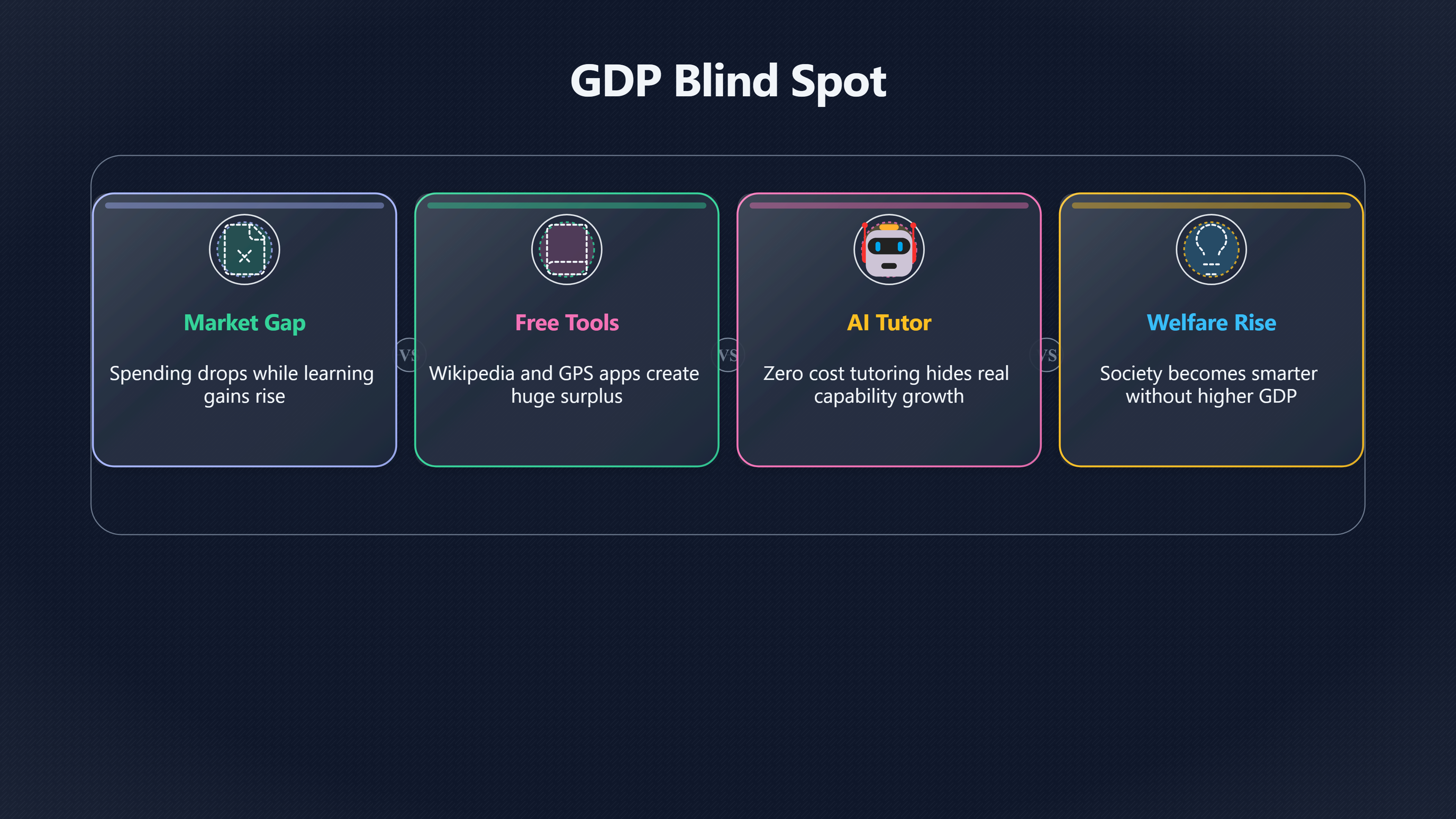
GDP measures market transactions. It records what people spend, not necessarily what they gain. That distinction becomes important when expertise becomes extremely cheap.
A traditional private tutor can cost hundreds or thousands of pounds per year. If a family pays for those lessons, GDP rises because money changes hands. But if an AI tutor delivers similar help for a tiny subscription fee or entirely free through a school system, measured economic activity may rise only slightly even if the educational improvement is large.
This is part of a broader problem economists have identified in the digital economy. Free online tools often create large “consumer surplus” — the gap between what users would be willing to pay and what they actually pay. Researchers associated with Stanford’s Digital Economy Lab and the GDP-B project argue that conventional GDP systematically misses much of the value created by digital goods, especially low-cost or free ones. [Stanford Digital Economy Lab]digitaleconomy.stanford.eduwhat is generative ai worthStanford Digital Economy Lab13 Apr 2026 —… consumer surplus increased from $116 billion to $172 billion. This surplus substantially ex… [AEA Publications]pubs.aeaweb.orgThis.Read moreAEA PublicationsGDP-B: Accounting for the Value of New and Free Goodsby E Brynjolfsson · 2025 · Cited by 16 — This can be shown to approx…
The educational implications are unusually important because learning compounds over decades. A modest improvement in reading ability at age ten can affect later academic performance, income, health outcomes, and civic participation. If AI tutoring systems improve learning for millions of people, the long-run effects could be enormous even if the software itself is cheap.
This creates an odd statistical possibility: a society could become significantly more capable while showing only modest increases in measured output.
Economists have seen smaller versions of this already. Search engines, GPS navigation, Wikipedia, translation software, and video calls generate benefits that far exceed their direct contribution to GDP. [ESCoE]escoe.ac.ukESCoEMeasuring the value of “free” digital products for…September 15, 2023 — 15 Sept 2023 — We tackle this challenge in our Discussion… [IMF]imf.orgIMFThe Digital Economy, GDP and Consumer Welfareby E Brynjolfsson · 2018 · Cited by 42 — We apply this framework to several empirical exa… AI tutoring pushes the same pattern into a domain central to human development itself.
The old scarcity: personalised tutoring was too expensive
The appeal of AI tutoring becomes clearer when viewed against a longstanding educational constraint.
In 1984, educational psychologist Benjamin Bloom described the “2 sigma problem”: students receiving one-to-one tutoring performed dramatically better than conventional classroom students, often by around two standard deviations. Bloom’s challenge was economic as much as pedagogical. Personal tutoring worked, but societies could not afford to provide expert tutors for every child. [Wikipedia]WikipediaBloom's 2 sigma problemBloom's 2 sigma problem
For decades, education systems accepted a compromise. One teacher would instruct dozens of students simultaneously because individual attention was scarce and expensive.
AI systems potentially weaken that constraint. They can provide instant feedback, endless repetition without frustration, adaptive pacing, translation support, conversational practice, and explanations tailored to different learning styles. Modern systems can also remain available outside school hours, which matters especially for students without educated parents or access to paid tutoring.
Projects such as Khan Academy’s Khanmigo and newer government-backed tutoring experiments are explicitly framed around extending personalised support to far larger populations. [Gerry Pedraza]gerrypedraza.comGerry Pedraza Can Khanmigo AI Tutor Solve Education's Two SigmaGerry PedrazaCan Khanmigo AI Tutor Solve Education's Two Sigma…March 7, 2024 — 7 Mar 2024 — By making personalized learning accessible… The World Bank and related education organisations have also begun examining AI tutors as tools for reducing educational inequality and improving teacher capacity in lower-income settings. [The World Bank]thedocs.worldbank.orgThe World BankAI Tutors and Teaching: How Might the Role of the Teacher…May 21, 2025 — 14 May 2025 — AI is reshaping education — from…
Even partial success matters. If AI systems can provide something meaningfully better than overcrowded classrooms at near-zero marginal cost, the economic implications reach beyond education spending alone. Human capital — skills, reasoning ability, literacy, scientific understanding — underpins productivity, innovation, and institutional quality across entire societies.
Yet much of this transformation may arrive through falling prices rather than rising expenditure. That is precisely the kind of change GDP struggles to capture well.
Capability gains from low-cost expertise
The strongest argument for AI tutors is not merely convenience. It is the possibility that expertise itself becomes abundant.
Historically, access to skilled instruction depended heavily on geography and wealth. Elite tutoring has long functioned as a hidden accelerator for affluent families. AI systems could partially flatten that advantage by making advanced assistance available almost everywhere with an internet connection.
Several capability shifts matter here.
Continuous feedback instead of episodic teaching
Most classrooms ration attention. Students often wait days before discovering they misunderstood a concept. AI tutors can provide immediate correction, additional examples, and alternative explanations.
That changes the speed of learning. The gain is not simply “more information”, but reduced friction in the learning process itself.
Personal pacing
Conventional classrooms move groups through material at a fixed speed. Some pupils become bored; others quietly fall behind.
AI tutors can adjust dynamically. Students can revisit concepts repeatedly without embarrassment, accelerate when ready, or ask basic questions they might avoid asking publicly. This matters particularly for adult learners, second-language learners, and people returning to education later in life.
Expertise in places where specialists are scarce
Many regions face severe shortages of qualified teachers in mathematics, science, languages, and special educational support. AI systems do not fully replace teachers, but they may significantly expand access to competent assistance where little existed before.
That possibility is especially relevant to the broader AI bloom idea because intelligence access has historically been highly unequal. Cheap cognitive support could become a form of infrastructure comparable to electrification or internet access.
Education outside formal institutions
AI tutoring also weakens the monopoly of formal schooling over advanced learning.
A motivated teenager with AI-assisted guidance can increasingly access explanations, coding help, language practice, exam preparation, and scientific material independently. Informal learning becomes more powerful when the cost of expert feedback collapses.
From a GDP perspective, much of this may look almost invisible. A free chatbot helping millions of people learn algebra produces little direct revenue compared with traditional tuition markets. But from a capability perspective, the change could be large.

Why the value may compound across generations
Education has unusually long time horizons. A productivity improvement in a factory may matter for quarterly output. A cognitive improvement in children can shape decades of future outcomes.
This is one reason AI tutoring matters within the wider discussion about humanity’s long-term future. Intelligence amplification compounds.
If students learn foundational skills earlier and more effectively, several downstream effects become more plausible:
- More people capable of advanced scientific and technical work
- Faster diffusion of knowledge across societies
- Reduced educational inequality between regions
- Larger pools of researchers, engineers, and creators
- Better informed citizens and institutions
- Greater adaptability during technological change
The cumulative effects could eventually matter at civilisational scale. A world where billions of people have access to personalised cognitive assistance may innovate differently from one where elite education remains scarce and expensive.
That does not mean AI tutoring automatically produces a flourishing future. But it illustrates one mechanism through which AI abundance might operate: not merely by producing more goods, but by expanding the number of minds able to participate meaningfully in science, culture, and economic life.
The hidden paradox: GDP can even move the wrong way
AI tutors expose another deeper problem with GDP: improvements can sometimes appear statistically weak or even negative.
Suppose expensive private tutoring becomes partly replaced by free or low-cost AI systems. Families spend less money while achieving similar educational outcomes. Measured market activity may stagnate or decline despite a real improvement in welfare.
Economists studying digital goods have pointed to similar examples before. Free messaging apps replaced paid SMS services. Wikipedia displaced printed encyclopaedias. GPS apps reduced demand for dedicated navigation devices. In each case, consumer welfare rose while some measured market activity fell. [BusinessThink]businessthink.unsw.edu.augdp b measuring free digital goods consumer welfareBusinessThinkWhy traditional economic measures miss billions in value17 Mar 2026 — Researchers developed GDP-B to measure the welfare val…
Education may become one of the largest such cases because tutoring has historically been labour-intensive and expensive.
This creates political risks. Governments relying heavily on GDP growth as the dominant success metric may underinvest in technologies that generate large non-market benefits. If national statistics fail to capture capability expansion properly, policymakers may misunderstand where progress is occurring.
Researchers behind GDP-B and related “beyond GDP” frameworks argue that economic measurement should include broader welfare effects and consumer surplus from digital goods. [Stanford Digital Economy Lab]digitaleconomy.stanford.eduwhat is generative ai worthStanford Digital Economy Lab13 Apr 2026 —… consumer surplus increased from $116 billion to $172 billion. This surplus substantially ex… [Australian Bureau of Statistics]abs.gov.auOur second method, GDP-B in equation (26), uses consumer valuations of free digital goods to derive an…Read more… AI tutoring provides a concrete illustration of why those debates are becoming more urgent.

Risks of unequal access and platform dependence
The optimistic story has serious caveats.
AI tutoring could reduce inequality, but it could also reinforce it.
Wealthier families may gain access to more advanced systems, better devices, safer environments, and stronger integration with elite schools. Meanwhile poorer students may receive low-quality automated instruction as a substitute for human support rather than a supplement to it.
There are also concerns about overdependence on large technology platforms. If educational infrastructure becomes controlled by a small number of AI companies, questions emerge about:
- Data privacy and surveillance
- Commercial influence over curricula
- Cultural and political bias
- Lock-in effects
- Subscription barriers
- Unequal language support
- Advertising or behavioural manipulation
The educational role of teachers also remains contested. Critics argue that learning is social and emotional as well as informational. AI systems may provide explanations without mentorship, discipline, inspiration, or community.
Evidence for dramatic learning gains is still mixed. Some commentators caution that claims about solving Bloom’s “2 sigma problem” remain far ahead of rigorous proof. Existing AI tutoring systems often perform best when teachers remain actively involved rather than replaced. [Medium]medium.comThe Quiet Math of Ed Tech — Can AI Tutors Really Teach?MediumThe Quiet Math of EdTech — Can AI Tutors Really Teach?September 17, 2025 — However, claims of “AI tutors” achieving Bloom's 2-sigma… [Education Next]educationnext.orgtwo sigma tutoring separating science fiction from science factTwo-Sigma Tutoring: Separating Science Fiction from…7 Mar 2024 — The major challenge facing education, Bloom argued, was to devise mor…
There is also the risk of superficial learning. Students may become dependent on AI-generated answers rather than developing durable reasoning skills. Educational systems could drift toward optimisation for convenience rather than deep understanding.
These objections matter because the broader AI abundance thesis depends not only on capability increases, but on whether those capabilities are distributed broadly and used in ways compatible with human flourishing.
Why AI tutors matter beyond education
AI tutoring is a narrow case study, but it points toward a larger possibility.
The deepest economic effect of advanced AI may not be producing more physical goods. It may be making forms of intelligence, expertise, and cognitive assistance radically cheaper.
If that happens across many domains — medicine, law, science, engineering, design, governance, accessibility, and research — societies could experience large improvements in capability that conventional production statistics only partially register.
Education is simply one of the first places where ordinary people can already see the mismatch.
A child gaining confidence in mathematics through a free AI tutor does not look like an industrial revolution in national accounts. But if millions of people gain access to forms of knowledge and guidance previously reserved for elites, the long-run implications may be larger than many conventional growth figures suggest.
That is the blind spot AI tutors expose. GDP can measure spending on intelligence more easily than the spread of intelligence itself.
Endnotes
-
Source: digitaleconomy.stanford.edu
Title: Digital Economy Lab GDP-B: Measuring Well-Being
Link: https://digitaleconomy.stanford.edu/project/gdp-b-a-new-well-being-metric-in-the-era-of-the-digital-economy/Source snippet
Consumer surplus. We begin by considering consumer surplus, which measures the...Read more...
-
Source: imf.org
Link: https://www.imf.org/-/media/Files/Conferences/2018/6th-stats-forum/session-4kevin-foxthe-digital-economy-gdp-and-consumer-welfare-theory-and-evidencepaper.ashxSource snippet
IMFThe Digital Economy, GDP and Consumer Welfareby E Brynjolfsson · 2018 · Cited by 42 — We apply this framework to several empirical exa...
-
Source: Wikipedia
Title: Bloom’s 2 sigma problem
Link: https://en.wikipedia.org/wiki/Bloom%27s_2_sigma_problem -
Source: medium.com
Title: The Quiet Math of Ed Tech — Can AI Tutors Really Teach?
Link: https://medium.com/%40adnanmasood/the-quiet-math-of-edtech-can-ai-tutors-really-teach-737195005abfSource snippet
MediumThe Quiet Math of EdTech — Can AI Tutors Really Teach?September 17, 2025 — However, claims of “AI tutors” achieving Bloom's 2-sigma...
Published: September 17, 2025
-
Source: digitaleconomy.stanford.edu
Title: what is generative ai worth
Link: https://digitaleconomy.stanford.edu/publication/what-is-generative-ai-worth/Source snippet
Stanford Digital Economy Lab13 Apr 2026 —... consumer surplus increased from $116 billion to $172 billion. This surplus substantially ex...
-
Source: businessthink.unsw.edu.au
Title: gdp b measuring free digital goods consumer welfare
Link: https://www.businessthink.unsw.edu.au/articles/gdp-b-measuring-free-digital-goods-consumer-welfareSource snippet
BusinessThinkWhy traditional economic measures miss billions in value17 Mar 2026 — Researchers developed GDP-B to measure the welfare val...
-
Source: pubs.aeaweb.org
Title: This.Read more
Link: https://pubs.aeaweb.org/doi/abs/10.1257/mac.20210319Source snippet
AEA PublicationsGDP-B: Accounting for the Value of New and Free Goodsby E Brynjolfsson · 2025 · Cited by 16 — This can be shown to approx...
-
Source: escoe.ac.uk
Link: https://www.escoe.ac.uk/measuring-the-value-of-free-digital-products-for-the-national-accounts/Source snippet
ESCoEMeasuring the value of “free” digital products for...September 15, 2023 — 15 Sept 2023 — We tackle this challenge in our Discussion...
Published: September 15, 2023
-
Source: educationnext.org
Title: two sigma tutoring separating science fiction from science fact
Link: https://www.educationnext.org/two-sigma-tutoring-separating-science-fiction-from-science-fact/Source snippet
Two-Sigma Tutoring: Separating Science Fiction from...7 Mar 2024 — The major challenge facing education, Bloom argued, was to devise mor...
-
Source: gerrypedraza.com
Title: Gerry Pedraza Can Khanmigo AI Tutor Solve Education’s Two Sigma
Link: https://gerrypedraza.com/uncategorized/khanmigo-ai-tutor/Source snippet
Gerry PedrazaCan Khanmigo AI Tutor Solve Education's Two Sigma...March 7, 2024 — 7 Mar 2024 — By making personalized learning accessible...
Published: March 7, 2024
-
Source: thedocs.worldbank.org
Link: https://thedocs.worldbank.org/en/doc/5ee3d2c55324a8093f177472fb55e794-0140022026/related/AI-in-Education-Recap-World-Bank-EdTech-Hub-May-14-2025.pdfSource snippet
The World BankAI Tutors and Teaching: How Might the Role of the Teacher...May 21, 2025 — 14 May 2025 — AI is reshaping education — from...
Published: May 21, 2025
-
Source: abs.gov.au
Link: https://www.abs.gov.au/system/files/documents/9d03e643ba44abb61eefe972765b3c67/Fox%20-%20The%20digital%20economy%2C%20welfare%20and%20productivity%20growth.pdfSource snippet
Our second method, GDP-B in equation (26), uses consumer valuations of free digital goods to derive an...Read more...
-
Source: ai2050.schmidtsciences.org
Title: community perspective erik brynjolfsson
Link: https://ai2050.schmidtsciences.org/community-perspective-erik-brynjolfsson/Source snippet
Perspective - Erik Brynjolfsson - AI2050GDP-B is focused on measuring annual changes in consumer surplus from goods and services and pote...
Additional References
-
Source: x.com
Link: https://x.com/erikbryn/status/1952115473820287142Source snippet
Erik BrynjolfssonToday, we have an article in the @WSJ about how it can be used to assess the consumer surplus of AI. In the fall, the AE...
-
Source: linkedin.com
Link: https://www.linkedin.com/posts/nicholasxthompson_the-most-interesting-thing-in-tech-how-much-activity-7361101402095427584-lLbnSource snippet
How AI benefits the economy: A new approachCollis and Brynjolfsson point out that GDP and productivity metrics understate AI's impact bec...
-
Source: joshbrake.substack.com
Link: https://joshbrake.substack.com/p/ai-tutors-cant-solve-blooms-two-sigma-problemSource snippet
Tutors Can't Solve Bloom's Two Sigma ProblemHow do AI chatbots play in the world of personal vs. personalized learning? Let's look at gen...
-
Source: linkedin.com
Link: https://www.linkedin.com/pulse/ai-personalised-tutoring-2-sigma-problem-martin-hallSource snippet
AI, personalised tutoring and the 2 sigma problemThe Holy Grail of generative AI in schooling is personalised tutoring; Benjamin Bloom's...
-
Source: researchgate.net
Title: 391526589 Measuring Economic Surplus from AI Enabled Products and Services
Link: https://www.researchgate.net/publication/391526589_Measuring_Economic_Surplus_from_AI-Enabled_Products_and_ServicesSource snippet
Measuring Economic Surplus from AI-Enabled Products...7 May 2025 — This publication addresses a critical gap in economic research: devel...
Published: May 2025
-
Source: reddit.com
Link: https://www.reddit.com/r/studytips/comments/1qkazui/can_ai_tutors_solve_educations_two_sigma_problem/Source snippet
summary, Khan Academy holds a cautiously optimistic view of AI in education. If educators design systems thoughtfully, avoid misuse, and...
-
Source: publicsectorexecutive.com
Title: ai tutoring revolution close disadvantaged attainment gap
Link: https://www.publicsectorexecutive.com/articles/ai-tutoring-revolution-close-disadvantaged-attainment-gapSource snippet
AI tutoring revolution to close the disadvantaged attainment...27 Jan 2026 — The UK Government announces AI-powered one-to-one tutoring...
-
Source: forum.effectivealtruism.org
Title: the blind spot in ai tutors holding students and poverty
Link: https://forum.effectivealtruism.org/posts/sgd9WGE9fkDMtziDP/the-blind-spot-in-ai-tutors-holding-students-and-povertySource snippet
Blind Spot in AI Tutors Holding Students and Poverty...25 Mar 2024 — Paul Goodman warned how planning the same future for all children w...
-
Source: linkedin.com
Link: https://www.linkedin.com/posts/erikbrynjolfsson_avinash-avi-collis-and-i-have-been-working-activity-7357881482167635968-_cTkSource snippet
rynjolfsson. Erik Brynjolfsson. Professor, Writer...Read more...
-
Source: substack.nomoremarking.com
Title: blooms famous 2 sigma tutoring paper
Link: https://substack.nomoremarking.com/p/blooms-famous-2-sigma-tutoring-paperSource snippet
nomoremarking.comBloom's famous 2 sigma tutoring paper is incredibly...3 Jan 2026 — In 1984, Benjamin Bloom published a famous paper: Th...
Amazon book picks
Further Reading
Books and field guides related to AI tutors and hidden value. Use these as the next step if you want deeper reading beyond the article.

AI and the Future of Education
Clear away the fog surrounding AI in education—and regain your peace of mind Among teachers, there is a cloud of rumors, confusion, and f...
The AI Classroom
What is the role of educators with the rise of the artificial intelligence era? We are entering an unprecedented era of innovation, where...

Artificial Intelligence in Education Technologies: New Develo...
This book is a collection of selected research papers presented at the 2023 4th International Conference on Artificial Intelligence in Ed...

Artificial Intelligence in Education
This work reports on research into intelligent systems, models, and architectures for educational computing applications. It covers a wid...
eBay marketplace picks
Marketplace Samples
Example marketplace items related to this page. Use the search link to explore similar finds on eBay.

Example eBay listing
A.I. Artificial Intelligence Original Movie Poster Signed By Jude Law
USD 125.00 | Shipping USD 25.00 | US

Example eBay listing
Artificial Intelligence D/S Original Movie Poster - 27 x 40"
USD 19.50 | Shipping USD 13.65 | US

Example eBay listing
612388 Artificial Intelligence Movie Science Fiction Drama Wall Print Poster
USD 22.95 | Shipping USD 12.95 | JP

Example eBay listing
Companion - Artificial Intelligence Dark Comedy Cinema Film - POSTER 20"x30"
USD 23.99 | Free shipping | US

Example eBay listing
Super Poster Display Rolls Value Pack 7.5m x 76cm
GBP 30.00 | Shipping GBP 5.01 | GB
Example eBay listing
LADDER HEALTH SAFETY BEST VALUE POSTER 3 SIZES FACTORY, WAREHOUSE CONSTRUCTION
GBP 9.99 | Free shipping | GB

Example eBay listing
True Value of Time: A Rare and Pric Framed Wall Art Poster Canvas Print Picture
GBP 24.95 | Shipping GBP 4.99 | GB

Example eBay listing
True Value of Time: A Rare and Pric Framed Wall Art Poster Canvas Print Picture
GBP 29.95 | Shipping GBP 4.95 | GB
Topic Tree