Within Shared Gains
AI Platform Lock in
Cloud and model partnerships can speed deployment, but they may also create switching costs, exclusivity, and market power that limit broad access.
On this page
- How cloud model deals work
- Competition risks for users and rivals
- What regulators can test
Page outline Jump by section
Introduction
AI partnerships can accelerate the spread of powerful tools, but they may also deepen the power of the largest technology platforms. The central concern is not simply that big firms are investing in AI. It is that frontier AI increasingly depends on tightly connected layers of cloud computing, specialised chips, enterprise software, distribution networks, and model access. When the same firms control several of those layers at once, smaller rivals and customers may become dependent on ecosystems they cannot easily leave.
 That matters far beyond Silicon Valley competition politics. If advanced AI eventually helps drive scientific discovery, medical progress, automation, education, and abundance on a civilisation-wide scale, then the structure of the AI industry could shape who benefits from that future. A world of cheap intelligence could still become a world where access to intelligence is mediated by a handful of gatekeepers charging rents, prioritising their own services, and setting the practical rules for governments, businesses, and users.
The debate is therefore not whether partnerships are inherently bad. Many are economically rational and technically useful. The harder question is whether today’s cloud-model alliances create temporary acceleration or long-term lock-in.
How cloud-model deals work
Frontier AI models are expensive to train and deploy. The largest systems require enormous quantities of computing power, advanced graphics processors, networking infrastructure, engineering talent, and electricity. Very few organisations can provide all of that internally. That has pushed AI developers and cloud companies into increasingly close partnerships.
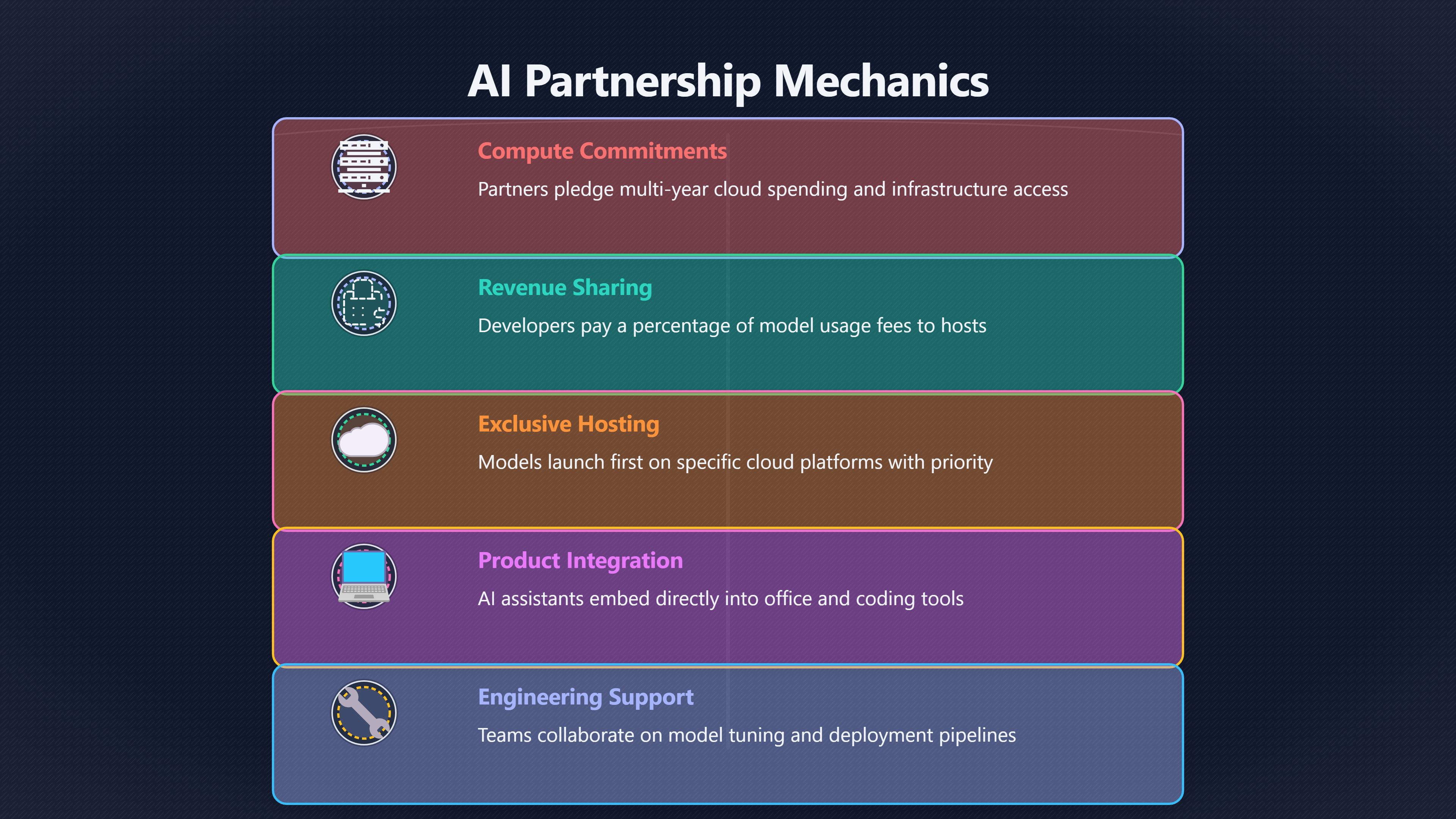
The best-known examples include Microsoft and OpenAI, Amazon and Anthropic, and Google and Anthropic. These arrangements typically combine several elements at once:
- cloud-computing commitments [reuters.com]reuters.comOpenAI products would also first ship on Microsoft's Azure cloud-computing platform…Read more…
- equity investments
- revenue-sharing agreements [ftc.gov]ftc.govFederal Trade CommissionFTC Issues Staff Report on AI Partnerships & Investments…The report details key aspects regarding the structur…
- preferred or exclusive hosting arrangements
- access to models for integration into existing products [ftc.gov]ftc.govThe partnerships offer CSP partners the ability to integrate their AI developer partners' AI models into their existing products and tool…
- technical collaboration and engineering support
The U.S. Federal Trade Commission’s 2025 study of major AI partnerships warned that such deals can include consultation rights, exclusivity provisions, sensitive information sharing, and contractual structures that raise switching costs for AI developers. [Federal Trade Commission]ftc.govFederal Trade Commission | Protecting America's ConsumersThe official website of the Federal Trade Commission, protecting America's consu… [Federal Trade Commission]ftc.govFederal Trade Commission | Protecting America's ConsumersThe official website of the Federal Trade Commission, protecting America's consu…
The structure matters because cloud providers are not neutral infrastructure firms in the AI race. Microsoft, Amazon, and Google are simultaneously:
- cloud providers
- AI model distributors
- enterprise software vendors
- platform operators
- direct competitors in AI products
That creates incentives to use partnerships not merely to host models, but to strengthen broader platform ecosystems.
Why AI companies accept these deals
From the perspective of AI labs, these partnerships solve immediate problems.
Training frontier systems can cost hundreds of millions or even billions of pounds once hardware, data-centre construction, inference serving, and staff are included. Cloud providers already own much of the required infrastructure. They can offer discounted compute, financing, chip access, and global deployment capacity.
The Microsoft–OpenAI relationship illustrates this dynamic. Microsoft invested heavily in OpenAI and integrated OpenAI systems throughout Azure and products such as Copilot. In exchange, Microsoft gained privileged access to OpenAI technology and a major position in the commercial AI stack. [Federal Trade Commission]ftc.govFederal Trade Commission | Protecting America's ConsumersThe official website of the Federal Trade Commission, protecting America's consu… [The Official Microsoft Blog]blogs.microsoft.comthe next phase of the microsoft openai partnershipRevenue share payments from OpenAI to Microsoft continue through 2030, independent…
For AI developers, these alliances can dramatically speed up deployment. Instead of building global infrastructure from scratch, they can piggyback on existing hyperscale cloud networks.
This partly explains why concerns about concentration coexist with genuine innovation benefits. Without these partnerships, some frontier systems might have developed more slowly.
Why cloud firms want deeper integration
Cloud providers are pursuing something larger than one-off AI revenue.
AI workloads are becoming a major driver of demand for cloud infrastructure. If a model developer commits to one provider for years, that can lock in vast future spending on computing, storage, networking, and enterprise integration.
The value extends beyond raw cloud revenue. AI models can strengthen entire software ecosystems.
For example:
- AI assistants embedded into office software increase switching costs for business customers.
- AI coding tools tied to cloud environments reinforce developer dependence on a platform.
- AI APIs integrated into enterprise systems encourage firms to keep data, workflows, and security infrastructure inside the same ecosystem.
This is why regulators increasingly view AI partnerships as part of a broader platform competition problem rather than isolated investment deals.
Why lock-in worries regulators
Competition authorities in the United States, United Kingdom, and European Union increasingly fear that AI could repeat patterns seen in earlier technology eras, where temporary advantages hardened into durable gatekeeping power.
The UK Competition and Markets Authority identified three major risks in foundation-model markets:
- control of critical inputs such as compute and expertise
- incumbents leveraging existing platform power
- partnerships reinforcing market concentration across the value chain GOV.UK [Morgan Lewis]morganlewis.comMorgan Lewis UK CMA Highlights Competition Risks Around AIUK CMA Highlights Competition Risks Around AI…May 8, 2024 — The paper cites three key risks to competition of FMs: Firms that control…
These concerns are not theoretical. The technology industry already has a history of lock-in through bundled ecosystems, proprietary standards, and high switching costs.
AI may intensify those dynamics because the systems are deeply integrated into workflows rather than used as isolated tools.
Switching costs can become invisible
Many forms of AI lock-in are subtle.
A company may technically be free to switch AI providers while facing practical barriers such as:
- retraining staff
- rewriting software integrations
- migrating data pipelines
- rebuilding security and compliance systems
- adapting custom AI workflows
- losing compatibility with other software products
Over time, these frictions can become powerful barriers to competition even without formal exclusivity clauses.
The FTC warned that cloud partnerships could create both contractual and technical switching costs that make it harder for AI developers to move elsewhere. [Federal Trade Commission]ftc.govFederal Trade Commission | Protecting America's ConsumersThe official website of the Federal Trade Commission, protecting America's consu…
The concern becomes even larger if AI systems become deeply embedded into medicine, education, finance, logistics, government administration, and scientific research. At that point, dependence on a small number of providers could shape whole sectors of society.
Bundling can extend dominance
One major regulatory concern is that existing platform giants may use AI to reinforce dominance in adjacent markets.
A cloud company with a leading AI model can:
- bundle AI into office software
- prioritise its own models in app stores or marketplaces
- offer discounts tied to broader enterprise contracts
- make rival tools harder to integrate
- subsidise AI services using profits from other divisions
The CMA and other regulators have repeatedly highlighted the risk that incumbents may leverage existing dominance into foundation-model markets. [GOV.UK]GOV.UKcma outlines growing concerns in markets for ai foundation modelsCMA outlines growing concerns in markets for AI…11 Apr 2024 — The CMA has outlined 3 key risks to effective competition on AI Foundati…
This is partly why recent scrutiny has expanded beyond the models themselves to the surrounding ecosystem of cloud licensing, interoperability, and enterprise integration.
The UK’s newer investigations into Microsoft’s broader software and cloud position reflect this wider concern about how AI could reinforce already dominant ecosystems. [Reuters]reuters.comOpenAI products would also first ship on Microsoft's Azure cloud-computing platform…Read more…
The strongest argument against the lock-in thesis
The counterargument is important: AI markets may still be too fluid for durable monopolies.
Unlike earlier platform eras, frontier AI changes extremely quickly. New models appear constantly. Open-source systems improve rapidly. Companies increasingly use multiple providers simultaneously. Costs are falling in some areas even while frontier training remains expensive.
There are also signs that major partnerships are becoming less exclusive than they first appeared.
In 2026, Microsoft and OpenAI revised parts of their arrangement, making aspects of the relationship non-exclusive and allowing OpenAI broader use of other cloud providers. [The Official Microsoft Blog]blogs.microsoft.comthe next phase of the microsoft openai partnershipRevenue share payments from OpenAI to Microsoft continue through 2030, independent… [Reuters]reuters.comBritain investigates Microsoft over business software dominanceThe probe—part of the CMA's broader "strategic market status" (SMS) framework—will assess whether Microsoft's bundling of products like W…
That shift suggests two things at once:
- lock-in pressures were real enough to require renegotiation
- neither side wanted complete dependence on the other
Some economists argue that AI competition could remain dynamic because:
- model quality changes rapidly
- open models reduce barriers [medium.com]medium.comThe End of the Microsoft-OpenAI Revenue PactMicrosoft is ending its revenue sharing deal with OpenAI and dropping parts of the exclusivit…
- enterprises increasingly mix providers
- AI products are not yet fully standardised
- infrastructure advantages can erode over time
Research on foundation-model concentration suggests that the frontier may naturally tend towards concentration because of scale economics, while downstream markets remain more competitive. [arXiv]arxiv.orgarXiv Market Concentration Implications of Foundation ModelsarXivMarket Concentration Implications of Foundation ModelsNovember 2, 2023…
In practice, the future may contain both concentration and competition at different layers of the stack.

Why this matters for AI abundance
The lock-in debate is not only about corporate profits. It shapes the broader AI bloom question: whether advanced AI becomes a widely shared civilisational capability or a tightly controlled commercial infrastructure.
If AI eventually accelerates science, medicine, engineering, and education, then access conditions matter enormously.
A highly concentrated AI ecosystem could produce several problems:
- poorer countries paying permanent rents to foreign platforms
- researchers lacking affordable compute access
- schools and hospitals dependent on proprietary systems
- governments relying on private infrastructure for core functions
- small firms unable to compete with integrated platform ecosystems
This would not necessarily stop technological progress. Humanity could still become far more productive and scientifically capable. But the gains might be distributed unevenly, with the biggest firms capturing outsized leverage over the flow of intelligence itself.
The analogy some critics use is that AI risks becoming closer to a privately controlled utility than a competitive software market.
There is also a geopolitical dimension
AI concentration is increasingly tied to national power.
Cloud infrastructure, advanced chips, and frontier models are disproportionately concentrated in the United States. If access to advanced AI capabilities becomes strategically important, countries without domestic infrastructure may become dependent on foreign providers.
That concern is helping drive interest in:
- sovereign AI infrastructure
- public compute initiatives
- national cloud strategies
- open-weight models [medium.com]medium.comThe End of the Microsoft-OpenAI Revenue PactMicrosoft is ending its revenue sharing deal with OpenAI and dropping parts of the exclusivit…
- regional semiconductor capacity
The issue is not technological nationalism for its own sake. It is resilience and bargaining power in a future where intelligence infrastructure may become economically central.
What regulators can actually test
Regulators face a difficult balancing act. Overly aggressive intervention could slow investment and deployment. Weak oversight could allow entrenched gatekeeping before markets mature.
The most practical regulatory questions are often narrower than calls to “break up Big Tech”.

Are partnerships effectively exclusive?
Formal exclusivity is easier to identify than softer forms of dependence.
Regulators can examine:
- minimum cloud-spending commitments [steptoe.com]steptoe.comSteptoeUK Competition and Markets Authority Accepts Voluntary…10 Apr 2026 — The cloud MIR Inquiry Group reported in July 2025 and iden…
- preferential access rights
- restrictions on multi-cloud deployment
- limits on model portability
- financial penalties for switching providers
The revised Microsoft–OpenAI agreements show how central these questions have become. [The Official Microsoft Blog]blogs.microsoft.comthe next phase of the microsoft openai partnershipRevenue share payments from OpenAI to Microsoft continue through 2030, independent…
Can customers move data and workflows easily?
Interoperability is one of the most important competition issues in AI.
Authorities increasingly focus on whether:
- AI systems use open standards
- customers can export data cleanly
- APIs are interoperable
- rival models can integrate into enterprise software
- licensing terms punish multi-platform use
Cloud-market investigations in the UK have already highlighted concerns around egress fees, interoperability barriers, and restrictive licensing. [Steptoe]steptoe.comSteptoeUK Competition and Markets Authority Accepts Voluntary…10 Apr 2026 — The cloud MIR Inquiry Group reported in July 2025 and iden…
Do platform firms gain unfair informational advantages?
Partnerships may give cloud providers access to commercially sensitive information about AI developers or customers.
The FTC specifically warned about access to sensitive technical and business information that competitors may not possess. [Federal Trade Commission]ftc.govFederal Trade Commission | Protecting America's ConsumersThe official website of the Federal Trade Commission, protecting America's consu…
This matters because platform operators could potentially:
- identify emerging rivals early
- replicate successful features
- favour internal products
- steer customers towards proprietary offerings
Is enough independent infrastructure available?
One long-term test is whether independent paths remain viable.
Healthy competition may require:
- alternative cloud providers [ftc.gov]ftc.govThe partnerships offer CSP partners the ability to integrate their AI developer partners' AI models into their existing products and tool…
- public or academic compute access
- open-source ecosystems
- independent chip supply chains
- neutral marketplaces for models and tools
If every successful AI company eventually becomes dependent on one of a few hyperscale platforms, regulators may conclude the market is no longer structurally contestable.
The deeper tension inside AI bloom
There is a genuine paradox at the centre of the AI boom.
The same concentration of capital that accelerates frontier AI may also centralise power over its benefits.
Large-scale AI development currently rewards firms able to coordinate:
- gigantic infrastructure investments
- elite technical talent
- global deployment systems
- vast energy consumption
- integrated software ecosystems
That concentration can speed progress. It may even help humanity reach transformative capabilities sooner.
But if advanced AI eventually becomes a core infrastructure for civilisation, then the governance question becomes unavoidable: should access to machine intelligence depend mainly on the strategic interests of a few dominant platforms?
The optimistic AI bloom vision depends not only on creating more intelligence, but on ensuring that intelligence becomes broadly usable, affordable, and contestable. Partnerships that accelerate deployment today may still require guardrails tomorrow if they risk turning abundance into dependency.
Endnotes
-
Source: ftc.gov
Link: https://www.ftc.gov/news-events/news/press-releases/2025/01/ftc-issues-staff-report-ai-partnerships-investments-studySource snippet
Federal Trade CommissionFTC Issues Staff Report on AI Partnerships & Investments...The report details key aspects regarding the structur...
-
Source: ftc.gov
Title: behind ftcs 6b report large ai partnerships investments
Link: https://www.ftc.gov/policy/advocacy-research/tech-at-ftc/2025/01/behind-ftcs-6b-report-large-ai-partnerships-investmentsSource snippet
Federal Trade CommissionBehind the FTC's 6(b) Report on Large AI Partnerships &...17 Jan 2025 — The report provides important insights r...
-
Source: ftc.gov
Link: https://www.ftc.gov/reports/ftc-staff-report-ai-partnerships-investments-6b-studySource snippet
FTC Staff Report on AI Partnerships & Investments 6(b) StudyFTC Staff Report on AI Partnerships & Investments 6(b) Study... Office of Te...
-
Source: blogs.microsoft.com
Title: the next phase of the microsoft openai partnership
Link: https://blogs.microsoft.com/blog/2026/04/27/the-next-phase-of-the-microsoft-openai-partnership/Source snippet
Revenue share payments from OpenAI to Microsoft continue through 2030, independent...
-
Source: reuters.com
Link: https://www.reuters.com/legal/litigation/microsoft-end-exclusive-license-openais-technology-2026-04-27/Source snippet
OpenAI products would also first ship on Microsoft's Azure cloud-computing platform...Read more...
-
Source: GOV.UK
Title: cma outlines growing concerns in markets for ai foundation models
Link: https://www.gov.uk/government/news/cma-outlines-growing-concerns-in-markets-for-ai-foundation-modelsSource snippet
CMA outlines growing concerns in markets for AI...11 Apr 2024 — The CMA has outlined 3 key risks to effective competition on AI Foundati...
-
Source: GOV.UK
Title: ai foundation models initial report
Link: https://www.gov.uk/government/publications/ai-foundation-models-initial-reportSource snippet
Foundation Models: Initial report18 Sept 2023 — A report following the CMA's review into AI Foundation Models, and their impact on compet...
-
Source: reuters.com
Title: Britain investigates Microsoft over business software dominance
Link: https://www.reuters.com/legal/litigation/uk-opens-antitrust-probe-into-microsofts-business-software-2026-05-14/Source snippet
The probe—part of the CMA's broader "strategic market status" (SMS) framework—will assess whether Microsoft's bundling of products like W...
-
Source: steptoe.com
Link: https://www.steptoe.com/en/news-publications/stepahead-antitrust-and-competition-insights/uk-competition-and-markets-authority-accepts-voluntary-commitments-to-address-cloud-market-concerns.htmlSource snippet
SteptoeUK Competition and Markets Authority Accepts Voluntary...10 Apr 2026 — The cloud MIR Inquiry Group reported in July 2025 and iden...
Published: July 2025
-
Source: reuters.com
Link: https://www.reuters.com/technology/openai-cap-microsoft-revenue-sharing-38-billion-information-reports-2026-05-12/Source snippet
This renegotiated deal allows OpenAI more flexibility to pursue new collaborations with tech giants like Amazon and Google. The cap is se...
-
Source: arxiv.org
Title: arXiv Market Concentration Implications of Foundation Models
Link: https://arxiv.org/abs/2311.01550Source snippet
arXivMarket Concentration Implications of Foundation ModelsNovember 2, 2023...
Published: November 2, 2023
-
Source: ftc.gov
Link: https://www.ftc.gov/Source snippet
Federal Trade Commission | Protecting America's ConsumersThe official website of the Federal Trade Commission, protecting America's consu...
-
Source: ftc.gov
Link: https://www.ftc.gov/system/files/ftc_gov/pdf/p246201_aipartnerships6breport_redacted_0.pdfSource snippet
The partnerships offer CSP partners the ability to integrate their AI developer partners' AI models into their existing products and tool...
-
Source: ftc.gov
Link: https://www.ftc.gov/news-events/news/press-releases/2024/01/ftc-launches-inquiry-generative-ai-investments-partnershipsSource snippet
FTC Launches Inquiry into Generative AI Investments and...Jan 25, 2024 — FTC Launches Inquiry into Generative AI Investments and Partner...
-
Source: reuters.com
Title: democratic us senators question google microsofts ai deals 2025 04 08
Link: https://www.reuters.com/sustainability/boards-policy-regulation/democratic-us-senators-question-google-microsofts-ai-deals-2025-04-08/Source snippet
Democratic US senators question Google and Microsoft's...8 Apr 2025 — The letters seek to establish how much the AI companies have paid...
-
Source: blogs.microsoft.com
Title: the next chapter of the microsoft openai partnership
Link: https://blogs.microsoft.com/blog/2025/10/28/the-next-chapter-of-the-microsoft-openai-partnership/Source snippet
API products developed with third parties will be exclusive to Azure. Non-API...Read more...
-
Source: blogs.microsoft.com
Link: https://blogs.microsoft.com/blog/2023/01/23/microsoftandopenaiextendpartnership/Source snippet
and OpenAI extend partnership23 Jan 2023 — Exclusive cloud provider – As OpenAI's exclusive cloud provider, Azure will power all OpenAI w...
-
Source: blogs.microsoft.com
Title: and openai joint statement on continuing partnership
Link: https://blogs.microsoft.com/blog/2026/02/27/microsoft-and-openai-joint-statement-on-continuing-partnership/Source snippet
The ongoing revenue share arrangement remains unchanged and has always included...Read more...
-
Source: OpenAI
Title: The next phase of the Microsoft Open AI partnership
Link: https://openai.com/index/next-phase-of-microsoft-partnership/Source snippet
comThe next phase of the Microsoft OpenAI partnership...
-
Source: OpenAI
Title: continuing microsoft partnership
Link: https://openai.com/index/continuing-microsoft-partnership/Source snippet
comJoint Statement from OpenAI and Microsoft27 Feb 2026 — Our commercial and revenue share relationship remains unchanged. The ongoing re...
-
Source: GOV.UK
Title: ai foundation models initial review
Link: https://www.gov.uk/cma-cases/ai-foundation-models-initial-reviewSource snippet
Foundation Models: initial review4 May 2023 — This initial review will help create an early understanding of the market for foundation mo...
Published: May 2023
-
Source: GOV.UK
Title: cma ai strategic update
Link: https://www.gov.uk/government/publications/cma-ai-strategic-update/cma-ai-strategic-updateSource snippet
AI strategic updateApr 29, 2024 — This document provides a strategic update on the CMA's approach to AI. This is set out through the foll...
-
Source: uk.investing.com
Link: https://uk.investing.com/news/stock-market-news/openai-and-microsoft-agree-to-cap-revenuesharing-at-38-bln-the-information-93CH-4669072Source snippet
and Microsoft agree to cap revenue-sharing at $38 bln- The Information...
-
Source: investing.com
Title: exclusive right to sell the startup’s AI models.Read more
Link: https://www.investing.com/news/stock-market-news/microsoft-and-openai-amend-partnership-terms-analyst-says-93CH-4639251Source snippet
Evercore ISI: new Microsoft/OpenAI deal gives both greater...4 minutes ago — Under the new agreement, Microsoft will no longer pay a rev...
-
Source: assets.publishing.service.gov.uk
Title: publishing.service.gov.uk A I Foundation Models
Link: https://assets.publishing.service.gov.uk/media/661e5a4c7469198185bd3d62/AI_Foundation_Models_technical_update_report.pdfSource snippet
Foundation Models - Technical update reportApr 16, 2024 — Powerful incumbents could exploit their positions in consumer or business facin...
-
Source: morganlewis.com
Title: Morgan Lewis UK CMA Highlights Competition Risks Around AI
Link: https://www.morganlewis.com/blogs/sourcingatmorganlewis/2024/05/uk-cma-highlights-competition-risks-around-ai-foundation-modelsSource snippet
UK CMA Highlights Competition Risks Around AI...May 8, 2024 — The paper cites three key risks to competition of FMs: Firms that control...
Published: May 8, 2024
-
Source: Wikipedia
Title: United Kingdom
Link: https://en.wikipedia.org/wiki/United_KingdomSource snippet
United KingdomIt comprises England, Scotland, Wales and Northern Ireland, with a population of over 69 million in 2024. The UK include...
-
Source: concurrences.com
Title: Part VIII
Link: https://www.concurrences.com/en/review/issues/no-8-2025/on-topic/cloud-and-competition-policy/cloud-and-competition-policy-part-viii-cloud-service-ai-partnerships-the-ftc-sSource snippet
Federal Trade Commission's Section 6(b) Report investigated three partnerships between major cloud service providers...
-
Source: troutman.com
Link: https://www.troutman.com/insights/cloud-and-competition-policy-part-viii-cloud-service-ai-partnerships-the-ftcs-section-6b-report-and-its-antitrust-implications-in-the-trump-20-administration/Source snippet
Federal Trade Commission's Section 6(b) Report investigated three partnerships between major cloud service providers (Alphabet/Google, Am...
Additional References
-
Source: warren.senate.gov
Link: https://www.warren.senate.gov/imo/media/doc/letter_from_senators_warren_wyden_to_openai_and_microsoft_on_anticompetitive_ai_partnerships.pdfSource snippet
from Senators Warren, Wyden to OpenAI and Microsoft...7 Apr 2025 — The recent boom in generative AI technology has produced new partners...
-
Source: linkedin.com
Link: https://www.linkedin.com/posts/shanthamohan_openai-completes-for-profit-transition-pushing-activity-7388967970888167425-uNiNSource snippet
Microsoft acquires OpenAI's IP rights, Azure deal"Under the agreement, Microsoft will have exclusive intellectual-property rights to Open...
-
Source: seekingalpha.com
Link: https://seekingalpha.com/news/4579947-microsoft-falls-as-openai-partnership-evolves-says-it-will-no-longer-pay-revenue-shareSource snippet
Microsoft in focus as OpenAI partnership evolves, says it...20 hours ago — Microsoft secures a 20% revenue share from OpenAI through 203...
-
Source: crn.com
Link: https://www.crn.com/news/ai/2026/microsoft-openai-revise-partnershipSource snippet
Microsoft, OpenAI Alter Partnership Terms, Revenue Share11 minutes ago — Microsoft and OpenAI have revised their partnership so that Micr...
-
Source: arstechnica.com
Link: https://arstechnica.com/ai/2026/04/no-longer-exclusive-microsoft-agrees-to-let-openai-see-other-cloud-providers/Source snippet
OpenAI ends its exclusive partnership with Microsoft7 hours ago — While OpenAI will continue to make the same 20 percent revenue share pa...
-
Source: chinadailyasia.com
Link: https://www.chinadailyasia.com/article/633365Source snippet
Report: OpenAI, Microsoft agree to cap revenue-sharing at...12 hours ago — OpenAI and Microsoft agreed to cap total revenue-sharing paym...
-
Source: medium.com
Link: https://medium.com/%40sebuzdugan/the-end-of-the-microsoft-openai-revenue-pact-what-it-means-for-your-ai-stack-408c6c463ee1Source snippet
The End of the Microsoft-OpenAI Revenue PactMicrosoft is ending its revenue sharing deal with OpenAI and dropping parts of the exclusivit...
-
Source: forbes.com
Link: https://www.forbes.com/sites/zacharyfolk/2024/01/25/ftc-investigating-ai-deals-and-investments-with-big-tech-firms-including-microsoft-amazon-and-alphabet/Source snippet
FTC Investigating AI Deals And Investments With Big Tech...Jan 25, 2024 — The Federal Trade Commission voted unanimously Thursday to ope...
-
Source: finance.yahoo.com
Link: https://finance.yahoo.com/sectors/technology/article/microsoft-openai-rewrite-partnership-to-eliminate-exclusive-model-access-change-revenue-sharing-140522820.htmlSource snippet
yahoo.comMicrosoft, OpenAI rewrite partnership to eliminate exclusive...13 hours ago — Microsoft, OpenAI rewrite partnership to eliminat...
-
Source: lexology.com
Link: https://www.lexology.com/indepth/guide/digital-markets-guide/fifth-edition/article/uk-and-eu-antitrust-authorities-target-ai-partnerships-in-expansion-of-merger-control-rulesSource snippet
UK and EU antitrust authorities target AI partnerships in...Sep 22, 2025 — UK and EU antitrust authorities are testing the limits of the...
Amazon book picks
Further Reading
Books and field guides related to AI Platform Lock in. Use these as the next step if you want deeper reading beyond the article.

The EU regulation on artificial intelligence: a commentary
The AI Act is the most important piece of AI regulation worldwide. After the soft law and ethics stage, a legal understanding of AI requi...
Platform Capitalism
First published 2016. Subjects: Big Data, Accelerationism, Politics, Internet, Data.

AI Regulation in Europe
Current to 1 March 2026. Includes all available implementing guidance and codes of practice. AI Regulation in Europe: EU AI Act Explained...
eBay marketplace picks
Marketplace Samples
Example marketplace items related to this page. Use the search link to explore similar finds on eBay.

Example eBay listing
A.I. Artificial Intelligence Original Movie Poster Signed By Jude Law
USD 125.00 | Shipping USD 25.00 | US

Example eBay listing
Artificial Intelligence D/S Original Movie Poster - 27 x 40"
USD 19.50 | Shipping USD 13.65 | US

Example eBay listing
612388 Artificial Intelligence Movie Science Fiction Drama Wall Print Poster
USD 22.95 | Shipping USD 12.95 | JP

Example eBay listing
Companion - Artificial Intelligence Dark Comedy Cinema Film - POSTER 20"x30"
USD 23.99 | Free shipping | US

Example eBay listing
The Worker Who Gets Drunk - 1930s Spanish Civil War Poster - 18x24
GBP 12.50 | Shipping GBP 13.78 | US

Example eBay listing
He Who Gets Slapped Poster - Lon Chaney Film Wall Art - 12X16/16X20/18X24/24X36
GBP 22.99 | Free shipping | GB

Example eBay listing
He Who Gets Slapped 1924 POSTER PRINT A5A1 Cult 20s Horror Cinema Film Wall Art
GBP 29.99 | Free shipping | GB

Example eBay listing
He Who Gets Slapped Poster Lon Chaney 1924 Old Movie Photo
GBP 5.41 | Shipping GBP 3.18 | AU
Topic Tree