Within AI Tutors
AI Tutor Crutches
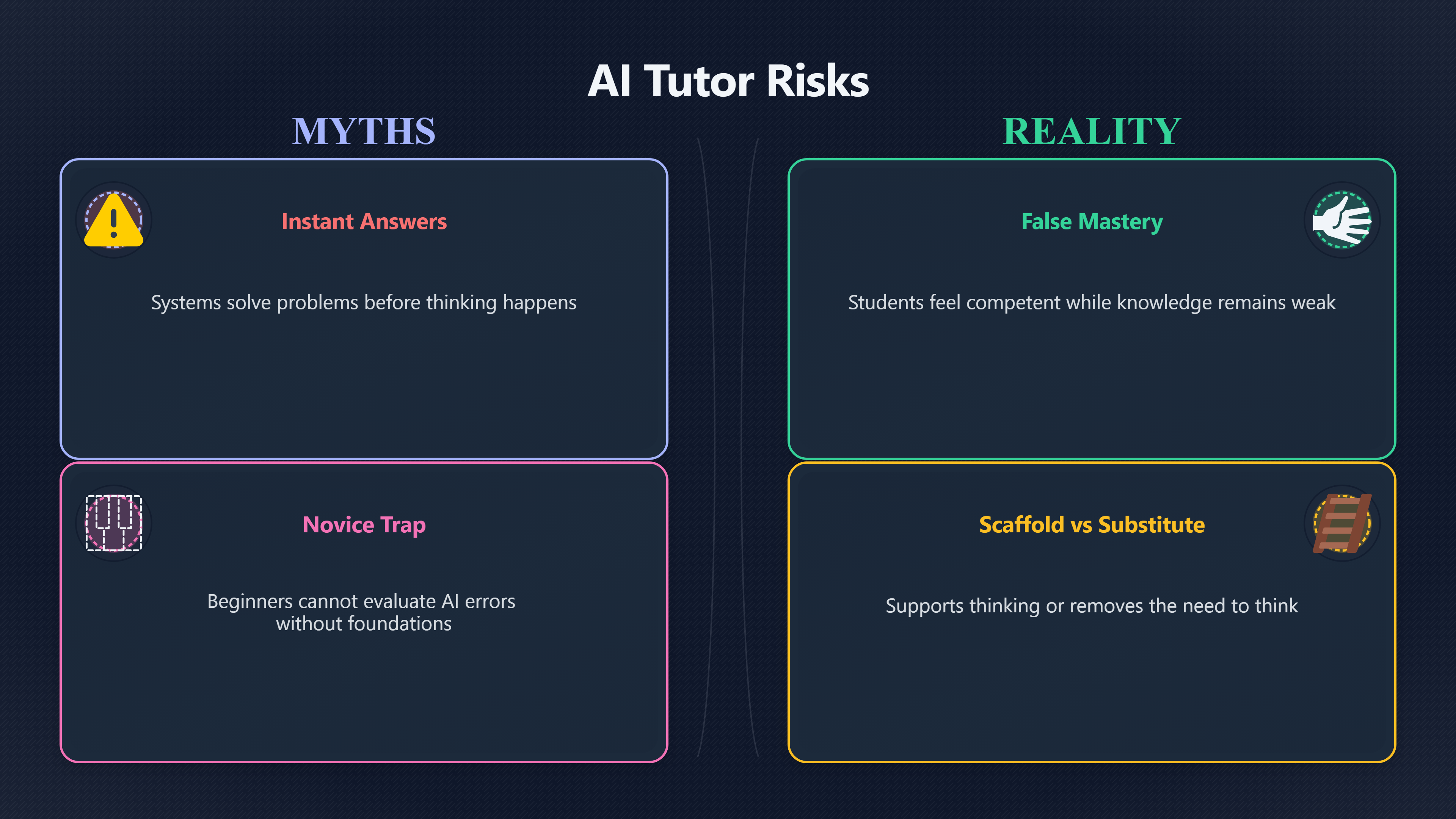
AI tutors can raise practice scores while weakening real learning if they make answers easier than thinking.
On this page
- Why instant answers can reduce durable learning
- Design safeguards that force practice before help
- How students can tell whether they are really learning
Page outline Jump by section
Introduction
AI tutors can genuinely help people learn. They can explain difficult ideas patiently, generate endless practice questions, adapt to different speeds, and make personalised support far cheaper and more widely available than traditional one-to-one tutoring. That matters for the larger vision of AI-enabled human flourishing: if more people can learn maths, languages, science or technical skills effectively, more people gain the freedom to contribute, retrain, create and participate in a more capable civilisation.
 But there is a serious catch. AI tutors can also become cognitive crutches. When a system makes answers easier than thinking, students may complete tasks without building durable understanding. They feel productive while avoiding the mental effort that real learning requires. Researchers increasingly describe this as “cognitive offloading” or “false mastery”: the learner appears competent while the underlying knowledge remains weak. [University of Technology Sydney]uts.edu.auUniversity of Technology SydneyArtificial intelligence, cognitive offloading and implications…February 26, 2026 — by JM Lodge · 2026 ·… [MDPI]mdpi.comMDPIAI Tools in Society: Impacts on Cognitive Offloading and…by M Gerlich · 2025 · Cited by 1173 — This study investigates the relatio…
The central question is therefore not whether AI can teach. It is whether AI systems can be designed and used in ways that preserve struggle, reflection, memory and independent reasoning instead of replacing them.
Why instant answers can weaken real learning
One of the oldest findings in cognitive science is that learning is effortful. Students usually remember more when they retrieve information from memory, wrestle with confusion, attempt problems before seeing solutions, and receive feedback after trying. The point is not that learning must feel miserable. It is that the brain builds durable understanding partly through effort.
Generative AI can interfere with that process because it is optimised to be helpful immediately. A student stuck on an algebra problem can ask for the full solution in seconds. An essay outline appears before the student has organised their own thoughts. A coding error is fixed before the learner has diagnosed the bug. The work gets completed, but the thinking may not happen.
Researchers increasingly worry that this changes the balance between performance and understanding. A 2025 study on AI-supported programming tasks found that students often experienced less stress and finished tasks more efficiently, yet the systems could bypass the “productive cognitive struggle” associated with long-term learning. [ScienceDirect]sciencedirect.comScienceDirectLess stress, better scores, same learning: The dissociation…by P Bassner · 2025 · Cited by 6 — AI tutors providing direct… A separate 2026 study reported evidence that generative AI tutors impaired “metacognitive monitoring”, especially among novice learners: students became worse at judging what they actually understood. [Zenodo]zenodo.orgThe Impact of Generative AI Tutors on MetacognitiveZenodoThe Impact of Generative AI Tutors on Metacognitive…April 10, 2026 — 10 Apr 2026 — This study provides the first rigorous experi…
This distinction matters because confidence and competence are not the same thing. A student who can produce polished homework with AI assistance may still fail an exam, struggle to apply ideas independently, or forget material rapidly once the tool disappears.
The danger of “false mastery”
The OECD and several education researchers now warn about “false mastery”: students mistake AI-supported task completion for learning itself. [University of Technology Sydney]uts.edu.auUniversity of Technology SydneyArtificial intelligence, cognitive offloading and implications…February 26, 2026 — by JM Lodge · 2026 ·… This is particularly risky for beginners who have not yet built strong mental models.
An expert pianist can use shortcuts because the foundations already exist. A novice cannot. In education, foundational knowledge still matters because higher-level thinking depends on it. Students cannot reliably evaluate AI outputs in history, mathematics or biology if they lack enough understanding to notice errors or shallow reasoning.
This is one reason educators increasingly distinguish between AI as a scaffold and AI as a substitute. A scaffold supports thinking. A substitute removes the need to think.
The difference often depends on small design choices:
- Does the system give hints before solutions?
- Does it ask the student to explain reasoning?
- Does it require retrieval from memory?
- Does it adapt difficulty gradually?
- Does it encourage reflection after mistakes?
- Does it allow effortless answer-copying?
The same underlying model can either deepen understanding or weaken it depending on these choices.
Cognitive offloading is not always bad
Not all cognitive offloading is harmful. Humans routinely use calculators, notebooks and search engines. Offloading some tasks can free mental resources for more advanced reasoning.
The problem emerges when students offload the exact mental work they still need to develop. Research on AI use and critical thinking suggests heavier reliance on AI tools can correlate with weaker independent reasoning, partly because users stop practising core cognitive skills themselves. [MDPI]mdpi.comMDPIAI Tools in Society: Impacts on Cognitive Offloading and…by M Gerlich · 2025 · Cited by 1173 — This study investigates the relatio…
The educational challenge is therefore selective offloading. AI may help students spend less time on repetitive bureaucracy or administrative friction while still preserving the core intellectual work that builds expertise.
A good tutor, human or artificial, does not simply eliminate difficulty. It keeps students operating near the edge of what they can do themselves.
The best AI tutors may behave less like answer machines
Many early chatbot experiences encouraged dependency because the systems were designed as universal assistants rather than pedagogically structured tutors. They rewarded asking for solutions. But learning science points in a different direction.
Researchers working on AI tutoring increasingly argue that effective systems should preserve “productive struggle” rather than eliminate it. [arXiv]arxiv.orgSource details in endnotes. [Wiley]wiley.comand asu partner to pilot ai powered tutor for computer science studentsWileyWiley and ASU Partner to pilot AI-powered tutor for computer5 Nov 2024 — The core goal of the AI tutor is to foster what educators c… [ERIC]files.eric.ed.govERICProductive StruggleERICby AC Kulesa · 2025 · Cited by 3 — A review of what cognitive science has already identified as the critical components of learning p… In practice, that means the tutor behaves less like an answer engine and more like a coach.
Instead of immediately solving a maths problem, a stronger tutor might:
- Ask the student to attempt the first step.
- Diagnose the misconception.
- Offer a hint rather than a full answer.
- Generate a simpler related problem.
- Ask the student to explain the reasoning aloud.
- Return later to test whether the concept stuck.
That can feel slower in the short term. But slower learning is sometimes deeper learning.
A recent line of research into “pedagogical steering” argues that large language models need explicit instructional constraints because default chatbot behaviour tends to over-help students. [arXiv]arxiv.orgSource details in endnotes. Left unmodified, many systems reveal answers too quickly because they are trained to maximise helpfulness and user satisfaction rather than long-term retention.
This creates a tension at the heart of educational AI. Students often prefer systems that make work easier. But systems that optimise for immediate convenience may produce worse long-run learning.
Design safeguards that reduce dependency
The most promising AI tutoring systems increasingly include safeguards intended to prevent passive learning.
Delayed answers and staged hints
One simple intervention is forcing a sequence: attempt first, help second. Instead of revealing the answer immediately, the tutor can provide escalating hints only after the learner tries independently.
This mirrors effective human tutoring. Skilled teachers rarely begin by giving the final solution. They ask questions that help students reconstruct the path themselves.
Research around “productive failure” suggests students often learn more deeply when they first struggle with a problem before receiving explanation. [arXiv]arxiv.orgSource details in endnotes. AI tutors may eventually become unusually good at managing this balance dynamically: not leaving students hopelessly stuck, but also not rescuing them too quickly.

Retrieval before explanation
Another safeguard is retrieval practice. Before showing notes or solutions, the tutor asks the student to recall information from memory.
This matters because memory retrieval itself strengthens learning. A tutor that constantly re-explains material may feel supportive while accidentally weakening retention.
Better systems may therefore interrupt dependency loops by repeatedly asking:
- “What do you remember already?”
- “Can you explain this in your own words?”
- “Why do you think that answer is wrong?”
- “What principle applies here?”
The goal is not merely correct output but independent mental reconstruction.
Transparency about uncertainty
AI tutors can also become crutches when students treat them as unquestionable authorities. Large language models still hallucinate facts, produce fake citations and generate plausible nonsense.
Systems that expose uncertainty, encourage verification and invite challenge may preserve more learner agency than systems presenting fluent answers with excessive confidence.
That matters beyond schoolwork. A civilisation that relies heavily on advanced AI may still need humans capable of scepticism, judgment and error detection. Education is partly about preserving those capacities.
Human teachers still matter
Even very capable AI tutors cannot fully replace human educational relationships. Motivation, emotional support, social development and classroom culture remain deeply human processes.
Some of the strongest current evidence comes not from replacing teachers, but from combining AI with human guidance. Studies of Tutor CoPilot and structured classroom deployments suggest AI may work best when supporting human tutors rather than operating alone. [ai.stanford.edu]ai.stanford.eduProductive Struggle: The Future of Human Learning in the Age…29 Jan 2025 — We believe AI's role in education isn't to eliminate strugg…
This hybrid model also reduces dependency risks. Teachers can notice when students are becoming passive, copying blindly or outsourcing thinking.
How students can tell whether they are actually learning
One of the hardest parts of AI-assisted learning is that it can feel effective even when it is not. Smoothness creates an illusion of mastery.
Several practical tests can expose the difference.

Can you solve the problem without the AI?
The clearest check is delayed independence. After studying with AI support, can the learner solve a similar problem later without assistance?
If performance collapses immediately after removing the tool, the AI may have replaced thinking rather than strengthened it.
Can you explain the idea simply?
Real understanding usually allows transfer and explanation. Students who truly grasp a concept can:
- paraphrase it,
- apply it in a new context,
- predict outcomes,
- explain mistakes,
- or teach it to someone else.
Students relying too heavily on AI often recognise answers when shown them but struggle to generate reasoning independently.
Are you becoming faster at thinking, or faster at finishing?
These are different outcomes. AI can dramatically accelerate assignment completion. But educational value depends on whether the student’s underlying competence is improving.
Fast completion with stagnant understanding is the core crutch problem.
Does the AI increase effort or reduce it?
This is a useful rule of thumb. Healthy tutoring often changes the shape of effort rather than removing it entirely.
A strong AI tutor may:
- target practice more precisely,
- reduce frustration,
- personalise explanations,
- identify weaknesses quickly,
- or maintain motivation.
But if every difficult step disappears instantly, the student may no longer be exercising the cognitive muscles education is supposed to build.
The larger stakes for an AI-enabled future
The debate over AI tutor crutches is not just about homework. It reflects a larger question inside the broader AI bloom vision: does advanced AI expand human capability, or quietly replace it?
The optimistic case for AI-enabled education is extraordinary. Billions of people could gain access to patient, adaptive learning support that was previously available only to wealthy students with private tutors. Adults could retrain continuously throughout life. Scientific and technical knowledge could spread more widely and more quickly. Human intellectual potential could become less constrained by geography or income.
But those gains depend on preserving human agency and cognition rather than outsourcing them completely.
A society where AI systems help humans think better could become more knowledgeable, creative and capable. A society where humans increasingly stop thinking for themselves may become more dependent even while appearing more efficient.
That is why the design philosophy matters so much. Educational AI aligned with human flourishing probably needs to optimise for durable understanding, curiosity, independence and intellectual resilience, not just convenience or task completion.
The long-term promise of AI tutors is therefore not frictionless learning. It is supported learning: systems that help more people persist through difficulty, acquire genuine competence and participate more fully in a more intelligent civilisation.
Endnotes
-
Source: uts.edu.au
Link: https://www.uts.edu.au/news/2026/03/experts-warn-unstructured-ai-use-in-schools-risks-cognitive-atrophy/contentassets/ai-cognitive-offloading-and-implications-for-education.pdfSource snippet
University of Technology SydneyArtificial intelligence, cognitive offloading and implications...February 26, 2026 — by JM Lodge · 2026 ·...
Published: February 26, 2026
-
Source: mdpi.com
Link: https://www.mdpi.com/2075-4698/15/1/6Source snippet
MDPIAI Tools in Society: Impacts on Cognitive Offloading and...by M Gerlich · 2025 · Cited by 1173 — This study investigates the relatio...
-
Source: sciencedirect.com
Link: https://www.sciencedirect.com/science/article/pii/S2666920X25001778Source snippet
ScienceDirectLess stress, better scores, same learning: The dissociation...by P Bassner · 2025 · Cited by 6 — AI tutors providing direct...
-
Source: zenodo.org
Title: The Impact of Generative AI Tutors on Metacognitive
Link: https://zenodo.org/records/19501204Source snippet
ZenodoThe Impact of Generative AI Tutors on Metacognitive...April 10, 2026 — 10 Apr 2026 — This study provides the first rigorous experi...
Published: April 10, 2026
-
Source: wiley.com
Title: and asu partner to pilot ai powered tutor for computer science students
Link: https://www.wiley.com/en-us/grow/teach-learn/insights/wiley-and-asu-partner-to-pilot-ai-powered-tutor-for-computer-science-students/Source snippet
WileyWiley and ASU Partner to pilot AI-powered tutor for computer5 Nov 2024 — The core goal of the AI tutor is to foster what educators c...
-
Source: files.eric.ed.gov
Title: ERICProductive Struggle
Link: https://files.eric.ed.gov/fulltext/ED674230.pdfSource snippet
ERICby AC Kulesa · 2025 · Cited by 3 — A review of what cognitive science has already identified as the critical components of learning p...
-
Source: ai.stanford.edu
Link: https://ai.stanford.edu/blog/teaching/Source snippet
Productive Struggle: The Future of Human Learning in the Age...29 Jan 2025 — We believe AI's role in education isn't to eliminate strugg...
-
Source: arxiv.org
Link: https://arxiv.org/abs/2410.03781 -
Source: arxiv.org
Link: https://arxiv.org/html/2512.23633v1Source snippet
arXivAI tutoring can safely and effectively support students25 Nov 2025 — When deployed responsibly, can generative AI safely and effecti...
-
Source: acceleratelearning.stanford.edu
Title: what do ai chatbots really mean for students and cheating
Link: https://acceleratelearning.stanford.edu/story/what-do-ai-chatbots-really-mean-for-students-and-cheating/Source snippet
do AI chatbots really mean for students and cheating?31 Oct 2023 — Stanford Accelerator for Learning Faculty Affiliates Victor Lee and De...
-
Source: thirdspacelearning.com
Title: cognitive offloading
Link: https://thirdspacelearning.com/blog/cognitive-offloading/Source snippet
and AI in Schools: What It Is And Why...1 Apr 2026 — This article outlines the difference between cognitive offloading and cognitive out...
Additional References
-
Source: linkedin.com
Link: https://www.linkedin.com/posts/will-van-reyk_there-are-very-few-thoughtful-pieces-on-ai-activity-7394830698689495040-SI7aSource snippet
Google DeepMind's Gillick on AI tutors and their limitationsThere are very few thoughtful pieces on AI tutors that speak to the realities...
-
Source: findtutors.co.uk
Link: https://www.findtutors.co.uk/blog/ai-cheating-in-schools-statisticsSource snippet
Based on the 2025 GoStudent report plus HEPI, Times & more. Are students using AI to cheat?...
-
Source: linkedin.com
Title: Cognitive offloading and metacognitive laziness | Matt Linn
Link: https://www.linkedin.com/posts/matt-linn_artificial-intelligence-cognitive-offloading-activity-7437087194525302785-J7krSource snippet
AI boosts short-term task performance while hollowing out durable learning. In a study of nearly 1000 maths students, those using AI solved...
-
Source: socialsciencespace.com
Title: A I Tutors Support 16 Percent of Learning
Link: https://www.socialsciencespace.com/2026/02/ai-tutors-support-16-percent-of-learning-what-about-the-other-84-percent/Source snippet
What About the...20 Feb 2026 — Recent research has found that AI-assisted learners demonstrate reduced self-monitoring, increased procra...
-
Source: unteaching.substack.com
Title: how to stop your students from cheating
Link: https://unteaching.substack.com/p/how-to-stop-your-students-from-cheatingSource snippet
to Stop Your Students from Cheating with AI - UnteachingGenerative AI didn't create cheating - it just made students more efficient at it...
-
Source: gse.harvard.edu
Title: ai can add not just subtract learning
Link: https://www.gse.harvard.edu/ideas/news/25/04/ai-can-add-not-just-subtract-learningSource snippet
Can Add, Not Just Subtract, From Learning8 Apr 2025 — Assistant Professor Ying Xu studies how artificial intelligence can impact a studen...
-
Source: michaelbhorn.substack.com
Title: deepminds learnings in developing
Link: https://michaelbhorn.substack.com/p/deepminds-learnings-in-developingSource snippet
substack.comDeepMind's Learnings in Developing an AI TutorShe's exploring how generative AI can truly enhance teaching and learning. And...
-
Source: theaustralian.com.au
Link: https://www.theaustralian.com.au/higher-education/student-reliance-on-ai-is-a-shortcut-that-masks-a-failure-to-learn-the-oecd-warns/news-story/868d0c5769c42446ba140807e8de8fd4Source snippet
The report highlights concerns that GenAI fosters a deceptive sense of mastery among students by generating high-quality outputs that mas...
-
Source: linkedin.com
Link: https://www.linkedin.com/posts/jeremy-roschelle_productive-struggle-how-artificial-intelligence-activity-7351634955203944449-DySHSource snippet
can lead to cognitive laziness and passivity...
-
Source: schoolsweek.co.uk
Title: two in five teachers feel theyre cheating when using ai
Link: https://schoolsweek.co.uk/two-in-five-teachers-feel-theyre-cheating-when-using-ai/Source snippet
Teachers are caught between enthusiasm for AI and worries about authentic education...Read more...
Amazon book picks
Further Reading
Books and field guides related to AI Tutor Crutches. Use these as the next step if you want deeper reading beyond the article.

Artificial Intelligence in Education
This work reports on research into intelligent systems, models, and architectures for educational computing applications. It covers a wid...

Science Learning, Science Teaching
First published 2012. Subjects: Science, study and teaching (secondary).

Learning science in the schools
First published 1995. Subjects: Science, study and teaching (elementary), Study and teaching (Secondary), Science, Psychology of Learning...

Learning science outside the classroom
First published 2004. Subjects: Science, Nature study, Study and teaching, Activity programs, Science, study and teaching.
eBay marketplace picks
Marketplace Samples
Example marketplace items related to this page. Use the search link to explore similar finds on eBay.

Example eBay listing
Artificial intelligence Framed Wall Art Poster Canvas Print Picture
USD 40.12 | GB

Example eBay listing
Artificial intelligence Framed Wall Art Poster Canvas Print Picture
USD 40.12 | GB
Example eBay listing
A.I. Artificial Intelligence Movie Poster Print, Wall Art - Unframed
USD 8.99 | Free shipping | US

Example eBay listing
612388 Artificial Intelligence Movie Science Fiction Drama Wall Print Poster
USD 22.95 | Shipping USD 12.95 | JP
Topic Tree