Within AlphaFold Access
Open access limits
The AlphaFold database lowers the cost of entry, yet unequal compute, expertise, laboratories and commercial power still shape who benefits most.
On this page
- How searchable structures changed who can start asking questions
- Why free data does not equal equal scientific power
- What broader access would require beyond the database
Page outline Jump by section
Introduction
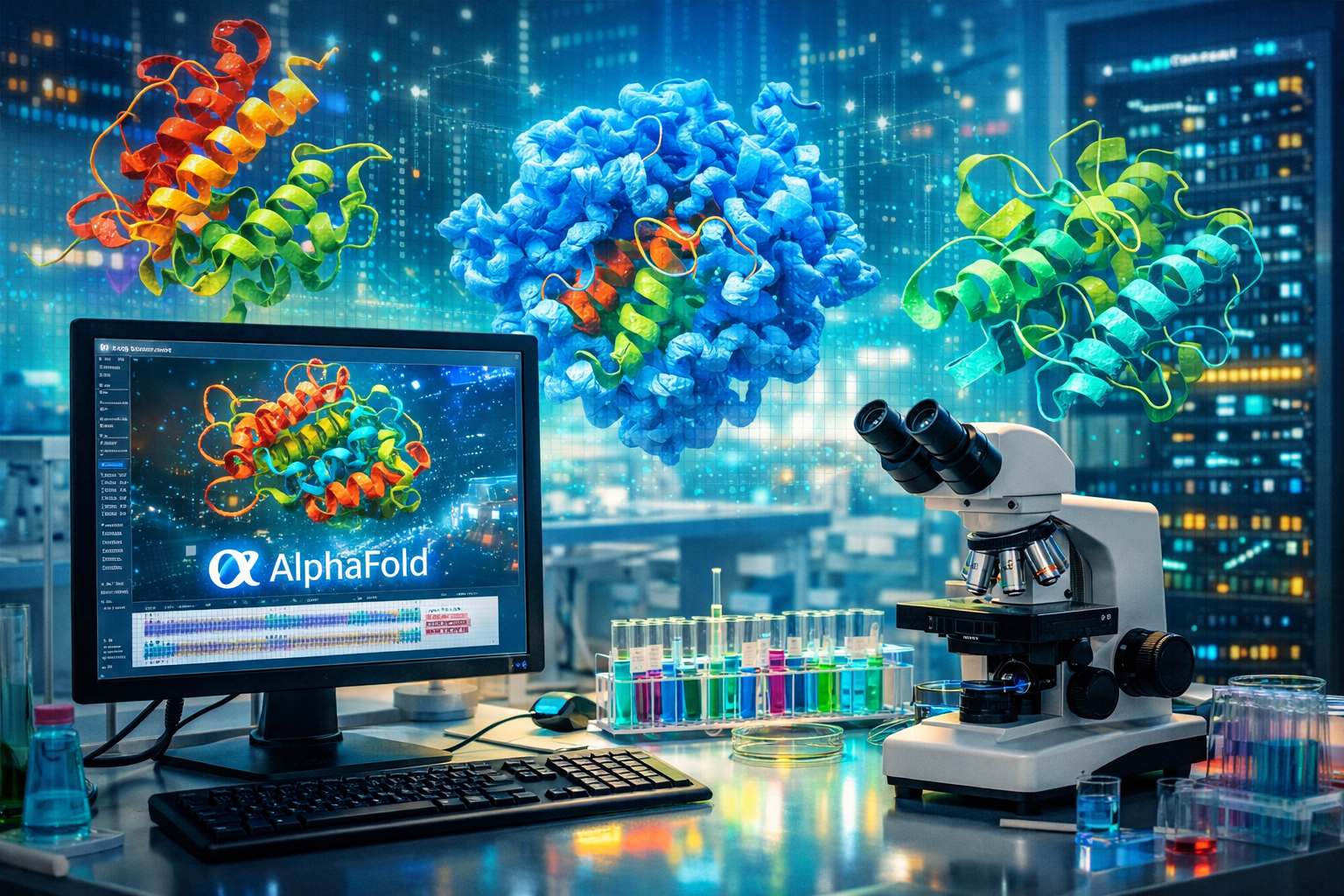
Open protein databases have made structural biology far more accessible than it was even a few years ago, but “accessible” is not the same as fully democratic. The release of the AlphaFold Protein Structure Database transformed one of biology’s most specialised resources into something searchable from an ordinary laptop. A scientist studying a neglected disease in Nairobi, São Paulo or Dhaka can now inspect predicted protein structures that previously might have required years of collaboration with elite laboratories. The database contains more than 200 million predicted structures and is freely available worldwide. [alphafold.ebi.ac.uk]alphafold.ebi.ac.ukAlpha Fold Protein Structure DatabaseAlphaFold Protein Structure Database - EMBL-EBIAlphaFold DB provides open access to over 200 million protein structure predictions to acc… [PMC]pmc.ncbi.nlm.nih.govProtein Structure Database in 2024 - PMC - NIHby M Varadi · 2023 · Cited by 2105 — The database provides access to over 214 million predi…
That is a real shift in scientific power. Yet the deeper story is more complicated. Open databases lower the cost of starting research, but they do not eliminate unequal access to computing infrastructure, experimental validation, funding, wet laboratories, pharmaceutical pipelines or commercial influence. Structural biology has become more open at the level of information access, while remaining uneven at the level of scientific capacity. The result is not a fully democratised field, but a partially widened scientific frontier.
How searchable structures changed who can start asking questions
Before AlphaFold and related databases, structural biology was bottlenecked by expensive experimental techniques such as X-ray crystallography and cryo-electron microscopy. Producing a single high-quality protein structure could require specialist equipment, months of labour and highly trained staff. Many universities and countries simply did not possess the infrastructure.
The importance of open databases is therefore less about replacing experiments than changing the entry point into biology. Instead of beginning with uncertainty about a protein’s shape, researchers can often begin with a plausible structural model immediately. That matters because modern biology increasingly works by generating hypotheses computationally before narrowing them experimentally.
The AlphaFold database, developed by Google DeepMind and EMBL-EBI, now provides open access to more than 200 million predicted protein structures. [alphafold.ebi.ac.uk]alphafold.ebi.ac.ukebi.ac.uk AboutAlphaFold Protein Structure DatabaseAlphaFold is an AI system developed by Google DeepMind that makes state-of-the-art accurate predictio… [PMC]pmc.ncbi.nlm.nih.govPMCA decentralized future for the open-science databasesPMCby G Sharma · 2025 — Here, we examine the structural limitations of centralized repositories, evaluate federated and decentralized mod… Researchers can search by protein name, sequence or organism without needing local high-performance computing resources. [ebi.ac.uk]alphafold.ebi.ac.ukAlpha Fold Protein Structure DatabaseAlphaFold Protein Structure Database - EMBL-EBIAlphaFold DB provides open access to over 200 million protein structure predictions to acc…
Several practical changes followed from this openness:
- Smaller laboratories can perform early-stage structural analysis without hiring dedicated structural biologists.
- Researchers studying rare or neglected diseases can explore protein targets that would previously have been ignored because experimental structure determination was too expensive.
- Students and interdisciplinary researchers can enter structural biology more quickly because the initial technical barriers are lower.
- Computational biology becomes more globally distributed because the key information resource is online and searchable.
The scale of adoption suggests that the shift is not confined to elite institutions. DeepMind and EMBL report millions of users across more than 190 countries, including substantial uptake in lower- and middle-income regions. [Google DeepMind]ebi.ac.ukalphafold 200 millionDeepMind and EMBL's European Bioinformatics Institute (EMBL-…Read more…
This resembles earlier moments in scientific history when open databases widened participation. Public genome databases reduced the cost of genetic research. Open satellite imagery expanded environmental monitoring. Open-source software widened access to advanced computing tools. AlphaFold appears to be doing something similar for molecular structure.
For the broader “AI bloom” idea, this matters because scientific acceleration depends not only on smarter tools but on who gets to use them. If advanced AI systems can spread scientific capability beyond a small set of wealthy institutions, they could increase the number of people able to contribute to discovery.
Why free data does not equal equal scientific power
Open databases democratise access to information more effectively than they democratise access to science itself.
A predicted structure is useful, but turning that structure into a validated biological discovery often still requires expensive downstream capabilities. Structural biology remains embedded inside broader systems of inequality involving funding, infrastructure, intellectual property and industrial scale.
Experimental science still matters
AlphaFold predictions are powerful, but they are not automatically correct in every context. The system can struggle with flexible proteins, interacting molecules, changing conformations and certain protein complexes. [2spiral.imperial.ac.uk]spiral.imperial.ac.ukThe AlphaFold database of protein structures: a biologist's guideHere we discuss the advantages, limitations and the still unsolved chall…
That means experimental validation remains essential in many cases. Laboratories with access to cryo-electron microscopy facilities, advanced sequencing infrastructure and medicinal chemistry platforms still possess major advantages.
A university researcher may now retrieve a protein model freely in seconds, yet still lack the ability to:
- test a drug candidate,
- validate molecular interactions,
- run large biological screens,
- manufacture compounds,
- conduct clinical trials,
- or commercialise discoveries.
In this sense, open databases reduce one bottleneck without removing the larger hierarchy of global scientific capacity.
Compute inequality did not disappear
Although the AlphaFold database itself is openly searchable, frontier AI biology increasingly depends on large-scale computation. Training advanced models, analysing massive datasets and running high-throughput simulations require expensive hardware and technical expertise.
Recent research on AI and scientific productivity suggests that AI tools can increase output while also amplifying advantages for institutions with stronger infrastructure. [ifo Institut]ifo.decesifo1 wp12462ifo InstitutCESifo Working Paper No. 12462by Z Yu · 2026 · Cited by 3 — This paper studies the impact of AI on productivity and inequalit… Elite universities and large technology firms are often best positioned to combine open biological data with proprietary computing resources.
This creates a paradox. Open databases can widen participation at the beginning of the research pipeline while concentrating power at later stages.
A small laboratory may now identify an interesting protein interaction. But scaling that insight into a therapeutic platform may still depend on partnerships with major pharmaceutical companies or AI firms possessing enormous compute budgets.
Commercial capture remains possible
Open scientific resources do not guarantee open economic outcomes.
Much of the value generated from structural biology emerges downstream through patents, proprietary models, drug pipelines and manufacturing systems. A freely available protein structure can still become part of a closed commercial ecosystem.
This tension has become sharper as AI biology moves from prediction toward design. Open access to structures is one thing; open access to advanced generative molecular design systems is another. Some newer frontier systems have more restricted access models than early AlphaFold releases, raising concerns that future gains in AI-enabled biology could become increasingly centralised. [arXiv]arxiv.orgarXiv Technical Report of Helix Fold3 for Biomolecular Structure PredictionarXivTechnical Report of HelixFold3 for Biomolecular Structure PredictionAugust 30, 2024…
The broader political question is therefore not merely whether scientific information is open, but who controls the surrounding infrastructure needed to turn information into medicines, industrial processes and economic power.
The hidden importance of shared scientific infrastructure
One reason open databases matter despite these limitations is that science depends heavily on shared infrastructure that most people never see.
Structural biology already relied on decades of open collaboration before AlphaFold existed. Databases such as UniProt, the Protein Data Bank and EMBL-EBI archives created large public repositories of sequences and structures that AI systems could train upon. [Wikipedia]WikipediaUni ProtUniProt - WikipediaAlphaFold Protein Structure Database - EMBL-EBIFebruary 13, 2026…
In other words, AlphaFold itself was partly a product of earlier open science.
This matters for the long-term future of AI-enabled discovery because advanced AI systems may become increasingly dependent on enormous shared datasets. If those datasets remain publicly accessible, scientific capability may spread more widely. If they become privatised, scientific progress could become more concentrated.
There are already debates over whether scientific infrastructure should remain centralised under a small number of institutions or move toward more decentralised and federated systems. [PMC]pmc.ncbi.nlm.nih.govProtein Structure Database in 2024 - PMC - NIHby M Varadi · 2023 · Cited by 2105 — The database provides access to over 214 million predi… These debates are not abstract administrative questions. They shape who can participate in future discovery.
Open databases also create educational spillovers. A student can now learn structural biology interactively using real protein models instead of static textbook diagrams. Training materials from EMBL-EBI and related institutions have expanded alongside the database itself. [ebi.ac.uk]ebi.ac.ukAccessing predicted protein structures in the AlphaFold…As of 2023, the AlphaFold Protein Structure Database (AFDB) hosts over 214 mil…
That educational effect may matter over decades. Scientific democratisation is not only about current access to tools. It is also about enlarging the pool of future researchers.
What broader access would require beyond the database
If the goal is genuine democratisation rather than partial openness, databases alone are insufficient.
Several additional conditions matter.
More global research infrastructure
Open protein structures are most useful when researchers can connect them to sequencing facilities, experimental laboratories and clinical systems.
That requires investment in universities, scientific equipment, broadband infrastructure, cloud computing access and technical training across lower-resource regions. Otherwise open databases risk functioning mainly as upstream resources feeding discoveries back toward already wealthy institutions.
Affordable compute access
As biology becomes increasingly computational, access to cloud computing and specialised AI hardware may become as important as access to microscopes once was.
Some advocates argue for publicly funded scientific compute infrastructure analogous to national laboratories or research libraries. Without that, AI-driven biology could become dominated by firms with the largest data centres.

Open methods, not only open outputs
The strongest democratising effect often occurs when models, datasets and methods are all openly accessible together.
AlphaFold’s influence partly came from combining a public database with published research and broad scientific integration. But newer AI systems in biology are not always equally open. Some provide restricted APIs or controlled access rather than fully open weights and code.
That shift could matter enormously for whether future AI science remains broadly participatory or becomes concentrated within a few firms.
Translation into public health
There is also a difference between democratising discovery and democratising benefit.
A researcher in a low-income country may gain access to structural biology tools while patients in that same country still lack access to resulting medicines. Intellectual property rules, manufacturing capacity and healthcare systems strongly affect who ultimately benefits from AI-accelerated biology.
The optimistic “AI abundance” vision depends not only on faster discovery but on broad diffusion of its gains.
What this means for the larger AI bloom argument
Open structural databases are one of the clearest early examples of AI widening access to frontier knowledge rather than merely automating routine tasks.
That does not prove the strongest versions of technological optimism. Protein science has not become universally equal, and advanced biology remains shaped by wealth, institutions and geopolitics. But AlphaFold demonstrates a mechanism that matters for the larger AI bloom thesis: advanced AI can drastically reduce the cost of certain forms of expertise.
Historically, many scientific revolutions initially benefited small elites before diffusing outward through public infrastructure, education and falling costs. Printing presses, public libraries, mass computing and the internet all followed versions of this pattern. Open biological databases may represent a similar transition for molecular science.
The unresolved question is whether future AI systems will continue that trajectory toward wider participation or reverse it through tighter control of compute, data and proprietary models.
The answer will shape more than structural biology. It may influence whether AI-driven scientific acceleration becomes a broadly shared civilisational resource or primarily a tool of already powerful institutions.
Endnotes
-
Source: alphafold.ebi.ac.uk
Title: Alpha Fold Protein Structure Database
Link: https://alphafold.ebi.ac.uk/Source snippet
AlphaFold Protein Structure Database - EMBL-EBIAlphaFold DB provides open access to over 200 million protein structure predictions to acc...
-
Source: pmc.ncbi.nlm.nih.gov
Link: https://pmc.ncbi.nlm.nih.gov/articles/PMC10767828/Source snippet
Protein Structure Database in 2024 - PMC - NIHby M Varadi · 2023 · Cited by 2105 — The database provides access to over 214 million predi...
-
Source: ebi.ac.uk
Link: https://www.ebi.ac.uk/training/online/courses/alphafold/accessing-and-predicting-protein-structures-with-alphafold/accessing-predicted-protein-structures-in-the-alphafold-database/Source snippet
Accessing predicted protein structures in the AlphaFold...As of 2023, the AlphaFold Protein Structure Database (AFDB) hosts over 214 mil...
-
Source: ebi.ac.uk
Link: https://www.ebi.ac.uk/training/online/courses/navigating-alphafold-database/what-is-the-afdb/accessing-searching-afdb/access-via-website/Source snippet
Background. AlphaFold is an AI system...Read more...
-
Source: deepmind.google
Title: alphafold five years of impact
Link: https://deepmind.google/blog/alphafold-five-years-of-impact/Source snippet
Google DeepMindAlphaFold: Five Years of Impact25 Nov 2025 — It has been used by over 3 million researchers in more than 190 countries, in...
-
Source: embl.org
Title: alphafold using open data and ai to discover the 3d protein universe
Link: https://www.embl.org/news/science/alphafold-using-open-data-and-ai-to-discover-the-3d-protein-universe/Source snippet
200 million protein structure predictions; 1 million organisms; 2 million users in 190 countries; AlphaFold...Read more...
-
Source: ebi.ac.uk
Title: strengths and limitations of alphafold
Link: https://www.ebi.ac.uk/training/online/courses/alphafold/an-introductory-guide-to-its-strengths-and-limitations/strengths-and-limitations-of-alphafold/Source snippet
25 Jan 2024 — One of AlphaFold's limitations is that it is not aware of molecules that bind to proteins, which can affect the protein's 3...
-
Source: spiral.imperial.ac.uk
Link: https://spiral.imperial.ac.uk/entities/publication/6c83947b-5159-434a-8084-006a5fb39b87Source snippet
The AlphaFold database of protein structures: a biologist's guideHere we discuss the advantages, limitations and the still unsolved chall...
-
Source: ifo.de
Title: cesifo1 wp12462
Link: https://www.ifo.de/DocDL/cesifo1_wp12462.pdfSource snippet
ifo InstitutCESifo Working Paper No. 12462by Z Yu · 2026 · Cited by 3 — This paper studies the impact of AI on productivity and inequalit...
-
Source: arxiv.org
Title: arXiv Technical Report of Helix Fold3 for Biomolecular Structure Prediction
Link: https://arxiv.org/abs/2408.16975Source snippet
arXivTechnical Report of HelixFold3 for Biomolecular Structure PredictionAugust 30, 2024...
Published: August 30, 2024
-
Source: Wikipedia
Title: Uni Prot
Link: https://en.wikipedia.org/wiki/UniProtSource snippet
UniProt - WikipediaAlphaFold Protein Structure Database - EMBL-EBIFebruary 13, 2026...
Published: February 13, 2026
-
Source: ebi.ac.uk
Link: https://www.ebi.ac.uk/training/services/alphafold-dbSource snippet
AlphaFold DB trainingAlphaFold database (AlphaFold DB) provides open access to over 200 million protein structure predictions to accelera...
-
Source: alphafold.ebi.ac.uk
Title: ebi.ac.uk About
Link: https://alphafold.ebi.ac.uk/aboutSource snippet
AlphaFold Protein Structure DatabaseAlphaFold is an AI system developed by Google DeepMind that makes state-of-the-art accurate predictio...
-
Source: ebi.ac.uk
Link: https://www.ebi.ac.uk/about/news/tag/alphafoldSource snippet
AlphaFoldalphafold · Millions of protein complexes added to AlphaFold Database shed light on how proteins interact · AlphaFold Database w...
-
Source: alphafold.ebi.ac.uk
Title: ebi.ac.uk Downloads
Link: https://alphafold.ebi.ac.uk/downloadSource snippet
AlphaFold Protein Structure Database - EMBL-EBIThe AlphaFold DB website currently provides bulk downloads for the 48 organisms listed bel...
-
Source: ebi.ac.uk
Title: first complexes alphafold database
Link: https://www.ebi.ac.uk/about/news/technology-and-innovation/first-complexes-alphafold-database/Source snippet
Millions of protein complexes added to AlphaFold...16 Mar 2026 — Millions of protein complexes added to AlphaFold Database shed light on...
-
Source: ebi.ac.uk
Title: alphafold 200 million
Link: https://www.ebi.ac.uk/about/news/technology-and-innovation/alphafold-200-millionSource snippet
DeepMind and EMBL's European Bioinformatics Institute (EMBL-...Read more...
-
Source: deepmind.google
Link: https://deepmind.google/science/alphafold/Source snippet
AlphaFold — Google DeepMindThe AlphaFold Protein Structure Database makes this data freely available. So far, it has over three million u...
-
Source: embl.org
Title: alphafold database community datasets
Link: https://www.embl.org/news/updates-from-data-resources/alphafold-database-community-datasets/Source snippet
The database...Read more...
-
Source: embl.org
Title: first complexes alphafold database
Link: https://www.embl.org/news/science-technology/first-complexes-alphafold-database/Source snippet
Millions of protein complexes added to AlphaFold...16 Mar 2026 — Millions of protein complexes added to AlphaFold Database shed light on...
-
Source: embl.org
Link: https://www.embl.org/news/science-technology/google-deepmind-partnership-renewal/Source snippet
EMBL-EBI and Google DeepMind renew partnership and...7 Oct 2025 — The AlphaFold Database, launched in 2021, is a collaboration between G...
-
Source: embl.org
Title: new distributed research infrastructure for structural biology
Link: https://www.embl.org/news/science/new-distributed-research-infrastructure-for-structural-biology/Source snippet
23 Feb 2012 — Breakthroughs in biomedical science are a step closer today, with the launch of a new distributed research infrastructure f...
-
Source: embl.org
Link: https://www.embl.org/about/info/annual-report/ar2021/alphafold-a-game-changer-for-structural-biologySource snippet
AlphaFold: a game-changer for structural biologyEMBL-EBI teams up with DeepMind to make breakthrough AI-powered protein structure predict...
Additional References
-
Source: nature.com
Link: https://www.nature.com/articles/s41586-021-03819-2Source snippet
Highly accurate protein structure prediction with AlphaFoldby J Jumper · 2021 · Cited by 49827 — The AlphaFold network directly predicts...
-
Source: pmc.ncbi.nlm.nih.gov
Title: PMCA decentralized future for the open-science databases
Link: https://pmc.ncbi.nlm.nih.gov/articles/PMC12486051/Source snippet
PMCby G Sharma · 2025 — Here, we examine the structural limitations of centralized repositories, evaluate federated and decentralized mod...
-
Source: pubmed.ncbi.nlm.nih.gov
Link: https://pubmed.ncbi.nlm.nih.gov/41273079/Source snippet
Protein Structure Database 2025: a redesigned...by D Bertoni · 2026 · Cited by 23 — The AlphaFold Protein Structure Database (AFDB; http...
-
Source: pubmed.ncbi.nlm.nih.gov
Link: https://pubmed.ncbi.nlm.nih.gov/37933859/Source snippet
Protein Structure Database in 2024by M Varadi · 2024 · Cited by 2119 — The AlphaFold Database Protein Structure Database (AlphaFold DB, h...
-
Source: eu.36kr.com
Link: https://eu.36kr.com/en/p/3570969454476169Source snippet
Wins Nobel Prize, Predicts All 200 Million Protein...27 Nov 2025 — Statistics from Nature show that the AlphaFold database has been used...
-
Source: biorxiv.org
Link: https://www.biorxiv.org/content/10.1101/2025.02.11.637417v2.full.pdfSource snippet
AI-qualizing Scienceby A Divakaruni · 2025 · Cited by 1 — This analysis reveals whether advanced HPC drives high-quality protein research...
-
Source: ouci.dntb.gov.ua
Link: https://ouci.dntb.gov.ua/en/works/4E6pNbVl/Source snippet
impact of AlphaFold Protein Structure Database...In 2021, DeepMind and EMBL‐EBI developed the AlphaFold Protein Structure Database to ma...
-
Source: network.febs.org
Title: alphafold five years on what this new era means for molecular life sciences
Link: https://network.febs.org/posts/alphafold-five-years-on-what-this-new-era-means-for-molecular-life-sciencesSource snippet
five years on: What this new era means for...26 Nov 2025 — Today it contains 200 million+ predicted structures, freely accessible and us...
-
Source: instruct-eric.org
Link: https://instruct-eric.org/news/millions-of-ai-predicted-structures-added-to-alphafold-database-/Source snippet
Millions of AI-Predicted Structures Added to AlphaFold...This initial data release is the next step in an ambition to double the size of...
-
Source: linkedin.com
Link: https://www.linkedin.com/posts/ebi_alphafold-protein-structure-database-in-2024-activity-7126147532019113984-Pz3RSource snippet
European Bioinformatics Institute | EMBL-EBI's PostSince its launch in 2021, the AlphaFold Protein Structure Database has had some major...
Amazon book picks
Further Reading
Books and field guides related to Open access limits. Use these as the next step if you want deeper reading beyond the article.
Realizing the Promise and Minimizing the Perils of AI for Sci...
Recommendations from the scientific community to ensure that the development and use of AI honors scientific norms In late 2022, OpenAI r...

Open Science by Design
Openness and sharing of information are fundamental to the progress of science and to the effective functioning of the research enterpris...


Open Science
First published 2022. Subjects: Open science, Research, Academia, Philosophy of science, Sociology of science.
eBay marketplace picks
Marketplace Samples
Example marketplace items related to this page. Use the search link to explore similar finds on eBay.

Example eBay listing
A.I. Artificial Intelligence Original Movie Poster Signed By Jude Law
USD 125.00 | Shipping USD 25.00 | US

Example eBay listing
Artificial Intelligence D/S Original Movie Poster - 27 x 40"
USD 19.50 | Shipping USD 13.65 | US

Example eBay listing
612388 Artificial Intelligence Movie Science Fiction Drama Wall Print Poster
USD 22.95 | Shipping USD 12.95 | JP

Example eBay listing
Companion - Artificial Intelligence Dark Comedy Cinema Film - POSTER 20"x30"
USD 23.99 | Free shipping | US
Topic Tree