Within Worker Gains
AI deskilling risk
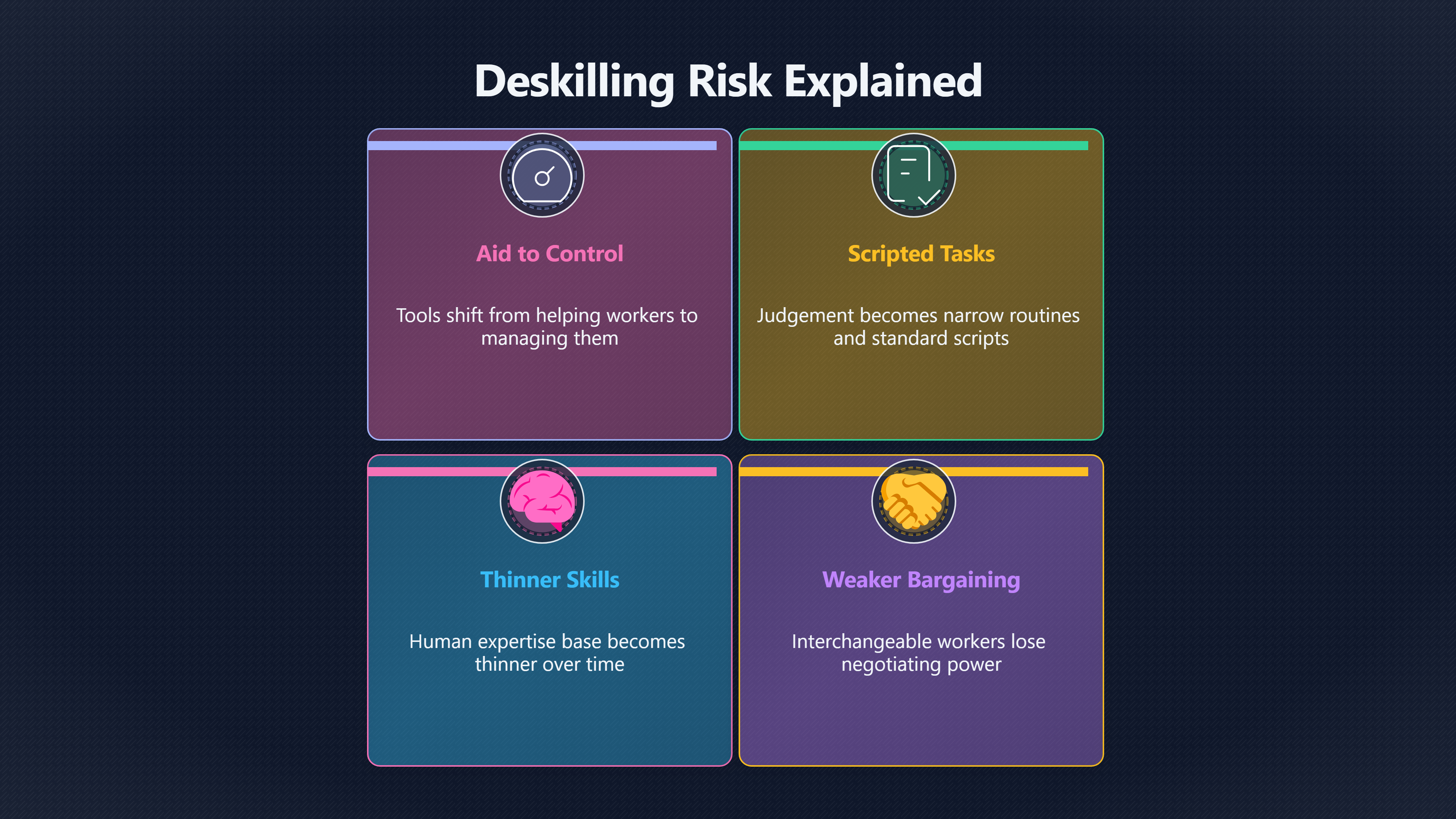
Augmentation can turn into deskilling when employers standardise workflows around AI and reduce workers’ autonomy.
On this page
- How helpful tools can become control systems
- Why deskilling weakens bargaining power
- What workplace design can preserve skill growth
Page outline Jump by section
Introduction
AI tools do not automatically make workers more valuable. In some workplaces, they do the opposite: they simplify jobs, reduce worker autonomy, weaken opportunities to learn difficult skills, and make labour easier to monitor, standardise, and replace.
 This is the deskilling risk. It sits at the centre of the debate over whether AI will broadly raise wages or mainly concentrate power. A generative AI assistant can help a junior worker perform like a more experienced one. But if firms redesign the job so workers merely follow AI-generated instructions, the same technology can reduce the need for expertise altogether.
That distinction matters far beyond office productivity. The optimistic “AI bloom” vision depends partly on AI expanding human capability and participation in scientific, economic, and creative life. If advanced AI instead turns large parts of the workforce into tightly managed operators of machine systems, the gains from abundance may flow upward while workers lose bargaining power, status, and pathways to mastery.
The danger is not only unemployment. It is the gradual erosion of skilled human agency inside the economy itself.
How helpful tools become control systems
Many technologies begin as aids and end as management systems. AI may follow the same pattern.
A navigation app helps a delivery driver avoid traffic. An AI coding assistant helps a programmer find errors. An AI diagnostic system helps a nurse interpret scans. At first, these systems appear empowering because they reduce friction and spread expertise.
But employers often discover a second use: standardisation.
Once work can be broken into measurable, AI-assisted steps, firms can redesign jobs around narrower routines. Tasks that once required judgement become scripts. Tacit knowledge becomes embedded in software. Workers become easier to train, supervise, compare, and replace.
This is not a speculative concern. Labour economists have studied similar dynamics for decades in earlier automation waves. Daron Acemoglu and Pascual Restrepo describe how automation frequently shifts tasks away from workers and toward capital systems, weakening labour’s share of economic gains. [OUP Academic]academic.oup.comOUP Academictask-based approach to inequality | Oxfordby D Acemoglu · 2024 · Cited by 15 — This article reviews recent work on how automa… [American Economic Association]aeaweb.orgAmerican Economic AssociationAutomation and New Tasks: How Technology Displaces…by D Acemoglu · 2019 · Cited by 4235 — We present a fr… [NBER]nber.orgNBERArtificial Intelligence, Automation and Workby D Acemoglu · 2018 · Cited by 3180 — Our task-based framework emphasizes the displaceme…
Generative AI intensifies this possibility because it reaches into cognitive and professional work rather than only physical routines.
The call-centre paradox
| One of the most important early AI workplace studies found that a generative AI assistant improved productivity among customer-support workers by around 14%, with especially large gains for less experienced staff. [Stanford Graduate School of Business]gsb.stanford.eduStanford Graduate School of BusinessGenerative AI at Work - Stanford Graduate School of BusinessIn this paper, we study the staggered int… [3NBER 3OUP Academic(#endnote-2 "Snippet: OUP Academictask-based approach]academic.oup.comOUP Academictask-based approach to inequality | Oxfordby D Acemoglu · 2024 · Cited by 15 — This article reviews recent work on how automa…</span></span></span> to inequality | Oxfordby D Acemoglu · 2024 · Cited by 15 — This article reviews recent work on how automa”) |
This result is often presented as evidence that AI complements labour. In one sense, it does. The system appeared to transfer the practices of top-performing workers to newer employees.
But the same mechanism can also reduce the long-term value of expertise.
If the system captures the knowledge that once made senior workers distinctive, firms may need fewer highly skilled staff. Workflows become easier to standardise. Training periods shrink. Performance differences narrow. The organisation becomes less dependent on scarce human knowledge and more dependent on the AI platform itself.
The productivity gains are real. But the bargaining power attached to expertise may weaken.
This is one reason AI can simultaneously raise short-term output while undermining wage growth over time.
AI systems can flatten skill ladders
Many professions depend on gradual apprenticeship.
Junior lawyers learn by drafting documents. Junior programmers learn by debugging difficult systems. Medical trainees learn through repeated interpretation and decision-making. Designers learn through iteration and critique.
AI systems may reduce precisely the kinds of lower-level work through which expertise develops.
If AI performs the first draft, chooses the coding pattern, recommends the diagnosis, or generates the presentation outline, junior workers may complete projects faster while learning less deeply.
Researchers have started warning about this explicitly in medicine, where heavy reliance on AI-assisted diagnostics may reduce opportunities to develop clinical judgement. [Springer Link]link.springer.comSpringer LinkAI-induced Deskilling in Medicine: A Mixed-Method Review…by C Natali · 2025 · Cited by 85 — This study presents a mixed-m…
The issue is not simply “people becoming lazy”. It is structural. If organisations redesign jobs around AI outputs, workers may no longer encounter enough difficult cases to build mastery.
That can create a paradoxical economy:
- workers appear more productive; [mitsloan.mit.edu]mitsloan.mit.eduwith less experience gain the most from…26 Jun 2023 — Contact center agents with access to an AI assistant were 14% more productive, w…
- firms rely more heavily on AI systems;
- but the underlying human skill base becomes thinner.
Over time, this may increase dependence on a small number of technology providers and highly specialised experts while weakening broad-based professional capability.
Why deskilling weakens bargaining power
Workers usually gain wages when they control scarce capabilities.
A surgeon earns more than a clerical worker partly because surgical expertise is difficult to acquire and difficult to replace. Skilled tradespeople retain leverage because their judgement matters in unpredictable environments. Senior engineers command high salaries because organisations depend on accumulated tacit knowledge.
Deskilling changes that balance.
When AI systems reduce the importance of individual judgement, firms become less dependent on workers and more dependent on scalable software systems.
Standardisation makes labour interchangeable
Industrial history provides many examples of this pattern.
Early craft production often relied on skilled workers with substantial autonomy. Factory systems frequently reorganised work into smaller, repeatable tasks that could be supervised centrally and performed by less-skilled labour.
AI may allow a similar transformation in white-collar sectors.
A junior employee following AI-generated prompts may produce acceptable legal summaries, customer responses, software patches, or marketing copy without understanding the underlying discipline deeply. That can lower labour costs and widen hiring pools, but it can also make workers more interchangeable.
Interchangeable workers generally have weaker negotiating power.
Acemoglu argues that firms often pursue automation in ways that prioritise labour cost reduction rather than the creation of genuinely complementary human roles. MIT News [IMF]imf.orgThe Post-COVID World, Inequality and AutomationTo reverse widening inequality, keep a tight rein on automation, writes Daron Acemoglu in…
This matters because productivity growth alone does not guarantee broad prosperity. If AI systems mainly reduce labour dependence, the gains may flow disproportionately to shareholders, platform owners, and highly concentrated technology firms.
Surveillance and algorithmic management
AI systems also expand managerial visibility into work itself.
Software can now monitor keystrokes, response speed, adherence to scripts, emotional tone, customer ratings, workflow timing, and communication patterns at enormous scale.
In some workplaces, AI becomes less a creative assistant than a continuous evaluation system.
Researchers and labour organisations increasingly warn that generative AI may deepen “algorithmic management”: the use of software systems to direct and monitor workers in real time. [Data & Society]datasociety.netData & Society Generative AI and Labor: Power, Hype, and Value at WorkData & SocietyGenerative AI and Labor: Power, Hype, and Value at WorkDecember 3, 2024 — This primer argues that the labor impact of gener…
This can reduce worker discretion in several ways:
- AI suggests the “correct” response.
- Deviations become measurable.
- Performance metrics become more granular.
- Managers can compare workers continuously.
- Firms can outsource or offshore standardised tasks more easily.
In extreme cases, workers become supervisors of machine-defined workflows rather than autonomous professionals.
That does not necessarily reduce employment immediately. But it can reduce the quality, independence, and long-term economic value of work.
Why the deskilling path matters for AI abundance
The broader AI abundance argument assumes that technological progress can expand human flourishing rather than merely enrich capital owners.
That future depends partly on whether AI creates more capable citizens or more dependent operators.
A society where AI amplifies education, scientific participation, creativity, and entrepreneurship could become dramatically more prosperous while still preserving meaningful human agency.
A society where AI systems centralise expertise inside a handful of platforms may look very different:
- fewer workers develop deep skills;
- fewer institutions train independent experts;
- labour’s bargaining power declines;
- wealth concentrates around model ownership and infrastructure;
- human judgement atrophies outside elite domains.
This is one reason labour structure matters even within long-run discussions of superintelligence and post-scarcity futures.
The optimistic case for AI is not merely that machines become more capable. It is that humans become more capable too.
If AI substitutes for learning rather than accelerating it, the economy may become richer while citizens become less economically empowered inside it.

The risk is uneven across occupations
Deskilling pressures are not distributed evenly.
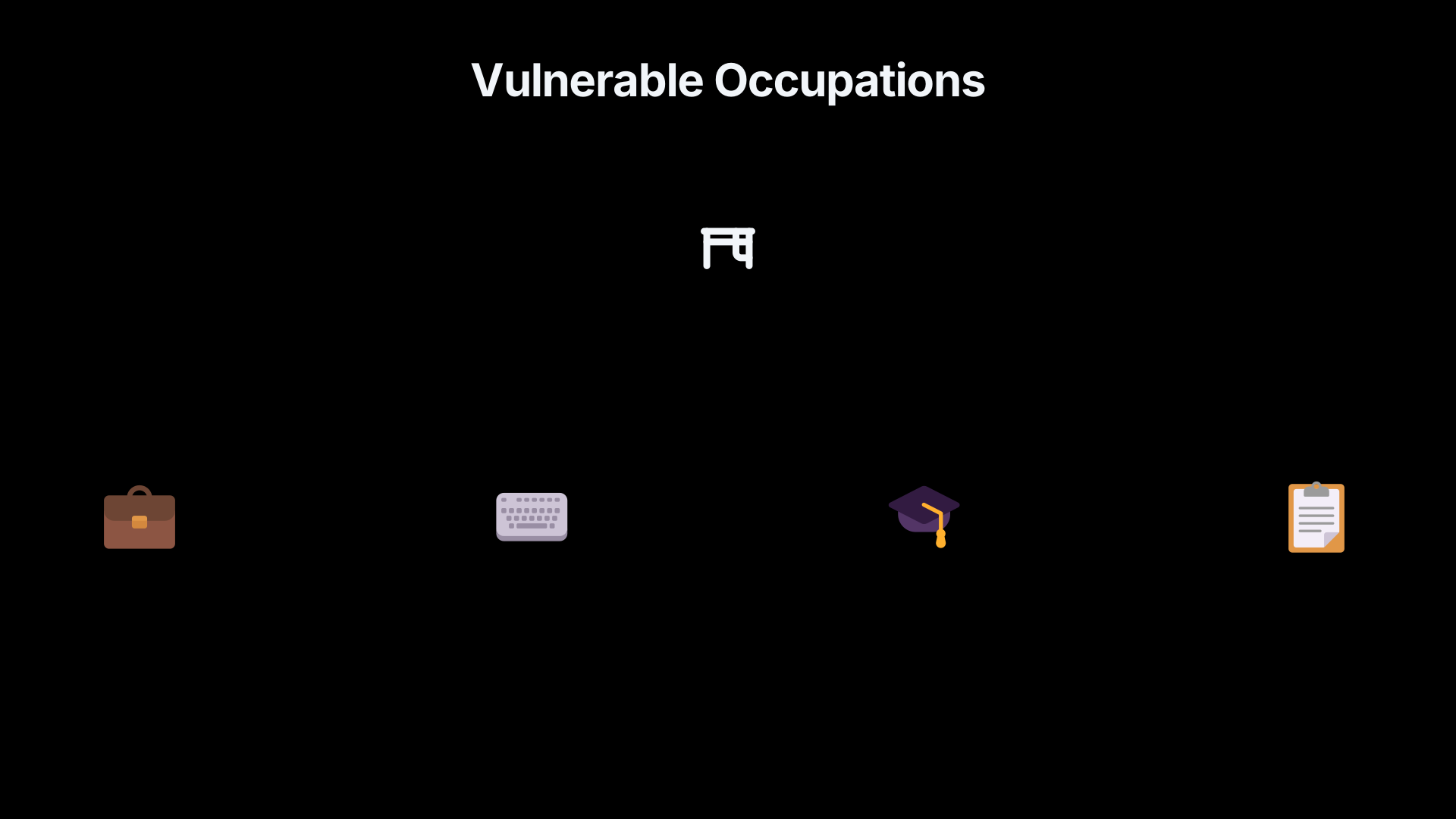
Jobs built around highly repeatable cognitive routines appear especially vulnerable:
- customer support;
- routine legal drafting;
- administrative coordination;
- standardised software maintenance;
- claims processing;
- repetitive content production.
In these areas, AI systems can absorb large amounts of procedural knowledge and embed it into workflows.
More complex occupations may resist deskilling longer because they depend on:
- trust;
- physical interaction;
- ambiguous judgement;
- responsibility under uncertainty;
- social coordination;
- ethical accountability.
Even there, however, parts of the workflow may become increasingly machine-directed.
Younger workers may be especially exposed
Early-career workers face a particular danger.
Historically, many professions relied on juniors handling lower-level tasks while gradually learning the field. AI threatens some of those entry pathways first.
Recent labour-market analysis has suggested that younger workers in AI-exposed sectors are already seeing reduced opportunities in some fields. [WIRED]wired.comAI Is Eliminating Jobs for Younger WorkersAnalyzing payroll data from ADP between late 2022 and mid-2025, researchers found a 16% decline in employment among workers aged 22 to 25…
This creates a difficult transition problem.
If AI systems remove beginner-level work:
- firms may need fewer trainees;
- workers may struggle to build experience;
- expertise pipelines may narrow over time.
The economy could then become dependent on a shrinking pool of elite experts while broad professional mobility declines.
That outcome would conflict sharply with the stronger versions of the AI bloom vision, which assume wider access to intelligence and capability rather than the narrowing of elite bottlenecks.
What workplace design can preserve skill growth
Deskilling is not inevitable. It depends heavily on institutional choices.
The same AI system can either deepen human capability or hollow it out depending on how work is organised.
Keep humans responsible for judgement
Workers retain leverage when they still exercise meaningful judgement.
AI systems are less likely to deskill roles when humans:
- make final decisions;
- interpret ambiguity;
- handle exceptions;
- communicate with other humans;
- remain accountable for outcomes.
This is one reason many economists distinguish between automating tasks and automating occupations. Most jobs combine routine and non-routine elements. AI deployment choices determine whether workers move upward into higher-value tasks or downward into passive oversight roles.
Design AI as a teaching system, not just a shortcut
The most productive AI systems may be those that actively help workers learn.
An AI tutor for programming, medicine, engineering, or law can either:
- explain reasoning and encourage understanding;
- or simply provide instant answers.
Those models produce different long-term outcomes.
Research on the call-centre study suggested that AI systems can disseminate best practices and accelerate learning for less experienced workers. [NBER]nber.orgNBERGenerative AI at Workby E Brynjolfsson · 2023 · Cited by 2564 — Access to the tool increases productivity, as measured by issues reso…
But preserving that benefit may require intentional design:
- explanation instead of black-box outputs;
- gradual reduction of assistance;
- opportunities for independent problem-solving;
- evaluation based on understanding, not only speed.
Otherwise organisations may optimise purely for short-term throughput.
Preserve apprenticeship pathways
Many industries may need deliberate policies to preserve entry-level learning opportunities.
That could include:
- protected trainee roles;
- mixed human-AI workflows;
- licensing requirements;
- rotational experience requirements;
- slower automation in training-intensive fields.
Without such measures, firms may rationally optimise away the very experiences through which future experts are created.
Give workers influence over deployment
Research on technological change repeatedly shows that power matters.
When workers, professional bodies, unions, or public institutions have influence over deployment, technologies are more likely to support augmentation rather than pure labour substitution.
That does not guarantee positive outcomes. But it changes incentives.
A firm focused entirely on short-term labour savings may adopt AI differently from:
- a hospital concerned with preserving clinical expertise;
- a public education system trying to expand learning;
- or a professional partnership dependent on long-term skill development.
The shape of AI deployment is therefore partly a governance question, not merely a technical one.
The deeper question behind the deskilling debate
The deskilling debate is ultimately about what kind of civilisation advanced AI creates.
One path uses AI to spread expertise, reduce drudgery, accelerate science, and expand the number of people capable of meaningful intellectual and creative work. Under that model, AI abundance strengthens human agency.
The other path treats human capability as a temporary cost to be minimised. Workers become cheaper complements to increasingly centralised machine systems. Knowledge concentrates inside platforms. Human judgement narrows. Economic dependence deepens even as productivity rises.
Both futures may involve astonishingly capable AI.
The difference is whether advanced intelligence becomes a tool for broad human flourishing or a mechanism that steadily removes ordinary people from positions of skill, leverage, and control.
Endnotes
-
Source: nber.org
Link: https://www.nber.org/system/files/working_papers/w24196/w24196.pdfSource snippet
NBERArtificial Intelligence, Automation and Workby D Acemoglu · 2018 · Cited by 3180 — Our task-based framework emphasizes the displaceme...
-
Source: academic.oup.com
Link: https://academic.oup.com/ooec/article/3/Supplement_1/i906/7708121Source snippet
OUP Academictask-based approach to inequality | Oxfordby D Acemoglu · 2024 · Cited by 15 — This article reviews recent work on how automa...
-
Source: nber.org
Link: https://www.nber.org/papers/w31161Source snippet
NBERGenerative AI at Workby E Brynjolfsson · 2023 · Cited by 2564 — Access to the tool increases productivity, as measured by issues reso...
-
Source: academic.oup.com
Link: https://academic.oup.com/qje/article/140/2/889/7990658Source snippet
OUP AcademicGenerative AI at Work* | The Quarterly Journal of Economicsby E Brynjolfsson · 2025 · Cited by 2564 — Generative AI could rep...
-
Source: gsb.stanford.edu
Link: https://www.gsb.stanford.edu/faculty-research/working-papers/generative-ai-workSource snippet
Stanford Graduate School of BusinessGenerative AI at Work - Stanford Graduate School of BusinessIn this paper, we study the staggered int...
-
Source: link.springer.com
Link: https://link.springer.com/article/10.1007/s10462-025-11352-1Source snippet
Springer LinkAI-induced Deskilling in Medicine: A Mixed-Method Review...by C Natali · 2025 · Cited by 85 — This study presents a mixed-m...
-
Source: news.mit.edu
Link: https://news.mit.edu/2026/study-firms-often-use-automation-control-certain-workers-wages-0507Source snippet
MIT NewsFirms often use automation to control certain workers' wages7 days ago — “There has been an inefficient targeting of automation,”...
-
Source: imf.org
Link: https://www.imf.org/external/pubs/ft/fandd/2021/03/COVID-inequality-and-automation-acemoglu.htm -
Source: shapingwork.mit.edu
Title: Stone Center Can We Have Pro-Worker AI?
Link: https://shapingwork.mit.edu/research/can-we-have-pro-worker-ai/Source snippet
Choosing a path of...The private sector is pursuing a path for generative AI that emphasizes automation and the displacement of labor, a...
-
Source: wired.com
Title: AI Is Eliminating Jobs for Younger Workers
Link: https://www.wired.com/story/stanford-research-ai-replace-jobs-young-workersSource snippet
Analyzing payroll data from ADP between late 2022 and mid-2025, researchers found a 16% decline in employment among workers aged 22 to 25...
-
Source: siepr.stanford.edu
Title: Author(s). Erik Brynjolfsson.Read more
Link: https://siepr.stanford.edu/publications/working-paper/generative-ai-workSource snippet
SIEPRGenerative AI at Work | Stanford Institute for Economic Policy...Our results suggest that access to generative AI can increase prod...
-
Source: economics.mit.edu
Title: Tasks Automation and the Rise in US Wage Inequality
Link: https://economics.mit.edu/sites/default/files/2022-10/Tasks%20Automation%20and%20the%20Rise%20in%20US%20Wage%20Inequality.pdfSource snippet
Wage InequalityWe identify tasks that can be automated with those that are routine (as classified in Acemoglu and Autor (2011)). Our firs...
-
Source: mitsloan.mit.edu
Link: https://mitsloan.mit.edu/ideas-made-to-matter/workers-less-experience-gain-most-generative-aiSource snippet
with less experience gain the most from...26 Jun 2023 — Contact center agents with access to an AI assistant were 14% more productive, w...
-
Source: news.mit.edu
Title: study inks automation inequality 0506
Link: https://news.mit.edu/2020/study-inks-automation-inequality-0506Source snippet
finds stronger links between automation and inequality5 May 2020 — MIT economist Daron Acemoglu examines the history of automation in the...
Published: May 2020
-
Source: mitsloan.mit.edu
Title: generative ai and worker productivity
Link: https://mitsloan.mit.edu/centers-initiatives/institute-work-and-employment-research/generative-ai-and-worker-productivitySource snippet
AI and Worker Productivity16 Apr 2024 — Access to the new tool increased worker productivity by about 14% on average, with the productivi...
-
Source: hai.stanford.edu
Link: https://hai.stanford.edu/news/will-generative-ai-make-you-more-productive-work-yes-only-if-youre-not-already-great-your-jobSource snippet
Yes...24 Apr 2023 — They found that access to AI assistance increased agent productivity by 14%, with the biggest impact on less experie...
-
Source: siepr.stanford.edu
Title: generative ai boost can boost productivity without replacing workers
Link: https://siepr.stanford.edu/news/generative-ai-boost-can-boost-productivity-without-replacing-workersSource snippet
AI boost can boost productivity without replacing...Dec 14, 2023 — Providing workers with a generative AI tool similar to ChatGPT can le...
-
Source: inequality.stanford.edu
Title: artificial intelligence automation and work
Link: https://inequality.stanford.edu/publications/media/details/artificial-intelligence-automation-and-workSource snippet
Intelligence, Automation and WorkWe summarize a framework for the study of the implications of automation and AI on the demand for labor...
-
Source: time.com
Link: https://time.com/charter/7316979/how-ai-has-transformed-the-economy/Source snippet
TIME14 Sept 2025 — ' It tended to help the more skilled workers get even more productive and not do as much for less skilled workers. So...
-
Source: aeaweb.org
Link: https://www.aeaweb.org/articles?id=10.1257%2Fjep.33.2.3Source snippet
American Economic AssociationAutomation and New Tasks: How Technology Displaces...by D Acemoglu · 2019 · Cited by 4235 — We present a fr...
-
Source: datasociety.net
Title: Data & Society Generative AI and Labor: Power, Hype, and Value at Work
Link: https://datasociety.net/wp-content/uploads/2024/12/DS_Generative-AI-and-Labor-Primer_Final.pdfSource snippet
Data & SocietyGenerative AI and Labor: Power, Hype, and Value at WorkDecember 3, 2024 — This primer argues that the labor impact of gener...
Published: December 3, 2024
-
Source: youtube.com
Title: Daron Acemoglu
Link: https://www.youtube.com/watch?v=R7CHckj2suQSource snippet
Automation and Labor in the Post-COVID...In this Impulse Talk, Daron Acemoğlu gives a sobering overview of the impact of automation on l...
Additional References
-
Source: linkedin.com
Link: https://www.linkedin.com/posts/erikbrynjolfsson_great-to-see-generative-ai-at-work-my-activity-7297390624809357312-HX0RSource snippet
Erik Brynjolfsson's PostThe most insightful yet deranging takeaway from this article (for me) was the finding of less skilled/experienced...
-
Source: theweek.com
Link: https://theweek.com/tech/deskilling-ai-technologySource snippet
Deskilling refers to the gradual loss of human ability to perform tasks independently as AI tools become more integrated into work routin...
-
Source: europarl.europa.eu
Link: https://www.europarl.europa.eu/RegData/etudes/STUD/2025/774670/EPRS_STU%282025%29774670_EN.pdfSource snippet
europa.euDigitalisation, artificial intelligence and algorithmic...The integration of automation and AI into workplaces is transforming...
-
Source: reports.weforum.org
Link: https://reports.weforum.org/docs/WEF_Leveraging_Generative_AI_for_Job_Augmentation_and_Workforce_Productivity_2024.pdfSource snippet
Generative AI for Job Augmentation and...GenAI has the potential to contribute to economic and productivity growth by creating efficienc...
-
Source: project-syndicate.org
Title: ai automation labor productivity by daron acemoglu and pascual restrepo 2019 03
Link: https://www.project-syndicate.org/commentary/ai-automation-labor-productivity-by-daron-acemoglu-and-pascual-restrepo-2019-03Source snippet
The Revolution Need Not Be Automated29 Mar 2019 — By replacing labor with machines in production tasks, automation reduces labor's share...
-
Source: etui.org
Link: https://www.etui.org/sites/default/files/2024-03/Artificial%20intelligence%2C%20labour%20and%20society_2024.pdfSource snippet
Artificial intelligence, labour and societyby AP Del Castillo · Cited by 25 — This book represents a stage in the ongoing journey of my r...
-
Source: laweconcenter.org
Title: ai productivity and labor markets a review of the empirical evidence
Link: https://laweconcenter.org/resources/ai-productivity-and-labor-markets-a-review-of-the-empirical-evidence/Source snippet
AI, Productivity, and Labor Markets: A Review of the...Feb 5, 2026 — Daron Acemoglu (2025) develops a task-based macro model that distin...
-
Source: ciceroinstitute.org
Title: ai and the future of work policy lessons from acemoglu and restrepo
Link: https://ciceroinstitute.org/blog/ai-and-the-future-of-work-policy-lessons-from-acemoglu-and-restrepo/Source snippet
AI and the Future of Work: Policy Lessons from Acemoglu...Feb 25, 2026 — Acemoglu and Restrepo call the resulting decline in task-specif...
-
Source: blogs.worldbank.org
Title: What we re reading about the age of AI jobs and inequality
Link: https://blogs.worldbank.org/en/jobs/What-we-re-reading-about-the-age-of-AI-jobs-and-inequalitySource snippet
we're reading about the age of AI, jobs, and inequality7 May 2024 — AI poses risks of labor displacement through task automation but also...
Published: May 2024
-
Source: resetdoc.org
Link: https://www.resetdoc.org/story/nobel-laureate-acemoglu-automation-inequality-future-society/Source snippet
Nobel Laureate Acemoglu on Automation, Inequality, and...14 Oct 2024 — I am going to discuss the question of automation and the prospect...
Amazon book picks
Further Reading
Books and field guides related to AI deskilling risk. Use these as the next step if you want deeper reading beyond the article.
The Shift: The Future of Work is Already Here
An unhysterical look at the future of employment.
Automation and the Future of Work
First published 2020. Subjects: Economic history, Automation, Social aspects, Economic aspects, Technological innovations.

Shaping the Future of Work
First published 2015. Subjects: Business ethics, Labor, Organizational behavior, Personnel management, Labor policy.
Future of Work Technology and Basic Income
First published 2019. Subjects: Economics, Information society, Economic aspects, Work, Technological innovations.
eBay marketplace picks
Marketplace Samples
Example marketplace items related to this page. Use the search link to explore similar finds on eBay.

Example eBay listing
A.I. Artificial Intelligence Original Movie Poster Signed By Jude Law
USD 125.00 | Shipping USD 25.00 | US

Example eBay listing
Artificial Intelligence D/S Original Movie Poster - 27 x 40"
USD 19.50 | Shipping USD 13.65 | US

Example eBay listing
612388 Artificial Intelligence Movie Science Fiction Drama Wall Print Poster
USD 22.95 | Shipping USD 12.95 | JP

Example eBay listing
Companion - Artificial Intelligence Dark Comedy Cinema Film - POSTER 20"x30"
USD 23.99 | Free shipping | US

Example eBay listing
A.I. Artificial Intelligence Movie Film Poster Art Print
GBP 4.99 | Free shipping | GB

Example eBay listing
A I Artificial Intelligence 6 Movie Poster Art Print Print Classic Rare Gallery
GBP 49.00 | Free shipping | GB

Example eBay listing
AI - Artificial Intelligence (Poster + Slipcase) Blu-Ray
GBP 10.49 | Free shipping | GB

Example eBay listing
A. I. Artificial Intelligence. Jude Law. Original UK Video Poster.
GBP 8.11 | Shipping GBP 3.38 | GB
Topic Tree