Within AI Medicine
AI as Clinical Backup
Medical AI looks most useful when it helps clinicians notice, prioritise and summarise rather than pretending to replace judgement.
On this page
- Where AI can support decisions
- Why automation bias matters
- How responsibility stays clear
Page outline Jump by section
Introduction
AI is unlikely to become a safe replacement for doctors in the near future. It may, however, become something more practical and potentially more valuable: a second set of clinical eyes. In medicine, many serious failures happen not because nobody looked, but because a warning sign was missed, a scan was not prioritised in time, or a clinician was overloaded with information. AI systems are increasingly being designed to help with exactly those problems: highlighting suspicious findings, summarising records, surfacing rare possibilities, and helping clinicians notice what might otherwise slip past.
 That distinction matters for the wider idea of AI-enabled human flourishing. The optimistic case for AI medicine is not mainly about robotic doctors replacing hospitals. It is about extending expert attention, reducing avoidable error, and making high-quality medical judgement more available across entire populations. If AI can safely amplify human clinicians rather than bypass them, it could become one of the clearest early examples of “AI abundance” in practice: more diagnostic capacity, faster triage, and better preventive care without needing to train impossible numbers of specialists overnight.
The evidence so far suggests that the safest and most effective systems are usually the ones that stay inside existing care teams. AI works best when it supports human judgement rather than pretending to eliminate it. But that also creates a difficult question: how do you stop clinicians from trusting the machine too much?
Where AI already works as a clinical back-up
The strongest evidence for medical AI today comes from narrow, repetitive, high-volume tasks where clinicians already work under time pressure. Radiology is the clearest example. Hospitals generate enormous numbers of scans, and radiologists must detect small abnormalities while managing fatigue, interruptions, and staffing shortages. AI systems are therefore often used not as autonomous diagnosticians, but as assistants that flag abnormalities, prioritise urgent cases, or provide a second review. [ScienceDirect]sciencedirect.comScienceDirectArtificial intelligence as a simultaneous second reader in…by M Omar · 2026 — Artificial intelligence as a simultaneous s… [2U.S.] Food and Drug Administration
Breast cancer screening shows why this model is attractive. In many screening programmes, mammograms are double-read by two radiologists because human readers can miss subtle cancers. AI systems can now act as an additional reviewer, helping identify suspicious areas and ranking scans by risk. The important question is not whether the AI scores highly on a benchmark, but whether patients actually benefit in real screening programmes.
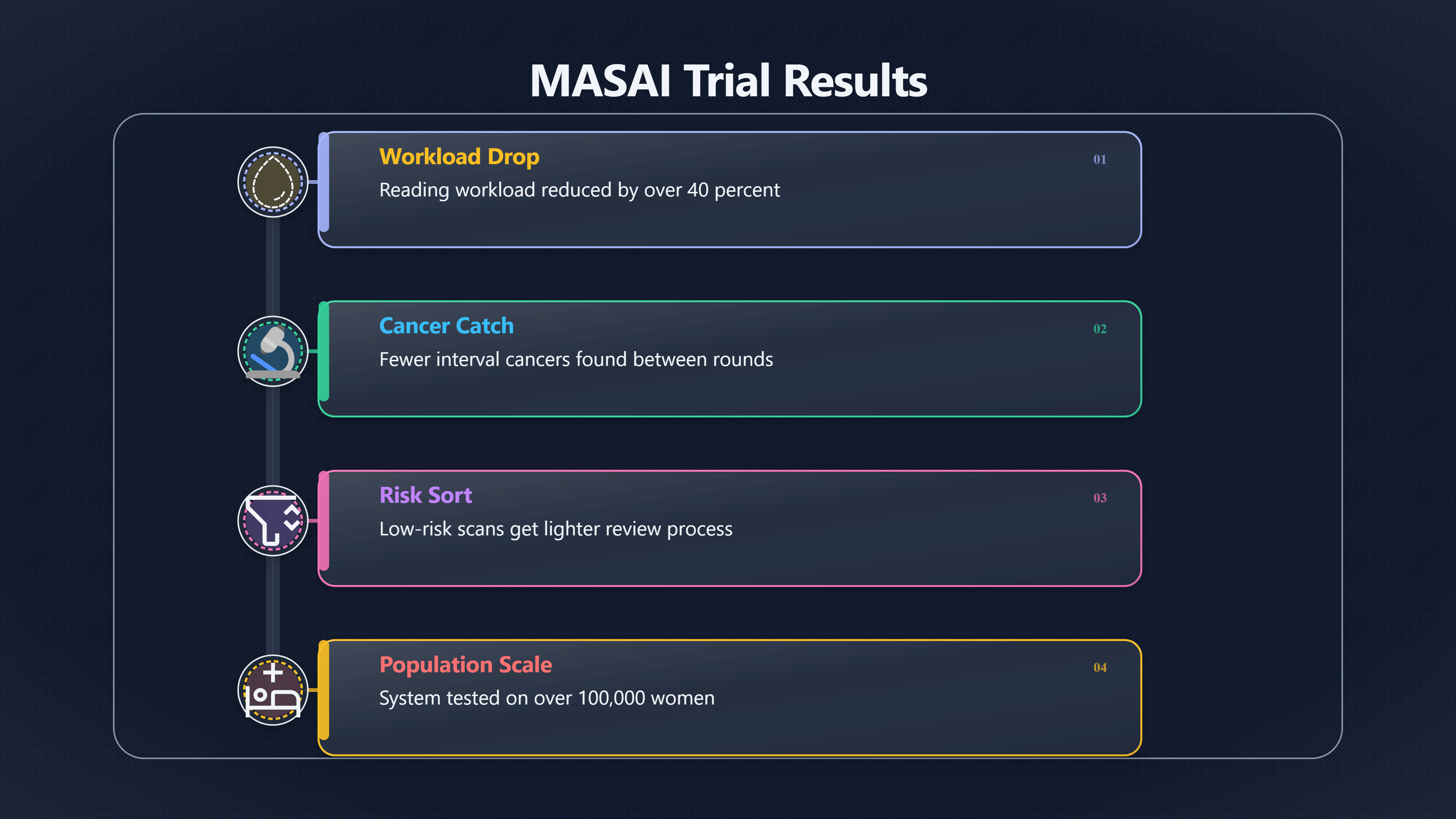
The Swedish MASAI trial became a landmark test because it examined AI-assisted mammography in a large population screening setting involving more than 100,000 women. Early findings suggested that AI-supported workflows maintained cancer detection rates while reducing radiologists’ reading workload by more than 40%. [The Lancet]thelancet.comThe LancetArtificial intelligence-supported screen reading versus…by K Lång · 2023 · Cited by 534 — The use of AI did not influence th… Later analyses reported fewer interval cancers — cancers discovered between screening rounds after being missed initially — suggesting the system may have helped detect dangerous cancers earlier. [PubMed]pubmed.ncbi.nlm.nih.govInterpretation: AI-supported mammography screening resulted in a similar cancer detection rate…Read more… [The ASCO Post]ascopost.comThe ASCO PostRandomized Trial Shows AI-Supported Mammography…Feb 2, 2026 — The interval cancer rate in the intervention group was 1.55…
The interesting part is not simply that the AI “beat” humans. In the MASAI workflow, the machine and clinicians shared labour. Lower-risk scans could receive a lighter review process, while high-risk scans received additional scrutiny. That is closer to how most useful medical AI may operate over the next decade: redistributing scarce expert attention rather than eliminating experts altogether. [Live Science]livescience.comPublished in The Lancet, the Mammography Screening with Artificial Intelligence (MASAI) trial involved over 100,000 women between ages…
The same pattern appears in other imaging fields:
- Stroke imaging systems can flag possible brain bleeds or vessel blockages so emergency teams respond faster.
- Chest imaging tools can highlight suspicious lung nodules for radiologists to review.
- Pathology systems can help identify tumour regions on microscope slides.
- Clinical decision-support systems can scan electronic records for abnormal combinations of symptoms or drug interactions.
In each case, the AI is usually acting as an alerting or prioritisation system rather than an independent decision-maker.
This matters because healthcare systems worldwide face chronic shortages of specialist attention. If AI can safely reduce routine workload while preserving clinical quality, it could increase access to earlier diagnosis across ageing populations. In AI bloom terms, that is a small but important example of abundance: making scarce expertise scale further than it otherwise could.
Why medicine is vulnerable to automation bias
The danger is that clinicians may start trusting AI too much, especially when systems sound confident or appear statistically impressive. Researchers call this automation bias: the tendency to defer to machine recommendations even when they are wrong. [ScienceDirect]sciencedirect.comScienceDirectArtificial intelligence as a simultaneous second reader in…by M Omar · 2026 — Artificial intelligence as a simultaneous s…
Medicine is especially vulnerable to this problem because healthcare workers are often exhausted, overloaded, interrupted, and under time pressure. A system that says “normal scan” or “low risk” can subtly change how carefully someone looks at a patient.
Research in mammography has shown that this effect is real. A 2023 study published in Radiology found that radiologists of all experience levels became susceptible to automation bias when AI systems provided incorrect recommendations. In some cases, clinicians changed previously correct interpretations after seeing flawed AI advice. [PubMed]pubmed.ncbi.nlm.nih.govInterpretation: AI-supported mammography screening resulted in a similar cancer detection rate…Read more…
That finding matters because many discussions about medical AI assume that human oversight automatically guarantees safety. In practice, oversight can become performative if clinicians stop independently evaluating evidence.
The problem may become more severe with large language models because conversational systems can sound persuasive even when they hallucinate information. Emerging studies examining physicians using systems like GPT-4o suggest that clinicians can still be influenced by incorrect AI reasoning, including doctors who already have AI training. [ClinicalTrials]clinicaltrials.govClinicalTrialsAutomation Bias in Physician-LLM Diagnostic ReasoningThis study aims to systematically measure the extent and patterns of a… [MedRxiv There is also a broader structural risk. Hospitals under financial pressure may gradually redesign workflows around AI recommendations. If st]medrxiv.org2025.08.23.25334280v2.full textAutomation Bias in Large Language Model Assisted…Sep 8, 2025 — This study demonstrates significant automation bias affecting physician… affing levels fall because administrators assume the software is “good enough”, clinicians may have less time to challenge machine outputs carefully. In that world, the AI stops being a second pair of eyes and quietly becomes the first — and perhaps only — meaningful reviewer.
That distinction is central to safe deployment.
The safest systems usually keep humans meaningfully involved
The evidence so far suggests that human-AI collaboration works best when responsibility remains clear and humans retain active cognitive involvement.
Several design choices appear especially important:
- AI should show evidence, not just conclusions. Clinicians are more able to challenge outputs when systems highlight suspicious image regions, explain reasoning pathways, or cite supporting data rather than producing opaque scores alone.
- Humans should make final clinical decisions. AI can recommend prioritisation or flag abnormalities, but accountability still rests with licensed professionals.
- Systems should be evaluated in real workflows. Laboratory accuracy does not guarantee safe deployment in crowded hospitals with interruptions, incomplete records, and diverse patient populations.
- Clinicians need training in failure modes. Doctors are trained to question other humans; they also need training to question machines.
- Hospitals need audit trails. It should remain possible to understand who decided what, and why.
Regulators are increasingly focusing on this distinction between assistive and autonomous systems. The US Food and Drug Administration has issued evolving guidance on clinical decision-support software, particularly around whether clinicians can independently review and understand the basis for recommendations. [U.S. Food and Drug Administration]fda.govartificial intelligence software medical deviceFood and Drug AdministrationArtificial Intelligence in Software as a Medical DeviceMar 25, 2025 — AI/ML technologies have the potential t…
This reflects a deeper reality about medicine: diagnosis is not merely pattern recognition. It also involves context, uncertainty, communication, ethics, and trade-offs. A scan may look suspicious, but the patient’s age, history, symptoms, and preferences still matter. AI systems can help process information, but they do not carry legal or moral responsibility for outcomes.
In practice, this may lead to a “centaur” model of medicine, similar to advanced chess systems where humans and AI cooperate rather than compete. Some studies already suggest that clinicians working with AI can outperform either humans or machines alone in certain tasks. [arXiv]arxiv.orgarXivHuman-AI Co-reasoning for Clinical Diagnosis with Evidence-Integrated Language AgentMarch 11, 2026…
Bias, inequality, and the risk of scaling bad medicine faster
Even if AI improves average diagnostic performance, it could still worsen inequality if poorly designed systems are deployed at scale.
Medical AI systems inherit patterns from their training data. If historical healthcare systems underdiagnosed certain groups, AI models can absorb and reproduce those distortions. Researchers have already identified examples where AI recommendations varied according to socioeconomic or demographic information despite identical clinical presentations. [Reuters]reuters.comHealth Rounds: AI can have medical care biases too, a study revealsFirst, a study published in Nature Medicine reveals that artificial intelligence (AI) models used in healthcare can exhibit biases based…
This creates a paradox. AI could expand medical access globally, especially in regions with too few specialists. Yet it could also industrialise existing biases if systems are trained mainly on wealthy-country populations or narrow datasets.
That matters enormously for the broader AI bloom question. A flourishing future is not simply one where technology becomes more powerful. It is one where capability gains are distributed broadly enough to improve human lives across entire populations rather than concentrating advantages among already privileged groups.
The hopeful scenario is that AI-supported medicine eventually allows earlier diagnosis and better preventive care in under-resourced systems that currently lack enough specialists. In parts of the world with very few radiologists or pathologists, a reasonably reliable second reader could make a substantial difference.
The pessimistic scenario is that wealthy hospitals receive carefully validated systems with extensive oversight, while poorer systems receive cheap automation with minimal human review.
Which future emerges depends less on raw AI capability than on governance, incentives, and deployment choices.
Why “second eyes” may matter more than superhuman doctors
Public discussion often focuses on whether AI can outperform doctors on benchmark tests. Some experimental systems already score impressively on diagnostic exams or structured case challenges. [The Guardian]theguardian.comIn tests involving the review of 76 emergency room patient cases, AI correctly identified diagnoses in 67% of cases, surpassing human doc… But benchmark victories can obscure the more important real-world question: can AI reduce harmful misses in messy clinical environments?
Medicine is full of small failures of attention:
- a subtle tumour overlooked late at night,
- a dangerous interaction buried in records,
- a rare disease never considered,
- an abnormal scan sitting too long in a queue.
A reliable second reviewer may therefore matter more than a supposedly autonomous “super-doctor”.
That is also why many clinicians remain cautiously optimistic despite concerns about hype. The practical value of AI may not come from replacing medical expertise, but from making expert attention less scarce. In an ageing world facing clinician shortages, that could become economically and socially significant.
If advanced AI eventually accelerates biomedical science, improves diagnostics, and supports preventive medicine at scale, the cumulative effect over decades could be enormous: fewer missed diseases, more years of healthy life, and lower cognitive and physical decline across populations. In the language of AI bloom, healthcare abundance is not just about curing more illnesses. It is about expanding the amount of healthy human life available for learning, relationships, creativity, and participation in civilisation itself.
But none of that follows automatically from better models. Safety depends on workflow design, accountability, transparency, regulation, and institutional culture. The key lesson from current evidence is surprisingly conservative: medical AI works best when it behaves less like an all-knowing machine authority and more like a careful colleague who never gets tired, never stops checking, and still expects a human to make the final call.
Endnotes
-
Source: sciencedirect.com
Link: https://www.sciencedirect.com/science/article/abs/pii/S0363018826000423Source snippet
ScienceDirectArtificial intelligence as a simultaneous second reader in...by M Omar · 2026 — Artificial intelligence as a simultaneous s...
-
Source: fda.gov
Title: artificial intelligence software medical device
Link: https://www.fda.gov/medical-devices/software-medical-device-samd/artificial-intelligence-software-medical-deviceSource snippet
Food and Drug AdministrationArtificial Intelligence in Software as a Medical DeviceMar 25, 2025 — AI/ML technologies have the potential t...
-
Source: sciencedirect.com
Link: https://www.sciencedirect.com/science/article/pii/S2666449624000410Source snippet
ScienceDirectExploring the risks of automation bias in healthcare...by M Abdelwanis · 2024 · Cited by 106 — This study conducts an in-de...
-
Source: clinicaltrials.gov
Link: https://clinicaltrials.gov/study/NCT06963957Source snippet
ClinicalTrialsAutomation Bias in Physician-LLM Diagnostic ReasoningThis study aims to systematically measure the extent and patterns of a...
-
Source: medrxiv.org
Title: 2025.08.23.25334280v2.full text
Link: https://www.medrxiv.org/content/10.1101/2025.08.23.25334280v2.full-textSource snippet
Automation Bias in Large Language Model Assisted...Sep 8, 2025 — This study demonstrates significant automation bias affecting physician...
-
Source: fda.gov
Title: clinical decision support software
Link: https://www.fda.gov/regulatory-information/search-fda-guidance-documents/clinical-decision-support-softwareSource snippet
Food and Drug AdministrationClinical Decision Support Software - Guidance29 Jan 2026 — This guidance clarifies the scope of FDA's oversig...
-
Source: arxiv.org
Link: https://arxiv.org/abs/2603.10492Source snippet
arXivHuman-AI Co-reasoning for Clinical Diagnosis with Evidence-Integrated Language AgentMarch 11, 2026...
Published: March 11, 2026
-
Source: reuters.com
Title: Health Rounds: AI can have medical care biases too, a study reveals
Link: https://www.reuters.com/business/healthcare-pharmaceuticals/health-rounds-ai-can-have-medical-care-biases-too-study-reveals-2025-04-09/Source snippet
First, a study published in Nature Medicine reveals that artificial intelligence (AI) models used in healthcare can exhibit biases based...
-
Source: arxiv.org
Link: https://arxiv.org/abs/2310.19917 -
Source: medrxiv.org
Link: https://www.medrxiv.org/content/10.1101/2025.08.23.25334280v2Source snippet
Automation Bias in Large Language Model Assisted...Sep 8, 2025 — Objective To determine whether exposure to erroneous LLM recommendation...
-
Source: sciencedirect.com
Link: https://www.sciencedirect.com/science/article/pii/S0720048X25003973Source snippet
Recognising errors in AI implementation in radiologyby N Stogiannos · 2025 · Cited by 12 — This narrative review aims to comprehensively...
-
Source: sciencedirect.com
Link: https://www.sciencedirect.com/science/article/pii/S2589750025000640Source snippet
AI as an independent second reader in detection of...by SL van Winkel · 2025 · Cited by 8 — Double human reading recalled 1244 mammogram...
-
Source: sciencedirect.com
Link: https://www.sciencedirect.com/science/article/abs/pii/S014067362502464XSource snippet
Interval cancer, sensitivity, and specificity comparing AI...by J Gommers · 2026 · Cited by 15 — The Mammography Screening with Artifici...
-
Source: automation.com
Link: https://www.automation.com/Source snippet
News, Articles & Resources for Industrial...Automation.com publishes news, articles, products & resources on industrial automation topics...
-
Source: arxiv.org
Link: https://arxiv.org/abs/2411.00998Source snippet
Automation Bias in AI-Assisted Medical Decision-Making...by E Rosbach · 2024 · Cited by 18 — Our results indicate that while AI integrat...
-
Source: thelancet.com
Link: https://www.thelancet.com/journals/lanonc/article/PIIS1470-2045%2823%2900298-X/fulltextSource snippet
The LancetArtificial intelligence-supported screen reading versus...by K Lång · 2023 · Cited by 534 — The use of AI did not influence th...
-
Source: pubmed.ncbi.nlm.nih.gov
Link: https://pubmed.ncbi.nlm.nih.gov/37541274/Source snippet
Interpretation: AI-supported mammography screening resulted in a similar cancer detection rate...Read more...
-
Source: pubmed.ncbi.nlm.nih.gov
Title: Secondary outcomes reported
Link: https://pubmed.ncbi.nlm.nih.gov/41620232/Source snippet
PubMedInterval cancer, sensitivity, and specificity comparing AI...by J Gommers · 2026 · Cited by 2 — This is a protocol-defined analysi...
-
Source: ascopost.com
Link: https://ascopost.com/news/february-2026/randomized-trial-shows-ai-supported-mammography-improves-sensitivity-and-lowers-interval-cancer-rate/Source snippet
The ASCO PostRandomized Trial Shows AI-Supported Mammography...Feb 2, 2026 — The interval cancer rate in the intervention group was 1.55...
-
Source: livescience.com
Link: https://www.livescience.com/health/cancer/a-second-set-of-eyes-ai-supported-breast-cancer-screening-spots-more-cancers-earlier-landmark-trial-findsSource snippet
Published in *The Lancet*, the Mammography Screening with Artificial Intelligence (MASAI) trial involved over 100,000 women between ages...
-
Source: qualitysafety.bmj.com
Link: https://qualitysafety.bmj.com/content/28/3/231Source snippet
Artificial intelligence, bias and clinical safetyby R Challen · 2019 · Cited by 1183 — 25 Automation bias48 describes the phenomenon wher...
-
Source: pubmed.ncbi.nlm.nih.gov
Link: https://pubmed.ncbi.nlm.nih.gov/37129490/Source snippet
PubMedAutomation Bias in Mammography: The Impact of Artificial...by T Dratsch · 2023 · Cited by 263 — The results show that inexperience...
-
Source: theguardian.com
Link: https://www.theguardian.com/technology/2026/apr/30/ai-outperforms-doctors-in-harvard-trial-of-emergency-triage-diagnosesSource snippet
In tests involving the review of 76 emergency room patient cases, AI correctly identified diagnoses in 67% of cases, surpassing human doc...
-
Source: Wikipedia
Link: https://en.wikipedia.org/wiki/AutomationSource snippet
AutomationAutomation describes a wide range of technologies that reduce human intervention in processes, mainly by predetermining deci...
-
Source: dictionary.cambridge.org
Link: https://dictionary.cambridge.org/dictionary/english/automationSource snippet
| English meaning - Cambridge Dictionary7 days ago — AUTOMATION definition: 1. the use of machines and computers that can operate without...
-
Source: nature.com
Link: https://www.nature.com/articles/s41746-025-01543-zSource snippet
No significant performance difference was found between AI models and physicians...Read mo...
-
Source: nature.com
Link: https://www.nature.com/articles/s43856-025-00781-2Source snippet
Physician clinical decision modification and bias...by E Goh · 2025 · Cited by 29 — This study aims to evaluate how physician clinical d...
-
Source: nature.com
Link: https://www.nature.com/articles/s41598-023-36435-3Source snippet
The impact of AI suggestions on radiologists' decisionsby MH Rezazade Mehrizi · 2023 · Cited by 52 — Various studies have shown that medi...
-
Source: merriam-webster.com
Link: https://www.merriam-webster.com/dictionary/automationSource snippet
Definition & Meaning29 Apr 2026 — The meaning of AUTOMATION is the technique of making an apparatus, a process, or a system operate autom...
-
Source: redhat.com
Link: https://www.redhat.com/en/topics/automationSource snippet
Understanding automation29 Jan 2025 — Automation is the use of technology to perform tasks with reduced human assistance. Any industry th...
-
Source: eurekalert.org
Title: news releases
Link: https://www.eurekalert.org/news-releases/1114399Source snippet
The Lancet: AI-supported mammography screening results...29 Jan 2026 — The interim safety results of the MASAI trial, published in The L...
Additional References
-
Source: businessinsider.com
Link: https://www.businessinsider.com/microsoft-ai-diagnosed-accurate-doctors-medicine-study-2025-7Source snippet
In a study involving 304 cases from the New England Journal of Medicine, the AI—when paired with large language models like OpenAI's o3—a...
-
Source: linkedin.com
Link: https://www.linkedin.com/posts/jorge-m-mendes-182522251_interval-cancer-sensitivity-and-specificity-activity-7449608119040565248-tpe3Source snippet
Jorge M. Mendes' PostWhen AI helps find breast cancer earlier, what really changes is not the machine; it is the chance that a woman is s...
-
Source: aivancity.ai
Link: https://aivancity.ai/en/blog/quand-lintelligence-artificielle-accelere-le-diagnostic-le-radilogue-a-lere-de-la-supervision-humaine/Source snippet
How Artificial Intelligence Is Transforming the Field of...26 Feb 2026 — Cognitive dependence on automation: Automation bias can lead to...
-
Source: esmo.org
Link: https://www.esmo.org/oncology-news/ai-supported-mammography-screening-shows-favourable-outcomes-compared-with-standard-double-readingSource snippet
AI-Supported Mammography Screening Shows Favourable...12 Feb 2026 — The analysis concluded that AI-supported screening was safe, as the...
-
Source: news-medical.net
Link: https://www.news-medical.net/news/20230503/Automation-bias-can-affect-the-performance-of-radiologists-when-reading-mammograms.aspxSource snippet
Automation bias can affect the performance of radiologists...3 May 2023 — Incorrect advice by an AI-based decision support system could...
Published: May 2023
-
Source: sciencemediacentre.es
Link: https://sciencemediacentre.es/en/clinical-trial-involving-more-100000-women-shows-ai-improves-breast-cancer-screeningSource snippet
AI improves breast cancer screeningJan 30, 2026 — Radiological results show that AI provides a clinically relevant improvement to mammogr...
-
Source: cov.com
Link: https://www.cov.com/news-and-insights/insights/2026/01/5-key-takeaways-from-fdas-revised-clinical-decision-support-cds-software-guidanceSource snippet
5 Key Takeaways from FDA's Revised Clinical Decision...6 Jan 2026 — On January 6, 2026, FDA issued a revised version of the Agency's Cli...
Published: January 6, 2026
-
Source: ecancer.org
Link: https://ecancer.org/en/news/27721-ai-supported-mammography-screening-results-in-fewer-aggressive-and-advanced-breast-cancers-finds-full-results-from-first-randomised-controlled-trialSource snippet
AI-supported mammography screening results in fewer...30 Jan 2026 — The interim safety results of the MASAI trial, published...
-
Source: cancer-rose.fr
Title: what is the masai mammography screening with artificial intelligence trial study
Link: https://cancer-rose.fr/en/2025/02/13/what-is-the-masai-mammography-screening-with-artificial-intelligence-trial-study/Source snippet
What is the MASAI (Mammography Screening with Artificial...18 Feb 2025 — The results suggest that AI contributes to the early detection...
-
Source: medicalnewstoday.com
Title: ai assisted mammograms cut risk developing aggressive breast cancer tumors
Link: https://www.medicalnewstoday.com/articles/ai-assisted-mammograms-cut-risk-developing-aggressive-breast-cancer-tumorsSource snippet
Breast cancer: AI-assisted mammography cuts later...Feb 8, 2026 — Evidence from a large-scale trial suggests that using AI-supported mam...
Amazon book picks
Further Reading
Books and field guides related to AI as Clinical Backup. Use these as the next step if you want deeper reading beyond the article.
Medical Applications Of Artificial Intelligence
First published 2013. Subjects: Artificial intelligence, Medical Informatics, Medicine, Data processing, Medical Informatics Applications.

Clinical Decision Support
This book examines the nature of medical knowledge, how it is obtained, and how it can be used for decision support. It provides complete...
Clinical Decision Support Systems
First published 2006. Subjects: Clinical medicine, Expert systems (Computer science), Diagnosis, Decision making, Data processing.

Molecular Biology and Biotechnology
Rating: 3.5/5 from 6 Google Books ratings
This work features 250 articles covering topics in molecular biology, molecular medicine and biotechnology. Each article has been careful...
eBay marketplace picks
Marketplace Samples
Example marketplace items related to this page. Use the search link to explore similar finds on eBay.

Example eBay listing
A.I. Artificial Intelligence Original Movie Poster Signed By Jude Law
USD 125.00 | Shipping USD 25.00 | US

Example eBay listing
Artificial Intelligence D/S Original Movie Poster - 27 x 40"
USD 19.50 | Shipping USD 13.65 | US

Example eBay listing
612388 Artificial Intelligence Movie Science Fiction Drama Wall Print Poster
USD 22.95 | Shipping USD 12.95 | JP

Example eBay listing
Companion - Artificial Intelligence Dark Comedy Cinema Film - POSTER 20"x30"
USD 23.99 | Free shipping | US

Example eBay listing
A.I. Artificial Intelligence Movie Film Poster Art Print
GBP 4.99 | Free shipping | GB

Example eBay listing
A I Artificial Intelligence 6 Movie Poster Art Print Print Classic Rare Gallery
GBP 49.00 | Free shipping | GB

Example eBay listing
AI - Artificial Intelligence (Poster + Slipcase) Blu-Ray
GBP 10.49 | Free shipping | GB

Example eBay listing
A. I. Artificial Intelligence. Jude Law. Original UK Video Poster.
GBP 8.11 | Shipping GBP 3.38 | GB
Topic Tree