Within Fair Access
Pulse oximeter bias
A biased bedside sensor can quietly pass false reassurance into AI triage, making unequal measurement a hidden source of unequal care.
On this page
- How a familiar device misreads some patients
- What happens when biased measurements feed AI models
- How hospitals and regulators can test the whole measurement chain

Page outline Jump by section
Introduction
A pulse oximeter looks simple: a small clip on a finger that estimates how much oxygen is in a patient’s blood. During the COVID-19 pandemic, these devices became one of the most familiar pieces of medical technology in the world. But they also exposed an uncomfortable problem for the future of medical AI. For some patients, especially people with darker skin tones, pulse oximeters can systematically overestimate oxygen levels, giving falsely reassuring readings. [New England Journal of Medicine]nejm.orgHowever, the variation… [NCBI]ncbi.nlm.nih.govMoreover, while…Read more…
That matters because modern medical AI systems increasingly rely on ordinary clinical measurements before any algorithm makes a prediction. If the underlying measurement is biased, the AI trained on that data may inherit and amplify the error. A triage model, deterioration-warning system, or hospital resource allocator can appear technically sophisticated while quietly reproducing unequal care at scale.
This is one of the clearest examples of a broader issue in the “AI bloom” debate. The optimistic case for AI-driven health abundance depends not only on smarter models, but on whether the entire measurement chain works fairly across real populations. Otherwise, systems designed to extend healthy life could end up distributing attention, urgency, and treatment unevenly.
How a familiar device misreads some patients
Pulse oximeters estimate blood oxygen saturation by shining light through tissue and measuring how much is absorbed. In practice, skin pigmentation can affect the signal. Researchers had raised concerns for years, but the issue became far more visible during COVID-19, when oxygen readings were used to decide whether patients should be admitted, monitored, or treated urgently.
A widely cited 2020 study in The New England Journal of Medicine compared pulse oximeter readings with arterial blood gas measurements, which directly measure oxygen in the blood. The researchers found “occult hypoxaemia” — dangerously low oxygen levels missed by the pulse oximeter — occurred substantially more often in Black patients than White patients. [New England Journal of Medicine]nejm.orgHowever, the variation…
Subsequent reviews and government investigations found the problem was broader than a single study. A major evidence review published through the US National Library of Medicine concluded that pulse oximeters likely overestimate oxygen saturation more often in patients with darker skin pigmentation. [NCBI]ncbi.nlm.nih.govMoreover, while…Read more… The UK government’s 2024 review into equity in medical devices similarly found “extensive evidence” of poorer performance for patients with darker skin tones. [GOV.UK]GOV.UKEquity in medical devices: independent review - quick read11 Mar 2024 — We found extensive evidence of poorer performance of pulse oximet…
The practical consequence is easy to miss. A patient may appear stable according to the monitor even while their true oxygen level is low enough to justify escalation of care. In crowded hospitals or remote monitoring systems, that false reassurance can delay treatment.
The bias is especially important because pulse oximetry is not a niche measurement. Oxygen saturation is used throughout modern medicine:
- emergency department triage [sciencedirect.com]sciencedirect.comScienceDirectAI-driven triage in emergency departments: A review of…by A Da’Costa · 2025 · Cited by 86 — AI-driven triage systems pres…
- ICU monitoring
- home monitoring
- respiratory disease management
- surgical recovery
- early warning scores
- ambulance care
- telemedicine systems
In other words, this is not an isolated device problem. It sits inside a much larger digital infrastructure.
What happens when biased measurements feed AI models
Many discussions about medical AI fairness focus on datasets or algorithms. Pulse oximeter bias highlights a different layer: measurement bias. The data entering the system may already be distorted before machine learning begins.
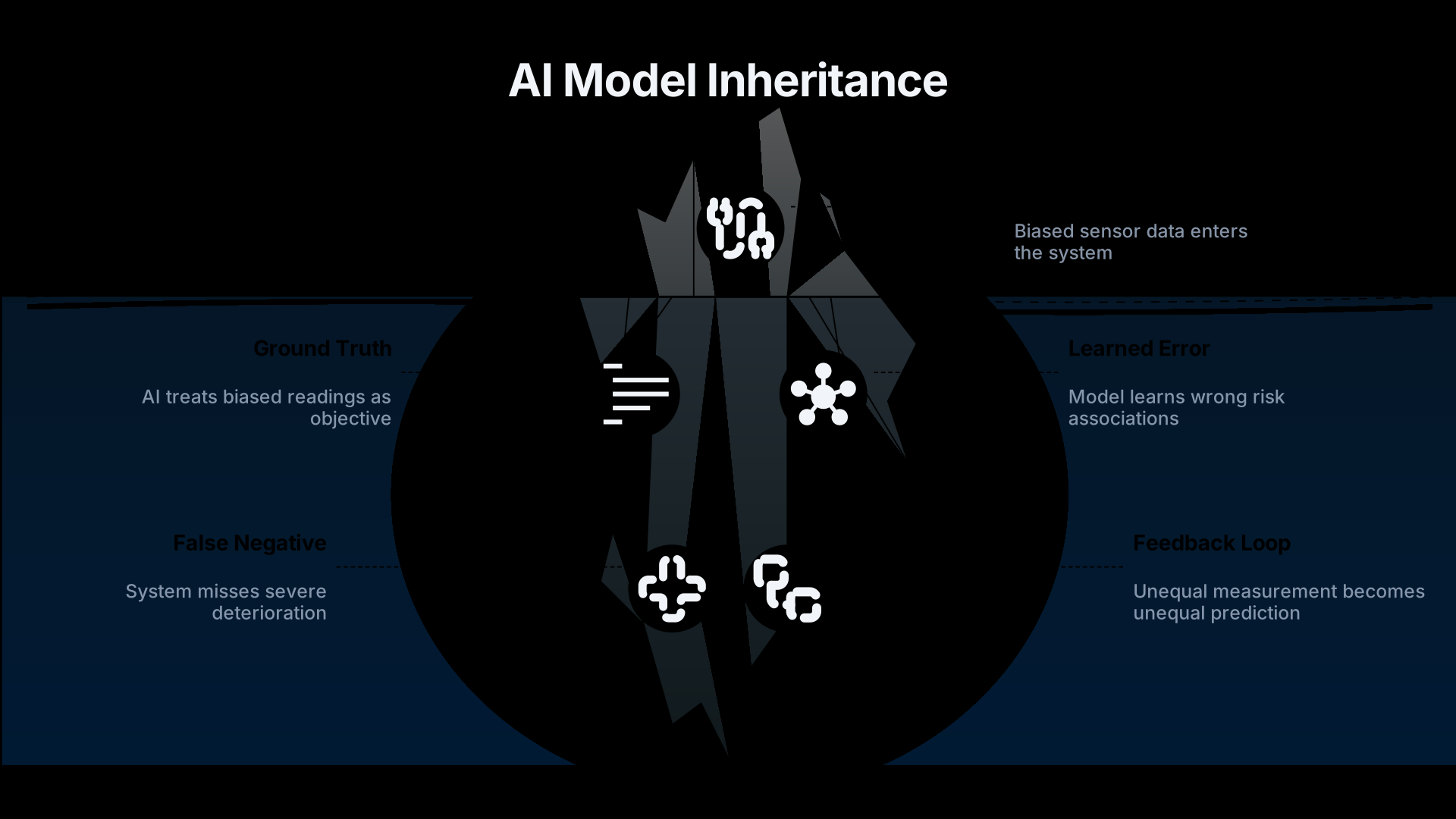
That distinction matters because AI models often treat clinical measurements as objective ground truth. If oxygen saturation readings systematically understate risk for one group of patients, the model can learn the wrong relationship between physiology and outcomes.
A hospital deterioration model, for example, may learn that a pulse oximeter reading of 94% is usually safe. But if that same reading masks significantly lower oxygen levels in some patients, the model effectively learns a biased clinical reality.
Researchers studying this directly found evidence that pulse oximeter bias can reduce AI performance for affected patients. A 2024 machine learning study comparing “biased” pulse oximetry measurements with more accurate blood-gas oxygen measurements found that models using the biased readings produced more false negatives when predicting severe outcomes. [arXiv]arxiv.orgarXivEvaluating the Impact of Pulse Oximetry Bias in Machine Learning under Counterfactual ThinkingAugust 8, 2024…
That finding is important because false negatives in medicine are often the most dangerous category of error. They mean the system misses deterioration rather than overreacting to it.
The mechanism is subtle:
- The sensor overestimates oxygen levels.
- The clinical record stores the biased value.
- The AI model trains on those records.
- The model learns weaker associations between low oxygen and danger for affected groups.
- The deployed system reproduces the same blind spot.
This creates a feedback loop where unequal measurement becomes unequal prediction.
The problem becomes even larger in AI-assisted triage systems. Modern emergency department AI tools increasingly analyse streams of vital signs — including oxygen saturation — to estimate patient risk and prioritise treatment. [ScienceDirect]sciencedirect.comScienceDirectAI-driven triage in emergency departments: A review of…by A Da’Costa · 2025 · Cited by 86 — AI-driven triage systems pres… If one key input systematically understates severity for some populations, the triage recommendations themselves may become uneven.
That is why pulse oximeter bias has become a powerful case study in AI ethics and healthcare fairness. It demonstrates that even highly advanced AI systems remain dependent on the quality of ordinary clinical infrastructure.
Why this matters beyond one device
Pulse oximeters are important partly because they reveal a broader pattern. Medical AI systems are built on layers of assumptions, sensors, classifications, and historical records. Bias can enter at any layer.
The lesson is not merely that one device performs imperfectly. It is that healthcare data is produced by physical systems operating in the real world. Sensors, imaging devices, diagnostic categories, insurance incentives, staffing pressures, and historical inequalities all shape the data AI learns from.
Researchers in healthcare AI increasingly describe this as a “data generation” problem rather than simply a model problem. [ScienceDirect]sciencedirect.comScienceDirectAI-driven triage in emergency departments: A review of…by A Da’Costa · 2025 · Cited by 86 — AI-driven triage systems pres… If unequal healthcare conditions produce unequal measurements, then scaling AI without fixing the measurement pipeline can automate those inequalities.
Pulse oximetry also matters because it undermines a common assumption about AI fairness: that more data alone solves the issue. Hospitals may possess millions of oxygen readings, but sheer quantity does not correct a biased instrument. A massive dataset generated through flawed measurement can simply encode the flaw more confidently.
This becomes especially significant in optimistic visions of AI-enabled healthcare abundance. The strongest versions of the “AI bloom” argument imagine systems that continuously monitor health, predict disease earlier, coordinate treatment efficiently, and eventually help extend healthy lifespan dramatically. But those gains depend on trustworthiness across populations.
If foundational measurements are uneven, the benefits of AI-enhanced medicine may arrive asymmetrically:
- earlier intervention for some groups
- delayed detection for others
- more accurate remote monitoring for some patients
- more hidden deterioration for others
In that sense, pulse oximeter bias is not only a technical issue. It is a warning about how civilisational-scale health systems can quietly inherit old inequalities through infrastructure that appears neutral.

The hidden danger of “objective” medical data
One reason the pulse oximeter story became so influential is that oxygen saturation feels objective. Unlike pain scores or symptom descriptions, it appears to come directly from a machine.
But medical devices are never entirely neutral. They are designed, calibrated, tested, regulated, and deployed within human systems. Choices about who gets included in validation studies can shape who receives accurate measurements later.
Critics argue that older validation standards for pulse oximeters did not adequately test performance across skin tones. The FDA’s earlier guidance required only limited representation of participants with darker skin pigmentation. [JAMA Network]jamanetwork.comJAMA NetworkFDA Guidance on Pulse Oximetry Testing Among Diverse…by K Ferryman · 2025 · Cited by 7 — Pulse oximeters overestimate arte…
Regulators are now responding. In 2025, the FDA proposed updated recommendations intended to improve pulse oximeter testing across a wider range of skin pigmentation. [U.S. Food and Drug Administration]fda.govU.S. Food and Drug AdministrationThe FDA is responsible for protecting the public health by ensuring the safety, efficacy, and security o… [2U.S. Food and Drug Administration]fda.govU.S. Food and Drug AdministrationThe FDA is responsible for protecting the public health by ensuring the safety, efficacy, and security o… The draft guidance calls for more representative clinical testing and clearer evaluation standards.
The UK’s independent review on equity in medical devices also argued for much stronger scrutiny of both pulse oximeters and AI systems trained on potentially biased data. [GOV.UK]GOV.UKEquity in medical devices: independent review - quick read11 Mar 2024 — We found extensive evidence of poorer performance of pulse oximet…
These responses reflect a broader shift in medical AI governance. Regulators increasingly recognise that fairness cannot be checked only at the final algorithm stage. The entire measurement chain must be evaluated:
- the sensor
- the calibration process
- the clinical workflow
- the dataset
- the model
- the deployment environment
Otherwise, AI validation risks becoming superficial. A system may appear accurate overall while performing worse for particular populations because the underlying measurements were distorted from the start.
How hospitals and regulators can test the whole measurement chain
The pulse oximeter problem has pushed researchers toward a more system-level view of medical AI fairness.
One lesson is that hospitals cannot assume a device reading is automatically suitable as a machine-learning input. Measurements need subgroup testing, especially when models influence triage or treatment prioritisation.
In practice, that means several changes.
Testing devices across real populations
Researchers and regulators increasingly argue that medical devices should be validated using more representative populations and more precise methods for measuring skin pigmentation. [ScienceDirect]sciencedirect.comScienceDirectAI-driven triage in emergency departments: A review of…by A Da’Costa · 2025 · Cited by 86 — AI-driven triage systems pres…
That sounds technical, but it changes what counts as acceptable evidence. Instead of asking whether a device works “on average”, regulators are asking whether it works consistently across groups likely to use it.
Auditing downstream AI systems
Hospitals deploying AI triage or deterioration systems can compare outcomes across demographic groups rather than relying only on overall accuracy scores.
An AI system with impressive aggregate performance may still miss deterioration more often in populations affected by measurement bias.
Tracking the source of errors
One difficulty in medical AI governance is that harms can appear downstream from the original cause. An unfair prediction may originate from:
- biased measurement
- incomplete records
- unequal access to care
- clinician behaviour
- model design
- deployment conditions
Pulse oximetry demonstrates why tracing the origin matters. Sometimes the AI is not inventing bias; it is inheriting it.
Building fairer data infrastructure
Long-term improvement may depend less on “debiasing algorithms” and more on improving the quality of healthcare infrastructure itself:
- better sensors
- broader validation studies
- more representative datasets
- transparent performance reporting
- continuous monitoring after deployment
That approach is slower and less glamorous than announcing a breakthrough AI model, but it is probably more important for equitable healthcare outcomes.
Why this case matters for the long-term future of AI healthcare
Pulse oximeter bias is a relatively narrow technical issue compared with grand visions of superintelligent medicine or radical longevity. Yet it matters precisely because it reveals how ambitious futures can fail in ordinary ways.
The strongest AI-healthcare scenarios imagine systems that:
- detect disease before symptoms appear
- personalise treatment continuously
- reduce diagnostic error
- accelerate biomedical discovery
- expand healthy lifespan globally
Those possibilities may eventually become real. But they depend on whether healthcare systems can build trustworthy foundations rather than merely powerful algorithms.
The pulse oximeter case shows how unequal care can emerge from infrastructure that most people barely notice. A bedside sensor becomes training data. Training data shapes prediction systems. Prediction systems influence treatment pathways. Over time, small measurement asymmetries can become large population-level differences in who receives timely care.
For advocates of AI-enabled human flourishing, that creates a demanding standard. Medical AI should not merely become more capable. It must become broadly reliable across the diversity of humanity it claims to serve.
Otherwise, the future may contain extraordinary medical intelligence alongside stubbornly unequal measurement — a world where healthcare becomes more automated and more advanced, yet still fails some groups in ways hidden inside the data itself.
Endnotes
-
Source: ncbi.nlm.nih.gov
Link: https://www.ncbi.nlm.nih.gov/books/NBK602599/Source snippet
Moreover, while...Read more...
-
Source: GOV.UK
Link: https://www.gov.uk/government/publications/equity-in-medical-devices-independent-review-final-report/equity-in-medical-devices-independent-review-quick-readSource snippet
Equity in medical devices: independent review - quick read11 Mar 2024 — We found extensive evidence of poorer performance of pulse oximet...
-
Source: arxiv.org
Link: https://arxiv.org/abs/2408.04396Source snippet
arXivEvaluating the Impact of Pulse Oximetry Bias in Machine Learning under Counterfactual ThinkingAugust 8, 2024...
Published: August 8, 2024
-
Source: sciencedirect.com
Link: https://www.sciencedirect.com/science/article/pii/S1386505625000553Source snippet
ScienceDirectAI-driven triage in emergency departments: A review of...by A Da’Costa · 2025 · Cited by 86 — AI-driven triage systems pres...
-
Source: sciencedirect.com
Link: https://www.sciencedirect.com/science/article/pii/S2666389921002026Source snippet
ScienceDirectAddressing bias in big data and AI for health careby N Norori · 2021 · Cited by 1053 — Measurements of the pulse oximeter ar...
-
Source: arxiv.org
Link: https://arxiv.org/abs/2310.19917 -
Source: fda.gov
Link: https://www.fda.gov/news-events/press-announcements/fda-proposes-updated-recommendations-help-improve-performance-pulse-oximeters-across-skin-tonesSource snippet
Food and Drug AdministrationFDA Proposes Updated Recommendations to Help...Jan 6, 2025 — The FDA published new draft guidance aimed at h...
-
Source: fda.gov
Link: https://www.fda.gov/regulatory-information/search-fda-guidance-documents/pulse-oximeters-medical-purposes-non-clinical-and-clinical-performance-testing-labeling-andSource snippet
Food and Drug AdministrationPulse Oximeters for Medical Purposes - Non-Clinical and...6 Jan 2025 — This draft guidance provides recommen...
-
Source: sciencedirect.com
Link: https://www.sciencedirect.com/science/article/abs/pii/S0007091225001229Source snippet
ScienceDirectTechnical and regulatory challenges in artificial...by AM Cabanas · 2025 · Cited by 3 — We highlight key challenges in deve...
-
Source: fda.gov
Title: pulse oximeters
Link: https://www.fda.gov/medical-devices/products-and-medical-procedures/pulse-oximetersSource snippet
6 Jan 2025 — Multiple factors can affect the accuracy of a pulse oximeter reading, such as poor circulation, skin pigmentation, skin thic...
-
Source: fda.gov
Link: https://www.fda.gov/Source snippet
U.S. Food and Drug AdministrationThe FDA is responsible for protecting the public health by ensuring the safety, efficacy, and security o...
-
Source: fda.gov
Link: https://www.fda.gov/media/173905/downloadSource snippet
Approach for Improving the Performance Evaluation ofEffects of skin pigmentation on pulse oximeter accuracy at low saturation. 715-719. 3...
-
Source: arxiv.org
Link: https://arxiv.org/html/2408.04396v1Source snippet
Evaluating the Impact of Pulse Oximetry Bias in Machine...Aug 8, 2024 — This mirrors clinical processes where biased pulse oximetry read...
-
Source: nejm.org
Link: https://www.nejm.org/doi/full/10.1056/NEJMc2029240Source snippet
However, the variation...
-
Source: jamanetwork.com
Link: https://jamanetwork.com/journals/jama/fullarticle/2828676Source snippet
JAMA NetworkFDA Guidance on Pulse Oximetry Testing Among Diverse...by K Ferryman · 2025 · Cited by 7 — Pulse oximeters overestimate arte...
-
Source: Wikipedia
Title: Food and Drug Administration
Link: https://en.wikipedia.org/wiki/Food_and_Drug_AdministrationSource snippet
Food and Drug AdministrationThe FDA is responsible for protecting and promoting public health through the control and supervision of f...
Additional References
-
Source: federalregister.gov
Link: https://www.federalregister.gov/documents/2025/01/07/2024-31540/pulse-oximeters-for-medical-purposes-non-clinical-and-clinical-performance-testing-labeling-andSource snippet
Pulse Oximeters for Medical Purposes-Non-Clinical and...7 Jan 2025 — This draft guidance document, when finalized, will provide recommen...
-
Source: researchgate.net
Link: https://www.researchgate.net/publication/397818323_Algorithmic_Bias_and_Fairness_in_Medical_AI_Ensuring_Equity_in_Data-Driven_Healthcare_InnovationSource snippet
(PDF) Algorithmic Bias and Fairness in Medical AINov 21, 2025 — It also evaluates fairness-enhancing strategies, including transparent mo...
-
Source: pulsetoday.co.uk
Link: https://www.pulsetoday.co.uk/Source snippet
Pulse Today: GP news, articles, views and learningThe latest GP political, financial and clinical news to help you treat your patients an...
-
Source: theguardian.com
Link: https://www.theguardian.com/society/2024/mar/11/medical-tools-devices-healthcare-bias-ukSource snippet
It emphasizes the need for an equity perspective throughout the lifecycle of medical devices to ensure fair healthcare. Concerns were hig...
-
Source: nhsrho.org
Link: https://nhsrho.org/research/pulse-oximetry-and-racial-bias-recommendations-for-national-healthcare-regulatory-and-research-bodies/Source snippet
Pulse Oximetry and Racial Bias: Recommendations for...17 Apr 2023 — It recommended that the NHS Race and Health Observatory (NHSRHO) und...
-
Source: news-medical.net
Link: https://www.news-medical.net/news/20260118/Pulse-oximeters-miss-hypoxemia-more-often-in-people-with-darker-skin-study-finds.aspxSource snippet
Pulse oximeters miss hypoxemia more often in people with...Jan 18, 2026 — SpO2 values tended to be higher in people with darker skin, po...
-
Source: chestphysician.org
Link: https://www.chestphysician.org/new-pulse-oximeter-recommendations-make-progress-toward-accuracy-across-skin-tones/Source snippet
New pulse oximeter recommendations make progress toward...5 Feb 2025 — The previous guidance recommended only three individuals or 15% o...
-
Source: publichealth.jhu.edu
Title: pulse oximeters infrequently tested by manufacturers on diverse sets of subjects
Link: https://publichealth.jhu.edu/2025/pulse-oximeters-infrequently-tested-by-manufacturers-on-diverse-sets-of-subjectsSource snippet
Oximeters Infrequently Tested by Manufacturers on...9 Jan 2025 — The FDA's new draft guidance includes recommendations for manufacturers...
-
Source: warren.senate.gov
Title: 20200125 letter to fda re bias in pulse oximetry measurements
Link: https://www.warren.senate.gov/download/20200125-letter-to-fda-re-bias-in-pulse-oximetry-measurementsSource snippet
Janet Woodcock, M.D. Acting...Jan 25, 2021 — The study noted that “[m]ost pulse oximeters have probably been calibrated using light-skin...
-
Source: news.vumc.org
Title: skin tone may affect accuracy of blood oxygen measurement in children study
Link: https://news.vumc.org/2025/03/04/skin-tone-may-affect-accuracy-of-blood-oxygen-measurement-in-children-study/Source snippet
tone may affect accuracy of blood oxygen measurement...4 Mar 2025 — Pulse oximetry in pediatric patients with darker skin tones may over...
Amazon book picks
Further Reading
Books and field guides related to Pulse oximeter bias. Use these as the next step if you want deeper reading beyond the article.

Ethics of Medical AI
This is the first book to provide a coherent overview over the ethical implications of AI-related technologies in medicine. It explores h...

Medical AI Ethics
Transform Healthcare's Future: The Essential Guide to AI Ethics Are life-and-death medical decisions being made by algorithms in your hos...

Ethics and governance of artificial intelligence for health
This WHO Guidance document discusses ethical and governance issues as they arise in the use of artificial intelligence (AI) for health. I...
eBay marketplace picks
Marketplace Samples
Example marketplace items related to this page. Use the search link to explore similar finds on eBay.

Example eBay listing
A.I. Artificial Intelligence Original Movie Poster Signed By Jude Law
USD 125.00 | Shipping USD 25.00 | US

Example eBay listing
Artificial Intelligence D/S Original Movie Poster - 27 x 40"
USD 19.50 | Shipping USD 13.65 | US

Example eBay listing
612388 Artificial Intelligence Movie Science Fiction Drama Wall Print Poster
USD 22.95 | Shipping USD 12.95 | JP

Example eBay listing
Companion - Artificial Intelligence Dark Comedy Cinema Film - POSTER 20"x30"
USD 23.99 | Free shipping | US

Example eBay listing
A.I. Artificial Intelligence Movie Film Poster Art Print
GBP 4.99 | Free shipping | GB

Example eBay listing
A I Artificial Intelligence 6 Movie Poster Art Print Print Classic Rare Gallery
GBP 49.00 | Free shipping | GB

Example eBay listing
AI - Artificial Intelligence (Poster + Slipcase) Blu-Ray
GBP 10.49 | Free shipping | GB

Example eBay listing
A. I. Artificial Intelligence. Jude Law. Original UK Video Poster.
GBP 8.11 | Shipping GBP 3.38 | GB
Topic Tree