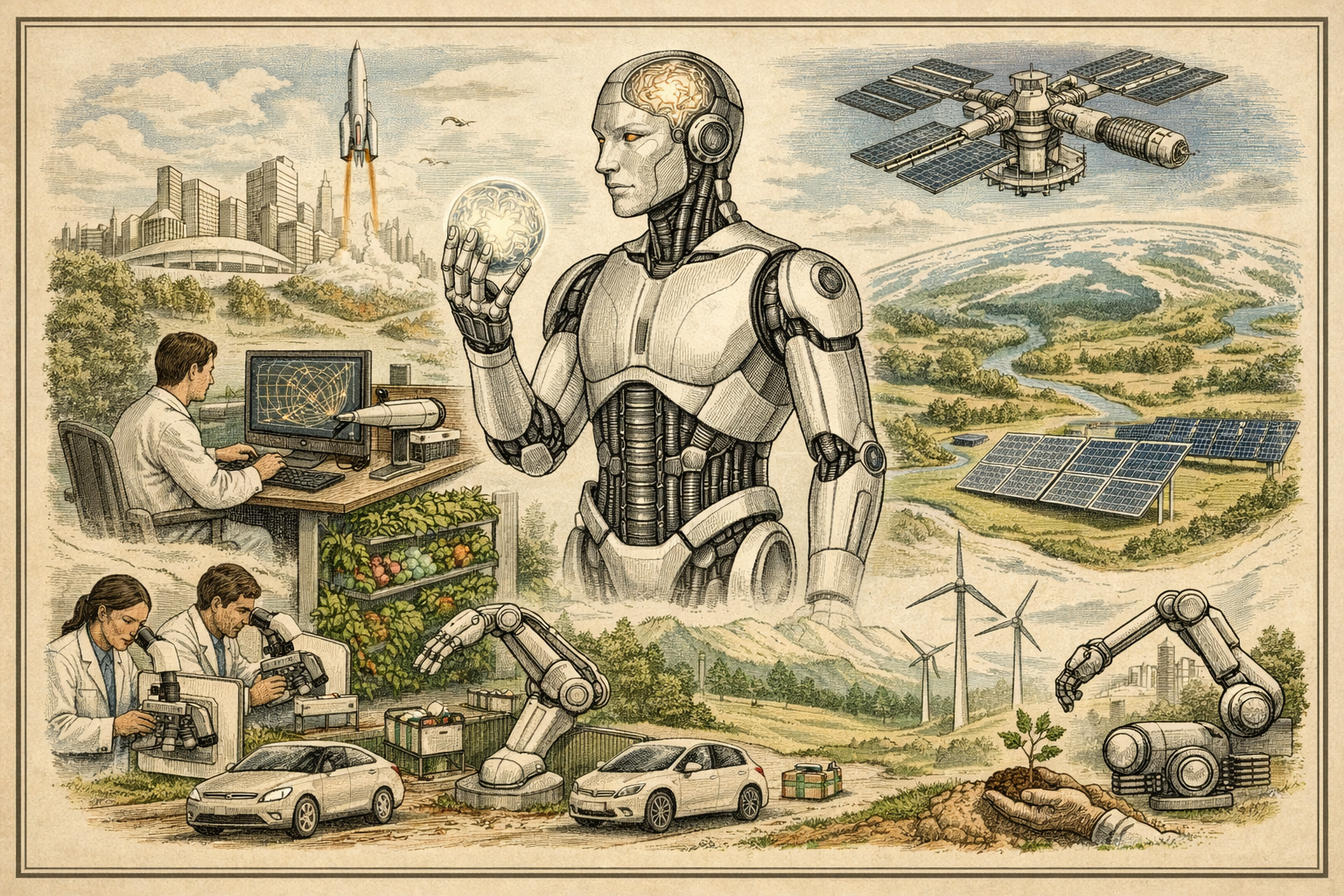
AI bloom is the optimistic but demanding idea that advanced AI could help humanity do far more than automate office work or raise GDP. In its strongest form, it means loosening deep constraints on human life: disease, scarcity, dangerous labour, poor education, slow science, energy limits, weak coordination, and vulnerability to catastrophe.
Page outline Jump by section
What “AI bloom” would actually mean
AI abundance is often described as a world where goods and services become cheaper because machines can do more of the work. AI bloom is a wider idea. It asks whether advanced AI could expand the range of lives humans can lead: longer healthy lives, better learning, cleaner energy, safer cities, richer culture, more scientific understanding, better disability support, and eventually a civilisation resilient enough to flourish for centuries or millennia.
That distinction matters. Ordinary economic growth can make societies richer while leaving many people insecure, isolated, unhealthy, or politically powerless. A genuine bloom would require abundance to be broad, not merely impressive in aggregate. It would mean AI systems helping people meet real human needs, while institutions prevent the gains from being captured by a small group of states, firms, or asset owners. The IMF has warned that AI could lift productivity and incomes, but also widen inequality and disrupt millions of jobs if countries are not prepared. [IMF]imf.orgAI Will Transform the Global Economy. Let’s Make Sure It Benefits HumanityAI Will Transform the Global Economy. Let’s Make Sure It Benefits Humanity
The optimistic case rests on a simple mechanism: intelligence is a bottleneck in almost every human project. Discovering drugs, proving theorems, designing batteries, planning cities, teaching children, detecting disease, managing energy grids, and negotiating treaties all require scarce expertise. If AI makes high-quality cognitive labour much cheaper and more widely available, progress could speed up across many fields at once. The harder question is whether that cognitive abundance translates into physical abundance, social trust, and durable flourishing.
The strongest evidence is scientific acceleration
The clearest early sign of AI bloom is not chatbots. It is AI as a scientific instrument. AlphaFold is the most famous example: the AlphaFold Protein Structure Database now provides open access to more than 200 million predicted protein structures, giving researchers a vast public resource for understanding biology, disease, drug design, and sustainability. This does not automatically produce cures, but it compresses a difficult part of the discovery process and gives many more scientists access to structural information that would once have been slow or expensive to obtain. [alphafold.ebi.ac.uk]alphafold.ebi.ac.ukAlpha Fold Protein Structure DatabaseAlpha Fold Protein Structure Database
Materials science shows the same pattern. Google DeepMind’s GNoME system reported 2.2 million new crystal predictions, including 380,000 predicted stable materials, with potential relevance to batteries, solar cells, semiconductors, and other technologies. The crucial caveat is that predicting a material is not the same as manufacturing it at scale, cheaply and reliably. Still, the discovery funnel changes when AI can propose many more plausible candidates and automated labs can test some of them far faster than traditional manual workflows. [Google DeepMind]deepmind.googleSource details in endnotes.
Weather forecasting is another concrete example. GraphCast, a machine-learning weather model from Google DeepMind, was reported to outperform the European Centre for Medium-Range Weather Forecasts’ deterministic system on most evaluated variables and lead times, while producing a 10-day forecast in under a minute on specialist hardware. This matters for bloom because better forecasting can protect lives, crops, infrastructure, energy systems, and disaster response. Yet the limits are also clear: later research has found that numerical models can still outperform AI systems for record-breaking extremes, which are precisely the events most relevant to climate adaptation and emergency planning. [Google DeepMind]deepmind.googleSource details in endnotes.
The deeper lesson is that AI may become most valuable when it is coupled to measurement, experiment, simulation, and expert judgement. The bloom path is not “AI imagines the future and reality obeys”. It is more like a faster loop: propose, test, learn, redesign, manufacture, deploy, monitor, and improve.
Health and longevity are the most human test
A flourishing future is hard to take seriously if people still lose decades of life to preventable disease. AI could matter in medicine in at least four ways: earlier diagnosis, faster drug discovery, more personalised treatment, and better public-health systems. Mammography is one of the strongest near-term cases. The Swedish MASAI randomised trial found that AI-supported breast screening could reduce interval cancers and reading workload compared with standard double reading without AI, suggesting that carefully tested AI can improve clinical workflows rather than simply add another layer of software. [ScienceDirect]sciencedirect.comSource details in endnotes.
Drug discovery is more uncertain but potentially larger. AI-designed molecules and AI-assisted target discovery could reduce the cost and time of early research, but clinical trials, safety testing, biology, regulation, and manufacturing remain hard constraints. Recent pharmaceutical partnerships, such as Eli Lilly’s expanded collaboration with Insilico Medicine, show that major companies are taking AI drug discovery seriously, yet the bloom claim will only be proven when AI-discovered treatments repeatedly reach patients and improve outcomes at scale. [Reuters]reuters.comSource details in endnotes.
Longevity is the point where optimism most easily turns into hype. AI may help researchers understand ageing, protein function, cellular pathways, and disease mechanisms. But radical life extension will require biological validation, safe interventions, affordable access, and long-term evidence. The responsible bloom view is not that AI has already solved ageing. It is that AI could widen the search space and make biomedical progress less dependent on small numbers of human experts moving through slow experimental pipelines.
Education could make intelligence more widely available
If AI bloom means expanding human potential, education is central. A society with cheap expert tutors, accessible explanations, translation, feedback, and adaptive practice could unlock talent that is currently wasted by poverty, geography, disability, overcrowded classrooms, or lack of confidence. A 2025 randomised controlled trial in college physics found that students using a carefully designed AI tutor learned more in less time than students in an active-learning class, while reporting higher engagement and motivation. [Nature]nature.comOpen source on nature.com.
The more realistic model is not “replace teachers”. It is “scale good pedagogy”. Tutor CoPilot, a human-AI system tested with 900 tutors and 1,800 K-12 students, improved topic mastery, with the largest gains for students working with lower-rated tutors. That suggests a powerful bloom mechanism: AI can help less experienced humans perform more like experts, especially where expert support is scarce. [arXiv]arxiv.orgSource details in endnotes.
There is also evidence for caution. Studies and classroom experience show that generic AI tools can encourage over-reliance, copying, or shallow engagement when students are not guided well. Khan Academy’s own updates on Khanmigo stress measurement, iteration, and careful tutoring design rather than assuming that access alone creates learning. In education, AI bloom depends on motivation, curriculum, teacher support, child safety, privacy, and equal access, not merely model capability. [Khan Academy Blog]blog.khanacademy.orgSource details in endnotes.
Abundance still has to pass through energy, materials, and infrastructure
Post-scarcity language can obscure a stubborn fact: AI runs on physical systems. Chips need fabrication plants. Data centres need land, water, cooling, transmission lines, and electricity. The International Energy Agency projects that global data-centre electricity consumption could more than double to around 945 TWh by 2030 in its base case, with AI as a major driver. That would still be under 3% of global electricity use, but the local effects can be severe because data centres cluster in particular grid regions. [IEA]iea.orgEnergy demand from AI – Energy and AI – AnalysisEnergy demand from AI – Energy and AI – Analysis
This is one of the central tensions in AI abundance. AI may help design better batteries, optimise grids, discover materials, forecast renewable generation, and improve energy efficiency. But rapid AI deployment can also raise power demand before those benefits arrive. The IEA expects renewables, natural gas, coal, and nuclear all to contribute to meeting data-centre demand, with renewables covering nearly half of additional demand in its base case. [IEA]iea.orgOpen source on iea.org.
For AI bloom, energy policy is not a side issue. A future of abundant intelligence will be far more politically legitimate if it is paired with clean power, better grids, transparent siting, efficiency gains, and rules that prevent ordinary households from subsidising private compute expansion without public benefit. If AI becomes a visible cause of higher bills, water stress, or fossil-fuel lock-in, the social licence for the bloom project will weaken.
Robotics could reduce drudgery, but labour politics decide who benefits
AI becomes more civilisation-changing when it can act in the physical world. Industrial robots are already widespread: the International Federation of Robotics reported 542,000 industrial robot installations in 2024, more than double the number from a decade earlier, with Asia accounting for most new deployments. The next frontier is not only more factory arms, but robots that can perceive, adapt, handle varied tasks, and work safely around people. [IFR International Federation of Robotics]ifr.orgInternational Federation of RoboticsInternational Federation of Robotics
The optimistic bloom case is morally strong here. Many jobs are dangerous, exhausting, repetitive, or degrading. Robots could reduce injuries, handle elder-care logistics, clean hazardous environments, support disabled people, build infrastructure, and make high-quality goods cheaper. NASA’s use of autonomous systems for Mars rovers and robotic exploration shows why autonomy matters whenever humans cannot be present or real-time control is impossible. [NASA]nasa.govOpen source on nasa.gov.
But labour-saving technology has never automatically meant worker flourishing. If AI and robotics raise output while weakening labour bargaining power, the result could be insecurity rather than abundance. The IMF estimates that nearly 40% of global employment is exposed to AI, with higher exposure in advanced economies, and warns that some roles may benefit while others face lower demand, wages, or hiring. Bloom requires transition policy: wage insurance, retraining that actually leads to jobs, portable benefits, worker voice, shorter working-time options, and broader ownership of productive capital. [IMF]imf.orgMapping the Worlds Readiness for Artificial Intelligence Shows Prospects DivergeMapping the Worlds Readiness for Artificial Intelligence Shows Prospects Diverge

Superintelligence is the biggest upside claim and the biggest uncertainty
The most dramatic version of AI bloom depends on superintelligence: AI systems that greatly exceed human capabilities across many intellectual tasks. The classic “intelligence explosion” argument goes back to I. J. Good’s 1965 idea that a machine smart enough to design better machines could trigger rapid self-improvement. Modern versions of the argument suggest that AI could eventually automate research itself, causing progress in software, hardware, biology, energy, and governance to accelerate sharply. [Machine Intelligence Research Institute]intelligence.orgMachine Intelligence Research Institute Intelligence Explosion FAQMachine Intelligence Research Institute Intelligence Explosion FAQ
Economic models of transformative AI take this seriously. Trammell and Korinek argue that if AI could automate essentially all work, especially production and research, growth patterns could change dramatically; output could rise very fast, labour’s share could fall, and wages could rise or fall depending on resources, returns to scale, and technical direction. That is exactly why “abundance” is not enough as a slogan: an economy can become vastly more productive while distributing power and income badly. [NBER]nber.orgEconomic Growth under Transformative AI | NBEREconomic Growth under Transformative AI | NBER
The objections are serious. Critics argue that current systems have not shown sustained recursive self-improvement, robust autonomous strategic awareness, or the reliable real-world agency assumed by some superintelligence scenarios. Others argue that intelligence is multi-dimensional, embodied, socially distributed, and constrained by data, energy, experiments, institutions, and the physical world. The fairest conclusion is that superintelligence is neither a proven near-term certainty nor a fantasy irrelevant to policy. It is a high-stakes possibility with uncertain timing, uncertain mechanisms, and consequences large enough to justify serious preparation. [arXiv]arxiv.orgSource details in endnotes.
The long future: resilience before expansion
A civilisation that blooms must first survive. AI could help reduce civilisational risk by improving disease surveillance, climate adaptation, cyber defence, food-system monitoring, disaster prediction, and infrastructure resilience. Better weather models, biomedical discovery tools, and autonomous space systems are early examples of AI extending human situational awareness and operational reach. [Google DeepMind]deepmind.googleSource details in endnotes.
Space settlement is the most speculative part of the bloom vision, but AI’s relevance is straightforward. Long-distance exploration needs autonomy because communication delays make direct control impossible. NASA notes that AI already helps spacecraft and rovers operate autonomously, and that Perseverance has done most of its driving autonomously. Future lunar or Martian industry would probably require robotic construction, mining, inspection, maintenance, and scientific exploration long before large human populations could live there. [NASA]nasa.govArtificial IntelligenceArtificial Intelligence
Still, space should not become an excuse to neglect Earth. The stronger argument is that a wiser, healthier, more capable civilisation could eventually expand the domain of conscious life and knowledge beyond one planet, while also protecting the only biosphere known to support us. Long-term expansion is a possible fruit of bloom, not a substitute for justice, safety, and environmental repair now.
The main objections are not anti-progress
The best objections to AI bloom are not objections to intelligence, medicine, education, or abundance. They are objections to naive diffusion: the assumption that because a technology could benefit humanity, it will. Several risks deserve central attention.
Power concentration. Frontier AI requires scarce chips, data, talent, capital, and energy. Without countervailing policy, a few firms and states could gain extraordinary leverage over labour markets, science, media, security, and political decision-making.
Misalignment and loss of control. Frontier systems may behave unpredictably, be misused, or pursue proxy goals in ways their developers did not intend. The Bletchley Declaration recognised the possibility of serious, even catastrophic, harm from advanced AI and called for international cooperation; the Seoul Frontier AI Safety Commitments asked leading companies to publish safety frameworks, conduct red-teaming, protect model weights, and define risk thresholds. [GOV.UK]GOV.UKai safety summit 2023 the bletchley declarationai safety summit 2023 the bletchley declaration
Weak voluntary governance. Voluntary commitments are useful signals, but they are not the same as enforceable law. A 2025 assessment of frontier safety frameworks found large gaps, including weak quantitative risk tolerances, unclear pause thresholds, and inadequate treatment of unknown risks. [arXiv]arxiv.orgSource details in endnotes.
Social disruption. If AI automates entry-level cognitive work, displaces parts of professional labour, or rewards capital more than wages, societies may see anger and instability rather than bloom. The same applies if AI-generated media corrodes trust or if AI education tools widen gaps between well-supported and poorly supported students.
Physical constraints. Compute, electricity, water, minerals, chips, and supply chains impose limits. A world of abundant intelligence still needs competent planning, clean energy, resilient infrastructure, and fair siting decisions.

What would make a flourishing future more likely
The credible route to AI bloom is neither acceleration at any cost nor blanket refusal. It is conditional acceleration: push hard where AI clearly expands human capability, while building institutions strong enough to manage risk and share gains.
First, societies should prioritise AI for public-good bottlenecks: disease, ageing, climate adaptation, clean energy, education, accessibility, scientific discovery, public administration, and disaster resilience. Public funding and open scientific infrastructure matter because many bloom-relevant gains, such as protein databases or weather models, become more valuable when researchers, smaller countries, and poorer institutions can use them. [alphafold.ebi.ac.uk]alphafold.ebi.ac.ukAlpha Fold Protein Structure DatabaseAlpha Fold Protein Structure Database
Second, frontier AI governance needs teeth. That means independent evaluations, incident reporting, cybersecurity requirements, model-risk thresholds, liability rules, whistle-blower protections, and the ability to delay or restrict deployments that cross dangerous capability lines. International cooperation is essential because the largest risks and benefits cross borders, but cooperation has to move beyond declarations into shared standards, audits, and enforcement. [GOV.UK]GOV.UKfrontier ai safety commitments ai seoul summit 2024frontier ai safety commitments ai seoul summit 2024
Third, abundance must be distributed by design. If AI makes production and research vastly more efficient, countries will need stronger systems for taxation, public investment, competition policy, labour transition, and broad ownership. Otherwise, “post-scarcity” may describe aggregate output while many people still experience scarcity of housing, healthcare, status, security, and political voice.
Finally, the bloom frame should keep humans at the centre. The goal is not to build impressive machines for their own sake. It is to expand the future of conscious life, knowledge, creativity, freedom, and achievement. AI could become one of the great tools for that purpose. Whether it does depends less on slogans about inevitability than on choices about safety, access, power, science, energy, and the kind of civilisation people are trying to build.
Endnotes
-
Source: alphafold.ebi.ac.uk
Title: Alpha Fold Protein Structure Database
Link: https://www.alphafold.ebi.ac.uk/ -
Source: deepmind.google
Link: https://deepmind.google/research/publications/22598/ -
Source: nber.org
Title: Economic Growth under Transformative AI | NBER
Link: https://www.nber.org/papers/w31815 -
Source: imf.org
Title: AI Will Transform the Global Economy. Let’s Make Sure It Benefits Humanity
Link: https://www.imf.org/en/Blogs/Articles/2024/01/14/ai-will-transform-the-global-economy-lets-make-sure-it-benefits-humanity -
Source: imf.org
Title: Mapping the Worlds Readiness for Artificial Intelligence Shows Prospects Diverge
Link: https://www.imf.org/en/Blogs/Articles/2024/06/25/mapping-the-worlds-readiness-for-artificial-intelligence-shows-prospects-diverge -
Source: alphafold.ebi.ac.uk
Title: Alpha Fold Protein Structure Database
Link: https://www.alphafold.ebi.ac.uk/about -
Source: deepmind.google
Link: https://deepmind.google/discover/blog/millions-of-new-materials-discovered-with-deep-learning/ -
Source: arxiv.org
Link: https://arxiv.org/abs/2508.15724 -
Source: sciencedirect.com
Link: https://www.sciencedirect.com/science/article/pii/S014067362502464X -
Source: reuters.com
Link: https://www.reuters.com/business/healthcare-pharmaceuticals/eli-lilly-extends-partnership-with-insilico-medicine-ai-powered-drug-discovery-2026-03-30/ -
Source: arxiv.org
Link: https://arxiv.org/abs/2402.08703 -
Source: nature.com
Link: https://www.nature.com/articles/s41598-025-97652-6 -
Source: arxiv.org
Title: arXiv Tutor Co Pilot: A Human-AI Approach for Scaling Real-Time Expertise
Link: https://arxiv.org/abs/2410.03017 -
Source: iea.org
Title: Energy demand from AI – Energy and AI – Analysis
Link: https://www.iea.org/reports/energy-and-ai/energy-demand-from-ai -
Source: iea.org
Link: https://www.iea.org/reports/energy-and-ai/executive-summary%C2%A0 -
Source: iea.org
Title: Energy supply for AI – Energy and AI – Analysis
Link: https://www.iea.org/reports/energy-and-ai/energy-supply-for-ai -
Source: ifr.org
Link: https://ifr.org/worldrobotics/report-2025 -
Source: ifr.org
Link: https://ifr.org/ifr-press-releases/news/robot-installations-hit-record-levels-in-2025%27%20target%3D%27_blank -
Source: nasa.gov
Link: https://www.nasa.gov/technology/robotics/ -
Source: nasa.gov
Title: Artificial Intelligence
Link: https://www.nasa.gov/artificial-intelligence/ -
Source: imf.org
Link: https://www.imf.org/en/Publications/WP/Issues/2023/10/04/Labor-Market-Exposure-to-AI-Cross-country-Differences-and-Distributional-Implications-539656?cid=em-COM-123-47236 -
Source: intelligence.org
Title: Machine Intelligence Research Institute Intelligence Explosion FAQ
Link: https://intelligence.org/ie-faq/ -
Source: arxiv.org
Link: https://arxiv.org/abs/2512.04119 -
Source: nasa.gov
Title: Autonomous Systems & Robotics
Link: https://www.nasa.gov/intelligent-systems-division/autonomous-systems-and-robotics/ -
Source: nasa.gov
Title: Introducing Cooperative Autonomous Distributed Robotic Exploration (CADRE)
Link: https://www.nasa.gov/?p=96235 -
Source: GOV.UK
Title: ai safety summit 2023 the bletchley declaration
Link: https://www.gov.uk/government/publications/ai-safety-summit-2023-the-bletchley-declaration -
Source: GOV.UK
Title: frontier ai safety commitments ai seoul summit 2024
Link: https://www.gov.uk/government/publications/frontier-ai-safety-commitments-ai-seoul-summit-2024/frontier-ai-safety-commitments-ai-seoul-summit-2024 -
Source: arxiv.org
Link: https://arxiv.org/abs/2512.01166 -
Source: GOV.UK
Title: frontier ai safety commitments ai seoul summit 2024
Link: https://www.gov.uk/government/publications/frontier-ai-safety-commitments-ai-seoul-summit-2024 -
Source: arxiv.org
Title: arXiv Emerging Practices in Frontier AI Safety Frameworks
Link: https://arxiv.org/abs/2503.04746 -
Source: ifr.org
Title: International Federation of Robotics
Link: https://ifr.org/ifr-press-releases -
Source: nasa.gov
Link: https://www.nasa.gov/nasa-missions/ -
Source: iea.org
Link: https://www.iea.org/news/data-centre-electricity-use-surged-in-2025-even-with-tightening-bottlenecks-driving-a-scramble-for-solutions -
Source: intelligence.org
Link: https://intelligence.org/2026/04/13/summary-ai-governance-to-avoid-extinction/ -
Source: nasa.gov
Title: Artificial Intelligence
Link: https://www.nasa.gov/chief-artificial-intelligence-officer/ -
Source: GOV.UK
Title: www.gov.uk A I for Science Strategy
Link: https://www.gov.uk/government/publications/ai-for-science-strategy/ai-for-science-strategy -
Source: ifr.org
Title: International Federation of Robotics
Link: https://ifr.org/ifr-press-releases/news-statistics -
Source: ifr.org
Title: International Federation of Robotics
Link: https://ifr.org/home/resources/publications/standards.html -
Source: ifr.org
Title: International Federation of Robotics
Link: https://ifr.org/ifr-press-releases/global-robot-demand-in-factories-doubles-over-10-years -
Source: nasa.gov
Title: Cooperative Autonomous Distributed Robotic Exploration (CADRE)
Link: https://www.nasa.gov/cooperative-autonomous-distributed-robotic-exploration-cadre/ -
Source: nasa.gov
Title: Integrated System for Autonomous and Adaptive Caretaking (ISAAC)
Link: https://www.nasa.gov/integrated-system-for-autonomous-and-adaptive-caretaking-isaac/ -
Source: iea.org
Title: Energy and AI – Analysis
Link: https://www.iea.org/reports/energy-and-ai/ -
Source: iea.org
Link: https://www.iea.org/news/ai-is-set-to-drive-surging-electricity-demand-from-data-centres-while-offering-the-potential-to-transform-how-the-energy-sector-works?_bhlid=a143b03d78b92f4b696509562ec3fafd5e06d86a -
Source: nature.com
Link: https://www.nature.com/articles/s41467-025-57824-4 -
Source: institute.global
Title: a new national purpose accelerating uk science in the age of ai
Link: https://institute.global/insights/tech-and-digitalisation/a-new-national-purpose-accelerating-uk-science-in-the-age-of-ai -
Source: GOV.UK
Link: https://www.gov.uk/government/publications/ai-safety-summit-2023-the-bletchley-declaration/the-bletchley-declaration-by-countries-attending-the-ai-safety-summit-1-2-november-2023
Published: november 2023 -
Source: nasa.gov
Title: NAS A Demonstrates Software ‘Brains’ Shared Across Satellite Swarms
Link: https://www.nasa.gov/?p=817611 -
Source: nature.com
Title: Artificial intelligence in drug development | Nature Medicine
Link: https://www.nature.com/articles/s41591-024-03434-4 -
Source: nasa.gov
Title: NAS A’s AI Use Cases: Advancing Space Exploration with Responsibility
Link: https://www.nasa.gov/general/2024-ai-use-cases/?TB_iframe=true&height=658.8&width=370.8 -
Source: science.nasa.gov
Title: towards autonomous surface missions on ocean worlds
Link: https://science.nasa.gov/science-research/science-enabling-technology/technology-highlights/towards-autonomous-surface-missions-on-ocean-worlds/ -
Source: nber.org
Link: https://www.nber.org/papers/w33139 -
Source: sciencedirect.com
Title: Economic impacts of AI-augmented R&D
Link: https://www.sciencedirect.com/science/article/pii/S0048733324000866 -
Source: nature.com
Title: Generative AI platforms drive drug discovery dealmaking
Link: https://www.nature.com/articles/d43747-024-00084-w -
Source: nature.com
Title: Machine learning in preclinical drug discovery | Nature Chemical Biology
Link: https://www.nature.com/articles/s41589-024-01679-1 -
Source: ntrs.nasa.gov
Link: https://ntrs.nasa.gov/citations/20240007067 -
Source: imf.org
Link: https://www.imf.org/en/Publications/WP/Issues/2024/06/07/Exposure-to-Artificial-Intelligence-and-Occupational-Mobility-A-Cross-Country-Analysis-549989 -
Source: elibrary.imf.org
Title: article A001 en.xml
Link: https://www.elibrary.imf.org/view/journals/001/2024/116/article-A001-en.xml -
Source: GOV.UK
Link: https://www.gov.uk/government/news/new-commitmentto-deepen-work-on-severe-ai-risks-concludes-ai-seoul-summit -
Source: GOV.UK
Link: https://www.gov.uk/government/publications/seoul-ministerial-statement-for-advancing-ai-safety-innovation-and-inclusivity-ai-seoul-summit-2024/seoul-ministerial-statement-for-advancing-ai-safety-innovation-and-inclusivity-ai-seoul-summit-2024 -
Source: GOV.UK
Title: seoul declaration for safe innovative and inclusive ai ai seoul summit 2024
Link: https://www.gov.uk/government/publications/seoul-declaration-for-safe-innovative-and-inclusive-ai-ai-seoul-summit-2024 -
Source: GOV.UK
Link: https://www.gov.uk/government/news/historic-first-as-companies-spanning-north-america-asia-europe-and-middle-east-agree-safety-commitments-on-development-of-ai -
Source: ntrs.nasa.gov
Link: https://ntrs.nasa.gov/citations/20240005060 -
Source: nature.com
Title: Drug discovery by AI trained on aging biology | Nature Aging
Link: https://www.nature.com/articles/s43587-024-00615-1 -
Source: ntrs.nasa.gov
Link: https://ntrs.nasa.gov/citations/20240002420 -
Source: nasa.gov
Title: NAS A Artemis Science, First Intuitive Machines Flight Head to Moon
Link: https://www.nasa.gov/news-release/nasa-artemis-science-first-intuitive-machines-flight-head-to-moon/ -
Source: imf.org
Title: Gen-AI: Artificial Intelligence and the Future of Work
Link: https://www.imf.org/en/publications/staff-discussion-notes/issues/2024/01/14/gen-ai-artificial-intelligence-and-the-future-of-work-542379 -
Source: imf.org
Title: Gen-AI: Artificial Intelligence and the Future of Work
Link: https://www.imf.org/en/Publications/Staff-Discussion-Notes/Issues/2024/01/14/Gen-AI-Artificial-Intelligence-and-the-Future-of-Work-542379?cid=bl-com-SDNEA2024001 -
Source: elibrary.imf.org
Title: article A001 en.xml
Link: https://www.elibrary.imf.org/view/journals/006/2024/001/article-A001-en.xml -
Source: nature.com
Title: Deep Mind AI accurately forecasts weather — on a desktop computer
Link: https://www.nature.com/articles/d41586-023-03552-y -
Source: deepmind.google
Link: https://deepmind.google/blog/graphcast-ai-model-for-faster-and-more-accurate-global-weather-forecasting -
Source: GOV.UK
Title: www.gov.uk Chair’s
Link: https://www.gov.uk/government/publications/ai-safety-summit-2023-chairs-statement-2-november/chairs-summary-of-the-ai-safety-summit-2023-bletchley-park -
Source: GOV.UK
Title: www.gov.uk Chair’s
Link: https://www.gov.uk/government/publications/ai-safety-summit-2023-chairs-statement-2-november/chairs-summary-of-the-ai-safety-summit-2023-bletchley-park?s=09 -
Source: GOV.UK
Title: ai safety summit 2023 the bletchley declaration.es 419
Link: https://www.gov.uk/government/publications/ai-safety-summit-2023-the-bletchley-declaration.es-419 -
Source: GOV.UK
Link: https://www.gov.uk/government/news/countries-agree-to-safe-and-responsible-development-of-frontier-ai-in-landmark-bletchley-declaration?bxid=5cec23dffc942d3ada01da49&cndid=38838028&esrc=Wired_etl_load -
Source: nature.com
Title: Upswing in AI drug-discovery deals | Nature Biotechnology
Link: https://www.nature.com/articles/s41587-023-02002-4 -
Source: imf.org
Link: https://www.imf.org/en/Publications/WP/Issues/2023/10/04/Labor-Market-Exposure-to-AI-Cross-country-Differences-and-Distributional-Implications-539656 -
Source: nature.com
Link: https://www.nature.com/articles/s41586-023-06185-3 -
Source: insilico.com
Link: https://insilico.com/blog/first_phase2 -
Source: nature.com
Link: https://www.nature.com/articles/s41587-023-01789-6 -
Source: ntrs.nasa.gov
Link: https://ntrs.nasa.gov/citations/20220003254 -
Source: nasa.gov
Title: Autonomous Pop-Up Flat Folding Explorer Robot (A-PUFFER)
Link: https://www.nasa.gov/directorates/stmd/game-changing-development-program/autonomous-pop-up-flat-folding-explorer-robot-a-puffer/ -
Source: sciencedirect.com
Title: Growth, degrowth, and the challenge of artificial superintelligence
Link: https://www.sciencedirect.com/science/article/pii/S0959652616322016 -
Source: ntrs.nasa.gov
Link: https://ntrs.nasa.gov/citations/19950005123 -
Source: iea.org
Link: https://www.iea.org/reports/key-questions-on-energy-and-ai/executive-summary -
Source: iea.org
Link: https://www.iea.org/reports/key-questions-on-energy-and-ai/executive-summary?_bhlid=10646f272364cf3af59c0fa8f3886b1cfe01e627 -
Source: iea.org
Title: Artificial Intelligence – Topics
Link: https://www.iea.org/topics/artificial-intelligence -
Source: ifr.org
Link: https://ifr.org/pages/www.ifr.org -
Source: ifr.org
Link: https://ifr.org/index.php -
Source: ifr.org
Title: International Federation of Robotics DOWNLOADS * Market Presentation
Link: https://ifr.org/pages/ -
Source: ifr.org
Link: https://ifr.org/ifr-press-releases/P6 -
Source: ifr.org
Title: press release news
Link: https://ifr.org/ifr-press-releases/press-release-news/ -
Source: ebi.ac.uk
Link: https://www.ebi.ac.uk/training/online/courses/navigating-alphafold-database/what-is-the-afdb -
Source: alphafold.ebi.ac.uk
Link: https://alphafold.ebi.ac.uk/download -
Source: ebi.ac.uk
Link: https://www.ebi.ac.uk/training/online/courses/alphafold/accessing-and-predicting-protein-structures-with-alphafold/accessing-predicted-protein-structures-in-the-alphafold-database/ -
Source: ebi.ac.uk
Link: https://www.ebi.ac.uk/about/news/tag/protein-structure -
Source: GOV.UK
Title: ai safety summit 2023
Link: https://www.gov.uk/government/topical-events/ai-safety-summit-2023 -
Source: GOV.UK
Title: ai seoul summit 2024
Link: https://www.gov.uk/government/topical-events/ai-seoul-summit-2024// -
Source: robotics.jpl.nasa.gov
Title: risk aware machine learning for resilient space exploration
Link: https://robotics.jpl.nasa.gov/what-we-do/research-tasks/risk-aware-machine-learning-for-resilient-space-exploration/ -
Source: robotics.jpl.nasa.gov
Title: nebula autonomy suite
Link: https://robotics.jpl.nasa.gov/how-we-do-it/systems/nebula-autonomy-suite/ -
Source: jpl.nasa.gov
Link: https://www.jpl.nasa.gov/missions/cadre/ -
Source: technology.nasa.gov
Title: advancing commercial space
Link: https://technology.nasa.gov/advancing-commercial-space -
Source: robotics.jpl.nasa.gov
Title: nebula autonomy
Link: https://robotics.jpl.nasa.gov/what-we-do/research-tasks/nebula-autonomy/ -
Source: www3.nasa.gov
Link: https://www3.nasa.gov/specials/60counting/future.html -
Source: costar.jpl.nasa.gov
Link: https://costar.jpl.nasa.gov/racer/ -
Source: robotics.jpl.nasa.gov
Title: cooperative autonomous distributed robotic exploration cadre
Link: https://robotics.jpl.nasa.gov/what-we-do/flight-projects/cooperative-autonomous-distributed-robotic-exploration-cadre/ -
Source: ai.jpl.nasa.gov
Link: https://ai.jpl.nasa.gov/public/projects/ase/ -
Source: sciencedirect.com
Link: https://www.sciencedirect.com/science/article/abs/pii/S147020452300298X -
Source: sciencedirect.com
Link: https://www.sciencedirect.com/science/article/pii/S147020452300298X -
Source: nber.org
Link: https://www.nber.org/papers/w32510 -
Source: aisi.gov.uk
Link: https://www.aisi.gov.uk/work/conference-on-frontier-ai-safety-frameworks -
Source: wired.com
Link: https://www.wired.com/story/an-ai-dreamed-up-380000-new-materials-the-next-challenge-is-making-them -
Source: blog.khanacademy.org
Link: https://blog.khanacademy.org/how-khan-academy-is-building-a-better-ai-tutor-our-most-recent-learnings/ -
Source: aiwiki.ai
Title: Bletchley Declaration | AI Wiki
Link: https://aiwiki.ai/wiki/bletchley_declaration -
Source: aiwiki.ai
Title: Superintelligence | AI Wiki
Link: https://aiwiki.ai/wiki/superintelligence -
Source: aisecurityandsafety.org
Title: frontier ai safety commitments
Link: https://aisecurityandsafety.org/en/frameworks/frontier-ai-safety-commitments/ -
Source: aisecurityandsafety.org
Title: frontier ai safety commitments
Link: https://aisecurityandsafety.org/pl/frameworks/frontier-ai-safety-commitments/ -
Source: aisecurityandsafety.org
Title: frontier ai safety commitments
Link: https://aisecurityandsafety.org/it/frameworks/frontier-ai-safety-commitments/ -
Source: longtermwiki.com
Title: Superintelligence | Longterm Wiki
Link: https://www.longtermwiki.com/wiki/superintelligence -
Source: go4robotics.org
Title: International Federation of Robotics
Link: https://go4robotics.org/ -
Source: blog.khanacademy.org
Title: khan academy efficacy results november 2024
Link: https://blog.khanacademy.org/khan-academy-efficacy-results-november-2024/
Published: november 2024 -
Source: blog.khanacademy.org
Link: https://blog.khanacademy.org/why-were-deeply-invested-in-making-ai-better-at-math-tutoring-and-what-weve-been-up-to-lately/ -
Source: blog.khanacademy.org
Title: how we built ai tutoring tools
Link: https://blog.khanacademy.org/how-we-built-ai-tutoring-tools/ -
Source: blog.khanacademy.org
Title: ai tutor tutoring khanmigo kl
Link: https://blog.khanacademy.org/ai-tutor-tutoring-khanmigo-kl/ -
Source: notebookcheck.net
Link: https://www.notebookcheck.net/Google-DeepMind-s-new-AI-has-developed-over-700-materials-for-EV-batteries-solar-cells-and-more.784486.0.html -
Source: astrobiology.com
Link: https://astrobiology.com/2023/12/google-deepmind-adds-nearly-400000-new-compounds-to-berkeley-labs-materials-project.html -
Source: itechpost.com
Title: Google Deep Mind Discovers 2.2 Million New Crystals
Link: https://www.itechpost.com/articles/119964/20231130/google-deepmind-discovers-2-million-new-crystals.htm -
Source: gigazine.net
Link: https://gigazine.net/gsc_news/en/20231130-google-deepmind-finds-millions-new-materials -
Source: venturebeat.com
Link: https://venturebeat.com/ai/google-deepminds-materials-ai-has-already-discovered-2-2-million-new-crystals -
Source: newscenter.lbl.gov
Title: google deepmind new compounds materials project
Link: https://newscenter.lbl.gov/2023/11/29/google-deepmind-new-compounds-materials-project/ -
Source: theregister.com
Title: google deepmind graphcast
Link: https://www.theregister.com/2023/11/15/google_deepmind_graphcast/ -
Source: support.khanacademy.org
Title: 14394953976333 Update Introducing Khanmigo Khan Academy s AI Tool
Link: https://support.khanacademy.org/hc/en-us/articles/14394953976333–Update-Introducing-Khanmigo-Khan-Academy-s-AI-Tool -
Source: en.wikiquote.org
Title: I. J. Good
Link: https://en.wikiquote.org/wiki/I._J._Good -
Source: oecd.ai
Title: Labour markets
Link: https://oecd.ai/en/work-innovation-productivity-skills/key-themes/labour-markets -
Source: people.eecs.berkeley.edu
Link: https://people.eecs.berkeley.edu/~russell/research/future/ -
Source: aima.eecs.berkeley.edu
Link: https://aima.eecs.berkeley.edu/~russell/research/future.html -
Source: 2023-2024.annualreport.khanacademy.org
Link: https://2023-2024.annualreport.khanacademy.org/ -
Source: annualreport.khanacademy.org
Link: https://annualreport.khanacademy.org/khanmigo -
Source: blog.khanacademy.org
Link: https://blog.khanacademy.org/research/ -
Source: khanacademy.org
Link: https://www.khanacademy.org/khan-labs
Additional References
-
Source: oecd.org
Link: https://www.oecd.org/en/topics/ai-and-work.html -
Source: oecd.org
Link: https://www.oecd.org/future-of-work/ -
Source: pubmed.ncbi.nlm.nih.gov
Link: https://pubmed.ncbi.nlm.nih.gov/40537565/ -
Source: psnet.ahrq.gov
Link: https://psnet.ahrq.gov/issue/artificial-intelligence-supported-screen-reading-versus-standard-double-reading-mammography -
Source: researchgate.net
Link: https://www.researchgate.net/publication/389749013_The_Economics_of_pdoom_Scenarios_of_Existential_Risk_and_Economic_Growth_in_the_Age_of_Transformative_AI -
Source: erctpapers.com
Link: https://erctpapers.com/papers/31-kestin-et-al-2025-ai-tutoring-active-learning-rct.html -
Source: lifescience.net
Link: https://www.lifescience.net/publications/1340181/ai-tutoring-outperforms-in-class-active-learning-a/ -
Source: theguardian.com
Link: https://www.theguardian.com/technology/2024/jan/15/ai-jobs-inequality-imf-kristalina-georgieva -
Source: the-independent.com
Link: https://www.the-independent.com/tech/ai-technology-coding-automation-doom-b2895330.html -
Source: ascoai.org
Link: https://ascoai.org/articles/2026/02/noninferiority-randomized-trial-of-ai-augmented-mammography-reading-in-breast-cancer-screening/
Amazon book picks
Further Reading
Books and field guides related to AI Bloom Abun. Use these as the next step if you want deeper reading beyond the article.
Medical Applications Of Artificial Intelligence
First published 2013. Subjects: Artificial intelligence, Medical Informatics, Medicine, Data processing, Medical Informatics Applications.

Clinical Decision Support
This book examines the nature of medical knowledge, how it is obtained, and how it can be used for decision support. It provides complete...

Clinical Decision Support Systems
First published 2006. Subjects: Clinical medicine, Expert systems (Computer science), Diagnosis, Decision making, Data processing.

Health Equity Social Justice and Human Rights
First published 2012. Subjects: Public health, Civil rights, Health services accessibility, Social justice.
eBay marketplace picks
Marketplace Samples
Example marketplace items related to this page. Use the search link to explore similar finds on eBay.

Example eBay listing
A.I. Artificial Intelligence Original Movie Poster Signed By Jude Law
USD 125.00 | Shipping USD 25.00 | US

Example eBay listing
Artificial Intelligence D/S Original Movie Poster - 27 x 40"
USD 19.50 | Shipping USD 13.65 | US

Example eBay listing
612388 Artificial Intelligence Movie Science Fiction Drama Wall Print Poster
USD 22.95 | Shipping USD 12.95 | JP

Example eBay listing
Companion - Artificial Intelligence Dark Comedy Cinema Film - POSTER 20"x30"
USD 23.99 | Free shipping | US

Example eBay listing
A.I. Artificial Intelligence Movie Film Poster Art Print
GBP 4.99 | Free shipping | GB

Example eBay listing
A I Artificial Intelligence 6 Movie Poster Art Print Print Classic Rare Gallery
GBP 49.00 | Free shipping | GB

Example eBay listing
AI - Artificial Intelligence (Poster + Slipcase) Blu-Ray
GBP 10.49 | Free shipping | GB

Example eBay listing
A. I. Artificial Intelligence. Jude Law. Original UK Video Poster.
GBP 8.11 | Shipping GBP 3.38 | GB
Topic Tree