Within Hard Limits
Attention after endless media
When AI can generate unlimited content, trust, provenance, curation and human attention become central scarce resources.
On this page
- Why infinite content makes selection scarce
- Trust, provenance and verified signal
- The politics of recommendation systems
Page outline Jump by section
Introduction
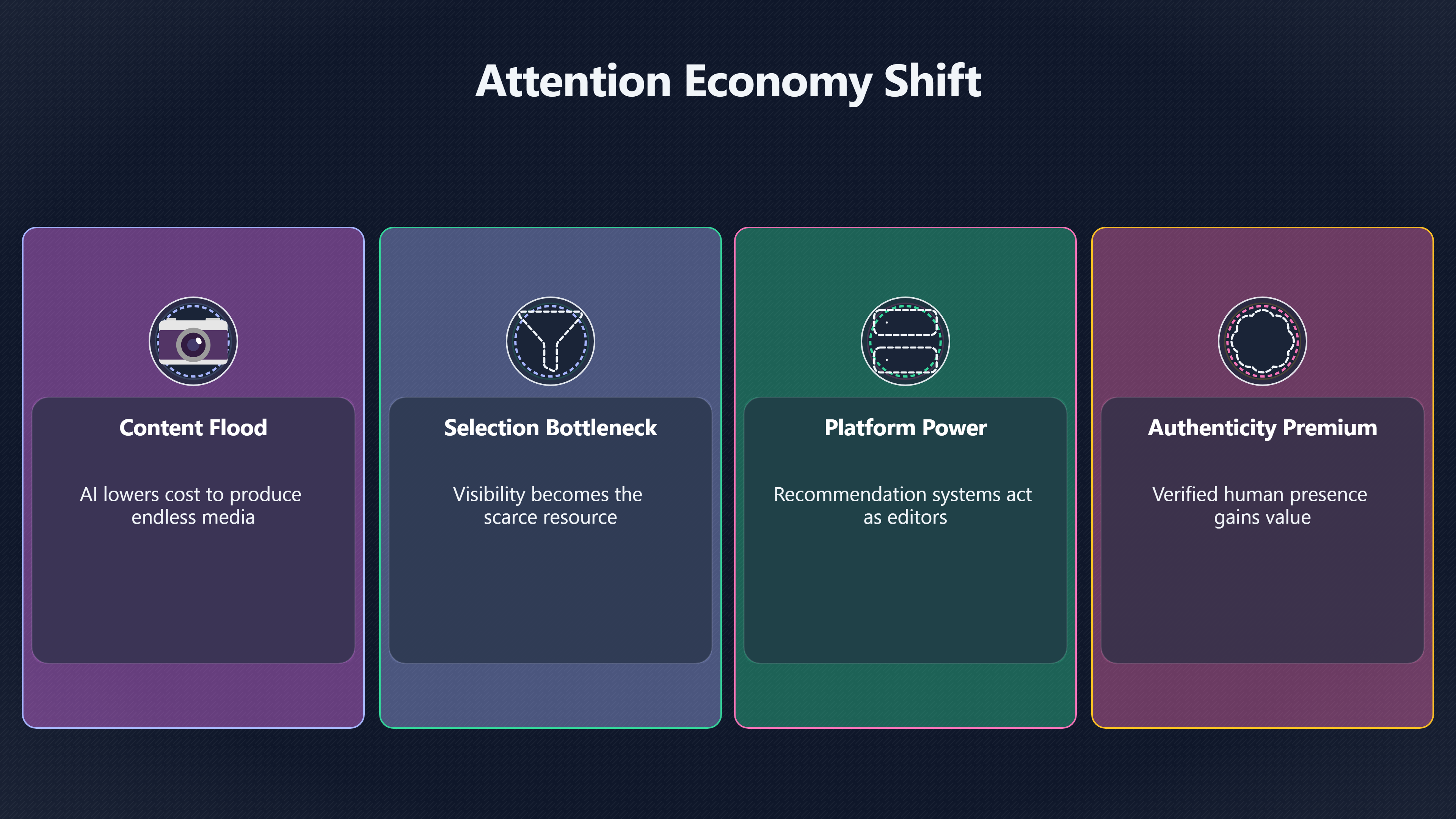
If advanced AI makes text, images, music, video and virtual personalities almost free to produce, the central scarcity may no longer be content itself. It may be human attention. In a world of endless media, the power shifts toward whoever controls discovery, ranking, recommendation and trust.
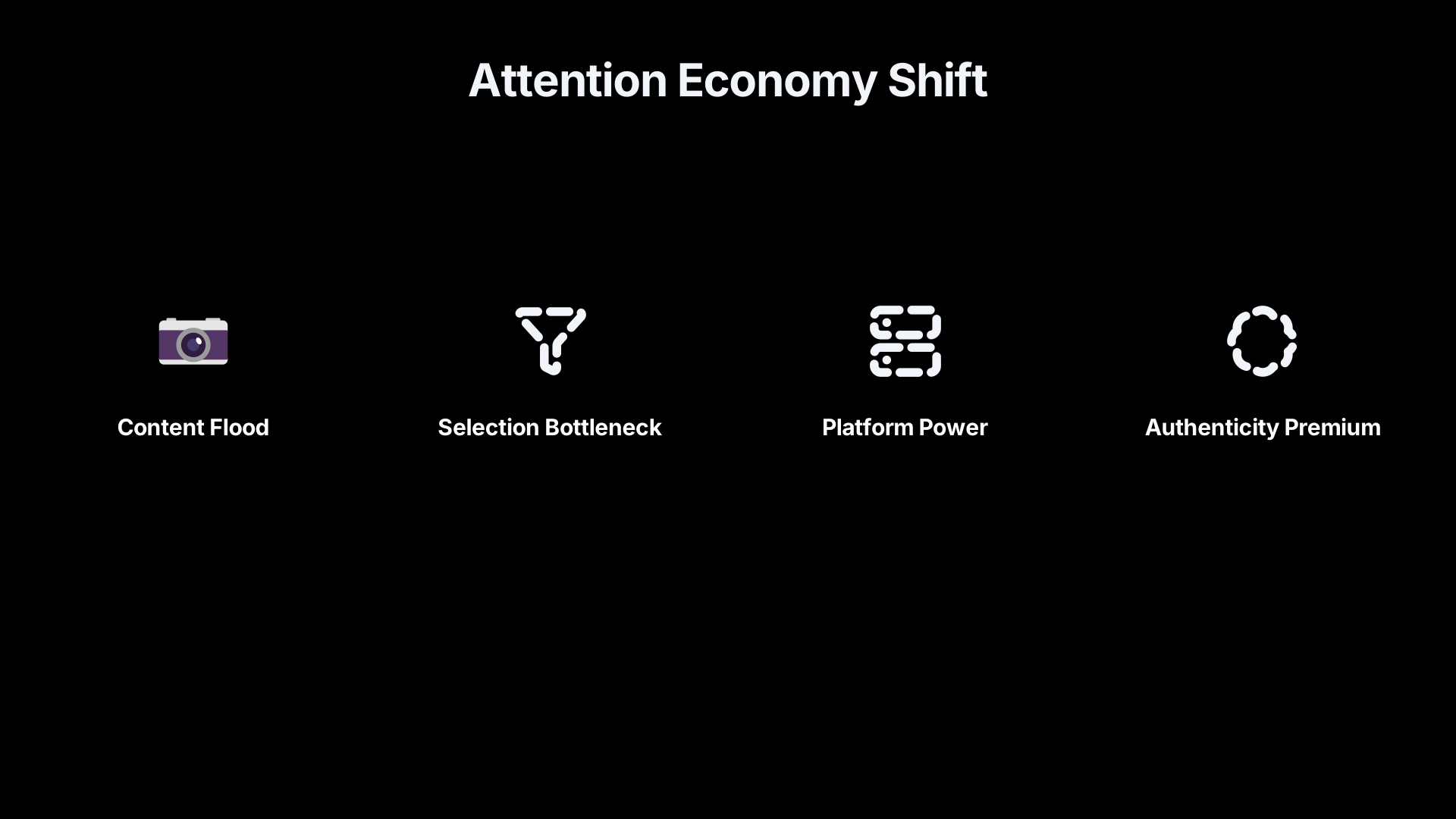 That changes the political economy of the internet. For most of the web’s history, media companies competed to produce scarce content. Generative AI changes the equation by making content creation vastly cheaper and faster. The bottleneck becomes selection: which voices people notice, which sources they trust, and which systems decide what deserves visibility. In an optimistic AI bloom future, abundant media could expand education, creativity and access to knowledge. But abundance also creates new risks: manipulation at industrial scale, synthetic propaganda, deepfake fraud, algorithmic concentration and a collapse of shared reality if trustworthy signals fail.
The result is a paradox. AI could create the richest information environment in human history while simultaneously making reliable attention harder to secure.
Why infinite content makes selection scarce
The internet already runs on what economists and technologists call the attention economy: platforms compete to capture finite human focus. AI intensifies this because it dramatically lowers the cost of generating persuasive material at scale. [DIGHUM]dighum.ec.tuwien.ac.atms and a user-machine feedback loop tainted by digital manipulation.Read more… [Center for Humane Technology]humanetech.comCenter for Humane TechnologyThe Attention EconomyEmotionally-charged content on social media achieves between 17-24% more engagement per…
A human creator has limited time. An AI system can produce thousands of videos, articles, comments or personalised messages in minutes. Once generation becomes cheap, visibility becomes the scarce resource.
This changes incentives across media systems:
- Platforms gain more influence because recommendation systems become the main gatekeepers.
- Creators compete less on production capacity and more on signalling authenticity, status or emotional connection.
- Advertisers and political actors gain new tools for targeted persuasion.
- Users rely increasingly on filters, curators and automated assistants to navigate overload.
The problem is not merely quantity. It is optimisation. AI systems can rapidly test which headlines, emotional tones, visual styles or narratives maximise engagement. Existing social media already rewards emotionally charged material because it spreads more effectively online. [Center for Humane Technology]humanetech.comCenter for Humane TechnologyThe Attention EconomyEmotionally-charged content on social media achieves between 17-24% more engagement per… With generative AI, this optimisation can become continuous and industrialised.
In practice, that could mean:
- Endless streams of hyper-personalised entertainment.
- AI-generated influencers tailored to niche identities.
- Automated political messaging adapted to individual psychological profiles.
- Synthetic communities populated partly by bots and AI agents.
- Recommendation systems that know users better than traditional broadcasters ever could.
Some observers describe this as a move from an economy of information scarcity to one of informational overproduction. [Medium]medium.comWhen the Attention Economy Collapses Under Its OwnMediumWhen the Attention Economy Collapses Under Its Own…February 8, 2026 — By pushing content production beyond any conceivable human… The challenge becomes less “Can I find content?” and more “Can I find reality, quality and meaning inside the flood?”
Recommendation systems become civilisation-scale filters
In an endless-media environment, recommendation systems become more important than creators themselves.
A person cannot evaluate millions of daily uploads. Platforms therefore decide what is visible through ranking systems trained on engagement, retention and advertising performance. This means attention increasingly flows through opaque algorithms rather than deliberate human choice.
That creates several forms of concentration.
First, a handful of companies may control the infrastructure through which most people encounter information. Search engines, video feeds, app stores, AI assistants and social recommendation systems become the effective editors of public culture.
Second, AI agents may increasingly mediate the web itself. Instead of humans browsing directly, automated assistants may summarise, rank and filter information on users’ behalf. Some analysts warn this could create a “machine-to-machine” internet where synthetic content is generated, filtered and consumed partly by AI systems rather than humans. [Live Science]livescience.comGenerative AI tools and large language models are flooding the web with synthetic content—known as "AI slop"—which ranges from low-qualit…
Third, recommendation systems can reshape culture without explicit censorship. If algorithms systematically amplify outrage, sentimentality, tribal identity or addictive formats because those maximise engagement, public attention may drift toward those modes even without a central authority ordering it.
This is one reason debates about AI bloom increasingly overlap with questions of governance. A civilisation with abundant intelligence and creativity still needs mechanisms that help people orient themselves inside abundance.
Trust, provenance and verified signal
When content can be generated endlessly, trust becomes economically valuable.
Readers may care less about whether media is technically impressive and more about whether it is genuine, accountable and connected to reality. In an AI-saturated environment, “human-made” or “verified real-world” content may itself become a premium good. [arXiv]arxiv.orgSource details in endnotes.
This is already visible in the growing focus on provenance systems: technologies designed to verify where media came from and whether it was altered.
The rise of provenance infrastructure
Several large technology companies are backing systems such as C2PA, the Coalition for Content Provenance and Authenticity, which attaches metadata to media files showing how they were created or edited. Google’s SynthID watermarking system attempts to invisibly mark AI-generated content. [The Verge]theverge.comAt Google’s I/O conference, it was announced that SynthID (an invisible watermark system for AI-generated content) and C2PA (metadata tha… [The Verge]theverge.comAt Google’s I/O conference, it was announced that SynthID (an invisible watermark system for AI-generated content) and C2PA (metadata tha…
The basic idea is simple:
- A photograph could carry cryptographic information showing it came from a real camera.
- An AI-generated image could contain a watermark identifying synthetic origin.
- Platforms could display provenance information directly to users.
- Journalists, courts or researchers could verify authenticity more quickly.
In theory, this creates a layered trust infrastructure for the AI age.
But current systems remain incomplete and fragile.
Researchers have shown that provenance metadata can often be stripped during uploads, screenshots or editing workflows. Independent security analyses argue that existing standards may not yet achieve their intended guarantees in high-stakes settings. [arXiv]arxiv.orgSource details in endnotes.
This matters because the deeper problem is social as well as technical. A watermark cannot solve distrust if users no longer believe institutions, platforms or verification authorities.
Deepfakes and the erosion of shared evidence
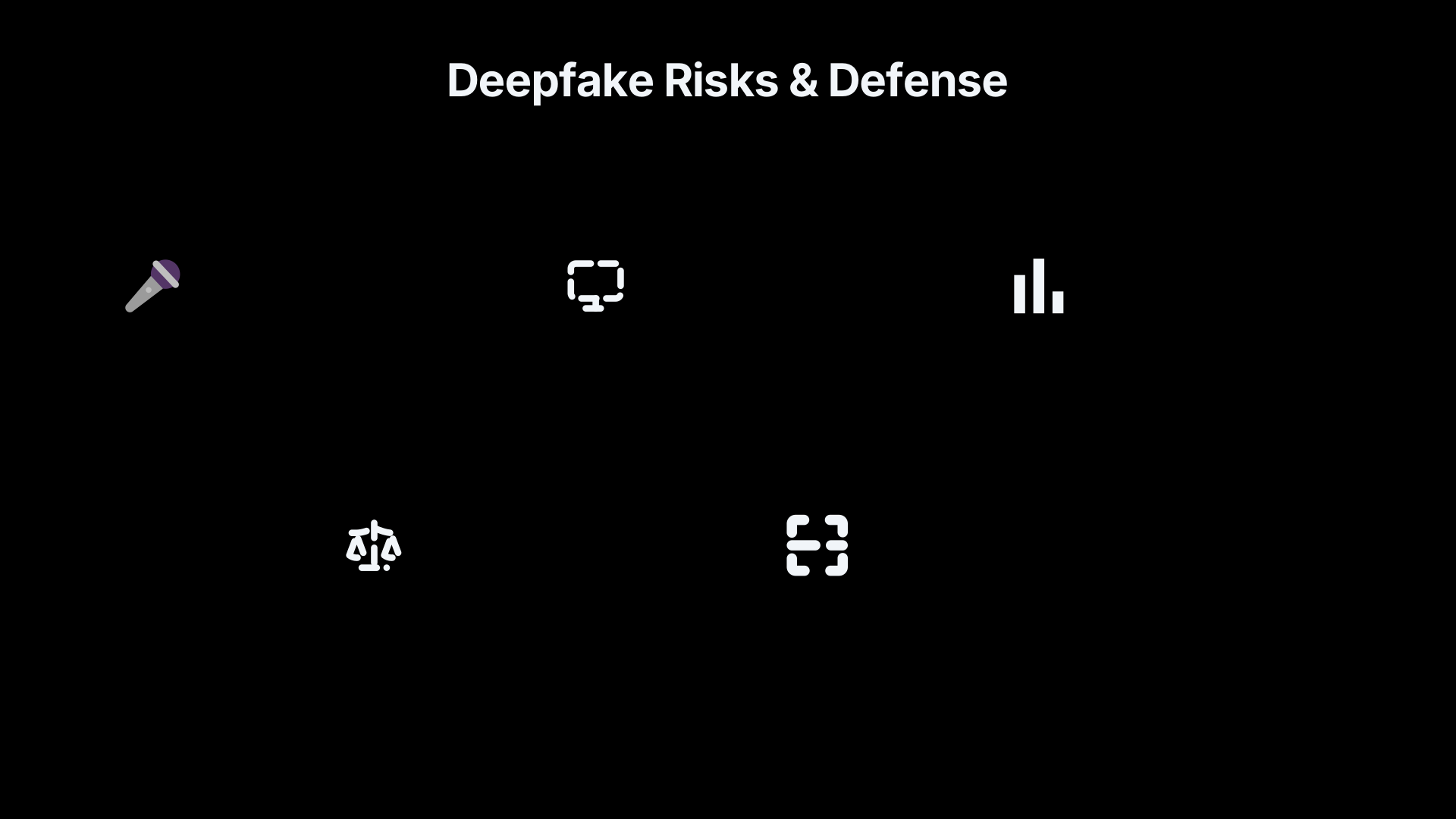
Deepfakes illustrate the stakes clearly. AI-generated audio and video are becoming more realistic and easier to produce. Researchers and public institutions warn that synthetic media can be used for fraud, impersonation, political manipulation and reputational attacks. [UN Regional Info Centre]unric.orgUN Regional Info Centre Artificial intelligence: What are deepfakes?6 days ago —deepfake technology; highly realistic fake images, videos and audio generated using AI. As deepfakes become more widespread and difficult… [The Alan Turing Institute]turing.ac.ukwhat are deepfakes and how can we detect themFor example, some older deepfake videos contained people who didn't blink. However, once people who didn't…Read more… [Police.uk]police.uka deepfake to trick you, to gain an advantage, such as taking your money or learning private information about you. False communications…
The danger is not only fake media itself. It is the collapse of confidence in evidence generally.
If convincing fabricated video becomes commonplace, genuine recordings may also become suspect. Public figures can dismiss real footage as fake. Citizens may stop trusting visual evidence altogether. UNESCO has described this as part of a broader “crisis of knowing”. [UNESCO]unesco.orgdeepfakes and crisis knowingUNESCODeepfakes and the crisis of knowing27 Oct 2025 —… deepfakes, and 29% video deepfakes (Statista, 2024). In January 2024, fraudste…
This creates a strange inversion of the optimistic internet vision. The web originally expanded access to information. But an AI-saturated media ecosystem could make verification harder even as information becomes more abundant.

Human presence as a scarce good
One possible outcome is a growing premium on verified human presence.
Live events, trusted personal relationships, local communities, authenticated journalism and known experts may gain relative value precisely because synthetic alternatives become cheap. Some researchers compare this to luxury or “Veblen” goods: scarcity itself becomes part of the appeal. [arXiv]arxiv.orgSource details in endnotes.
This could reshape creative industries in unexpected ways.
Instead of replacing all human creators, AI may push human creativity toward areas where authenticity, lived experience and accountability matter most:
- Investigative journalism tied to real-world reporting.
- Live performance and direct audience connection.
- Expert commentary with reputational risk.
- Trusted educational institutions.
- Communities built around persistent identity rather than anonymous content streams.
In this sense, the scarcity after post-scarcity may not be information. It may be believable humans.
The politics of recommendation systems
The key governance question is not merely whether AI-generated media exists. It is who decides what rises above the noise.
Recommendation systems already shape political discourse, consumer behaviour and cultural trends. In an era of infinite content, their power could expand dramatically.
Platform power may increase, not decrease
One common assumption is that AI abundance decentralises creativity. In some ways it does: more people can make films, games, music or educational tools with lower budgets.
But abundance can also strengthen intermediaries.
When content becomes effectively infinite, discovery systems become indispensable. Large platforms with the best recommendation engines, behavioural data and computing infrastructure may gain even more influence over collective attention.
This creates several tensions:
- Openness versus moderation.
- Personalisation versus shared public culture.
- Free expression versus manipulation.
- Convenience versus dependency on a few platforms.
An AI assistant that curates a user’s entire information diet could become more influential than any newspaper editor in history.
The incentives of engagement optimisation
Most current recommendation systems optimise for measurable engagement: clicks, watch time, comments and retention.
That can create distortions even without malicious intent. Sensationalism, outrage and emotionally activating content often outperform calmer or more nuanced material. [Center for Humane Technology]humanetech.comCenter for Humane TechnologyThe Attention EconomyEmotionally-charged content on social media achieves between 17-24% more engagement per…
Generative AI may intensify this because it enables rapid production and testing of engagement-maximising variants.
[For example:]turing.ac.ukwhat are deepfakes and how can we detect themFor example, some older deepfake videos contained people who didn't blink. However, once people who didn't…Read more…
- Political campaigns could automatically generate thousands of narrative versions tuned to different audiences.
- Commercial spam could become conversational, adaptive and psychologically targeted.
- Synthetic influencers could operate continuously across languages and demographics.
- Extremist or conspiratorial communities could flood platforms with persuasive AI-generated media faster than moderation systems can respond.
The concern is not simply misinformation. It is attentional capture: systems optimised to monopolise cognitive bandwidth.
Can abundance support better attention instead?
The optimistic case is that recommendation systems do not have to maximise addiction or outrage.
AI could also help people manage overload more intelligently:
- Personal AI tutors could filter low-quality information.
- Scientific knowledge could become easier to navigate.
- Translation systems could expose users to more global perspectives.
- Recommendation systems could optimise for long-term wellbeing or learning rather than raw engagement.
- Smaller communities could use AI moderation and curation tools to sustain healthier discussion spaces.
In this view, AI abundance only becomes socially destructive if institutions choose metrics that reward manipulation over flourishing.
The core political question is therefore institutional rather than purely technical: who defines the objectives of the systems that allocate attention?
Attention as a remaining scarcity
In a post-scarcity future, material abundance may coexist with intense competition for recognition, trust and cognitive space.
A person can consume only so much media in a day. Human focus remains biologically finite even if synthetic information becomes effectively infinite. That makes attention one of the central bottlenecks of an AI-rich civilisation.
This has implications far beyond entertainment.
Scientific research, democratic legitimacy, education, journalism and social coordination all depend on trustworthy attentional systems. A civilisation overwhelmed by noise may struggle to make wise collective decisions even if it possesses extraordinary technical power.
That is why media abundance is not a trivial side effect of AI bloom. It is one of the main governance challenges of abundance itself.
The optimistic future is not simply one where everyone can generate unlimited content. It is one where people can still find signal, maintain shared reality, build trust and direct collective attention toward things that genuinely matter.
Endnotes
-
Source: dighum.ec.tuwien.ac.at
Link: https://dighum.ec.tuwien.ac.at/perspectives-on-digital-humanism/the-attention-economy-and-the-impact-of-ai/Source snippet
ms and a user-machine feedback loop tainted by digital manipulation.Read more...
-
Source: arxiv.org
Link: https://arxiv.org/abs/2410.13101 -
Source: medium.com
Title: When the Attention Economy Collapses Under Its Own
Link: https://medium.com/%40J.S.Matkowski/when-the-attention-economy-collapses-under-its-own-speed-31f417c6b0c7Source snippet
MediumWhen the Attention Economy Collapses Under Its Own...February 8, 2026 — By pushing content production beyond any conceivable human...
Published: February 8, 2026
-
Source: arxiv.org
Link: https://arxiv.org/html/2605.03210v1Source snippet
arXivHuman-Provenance Verification should be Treated as...4 May 2026 — This position paper argues that AI-saturated markets are likely t...
Published: May 2026
-
Source: arxiv.org
Link: https://arxiv.org/abs/2604.24890Source snippet
arXivVerifying Provenance of Digital Media: Why the C2PA Specifications Fall ShortApril 27, 2026...
Published: April 27, 2026
-
Source: arxiv.org
Link: https://arxiv.org/abs/2603.02378 -
Source: police.uk
Link: https://www.police.uk/advice/advice-and-information/online-safety/online-safety/deepfakes-what-is-a-deepfake/Source snippet
a deepfake to trick you, to gain an advantage, such as taking your money or learning private information about you. False communications...
-
Source: unesco.org
Title: deepfakes and crisis knowing
Link: https://www.unesco.org/en/articles/deepfakes-and-crisis-knowingSource snippet
UNESCODeepfakes and the crisis of knowing27 Oct 2025 —... deepfakes, and 29% video deepfakes (Statista, 2024). In January 2024, fraudste...
Published: January 2024
-
Source: arxiv.org
Link: https://arxiv.org/abs/2407.19586 -
Source: medium.com
Link: https://medium.com/spherity/beyond-the-ai-noise-ensuring-authenticity-provenance-in-the-digital-sphere-22325801a00aSource snippet
high-quality content can flood digital platforms, making...Read more...
-
Source: humanetech.com
Link: https://www.humanetech.com/youth/the-attention-economySource snippet
Center for Humane TechnologyThe Attention EconomyEmotionally-charged content on social media achieves between 17-24% more engagement per...
-
Source: livescience.com
Link: https://www.livescience.com/technology/artificial-intelligence/it-wont-be-so-much-a-ghost-town-as-a-zombie-apocalypse-how-ai-might-forever-change-how-we-use-the-internetSource snippet
Generative AI tools and large language models are flooding the web with synthetic content—known as "AI slop"—which ranges from low-qualit...
Published: December 24, 2025
-
Source: theverge.com
Link: https://www.theverge.com/ai-artificial-intelligence/934521/google-synthid-c2pa-content-credentials-ai-labelling-effortsSource snippet
At Google’s I/O conference, it was announced that SynthID (an invisible watermark system for AI-generated content) and C2PA (metadata tha...
-
Source: theverge.com
Link: https://www.theverge.com/ai-artificial-intelligence/933442/openai-synthid-content-credentials-c2pa-expansionSource snippet
The company will now apply Google’s SynthID watermarking system alongside C2PA content credentials, creating a dual-layered approach to c...
-
Source: theverge.com
Link: https://www.theverge.com/tech/933424/google-synthid-c2pa-content-credentials-expansionSource snippet
Unveiled at Google I/O, the update includes broader support for both SynthID — Google's invisible watermarking technology — and C2PA cont...
-
Source: turing.ac.uk
Title: what are deepfakes and how can we detect them
Link: https://www.turing.ac.uk/blog/what-are-deepfakes-and-how-can-we-detect-themSource snippet
For example, some older deepfake videos contained people who didn't blink. However, once people who didn't...Read more...
-
Source: unric.org
Title: UN Regional Info Centre Artificial intelligence: What are deepfakes?6 days ago —
Link: https://unric.org/en/artificial-intelligence-what-are-deepfakes/Source snippet
deepfake technology; highly realistic fake images, videos and audio generated using AI. As deepfakes become more widespread and difficult...
Additional References
-
Source: acalytica.com
Link: https://acalytica.com/the-ai-abundance-paradox/Source snippet
The Abundance Paradox: AI, Scarcity, and the Natural OrderThe emergence of artificial intelligence as a driver of radical abundance—in in...
-
Source: shorensteincenter.org
Link: https://shorensteincenter.org/resource/from-attention-merchants-to-intention-architects-the-invisible-infrastructure-reshaping-human-curiosity/Source snippet
The Shorenstein CenterFrom Attention Merchants to Intention Architects29 Oct 2025 — When AI can generate infinite content at zero margina...
-
Source: vogue.com
Link: https://www.vogue.com/article/will-ai-kill-the-creator-economySource snippet
AI-generated influencers like Aitana Lopez and the Zelu sisters have gained significant online followings and brand partnerships, raising...
-
Source: businessengineer.ai
Title: A I & The Evolution of Online Media
Link: https://businessengineer.ai/p/ai-and-the-evolution-of-online-mediaSource snippet
AI & The Evolution of Online Media - by Gennaro Cuofano16 Apr 2025 — Perhaps the most interesting emerging model involves creating econom...
-
Source: instagram.com
Link: https://www.instagram.com/reel/DYXSYOYMrBM/Source snippet
ent while reducing labor costs across marketing, media, and...
-
Source: newyorkfed.org
Link: https://www.newyorkfed.org/medialibrary/media/research/conference/2023/FinTech/400pm_Korinek_Paper_LLMs_final.pdfSource snippet
tants will become increasingly useful for generating more and more of the content that makes up research...Read more...
-
Source: tandfonline.com
Link: https://www.tandfonline.com/doi/full/10.1080/20414005.2025.2562681Source snippet
Full article: Platforms as architects of AI influenceby D Carlon · 2025 · Cited by 1 — The widespread availability of generative AI has r...
-
Source: pmc.ncbi.nlm.nih.gov
Link: https://pmc.ncbi.nlm.nih.gov/articles/PMC12658474/Source snippet
Law and Economics of Generative AI and Copyright - PMCby Z Cooper · 2025 — Abstract. Generative AI (GenAI) systems raise fundamental chal...
-
Source: youtube.com
Link: https://www.youtube.com/watch?v=EUNFy764rsISource snippet
d those two things are really shaped by three aspects...
-
Source: GOV.UK
Title: deepfake detection technology
Link: https://www.gov.uk/government/publications/deepfake-detection-technology/deepfake-detection-technologySource snippet
detection technology26 Mar 2026 — Deepfake detection technology has emerged as a critical field in recent years, combating the growing th...
Amazon book picks
Further Reading
Books and field guides related to Attention after endless media. Use these as the next step if you want deeper reading beyond the article.

Artificial intelligence
First published 1994. Subjects: problem solving, constraint satisfaction, knowledge, reasoning, planning.

Artificial Intelligence and Soft Computing
First published 2012. Subjects: Computer Imaging, Vision, Pattern Recognition and Graphics, Database management, Information storage and...

Artificial Intelligence Applications and Innovations
First published 2006. Subjects: Artificial intelligence, Technological innovations, Expert systems (computer science), Intelligent contro...
The Attention Economy
Thought provoking -Time Magazine Welcome to the attention economy, in which the new scarcest resource isn't ideas or talent, but attentio...
eBay marketplace picks
Marketplace Samples
Example marketplace items related to this page. Use the search link to explore similar finds on eBay.

Example eBay listing
A.I. Artificial Intelligence Original Movie Poster Signed By Jude Law
USD 125.00 | Shipping USD 25.00 | US

Example eBay listing
Artificial Intelligence D/S Original Movie Poster - 27 x 40"
USD 19.50 | Shipping USD 13.65 | US

Example eBay listing
612388 Artificial Intelligence Movie Science Fiction Drama Wall Print Poster
USD 22.95 | Shipping USD 12.95 | JP

Example eBay listing
Companion - Artificial Intelligence Dark Comedy Cinema Film - POSTER 20"x30"
USD 23.99 | Free shipping | US
Topic Tree