Within Robot Dividend
Algorithmic management at work
AI monitoring can turn ordinary jobs into constant measurement, making transparency and human review central bargaining demands.
On this page
- How workplace AI measures, scores and directs workers
- Why opaque metrics weaken worker voice
- Bargaining demands for transparency, consent and appeal rights
Page outline Jump by section
Introduction
AI systems are increasingly managing workers as well as assisting them. In warehouses, delivery networks, call centres, offices and gig platforms, software now measures pace, allocates tasks, predicts behaviour, scores performance and sometimes triggers discipline automatically. This is often called algorithmic management: the use of data-driven systems to direct labour in ways once handled by human supervisors.
 That shift matters because bargaining power at work depends partly on information and discretion. When employers know far more about workers than workers know about the systems judging them, power can move sharply towards management. A worker arguing with a human supervisor can question judgement, context or fairness. A worker challenging a hidden metric or automated productivity score may not even know how the decision was made.
Within debates about AI abundance and the “robot dividend”, this is a crucial issue. Even if AI greatly increases productivity, workers may capture little of the benefit if algorithmic systems intensify surveillance, weaken collective organising and make labour easier to monitor and replace. Many modern labour disputes are therefore not mainly about humanoid robots taking jobs. They are about software systems that continuously track, rank and direct human labour.
How workplace AI measures, scores and directs workers
Algorithmic management combines several older management ideas — productivity measurement, scheduling software, surveillance systems and statistical optimisation — into a continuous feedback loop. Sensors, scanners, apps and software platforms feed data into systems that evaluate workers in real time. FEPS [Sage Journals]journals.sagepub.comSage JournalsAlgorithmic management and collective bargainingby V De Stefano · 2023 · Cited by 205 — This article addresses the challenge…
In practice, this can include:
- Productivity quotas based on scan rates or task completion
- Automated scheduling that adjusts shifts minute by minute
- GPS tracking for drivers and delivery workers
- Customer-rating systems that affect pay or job access
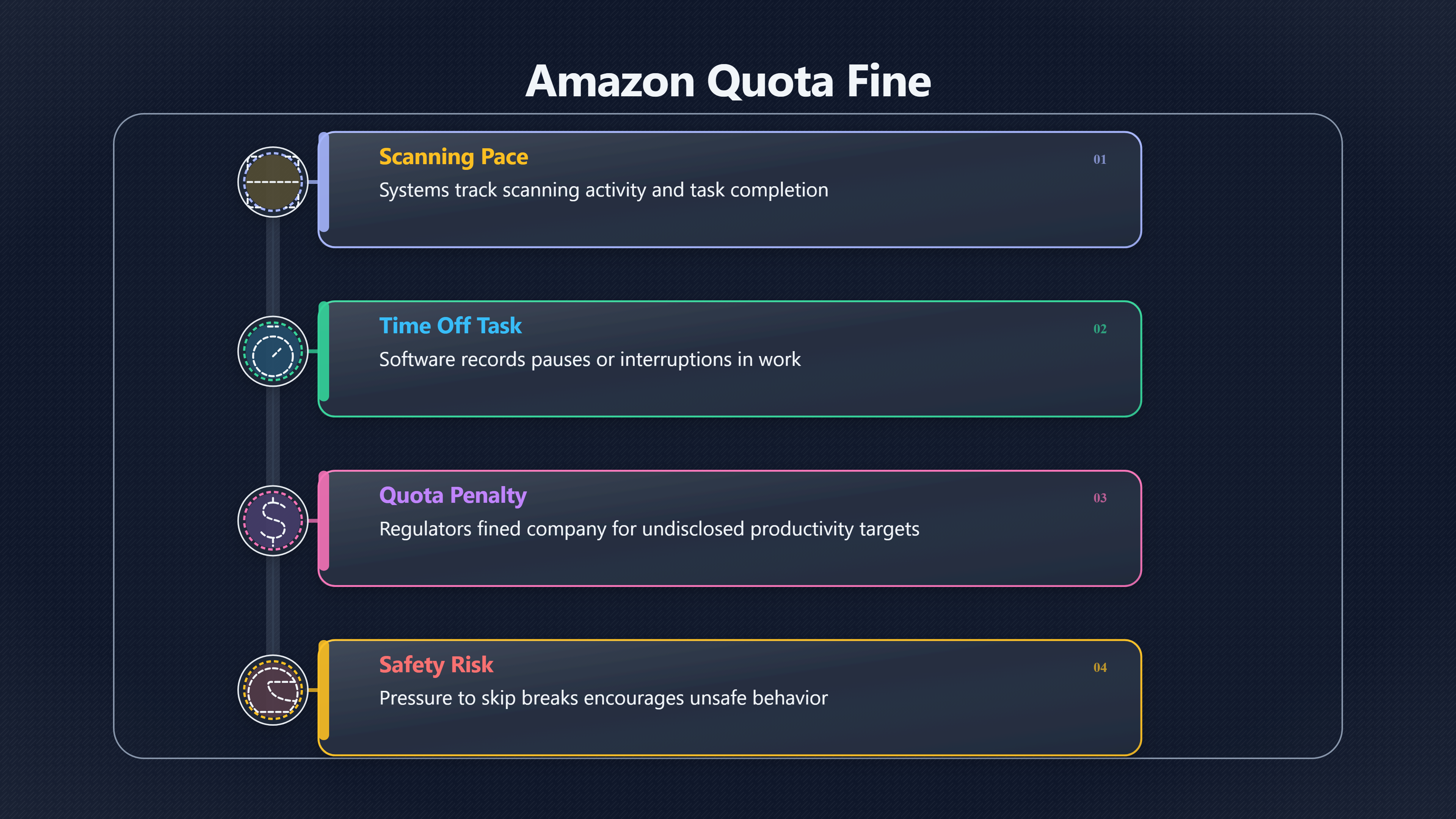
- “Time off task” monitoring that records pauses or interruptions
- Automated hiring, discipline or dismissal recommendations
- AI systems predicting staffing needs or “underperformance”
The result is not simply more measurement. It is a workplace where management decisions become faster, more centralised and more difficult to contest.
Warehouse work offers some of the clearest examples. Amazon’s systems track worker scanning activity and measure “Time Off Task”, or periods where workers are not actively processing items. Researchers and labour advocates argue that such systems create intense pressure to maintain pace while reducing opportunities for informal discretion or recovery. Sage Journals [UNI Global Union]uniglobalunion.orgAlgorithmic Management: Opportunities for Collective…Unions globally report that algorithmic surveillance of work activities is being…
California regulators fined Amazon nearly $6 million in 2024 under the state’s warehouse quota law, arguing the company failed to provide sufficiently clear written information about productivity quotas and associated penalties. Regulators linked undisclosed quotas to pressure that could encourage workers to skip breaks or work unsafely. Amazon disputed the allegations and said it does not use fixed quotas in the way critics describe. [Reuters]reuters.comAmazon fined $5.9 million over warehouse worker quotas in CaliforniaThis fine follows a 2022 California law requiring employers to provide written descriptions of quotas if failing to meet them could lead… [MarketWatch The broader point extends beyond one company. Increasingly]marketwatch.comThis law requires operators to inform workers of any work-related quotas and potential punishments. According to the labor commissioner's…, work itself becomes machine-readable. Software converts human activity into metrics that can be compared, ranked and optimised continuously.
For employers, this can improve logistics, reduce idle time and increase output. In some sectors, algorithmic systems genuinely help coordinate complex operations more efficiently. But the same tools can also reshape the balance of authority inside workplaces by reducing the space for negotiation, judgement and worker autonomy.
Why opaque metrics weaken worker voice
A traditional supervisor may be biased or inconsistent, but workers can usually identify who made a decision and challenge it socially or legally. Algorithmic management often obscures both the criteria and the chain of responsibility.
Workers may not know:
- Which data are being collected
- How scores are calculated
- Which behaviours trigger penalties
- Whether systems contain errors or biases
- Whether a human actually reviewed the decision
This opacity matters because bargaining power depends partly on the ability to understand and contest management decisions. When metrics are hidden, workers struggle to organise around common grievances. Each person sees only fragments of the system.
Research on platform work repeatedly finds that workers experience uncertainty about how algorithms allocate jobs, calculate pay or prioritise labour. A 2024 study on rideshare work described a “transparency gap” in which workers lacked the information needed to understand fares, route assignments, incentives and ranking systems. [arXiv]arxiv.orgarXivRideshare Transparency: Translating Gig Worker Insights on AI Platform Design to PolicyJune 16, 2024…
This can weaken solidarity in subtle ways. If workers cannot tell whether declining income comes from lower demand, changing algorithms or individual penalties, collective action becomes harder. Problems appear personalised rather than systemic.
Algorithmic systems can also individualise pressure. Instead of a supervisor publicly demanding faster work, software quietly produces rankings, warnings or nudges targeted at each employee. Workers compete against metrics and dashboards rather than negotiating collectively over reasonable pace or staffing levels.
Researchers on algorithmic management argue that constant monitoring can suppress organising itself. Surveillance systems may identify communication patterns, location data or behavioural changes associated with union activity. Even where employers do not explicitly target organising, workers may fear that digital monitoring creates retaliation risks. [AI Now Institute]ainowinstitute.orgAI Now Institute Algorithmic Management: Restraining WorkplaceAI Now InstituteAlgorithmic Management: Restraining Workplace…April 11, 2023 — 11 Apr 2023 — To meaningfully build worker power, we mu…
This changes workplace psychology. Human supervisors can occasionally ignore rules, show sympathy or negotiate informally. Automated systems tend to standardise expectations and enforce them relentlessly unless deliberately designed otherwise.
The result can be a workplace that feels less like negotiated employment and more like continuous optimisation.
The shift from human supervision to statistical control
One important change in algorithmic management is that control increasingly operates through probabilities and aggregated data rather than direct instruction.
Older industrial management often relied on explicit commands: do this task this way at this speed. Algorithmic systems instead shape incentives indirectly through rankings, nudges, forecasts and behavioural prediction.
For example:
- Drivers may receive fewer profitable jobs after rejecting assignments
- Warehouse workers may lose preferred shifts if performance scores fall
- Call-centre workers may be judged on speech analytics or emotional tone
- Retail staffing systems may reduce hours automatically based on predicted demand
This can make managerial authority feel both more pervasive and less accountable. Decisions appear “objective” because they emerge from data systems, even when the assumptions behind the models remain contestable.
Critics argue this creates a form of statistical control in which software becomes a disciplinary layer between workers and management. [Sage Journals]journals.sagepub.comSage JournalsAlgorithmic management and collective bargainingby V De Stefano · 2023 · Cited by 205 — This article addresses the challenge…
Importantly, algorithmic management does not necessarily reduce managerial power. In many cases it centralises it. A local supervisor may once have exercised discretion about pacing, scheduling or discipline. Software systems designed at corporate level can standardise expectations across thousands of workers simultaneously.
That scale matters politically. A company with detailed behavioural data on a workforce gains new leverage in disputes over productivity, staffing and labour costs.
Bargaining demands for transparency, consent and appeal rights
Because algorithmic management changes information asymmetries, many labour negotiations now focus less on stopping AI entirely and more on forcing visibility and accountability into workplace systems.
Common bargaining demands include:
- The right to know which data are collected
- Access to performance metrics and scoring criteria
- Human review of automated decisions
- Limits on biometric or emotional surveillance
- Restrictions on off-duty tracking
- Worker consultation before deploying monitoring tools
- Independent auditing for discrimination or safety harms
- The ability to challenge incorrect data or automated penalties
These demands increasingly appear in labour law debates as well as union bargaining.
The European Union’s Platform Work Directive introduced new rules on algorithmic management, including transparency requirements, human oversight obligations and protections concerning automated decision-making. The directive reflects growing concern that AI management systems can undermine worker rights if left opaque and unregulated. [Eur-Lex]eur-lex.europa.euworking conditions in platform workEur-LexWorking conditions in platform work | EUR-Lex12 Mar 2026 — Directive (EU) 2024/2831 lays down minimum rules to improve working con… [ETUI The directive is formally focused on platform work]etui.orgOpen source on etui.org., but its logic reaches further. Many of the same systems used by ride-hailing or delivery apps are now spreading into more traditional workplaces. Researchers in Nordic countries have documented algorithmic management tools expanding into logistics, retail, finance and journalism. [FEPS]feps-europe.euAlgorithmic management in traditional workplacesFEPSALGORITHMIC MANAGEMENT IN THE WORKPLACEOctober 8, 2024 — AM refers to the use of computer algorithms to control workers, while many o…
Trade unions increasingly argue that transparency itself is now a bargaining issue. If algorithms shape workloads, scheduling or dismissal risk, workers need access to the underlying rules in order to negotiate fairly.
Some labour advocates also push for “human in the loop” requirements: important employment decisions should not be fully automated. European policymakers have increasingly endorsed this principle. [Global Compliance News]globalcompliancenews.comGlobal Compliance NewsEuropean Union: Platform Workers Directive goes ahead3 Apr 2024 — Regardless of employment status, the Directive al… [2equineteurope.org]equineteurope.orgcontribute to workers having more.Read more…
The underlying conflict is not simply technical. It concerns whether workers remain participants in workplace governance or become subjects of systems they cannot inspect.

Why this matters for the robot dividend
The optimistic AI bloom vision imagines a future where intelligent machines dramatically reduce drudgery and expand human flourishing. In principle, algorithmic coordination could help workplaces become safer, more efficient and less wasteful. AI could reduce repetitive paperwork, optimise staffing without exhausting workers and automate dangerous tasks.
But algorithmic management shows why abundance alone does not settle distributional questions.
A highly productive economy can still produce insecurity if workers lack bargaining power over how technology is deployed. If AI mainly strengthens employer surveillance while weakening worker voice, the gains from automation may flow disproportionately towards capital owners and dominant firms.
This is one reason labour politics increasingly focuses on governance rather than simple adoption. The central question is not whether AI enters workplaces. It already has. The question is who shapes the rules under which it operates.
In the best-case scenario, AI systems could help eliminate dangerous labour, reduce exhausting schedules and support shorter working weeks while preserving dignity and autonomy. In the worst-case scenario, the same systems could create workplaces defined by relentless measurement, opaque discipline and weakened collective power.
The difference may depend less on the sophistication of the technology itself than on whether workers gain enforceable rights to transparency, appeal and collective negotiation over how algorithmic systems are used.
Endnotes
-
Source: reuters.com
Title: Amazon fined $5.9 million over warehouse worker quotas in California
Link: https://www.reuters.com/sustainability/boards-policy-regulation/amazon-fined-59-million-over-warehouse-worker-quotas-california-2024-06-18/Source snippet
This fine follows a 2022 California law requiring employers to provide written descriptions of quotas if failing to meet them could lead...
-
Source: marketwatch.com
Link: https://www.marketwatch.com/story/amazon-hit-with-5-9-million-fine-as-california-says-it-failed-to-disclose-quotas-to-workers-db03d462Source snippet
This law requires operators to inform workers of any work-related quotas and potential punishments. According to the labor commissioner's...
-
Source: context.news
Title: amazon and other us companies in crosshairs on warehouse safety
Link: https://www.context.news/money-power-people/amazon-and-other-us-companies-in-crosshairs-on-warehouse-safetySource snippet
Amazon and other U.S. companies in crosshairs on...Jul 5, 2024 — Regulators in California fined Amazon nearly $6 million for violating i...
-
Source: arxiv.org
Link: https://arxiv.org/abs/2406.10768Source snippet
arXivRideshare Transparency: Translating Gig Worker Insights on AI Platform Design to PolicyJune 16, 2024...
Published: June 16, 2024
-
Source: etui.org
Link: https://www.etui.org/publications/eu-platform-work-directive -
Source: equineteurope.org
Link: https://equineteurope.org/wp-content/uploads/2024/09/Equinet-Directive-Summary_Platform-Work-Directive.pdfSource snippet
contribute to workers having more.Read more...
-
Source: amazon.com
Link: https://www.amazon.com/Source snippet
Spend less. Smile more.Free shipping on millions of items. Get the best of Shopping and Entertainment with Prime. Enjoy low prices and gr...
-
Source: etui.org
Title: Algorithmic management and collective bargaining web 2021
Link: https://www.etui.org/sites/default/files/2021-05/Algorithmic%20management%20and%20collective%20bargaining-web-2021.pdfSource snippet
Algorithmic management and collective bargaining-...by V De Stefano · 2021 — To conclude, the introduction of AI and algorithmic managem...
-
Source: arxiv.org
Link: https://arxiv.org/html/2508.09438v1Source snippet
Fulfillment of the Work Games: Warehouse Workers...13 Aug 2025 — We highlight this workplace as one that is increasingly equipped with a...
-
Source: youtube.com
Title: Regulating AI through collective bargaining
Link: https://www.youtube.com/watch?v=5gReA24daNISource snippet
www.etui.org...
-
Source: journals.sagepub.com
Link: https://journals.sagepub.com/doi/10.1177/10242589221141055Source snippet
Sage JournalsAlgorithmic management and collective bargainingby V De Stefano · 2023 · Cited by 205 — This article addresses the challenge...
-
Source: journals.sagepub.com
Link: https://journals.sagepub.com/doi/10.1177/23780231251318389Source snippet
2022) by requiring workers...Read more...
-
Source: uniglobalunion.org
Link: https://uniglobalunion.org/wp-content/uploads/Algorithmic-Management-Opportunities-for-Collective-Action.pdfSource snippet
Algorithmic Management: Opportunities for Collective...Unions globally report that algorithmic surveillance of work activities is being...
-
Source: ainowinstitute.org
Title: AI Now Institute Algorithmic Management: Restraining Workplace
Link: https://ainowinstitute.org/publications/algorithmic-managementSource snippet
AI Now InstituteAlgorithmic Management: Restraining Workplace...April 11, 2023 — 11 Apr 2023 — To meaningfully build worker power, we mu...
Published: April 11, 2023
-
Source: eur-lex.europa.eu
Title: working conditions in platform work
Link: https://eur-lex.europa.eu/EN/legal-content/summary/working-conditions-in-platform-work.htmlSource snippet
Eur-LexWorking conditions in platform work | EUR-Lex12 Mar 2026 — Directive (EU) 2024/2831 lays down minimum rules to improve working con...
-
Source: globalcompliancenews.com
Link: https://www.globalcompliancenews.com/2024/04/03/https-insightplus-bakermckenzie-com-bm-investigations-compliance-ethics-european-union-platform-workers-directive-goes-ahead-presumption-of-employment-and-regulation-of-algorithmic-management-in-pla/Source snippet
Global Compliance NewsEuropean Union: Platform Workers Directive goes ahead3 Apr 2024 — Regardless of employment status, the Directive al...
-
Source: Wikipedia
Title: European Union
Link: https://en.wikipedia.org/wiki/European_UnionSource snippet
European Union6 hours ago — The European Union (EU) is a political and economic union of 27 member states that are located primarily i...
Additional References
-
Source: algorithmwatch.org
Link: https://algorithmwatch.org/en/wp-content/uploads/2023/02/2023_AlgorithmWatch_ITUC_Report.pdfSource snippet
Algorithmic transparency and accountability in the world of...This report, prepared by AlgorithmWatch for the ITUC, looks at examples fr...
-
Source: fightforthefuture.org
Link: https://www.fightforthefuture.org/actions/amazonhurtsSource snippet
Amazon Hurts WorkersWork Shouldn't. Hurt. Every month, thousands of Amazon workers get hurt on the job. A new interim Senate report shows...
-
Source: taylorwessing.com
Link: https://www.taylorwessing.com/-/media/taylor-wessing/files/germany/2025/01/tw25_eu-platform-work-directive.pdfSource snippet
EU Platform Work Directive brings in new protections for...It aims to better protect platform workers not only by regulating their statu...
-
Source: itpro.com
Link: https://www.itpro.com/security/privacy/eu-lawmakers-want-to-limit-the-use-of-algorithmic-management-systems-at-workSource snippet
Currently, 42% of EU workers are affected by such systems, a number expected to rise to 55.5% within five years. Although legislation suc...
-
Source: ejournals.eu
Link: https://ejournals.eu/en/journal/szppips/article/transparency-and-algorithmic-oversight-in-the-digital-workplace-legal-challenges-under-directive-2024-2831Source snippet
Legal Challenges under Directive 2024/2831by M Tomaszewska · Cited by 1 — In recent years, the Court of Justice of the European Union (CJ...
-
Source: GOV.UK
Link: https://www.gov.uk/eu-eeaSource snippet
in the EU and EEAThe European Union (EU) is an economic and political union of 27 countries. It operates an internal (or single) market...
-
Source: equitablegrowth.org
Link: https://equitablegrowth.org/research-paper/estimating-the-prevalence-of-automated-management-and-surveillance-technologies-at-work-and-their-impact-on-workers-well-being/Source snippet
the US workforce intended to provide higher-quality estimates of the prevalence of automated management and...Read mor...
-
Source: privacyinternational.org
Link: https://privacyinternational.org/examples/examples-algorithmic-management-abusesSource snippet
02 Jun 2022. Documents filed with the US National Labor Relations Board show that Amazon issues warehouse...Read more...
-
Source: europeansources.info
Title: proposal for a directive on improving working conditions in platform work
Link: https://www.europeansources.info/record/proposal-for-a-directive-on-improving-working-conditions-in-platform-work/Source snippet
Directive (EU) 2024/2831 on improving working conditions...11 Nov 2024 — This Directive introduces measures to facilitate the determinat...
-
Source: nlrb.gov
Title: board rules captive audience meetings unlawful
Link: https://www.nlrb.gov/news-outreach/news-story/board-rules-captive-audience-meetings-unlawfulSource snippet
Board Rules Captive-Audience Meetings UnlawfulNov 13, 2024 — Today, the Board issued a decision in Amazon.com Services LLC, ruling that a...
Amazon book picks
Further Reading
Books and field guides related to Algorithmic management at work. Use these as the next step if you want deeper reading beyond the article.

Surveillance
First published 2021. Subjects: Commerce, Electronic monitoring in the workplace, Electronic surveillance, Personnel management, Organiza...

Electronic Monitoring in the Workplace
First published 2004. Subjects: Supervision, Droit à la vie privée, Personnel, Supervision of employees, Right of Privacy.
eBay marketplace picks
Marketplace Samples
Example marketplace items related to this page. Use the search link to explore similar finds on eBay.

Example eBay listing
A.I. Artificial Intelligence Original Movie Poster Signed By Jude Law
USD 125.00 | Shipping USD 25.00 | US

Example eBay listing
Artificial Intelligence D/S Original Movie Poster - 27 x 40"
USD 19.50 | Shipping USD 13.65 | US

Example eBay listing
612388 Artificial Intelligence Movie Science Fiction Drama Wall Print Poster
USD 22.95 | Shipping USD 12.95 | JP

Example eBay listing
Companion - Artificial Intelligence Dark Comedy Cinema Film - POSTER 20"x30"
USD 23.99 | Free shipping | US

Example eBay listing
A.I. Artificial Intelligence Movie Film Poster Art Print
GBP 4.99 | Free shipping | GB

Example eBay listing
A I Artificial Intelligence 6 Movie Poster Art Print Print Classic Rare Gallery
GBP 49.00 | Free shipping | GB

Example eBay listing
AI - Artificial Intelligence (Poster + Slipcase) Blu-Ray
GBP 10.49 | Free shipping | GB

Example eBay listing
A. I. Artificial Intelligence. Jude Law. Original UK Video Poster.
GBP 8.11 | Shipping GBP 3.38 | GB
Topic Tree