Within Medicine Access
Why Insulin Access Still Fails
Insulin shows how patents, concentrated production, and weak health systems can keep an old medicine scarce.
On this page
- How a few firms came to dominate insulin supply
- Why low income patients still face high prices
- What insulin reveals about AI driven medical abundance
Page outline Jump by section
Introduction
Insulin was discovered in the early 1920s, and its original researchers famously argued that the treatment belonged to humanity rather than to any one company. Yet more than a century later, insulin remains unaffordable or unavailable for many of the people who need it most. The problem is not that scientists do not know how to make insulin. It is that medicine exists inside economic, regulatory, manufacturing, and political systems that can still produce scarcity long after discovery.
 That makes insulin one of the clearest case studies for the wider debate about AI abundance and human flourishing. Even if advanced AI dramatically accelerates drug discovery, predicts proteins perfectly, or designs better therapies, scientific knowledge alone does not guarantee universal access. Insulin shows how supply chains, patents, concentrated corporate power, weak health systems, and unequal global purchasing power can keep an old life-saving medicine scarce decades after the core science became established. [PMC]pmc.ncbi.nlm.nih.govPMCThe insulin market reaches 100 - PMCby D Beran · 2022 · Cited by 14 — Around half of these sales were by Novo Nordisk, with Eli Lilly… [BMJ Global Health]gh.bmj.comBMJ Global HealthInsulin prices, availability and affordability in 13 low-…by M Ewen · 2019 · Cited by 161 — Few studies have assessed…
How a few firms came to dominate insulin supply
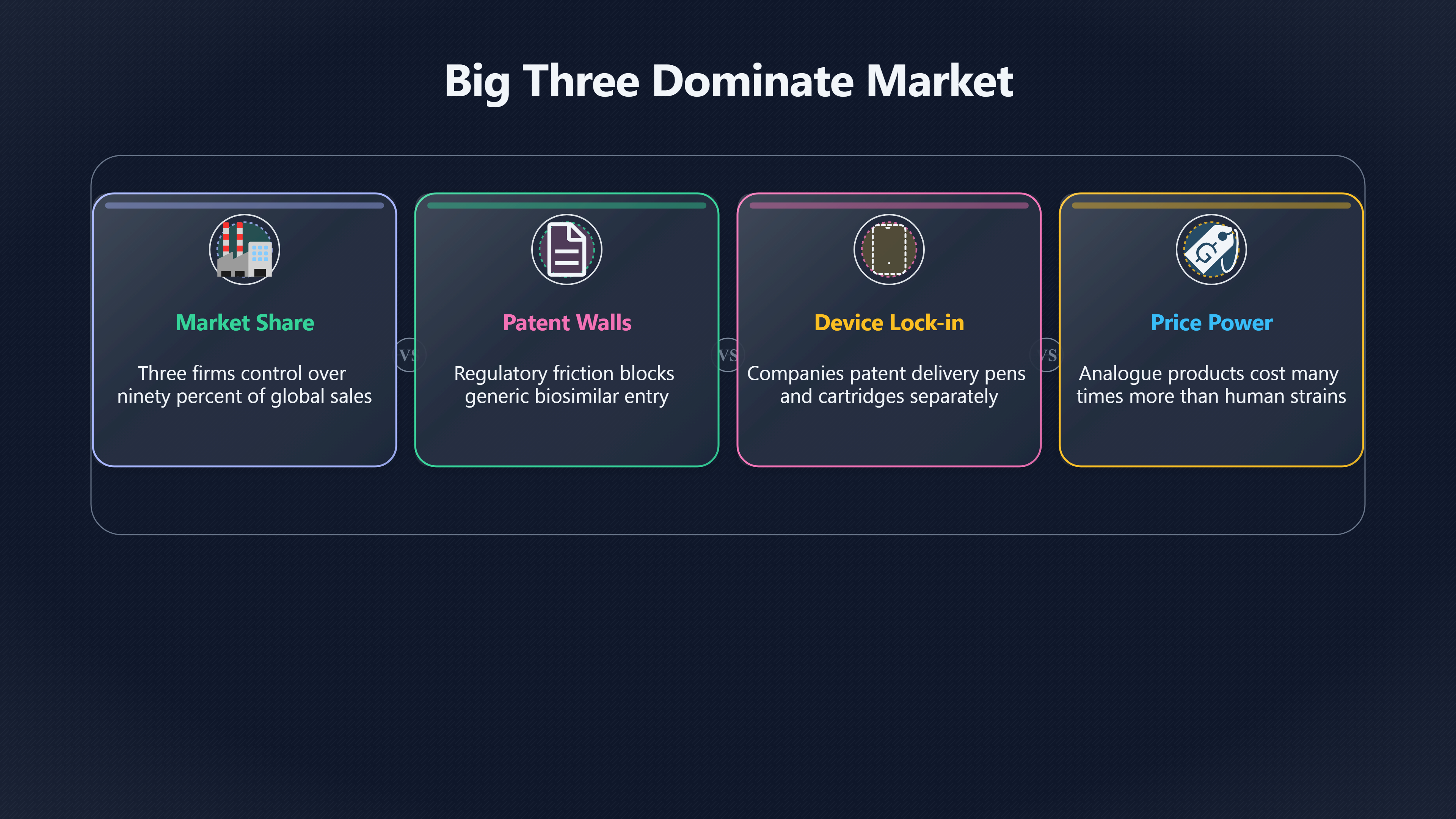
Modern insulin markets are extraordinarily concentrated. Three companies — Eli Lilly, Novo Nordisk, and Sanofi — control the overwhelming majority of global insulin sales by value. Multiple studies and market analyses estimate their combined share at above 90%, with some placing it even higher. OUP Academic [Springer This concentration did not happen because insulin itself remained scientifically mysterious. Early insulin came from animal pancreases and wa]link.springer.comThe insulin market reaches 100 | DiabetologiaSpringerThe insulin market reaches 100 | Diabetologia - Springer Natureby D Beran · 2022 · Cited by 14 — The resulting 'Big Three'—Eli Li… s produced by many firms. But over decades the market shifted toward genetically engineered “human” insulin and then toward newer insulin analogues designed to act faster or last longer in the body. Manufacturing these biological medicines requires expensive factories, specialised expertise, sterile production systems, and extensive regulatory approval.
As insulin technology became more sophisticated, smaller competitors struggled to survive. Large firms accumulated patents, manufacturing capacity, distribution networks, regulatory experience, and relationships with healthcare systems. Some competitors disappeared through mergers or market exit. By the start of the twenty-first century, the “Big Three” had become dominant globally. [Springer]link.springer.comThe insulin market reaches 100 | DiabetologiaSpringerThe insulin market reaches 100 | Diabetologia - Springer Natureby D Beran · 2022 · Cited by 14 — The resulting 'Big Three'—Eli Li… [Europe PMC]europepmc.orgEurope PMCThe insulin market reaches 100Abstractby D Beran · 2022 · Cited by 14 — The resulting 'Big Three'—Eli Lilly, Novo Nordisk and Sanofi—had acquired >96% of the global ma…
A common misunderstanding is that expired patents should automatically create a competitive generic market, as happened with many ordinary pills. Insulin is different because it is a biologic medicine rather than a simple chemical compound. Biosimilar insulin — roughly comparable to a generic version of a biologic drug — is harder and more expensive to develop and approve. Regulatory requirements are more demanding, manufacturing is technically difficult, and proving interchangeability can cost large sums. Iris [Cardiometabolic Health Congress]cardiometabolichealth.orgCardiometabolic Health CongressSanofi Joins Lilly and Novo to Cut Insulin PricesThe increasing availability of biosimilar and interchange…
That means insulin scarcity today is not mainly about one secret formula being hidden away. It is about industrial capacity, regulatory barriers, and market structure.
Why competition stayed weak even after old patents expired
Several reinforcing mechanisms kept prices high and competition limited:
- Manufacturing complexity: Insulin must be produced in carefully controlled biological systems. Building compliant facilities takes years and large capital investment.
- Regulatory friction: Countries often require extensive evidence before approving biosimilar insulin, raising costs for newcomers.
- Incremental patenting: Even after older insulin patents expired, companies patented delivery devices, formulations, and newer analogue products.
- Distribution lock-in: Large firms already had global supply chains and long-standing procurement relationships.
- Market incentives: Companies had financial incentives to shift patients toward newer analogue insulins with stronger pricing power. [Springer]link.springer.comThe insulin market reaches 100 | DiabetologiaSpringerThe insulin market reaches 100 | Diabetologia - Springer Natureby D Beran · 2022 · Cited by 14 — The resulting 'Big Three'—Eli Li… [PMC The result is a market where medical knowledge became widespread]pmc.ncbi.nlm.nih.govPMCThe insulin market reaches 100 - PMCby D Beran · 2022 · Cited by 14 — Around half of these sales were by Novo Nordisk, with Eli Lilly…, but productive capacity and commercial leverage remained highly concentrated.
Why low-income patients still face high prices
For millions of patients, especially in low-income and middle-income countries, insulin is not merely expensive. It is intermittently available, financially catastrophic, or entirely inaccessible.
A widely cited 2019 study in BMJ Global Health found that roughly half the people globally who need insulin may lack reliable access. Researchers surveying 13 low- and middle-income countries found poor availability and severe affordability problems, especially for analogue insulin products. [BMJ Global Health]gh.bmj.comBMJ Global HealthInsulin prices, availability and affordability in 13 low-…by M Ewen · 2019 · Cited by 161 — Few studies have assessed… [BMJ Global Health]gh.bmj.comBMJ Global HealthInsulin prices, availability and affordability in 13 low-…by M Ewen · 2019 · Cited by 161 — Few studies have assessed…
In some countries, even older “human” insulin strains household budgets. Newer analogue insulins can cost many times more. One study in Delhi found analogue insulin pens and cartridges were five to nine times more expensive than human insulin vials. [BMJ Global Health]gh.bmj.comBMJ Global HealthInsulin prices, availability and affordability in 13 low-…by M Ewen · 2019 · Cited by 161 — Few studies have assessed…
The barriers extend beyond the factory gate.
Patients often pay for system weakness as well as the drug itself
Even when manufacturers lower official prices, patients may still face high final costs because of:
- import tariffs and taxes
- wholesaler mark-ups
- pharmacy mark-ups
- fragmented procurement systems
- weak public insurance coverage
- stock shortages
- poor cold-chain infrastructure
- long travel distances to clinics
Studies examining insulin pricing in lower-income countries found that these added layers can substantially increase what patients ultimately pay. [BMJ Global Health]gh.bmj.comBMJ Global HealthInsulin prices, availability and affordability in 13 low-…by M Ewen · 2019 · Cited by 161 — Few studies have assessed…
For people with type 1 diabetes, insulin is not optional. Missing doses can rapidly become fatal. Families therefore cut spending elsewhere, ration doses, or fall into debt to continue treatment.
The United States showed that rich countries are not immune
Insulin scarcity is often associated with poorer countries, but the United States became a striking example of how even wealthy health systems can generate affordability crises.
Over many years, list prices for insulin products rose sharply. Congressional investigations and academic analyses argued that manufacturers, pharmacy benefit managers, insurers, and rebate systems all contributed to inflated costs. [PMC]pmc.ncbi.nlm.nih.govPMCThe insulin market reaches 100 - PMCby D Beran · 2022 · Cited by 14 — Around half of these sales were by Novo Nordisk, with Eli Lilly…
Public pressure eventually forced major policy and pricing changes. Manufacturers later announced large price cuts and caps for many US patients. [GaBI]gabionline.netlilly novo nordisk and sanofi slash prices of insulin in the usGaBILilly, Novo Nordisk and Sanofi slash prices of insulin in the…23 Mar 2023 — Lilly hopes that these aggressive price cuts and their… [Reuters]reuters.comThe lawsuit accused Novo Nordisk and two other major insulin manufacturers, Eli Lilly and Sanofi, of overcharging for insulin. Under the…
But the broader lesson remained uncomfortable: a medicine discovered in 1921 could still become financially dangerous in one of the richest societies in history.
Scarcity persisted even though insulin is medically essential
Economically, insulin is unusual because demand is highly inelastic. Patients cannot simply stop buying it during price increases. That changes the market dynamic dramatically.
For many goods, high prices reduce demand and encourage substitution. For insulin-dependent patients, there may be no substitute at all. This gives suppliers unusual pricing power, especially where competition is weak and public bargaining systems are fragmented.
At the same time, insulin markets are relatively small compared with mass consumer products. That limits incentives for many new entrants, especially in poorer countries where patients and governments have limited ability to pay.
This combination — medically essential demand plus technically difficult manufacturing plus concentrated suppliers — helps explain why scarcity persisted despite the age of the underlying discovery.

What insulin reveals about AI-driven medical abundance
The insulin story matters far beyond diabetes. It exposes one of the central tensions inside optimistic visions of AI-driven abundance.
Advanced AI could plausibly accelerate:
- protein engineering
- molecular discovery
- clinical trial design
- manufacturing optimisation
- supply-chain forecasting
- automated quality control
- personalised treatment planning
Many pharmaceutical companies are already investing heavily in machine learning for these purposes. But insulin demonstrates that scientific acceleration alone does not guarantee broad human flourishing.
A world with superhuman biomedical AI could still fail to distribute benefits fairly if production capacity, patents, regulation, infrastructure, and political power remain concentrated.
Discovery can become abundant while delivery remains scarce
An AI system might help researchers design a breakthrough therapy in weeks instead of years. Yet patients could still face barriers if:
- only a handful of firms can manufacture it
- regulators approve it slowly
- health systems cannot afford procurement
- supply chains are fragile
- intellectual property rules limit competition
- poor countries lack negotiating leverage
Insulin is therefore a warning against simplistic versions of technological optimism. Knowledge abundance does not automatically produce material abundance.
The same pattern appeared during the COVID-19 pandemic. Vaccine science advanced at extraordinary speed, but manufacturing capacity and global access remained highly unequal for years. Insulin shows that this problem did not begin with AI-era biotechnology and will not automatically disappear because AI becomes more powerful.

Could AI still help reduce insulin scarcity?
Insulin also shows where AI could genuinely matter if paired with institutional reform rather than treated as a magic solution.
Potentially important areas include:
- Manufacturing optimisation: AI systems may improve yield, detect contamination earlier, reduce downtime, and lower production costs.
- Supply forecasting: Better prediction tools could reduce shortages and procurement failures.
- Regulatory assistance: AI-supported modelling and documentation may lower the cost of biosimilar approval.
- Distributed production: More automated biotechnology platforms might eventually allow insulin production in more countries rather than concentrating it in a few industrial hubs.
- Health-system coordination: AI-assisted logistics could improve cold-chain management and clinic distribution in fragile health systems.
But insulin also demonstrates that technology alone is insufficient. If manufacturing know-how remains proprietary, if governments underinvest in healthcare systems, or if markets remain highly concentrated, even powerful AI tools may mostly strengthen already dominant firms.
The deeper question for AI bloom is therefore political as well as technological: can civilisation build institutions capable of spreading abundance broadly rather than allowing capability gains to pool in a few countries or corporations?
Why insulin access still fails
A century after discovery, insulin remains one of the clearest examples of how humanity can possess the knowledge to prevent suffering while still failing to deliver treatment consistently and affordably.
The bottleneck is no longer basic science. It is coordination.
Insulin scarcity emerged from overlapping systems:
- concentrated industrial power
- difficult biologic manufacturing
- regulatory barriers
- fragmented healthcare financing
- weak procurement systems
- global inequality
- political incentives that often reward profitable innovation more than universal delivery
That is why insulin matters so much inside debates about AI abundance and the long-term future. It forces a harder question than whether advanced AI can discover miracles. The harder question is whether civilisation can build the economic and institutional systems needed to distribute those miracles at planetary scale.
Without that second achievement, even extraordinary scientific progress may coexist with preventable scarcity for decades. [PMC]pmc.ncbi.nlm.nih.govPMCThe insulin market reaches 100 - PMCby D Beran · 2022 · Cited by 14 — Around half of these sales were by Novo Nordisk, with Eli Lilly… [3Iris 3PMC(#endnote-7 "Snippet: PMCThe insulin market]link.springer.comThe insulin market reaches 100 | DiabetologiaSpringerThe insulin market reaches 100 | Diabetologia - Springer Natureby D Beran · 2022 · Cited by 14 — The resulting 'Big Three'—Eli Li… reaches 100 - PMCby D Beran · 2022 · Cited by 14 — Around half of these sales were by Novo Nordisk, with Eli Lilly…”)
Endnotes
-
Source: pmc.ncbi.nlm.nih.gov
Link: https://pmc.ncbi.nlm.nih.gov/articles/PMC8249113/Source snippet
PMCInsulin insulated: barriers to competition and affordability in...by R Knox · 2020 · Cited by 52 — Only three companies—Novo Nordisk...
-
Source: gh.bmj.com
Link: https://gh.bmj.com/content/4/3/e001410Source snippet
BMJ Global HealthInsulin prices, availability and affordability in 13 low-...by M Ewen · 2019 · Cited by 161 — Few studies have assessed...
-
Source: iris.who.int
Link: https://iris.who.int/bitstreams/0e4435c6-9f8c-4246-80e1-b2e61a6ae036/downloadSource snippet
IrisKeeping the 100-year-old promise: making insulin access...by World Health Organization · 2021 · Cited by 29 — The United States Food...
-
Source: academic.oup.com
Link: https://academic.oup.com/jlb/article/7/1/lsaa061/5918811Source snippet
OUP AcademicInsulin insulated: barriers to competition and affordability in...by R Knox · 2020 · Cited by 51 — These three companies are...
-
Source: link.springer.com
Title: The insulin market reaches 100 | Diabetologia
Link: https://link.springer.com/article/10.1007/s00125-022-05680-ySource snippet
SpringerThe insulin market reaches 100 | Diabetologia - Springer Natureby D Beran · 2022 · Cited by 14 — The resulting 'Big Three'—Eli Li...
-
Source: europepmc.org
Title: Europe PMCThe insulin market reaches 100
Link: https://europepmc.org/article/med/35275238Source snippet
Abstractby D Beran · 2022 · Cited by 14 — The resulting 'Big Three'—Eli Lilly, Novo Nordisk and Sanofi—had acquired >96% of the global ma...
-
Source: pmc.ncbi.nlm.nih.gov
Link: https://pmc.ncbi.nlm.nih.gov/articles/PMC8915140/Source snippet
PMCThe insulin market reaches 100 - PMCby D Beran · 2022 · Cited by 14 — Around half of these sales were by Novo Nordisk, with Eli Lilly...
-
Source: pmc.ncbi.nlm.nih.gov
Link: https://pmc.ncbi.nlm.nih.gov/articles/PMC10653475/Source snippet
PMCPatents and regulatory exclusivities on FDA-approved insulin...by A Olsen · 2023 · Cited by 14 — The insulin market is dominated by 3...
-
Source: gh.bmj.com
Link: https://gh.bmj.com/content/bmjgh/4/3/e001410.full.pdfSource snippet
Introduction Globally, one in two people needing insulin lack access. High prices and poor availability are thought.Read more...
-
Source: gh.bmj.com
Link: https://gh.bmj.com/content/1/3/e000112Source snippet
BMJ Global HealthChallenges constraining access to insulin in the private...by A Sharma · 2016 · Cited by 30 — The mean availability of...
-
Source: gh.bmj.com
Link: https://gh.bmj.com/content/4/5/e001705Source snippet
BMJ Global HealthInsulin price components: case studies in six low/middle...by D Ball · 2019 · Cited by 20 — Insulin prices, availabilit...
-
Source: gh.bmj.com
Link: https://gh.bmj.com/content/4/1/e001258Source snippet
BMJ Global HealthThe costs of diabetes treatment in low- and middle-income...by C Moucheraud · 2019 · Cited by 230 — Among articles abou...
-
Source: reuters.com
Link: https://www.reuters.com/business/healthcare-pharmaceuticals/novo-nordisk-cap-insulin-prices-minnesota-settlement-2025-01-27/Source snippet
The lawsuit accused Novo Nordisk and two other major insulin manufacturers, Eli Lilly and Sanofi, of overcharging for insulin. Under the...
-
Source: reuters.com
Link: https://www.reuters.com/business/healthcare-pharmaceuticals/sanofi-offer-all-insulin-products-35-per-month-us-2025-09-26/Source snippet
patients holding a valid prescription, regardless of their insurance status. The program, initially aimed at uninsured individuals with d...
-
Source: uniatf.who.int
Title: int A Competition law Approach to Accessing Insulin
Link: https://uniatf.who.int/docs/librariesprovider22/default-document-library/undp-a-competition-law-approach-to-accessing-insuling-a-working-paper.pdf?sfvrsn=ab888fa3_1Source snippet
market is mostly dominated by three multinational companies... companies for a significant share (>95 percent) of their insulin supplies...
-
Source: gh.bmj.com
Link: https://gh.bmj.com/content/9/1/e014425Source snippet
the future of global access to safe, effective...by R Ravinetto · 2024 · Cited by 13 — Insulin prices, availability and affordability i...
-
Source: gh.bmj.com
Link: https://gh.bmj.com/content/9/1/e014489Source snippet
Volume-Based Procurement (NVBP): Insulin Access...by J Yuan · 2024 · Cited by 6 — Insulin affordability and accessibility improved subst...
-
Source: gh.bmj.com
Link: https://gh.bmj.com/content/3/5/e000850Source snippet
costs and potential prices for biosimilars of...by D Gotham · 2018 · Cited by 105 — Three originator companies control 96% of the global...
-
Source: gh.bmj.com
Link: https://gh.bmj.com/content/10/8/e019355Source snippet
and redefining the definitions and how we...by C Mettraux · 2025 — Insulin prices, availability and affordability in 13 low-income and m...
-
Source: bmjpublichealth.bmj.com
Link: https://bmjpublichealth.bmj.com/content/3/1/e001128Source snippet
bmj.comAvailability, prices and affordability of self-[monitoring]({{ 'ai-bloom-abun/ai-bloom-abun-98d3a6-ai-coordinati-e1e5d8-ai-peace-medi-f1e1df-ai-ceasefire-cf9e0a/' | relative_url }}) blood...by M Ewen · 2025 · C...
-
Source: cardiometabolichealth.org
Link: https://www.cardiometabolichealth.org/article/sanofi-joins-lilly-and-novo-to-cut-insulin-prices/Source snippet
Cardiometabolic Health CongressSanofi Joins Lilly and Novo to Cut Insulin PricesThe increasing availability of biosimilar and interchange...
-
Source: gabionline.net
Title: lilly novo nordisk and sanofi slash prices of insulin in the us
Link: https://gabionline.net/es/biosimilares/general/lilly-novo-nordisk-and-sanofi-slash-prices-of-insulin-in-the-usSource snippet
GaBILilly, Novo Nordisk and Sanofi slash prices of insulin in the...23 Mar 2023 — Lilly hopes that these aggressive price cuts and their...
-
Source: onlinelibrary.wiley.com
Link: https://onlinelibrary.wiley.com/doi/full/10.1002/pdi.2345Source snippet
to insulin: a comparison between low‐ and middle‐...by M Lepeska · 2021 · Cited by 5 — Insulin prices, availability and affordability in...
Additional References
-
Source: drugpricing.norc.org
Link: https://drugpricing.norc.org/content/rx-supplychain/us/en/playbooks/insulin.htmlSource snippet
Drug Pricing NORCInsulin: Uneven Progress Toward AffordabilityEli Lilly, maker of Humalog, matched the IRA's cap for insulin products dis...
-
Source: haiweb.org
Link: https://haiweb.org/storage/2015/05/HAI_ACCISS_factsheet_insulinmarket.pdfSource snippet
FACT SHEET Insulin Market ProfileThe big three insulin manufacturers, Novo Nor disk. Sanofi and Eli Lilly, hold 88.7 percent value share...
-
Source: scribd.com
Link: https://www.scribd.com/document/954235463/Insulin-Prices-Study-1Source snippet
Insulin Prices Study | PDF | Health CareInsulin prices, availability and. affordability in 13 low-income and. BMJ Global Health: first pu...
-
Source: ifpma.org
Link: https://www.ifpma.org/news/pharmaceutical-industry-reacts-to-who-report-on-access-to-insulin-highlighting-shared-goals-and-divergent-views/Source snippet
Pharmaceutical industry reacts to WHO report on access...17 Nov 2021 — The report states that there are “at least 40 companies” currentl...
-
Source: accesstomedicinefoundation.org
Link: https://accesstomedicinefoundation.org/news/how-the-dominant-global-insulin-producers-must-scale-up-access-efforts-to-reach-people-with-diabetes-worldwideSource snippet
Drugmakers that dominate the world's insulin market must...6 Oct 2022 — A new report by the Access to Medicine Foundation examines what...
-
Source: accesstomedicinefoundation.org
Link: https://accesstomedicinefoundation.org/resource/what-are-pharma-companies-doing-to-expand-access-to-insulin-and-how-can-efforts-be-scaled-upSource snippet
What are pharma companies doing to expand access...Oct 6, 2022 — A new report by the Access to Medicine Foundation finds that the three...
-
Source: fortunebusinessinsights.com
Link: https://www.fortunebusinessinsights.com/industry-reports/human-insulin-market-100395Source snippet
Novo Nordisk, Eli Lilly and Company, and Sanofi Accounts for a Dominant Share in Terms of Revenue. Novo Nordisk...Read more...
-
Source: pmc.ncbi.nlm.nih.gov
Title: PMCA global perspective on the issue of access to insulin
Link: https://pmc.ncbi.nlm.nih.gov/articles/PMC8012321/Source snippet
global perspective on the issue of access to insulin - PMCby D Beran · 2021 · Cited by 136 — A study in 13 low- and middle-income countri...
-
Source: studeersnel.nl
Link: https://www.studeersnel.nl/nl/document/emmauscollege-rotterdam/wiskunde/ewen-et-al-bmj-global-health-2019/76380075Source snippet
availability in outlets is poor, and treatment is unaf-. fordable for those on low wages having to pay out.Read more...
-
Source: youtube.com
Link: https://www.youtube.com/watch?v=ILz2cfM4QWc
Amazon book picks
Further Reading
Books and field guides related to Why Insulin Access Still Fails. Use these as the next step if you want deeper reading beyond the article.
The Handbook of Global Health Policy
The Handbook of Global Health Policy provides a definitive source of the key areas in the field. It examines the ethical and practical di...
Shaping Global Health Policy
First published 2015. Subjects: Medical policy, Globalization, SOCIAL SCIENCE / Disease & Health Issues, POLITICAL SCIENCE / Public Polic...
Ebook: Globalization and Global Health: Critical Issues and P...
“I can easily see this book being the ‘go-to’ text for students of global health. It provides a comprehensive overview of globalisation’s...
Introducing Global Health: Practice, Policy, and Solutions
Introducing Global Health: Practice, Policy, and Solutions is a contemporary overview of the major issues in global public health. The bo...
eBay marketplace picks
Marketplace Samples
Example marketplace items related to this page. Use the search link to explore similar finds on eBay.

Example eBay listing
A.I. Artificial Intelligence Original Movie Poster Signed By Jude Law
USD 125.00 | Shipping USD 25.00 | US

Example eBay listing
Artificial Intelligence D/S Original Movie Poster - 27 x 40"
USD 19.50 | Shipping USD 13.65 | US

Example eBay listing
612388 Artificial Intelligence Movie Science Fiction Drama Wall Print Poster
USD 22.95 | Shipping USD 12.95 | JP

Example eBay listing
Companion - Artificial Intelligence Dark Comedy Cinema Film - POSTER 20"x30"
USD 23.99 | Free shipping | US
Topic Tree