Within Shared Gains
AI Profits and Ownership
If AI’s biggest rewards arrive as profits, equity gains, cloud rents, and intellectual property income, ownership will shape who benefits most.
On this page
- Capital income in the AI economy
- Who owns the bottlenecks
- Ways to broaden ownership
Page outline Jump by section
Introduction
AI could make humanity far richer without making most people proportionally richer. That is the core issue behind the debate over AI profits and ownership. If advanced AI mainly increases the value of companies, data centres, chips, cloud platforms, patents, and automated capital systems, then the biggest gains may flow to owners rather than workers. In that world, society could experience extraordinary productivity growth while wages lag behind.
 This matters because the optimistic “AI bloom” vision depends not only on abundance, but on who can access and benefit from it. A future with cheap intelligence, accelerated science, radical medical progress, and automated production could still leave power concentrated in a narrow layer of firms, investors, and states. The question is therefore not simply whether AI creates wealth. It is whether the wealth arrives mainly as labour income, or as profits, equity appreciation, and ownership rents.
Capital income in the AI economy
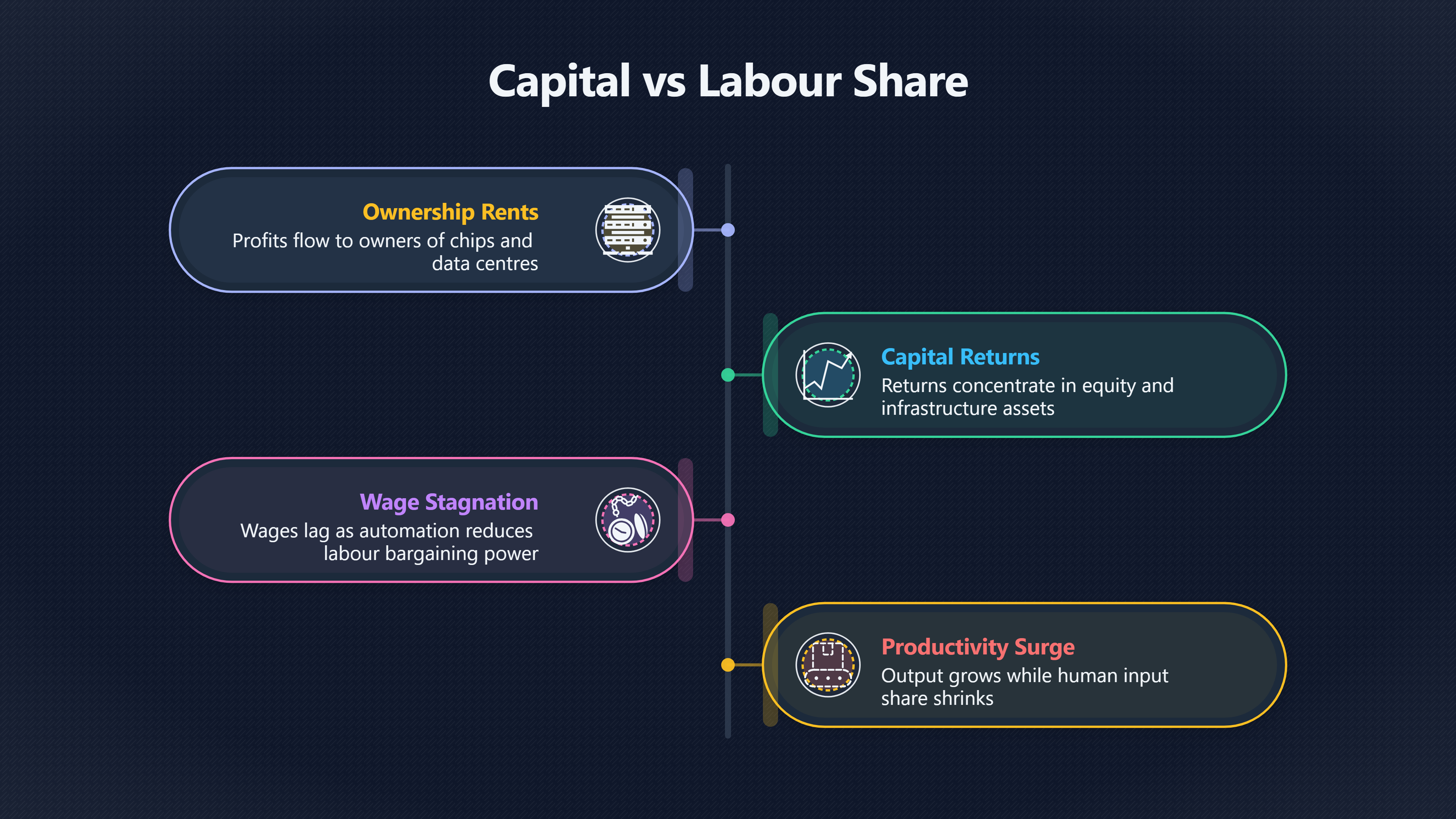
Modern economies distribute income through two broad channels: wages paid to labour, and returns paid to capital. Capital includes shares in companies, patents, land, data centres, chips, software infrastructure, and financial assets. Historically, industrialisation increased both wages and profits over time, though unevenly. The concern with advanced AI is that it may shift the balance more sharply towards capital ownership than previous technologies did.
Economists studying transformative AI increasingly focus on the possibility of a falling “labour share”: the proportion of economic output that goes to workers rather than owners. Research discussed by Anton Korinek and Erik Brynjolfsson argues that advanced AI could automate a large share of cognitive labour, weakening workers’ bargaining position even while overall productivity rises. [Brookings]brookings.eduHow generative AI will power the coming productivity boomBrookingsHow generative AI will power the coming productivity boomMay 5, 2023 — Martin Baily, Erik Brynjolfsson, and Anton Korinek discus… [NBER]nber.orgormation since the Industrial Revolution.Read more…
This is not only a theoretical concern. A 2025 study of European regions found that greater AI innovation correlated with a measurable decline in labour’s share of income, suggesting that AI behaves as a “capital-biased” technology that increases returns to ownership more than returns to work. [ScienceDirect]sciencedirect.comScienceDirectAI innovation and the labor share in European regionsby A Minniti · 2025 · Cited by 30 — This paper examines how the develop…
The distinction matters because ownership is far more concentrated than labour income in most societies. Millions of people earn wages. Far fewer own substantial equity stakes in frontier AI firms, semiconductor manufacturers, hyperscale cloud providers, or the infrastructure funds financing AI data centres. If AI systems can increasingly perform valuable economic tasks with limited human labour input, then profits may scale faster than payrolls.
Some economists modelling transformative AI go even further. Philip Trammell and Anton Korinek argue that if AI systems become highly substitutable for human cognitive work, economies could experience explosive growth alongside a “vanishing labour share”. In plain language: production could surge while human workers capture a shrinking fraction of the value created. [philiptrammell.com]philiptrammell.comegtai newEconomic Growth under Transformative AIApril 11, 2026 — by P Trammell · 2025 · Cited by 159 — Section 2 examines the im- plications of au…
That does not automatically mean mass immiseration. AI could still reduce the cost of goods, healthcare, energy, education, and services dramatically. But it does imply that ownership structures may matter more than traditional employment relationships in determining who benefits most from an AI-rich economy.
Why AI may reward ownership more than labour
Several mechanisms push advanced AI towards concentrated capital returns rather than broad wage growth.
AI systems can substitute for cognitive labour
Previous industrial revolutions mainly automated physical effort. AI targets cognitive tasks: writing, coding, research, analysis, design, diagnosis, customer support, and increasingly forms of decision-making itself.
If AI acts mainly as a tool that enhances workers, wages may rise. RAND researchers note substantial evidence that AI can augment labour by helping people work faster and better. [RAND Corporation]rand.orgRAND CorporationThe Dynamics Behind Artificial Intelligence's Impact on…December 1, 2025 — One pathway through which AI could boost pr… But if systems become capable enough to replace large amounts of routine and even advanced cognitive work, then firms may need fewer workers relative to the capital they own.
This changes the bargaining balance. A company that depends heavily on scarce human expertise must compete for talent. A company that can scale automated systems globally at near-zero marginal labour cost may instead direct more income towards shareholders, infrastructure spending, and intellectual property.
AI scales like software
One successful AI model can serve millions or billions of users simultaneously. That creates “winner-takes-most” dynamics familiar from earlier digital platforms, but potentially on a larger scale.
Once a frontier model exists, the cost of distributing its outputs is often much lower than the cost of training it. This allows successful firms to capture enormous global markets with relatively small workforces compared with traditional industrial giants.
The largest gains therefore may not come from hiring millions of employees, but from controlling scalable systems that can repeatedly generate value with limited incremental labour input.
Compute infrastructure behaves like a bottleneck
AI depends on scarce physical infrastructure: advanced semiconductors, energy systems, networking, and data centres. These are capital-intensive industries with high barriers to entry.
Nvidia’s recent financial performance illustrates the scale of these rents. Its data-centre revenue reached $75.2 billion in a single quarter as AI demand surged globally. [The Guardian]theguardian.comThis surge was largely driven by explosive growth in its datacenter segment, which posted a 92% year-over-year increase to $75.2 billion… Meanwhile, firms and investors are committing hundreds of billions to AI infrastructure build-outs. [Goldman Sachs]goldmansachs.comGoldman Sachs The Assumptions Shaping the Scale of the AI Build-OutGoldman SachsThe Assumptions Shaping the Scale of the AI Build-OutMay 1, 2026 — 1 May 2026 — The most critical assumptions for the level… [The Guardian]theguardian.comThis surge was largely driven by explosive growth in its datacenter segment, which posted a 92% year-over-year increase to $75.2 billion…
Ownership of these bottlenecks can generate extraordinary profits even if ordinary wages across the economy grow slowly.
Data and feedback loops create compounding advantages
AI systems improve through access to data, users, and compute. Firms with large customer bases can often improve their systems faster, attracting more users and generating more data in return.
Recent economic modelling describes this as a “data flywheel” that can push AI markets towards winner-takes-all outcomes. [arXiv]arxiv.orgarXiv Economic Policy Challenges for the Age of AIarXiv Economic Policy Challenges for the Age of AI Once a company reaches sufficient scale, its advantages may compound faster than smaller rivals can catch up.
That dynamic resembles earlier platform monopolies, but AI systems may become even more deeply embedded into research, education, administration, logistics, and scientific discovery.
Who owns the bottlenecks
The AI economy is not evenly distributed across society. Ownership is concentrated in specific layers.
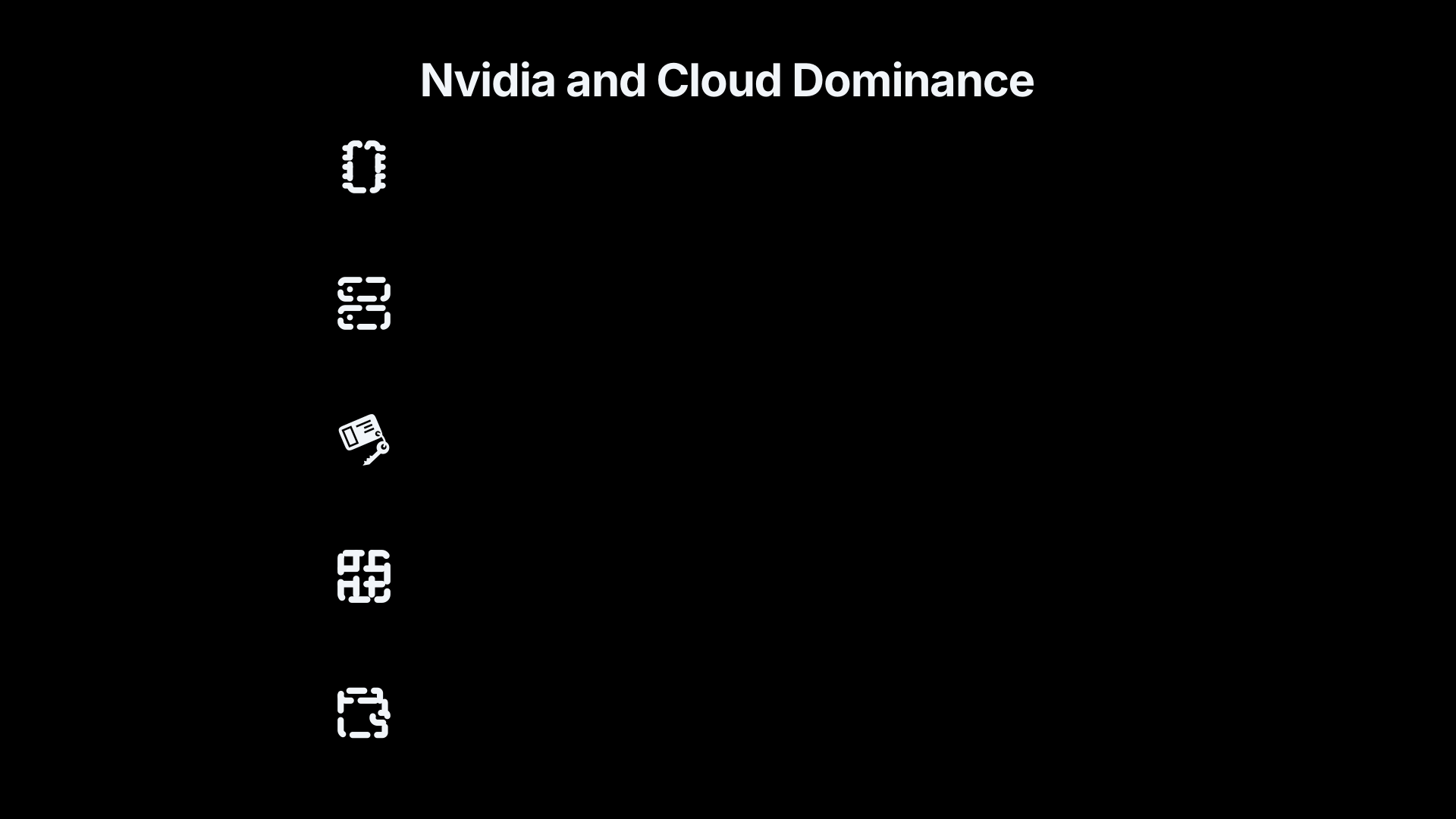
Semiconductor firms
Advanced AI training relies heavily on a small number of chipmakers, especially Nvidia. Demand for AI accelerators has created one of the largest capital concentration events in recent technology history. [The Guardian]theguardian.comThis surge was largely driven by explosive growth in its datacenter segment, which posted a 92% year-over-year increase to $75.2 billion…
This matters because semiconductor profits can become a toll on the entire AI economy. Every major model developer, cloud platform, robotics company, or scientific AI project depends on compute access.
Cloud providers and data centres
Most frontier AI development depends on a handful of cloud firms with global-scale infrastructure. Partnerships between Microsoft and OpenAI, Amazon and Anthropic, and Google and Anthropic have attracted scrutiny from regulators concerned about concentration and lock-in. [Federal Trade Commission]ftc.govFederal Trade Commission Partnerships Between Cloud Service Providers and AIFederal Trade CommissionPartnerships Between Cloud Service Providers and AI…January 17, 2025 — 4.5.1 - The partnerships offer CSP part…
Cloud dominance creates several forms of leverage simultaneously:
- control over compute access
- privileged access to AI developers
- long-term contractual dependence [reuters.com]reuters.comMassive AI-driven capital expenditures—estimated at $7.6 trillion over five years—are shifting financial markets, prompting reassessments…
- influence over pricing and deployment
- ownership of the infrastructure layer
The result is an economy where the owners of computational infrastructure may resemble the owners of railroads, oil pipelines, or electrical grids during earlier industrial eras.
Intellectual property holders
Patents, proprietary models, training data, and closed ecosystems can also generate durable rents.
If the most capable AI systems remain closed and centrally controlled, then access to advanced intelligence itself may become a paid service. In that scenario, firms owning frontier models effectively operate gateways to cognitive capability.
That could shape who benefits from accelerated science and productivity. Wealthy firms and states may gain access first to advanced discovery systems for medicine, engineering, defence, and research, while poorer institutions remain dependent customers.
Financial ownership itself
Even when AI productivity spreads widely, the gains may still flow disproportionately to asset owners because stock ownership is already concentrated.
If AI dramatically increases corporate profitability, stock market gains could become one of the main transmission channels through which AI wealth appears. But in many countries, wealthier households own most equities directly or indirectly.
This creates a paradox. AI could make civilisation vastly more productive while simultaneously deepening inequality unless ownership broadens alongside productivity.
Why this matters for the AI bloom vision
The optimistic case for AI is not merely that GDP rises. It is that humanity gains the ability to overcome major constraints: disease, scarcity, dangerous labour, scientific stagnation, environmental damage, and perhaps eventually biological and planetary limits themselves.
But concentrated ownership can distort that trajectory in several ways.
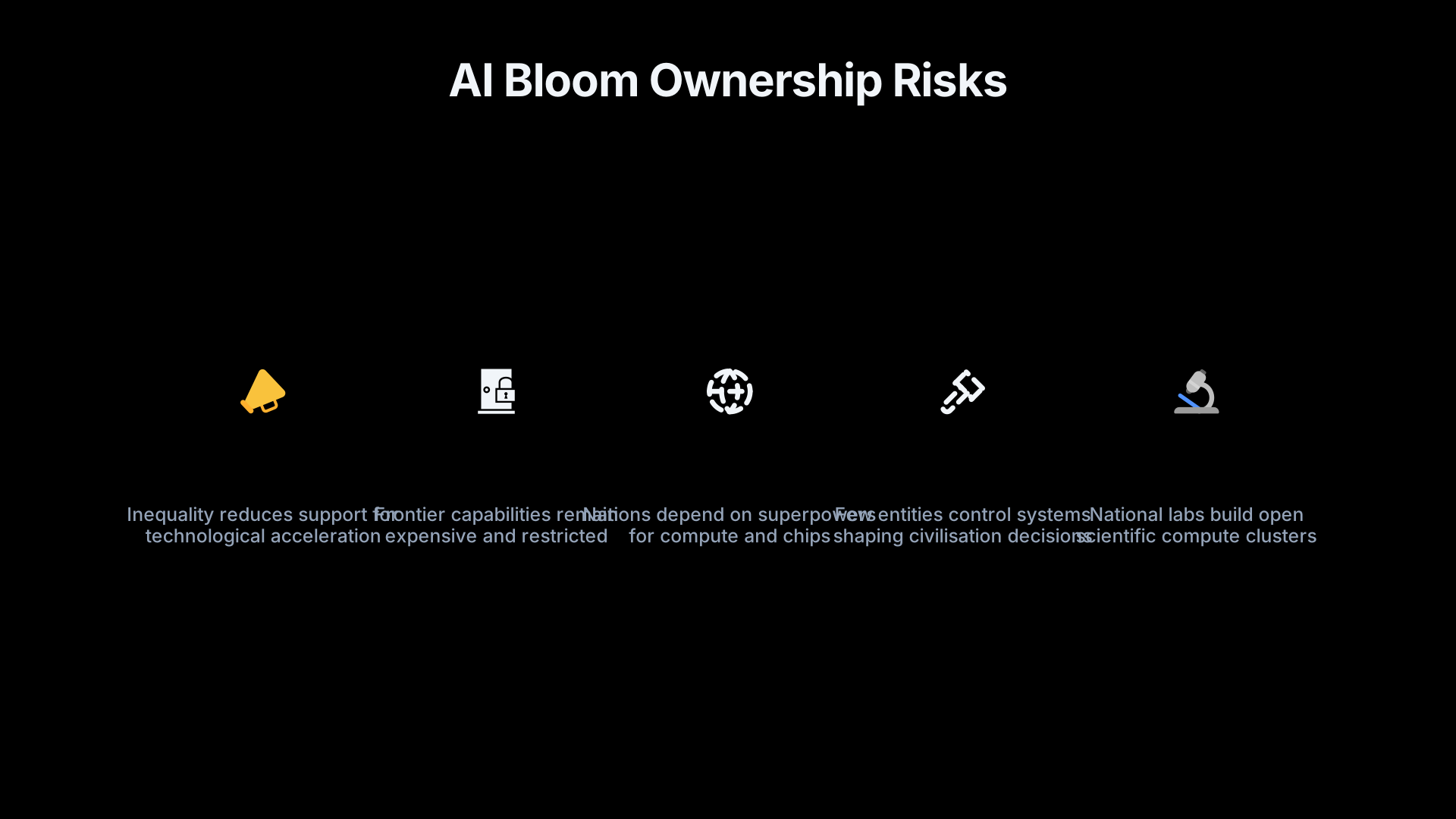
First, it may reduce political support for continued technological acceleration. If most people experience AI mainly as insecurity while a small class accumulates extraordinary wealth, backlash becomes more likely.
Second, concentration can slow diffusion. Frontier capabilities may remain expensive, restricted, or strategically controlled rather than becoming broadly available public infrastructure.
Third, concentrated AI ownership may produce geopolitical instability. Countries without compute infrastructure, chip supply chains, or advanced models could become dependent on a small number of AI superpowers.
Finally, concentration affects civilisation-scale decision-making itself. If a few corporations or states control systems capable of accelerating science, automating cyber operations, influencing information flows, or shaping economic coordination, then the governance question becomes inseparable from the ownership question.
A future of abundant intelligence is not automatically a future of distributed power.
Ways to broaden ownership
The debate is not simply between total concentration and forced equality. Many institutional choices could spread AI gains more widely while preserving incentives for innovation.
Wider capital ownership
If AI wealth increasingly arrives through profits and equity appreciation, then broader ownership of productive assets becomes more important.
Possible mechanisms include:
- public pension ownership of AI-linked assets
- sovereign wealth funds
- employee ownership schemes
- universal savings accounts
- public stakes in national AI infrastructure
- broader retail access to long-term capital growth
Some commentators compare this to earlier eras when industrial wealth flowed primarily to factory owners or oil producers. The difference is that AI systems may scale globally much faster.
Public compute and open infrastructure
Governments and universities may reduce concentration by supporting public AI infrastructure rather than relying entirely on private platforms.
Public compute clusters, open scientific models, shared research infrastructure, and national laboratories could help universities, hospitals, startups, and smaller countries participate in advanced AI development.
Nvidia’s partnerships with U.S. national laboratories show how infrastructure can also be directed towards scientific and public-interest uses rather than purely commercial applications. [NVIDIA Newsroom]nvidianews.nvidia.compartners ai infrastructure americaDepartment of Energy's national labs and the nation's leading companies to build…
Competition policy
Regulators increasingly worry that AI markets could become structurally closed before competition fully develops.
The FTC and OECD have both highlighted risks involving cloud dependence, sensitive information sharing, switching costs, and vertically integrated AI ecosystems. [Federal Trade Commission]ftc.govFederal Trade Commission Partnerships Between Cloud Service Providers and AIFederal Trade CommissionPartnerships Between Cloud Service Providers and AI…January 17, 2025 — 4.5.1 - The partnerships offer CSP part…
Competition policy may therefore shape whether AI becomes a relatively open platform ecosystem or a tightly controlled set of corporate empires.
Tax and redistribution systems
If AI productivity eventually weakens labour’s role in income distribution, then societies may rely more heavily on taxes tied to profits, capital gains, or resource rents rather than wages alone.
That does not necessarily imply a single radical policy like universal basic income. The more practical issue is whether states can still fund healthcare, education, science, infrastructure, and social stability if labour income becomes a smaller share of national output.
The deeper question behind AI profits
The argument that AI profits may matter more than AI wages is ultimately about the structure of a post-scarcity economy.
If advanced AI and robotics can generate immense abundance with relatively little human labour, then ownership becomes central. The decisive divide may no longer be between high-skill and low-skill workers, but between those who own productive AI systems and those who merely access them temporarily.
That possibility does not invalidate the broader AI bloom vision. In fact, it highlights what the optimistic case truly requires. A civilisation with superhuman scientific tools, automated production, radical medical advances, and abundant intelligence could become vastly more prosperous than the present world. But whether that prosperity translates into broad human flourishing depends heavily on governance, competition, institutional design, and the distribution of ownership itself.
The future may not be determined only by how intelligent AI becomes, but by who owns the machines that think.
Endnotes
-
Source: brookings.edu
Title: How generative AI will power the coming productivity boom
Link: https://www.brookings.edu/?p=1687743&post_type=article&preview_id=1687743Source snippet
BrookingsHow generative AI will power the coming productivity boomMay 5, 2023 — Martin Baily, Erik Brynjolfsson, and Anton Korinek discus...
Published: May 5, 2023
-
Source: nber.org
Link: https://www.nber.org/reporter/2024number4/economics-transformative-aiSource snippet
ormation since the Industrial Revolution.Read more...
-
Source: arxiv.org
Title: arXiv Economic Policy Challenges for the Age of AI
Link: https://arxiv.org/abs/2409.13168 -
Source: sciencedirect.com
Link: https://www.sciencedirect.com/science/article/pii/S0014292125000935Source snippet
ScienceDirectAI innovation and the labor share in European regionsby A Minniti · 2025 · Cited by 30 — This paper examines how the develop...
-
Source: philiptrammell.com
Title: egtai new
Link: https://philiptrammell.com/static/egtai_new.pdfSource snippet
Economic Growth under Transformative AIApril 11, 2026 — by P Trammell · 2025 · Cited by 159 — Section 2 examines the im- plications of au...
Published: April 11, 2026
-
Source: rand.org
Link: https://www.rand.org/content/dam/rand/pubs/perspectives/PEA4300/PEA4392-1/RAND_PEA4392-1.pdfSource snippet
RAND CorporationThe Dynamics Behind Artificial Intelligence's Impact on...December 1, 2025 — One pathway through which AI could boost pr...
Published: December 1, 2025
-
Source: arxiv.org
Link: https://arxiv.org/abs/2601.12339Source snippet
arXivThe Economics of Digital Intelligence Capital: Endogenous Depreciation and the Structural Jevons ParadoxJanuary 18, 2026...
Published: January 18, 2026
-
Source: ftc.gov
Title: Federal Trade Commission Partnerships Between Cloud Service Providers and AI
Link: https://www.ftc.gov/system/files/ftc_gov/pdf/p246201_aipartnerships6breport_redacted_0.pdfSource snippet
Federal Trade CommissionPartnerships Between Cloud Service Providers and AI...January 17, 2025 — 4.5.1 - The partnerships offer CSP part...
Published: January 17, 2025
-
Source: oecd.org
Title: component 7
Link: https://www.oecd.org/en/publications/competition-in-artificial-intelligence-infrastructure_623d1874-en/full-report/component-7.htmlSource snippet
Sources: US FTC (...Read more...
-
Source: nvidianews.nvidia.com
Title: partners ai infrastructure america
Link: https://nvidianews.nvidia.com/news/nvidia-partners-ai-infrastructure-americaSource snippet
Department of Energy's national labs and the nation's leading companies to build...
-
Source: oecd.org
Link: https://www.oecd.org/content/dam/oecd/en/publications/reports/2024/04/the-impact-of-artificial-intelligence-on-productivity-distribution-and-growth_d54e2842/8d900037-en.pdfSource snippet
The impact of Artificial Intelligence on productivity...by F Filippucci · 2024 · Cited by 161 — This paper explores the economics of Ar...
-
Source: theguardian.com
Link: https://www.theguardian.com/technology/2026/may/20/nvidia-revenue-ai-boomSource snippet
This surge was largely driven by explosive growth in its datacenter segment, which posted a 92% year-over-year increase to $75.2 billion...
-
Source: goldmansachs.com
Title: Goldman Sachs The Assumptions Shaping the Scale of the AI Build-Out
Link: https://www.goldmansachs.com/insights/articles/tracking-trillions-the-assumptions-shaping-scale-of-the-ai-build-outSource snippet
Goldman SachsThe Assumptions Shaping the Scale of the AI Build-OutMay 1, 2026 — 1 May 2026 — The most critical assumptions for the level...
Published: May 1, 2026
-
Source: theguardian.com
Title: The Guardian Boom or bubble?
Link: https://www.theguardian.com/technology/2025/nov/02/global-datacentre-boom-investment-debtSource snippet
Inside the $3tn AI datacentre spending...2 Nov 2025 — Over the next two years they are expected to spend more than $750bn on AI-related...
-
Source: linkedin.com
Title: Erik Brynjolfsson
Link: https://www.linkedin.com/posts/erikbrynjolfsson_advances-in-ai-have-been-breathtaking-with-activity-7377490741373280256-iSy4Source snippet
How to study the economic impact of AITheir research agenda on the economics of transformative AI highlights nine key challenges – from g...
Additional References
-
Source: medium.com
Link: https://medium.com/%40markchen69/ai-industry-capital-loops-and-economic-impacts-a-comprehensive-analysis-bb9115c67029Source snippet
AI Industry Capital Loops and Economic ImpactsThe rapid rise of artificial intelligence has sparked a financial and economic whirlwind. O...
-
Source: facebook.com
Link: https://www.facebook.com/Reuters/posts/blackrock-nvidia-backed-group-strikes-40-billion-ai-data-center-dealclick-the-li/1362313112426084/Source snippet
BlackRock, Nvidia-backed group strikes $40 billion AI data...AI Industrial Revolution Gains Momentum as Nvidia and Foxconn Forge Strateg...
-
Source: reuters.com
Link: https://www.reuters.com/commentary/reuters-open-interest/bond-yields-may-finally-be-baking-an-ai-world-2026-05-20/Source snippet
Massive AI-driven capital expenditures—estimated at $7.6 trillion over five years—are shifting financial markets, prompting reassessments...
-
Source: ft.com
Link: https://www.ft.com/content/c6b362b8-ab6b-4723-af48-28082bdfcac2Source snippet
Led by CEO Jensen Huang, the company has distributed funds across more than 145 companies, ranging from AI developers and cloud providers...
-
Source: reuters.com
Link: https://www.reuters.com/business/retail-consumer/nvidia-forecasts-quarterly-revenue-above-estimates-announces-80-billion-share-2026-05-20/Source snippet
The company projects $91 billion in revenue, exceeding Wall Street's $86.84 billion estimate. Despite slightly dipping 0.2% in after-hour...
-
Source: man.com
Link: https://www.man.com/insights/the-ai-bubbleSource snippet
The AI Bubble: Hidden Risks and OpportunitiesAI technology is transformative and here to stay. But the inflated financial architecture su...
-
Source: reuters.com
Link: https://www.reuters.com/legal/transactional/nvidia-ceos-foundation-buys-108-million-ai-computing-coreweave-donates-it-2026-05-13/Source snippet
This initiative includes free engineering services provided by Nvidia to some recipients. The move highlights Huang’s philanthropy while...
-
Source: ainowinstitute.org
Title: 2 heads i win tails you lose how tech companies have rigged the ai market
Link: https://ainowinstitute.org/publications/2-heads-i-win-tails-you-lose-how-tech-companies-have-rigged-the-ai-marketSource snippet
2: Heads I Win, Tails You Lose: How Tech Companies...3 Jun 2025 — This section maps the drivers that are securing Big Tech firms' advant...
-
Source: youtube.com
Link: https://www.youtube.com/watch?v=9-eIkyr2UZM -
Source: bfi.uchicago.edu
Title: data centers and local economies in the age of ai a shift share approach
Link: https://bfi.uchicago.edu/working-papers/data-centers-and-local-economies-in-the-age-of-ai-a-shift-share-approach/Source snippet
Centers and Local Economies in the Age of AI: A Shift...12 May 2026 — Data centers are the physical infrastructure behind cloud computin...
Published: May 2026
Amazon book picks
Further Reading
Books and field guides related to AI Profits and Ownership. Use these as the next step if you want deeper reading beyond the article.

Cutting Edge
The rapid expansion of laborless production systems creates enormous instability. Money previously paid in wages is spent on technology....

Cyber-Marx
In this highly readable and thought-provoking work, Nick Dyer-Witheford assesses the relevance of Marxism in our time and demonstrates ho...

The Critique of Digital Capitalism
Anything that can be automated, will be. The "magic" that digital technology has brought us - self-driving cars, Bitcoin, high frequency...

The Distribution of Wealth – Growing Inequality?
This book answers a number of important questions about the distribution of wealth among people and the way that this distribution has ch...
eBay marketplace picks
Marketplace Samples
Example marketplace items related to this page. Use the search link to explore similar finds on eBay.

Example eBay listing
A.I. Artificial Intelligence Original Movie Poster Signed By Jude Law
USD 125.00 | Shipping USD 25.00 | US

Example eBay listing
Artificial Intelligence D/S Original Movie Poster - 27 x 40"
USD 19.50 | Shipping USD 13.65 | US

Example eBay listing
612388 Artificial Intelligence Movie Science Fiction Drama Wall Print Poster
USD 22.95 | Shipping USD 12.95 | JP

Example eBay listing
Companion - Artificial Intelligence Dark Comedy Cinema Film - POSTER 20"x30"
USD 23.99 | Free shipping | US

Example eBay listing
The Worker Who Gets Drunk - 1930s Spanish Civil War Poster - 18x24
GBP 12.50 | Shipping GBP 13.78 | US

Example eBay listing
He Who Gets Slapped Poster - Lon Chaney Film Wall Art - 12X16/16X20/18X24/24X36
GBP 22.99 | Free shipping | GB

Example eBay listing
He Who Gets Slapped 1924 POSTER PRINT A5A1 Cult 20s Horror Cinema Film Wall Art
GBP 29.99 | Free shipping | GB

Example eBay listing
He Who Gets Slapped Poster Lon Chaney 1924 Old Movie Photo
GBP 5.41 | Shipping GBP 3.18 | AU
Topic Tree