Within Trusted warnings
The Texas flood lesson
The deadly Texas floods showed how accurate forecasts can still fail when local alerts, night-time communication, and preparedness break down.
On this page
- What forecasts got right
- Where the response chain broke
- Lessons for AI enabled disaster warning
Page outline Jump by section
Introduction
The July 2025 floods in Texas Hill Country became a grim demonstration of a wider problem in disaster preparedness: modern forecasting can work reasonably well while the warning system as a whole still fails catastrophically. Meteorologists identified the risk of dangerous flash flooding before the disaster unfolded. Emergency alerts were issued. River gauges showed rapidly rising water. Yet more than one hundred people still died, including children at riverside summer camps. [United Nations University]unu.educatastrophic texas flood science warned sirens stayed silentUnited Nations UniversityCatastrophic Texas Flood as Science Warned but Sirens…16 Jul 2025 — On the night of July 4, 2025, torrential… [Wikipedia That gap matters far beyond Texas. The broader promise of AI-enabled forecasting is that machine learning could help societies anticipate flo]WikipediaJuly 2025 Central Texas floodsJuly 2025 Central Texas floods ods, storms, fires, pandemics, and infrastructure failures earlier and more accurately than before. But the Texas floods showed that prediction is only one link in a longer chain involving institutions, trust, communication, local infrastructure, and human behaviour. A civilisation that can “see” danger earlier through AI still needs systems capable of turning foresight into coordinated action.
What forecasts got right
One of the most important facts about the Texas floods is that the disaster was not primarily caused by an absence of meteorological warning. Multiple analyses after the event argued that forecasters had correctly identified the risk of severe flash flooding in the region before the Guadalupe River surged. [United Nations University]unu.educatastrophic texas flood science warned sirens stayed silentUnited Nations UniversityCatastrophic Texas Flood as Science Warned but Sirens…16 Jul 2025 — On the night of July 4, 2025, torrential…
The National Weather Service issued flash flood warnings and escalating emergency notices as rainfall intensified overnight. Experts later pushed back against claims that meteorologists had been completely surprised by the event. Instead, the core issue was that the rainfall became extraordinarily intense and fast-moving in a region already known for extreme flash-flood risk. The Guardian [Science Media Centre]sciencemediacentre.orgexpert reaction to texas floods5 Jul 2025 — The devastating flooding in Texas yet again underlines the need for better early warning systems for these very intense stor…
This distinction matters because it clarifies what advanced forecasting systems can and cannot do.
Forecasting systems are increasingly capable of:
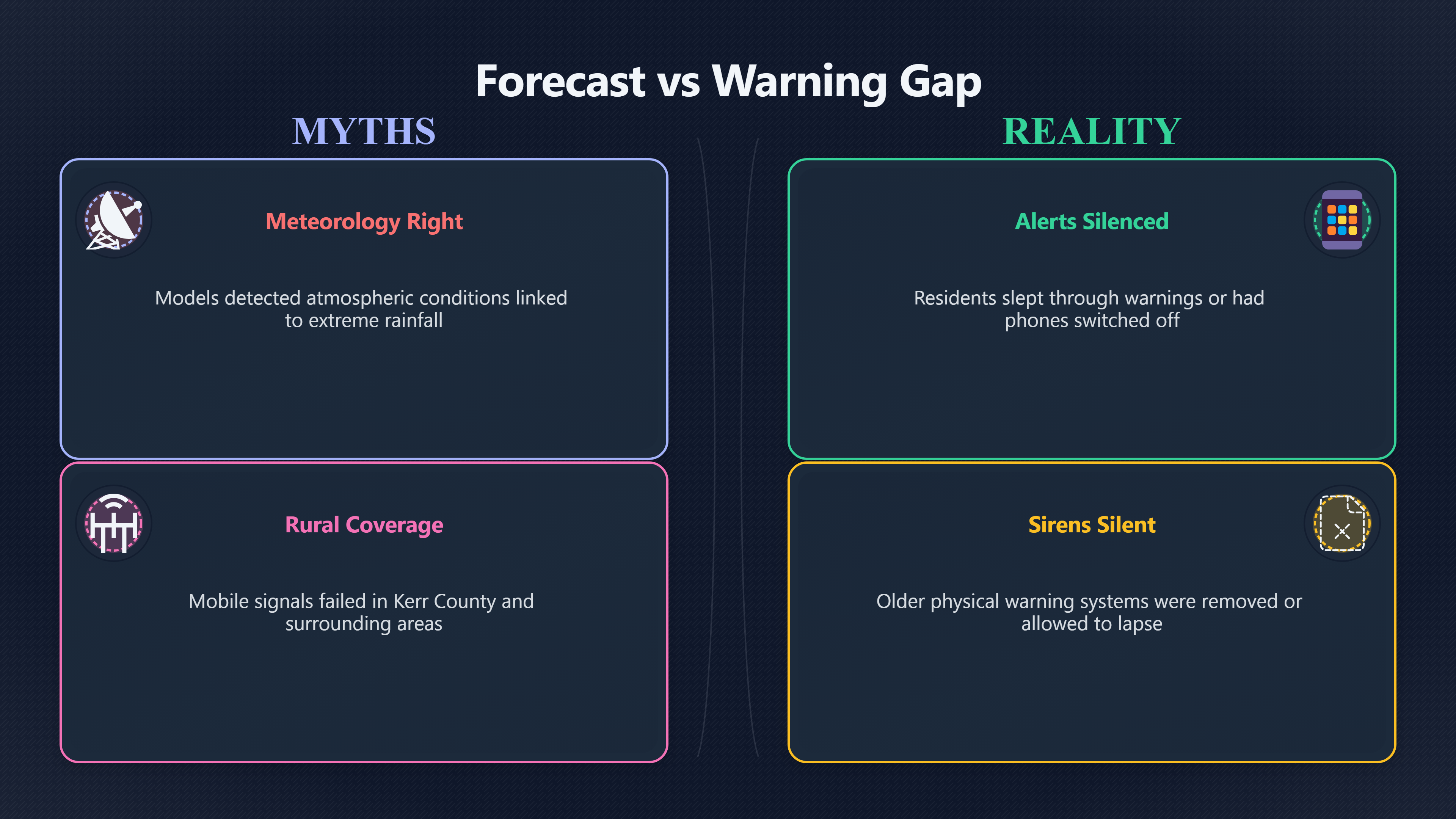
- detecting atmospheric conditions linked to extreme rainfall;
- modelling river rises faster than older systems;
- integrating satellite imagery, radar, and terrain data;
- updating risk assessments in near real time.
But even a highly accurate forecast does not automatically produce evacuation, public understanding, or survival. The Texas floods exposed the difference between a technically successful forecast and a socially successful warning system.
The event also highlighted a recurring feature of flash floods: timing. The most dangerous flooding occurred overnight and in the early morning hours, when many residents were asleep, travelling visibility was poor, and communication channels were weaker. [United Nations University]unu.educatastrophic texas flood science warned sirens stayed silentUnited Nations UniversityCatastrophic Texas Flood as Science Warned but Sirens…16 Jul 2025 — On the night of July 4, 2025, torrential…
For AI forecasting advocates, this is a critical lesson. Better predictive models may increase lead time from minutes to hours, or hours to days, but the usefulness of those gains depends on whether institutions and communities can act on them under real conditions: darkness, uncertainty, fatigue, poor mobile reception, and fragmented authority.
Where the response chain broke
The warning problem was local, not only technical
Post-disaster scrutiny focused heavily on Kerr County and surrounding communities along the Guadalupe River. Reports described a region that relied largely on mobile-phone alerts despite longstanding concerns about flash-flood vulnerability. [Wikipedia]WikipediaJuly 2025 Central Texas floodsJuly 2025 Central Texas floods
That dependence created several overlapping weaknesses:
- mobile coverage in rural areas was inconsistent;
- alerts arrived during sleeping hours;
- some residents had phones silenced or switched off;
- children at camps often did not possess phones at all;
- repeated emergency alerts in modern life may have reduced urgency or attention.
The result was not a total absence of warning, but a breakdown in the final stage of communication: ensuring that people actually received, trusted, and acted on the information.
This is a crucial distinction in disaster governance. A forecast exists at the level of data and models. A warning exists at the level of human behaviour.
Sirens, infrastructure, and institutional memory
One of the most striking details after the floods was that local debates about flood-warning infrastructure had existed for years. According to later reporting, earlier flood-warning systems had once been discussed or partially implemented in the region after previous deadly floods, including the 1987 Guadalupe River disaster. Some systems were later removed or allowed to lapse because of concerns about cost, maintenance, or false alarms. [Wikipedia]Wikipedia20252025 (MMXXV) was a common year starting on Wednesday of the Gregorian calendar, the 2025th year of the Common Era (CE) and Anno Do…
The floods therefore revealed something deeper than a sudden technical failure. They exposed long-term institutional drift.
Communities often know where their vulnerabilities are. The harder problem is sustaining political attention and funding across decades between disasters.
That challenge appears repeatedly across disaster preparedness:
- flood barriers deferred until after catastrophe;
- evacuation systems left underfunded;
- warning drills neglected during calm periods;
- agencies assuming that mobile technology has replaced physical infrastructure.
The Texas case illustrated how older technologies such as sirens may still matter precisely because they are blunt, redundant, and difficult to ignore.
One nearby community with an automated siren-linked flood warning system reportedly experienced no fatalities during the same flood event. [Wikipedia]WikipediaProject 2025Project 2025Project 2025 is a political initiative published in April 2023 by the Heritage Foundation with the goal of reshaping the U…
The implication is uncomfortable for a technology-focused worldview: sophisticated forecasting can fail socially if basic civic systems are weak.
Forecast uncertainty collided with public psychology
The floods also revealed a persistent difficulty in risk communication: people rarely experience probabilities emotionally.
Meteorologists may issue warnings about “once in a generation” or “catastrophic” flooding, but residents often interpret alerts through personal experience:
- “It flooded before and nothing happened.”
- “Warnings are always exaggerated.”
- “We’ve stayed here safely for years.”
- “The river usually rises slowly.”
This mismatch between statistical forecasting and lived intuition becomes especially dangerous during rare extremes.
Research on disaster warnings has long shown that false alarms can erode trust. But the opposite problem also exists: authorities may hesitate to communicate maximum danger because they fear overreaction, panic, or future credibility loss.
AI forecasting could intensify this tension. Machine learning systems may produce more granular, more frequent, and more probabilistic warnings. That may improve technical accuracy while simultaneously overwhelming public attention.
The Texas floods showed that the bottleneck is often not information scarcity but attention scarcity and trust scarcity.
Why the disaster matters for AI-enabled forecasting
Better prediction does not automatically create coordination
The broader AI bloom debate often assumes that better intelligence naturally leads to better outcomes. The Texas floods complicate that assumption.
Advanced AI systems may eventually help humanity predict many dangers earlier:
- extreme weather;
- crop failures;
- disease outbreaks;
- grid instability;
- wildfire spread;
- supply-chain shocks.
But the Texas case shows that civilisation also needs institutions capable of coordinated response under pressure.
An AI system might correctly forecast a deadly flood three days in advance. Yet survival still depends on questions such as:
- Who decides when to evacuate?
- Which warning channel reaches sleeping residents?
- Who pays for infrastructure upgrades?
- Which agency has authority?
- How do officials communicate uncertainty?
- What happens when warnings disrupt tourism or local business?
- Which communities are trusted by residents?
These are governance and coordination problems rather than prediction problems.

AI may widen the “last mile” problem
There is a paradox in modern forecasting. As predictive systems improve, the remaining failures become more concentrated in the “last mile” between information and action.
That last mile includes:
- public trust;
- emergency management capacity;
- local political incentives;
- communication design;
- infrastructure maintenance;
- behavioural psychology;
- inequality and access.
The Texas floods demonstrated how fragile that last mile can be.
This matters because many optimistic visions of AI-driven abundance assume that information bottlenecks are the primary constraint on human flourishing. Sometimes they are. But disasters repeatedly show that coordination bottlenecks can remain even after information improves dramatically.
A society may possess extraordinary predictive intelligence while still struggling to mobilise collective action quickly enough.
The human layer remains indispensable
One lesson from the floods is that resilience often depends on layered systems rather than singular technological breakthroughs.
Effective warning systems usually combine:
- forecasting models;
- local officials;
- physical infrastructure;
- trusted media;
- community networks;
- rehearsed emergency plans;
- public education;
- redundancy across communication channels.
AI may strengthen one layer enormously without replacing the others.
This is relevant to the larger question of whether advanced AI could help humanity flourish over the long term. The optimistic case for AI abundance depends not only on intelligence amplification, but on whether institutions can absorb and operationalise that intelligence safely and fairly.
The Texas floods therefore act as a small but vivid example of a broader civilisational challenge: foresight alone is not enough.

Lessons for AI-enabled disaster warning
Prediction systems should be designed around action
The Texas floods reinforced an increasingly important idea in disaster science: warnings should be designed around decisions, not only around meteorology.
A technically accurate prediction is insufficient if recipients do not know:
- what is happening;
- how unusual it is;
- what action is expected;
- how urgently they must act;
- whether evacuation is realistic.
Future AI warning systems may need to focus less on generating ever more data and more on translating risk into simple, trusted, actionable guidance.
[That could include:]theguardian.comtexas deadly floods could be new normalDeadly floods could be new normal as Trump guts federal…8 Jul 2025 — The deadly Texas floods could signal a new norm in the US, as Don…
- personalised evacuation instructions;
- geographically precise risk maps;
- multilingual alerts;
- automatic escalation systems;
- integration with transport and infrastructure systems;
- adaptive warnings calibrated to local vulnerability.
But technology alone cannot guarantee legitimacy or compliance.
Redundancy matters more than elegance
Modern societies often assume newer communication technologies automatically replace older ones. The Texas floods challenged that assumption.
Phone alerts are flexible and cheap, but they also depend on:
- network connectivity;
- charged devices;
- notification settings;
- human attention.
Sirens are crude by comparison, but they are difficult to miss and operate collectively rather than individually.
The broader lesson is that resilient systems usually rely on redundancy rather than elegance. AI-enhanced forecasting may be most effective when paired with low-tech but robust communication infrastructure.
Trust is infrastructure too
One of the deepest lessons from the disaster is that trust itself functions as a form of infrastructure.
Communities act faster when they believe:
- warnings are credible;
- institutions are competent;
- authorities are transparent;
- previous alerts were justified;
- evacuation plans are realistic.
Without trust, even accurate predictions can fail behaviourally.
This insight extends well beyond floods. Future AI systems may help governments anticipate economic shocks, pandemics, or environmental crises with unprecedented sophistication. But public response will still depend heavily on institutional legitimacy and social cohesion.
The Texas floods showed how difficult that translation can be in practice.
The wider warning for an AI-enabled future
The Texas floods were not a referendum on AI forecasting itself. Better predictive systems still save lives and will likely become increasingly important as climate extremes intensify. But the disaster exposed a recurring misunderstanding in technological optimism: knowing more is not the same as coordinating better.
The wider promise of AI bloom is that advanced intelligence could help humanity overcome many longstanding limits, from disease to material scarcity to scientific stagnation. Yet disasters like the Texas floods suggest that one of civilisation’s hardest problems may remain collective action under uncertainty.
The challenge is not only building systems that can predict danger. It is building societies capable of hearing, trusting, and acting on what those systems say. The Guardian [United Nations University]unu.educatastrophic texas flood science warned sirens stayed silentUnited Nations UniversityCatastrophic Texas Flood as Science Warned but Sirens…16 Jul 2025 — On the night of July 4, 2025, torrential… [Wikipedia]WikipediaJuly 2025 Central Texas floodsJuly 2025 Central Texas floods
Endnotes
-
Source: Wikipedia
Title: July 2025 Central Texas floods
Link: https://en.wikipedia.org/wiki/July_2025_Central_Texas_floods
Published: July 2025 -
Source: Wikipedia
Link: https://en.wikipedia.org/wiki/2025Source snippet
20252025 (MMXXV) was a common year starting on Wednesday of the Gregorian calendar, the 2025th year of the Common Era (CE) and Anno Do...
-
Source: Wikipedia
Title: Project 2025
Link: https://en.wikipedia.org/wiki/Project_2025Source snippet
Project 2025Project 2025 is a political initiative published in April 2023 by the Heritage Foundation with the goal of reshaping the U...
Published: April 2023
-
Source: unu.edu
Title: catastrophic texas flood science warned sirens stayed silent
Link: https://unu.edu/inweh/article/catastrophic-texas-flood-science-warned-sirens-stayed-silentSource snippet
United Nations UniversityCatastrophic Texas Flood as Science Warned but Sirens...16 Jul 2025 — On the night of July 4, 2025, torrential...
Published: July 4, 2025
-
Source: sciencemediacentre.org
Title: expert reaction to texas floods
Link: https://www.sciencemediacentre.org/expert-reaction-to-texas-floods/Source snippet
5 Jul 2025 — The devastating flooding in Texas yet again underlines the need for better early warning systems for these very intense stor...
Additional References
-
Source: theguardian.com
Title: national weather service cuts texas flooding
Link: https://www.theguardian.com/commentisfree/2025/jul/08/national-weather-service-cuts-texas-floodingSource snippet
NWS and the National Oceanic and Atmospheric Administration, its parent organization, inevitably led to the failure in Texas.” They link...
-
Source: appliedsciences.nasa.gov
Title: texas flooding july 2025
Link: https://appliedsciences.nasa.gov/what-we-do/disasters/disasters-activations/texas-flooding-july-2025Source snippet
Flooding July 20254 Jul 2025 — Map of UAVSAR imagery collected from the July 2025 Texas floods. This map shows classifications that help...
Published: july 2025
-
Source: theguardian.com
Title: texas deadly floods could be new normal
Link: https://www.theguardian.com/us-news/2025/jul/08/texas-deadly-floods-could-be-new-normalSource snippet
Deadly floods could be new normal as Trump guts federal...8 Jul 2025 — The deadly Texas floods could signal a new norm in the US, as Don...
-
Source: youtube.com
Link: https://www.youtube.com/watch?v=tPfmAdxv1IoSource snippet
Central Texas Floods 2025: Stories from the Hill Country | Band Together Texas...
-
Source: disastertechlab.org
Title: texas flood 2025 response
Link: https://disastertechlab.org/texas-flood-2025-response/Source snippet
10 Jul 2025 — In July 2025, severe flash floods swept through Central Texas, particularly along the Guadalupe River in Kerr County. The d...
Published: July 2025
-
Source: facebook.com
Link: https://www.facebook.com/NOAASatellites/videos/in-the-early-hours-of-july-4-2025-a-devastating-flash-flood-occurred-in-the-texa/1138194188271008/Source snippet
July 4, 2025, a devastating flash flood...In the early hours of July 4, 2025, a devastating flash flood occurred in the Texas Hill Count...
Published: July 4, 2025
-
Source: youtube.com
Link: https://www.youtube.com/watch?v=2XbwJxbKXDMSource snippet
Ex-NOAA official...The National Weather Service says it had enough staff that its alerts went out they've given us the timeline but we d...
-
Source: britannica.com
Title: 2025 Year in Review
Link: https://www.britannica.com/topic/2025-Year-in-ReviewSource snippet
2025: Year in Review | Pop Culture, Images, Current...In 2025 numerous countries—such as the United States, Canada, and Germany—installe...
-
Source: tvguide.co.uk
Title: best scottish premiership goals 2025 26
Link: https://www.tvguide.co.uk/schedule/1d93544e-d767-513d-92bb-44b5a1092072/best-scottish-premiership-goals-2025-26Source snippet
Best Scottish Premiership Goals 2025/26 on Sky Sports Football: full details and when it's on...
-
Source: youtube.com
Link: https://www.youtube.com/watch?v=mQvn7KgiVNASource snippet
July 4th Catastrophic Floods in Texas! 7/4/2025...
Amazon book picks
Further Reading
Books and field guides related to The Texas flood lesson. Use these as the next step if you want deeper reading beyond the article.
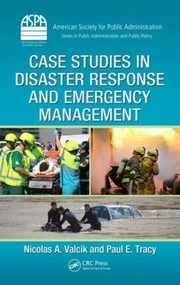
Case Studies In Disaster Response And Emergency Management
First published 2013. Subjects: Emergency management, Case studies, POLITICAL SCIENCE / Public Policy / City Planning & Urban Development...

Emergency management
First published 2007. Subjects: Emergency management, Hazard mitigation, Natural disasters.

Information systems for emergency management
First published 2010. Subjects: Emergency management, Data processing, Management information systems, Information services, Emergency co...

Introduction to emergency management
First published 2003. Subjects: Emergency management, Etat d'urgence, Secours d'urgence, Gestion de crises, Information management.
eBay marketplace picks
Marketplace Samples
Example marketplace items related to this page. Use the search link to explore similar finds on eBay.

Example eBay listing
A.I. Artificial Intelligence Original Movie Poster Signed By Jude Law
USD 125.00 | Shipping USD 25.00 | US
Example eBay listing
Artificial Intelligence D/S Original Movie Poster - 27 x 40"
USD 19.50 | Shipping USD 13.65 | US

Example eBay listing
612388 Artificial Intelligence Movie Science Fiction Drama Wall Print Poster
USD 22.95 | Shipping USD 12.95 | JP

Example eBay listing
Companion - Artificial Intelligence Dark Comedy Cinema Film - POSTER 20"x30"
USD 23.99 | Free shipping | US

Example eBay listing
A.I. Artificial Intelligence Movie Film Poster Art Print
GBP 4.99 | Free shipping | GB

Example eBay listing
A I Artificial Intelligence 6 Movie Poster Art Print Print Classic Rare Gallery
GBP 49.00 | Free shipping | GB

Example eBay listing
AI - Artificial Intelligence (Poster + Slipcase) Blu-Ray
GBP 10.49 | Free shipping | GB

Example eBay listing
A. I. Artificial Intelligence. Jude Law. Original UK Video Poster.
GBP 8.11 | Shipping GBP 3.38 | GB
Topic Tree