Within Autonomous Labs
From lab success to scale
A material that works in a tiny automated experiment may still fail on cost, durability, safety, scale, or manufacturing practicality.
On this page
- Why synthesis success is only the first hurdle
- Manufacturing, durability, and safety constraints
- What this means for batteries, catalysts, and clean energy
Page outline Jump by section
Introduction
A material can look revolutionary in an AI-driven laboratory and still fail completely in industry. That gap between “it worked once in a controlled experiment” and “it can be manufactured safely and cheaply at massive scale” is one of the central bottlenecks in modern materials science. Autonomous laboratories and machine-learning systems are becoming much better at proposing and synthesising new compounds, especially for batteries, catalysts and clean-energy technologies. But industrial success depends on far more than producing a promising crystal in a robotic experiment.
 The problem matters because many of the largest hopes associated with AI-enabled scientific acceleration — cheaper energy, better batteries, cleaner industry, advanced semiconductors and lower material scarcity — depend not merely on discovery, but on deployment. A compound that cannot survive manufacturing, maintain performance over years, meet safety rules, or compete economically does little to change civilisation-scale constraints. The history of materials science is full of examples where laboratory excitement collapsed during scale-up, sometimes after billions in investment. Autonomous labs may shorten discovery cycles, but they do not remove the underlying physics, engineering and economic realities that determine whether a material becomes useful in the real world. Nature [2worksinprogress.co]worksinprogress.cogetting materials out of the lab17 May 2024 — Essentially, the system of discovery sets up scaling for failure by not creating materials without any consideration of the…
From synthesis success to industrial reality
The recent excitement around autonomous materials laboratories comes from their ability to close one important gap: turning computational predictions into real physical samples. Systems such as Berkeley Lab’s A-Lab combine robotics, machine learning and automated analysis to synthesise compounds far faster than traditional manual workflows. In one widely discussed demonstration, the platform produced dozens of predicted inorganic materials during continuous operation. Nature [Dim Materre]dim-materre.fran autonomous laboratory for the accelerated synthesis of novel materialsAn autonomous laboratory for the accelerated synthesis of…29 Nov 2023 — Over 17 days of continuous operation, the A-Lab realized 41 no…
But synthesis is only the first hurdle.
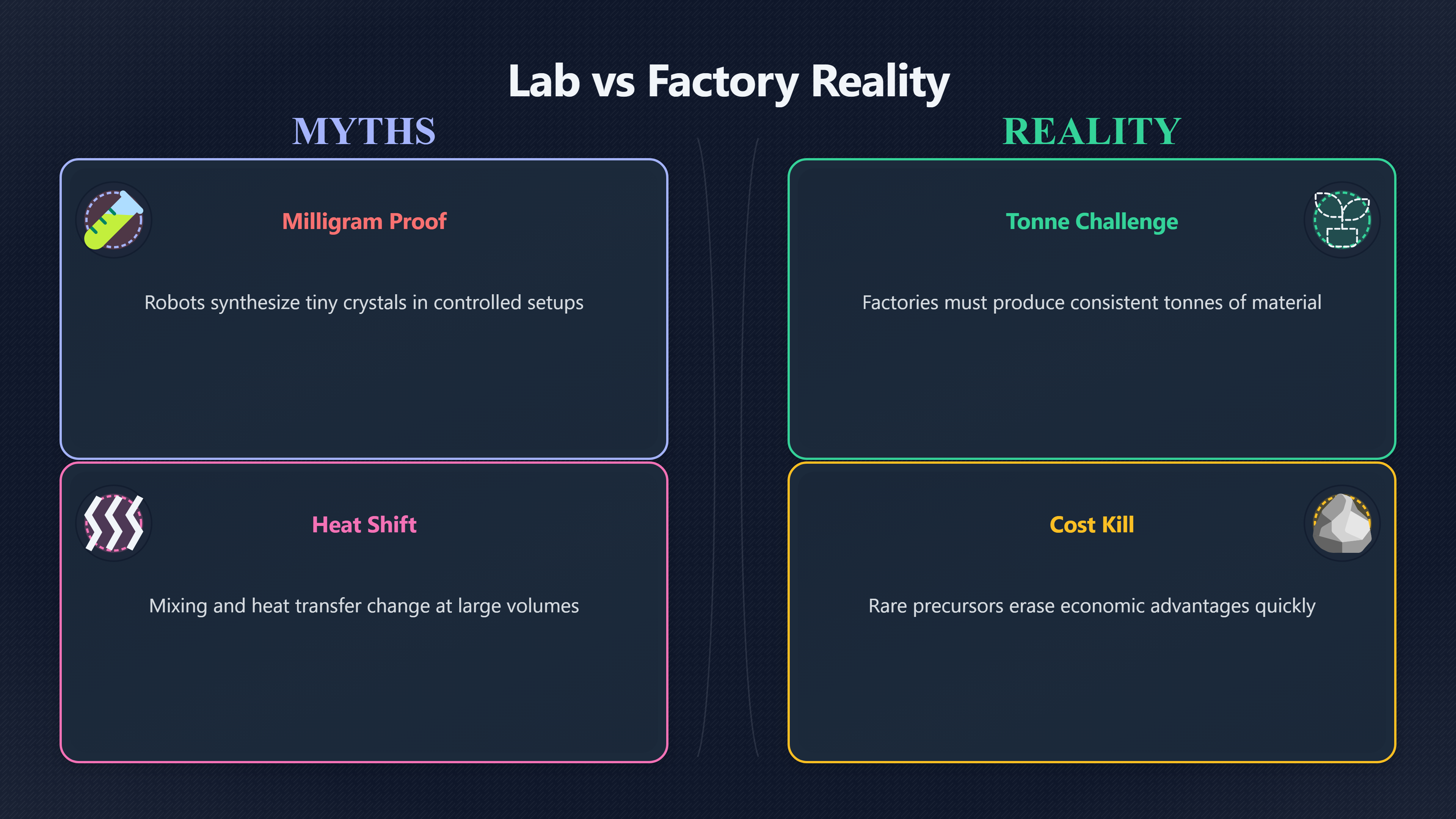
A laboratory demonstration often proves something much narrower than headlines imply. It may show that:
- a crystal structure can exist briefly under controlled conditions
- a tiny sample can be produced with acceptable purity
- a material exhibits one promising property in isolation
- a result can be reproduced inside one experimental setup
Industrial deployment asks much harsher questions:
- Can the material be made reliably in tonnes rather than milligrams?
- Can factories produce it consistently despite impurities and process variation?
- Does it remain stable after years of heat, vibration, cycling or weather exposure?
- Are the precursor materials abundant and affordable?
- Can the manufacturing process meet environmental and safety regulations?
- Does the material still outperform alternatives after total system costs are counted?
This is why many “breakthrough materials” disappear between publication and commercialisation. The distance from laboratory novelty to industrial utility is often measured not in months, but in decades.
The mismatch partly comes from incentives. Academic research rewards novelty, publication and proof-of-concept demonstrations. Industry rewards reliability, manufacturability and cost reduction. As the technology publication Works in Progress noted, research systems can unintentionally “set up scaling for failure” because materials are often developed without serious consideration of industrial constraints from the beginning. [worksinprogress.co]worksinprogress.cogetting materials out of the lab17 May 2024 — Essentially, the system of discovery sets up scaling for failure by not creating materials without any consideration of the…
Why scaling changes the physics
One reason scale-up is so difficult is that chemical processes behave differently at industrial volume.
A reaction that works in a tiny laboratory vial may become unstable in a large reactor. Heat transfer changes. Mixing becomes uneven. Impurities accumulate differently. Reaction kinetics shift. Tiny variations that were irrelevant in a controlled experiment can suddenly destroy yield or quality at scale. A recent European scientific review on advanced materials noted that industrial production rarely adopts gram-scale laboratory processes without substantial redesign because large-scale systems alter mixing, heat transfer and interface behaviour. [scientificadvice.eu]scientificadvice.euadvanced materials evidence review reportIndustrial large-scale production in kilograms or tonnes rarely adopts lab-scale…Read more…
Battery manufacturing shows this clearly.
Modern lithium-ion batteries are extraordinarily sensitive to manufacturing precision. Small defects in coating thickness, moisture control or particle contamination can reduce performance or create dangerous failure modes. Researchers studying battery production at gigawatt-hour scale warn that minor manufacturing variation can produce major reliability and safety problems. [arXiv]arxiv.orgarXivPerspective: Challenges and opportunities for high-quality battery production at scaleMarch 2, 2024…
This is one reason apparently superior battery chemistries frequently struggle commercially. A laboratory cell may achieve excellent energy density under ideal conditions, yet fail because:
- the electrodes crack during mass production
- moisture sensitivity makes manufacturing prohibitively expensive
- cycle life degrades rapidly outside laboratory testing
- the chemistry requires scarce or geopolitically constrained minerals
- yield losses during manufacturing erase economic advantages
Solid-state batteries illustrate the issue. Many experimental designs show impressive laboratory performance, but scaling them into durable, manufacturable products has proved extremely difficult. Tiny defects inside solid electrolytes can create short circuits or rapid degradation during repeated charging cycles. Producing perfectly uniform interfaces at industrial scale remains a major challenge.
The same pattern appears across advanced materials. Catalysts may deactivate under real industrial contamination. Solar materials may degrade under ultraviolet exposure. Hydrogen-storage materials may become too expensive once purification and processing costs are included.
Durability is often harder than discovery
Materials science is not only about making something work once. It is about making it survive.
Industrial environments are brutal compared with laboratory conditions. Materials may face years of:
- temperature cycling
- corrosion
- vibration
- mechanical stress
- radiation exposure
- chemical contamination
- humidity
- repeated charging and discharging
A catalyst that performs brilliantly for ten hours in a laboratory reactor may fail commercially if it degrades after a few months. A battery material with exceptional energy density may become unusable if it swells, cracks or overheats after repeated cycles.
This durability problem is especially important for clean-energy infrastructure because many technologies depend on extremely long operational lifetimes. Offshore wind systems, grid batteries, nuclear materials and industrial electrolysers may need to operate reliably for decades. Tiny degradation rates that appear trivial in short experiments can become economically catastrophic over long deployment periods.
Autonomous laboratories can accelerate discovery, but long-term durability testing still takes real time. AI can help identify promising candidates faster, yet there is no shortcut around years of exposure data for many applications. This creates a structural bottleneck in the dream of rapid materials acceleration.
Some researchers are now trying to address this directly. A recent proposal for “born-qualified” autonomous development argued that autonomous systems should optimise for manufacturability, cost and durability from the outset rather than chasing narrow laboratory metrics alone. [arXiv]arxiv.orgarXivPerspective: Challenges and opportunities for high-quality battery production at scaleMarch 2, 2024…

The reproducibility problem
Another reason lab-made materials fail industrial tests is that many published results are difficult to reproduce consistently.
Chemistry and materials science are highly sensitive to experimental conditions. Tiny differences in precursor quality, humidity, temperature control or measurement technique can change outcomes substantially. Broader scientific concerns about reproducibility have affected materials research as well. [NCBI]ncbi.nlm.nih.govNCBIUnderstanding Reproducibility and ReplicabilityNCBI - NIHby M Engineering · 2019 — In this chapter, we discuss how the practice of science has evolved and how these changes have introd…
Autonomous laboratories may help in some ways because robotics can produce more standardised workflows and cleaner experimental records. Automated systems can also generate large, structured datasets instead of fragmented laboratory notes. Reports on laboratory automation have argued that these digital records become valuable during later manufacturing and scale-up work. [Henry Royce Institute]royce.ac.ukHenry Royce Institutematerials 4.0lab processes, it also creates high quality data and structured digital assets which are of high long term value for later scale-up and m…
But automation does not eliminate uncertainty.
In fact, autonomous systems can sometimes amplify it by rapidly exploring huge experimental spaces with limited human interpretation. Debate around Berkeley’s A-Lab reflected this tension. Shortly after publication, outside researchers questioned whether some reported compounds had truly been synthesised as claimed, highlighting difficulties in phase identification and experimental interpretation. [chemistryworld.com]chemistryworld.comNew analysis raises doubts over autonomous lab's…16 Jan 2024 — Experimental and computational issues flagged as researchers conclude t…
The dispute did not invalidate autonomous labs altogether, but it showed an important reality: even highly automated systems still depend on difficult scientific judgement. Materials characterisation is often ambiguous, especially for novel compounds containing multiple phases or impurities.
For industry, this matters because factories require extremely high confidence and repeatability. A process that works “most of the time” in a research environment may be commercially unusable.
Cost defeats many technically successful materials
A material can succeed scientifically yet fail economically.
This is common in advanced materials research because laboratory optimisation often ignores industrial supply chains. Researchers may use expensive precursor chemicals, rare elements, energy-intensive synthesis routes or highly specialised processing methods that are impractical outside research settings.
Some AI-generated materials face exactly this problem. Analyses of systems such as DeepMind’s GNoME have noted that many predicted compounds involve scarce, radioactive or difficult-to-source elements. Others require extreme synthesis conditions that are impractical for large-scale manufacturing. [WIRED]wired.comGoogle Deep Mind's AI Dreamed Up 380,000 New MaterialsThe Next Challenge Is Making ThemNovember 29, 2023 — Google DeepMind developed an AI program, GNoME, which has predicted 380,000 new stab…
Industrial economics can overturn seemingly superior technologies:
- A catalyst that improves efficiency slightly may still lose if it requires rare platinum-group metals.
- A battery chemistry may become commercially impossible if purification costs are too high.
- A carbon-capture material may consume too much energy during regeneration.
- A semiconductor process may require fabrication tolerances beyond existing factories.
History is full of technically impressive materials that failed for cost reasons. Aerogels, carbon nanotubes and various advanced ceramics all demonstrated remarkable laboratory properties long before finding limited or niche commercial uses. Performance alone was not enough.
This matters for the wider AI abundance argument because abundance depends not merely on invention, but on affordable deployment at enormous scale. A civilisation-changing material must eventually become manufacturable by ordinary industrial systems, not just by elite research facilities.

Batteries, catalysts and clean energy: where the bottlenecks are sharpest
The laboratory-to-industry gap is especially important in sectors linked to long-term AI bloom hopes, including clean energy, electrification and advanced computing.
Batteries
Battery research produces constant headlines about breakthroughs in energy density, charging speed or new chemistries. Yet only a tiny fraction of laboratory battery concepts reach commercial deployment.
The reasons include:
- instability during repeated charging cycles
- manufacturing defects at scale [advanced.onlinelibrary.wiley.com]advanced.onlinelibrary.wiley.comAP‐Lab: An AI‐Driven Autonomous Pilot‐Scale Platform…12 Feb 2026 — AP-Lab bridges materials discovery and industrial manufacturing by…
- fire and thermal runaway risks
- supply-chain constraints for lithium, nickel or cobalt
- difficulty integrating new chemistries into existing factories
- low production yields during scaling
Even when a chemistry works technically, retooling global battery manufacturing infrastructure is enormously expensive.
Catalysts
Catalysts are central to fertiliser production, fuel synthesis, hydrogen systems and industrial decarbonisation. AI-driven discovery could potentially improve chemical efficiency across major industries.
But catalysts often fail because industrial environments are chemically dirty. Real-world feedstocks contain contaminants that poison catalyst surfaces over time. Mechanical wear, sintering and thermal degradation can steadily reduce performance. Industrial operators also prioritise stability and replacement cost over peak laboratory efficiency.
Solar and clean-energy materials
Many next-generation photovoltaic materials achieve impressive laboratory efficiencies but degrade rapidly outdoors. Perovskite solar cells are a prominent example: researchers have achieved dramatic gains in efficiency, yet long-term stability under moisture, oxygen and sunlight exposure remains a major challenge.
This pattern illustrates a broader truth. Materials that appear transformative inside highly controlled environments frequently struggle under real environmental conditions.
What autonomous labs may genuinely change
Despite these limits, autonomous laboratories still matter.
Historically, materials development has often been painfully slow because researchers could test only a tiny fraction of possible combinations. AI-guided robotics can accelerate exploration dramatically. Autonomous systems can operate continuously, search chemical spaces more systematically and reduce repetitive manual work. [Nature]nature.comNatureAn autonomous laboratory for the accelerated synthesis of…29 Nov 2023 — We introduce the A-Lab, an autonomous laboratory for the…
The most realistic near-term impact is probably not instant scientific revolutions, but faster filtering.
Instead of spending years pursuing weak candidates, researchers may identify dead ends earlier and focus resources on compounds with realistic industrial potential. More advanced systems may increasingly integrate manufacturing constraints, cost modelling and durability testing directly into experimental loops.
Some newer projects are already moving in this direction. Pilot-scale autonomous platforms are beginning to connect laboratory optimisation with manufacturing-oriented benchmarks rather than purely academic performance metrics. [advanced.onlinelibrary.wiley.com]advanced.onlinelibrary.wiley.comAP‐Lab: An AI‐Driven Autonomous Pilot‐Scale Platform…12 Feb 2026 — AP-Lab bridges materials discovery and industrial manufacturing by…
If this approach matures, it could eventually compress parts of the decades-long cycle that normally separates discovery from deployment. That would matter enormously for technologies linked to energy abundance, climate mitigation and advanced infrastructure.
But the key lesson from industrial materials history remains intact: discovery is not deployment. Autonomous labs can help generate promising compounds faster, yet the hardest parts of industrial civilisation — manufacturing reliability, safety, logistics, economics and long-term durability — still resist easy automation.
For the broader AI bloom vision, this is both a caution and a clarification. Scientific acceleration could become real and economically transformative without making the physical world frictionless. The future may depend less on AI discovering magical materials overnight than on steadily improving humanity’s ability to move useful discoveries through the long and difficult path from laboratory success to industrial reality.
Endnotes
-
Source: nature.com
Link: https://www.nature.com/articles/s41586-023-06734-wSource snippet
NatureAn autonomous laboratory for the accelerated synthesis of...29 Nov 2023 — We introduce the A-Lab, an autonomous laboratory for the...
-
Source: worksinprogress.co
Title: getting materials out of the lab
Link: https://worksinprogress.co/issue/getting-materials-out-of-the-lab/Source snippet
17 May 2024 — Essentially, the system of discovery sets up scaling for failure by not creating materials without any consideration of the...
Published: May 2024
-
Source: scientificadvice.eu
Title: advanced materials evidence review report
Link: https://scientificadvice.eu/scientific-outputs/advanced-materials-evidence-review-report/Source snippet
Industrial large-scale production in kilograms or tonnes rarely adopts lab-scale...Read more...
-
Source: dim-materre.fr
Title: an autonomous laboratory for the accelerated synthesis of novel materials
Link: https://www.dim-materre.fr/en/publications/an-autonomous-laboratory-for-the-accelerated-synthesis-of-novel-materials/Source snippet
An autonomous laboratory for the accelerated synthesis of...29 Nov 2023 — Over 17 days of continuous operation, the A-Lab realized 41 no...
-
Source: arxiv.org
Link: https://arxiv.org/abs/2403.01065Source snippet
arXivPerspective: Challenges and opportunities for high-quality battery production at scaleMarch 2, 2024...
Published: March 2, 2024
-
Source: arxiv.org
Link: https://arxiv.org/html/2605.00639v1Source snippet
arXivBorn-Qualified: An Autonomous Framework for Deploying...1 May 2026 — Autonomous science is transforming how we discover materials a...
Published: May 2026
-
Source: ncbi.nlm.nih.gov
Title: NCBIUnderstanding Reproducibility and Replicability
Link: https://www.ncbi.nlm.nih.gov/books/NBK547546/Source snippet
NCBI - NIHby M Engineering · 2019 — In this chapter, we discuss how the practice of science has evolved and how these changes have introd...
-
Source: chemistryworld.com
Link: https://www.chemistryworld.com/news/new-analysis-raises-doubts-over-autonomous-labs-materials-discoveries/4018791.articleSource snippet
New analysis raises doubts over autonomous lab's...16 Jan 2024 — Experimental and computational issues flagged as researchers conclude t...
-
Source: wired.com
Title: Google Deep Mind’s AI Dreamed Up 380,000 New Materials
Link: https://www.wired.com/story/an-ai-dreamed-up-380000-new-materials-the-next-challenge-is-making-themSource snippet
The Next Challenge Is Making ThemNovember 29, 2023 — Google DeepMind developed an AI program, GNoME, which has predicted 380,000 new stab...
Published: November 29, 2023
-
Source: advanced.onlinelibrary.wiley.com
Link: https://advanced.onlinelibrary.wiley.com/doi/10.1002/advs.74293Source snippet
AP‐Lab: An AI‐Driven Autonomous Pilot‐Scale Platform...12 Feb 2026 — AP-Lab bridges materials discovery and industrial manufacturing by...
-
Source: ceder.berkeley.edu
Title: autonomous experimentation for accelerated materials discovery
Link: https://ceder.berkeley.edu/research-areas/autonomous-experimentation-for-accelerated-materials-discovery/Source snippet
Nature (2023). [https://doi.org/10.1038/s41586-023-06734-w](https://doi.org/10.1038/s41586-023-06734-w). N. J. Szymanski, Y...Read more...
-
Source: nature.com
Link: https://www.nature.com/articles/s41586-025-09992-ySource snippet
Author Correction: An autonomous laboratory for the...by NJ Szymanski · 2026 — Author Correction: An autonomous laboratory for the accel...
-
Source: royce.ac.uk
Title: Henry Royce Institutematerials 4.0
Link: https://www.royce.ac.uk/wp-content/uploads/2024/11/Materials-4.0-Lab-Automation-for-Innovation-in-Materials-Chemistry.pdfSource snippet
lab processes, it also creates high quality data and structured digital assets which are of high long term value for later scale-up and m...
Additional References
-
Source: phys.org
Link: https://phys.org/news/2026-04-robotic-chemistry-built-deployed-lab.htmlSource snippet
Low-cost robotic chemistry system can be built and...3 days ago — A modular, low-cost robotic chemistry system, RoboChem Flex, enables a...
-
Source: acmedsci.ac.uk
Link: https://acmedsci.ac.uk/viewFile/56314e40aac61.pdfSource snippet
Reproducibility and reliability of biomedical researchSTELAR's work provides clear examples of how large-scale collaborations and good te...
-
Source: facebook.com
Link: https://www.facebook.com/groups/1572893699951268/posts/1913394545901180/Source snippet
Self-driving labs accelerate materials discoveryThese AI- powered labs leverage machine learning and robotics to accelerate the discovery...
-
Source: Wikipedia
Link: https://en.wikipedia.org/wiki/Replication_crisisSource snippet
Replication crisisThe replication crisis, also known as the reproducibility or replicability crisis, refers to widespread failures to...
-
Source: mgi.gov
Link: https://www.mgi.gov/sites/mgi/files/MGI_Autonomous_Materials_Innovation_Infrastructure_Workshop_Report.pdfSource snippet
Inertia in the academic and corporate materials communities. Ceramics. Electronic Materials.Read more...
-
Source: newswise.com
Title: qamp a with ornl s advincula on autonomous labs in materials research
Link: https://www.newswise.com/doescience/qamp-a-with-ornl-s-advincula-on-autonomous-labs-in-materials-researchSource snippet
Q&A with ORNL's Advincula on Autonomous Labs in...30 Mar 2026 — ORNL researchers are moving beyond traditional chemical development to m...
-
Source: pubmed.ncbi.nlm.nih.gov
Link: https://pubmed.ncbi.nlm.nih.gov/38030721/Source snippet
PubMedAn autonomous laboratory for the accelerated synthesis of...by NJ Szymanski · 2023 · Cited by 1071 — We introduce the A-Lab, an au...
-
Source: uk-cpi.com
Title: Innovation at Scale: Overcoming Battery Manufacturing
Link: https://www.uk-cpi.com/blog/innovation-at-scale-overcoming-the-challenges-of-battery-manufacturingSource snippet
CPI27 Mar 2026 — Scaling next‑gen battery materials is a key challenge as innovators struggle to move from lab breakthroughs to reliable...
-
Source: researchgate.net
Link: https://www.researchgate.net/publication/376043973_An_autonomous_laboratory_for_the_accelerated_synthesis_of_inorganic_materialsSource snippet
November 2023; Nature 624(7990):86-91. DOI:10.1038/s41586-023...Read more...
Published: November 2023
-
Source: linkedin.com
Link: https://www.linkedin.com/posts/hameed-ullah-b20354315_laboratory-industry-research-activity-7456536898421800960-wtkYSource snippet
strength and durability... ⚙️ Root Cause Identified...Read more...
Amazon book picks
Further Reading
Books and field guides related to From lab success to scale. Use these as the next step if you want deeper reading beyond the article.

Advanced Materials
This book provides a thorough introduction to the essential topics in modern materials science. It brings together the spectrum of materi...

Concepts of Materials Science
This book provides an expert perspective and a unique insight into the essence of the science of materials, introducing the reader to ten...

Introduction to Materials Science
The approach of this concise but comprehensive introduction, covering all major classes of materials, is right for not just materials sci...
eBay marketplace picks
Marketplace Samples
Example marketplace items related to this page. Use the search link to explore similar finds on eBay.

Example eBay listing
A.I. Artificial Intelligence Original Movie Poster Signed By Jude Law
USD 125.00 | Shipping USD 25.00 | US

Example eBay listing
Artificial Intelligence D/S Original Movie Poster - 27 x 40"
USD 19.50 | Shipping USD 13.65 | US

Example eBay listing
612388 Artificial Intelligence Movie Science Fiction Drama Wall Print Poster
USD 22.95 | Shipping USD 12.95 | JP

Example eBay listing
Companion - Artificial Intelligence Dark Comedy Cinema Film - POSTER 20"x30"
USD 23.99 | Free shipping | US

Example eBay listing
A.I. Artificial Intelligence Movie Film Poster Art Print
GBP 4.99 | Free shipping | GB

Example eBay listing
A I Artificial Intelligence 6 Movie Poster Art Print Print Classic Rare Gallery
GBP 49.00 | Free shipping | GB

Example eBay listing
AI - Artificial Intelligence (Poster + Slipcase) Blu-Ray
GBP 10.49 | Free shipping | GB

Example eBay listing
A. I. Artificial Intelligence. Jude Law. Original UK Video Poster.
GBP 8.11 | Shipping GBP 3.38 | GB
Topic Tree