Within AI Bloom Futures
Energy Limits
Data centres, chips, grids, water, and land make clear that digital abundance still depends on physical infrastructure.
On this page
- Data centre electricity demand
- Clean power and grid bottlenecks
- Public benefit and social licence
Page outline Jump by section
Introduction
AI abundance still has to plug into the physical world. However powerful future models become, they will need data centres, chips, cooling systems, transmission lines, water, land, minerals and dependable electricity. That does not mean AI-driven abundance is impossible. It does mean that the road to it runs through energy systems that are already slow to build, politically contested and unevenly distributed.
The central tension is simple: data centres can be built in two or three years, while power plants, transmission lines and grid upgrades often take longer to plan, permit and finance. The International Energy Agency projects that global data-centre electricity consumption could roughly double to about 945 terawatt-hours by 2030, just under 3% of global electricity demand, with AI as the most important driver of growth. The figure is not civilisation-ending by itself, but the local effects can be severe because data centres cluster in particular regions and require large, constant loads. [IEA]iea.orgEnergy demand from AI – Energy and AI – AnalysisIEAEnergy demand from AI – Energy and AI – Analysis - IEA…
For the AI bloom thesis, this is a reality check. Digital intelligence may become abundant faster than clean energy, grid capacity and local consent. A flourishing future depends not only on smarter models, but on whether societies build enough clean power, allocate costs fairly, protect communities, and use AI itself to improve the energy system rather than merely consume it.
Data-centre demand is becoming a power-system issue
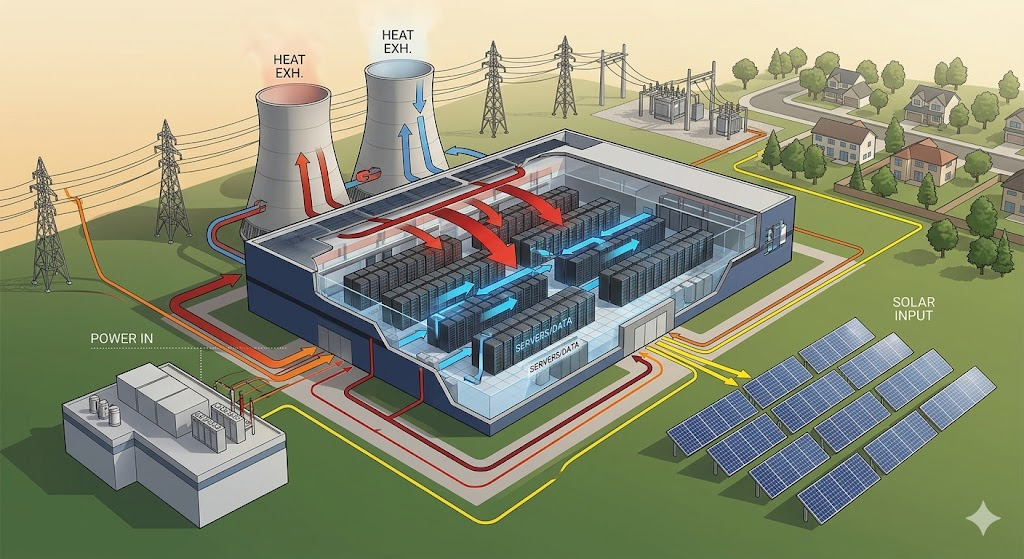
The easiest mistake is to treat AI as “weightless” because its outputs are digital. In practice, advanced AI relies on specialised servers packed with graphics processing units and other accelerators. These machines draw electricity for computation, while cooling and supporting equipment draw more.
The IEA’s base case projects data-centre electricity use rising from roughly 460 TWh in 2024 to around 945 TWh in 2030. Accelerated servers, mainly driven by AI adoption, are projected to grow in electricity consumption by about 30% annually, far faster than conventional servers. [IEA]iea.orgIEAExecutive summary – Energy and AI – Analysis - IEA…
Those global figures need context. Even by 2030, data centres would still be a minority share of world electricity demand. Electric vehicles, air conditioning, industrial electrification and economic growth also place heavy pressure on grids. But data centres differ from many other loads in three ways.
First, they are concentrated. A new data-centre campus can land in a region that already has grid bottlenecks, creating a sudden step-change in demand rather than a gradual rise spread across millions of households.
Second, they run continuously. Unlike many homes or offices, large computing facilities often want reliable power around the clock. That makes them attractive customers for utilities, but also harder to integrate when local supply is tight.
Third, AI demand can scale very quickly. Model training, inference, cloud services and enterprise adoption can expand faster than electricity infrastructure. The IEA explicitly warns that data centres can be operational in a few years, while broader energy infrastructure requires longer lead times and high upfront investment. [IEA]iea.orgEnergy supply for AI – Energy and AI – AnalysisIEAEnergy supply for AI – Energy and AI – Analysis - IEA…
This turns AI infrastructure into a planning problem, not just an engineering problem. A world pursuing AI abundance has to decide where compute should be built, what power it should use, who pays for the grid upgrades, and whether the social benefit justifies the local burden.
The bottleneck is local, not only global
The global electricity share can sound manageable while the local effects are disruptive. Northern Virginia, Ireland, parts of Oregon and other data-centre hubs show why. AI infrastructure tends to cluster near fibre networks, cloud regions, tax incentives, skilled labour, land, and existing power connections. That clustering can make the same amount of compute much harder to absorb than if it were geographically spread.
A 2026 modelling study on AI data-centre siting projected that new AI infrastructure would be highly concentrated in North America, Western Europe and the Asia-Pacific, with those regions accounting for more than 90% of projected compute capacity. It identified places such as Virginia, Oregon and Ireland as potentially vulnerable to high local power-system stress. [arXiv]arxiv.orgarXivConcentrated siting of AI data centers drives regional power-system stress under rising global compute demandMarch 13, 2026…
The United States illustrates the issue sharply. The IEA expects data centres to account for nearly half of US electricity demand growth to 2030, and says that by the end of the decade US data centres could consume more electricity than the country’s production of aluminium, steel, cement, chemicals and other energy-intensive goods combined. [IEA]iea.orgOpen source on iea.org.
This does not mean every AI data centre is harmful. It means that averages hide distribution. A national grid may be able to absorb a rising load in theory while specific substations, transmission corridors or local water systems cannot absorb it in practice.
That is why the politics of AI infrastructure is increasingly local. Communities ask concrete questions:
- Will household electricity bills rise? [reuters.com]reuters.comAnalysts argue the merger would grant the scale and resources needed to accelerate power generation and transmission for data centers, wi…
- Will water use affect local supply?
- Will the facility create many long-term jobs, or mainly construction work?
- Who pays for grid upgrades?
- Does the project bring public benefits beyond private profit?
- Is clean power actually new, local and additional, or only claimed through accounting?
These questions are not anti-technology. They are the basic terms of social licence.
Clean power helps, but grids are the hard part
The optimistic case is that AI companies can become major buyers of clean energy, bringing forward solar, wind, geothermal, nuclear, storage and advanced grid technologies. There is evidence for this. The IEA projects that renewables will meet nearly half of additional data-centre electricity demand to 2035, with natural gas, coal and nuclear also contributing. [IEA]iea.orgelectricity 2026electricity 2026
Major technology firms are also signing large clean-energy deals. Google reported that in 2024 it signed contracts for more than 8 GW of clean energy generation and reduced data-centre energy emissions by 12% compared with the previous year, while also acknowledging increased energy demand. [Sustainability]sustainability.googleSustainable Innovation & TechnologySustainabilitySustainable Innovation & Technology - Google Sustainability…
But clean-energy procurement is not the same as solving the physical grid problem. A company can buy renewable-energy credits or contract for future clean generation while its facility still depends on local grid power at particular hours. What matters for the climate and for local reliability is whether new demand is matched by real, additional, deliverable clean electricity and enough transmission capacity.
Gas can fill the gap if clean power is too slow
The risk is that AI growth outruns clean build-out and is met by fossil generation. The IEA’s base case expects natural gas to expand significantly to meet data-centre demand, notably in the United States. Coal remains part of the current global electricity mix for data centres, especially in some regions. [IEA]iea.orgelectricity 2026electricity 2026
That matters because AI abundance is often framed as a route to solving scarcity, including climate and energy constraints. If the near-term AI build-out increases fossil generation, delays coal retirement, or drives new gas infrastructure without credible decarbonisation, the bloom case weakens. AI could still help discover better batteries, optimise grids or accelerate fusion research, but those benefits would need to outweigh the emissions and infrastructure lock-in created along the way.
Nuclear and geothermal are promising but not instant
AI companies are increasingly interested in nuclear power, small modular reactors and enhanced geothermal energy because they promise clean, firm power: electricity available when the sun is not shining and the wind is not blowing. The IEA expects nuclear to contribute more toward the end of the decade and beyond, with the first small modular reactors appearing around 2030 in its modelling. [IEA]iea.orgOpen source on iea.org.
These technologies could matter enormously for a long-term AI-rich civilisation. But they are not quick fixes for today’s grid queues. Nuclear projects face licensing, cost, construction and political hurdles. Geothermal has great potential in some regions but still needs commercial scaling. Transmission remains difficult even when generation is clean.
The practical lesson is not “AI cannot be powered cleanly”. It is that clean power for AI must be built deliberately, ahead of demand, rather than assumed after the fact.
Efficiency gains can help, but they may not cap demand
AI systems can become far more efficient. Better chips, model compression, smarter inference, cooling improvements and workload scheduling can reduce the electricity required for a given task. Google has reported large improvements in the power efficiency of its custom AI chips over successive generations, and its 2024 environmental reporting highlighted infrastructure and model-training practices intended to reduce energy use and emissions. [Sustainability]sustainability.googleReports & Case StudiesSustainabilitySustainability Reports & Case Studies - Google Sustainability…
Efficiency is one of the strongest reasons not to extrapolate today’s energy use in a straight line. The cost of computation per unit of capability may keep falling. Smaller models may handle many routine tasks. Data centres may shift flexible workloads to times and places where clean power is abundant.
But efficiency does not automatically reduce total energy consumption. If AI becomes much cheaper and more useful, demand may grow faster than efficiency improves. This is the familiar rebound problem: when a service gets cheaper, people use more of it.
The IEA’s scenarios reflect this uncertainty. Its “High Efficiency” case assumes stronger progress in hardware, software and infrastructure, while its “Lift-Off” case assumes stronger AI adoption and easier deployment. The difference matters: by 2035, the higher-growth pathway exceeds 1,700 TWh of data-centre electricity demand, about 45% above the base case. [IEA]iea.orgEnergy and AI – AnalysisEnergy and AI – Analysis
For AI bloom, this is a central uncertainty. If intelligence becomes extremely cheap, societies may use vast amounts of it: for science, education, robotics, entertainment, surveillance, finance, advertising, administration and autonomous systems. The energy limit is not only the electricity per query. It is the total volume of useful, profitable or addictive machine cognition the world chooses to run.
Water, land and chips make “digital abundance” material
Electricity is the headline constraint, but it is not the only one. Data centres also need cooling, land, backup systems, buildings, high-voltage equipment, networking hardware and advanced chips. In some regions, water use has become a major source of local opposition.
Data centres use water in different ways. Some rely more on air cooling or closed-loop systems; others use evaporative cooling, which can reduce electricity demand but consumes water. The trade-off is often between electricity and water: in hot or dry areas, cooling choices can shift pressure from one scarce resource to another.
This matters because AI abundance could otherwise be described too abstractly. A data centre is not just a neutral box where intelligence happens. It is a large industrial facility with local impacts:
- heat must be removed;
- electricity must be delivered;
- land must be permitted;
- water may be consumed;
- backup generation may be installed;
- noise and visual impacts may affect nearby residents;
- grid costs may be shared through electricity bills.
Recent local decisions show the social consequences. In May 2026, Millville, New Jersey, voted to ban new data-centre projects after concerns about infrastructure, land use, public health, water resources, utility costs, noise and limited job creation. The rejected proposal reportedly involved a 1.4 GW campus, a scale comparable to major power-station demand rather than ordinary commercial development. [Business Insider]businessinsider.comSource details in endnotes.
Opposition of this kind is likely to grow if communities believe they are carrying the costs of AI infrastructure while benefits flow elsewhere. The question is not whether every objection is correct. It is whether the AI industry can earn trust through transparent resource use, fair rates, local benefits and credible environmental performance.
Public benefit is the test of social licence
The energy burden of AI would be easier to justify if the benefits were visibly broad: better healthcare, cheaper education, faster scientific discovery, climate repair, safer infrastructure and wider access to opportunity. It becomes harder to justify if the most visible uses are low-value content generation, manipulative advertising, speculative finance, surveillance or status competition among a few companies.
That distinction is central to the AI bloom frame. “More compute” is not the same as “more flourishing”. Energy-intensive AI infrastructure deserves public support only if it contributes to public value at a scale commensurate with its demands on shared systems.
This is especially important where costs are socialised. Reuters reported in May 2026 that AI-driven data-centre expansion is increasingly tied to US grid pressure, power bills and regulatory disputes, including in northern Virginia’s data-centre corridor. The proposed NextEra-Dominion deal was partly framed around supplying the data-centre sector, but also faced scrutiny over consumer electricity prices and who benefits from the infrastructure build-out. [Reuters]reuters.comAnalysts argue the merger would grant the scale and resources needed to accelerate power generation and transmission for data centers, wi…
The risk is a political backlash in which AI infrastructure is seen as extracting local resources for private gain. Avoiding that requires more than sustainability branding. It requires rules that make the bargain explicit:
- large data-centre customers should pay an appropriate share of grid upgrades;
- clean-energy claims should be transparent and auditable;
- communities should know expected water and power use before approval;
- projects should be evaluated against local reliability and affordability;
- public-sector access to beneficial AI should be part of the wider settlement.
Without this, AI abundance may look less like shared flourishing and more like another infrastructure rush in which powerful firms capture scarce capacity first.
AI can also help solve the energy problem
The critique is not one-sided. AI may increase energy demand, but it can also improve energy systems. Better forecasting, grid optimisation, materials discovery, battery management, industrial efficiency, building controls and climate modelling are all plausible areas where AI can reduce waste or accelerate clean-energy deployment.
The IEA’s broader energy-and-AI work treats this as a two-way relationship: AI is both a source of new electricity demand and a tool that may improve energy supply, demand response and system flexibility. [IEA]iea.orgThe deepening ties between energy and AIThe deepening ties between energy and AI
There are also emerging proposals for more flexible data-centre operation. Some AI workloads, such as batch training or non-urgent processing, can in principle be shifted across time or location. A 2026 study on AI data-centre flexibility found that temporal and spatial shifting could reduce grid investment and operational costs in some cases, though benefits varied by location and grid conditions. [arXiv]arxiv.orgarXivConcentrated siting of AI data centers drives regional power-system stress under rising global compute demandMarch 13, 2026…
This points to a more mature model of AI infrastructure. Instead of treating data centres as rigid consumers demanding power at all times, grids and operators could distinguish between:
- latency-sensitive inference that must run immediately;
- batch workloads that can wait;
- training jobs that can be scheduled around clean-power availability;
- emergency curtailment arrangements during grid stress;
- on-site storage that helps rather than harms reliability.
Such flexibility will not solve every problem. Frontier AI labs may still want enormous always-on clusters. But flexible compute could reduce the conflict between digital abundance and physical bottlenecks.
The real constraint is coordination
Energy limits do not refute the possibility of AI bloom. They make it conditional.
A world with abundant machine intelligence would need abundant clean power too. It would need faster permitting without trampling local rights, more transmission without endless delay, better storage, smarter demand response, stronger public-interest regulation, and more honest accounting of environmental costs. It would also need to prioritise high-value AI uses over wasteful ones.
The most important point is not that AI uses electricity. Every serious technology does. The point is that the scale, speed and concentration of AI infrastructure can collide with slow-moving public systems. Data centres are private projects, but grids, water systems, land-use decisions and electricity prices are public concerns.
For AI to support a long-term human bloom, the physical build-out must match the moral ambition. Intelligence cannot become truly abundant if the energy system remains scarce, dirty, brittle or unfairly governed. The promise of AI is therefore tied to a wider project: building clean, reliable and socially legitimate infrastructure fast enough for digital progress to become real-world flourishing.
Endnotes
-
Source: iea.org
Title: Energy demand from AI – Energy and AI – Analysis
Link: https://www.iea.org/reports/energy-and-ai/energy-demand-from-aiSource snippet
IEAEnergy demand from AI – Energy and AI – Analysis - IEA...
-
Source: iea.org
Link: https://www.iea.org/reports/energy-and-ai/executive-summary%C2%A0Source snippet
IEAExecutive summary – Energy and AI – Analysis - IEA...
-
Source: arxiv.org
Link: https://arxiv.org/abs/2604.06198Source snippet
arXivConcentrated siting of AI data centers drives regional power-system stress under rising global compute demandMarch 13, 2026...
Published: March 13, 2026
-
Source: iea.org
Title: Energy supply for AI – Energy and AI – Analysis
Link: https://www.iea.org/reports/energy-and-ai/energy-supply-for-aiSource snippet
IEAEnergy supply for AI – Energy and AI – Analysis - IEA...
-
Source: sustainability.google
Title: Sustainable Innovation & Technology
Link: https://sustainability.google/Source snippet
SustainabilitySustainable Innovation & Technology - Google Sustainability...
-
Source: sustainability.google
Title: Reports & Case Studies
Link: https://sustainability.google/google-2025-environmental-report/Source snippet
SustainabilitySustainability Reports & Case Studies - Google Sustainability...
-
Source: reuters.com
Link: https://www.reuters.com/legal/litigation/giant-us-power-merger-bets-ai-build-out-may-hinge-power-bills-2026-05-20/Source snippet
Analysts argue the merger would grant the scale and resources needed to accelerate power generation and transmission for data centers, wi...
-
Source: iea.org
Link: https://www.iea.org/news/data-centre-electricity-use-surged-in-2025-even-with-tightening-bottlenecks-driving-a-scramble-for-solutions -
Source: arxiv.org
Link: https://arxiv.org/abs/2604.05376 -
Source: iea.org
Title: electricity 2026
Link: https://www.iea.org/reports/electricity-2026 -
Source: iea.org
Title: electricity 2026
Link: https://www.iea.org/reports/electricity-2026?language=it -
Source: iea.org
Link: https://www.iea.org/news/ai-is-set-to-drive-surging-electricity-demand-from-data-centres-while-offering-the-potential-to-transform-how-the-energy-sector-works?_bhlid=a143b03d78b92f4b696509562ec3fafd5e06d86a -
Source: iea.org
Title: Energy and AI – Analysis
Link: https://www.iea.org/reports/energy-and-ai -
Source: iea.org
Title: The deepening ties between energy and AI
Link: https://www.iea.org/spotlights/the-deepening-ties-between-energy-and-ai -
Source: iea.org
Link: https://www.iea.org/reports/key-questions-on-energy-and-ai/executive-summary?_bhlid=10646f272364cf3af59c0fa8f3886b1cfe01e627 -
Source: sustainability.google
Title: Sustainable & Efficient Operations
Link: https://sustainability.google/operations/ -
Source: sustainability.google
Title: Sustainable & Efficient Operations
Link: https://sustainability.google/responsible-supply-chain/ -
Source: blog.google
Title: 2024 environmental report
Link: https://blog.google/outreach-initiatives/sustainability/2024-environmental-report/ -
Source: businessinsider.com
Link: https://www.businessinsider.com/ai-data-center-ban-opposition-new-jersey-2026-5 -
Source: blog.google
Title: 2024 environmental report
Link: https://blog.google/company-news/outreach-and-initiatives/sustainability/2024-environmental-report/
Additional References
-
Source: youtube.com
Title: The Data Center Energy Crisis: Can We Power the Age of AI? | Breakthrough
Link: https://www.youtube.com/watch?v=j2w4X1OkdIoSource snippet
Exposing The Dark Side of America's AI Data Center Explosion | View From Above | Business Insider...
-
Source: youtube.com
Link: https://www.youtube.com/watch?v=t-8TDOFqkQASource snippet
OpenAI's $850 billion buildout contends with grid limits...
-
Source: youtube.com
Title: How AI Can Solve Its Own Energy Crisis | Varun Sivaram | TED
Link: https://www.youtube.com/watch?v=p8Ed8pDlAmMSource snippet
AI Is About to Break the Power Grid — And Space Solar Might Be the Only Escape Hatch...
-
Source: newscenter.lbl.gov
Title: berkeley lab report evaluates increase in electricity demand from data centers
Link: https://newscenter.lbl.gov/2025/01/15/berkeley-lab-report-evaluates-increase-in-electricity-demand-from-data-centers/ -
Source: vendor.energy
Link: https://vendor.energy/articles/ai-data-center-grid-bottleneck-europe/ -
Source: belfercenter.org
Link: https://www.belfercenter.org/research-analysis/ai-data-centers-us-electric-grid -
Source: spglobal.com
Link: https://www.spglobal.com/en/research-insights/special-reports/look-forward/data-center-frontiers/global-ai-power-demand-challenges-opportunities -
Source: tomshardware.com
Link: https://www.tomshardware.com/tech-industry/amazons-european-data-center-projects-stalled-by-grid-delays -
Source: economy.ac
Link: https://economy.ac/news/2025/09/202509279542 -
Source: computing.co.uk
Link: https://www.computing.co.uk/news/2025/datacentres-hoarding-power-capacity-ai-demand
Amazon book picks
Further Reading
Books and field guides related to Energy Limits. Use these as the next step if you want deeper reading beyond the article.
Energy Efficiency of Modern Power and Energy Systems
Energy Efficiency and Management of Power and Energy Systems introduces students and researchers to a broad range of power system managem...


eBay marketplace picks
Marketplace Samples
Example marketplace items related to this page. Use the search link to explore similar finds on eBay.

Example eBay listing
A.I. Artificial Intelligence Original Movie Poster Signed By Jude Law
USD 125.00 | Shipping USD 25.00 | US

Example eBay listing
Artificial Intelligence D/S Original Movie Poster - 27 x 40"
USD 19.50 | Shipping USD 13.65 | US

Example eBay listing
612388 Artificial Intelligence Movie Science Fiction Drama Wall Print Poster
USD 22.95 | Shipping USD 12.95 | JP

Example eBay listing
Companion - Artificial Intelligence Dark Comedy Cinema Film - POSTER 20"x30"
USD 23.99 | Free shipping | US

Example eBay listing
A.I. Artificial Intelligence Movie Film Poster Art Print
GBP 4.99 | Free shipping | GB

Example eBay listing
A I Artificial Intelligence 6 Movie Poster Art Print Print Classic Rare Gallery
GBP 49.00 | Free shipping | GB

Example eBay listing
AI - Artificial Intelligence (Poster + Slipcase) Blu-Ray
GBP 10.49 | Free shipping | GB

Example eBay listing
A. I. Artificial Intelligence. Jude Law. Original UK Video Poster.
GBP 8.11 | Shipping GBP 3.38 | GB
Topic Tree
Follow this branch
Parent topic
AI Bloom FuturesRelated pages 9
- Abundant Intelligence
- AI Medicine
- AI Tutors
- Coordination
- Discovery
- Long Future
- Robots and Work
- Shared Gains
- +1 more in sidebar