Within AI Profits
Compute bottlenecks
Chips, cloud platforms and data centres can act like toll roads for the AI economy, letting infrastructure owners capture large profits from everyone else’s
On this page
- Why advanced chips are scarce
- How cloud control shapes market power
- Whether infrastructure rents limit broad abundance
Page outline Jump by section
Introduction
Advanced AI does not run on abstract “intelligence”. It runs on scarce physical infrastructure: advanced chips, semiconductor fabrication plants, electricity, networking equipment, cooling systems, and giant data centres. That scarcity matters economically because whoever controls the bottlenecks can charge rents to everyone else using the system.
 This is one reason AI profits may matter more than AI wages. Even if AI makes millions of people more productive, a large share of the value may still flow to the owners of compute infrastructure rather than to workers. In practice, the AI economy increasingly resembles a system of toll roads. Frontier model developers need access to rare GPUs, cloud capacity, specialised chip packaging, and power-hungry data centres. Businesses building on top of AI often rent access from the same small group of infrastructure providers. The result is a stack of concentrated profit centres sitting underneath much of the wider AI economy.
For the broader “AI bloom” vision, this creates a central tension. AI could eventually help produce extraordinary abundance in medicine, science, education, robotics, and material production. But if the key infrastructure remains highly concentrated, the gains from that abundance may initially accrue unevenly, strengthening the market and political power of a relatively small number of firms and states.
Why advanced chips are scarce
The modern AI boom depends heavily on a narrow class of extremely advanced chips, especially graphics processing units (GPUs) designed for machine learning workloads. Training frontier AI systems requires enormous quantities of these chips working together across large clusters.
What makes this economically important is not merely that the chips are useful, but that they are unusually difficult to produce at scale.
Several layers of scarcity reinforce each other:
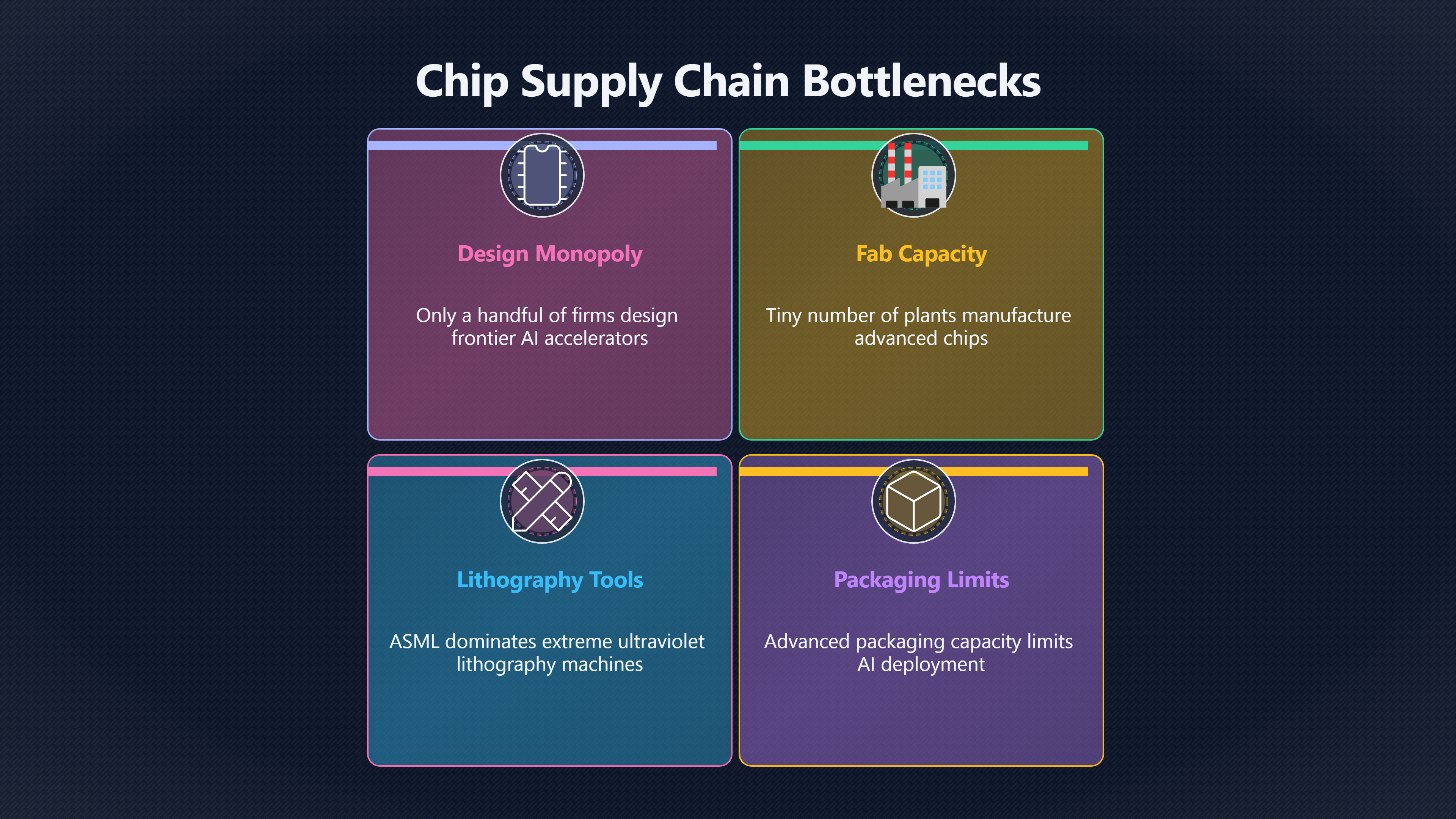
- Only a handful of companies can design frontier AI accelerators.
- Only a tiny number of fabrication plants can manufacture the most advanced chips.
- Advanced lithography equipment comes from an even smaller number of suppliers.
- Packaging and memory systems have become separate bottlenecks.
- Building new fabrication capacity takes years and tens of billions of pounds.
The semiconductor supply chain therefore behaves less like a normal competitive market and more like a strategic choke-point system.
Taiwan Semiconductor Manufacturing Company (TSMC) occupies a particularly important role because many leading AI chips rely on its most advanced manufacturing nodes. Analysts and policy researchers increasingly describe TSMC capacity itself as a major AI bottleneck. [CNAS]cnas.orgCNASAmerican AI Companies Can't Get Enough ChipsWei, echoed this claim: “The bottleneck is TSMC's wafer supply, not the power consumption… [2digitalstatecraft.substack.com]digitalstatecraft.substack.comGlobal Compute Bottleneck: Chips, TSMC, and the…It is the global supply chain for advanced semiconductors. If energy is the fuel of AI…
ASML, meanwhile, effectively dominates the market for extreme ultraviolet lithography machines, which are essential for cutting-edge semiconductor production. Reuters recently reported that ASML’s chief executive expects prolonged supply tightness because AI demand is rising faster than semiconductor capacity expansion. [Reuters]reuters.comIn a Reuters interview, Fouquet emphasized a supply-limited market environment, projecting sporadic bottlenecks as chip industry demand c…
Even packaging has become strategically important. Modern AI chips depend on advanced packaging systems that allow processors and memory to communicate at extremely high speeds. Industry analysts have repeatedly identified packaging capacity as a limiting factor for AI deployment. [LinkedIn]linkedin.comLinkedInSemiconductor Bottlenecks: AI, Hardware, Materials, and…December 29, 2025 — Bottleneck: Only TSMC can… [Medium This combination creates classic economic rents. When demand surges faster than supply]medium.comHow the Chip Shortage Never Really EndedGross margins on advanced packaging, while still below TSMC's corporate average, have improved as…, suppliers can charge far above production cost because customers have few substitutes.
Nvidia became the clearest example of this phenomenon. During the generative AI boom, demand for Nvidia’s AI accelerators dramatically exceeded available supply, contributing to unusually high profit margins for a hardware company. OECD analysis noted Nvidia gross margins above 70% during the AI expansion. [OECD]oecd.orgcomponent 5OECDOverview of the AI supply chain: Competition in artificial…14 Nov 2025 — Nvidia has gross margins of over 70% and has seen its rev…
That level of profitability is difficult to explain through ordinary manufacturing economics alone. It reflects scarcity power: the ability to charge premium prices because customers cannot easily go elsewhere.
Compute became the gateway to frontier AI
In earlier internet eras, startups could often scale using relatively cheap commodity hardware. Frontier AI changed the economics.
Training state-of-the-art models now requires enormous compute expenditure. Companies increasingly spend billions on chips, networking, and electricity before they earn meaningful revenue.
This shifts competitive advantage towards organisations with:
- access to capital markets,
- relationships with cloud providers, [runpod.io]runpod.ioTop 12 Cloud GPU Providers for AI and Machine LearningRunpodTop 12 Cloud GPU Providers for AI and Machine Learning…January 9, 2026 — 9 Jan 2026 — This side-by-side comparison breaks down 1…
- privileged chip allocation,
- and the ability to finance gigantic infrastructure projects.
The effect resembles earlier infrastructure revolutions. Railways, oil pipelines, telecom networks, and electricity grids often produced powerful “rent extraction” opportunities because the underlying infrastructure was expensive, difficult to duplicate, and essential for everyone else.
AI compute increasingly shows similar characteristics.
The largest frontier models depend on massive training runs using clusters containing tens or hundreds of thousands of GPUs. That scale is inaccessible to most firms, universities, nonprofits, or poorer states. Even renting compute has become extraordinarily expensive. Reports on GPU cloud markets show persistent shortages and high rental prices for advanced hardware. [Runpod]runpod.ioTop 12 Cloud GPU Providers for AI and Machine LearningRunpodTop 12 Cloud GPU Providers for AI and Machine Learning…January 9, 2026 — 9 Jan 2026 — This side-by-side comparison breaks down 1… [LinkedIn As a result]linkedin.comLinkedInSemiconductor Bottlenecks: AI, Hardware, Materials, and…December 29, 2025 — Bottleneck: Only TSMC can…, many AI companies do not truly “own” their intelligence infrastructure. They lease it from hyperscale cloud providers or specialised GPU clouds. This creates a layered dependency structure:
- model companies depend on cloud platforms,
- application startups depend on model companies,
- and end users depend on the entire stack.
The owner of the bottleneck infrastructure can therefore collect rents from nearly every downstream layer.
How cloud control shapes market power
The AI economy is not controlled only by chipmakers. Cloud platforms are becoming equally important.
Training and running advanced AI systems requires giant data centres with:
- high-end networking,
- specialised cooling,
- stable energy supplies,
- massive financing,
- and global software infrastructure.
Only a small number of firms can build this at frontier scale.
Amazon, Microsoft, and Google already dominated cloud computing before the AI boom. AI has strengthened their position because the largest models increasingly require integration between chips, cloud services, storage systems, and proprietary software ecosystems.
This creates several reinforcing forms of market power.
Scale advantages compound
The largest cloud providers can buy chips in enormous volumes, negotiate preferential supply deals, and finance multibillion-pound infrastructure expansion. Smaller competitors often cannot match those economics.
As compute demand rises, scale itself becomes a defensive moat. The more customers a cloud platform attracts, the easier it becomes to justify building larger data centres, securing more energy contracts, and financing new hardware purchases.
AI companies become dependent tenants
Many AI startups appear independent on the surface while relying heavily on infrastructure controlled by larger firms.
OpenAI’s close relationship with Microsoft is one example. Anthropic has major ties to Amazon and Google. Numerous smaller AI companies rent compute from specialised providers like CoreWeave.
The AI Now Institute noted that even major firms were sometimes forced to rent compute from Nvidia-favoured intermediaries because GPU access itself became constrained. [AI Now Institute]ainowinstitute.orgcompute and aiAI Now InstituteComputational Power and AISeptember 27, 2023 — 27 Sept 2023 — Large cloud players and AI companies are thus compelled to…
This means infrastructure providers can potentially capture value regardless of which application company “wins”. In a gold rush, the sellers of shovels and land rights often profit most consistently.
Compute scarcity favours incumbents
When compute is scarce, allocation itself becomes power.
Cloud providers and chip suppliers can decide:
- who receives early access,
- which customers get priority,
- which workloads are economically viable,
- and which countries or organisations remain compute-constrained.
This can shape the direction of AI development itself.
A startup with a superior research idea may still lose if it cannot secure sufficient compute. Universities may struggle to compete with commercial labs. Smaller countries may depend on foreign infrastructure providers for advanced AI capabilities.
In that sense, compute bottlenecks influence not only profits but also who participates in the future of intelligence creation.
Why infrastructure owners may capture disproportionate profits
One of the striking features of the current AI boom is how much investor attention has concentrated on infrastructure providers rather than end-user applications.
This reflects a broader economic pattern. When a resource is both essential and scarce, upstream suppliers can sometimes earn more stable returns than downstream innovators.
A restaurant may fail. A food delivery startup may collapse. But the landlord collecting rent from all of them can still profit.
In AI, infrastructure owners benefit from several unusually strong advantages.
Demand can become almost universal
If AI becomes deeply integrated into medicine, education, logistics, finance, manufacturing, science, and robotics, then compute demand may spread across nearly the entire economy.
That creates the possibility of economy-wide infrastructure rents.
Rather than profiting from one application category, compute providers may earn revenue from thousands of industries simultaneously.

Marginal costs may fall slower than software scaling
Software businesses often become extremely profitable because copying software is cheap. But frontier AI systems still require substantial ongoing compute expenditure.
Inference — actually running models for users — consumes energy and hardware capacity continuously. If intelligence becomes embedded into daily economic activity, compute usage may scale with it.
That could allow infrastructure owners to keep collecting recurring rents even after models become widespread.
Physical constraints matter again
For years, parts of the digital economy appeared relatively detached from physical limits. AI has reversed some of that.
Advanced AI systems require:
- electricity,
- water for cooling,
- land,
- specialised construction,
- fibre connectivity,
- transformers,
- and semiconductor manufacturing capacity.
Those are physical bottlenecks with long construction timelines.
Industry reporting increasingly focuses on power shortages and data-centre constraints as major limits on AI expansion. Analysts interviewed by Dwarkesh Patel and SemiAnalysis identified logic chips, memory, and power infrastructure as major scaling bottlenecks. [Dwarkesh Podcast]dwarkesh.comDwarkesh PodcastDylan Patel — Deep dive on the 3 big bottlenecks to…March 13, 2026 — 13 Mar 2026 — Dylan Patel, founder of SemiAnalysi…
This reintroduces a more industrial political economy into the digital sector. Control over energy grids, chip plants, and data-centre clusters may become as strategically important as control over software.
Whether compute rents limit broad abundance
The optimistic AI bloom vision depends partly on intelligence becoming abundant and widely accessible. Compute bottlenecks complicate that vision.
If advanced AI remains expensive to run, or if a small number of firms tightly control access, then abundance may arrive unevenly.
Several risks follow from this.
AI gains could concentrate geographically
Countries with advanced semiconductor ecosystems, abundant capital, and large energy infrastructure may capture disproportionate benefits.
Nations lacking domestic compute capacity could become dependent on foreign providers for access to frontier AI systems.
This is one reason governments increasingly treat semiconductors and AI infrastructure as strategic national assets rather than ordinary commercial goods. [CETS]cetas.turing.ac.uksemiconductor supply chains ai and economic statecraftCETSSemiconductor Supply Chains, AI and Economic Statecraft9 Apr 2024 —… semiconductor solutions optimised for AI systems. The main ob…
Wealth concentration could intensify
If infrastructure owners collect large rents across the AI economy, wealth may concentrate further among:
- shareholders,
- hyperscale cloud firms,
- semiconductor suppliers,
- and infrastructure financiers.
This matters because ownership of these assets is already highly unequal.
An AI-driven economy could therefore produce enormous aggregate wealth while still leaving many people with relatively weak claims on that wealth.
Research access may narrow
Large compute requirements can reduce openness in science itself.
Earlier eras of machine learning allowed relatively small research groups to compete. Frontier AI increasingly requires resources available only to governments and giant corporations.
That may slow independent scrutiny, reduce scientific pluralism, and increase the influence of a small number of labs over the future direction of AI systems.
Why compute rents may not last forever
Compute bottlenecks are powerful, but they are not guaranteed to remain permanent.
Historically, many technological shortages eventually eased as:
- production expanded,
- competitors emerged,
- engineering improved,
- and costs fell through scale.
Several forces could reduce compute rents over time.
Hardware competition may increase
Nvidia currently dominates advanced AI accelerators, but rivals are investing heavily in alternatives:
- AMD,
- Google’s TPUs,
- Amazon’s Trainium chips,
- custom AI ASICs, [tomshardware.com]tomshardware.comglobal semiconductor foundry market hit a record 320 billion in 2025According to Counterpoint Research, TSMC led the market with a 38% share and an annual growth rate over four times that of its nearest co…
- and open hardware ecosystems.
If substitutes improve, pricing power could weaken.
Efficiency gains matter
AI systems may become dramatically more efficient.
Researchers continue finding ways to:
- reduce training costs,
- compress models,
- improve inference efficiency,
- and use smaller specialised systems for many tasks.
If intelligence becomes cheaper per unit of compute, infrastructure scarcity could ease even while AI capability rises.
Energy abundance could help
Long-term AI abundance may depend partly on energy abundance.
Cheap clean electricity, improved grids, advanced nuclear systems, or major breakthroughs in power generation could lower one of the largest constraints on AI scaling.
That would not automatically eliminate concentration, but it could reduce the severity of infrastructure bottlenecks.
Open-source diffusion may widen access
Open-weight models and cheaper hardware already allow smaller actors to perform tasks that once required frontier systems.
The history of computing often shows an initial phase of extreme concentration followed by broader diffusion as technology matures.
The key uncertainty is timing. Compute rents may dominate the early decades of advanced AI even if they weaken later.
The deeper tension inside the AI bloom vision
The AI bloom idea imagines a future where intelligence becomes radically more abundant, helping humanity solve problems that today appear structurally difficult: disease, scientific stagnation, energy scarcity, dangerous labour, and perhaps eventually even limits on lifespan or interplanetary expansion.
But intelligence abundance does not automatically imply power abundance.
The same systems that could accelerate civilisation might also centralise economic control if the underlying infrastructure remains scarce and expensive.
This creates a fundamental political-economic question beneath many AI debates:
- Will advanced AI behave like a widely distributed public utility?
- Or like a highly concentrated industrial platform dominated by infrastructure owners?
The answer matters because compute bottlenecks shape who captures the surplus from machine intelligence.
If compute remains scarce, AI may initially enrich the owners of chips, cloud platforms, data centres, and energy infrastructure faster than it enriches labour. That does not negate the possibility of a flourishing future. But it means that ownership, governance, and access may become just as important as technical capability in determining whether AI-driven abundance is broad or narrowly captured.
Endnotes
-
Source: cnas.org
Link: https://www.cnas.org/publications/reports/american-ai-companies-cant-get-enough-chipsSource snippet
CNASAmerican AI Companies Can't Get Enough ChipsWei, echoed this claim: “The bottleneck is TSMC's wafer supply, not the power consumption...
-
Source: digitalstatecraft.substack.com
Link: https://digitalstatecraft.substack.com/p/the-global-compute-bottleneck-chipsSource snippet
Global Compute Bottleneck: Chips, TSMC, and the...It is the global supply chain for advanced semiconductors. If energy is the fuel of AI...
-
Source: reuters.com
Link: https://www.reuters.com/business/autos-transportation/asml-ceo-sees-tight-supply-booming-chip-market-ai-demand-soars-2026-05-20/Source snippet
In a Reuters interview, Fouquet emphasized a supply-limited market environment, projecting sporadic bottlenecks as chip industry demand c...
-
Source: linkedin.com
Link: https://www.linkedin.com/posts/kumar-priyadarshi-b0a2a7a2_4-major-types-of-bottlenecks-in-semiconductor-activity-7411243545199636480-GG-YSource snippet
LinkedInSemiconductor Bottlenecks: AI, Hardware, [Materials]({{ 'ai-bloom-abun/ai-bloom-abun-98d3a6-machine-speed-f30c72-autonomous-ma-5d88c7-materials-val-3ca4e2/' | relative_url }}), and...December 29, 2025 — Bottle...
Published: December 29, 2025
-
Source: medium.com
Link: https://medium.com/%40Elongated_musk/how-the-chip-shortage-never-really-ended-fbcc663aa3bdSource snippet
How the Chip Shortage Never Really EndedGross margins on advanced packaging, while still below TSMC's corporate average, have improved as...
-
Source: oecd.org
Title: component 5
Link: https://www.oecd.org/en/publications/competition-in-artificial-intelligence-infrastructure_623d1874-en/full-report/component-5.htmlSource snippet
OECDOverview of the AI supply chain: Competition in artificial...14 Nov 2025 — Nvidia has gross margins of over 70% and has seen its rev...
-
Source: runpod.io
Title: Top 12 Cloud GPU Providers for AI and Machine Learning
Link: https://www.runpod.io/articles/guides/top-cloud-gpu-providersSource snippet
RunpodTop 12 Cloud GPU Providers for AI and Machine Learning...January 9, 2026 — 9 Jan 2026 — This side-by-side comparison breaks down 1...
Published: January 9, 2026
-
Source: linkedin.com
Link: https://www.linkedin.com/posts/datacenterfrontier_is-there-a-gpu-rental-squeeze-we-are-entering-activity-7446178894757588992-hegHSource snippet
GPU Rental Costs Rise 40% Amid AI Demand SurgeOn NVIDIA we spent $8k on a server to get the same amount of memory on a $2,500 Mac Mini an...
-
Source: dwarkesh.com
Link: https://www.dwarkesh.com/p/dylan-patelSource snippet
Dwarkesh PodcastDylan Patel — Deep dive on the 3 big bottlenecks to...March 13, 2026 — 13 Mar 2026 — Dylan Patel, founder of SemiAnalysi...
Published: March 13, 2026
-
Source: cetas.turing.ac.uk
Title: semiconductor supply chains ai and economic statecraft
Link: https://cetas.turing.ac.uk/publications/semiconductor-supply-chains-ai-and-economic-statecraftSource snippet
CETSSemiconductor Supply Chains, AI and Economic Statecraft9 Apr 2024 —... semiconductor solutions optimised for AI systems. The main ob...
-
Source: linkedin.com
Link: https://www.linkedin.com/posts/chris-pisarski_last-year-nvidias-astounding-gross-margins-activity-7338681781786714114-zCmJSource snippet
How Nvidia's AI chip dominance drives its high marginsLast year, Nvidia's astounding gross margins (76%) were higher than SaaS companies...
-
Source: uk.investing.com
Link: https://uk.investing.com/analysis/the-nvidia-trap-why-the-worlds-most-valuable-company-is-built-on-borrowed-time-200619893Source snippet
Nvidia Trap: Why the World's Most Valuable Company...3 Nov 2025 — NVIDIA's gross margins hit 78% when chips were scarce and customers we...
-
Source: ainowinstitute.org
Title: compute and ai
Link: https://ainowinstitute.org/publications/compute-and-aiSource snippet
AI Now InstituteComputational Power and AISeptember 27, 2023 — 27 Sept 2023 — Large cloud players and AI companies are thus compelled to...
Published: September 27, 2023
Additional References
-
Source: researchgate.net
Link: https://www.researchgate.net/publication/390535373_The_Global_Chip_Bottleneck_Intel_TSMC_and_ASML%27s_Monopoly_on_the_Future_of_SemiconductorsSource snippet
Intel, TSMC, and ASML's Monopoly on the Future of...6 Apr 2025 — In this paper, we explore the fragile yet central structure of the worl...
-
Source: instagram.com
Link: https://www.instagram.com/reel/DW4foCYCENP/?hl=enSource snippet
CNBC on Instagram: "An underappreciated step in the...The AI chip revolution is reshaping the semiconductor industry, driving unpreceden...
-
Source: oneas1a.com
Link: https://www.oneas1a.com/understanding-cloud-compute-rental-models-and-gaining-high-performance-computing-advantages/Source snippet
Cloud Compute Rental Models and HPC AdvantagesThis article takes an in-depth look at how cloud compute power rental models work, how ente...
-
Source: cbreim.com
Link: https://www.cbreim.com/insights/articles/data-centers-aint-no-mountain-high-enoughSource snippet
Data Centers: Ain't No Mountain High EnoughThe data center industry is entering the next transformative stage in its lifecycle, propelled...
-
Source: facebook.com
Link: https://www.facebook.com/groups/1098967350204669/posts/25193170347024366/Source snippet
Nvidia H100 rental costs comparedRenting an Nvidia H100 from a legacy cloud giant will cost you $10-$12+/hour. Specialized Alt-Clouds are...
-
Source: researchgate.net
Link: https://www.researchgate.net/publication/399456576The_Global_Computing_Power_Game_NVIDIA%27s_Profit_Structure_and_China%27s_Domestic_Substitution_Under_the%27Chip_Tax%27Source snippet
(PDF) The Global Computing Power Game: NVIDIA's Profit...7 Jan 2026 — Abstract and Figures · 26 · Profitability Ratios · 2025 Q2 · 2025...
-
Source: tomshardware.com
Title: global semiconductor foundry market hit a record 320 billion in 2025
Link: https://www.tomshardware.com/tech-industry/global-semiconductor-foundry-market-hit-a-record-320-billion-in-2025Source snippet
According to Counterpoint Research, TSMC led the market with a 38% share and an annual growth rate over four times that of its nearest co...
-
Source: facebook.com
Title: Nvidia’s outlook will be a test of its strategy to maintain AI
Link: https://www.facebook.com/Reuters/posts/nvidias-outlook-will-be-a-test-of-its-strategy-to-maintain-ai-dominanceclick-the/1551495550174505/Source snippet
AI spending and gross margin impact from new product line.... Even gross margins in the low-70% range that Nvidia said to expect...Read...
-
Source: qz.com
Title: Quartz NVIDIA’s Gross Margin Hovers Near 75%
Link: https://qz.com/nvidia-s-gross-margin-hovers-near-75-can-nvda-maintain-this-levelSource snippet
QuartzNVIDIA's Gross Margin Hovers Near 75% - QuartzNVDA's 75% gross margin highlights strong AI chip pricing power. Can it sustain these...
-
Source: theinformation.com
Title: race rent nvidia chips cloud intensifies
Link: https://www.theinformation.com/articles/race-rent-nvidia-chips-cloud-intensifiesSource snippet
The Race to Rent Out Nvidia Chips in the Cloud Intensifies14 Oct 2025 — Demand for Nvidia's artificial intelligence chips has spawned hal...
Amazon book picks
Further Reading
Books and field guides related to Compute bottlenecks. Use these as the next step if you want deeper reading beyond the article.

Chips and Change
How the chip industry has responded to a series of crises over the past twenty-five years, often reinventing itself and shifting the basi...

The AI Infrastructure Revolution
The AI Infrastructure Revolution Inside Nvidia's CES 2026 Breakthroughs and the Rise of Thinking Machines Step inside the most consequent...

Generative AI with Kubernetes
DESCRIPTION Over the past few years, we have seen leaps and strides in ML and most recently generative AI. Companies and software teams a...

The Competitive Advantage of Knowledge-Based Resources in the...
First Published in 1997. Knowledge and knowledge-based resources occupy critical positions in a company’s value chain. The theme of the b...
eBay marketplace picks
Marketplace Samples
Example marketplace items related to this page. Use the search link to explore similar finds on eBay.

Example eBay listing
A.I. Artificial Intelligence Original Movie Poster Signed By Jude Law
USD 125.00 | Shipping USD 25.00 | US

Example eBay listing
Artificial Intelligence D/S Original Movie Poster - 27 x 40"
USD 19.50 | Shipping USD 13.65 | US

Example eBay listing
612388 Artificial Intelligence Movie Science Fiction Drama Wall Print Poster
USD 22.95 | Shipping USD 12.95 | JP

Example eBay listing
Companion - Artificial Intelligence Dark Comedy Cinema Film - POSTER 20"x30"
USD 23.99 | Free shipping | US
Topic Tree