Within Robot Dividend
AI and shorter hours
AI productivity gains could fund shorter working weeks, but only if workers have enough bargaining power to claim time as part of the dividend.
On this page
- Why productivity gains do not automatically become free time
- What unions can bargain for: pay, hours and transition guarantees
- Four day weeks as a test of the robot dividend
Page outline Jump by section
Introduction
AI could make many jobs faster and more productive. The difficult question is whether workers will actually gain more free time from those productivity gains, or simply face higher targets, tighter monitoring and fewer secure jobs. History suggests that technology alone does not shorten the working week. Reduced hours usually arrive when workers, unions and governments successfully bargain for them.
 That makes collective bargaining a central test of the wider “robot dividend” idea. If AI systems and robotics can eventually produce far more with less human labour, one possible outcome is a society with more leisure, better health and less exhausting work. Another is a world where output rises while people remain permanently “on”, competing with software systems that never sleep. Whether AI contributes to broader human flourishing therefore depends not only on technical progress, but on power inside workplaces and labour markets. Evidence from Europe, four-day-week trials and earlier automation waves suggests unions can sometimes turn productivity gains into shorter hours — but only under specific political and economic conditions. OECD [UK Parliament Committees]committees.parliament.ukUK Parliament CommitteesAFW0019 - Evidence on Automation and the future of workThe German metal workers union, IG Metall, has recently ne…
Why productivity gains do not automatically become free time
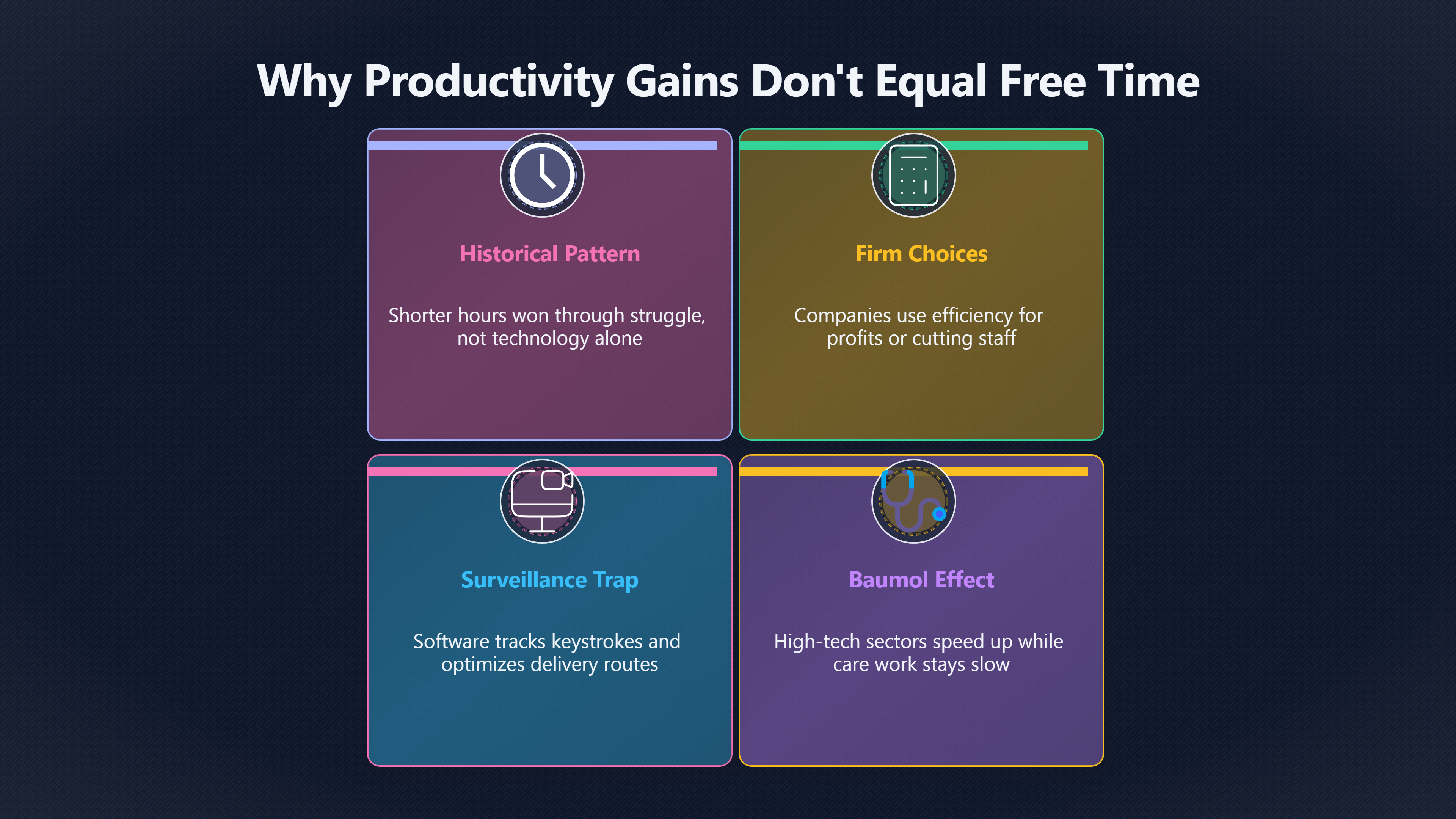
Many people assume that if AI lets workers complete tasks more quickly, working hours will naturally fall. Economic history is more complicated.
Over the last century, productivity rose dramatically across industrial economies. Average annual working hours did fall over the long run, but the decline slowed sharply in recent decades. In several countries, hours stopped falling altogether despite continued technological progress. The OECD notes that where shorter hours continued to spread, they were often linked to legislation or strong collective bargaining systems rather than automation alone. [OECD]oecd.orgOECDTrends in Working Hours in OECD CountriesIn recent years, the decline in average annual hours of work per person in employment, which…
This matters because firms can use productivity gains in different ways:
- producing more with the same staff and hours
- reducing headcount while intensifying work
- increasing profits
- lowering prices
- raising wages
- reducing hours without cutting pay
AI makes this tension sharper because digital systems can also increase surveillance and performance measurement. Software can optimise delivery routes, monitor keystrokes, analyse customer calls or generate productivity rankings in real time. Without bargaining power, workers may experience AI not as liberation from drudgery but as constant acceleration.
Recent scepticism about AI-driven leisure reflects this concern. Analysts have noted that earlier waves of productivity growth often increased consumption expectations rather than creating large amounts of free time. If every firm uses AI to compete more aggressively, workers may simply be expected to produce more output in the same number of hours. [Financial Times]ft.comWhile AI is improving individual productivity and wages, these micro-level benefits do not scale simply to societal-level reductions in w…
There is also a practical problem: many important sectors remain labour-intensive. Care work, nursing, teaching, construction and hospitality cannot be fully automated in the same way as software coding or document drafting. Economists sometimes describe this as the “Baumol effect”: highly productive sectors can become more efficient rapidly, while human-centred sectors still require time-intensive labour. [Financial Times]ft.comWhile AI is improving individual productivity and wages, these micro-level benefits do not scale simply to societal-level reductions in w…
In other words, AI abundance at the level of computation does not automatically create abundant leisure for households.
How unions have historically reduced working time
Shorter working hours were historically won through political and industrial struggle, not gifted by employers. The weekend, paid holidays and the eight-hour day emerged through decades of labour organising across Europe and North America.
That history matters because AI debates sometimes treat reduced hours as an inevitable side-effect of automation. The historical pattern suggests otherwise. Productivity gains become free time mainly when workers can collectively demand a share of them.
The OECD has noted that countries with stronger bargaining systems and social partnership traditions often achieved larger reductions in working time. Germany and the Netherlands are frequently cited examples. [OECD]oecd.orgHours workedActual hours worked include regular work hours of full-time, part-time and part-year workers, paid and unpaid overtime, hours…
One of the clearest recent examples came from Germany’s industrial union IG Metall. In 2018, the union negotiated an agreement giving many workers the right to temporarily reduce their working week from 35 hours to 28 hours while preserving a route back to full-time work. The deal also included pay increases. [The Guardian]theguardian.comMarch 9, 2018 — 9 Mar 2018 — From January 2019, workers represented by IG Metall can expect not only a 4.3% pay rise, but also the option… [TUC]tuc.org.ukNegotiating automation and new technology: Better terms…In 2018, IG Metall in Germany, which represents the metalworking and electrica…
The significance of the agreement was not simply the exact number of hours. It showed that advanced manufacturing sectors — among the most automated in Europe — could still use collective bargaining to convert productivity gains into greater time autonomy rather than endless output expansion.
This does not mean unions always oppose automation. Research on German works councils suggests worker representation can coexist with successful technological adoption and may even improve implementation by increasing trust and coordination. The argument is less “stop the machines” than “who benefits from them?” [UK Parliament Committees]committees.parliament.ukUK Parliament CommitteesAFW0019 - Evidence on Automation and the future of workThe German metal workers union, IG Metall, has recently ne…
What unions can bargain for: pay, hours and transition guarantees
In practice, unions rarely negotiate around AI in purely abstract terms. They bargain over specific mechanisms that determine whether productivity gains improve life or increase pressure.
Reduced hours without loss of pay
The central demand in many four-day-week campaigns is not compressed hours — squeezing five days into four — but genuine reductions in working time while maintaining pay.
This matters because many workers already face burnout, unpaid overtime and digital exhaustion. If AI tools genuinely increase output per hour, unions argue some of that efficiency should return to workers as time.
Several four-day-week pilots have reported stable productivity alongside improved wellbeing and lower turnover. A Welsh government review of shorter-workweek evidence found many trials reported gains in productivity, retention and mental health. GOV.WALES
Supporters see this as an early test of whether AI-era productivity can be converted into quality of life improvements rather than permanent intensification.
Protection against “speed-up”
Automation often changes jobs before it eliminates them. Warehouse staff may walk less because robots move goods, but face harsher performance targets because software tracks every minute. Office workers may draft reports faster with AI systems, yet receive larger workloads because management assumes tasks now take less time.
Some union agreements therefore focus on limits to algorithmic management:
- restrictions on surveillance
- transparency about productivity metrics
- consultation before AI deployment
- workload caps
- staffing minimums
- guaranteed break times
Without these protections, AI productivity gains can paradoxically make jobs more exhausting.

Retraining and transition rights
A shorter-hours future only becomes politically stable if workers believe they will share the gains rather than simply lose employment.
That is why some labour organisations push for:
- retraining guarantees
- internal redeployment rights
- income protection during transitions
- consultation rights before automation
- public funding for skills programmes
These demands are especially important in sectors where AI may partially automate cognitive work rather than only manual labour.
Four-day weeks as a test of the robot dividend
The four-day week has become a symbolic test of whether advanced economies can turn technological efficiency into broader human flourishing.
Supporters argue that AI systems may finally make large-scale reductions in working hours economically feasible. Administrative tasks, scheduling, drafting, coding assistance and customer support can increasingly be partially automated. If these tools reduce wasted time, some organisations may maintain output with fewer human hours.
Recent company experiments have strengthened interest in the idea. Some firms adopting AI-assisted workflows report that automation helped sustain shorter working schedules without major productivity losses. [The Washington Post]washingtonpost.comThe Washington Post These companies say AI is key to their four-day workweeksRoger Kirkness, founder of Convictional, used AI to automate repetitive tasks, allowing his remote team to maintain output while enjoying…
Research on four-day-week pilots has also found several recurring patterns:
- lower burnout
- improved retention
- fewer sick days
- stable or improved productivity
- better work-life balance [autonomy.work]autonomy.workes, and 62% reported it easier to combine work with social life.Read more…
But the evidence remains mixed and incomplete. Results vary heavily by sector, management quality and worker autonomy. Knowledge work and software teams may adapt more easily than healthcare, logistics or retail. [arXiv]arxiv.orgSource details in endnotes.
There is also an unresolved distribution question. High-skilled workers using AI tools may gain flexibility first, while lower-paid service workers remain stuck in rigid schedules. An AI economy could therefore split into:
- highly productive sectors with shorter hours [inverse.com]inverse.com40847 ig metall union strikes for 28 hour weekA Strike for a Shorter Work Week in Germany Signals…1 Feb 2018 — With 24-hour strikes, IG Metall's fight for the temporary reduction o…
- low-paid in-person sectors with persistent long hours
That risk already appears in many advanced economies.
The main obstacle is bargaining power, not technology
One striking feature of the current debate is that even some technology executives now openly discuss shorter working weeks. Public speculation about three-day weeks or AI-enabled leisure has become common in Silicon Valley.
Yet optimistic predictions alone do not redistribute power.
Critics point out that recent decades already delivered large productivity gains without proportional growth in leisure for most workers. In many countries, wage growth weakened while inequality rose. Labour’s share of income often fell as capital ownership became more concentrated. [The Guardian]theguardian.comMarch 9, 2018 — 9 Mar 2018 — From January 2019, workers represented by IG Metall can expect not only a 4.3% pay rise, but also the option…
That experience shapes scepticism around AI abundance claims. If a small number of firms own the most powerful AI systems, data infrastructure and robotics platforms, they may capture most of the gains unless countervailing institutions exist.
This is why the shorter-hours debate increasingly overlaps with wider questions about:
- union density
- labour law
- taxation [oecd.org]oecd.orgdividuals in OECD countries, focussing on the impact of taxation…
- ownership of AI infrastructure
- platform monopolies
- public services
- universal basic income
- worker representation in technology deployment
The argument is ultimately about who controls the productivity surplus created by intelligent machines.
Could AI eventually support a much lower-work society?
The most ambitious AI bloom scenarios imagine a future where dangerous, repetitive and exhausting labour shrinks dramatically. In that vision, humans spend less time on compulsory work and more on care, learning, creativity, relationships and exploration.
Shorter working hours are one of the clearest measurable indicators of whether that future is becoming real.
If AI systems eventually generate enormous productivity gains across logistics, manufacturing, administration, energy and scientific research, societies could theoretically support high living standards with far less human labour. Economists from John Maynard Keynes onwards imagined this possibility long before modern AI. Yet Keynes’s famous prediction of a 15-hour week never arrived for most people. [arXiv]arxiv.orgSource details in endnotes.
The difference may again come down to institutions rather than machines.
A future of AI abundance could still contain overwork, insecurity and inequality if competition forces workers to remain permanently available. Equally, advanced AI could help finance a transition towards shorter weeks, longer holidays, earlier retirement and more autonomy over time.
The technology alone does not decide between those futures. Collective bargaining, labour law and political choices help determine whether AI productivity becomes a larger human life or simply a faster economy.
Endnotes
-
Source: oecd.org
Link: https://www.oecd.org/en/publications/trends-in-working-hours-in-oecd-countries_674061356827.htmlSource snippet
OECDTrends in Working Hours in OECD CountriesIn recent years, the decline in average annual hours of work per person in employment, which...
-
Source: committees.parliament.uk
Link: https://committees.parliament.uk/writtenevidence/92873/html/Source snippet
UK Parliament CommitteesAFW0019 - Evidence on Automation and the future of workThe German metal workers union, IG Metall, has recently ne...
-
Source: oecd.org
Link: https://www.oecd.org/en/data/indicators/hours-worked.htmlSource snippet
Hours workedActual hours worked include regular work hours of full-time, part-time and part-year workers, paid and unpaid overtime, hours...
-
Source: arxiv.org
Link: https://arxiv.org/abs/2512.05995 -
Source: autonomy.work
Title: Shorter working week doc V6
Link: https://autonomy.work/wp-content/uploads/2019/03/Shorter-working-week-docV6.pdfSource snippet
The Autonomy InstituteThe Shorter Working Week:In 2014, a report by the OECD stated: 'There is consistent evidence...that overall earning...
-
Source: tuc.org.uk
Link: https://www.tuc.org.uk/node/528712Source snippet
Negotiating automation and new technology: Better terms...In 2018, IG Metall in Germany, which represents the metalworking and electrica...
-
Source: gov.wales
Link: https://www.gov.wales/the-4-day-week-a-social-partnership-insight-htmlSource snippet
The 4-day week: a social partnership insight [HTML]4 Apr 2024 — Overall, these pilots, as well as the Autonomy report on AI and shorter w...
-
Source: arxiv.org
Link: https://arxiv.org/abs/2507.09911Source snippet
arXivWhen Less is More: A systematic review of four-day workweek conceptualizations and their effects on organizational performanceJuly 1...
-
Source: arxiv.org
Title: arXiv How a 4-day Work Week affects Agile Software Development Teams
Link: https://arxiv.org/abs/2111.08968 -
Source: oecd.org
Link: https://www.oecd.org/en/publications/automation-and-occupational-wage-trends_596b32ce-en.htmlSource snippet
Automation and occupational wage trendsRoutine-biased technological change has emerged as a leading explanation for the differential wage...
-
Source: autonomy.work
Link: https://autonomy.work/portfolio/uk4dwpilotresults/Source snippet
es, and 62% reported it easier to combine work with social life.Read more...
-
Source: oecd.org
Link: https://www.oecd.org/en/publications/oecd-employment-outlook-2023_08785bba-en/full-report/under-pressure-labour-market-and-wage-developments-in-oecd-countries_dd4dbb5b.htmlSource snippet
ross the OECD countries with a particular focus on wage dynamics.Read more...
-
Source: oecd.org
Title: component 5
Link: https://www.oecd.org/en/publications/2025/07/oecd-employment-outlook-2025_5345f034/full-report/component-5.htmlSource snippet
OECD Employment Outlook 2025: Bouncing back, but on...9 Jul 2025 — OECD labour markets have continued to show resilience over the past y...
-
Source: oecd.org
Title: oecd compendium of productivity indicators 2025 b024d9e1 en
Link: https://www.oecd.org/en/publications/oecd-compendium-of-productivity-indicators-2025_b024d9e1-en.htmlSource snippet
OECD Compendium of Productivity Indicators 202510 Jul 2025 — This report presents a comprehensive overview of both recent and long-term t...
-
Source: oecd.org
Title: insights on productivity developments in 2024 c4061fb7
Link: https://www.oecd.org/en/publications/oecd-compendium-of-productivity-indicators-2025_b024d9e1-en/full-report/insights-on-productivity-developments-in-2024_c4061fb7.htmlSource snippet
OECD Compendium of Productivity Indicators 202510 Jul 2025 — This report presents a comprehensive overview of both recent and long-term t...
-
Source: oecd.org
Link: https://www.oecd.org/content/dam/oecd/en/publications/reports/2023/08/is-there-a-trade-off-between-productivity-and-employment_804cbedf/99bede51-en.pdfSource snippet
is there a trade-off between productivity and employment?Studies have documented a productivity slowdown, a decline in business dynamism...
-
Source: oecd.org
Link: https://www.oecd.org/en/publications/what-happened-to-jobs-at-high-risk-of-automation_10bc97f4-en.htmlSource snippet
across 21 countries.There is no support for net job destruction at the...Read more...
-
Source: data-explorer.oecd.org
Link: https://data-explorer.oecd.org/s/27aSource snippet
annual hours actually worked per workerTo change the table layout 1) Ensure your screen reader is in focus mode or forms mode 2) Use the...
-
Source: oecd.org
Link: https://www.oecd.org/en/publications/explaining-differences-in-hours-worked-among-oecd-countries_244230044118.htmlSource snippet
dividuals in OECD countries, focussing on the impact of taxation...
-
Source: oecd.org
Link: https://www.oecd.org/content/dam/oecd/en/publications/reports/2022/01/labour-saving-technologies-and-employment-levels_c1bb460f/9ce86ca5-en.pdfSource snippet
Labour-saving technologies and employment levels (EN)by ARERR MAKING · 2022 · Cited by 22 — This publication contributes to the OECD's Ar...
-
Source: ft.com
Link: https://www.ft.com/content/d6baf228-5e7d-40ee-9a90-6e09ca226dd1Source snippet
While AI is improving individual productivity and wages, these micro-level benefits do not scale simply to societal-level reductions in w...
-
Source: theguardian.com
Link: https://www.theguardian.com/world/2018/mar/09/28-hour-week-gains-momentum-in-german-unions-push-for-flexible-rightsSource snippet
March 9, 2018 — 9 Mar 2018 — From January 2019, workers represented by IG Metall can expect not only a 4.3% pay rise, but also the option...
Published: March 9, 2018
-
Source: washingtonpost.com
Title: The Washington Post These companies say AI is key to their four-day workweeks
Link: https://www.washingtonpost.com/business/2025/12/31/ai-four-day-workweek/Source snippet
Roger Kirkness, founder of Convictional, used AI to automate repetitive tasks, allowing his remote team to maintain output while enjoying...
-
Source: theguardian.com
Title: The Guardian The bogus four-day workweek that AI supposedly ‘frees up’
Link: https://www.theguardian.com/technology/ng-interactive/2026/feb/18/ai-four-day-workweekSource snippet
Recent headlines tout AI's role in enabling four-day workweeks, with figures like Zoom’s CEO, Jamie Dimon, Bill Gates, and Elon Musk spec...
-
Source: ourworldindata.org
Title: working hours
Link: https://ourworldindata.org/working-hoursSource snippet
We explore how it differs across countries and over time and how these differences matter for people's lives.Read more...
-
Source: theguardian.com
Title: labour must learn lessons from history as automation hits jobs market
Link: https://www.theguardian.com/business/2025/dec/28/labour-must-learn-lessons-from-history-as-automation-hits-jobs-marketSource snippet
Labour must learn lessons from history as automation hits...28 Dec 2025 — Productivity is up in retail and other low-paying sectors as t...
Additional References
-
Source: facebook.com
Link: https://www.facebook.com/UniteSharonGraham/posts/ai-and-automation-will-radically-change-the-world-of-work-and-it-has-the-capacit/1525841259543248/Source snippet
AI and automation will radically change the world of work...” In Germany, the industrial union IG Metall is already using its... 28-ho...
-
Source: unison.org.uk
Link: https://www.unison.org.uk/content/uploads/2024/11/Four-Day-Week-Guide-v6.pdfSource snippet
Four Day Working Week Bargaining GuideThe union argued that this would have a damaging effect on staff health and presented evidence on t...
-
Source: irishtimes.com
Link: https://www.irishtimes.com/business/work/german-union-ig-metall-wins-right-to-28-hour-working-week-and-4-3-pay-rise-1.3382445Source snippet
German union IG Metall wins right to 28-hour working week...6 Feb 2018 — IG Metall, Germany's most powerful union, has won a 4.3 per cen...
-
Source: businessinsider.com
Title: Business Insider One thing that might get workers to embrace AI?
Link: https://www.businessinsider.com/four-day-workweek-might-incentivize-employees-embrace-ai-2026-1Source snippet
The 4-day workweek.A recent article from Business Insider explores how introducing a four-day workweek could help ease employee resistanc...
-
Source: cepr.org
Title: new measures hours worked and implications oecd business cycles
Link: https://cepr.org/voxeu/columns/new-measures-hours-worked-and-implications-oecd-business-cyclesSource snippet
New measures of hours worked and implications for OECD...Oct 16, 2011 — This column constructs a new dataset for total hours worked per...
-
Source: youtube.com
Title: Professor Ben Hunnicutt: After Work Recovering Virtue Beyond the Selfish System
Link: https://www.youtube.com/watch?v=M_c_2b5kdoMSource snippet
Unions AI automation shorter working hours 4 day week 50+ Best AI Tools for Productivity in 2025 (ChatGPT, Canva, Notion & More!) Pynade...
-
Source: oecdstatistics.blog
Title: are international productivity gaps as large as we thought
Link: https://oecdstatistics.blog/2018/12/17/are-international-productivity-gaps-as-large-as-we-thought/Source snippet
?17 Dec 2018 — Figure 1 presents official estimates of hours worked in countries' national accounts, and compares them with the OECD simp...
-
Source: facebook.com
Link: https://www.facebook.com/news.com.au/posts/unions-have-launched-a-radical-push-for-a-four-day-work-week-without-pay-cuts-ca/1479814740848497/Source snippet
s you ask your employees which day suits them and work around that...Read more...
-
Source: inverse.com
Title: 40847 ig metall union strikes for 28 hour week
Link: https://www.inverse.com/article/40847-ig-metall-union-strikes-for-28-hour-weekSource snippet
A Strike for a Shorter Work Week in Germany Signals...1 Feb 2018 — With 24-hour strikes, IG Metall's fight for the temporary reduction o...
-
Source: epsu.org
Link: https://www.epsu.org/article/working-hours-information-ig-metallSource snippet
are agreed to. There is no unpaid increase of working time.Read more...
Amazon book picks
Further Reading
Books and field guides related to AI and shorter hours. Use these as the next step if you want deeper reading beyond the article.
AI and Work
AI and Work Understanding How Artificial Intelligence Is Changing the AI Future of Jobs, Skills, and Employment As artificial intelligenc...

Overtime
Overtime is about the politics of time, and specifically the amount of time that we spend labouring within capitalist society. It argues...
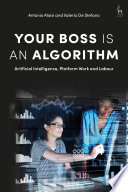
Your Boss Is an Algorithm
What effect do robots, algorithms, and online platforms have on the world of work? Using case studies and examples from across the EU, th...
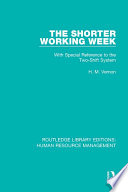
The Shorter Working Week
In 1931 the International Association for Social Progress decided to undertake an enquiry concerning the effects of a shorter working wee...
eBay marketplace picks
Marketplace Samples
Example marketplace items related to this page. Use the search link to explore similar finds on eBay.

Example eBay listing
A.I. Artificial Intelligence Original Movie Poster Signed By Jude Law
USD 125.00 | Shipping USD 25.00 | US

Example eBay listing
Artificial Intelligence D/S Original Movie Poster - 27 x 40"
USD 19.50 | Shipping USD 13.65 | US

Example eBay listing
612388 Artificial Intelligence Movie Science Fiction Drama Wall Print Poster
USD 22.95 | Shipping USD 12.95 | JP

Example eBay listing
Companion - Artificial Intelligence Dark Comedy Cinema Film - POSTER 20"x30"
USD 23.99 | Free shipping | US

Example eBay listing
A.I. Artificial Intelligence Movie Film Poster Art Print
GBP 4.99 | Free shipping | GB

Example eBay listing
A I Artificial Intelligence 6 Movie Poster Art Print Print Classic Rare Gallery
GBP 49.00 | Free shipping | GB

Example eBay listing
AI - Artificial Intelligence (Poster + Slipcase) Blu-Ray
GBP 10.49 | Free shipping | GB

Example eBay listing
A. I. Artificial Intelligence. Jude Law. Original UK Video Poster.
GBP 8.11 | Shipping GBP 3.38 | GB
Topic Tree