Within Shared Gains
AI and Worker Gains
AI can spread gains through work when employees get better tools, training, bargaining power, and a real share of productivity growth.
On this page
- Augmentation versus automation
- Who is most exposed at work
- Rules that share productivity gains
Page outline Jump by section
Introduction
AI does not automatically raise wages or destroy jobs. The same system can either make workers more productive and valuable, or reduce them to cheaper, more tightly monitored labour. The difference often depends less on the technology itself than on who controls deployment, training, workflow design, and bargaining power.
 That distinction matters far beyond ordinary workplace policy. If advanced AI eventually enables a world of far greater abundance, scientific progress, and material prosperity, then the route into that future matters enormously. A society where AI mainly replaces workers may become richer on paper while concentrating power and weakening labour. A society where AI expands human capability could spread the gains more broadly through higher pay, safer work, stronger public services, and wider access to expertise.
Early evidence suggests both paths are already emerging. Some firms use AI to automate narrow tasks and cut labour costs. Others use it to help workers solve harder problems, learn faster, and perform at a higher level. The long-term “AI bloom” case depends heavily on which model becomes dominant.
Augmentation versus automation
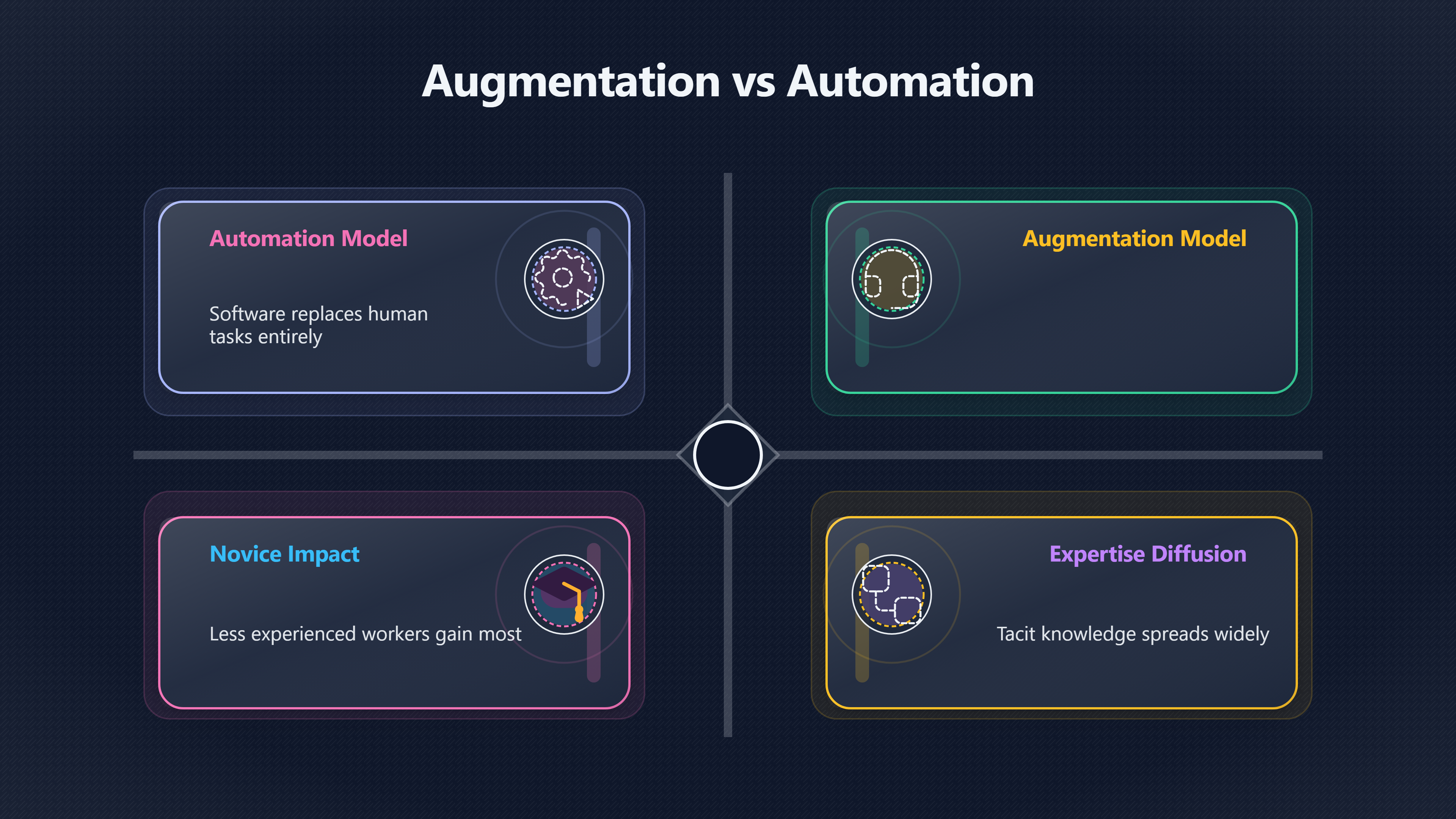
The central economic distinction is between augmentation and automation.
- Automation replaces human tasks with software or machines.
- Augmentation helps humans perform tasks better, faster, or at a higher skill level.
The same AI tool can do either.
A customer-service chatbot, for example, can be used to eliminate support staff. But it can also function as a real-time assistant that helps agents solve problems more effectively, especially newer employees. In that second model, workers become more productive rather than redundant.
One of the most cited real-world studies of generative AI at work examined more than 5,000 customer-support agents using an AI assistant based on large language models. Researchers Erik Brynjolfsson, Danielle Li, and Lindsey Raymond found productivity rose by roughly 15% overall, with the largest gains concentrated among less experienced and lower-skilled workers. The tool effectively helped workers perform more like experienced staff. OUP Academic [NBER]nber.orgNBER WORKING PAPER SERIES GENERATIVE AI AT…by E Brynjolfsson · 2023 · Cited by 3399 — We study the impact of generative AI on producti…
That result matters because it points to a possible equalising effect. If AI systems spread expertise instead of merely replacing labour, they may reduce skill bottlenecks and raise the productivity of large numbers of ordinary workers.
The mechanism is important:
- AI captures and distributes tacit knowledge.
- Workers receive guidance while doing the task itself.
- New employees improve faster.
- Firms can raise output without cutting headcount.
- Workers gain leverage because they can handle more valuable work.
This is different from the classic “machines replace workers” story associated with earlier automation waves.
Economist Daron Acemoglu argues that AI’s long-run economic impact depends heavily on whether systems mainly automate existing labour or create “task complementarities” that increase the value of human work. [MIT Economics]economics.mit.eduMIT EconomicsThe Simple Macroeconomics of AIApril 8, 2024 — by D Acemoglu · 2024 · Cited by 930 — This paper evaluates claims about the l…
In practical terms, augmentation often means:
- nurses using AI-supported diagnostics rather than being replaced by software;
- teachers using AI tutoring systems to personalise learning;
- engineers using coding assistants while remaining responsible for system design;
- scientists using AI to analyse data while directing research goals;
- tradespeople using AI planning and visualisation tools on site.
Under this model, AI behaves less like a robotic replacement and more like a “capability multiplier”.
Why some AI deployments raise wages
Higher productivity alone does not guarantee higher wages. Productivity gains can flow to shareholders, executives, platform owners, or consumers through lower prices. Worker gains usually require additional conditions.
Several mechanisms appear especially important.
Workers must keep control over valuable judgement
AI tends to complement labour most strongly when humans still control judgement, relationships, accountability, and complex coordination.
In medicine, for example, AI image-analysis tools may improve diagnosis rates, but clinicians still interpret results, communicate with patients, weigh uncertainty, and make treatment decisions. The AI increases the value of skilled medical work instead of eliminating it.
The same pattern appears in law, consulting, engineering, and software development. AI often handles drafts, searches, summarisation, and routine analysis, while humans remain responsible for strategy, trust, and final decisions.
When workers retain these higher-level functions, their productivity can rise without their role collapsing into low-paid supervision.
AI can spread elite skills more widely
Some evidence suggests AI tools disproportionately help weaker or less experienced workers.
The customer-service study found novice agents improved far more than top performers. [OUP Academic]academic.oup.comSource details in endnotes.
This creates a possible “expertise diffusion” effect:
- fewer years are needed to reach competence;
- workers from weaker educational backgrounds may access higher-value work;
- firms can train employees more quickly;
- productivity gains become broader rather than concentrated among a small elite.
That possibility is especially relevant for the wider AI bloom vision. If advanced systems make high-quality expertise abundant and widely accessible, they could reduce some forms of educational and geographic inequality rather than amplifying them.
But this only happens if workers retain bargaining power and pathways to advancement. Otherwise AI may merely reduce training costs while holding wages down.
Labour shortages change incentives
AI is more likely to augment workers in sectors already facing labour shortages.
Healthcare, elder care, skilled trades, logistics, education, and scientific research all suffer from shortages in many countries. In these settings, firms and governments often need workers badly enough that improving productivity becomes more attractive than replacing staff outright.
The Bank of Canada recently argued that AI may help offset labour shortages linked to ageing populations rather than simply driving mass unemployment. [Reuters]reuters.comAI is not replacing workers on a large scale so far, says Bank of CanadaDeputy Governor Michelle Alexopoulos emphasized that while some job displacement is anticipated as AI adoption increases, current evidenc…
This distinction matters politically and economically. When societies lack enough nurses, technicians, teachers, or engineers, AI can raise effective labour supply by helping each worker do more.
In a long-term abundance scenario, this could help civilisation overcome some hard constraints:
- limited medical expertise;
- overstretched education systems;
- shortages of scientific talent;
- ageing populations;
- insufficient care capacity.
Who is most exposed at work
Not all workers face the same risks or opportunities.
Research increasingly suggests that AI exposure depends less on industry labels and more on the structure of tasks inside jobs.
Routine cognitive work is especially vulnerable
Jobs built around predictable information processing are easier to automate:
- basic copywriting;
- transcription;
- repetitive administration;
- simple coding;
- routine customer support;
- standardised document review.
These tasks are easier for AI systems to imitate because they involve patterns already present in training data.
Evidence from online labour markets already suggests substitution is occurring in some outsourced digital work. One recent paper found firms adopting generative AI reduced spending on freelance online labour platforms while increasing AI spending. [arXiv]arxiv.orgarXiv Generative AI at WorkarXiv Generative AI at Work
This does not necessarily eliminate entire occupations immediately. More commonly, it weakens bargaining power by increasing labour supply or reducing the value of entry-level tasks.
Hybrid roles may benefit most
Jobs combining technical skill, social trust, physical presence, and judgement are often harder to replace fully.
Examples include:
- electricians;
- advanced manufacturing technicians;
- nurses;
- project managers;
- therapists;
- research scientists;
- teachers;
- senior software engineers.
In these roles, AI may automate portions of the workflow while increasing the importance of coordination, interpretation, and human responsibility.
Recent research analysing millions of job postings found rising demand for “AI-complementary” skills including teamwork, resilience, digital literacy, and ethical judgement. The study concluded complementarity effects may currently exceed substitution effects overall. [arXiv]arxiv.orgarXiv Generative AI at WorkarXiv Generative AI at Work
This hints at a broader transition in labour markets:
- narrow routine expertise becomes cheaper;
- human coordination and adaptive reasoning become more valuable;
- workers increasingly manage AI systems rather than compete directly with them.

The danger of deskilling
Augmentation can quietly become automation.
A worker initially empowered by AI tools may gradually lose autonomy as firms standardise workflows around the system.
This “deskilling” pattern appeared during earlier industrial revolutions:
- craftsmen became machine operators;
- clerical workers became data-entry processors;
- retail workers became checkout attendants following scripts.
AI could accelerate similar trends.
If workers rely heavily on AI systems while losing opportunities to develop independent expertise, firms gain leverage. Employees become easier to replace because fewer deep skills are required.
Trade unions and labour researchers increasingly warn about this risk. The UK Trades Union Congress argues that AI could either reduce drudgery or weaken worker bargaining power through surveillance, deskilling, and tighter managerial control. [TUC]tuc.org.ukbuilding pro worker ai innovation strategyTUCBuilding a pro-worker AI innovation strategy | TUC27 Aug 2025 — As more tasks are automated, deskilled workers may be less able to com…
This is one reason “AI productivity” alone is an incomplete metric. A workplace can become more productive while simultaneously making workers less autonomous and less able to command high wages.
The productivity paradox
Many AI productivity gains remain uneven, hard to measure, or disappointing.
Some workers save time but spend more effort checking outputs, fixing errors, or managing fragmented systems. A recent Workday survey described employees acting as “human middleware” between disconnected AI tools and software systems. [TechRadar]techradar.comWorkers are reportedly spending nearly a full workday each week—especially among one in four employees—performing manual tasks like copyi…
Other studies show mixed results:
- workers often report feeling faster; [barrons.com]barrons.comThese users were four times more likely than non-users to express decreased productivity, possibly because AI often handles routine tasks…
- organisational gains are sometimes smaller than expected;
- quality problems can offset speed improvements;
- AI may increase low-value output rather than meaningful achievement. [Financial Times]ft.comFinancial Times Are we thinking about AI and productivity all wrong?Despite significant enthusiasm around AI tools, quantifying how much value they actually add is challenging. Early research from the nonp…
This matters because wage growth usually depends on sustained productivity improvements large enough to reshape markets and institutions.
Historically, major wage gains from technology often arrived slowly:
- electricity required factory redesign;
- computers required organisational restructuring;
- the internet required new business models.
AI may follow a similar path. Early tools can look impressive without immediately generating broad wage growth.
Rules that share productivity gains
Whether AI raises wages or weakens labour depends heavily on institutions.
Technology does not determine distribution by itself.

Training and access matter
Workers cannot benefit from AI tools they do not understand or cannot access.
Firms that invest in training may create:
- higher-productivity employees; [oecd.org]oecd.orgAI and workAI can bring many benefits to the workplace such as higher productivity, improved job quality and stronger occupational safety…
- broader skill diffusion;
- internal promotion pathways;
- more resilient workforces.
Without training, AI advantages tend to concentrate among already highly educated workers and elite firms.
Public policy matters here too:
- affordable AI access for schools and small firms;
- adult retraining systems;
- technical education;
- support for workers changing occupations;
- digital infrastructure.
If advanced AI becomes a core economic capability, unequal access may deepen class and geographic divides.
Labour bargaining power still matters
Historically, productivity growth only translated into broad wage growth when workers had leverage through:
- unions;
- labour shortages;
- regulation;
- political organisation;
- social norms favouring wage sharing.
The same is likely true for AI.
If firms can easily replace workers, productivity gains may mainly increase profits. If labour markets remain tight and workers retain bargaining power, gains are more likely to appear in wages, hours, benefits, and working conditions.
This may become one of the defining political economy questions of the AI era:
can intelligence become abundant without making human labour disposable?
Competition policy shapes distribution
AI markets show strong tendencies towards concentration:
- cloud infrastructure;
- frontier models;
- proprietary data;
- chip production;
- platform ecosystems.
If a few firms dominate AI infrastructure, they may capture most productivity gains while workers and smaller firms remain dependent customers.
More competitive ecosystems could spread gains more widely:
- open-source models;
- interoperable tools;
- public compute infrastructure;
- smaller specialist providers;
- stronger antitrust enforcement.
The structure of AI markets therefore affects labour outcomes indirectly. Workers usually capture more gains in economies where firms compete for labour rather than exercising monopoly-like control.
Why this matters for the wider AI bloom vision
The optimistic case for AI is not merely that machines will do work more cheaply. It is that abundant intelligence could help humanity overcome deep limits:
- scarcity of expertise;
- slow scientific discovery;
- dangerous labour;
- poor education access;
- medical bottlenecks;
- administrative overload;
- coordination failures.
But that future becomes politically fragile if most people experience AI primarily as downward pressure on wages and status.
Broad worker gains may therefore be one of the practical conditions for sustaining long-term support for advanced AI development.
A world where AI helps ordinary people become more capable, productive, healthy, and economically secure is easier to reconcile with democratic legitimacy and human flourishing. A world where intelligence concentrates into a small number of firms and governments while labour loses bargaining power may produce backlash, instability, and resistance even if aggregate wealth rises.
The deeper question is not whether AI can generate abundance. It is whether human beings remain meaningful participants in creating and directing that abundance.
Early evidence suggests both futures remain possible.
Endnotes
-
Source: academic.oup.com
Link: https://academic.oup.com/qje/article/140/2/889/7990658 -
Source: nber.org
Link: https://www.nber.org/system/files/working_papers/w31161/w31161.pdfSource snippet
NBER WORKING PAPER SERIES GENERATIVE AI AT...by E Brynjolfsson · 2023 · Cited by 3399 — We study the impact of generative AI on producti...
-
Source: arxiv.org
Title: arXiv Generative AI at Work
Link: https://arxiv.org/abs/2304.11771 -
Source: economics.mit.edu
Link: https://economics.mit.edu/sites/default/files/2024-04/The%20Simple%20Macroeconomics%20of%20AI.pdfSource snippet
MIT EconomicsThe Simple Macroeconomics of AIApril 8, 2024 — by D Acemoglu · 2024 · Cited by 930 — This paper evaluates claims about the l...
Published: April 8, 2024
-
Source: reuters.com
Title: AI is not replacing workers on a large scale so far, says Bank of Canada
Link: https://www.reuters.com/world/americas/ai-is-not-replacing-workers-large-scale-so-far-says-bank-canada-2026-05-15/Source snippet
Deputy Governor Michelle Alexopoulos emphasized that while some job displacement is anticipated as AI adoption increases, current evidenc...
-
Source: arxiv.org
Link: https://arxiv.org/abs/2602.00139Source snippet
arXivPayrolls to Prompts: Firm-Level Evidence on the Substitution of Labor for AIJanuary 28, 2026...
Published: January 28, 2026
-
Source: arxiv.org
Title: arXiv Complement or substitute? How AI increases the demand for human skills
Link: https://arxiv.org/abs/2412.19754Source snippet
arXivComplement or substitute? How AI increases the demand for human skillsDecember 27, 2024...
Published: December 27, 2024
-
Source: tuc.org.uk
Title: building pro worker ai innovation strategy
Link: https://www.tuc.org.uk/research-analysis/reports/building-pro-worker-ai-innovation-strategySource snippet
TUCBuilding a pro-worker AI innovation strategy | TUC27 Aug 2025 — As more tasks are automated, deskilled workers may be less able to com...
-
Source: techradar.com
Link: https://www.techradar.com/pro/too-many-employees-are-serving-as-the-human-middleware-between-disconnected-ai-systems-new-study-claims-workers-are-spending-a-whole-day-every-week-managing-ai-toolsSource snippet
Workers are reportedly spending nearly a full workday each week—especially among one in four employees—performing manual tasks like copyi...
-
Source: arxiv.org
Title: Augmenting or Automating Labor?
Link: https://arxiv.org/pdf/2503.19159Source snippet
The Effect of AI...by D Marguerit · 2025 · Cited by 25 — Automation AI refers to technologies that substitute for labor by automating ta...
-
Source: ft.com
Title: Financial Times Are we thinking about AI and productivity all wrong?
Link: https://www.ft.com/content/197acda2-028f-484e-9489-140443289bbfSource snippet
Despite significant enthusiasm around AI tools, quantifying how much value they actually add is challenging. Early research from the nonp...
-
Source: dallasfed.org
Link: https://www.dallasfed.org/research/economics/2026/0224Source snippet
AI is simultaneously aiding and replacing workers, wage...24 Feb 2026 — Artificial intelligence's impact on the labor market will depend...
Additional References
-
Source: oecd.org
Link: https://www.oecd.org/en/topics/ai-and-work.htmlSource snippet
AI and workAI can bring many benefits to the workplace such as higher productivity, improved job quality and stronger occupational safety...
-
Source: oecd.org
Link: https://www.oecd.org/en/topics/future-of-work.htmlSource snippet
Future of workAI can bring many benefits to the workplace such as higher productivity, improved job quality and stronger occupational saf...
-
Source: oecd.org
Link: https://www.oecd.org/en.htmlSource snippet
OECD: The Organisation for Economic Co-operation and...The OECD designs international standards and guidelines for development co-operat...
-
Source: oecd.org
Title: reaping the benefits of ai for performance at work and job quality 5fdcb07e
Link: https://www.oecd.org/en/publications/artificial-intelligence-and-the-labour-market-in-japan_b825563e-en/full-report/reaping-the-benefits-of-ai-for-performance-at-work-and-job-quality_5fdcb07e.htmlSource snippet
Artificial Intelligence and the Labour Market in Japan28 Nov 2025 — The automation of tedious and repetitive tasks by AI could improve jo...
-
Source: oecd.org
Title: artificial intelligence and the labour market
Link: https://www.oecd.org/en/publications/oecd-employment-outlook-2023_08785bba-en/full-report/artificial-intelligence-and-the-labour-market-introduction_ea35d1c5.htmlSource snippet
Introduction11 July 2023 — On the positive side, AI can automate repetitive tasks, which c...
Published: July 2023
-
Source: barrons.com
Link: https://www.barrons.com/articles/heavy-ai-usage-makes-workers-feel-less-productive-0eb79832Source snippet
These users were four times more likely than non-users to express decreased productivity, possibly because AI often handles routine tasks...
-
Source: datasociety.net
Link: https://datasociety.net/wp-content/uploads/2024/12/DS_Generative-AI-and-Labor-Primer_Final.pdfSource snippet
Generative AI and Labor: Power, Hype, and Value at WorkGenerative AI models can recognize patterns in data, such as transcripts of call c...
-
Source: oecd.ai
Link: https://oecd.ai/en/work-innovation-productivity-skills/key-themes/labour-marketsSource snippet
Labour marketsAI is likely to have a significant impact on the world of work, acting as a substitute to human labour in some tasks, and a...
-
Source: facebook.com
Link: https://www.facebook.com/theOECD/Source snippet
OECD | ParisOur latest blog draws on new OECD data to examine how governments are investing in energy research and innovation and how the...
-
Source: x.com
Link: https://x.com/OECD?lang=enSource snippet
OECD ➡️ Better Policies for Better LivesThe Organisation for Economic Co-operation and Development. Secretary-General: @MathiasCormann. P...
Amazon book picks
Further Reading
Books and field guides related to AI and Worker Gains. Use these as the next step if you want deeper reading beyond the article.

The Shift: The Future of Work is Already Here
An unhysterical look at the future of employment.
Automation and the Future of Work
First published 2020. Subjects: Economic history, Automation, Social aspects, Economic aspects, Technological innovations.
Future of Work Technology and Basic Income
First published 2019. Subjects: Economics, Information society, Economic aspects, Work, Technological innovations.
The Future of Work in the United States
This book presents and analyzes how restructuring processes due to technological change are reflected and processed in political and publ...
eBay marketplace picks
Marketplace Samples
Example marketplace items related to this page. Use the search link to explore similar finds on eBay.

Example eBay listing
A.I. Artificial Intelligence Original Movie Poster Signed By Jude Law
USD 125.00 | Shipping USD 25.00 | US

Example eBay listing
Artificial Intelligence D/S Original Movie Poster - 27 x 40"
USD 19.50 | Shipping USD 13.65 | US

Example eBay listing
612388 Artificial Intelligence Movie Science Fiction Drama Wall Print Poster
USD 22.95 | Shipping USD 12.95 | JP

Example eBay listing
Companion - Artificial Intelligence Dark Comedy Cinema Film - POSTER 20"x30"
USD 23.99 | Free shipping | US

Example eBay listing
The Worker Who Gets Drunk - 1930s Spanish Civil War Poster - 18x24
GBP 12.50 | Shipping GBP 13.78 | US

Example eBay listing
He Who Gets Slapped Poster - Lon Chaney Film Wall Art - 12X16/16X20/18X24/24X36
GBP 22.99 | Free shipping | GB

Example eBay listing
He Who Gets Slapped 1924 POSTER PRINT A5A1 Cult 20s Horror Cinema Film Wall Art
GBP 29.99 | Free shipping | GB

Example eBay listing
He Who Gets Slapped Poster Lon Chaney 1924 Old Movie Photo
GBP 5.41 | Shipping GBP 3.18 | AU
Topic Tree