Within Discovery
Molecular Binding Predictions
AlphaFold 3 moves AI biology towards molecular interactions, but binding predictions can still fail in flexible, living systems.
On this page
- Why interactions matter more than isolated shapes
- Where binding models could help drug discovery
- Flexible proteins, context and confidence limits
Page outline Jump by section
Introduction
AlphaFold 3 matters because biology is not mainly about isolated protein shapes. Life depends on molecules binding, separating, switching states and reacting inside crowded, changing cellular environments. Drugs work by binding to targets. Antibodies recognise pathogens through binding. Genes are regulated through proteins binding to DNA and RNA. Much of medicine and biochemistry is really the study of molecular interactions.
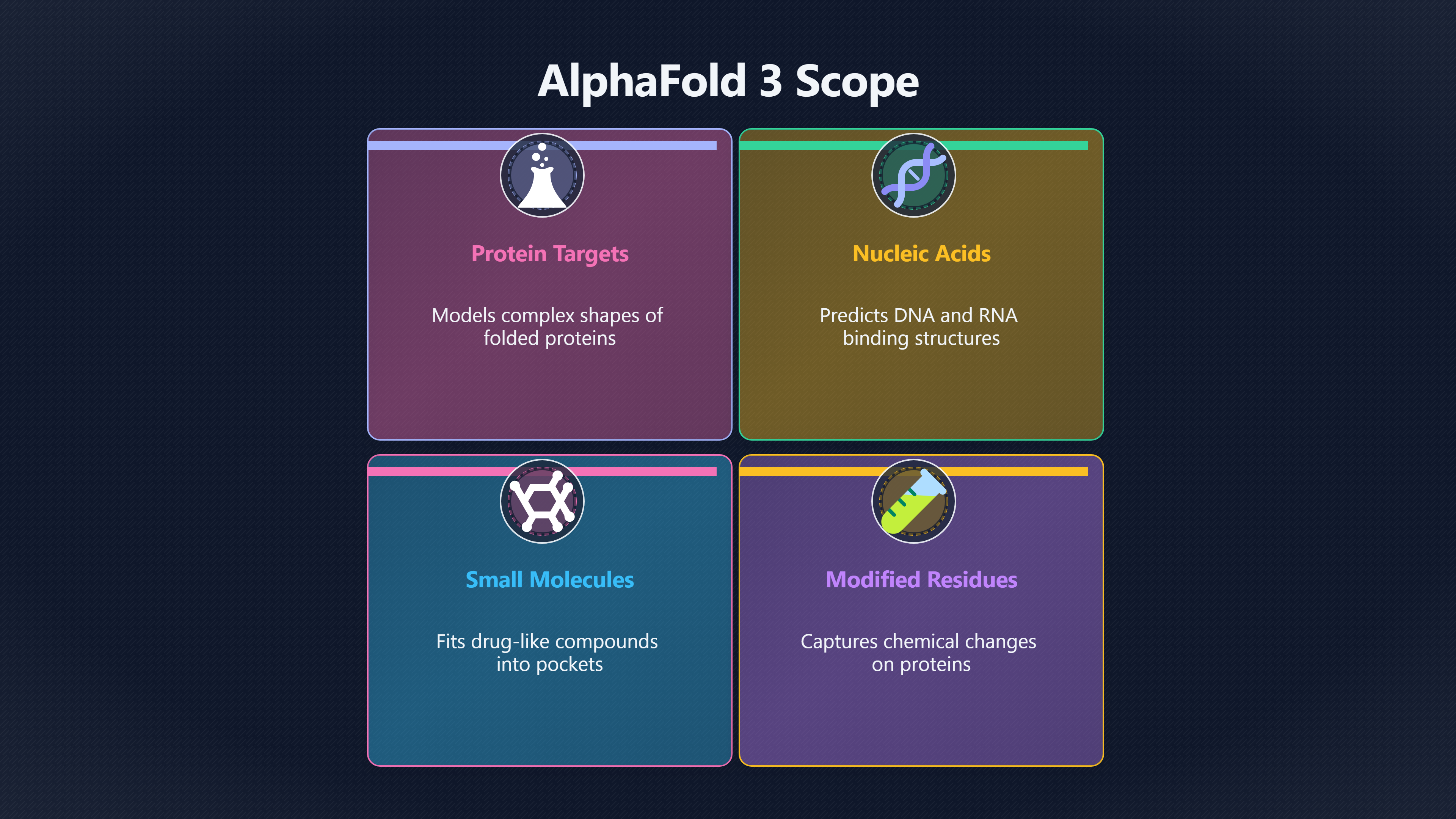
 That is why AlphaFold 3 represents a larger conceptual leap than AlphaFold 2. Instead of predicting mainly single protein structures, it attempts to model how proteins interact with other molecules, including DNA, RNA, ions and small drug-like compounds. DeepMind described this as predicting “the structure and interactions of all life’s molecules”. [Nature]nature.comNatureAccurate structure prediction of biomolecular interactions…by J Abramson · 2024 · Cited by 14654 — Here we describe our AlphaFol…
But the breakthrough comes with important caveats. AlphaFold 3 is powerful at predicting many binding arrangements, yet living biology is still far more dynamic, flexible and context-dependent than current AI models can fully capture. The system reveals how much scientific search can be accelerated by AI — while also revealing how far biology remains from being computationally solved.
Why interactions matter more than isolated shapes
AlphaFold 2 became famous for predicting protein folding, but folded structure was never the whole biological story.
A protein’s function often depends less on its resting shape than on what it binds to and how it changes during binding. Enzymes open and close around substrates. Receptors alter shape when molecules attach. Antibodies recognise tiny surface features on pathogens. DNA-binding proteins switch genes on and off depending on complex molecular conditions.
Earlier AlphaFold systems struggled with this broader interaction landscape. Even when AlphaFold 2 predicted a protein accurately, it often ignored the molecules that changed the protein’s behaviour. EMBL-EBI’s own training materials noted that AlphaFold 2 was “not aware of molecules that bind to proteins”, which could strongly alter structure and function. [ebi.ac.uk]ebi.ac.ukstrengths and limitations of alphafold25 Jan 2024 — One of AlphaFold's limitations is that it is not aware of molecules that bind to proteins, which can affect the protein's 3…
AlphaFold 3 tries to address that limitation directly.
The 2024 Nature paper introducing the model described a new diffusion-based architecture capable of predicting joint structures involving:
- proteins [ebi.ac.uk]ebi.ac.ukWhat is AlphaFold?AlphaFold2 is a multicomponent artificial intelligence (AI) system that uses machine learning to predict a protein's 3D…
- DNA
- RNA
- small-molecule ligands [cen.acs.org]cen.acs.org3 to offer structure prediction via web browser - C&EN16 May 2024 — The new tool can predict the structures and interactions of an array…
- ions
- modified residues
inside a single integrated prediction system. [Nature]nature.comNatureBenchmarking all-atom biomolecular structure prediction…by S Xu · 2025 · Cited by 24 — For the entire protein-ligand set, AlphaF…
That matters because real cells are chemically crowded environments. Proteins rarely act alone. Drug discovery, gene regulation and cell signalling all depend on interaction networks rather than isolated structures.
In practical terms, AlphaFold 3 shifts AI biology from asking:
- “What shape does this protein fold into?”
towards:
- “What happens when biological molecules meet?”
That is a much more ambitious scientific problem.
Where binding models could help drug discovery
The strongest near-term excitement around AlphaFold 3 comes from drug discovery.
Most medicines work by binding to biological targets. A drug molecule fits into a protein pocket, changes behaviour and alters disease processes. Predicting those interactions accurately has historically required enormous amounts of experimental work.
Faster screening of candidate molecules
Traditional drug discovery often involves screening huge libraries of compounds experimentally or using slower physics-based simulations. AlphaFold 3 offers a way to narrow the search space earlier.
DeepMind reported that AlphaFold 3 showed at least a 50% improvement over existing methods for some categories of protein interaction prediction. [blog.google]blog.googlegoogle deepmind isomorphic alphafold 3 ai modelAlphaFold 3 predicts the structure and interactions of all…8 May 2024 — Our new AI model AlphaFold 3 can predict the structure and int…
Independent benchmarking studies have also shown substantial gains in protein-ligand docking tasks — the challenge of predicting how drug-like molecules fit into proteins. A 2025 Nature Communications benchmark found AlphaFold 3 outperforming several competing systems on protein-ligand prediction tasks, reaching success rates around 65% on benchmark datasets. [Nature]nature.comInvestigating whether deep learning models for co-folding…by MR Masters · 2025 · Cited by 59 — Recently, the works of AlphaFold 3 (AF3…
That does not mean AI is designing finished medicines automatically. But it can help researchers:
- identify promising binding pockets
- eliminate implausible candidates earlier
- prioritise experiments
- model interactions for poorly understood proteins
- investigate disease mutations more rapidly
The key economic effect is not replacing laboratories entirely. It is compressing the search process.
Previously difficult targets become more tractable
Some proteins are hard to study experimentally because they are unstable, rare or difficult to crystallise. AI-generated interaction models can give researchers a useful starting hypothesis even when experimental structures are incomplete.
This is especially important for:
- rare diseases
- neglected tropical diseases
- understudied proteins
- membrane proteins
- rapidly mutating pathogens
Several groups are already combining AlphaFold-style systems with molecular dynamics simulations and experimental validation to study ion channels, bacterial targets and protein complexes involved in disease. [eLife]elifesciences.orgreviewed preprintseLifeHarnessing AlphaFold to reveal hERG channel…by K Ngo · 2025 · Cited by 13 — This valuable study uses AlphaFold2 to guide the stru…
In the broader AI bloom frame, this is one of the clearest examples of AI potentially accelerating scientific discovery itself rather than merely automating office work. If the loop between hypothesis and experiment shortens substantially, medical progress could compound over decades.
But the limits become clearer the deeper one looks.
Flexible proteins remain a major problem
The biggest misconception about AlphaFold 3 is that biology has become predictable in a static, engineering-style sense.
Proteins are not rigid mechanical objects. Many constantly shift between states, partly unfold, reconfigure or interact differently depending on cellular conditions.
This creates a fundamental challenge for AI structure prediction.
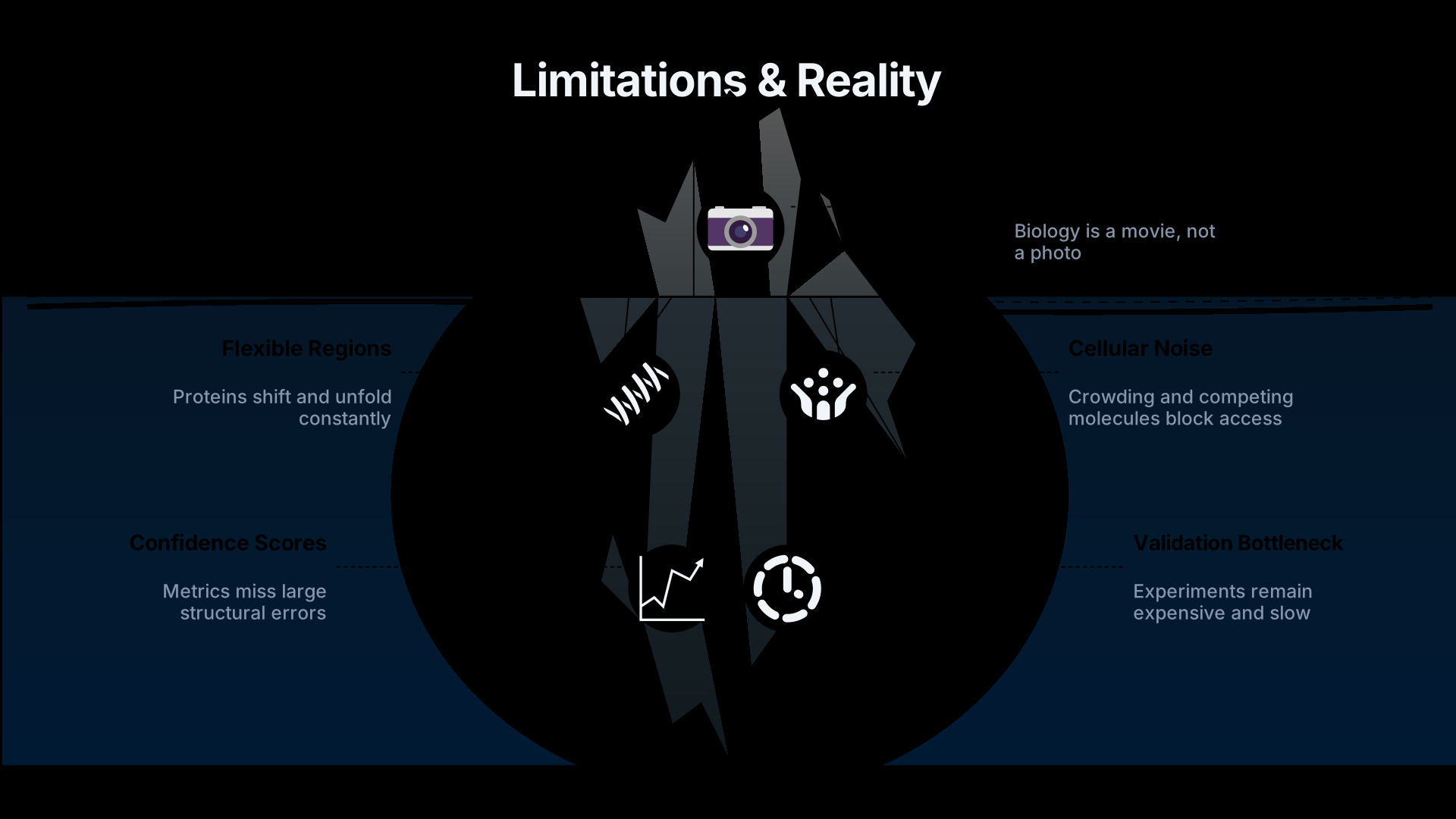
Biology is a movie, not a snapshot
Many proteins exist as moving ensembles rather than single fixed structures. Their behaviour changes with:
- temperature
- pH
- crowding
- phosphorylation
- nearby molecules
- membrane conditions
- mechanical stress
- time
AlphaFold 3 can often predict one plausible binding arrangement, but living systems frequently depend on transitions between multiple states.
This matters enormously in drug discovery because drugs often target transient conformations rather than dominant resting structures. Allosteric drugs — compounds that regulate proteins indirectly by binding at secondary sites — are especially difficult because binding can trigger long-range shape changes across the molecule. [ACS Publications]pubs.acs.orgACS PublicationsProtein Structure Prediction of Ligand-Induced Conformational…1 Nov 2024 — This study focuses on predicting the dynami…
Reviews of AlphaFold 3 repeatedly note weaknesses around:
- dynamic conformational behaviour [pubs.acs.org]pubs.acs.orgACS PublicationsProtein Structure Prediction of Ligand-Induced Conformational…1 Nov 2024 — This study focuses on predicting the dynami…
- flexible regions
- large assemblies
- intrinsically disordered proteins
- transient interactions
[PMC]pmc.ncbi.nlm.nih.govPMCAnalysing protein complexes in plant science: insightsPMCby PY Lin · 2025 · Cited by 25 — Lastly, we discussed the limitations of AF3, particularly in predicting large molecular assemblies, d… [2arXiv]arxiv.orgarXivBenchmarking AlphaFold3's protein-protein complex accuracy and machine learning prediction reliability for binding free energy chang…
Some proteins are partly disordered by design. They only adopt stable shapes when interacting with other molecules. Those cases remain much harder for current systems.

Cellular context still matters enormously
Real molecular binding happens inside cells full of competing interactions and chemical noise.
A predicted binding arrangement that looks convincing computationally may fail biologically because:
- another molecule blocks access
- the protein is modified inside the cell
- concentrations differ
- membranes alter behaviour
- the interaction is too weak or transient
- the binding event triggers downstream changes not captured structurally
This is one reason many researchers stress that AlphaFold predictions are hypotheses rather than experimental truth.
Even highly accurate structural prediction does not automatically predict:
- biological efficacy
- toxicity
- pharmacology
- immune response
- metabolic stability
- clinical usefulness
Drug development failures often occur long after binding prediction appears successful.
Confidence scores can look more certain than reality
One subtle risk with powerful AI systems is that convincing outputs can encourage overconfidence.
AlphaFold 3 produces confidence estimates for many predictions, but benchmarking studies suggest these metrics do not always detect major failures.
A 2024 benchmark on protein-protein complexes found that some AlphaFold 3 predictions contained large structural errors that were not captured well by the model’s confidence scores. Flexible regions were especially unreliable. [arXiv]arxiv.orgarXivBenchmarking AlphaFold3's protein-protein complex accuracy and machine learning prediction reliability for binding free energy chang…
Other benchmarking work found that performance drops when molecules differ substantially from examples seen during training. [ebi.ac.uk]ebi.ac.ukmore…
That matters because the hardest scientific problems often involve novelty:
- new pathogens
- unusual chemistry
- rare proteins
- poorly studied organisms
- unfamiliar drug scaffolds
If a model partly relies on recognising patterns similar to its training data, genuine scientific generalisation becomes harder than benchmark scores may suggest.
Some critics worry that strong performance on familiar molecular motifs could be mistaken for deeper chemical understanding. [nexco.ch]nexco.chThe Limitations of Protein Ligand Co folding with Alpha Fold 3, UnveiledThe Limitations of Protein-Ligand Co-folding with…Nov 17, 2025 — The conclusion is stark: AlphaFold 3, and possibly the other tools ca…
This does not make AlphaFold 3 unimportant. But it changes the interpretation. The system may function more like an extraordinarily capable probabilistic pattern engine than a complete simulator of living chemistry.
Why experimental science still dominates
AlphaFold 3 changes the economics of biological reasoning, but it does not eliminate experimental science.
The central bottleneck in biology increasingly shifts from:
- “Can we generate a plausible structure?”
towards:
- “Which predictions survive contact with reality?”
That distinction matters for understanding scientific acceleration realistically.
Prediction is getting cheaper faster than validation
AI systems can now generate structural hypotheses at extraordinary speed. But experiments remain comparatively expensive and slow.
Researchers still need to:
- synthesise molecules
- test binding experimentally
- measure toxicity
- study pharmacokinetics
- validate cell behaviour
- reproduce findings
- run animal studies
- conduct clinical trials
The danger is not merely scientific error. It is flooding biology with plausible-looking predictions faster than laboratories can validate them.
Some researchers therefore argue that the next major transformation may require pairing AI prediction with:
- automated robotic laboratories
- faster assays
- large-scale experimental feedback loops
- improved simulation systems
Machine-speed discovery becomes much more powerful when the physical world can answer back quickly.
What AlphaFold 3 suggests about AI and scientific acceleration
AlphaFold 3 is important less because it “solves biology” than because it demonstrates a broader pattern.
AI systems are increasingly able to compress parts of the scientific search process that once required enormous human effort:
- ranking possibilities
- modelling interactions
- identifying plausible mechanisms
- narrowing experimental pathways
That could matter profoundly for medicine, materials science and long-term human flourishing.
If future systems become substantially better at modelling molecular interactions, humanity may eventually:
- discover therapies faster
- understand disease mechanisms earlier
- engineer enzymes more efficiently
- design biological systems with greater precision
- reduce parts of the trial-and-error burden in medicine
But AlphaFold 3 also reveals the boundaries of current AI optimism.
Living systems are not just static geometry problems. Biology emerges from movement, timing, competition, noise, evolution and multi-scale interactions across entire cells and organisms. Molecular binding is only one layer inside that complexity.
The deeper lesson is therefore double-edged:
- AI can dramatically accelerate scientific hypothesis generation.
- Reality remains richer and harder than even the best predictive systems currently capture.
That tension is central to the broader AI bloom debate. Scientific acceleration is real and increasingly measurable. Yet the path from faster prediction to civilisation-scale abundance still depends on experimentation, institutions, manufacturing, regulation and the stubborn complexity of the natural world.
Endnotes
-
Source: nature.com
Link: https://www.nature.com/articles/s41586-024-07487-wSource snippet
NatureAccurate structure prediction of biomolecular interactions...by J Abramson · 2024 · Cited by 14654 — Here we describe our AlphaFol...
-
Source: blog.google
Title: google deepmind isomorphic alphafold 3 ai model
Link: https://blog.google/innovation-and-ai/products/google-deepmind-isomorphic-alphafold-3-ai-model/Source snippet
AlphaFold 3 predicts the structure and interactions of all...8 May 2024 — Our new AI model AlphaFold 3 can predict the structure and int...
Published: May 2024
-
Source: ebi.ac.uk
Title: strengths and limitations of alphafold
Link: https://www.ebi.ac.uk/training/online/courses/alphafold/an-introductory-guide-to-its-strengths-and-limitations/strengths-and-limitations-of-alphafold/Source snippet
25 Jan 2024 — One of AlphaFold's limitations is that it is not aware of molecules that bind to proteins, which can affect the protein's 3...
-
Source: nature.com
Link: https://www.nature.com/articles/s41467-025-67127-3Source snippet
NatureBenchmarking all-atom biomolecular structure prediction...by S Xu · 2025 · Cited by 24 — For the entire protein-ligand set, AlphaF...
-
Source: pubs.acs.org
Link: https://pubs.acs.org/doi/10.1021/acs.jcim.4c01475Source snippet
ACS PublicationsProtein Structure Prediction of Ligand-Induced Conformational...1 Nov 2024 — This study focuses on predicting the dynami...
-
Source: pmc.ncbi.nlm.nih.gov
Title: PMCAnalysing protein complexes in plant science: insights
Link: https://pmc.ncbi.nlm.nih.gov/articles/PMC12098255/Source snippet
PMCby PY Lin · 2025 · Cited by 25 — Lastly, we discussed the limitations of AF3, particularly in predicting large molecular assemblies, d...
-
Source: arxiv.org
Link: https://arxiv.org/abs/2406.03979Source snippet
arXivBenchmarking AlphaFold3's protein-protein complex accuracy and machine learning prediction reliability for binding free energy chang...
-
Source: ebi.ac.uk
Link: https://www.ebi.ac.uk/training/online/courses/alphafold/alphafold-3-and-alphafold-server/introducing-alphafold-3/how-have-alphafold-3s-predictions-been-validated/Source snippet
more...
-
Source: nexco.ch
Title: The Limitations of Protein Ligand Co folding with Alpha Fold 3, Unveiled
Link: https://nexco.ch/blog/The-Limitations-of-Protein-Ligand-Co-folding-with-AlphaFold-3%2C-UnveiledSource snippet
The Limitations of Protein-Ligand Co-folding with...Nov 17, 2025 — The conclusion is stark: AlphaFold 3, and possibly the other tools ca...
-
Source: nature.com
Link: https://www.nature.com/articles/s41467-025-63947-5Source snippet
Investigating whether deep learning models for co-folding...by MR Masters · 2025 · Cited by 59 — Recently, the works of AlphaFold 3 (AF3...
-
Source: ebi.ac.uk
Link: https://www.ebi.ac.uk/training/online/courses/alphafold/alphafold-3-and-alphafold-server/introducing-alphafold-3/what-alphafold-3-struggles-with/Source snippet
What AlphaFold 3 struggles withNevertheless, AlphaFold 3 still has limitations. A key limitation of protein structure prediction models i...
-
Source: ebi.ac.uk
Title: introducing alphafold 3
Link: https://www.ebi.ac.uk/training/online/courses/alphafold/alphafold-3-and-alphafold-server/introducing-alphafold-3/Source snippet
25 Jun 2025 — AlphaFold 3 can also predict the structures of single molecules such as protein monomers, single- and double-stranded DNA a...
-
Source: ebi.ac.uk
Link: https://www.ebi.ac.uk/training/online/courses/alphafold/an-introductory-guide-to-its-strengths-and-limitations/what-is-alphafold/Source snippet
What is AlphaFold?AlphaFold2 is a multicomponent artificial intelligence (AI) system that uses machine learning to predict a protein's 3D...
-
Source: deepmind.google
Link: https://deepmind.google/science/alphafold/Source snippet
AlphaFold — Google DeepMindAlphaFold has revealed millions of intricate 3D protein structures, and is helping scientists understand how a...
-
Source: deepmind.google
Title: alphafold five years of impact
Link: https://deepmind.google/blog/alphafold-five-years-of-impact/Source snippet
AlphaFold: Five Years of ImpactNov 25, 2025 — Explore five years of AlphaFold's impact on biology. Learn how this Nobel Prize-winning AI...
-
Source: nature.com
Link: https://www.nature.com/articles/s42003-026-10112-3Source snippet
protein binder design and conformational state predictionby LA Abriata · 2026 — In the case of DeepMind's AlphaFold 2, the defining momen...
-
Source: nature.com
Link: https://www.nature.com/articles/s41586-021-03819-2Source snippet
Highly accurate protein structure prediction with AlphaFoldby J Jumper · 2021 · Cited by 49425 — The AlphaFold network directly predicts...
-
Source: pubs.acs.org
Link: https://pubs.acs.org/doi/10.1021/jacs.5c22222Source snippet
of Covalent Ligands with AlphaFold3On a pose-prediction benchmark set of covalent complexes curated by the... If we disregard early enri...
-
Source: pubs.acs.org
Link: https://pubs.acs.org/doi/10.1021/acs.jcim.2c01219Source snippet
Refined and Unrefined AlphaFold2 Structures...Mar 10, 2023 — Recent studies have reported successful application of AF2 structures in dr...
-
Source: cen.acs.org
Link: https://cen.acs.org/analytical-chemistry/structural-biology/AlphaFold-3-offer-structure-prediction/102/i15Source snippet
3 to offer structure prediction via web browser - C&EN16 May 2024 — The new tool can predict the structures and interactions of an array...
Published: May 2024
-
Source: biochemistry.org
Link: https://www.biochemistry.org/about-us/resources-and-videos/video-library/alphafold-3-structure-modelling-access-uses-limitations-and-rivals/Source snippet
AlphaFold 3 structure modelling: access, uses, limitations...This webinar covered how to obtain AF3 models, their strengths and occasion...
-
Source: elifesciences.org
Title: reviewed preprints
Link: https://elifesciences.org/reviewed-preprints/104901Source snippet
eLifeHarnessing AlphaFold to reveal hERG channel...by K Ngo · 2025 · Cited by 13 — This valuable study uses AlphaFold2 to guide the stru...
-
Source: alphafold.ebi.ac.uk
Link: https://alphafold.ebi.ac.uk/Source snippet
Protein Structure DatabaseAlphaFold is an AI system developed by Google DeepMind that predicts a protein's 3D structure from its amino ac...
-
Source: facebook.com
Title: Proteins do not act alone
Link: https://www.facebook.com/ItisaScience/posts/-proteins-do-not-act-alone-in-living-cells-they-constantly-interact-with-dna-rna/122217911996051326/Source snippet
In living cells...3 Mar 2026 — AlphaFold 3 predicts the structure and interactions of all of life's molecules... interaction support (p...
Additional References
-
Source: medium.com
Link: https://medium.com/%40cognidownunder/alphafold-changed-biology-forever-when-it-solved-protein-folding-78bb8768483aSource snippet
AlphaFold 3 Predicts Everything Now, Not Just Proteins...AlphaFold 3 shows you molecular shapes but can't predict binding affinities, ki...
-
Source: alphafoldserver.com
Link: https://alphafoldserver.com/Source snippet
AlphaFold ServerAlphaFold Server is a web-service that can generate highly accurate biomolecular structure predictions containing protein...
-
Source: medium.com
Link: https://medium.com/%40leowossnig/alphafold3-whats-next-in-computational-drug-discovery-2da534c0845eSource snippet
AlphaFold3 — What's next in computational drug discovery?We take a more measured approach and use this blog to examine its impact on comp...
-
Source: github.com
Link: https://github.com/google-deepmind/alphafoldSource snippet
Open source code for AlphaFold 2.This package provides an implementation of the inference pipeline of AlphaFold v2. For simplicity, we re...
-
Source: frontiersin.org
Link: https://www.frontiersin.org/journals/artificial-intelligence/articles/10.3389/frai.2026.1739303/fullSource snippet
The transformative impact of AI-enabled AlphaFold 3by C Chakraborty · Cited by 1 — Additionally, AlphaFold has enabled researchers to adv...
-
Source: linkedin.com
Link: https://www.linkedin.com/posts/%F0%9F%8E%AF-ming-tommy-tang-40650014_alphafolddrugdevelopment-activity-7436051840984576000-CzYGSource snippet
AlphaFold limitations in drug developmentEven with AlphaFold, protein structure is not a solved problem. And protein structure was never...
-
Source: rcastoragev2.blob.core.windows.net
Link: https://rcastoragev2.blob.core.windows.net/9e6c827f9d7f88eac8af0797432cefc7/41586_2024_7487_MOESM1_ESM.pdfSource snippet
3 is capable of predicting systems with any combination of protein, DNA, RNA, and ligands. As an additional baseline for RNA tertiary...
-
Source: isomorphiclabs.com
Title: alphafold 3 predicts the structure and interactions of all of lifes molecules
Link: https://www.isomorphiclabs.com/articles/alphafold-3-predicts-the-structure-and-interactions-of-all-of-lifes-moleculesSource snippet
AlphaFold 3 predicts the structure and interactions of all...8 May 2024 — It models large biomolecules such as proteins, DNA, and RNA, a...
Published: May 2024
-
Source: collaborate.princeton.edu
Link: https://collaborate.princeton.edu/en/publications/accurate-structure-prediction-of-biomolecular-interactions-with-a/Source snippet
structure prediction of biomolecular interactions...by J Abramson · 2024 · Cited by 14875 — Here we describe our AlphaFold 3 model with...
-
Source: pharmaphorum.com
Title: alphafold 3 takes structure predictions well beyond proteins
Link: https://pharmaphorum.com/news/alphafold-3-takes-structure-predictions-well-beyond-proteinsSource snippet
9 May 2024 — “For the interactions of proteins with other molecule types we see at least a 50% improvement compared with existing predict...
Published: May 2024
Amazon book picks
Further Reading
Books and field guides related to Molecular Binding Predictions. Use these as the next step if you want deeper reading beyond the article.

Molecular Biology of the Cell
First published 1983. Subjects: biology, cells, cell biology, textbook, nonfiction.

Drug Discovery and Evaluation: Pharmacological Assays
The new edition of this successful reference offers both cutting-edge and classic pharmacological methods. Thoroughly revised and expande...


Molecular Cell Biology
First published 1990. Subjects: Cytology, Molecular biology, Cellular biology, Genetics (non-medical), Science.
eBay marketplace picks
Marketplace Samples
Example marketplace items related to this page. Use the search link to explore similar finds on eBay.

Example eBay listing
A.I. Artificial Intelligence Original Movie Poster Signed By Jude Law
USD 125.00 | Shipping USD 25.00 | US

Example eBay listing
Artificial Intelligence D/S Original Movie Poster - 27 x 40"
USD 19.50 | Shipping USD 13.65 | US

Example eBay listing
612388 Artificial Intelligence Movie Science Fiction Drama Wall Print Poster
USD 22.95 | Shipping USD 12.95 | JP

Example eBay listing
Companion - Artificial Intelligence Dark Comedy Cinema Film - POSTER 20"x30"
USD 23.99 | Free shipping | US
Topic Tree