Within Public Compute
Cloud lock in risks
Exclusive cloud deals can make AI builders dependent on a few infrastructure owners through spending commitments, privileged access, and control rights.
On this page
- How cloud dependence forms around AI infrastructure
- Why lock in matters for public access and competition
- What public compute can and cannot counterbalance
Page outline Jump by section
Introduction
A public-compute strategy can fail even if governments buy large numbers of AI chips. The deeper problem is that advanced AI increasingly runs through long-term partnerships between model developers and a small number of cloud companies. These deals do not just provide servers. They can shape who gets access to compute, where models are deployed, which tools become industry standards, and how difficult it is for rivals to compete.
 That is why critics increasingly describe parts of the AI industry as a potential toll road. If a handful of cloud providers become the unavoidable gateways to advanced AI, then researchers, start-ups, universities, hospitals, and even governments may end up renting access to essential cognitive infrastructure on terms largely set by private firms. The concern is not merely high prices. It is dependency: technical, financial, and institutional lock-in that becomes harder to escape as AI spreads into science, medicine, education, logistics, and public administration.
The optimistic AI bloom vision imagines intelligence becoming abundant enough to accelerate discovery and widen human capability. Cloud lock-in raises the opposite possibility: abundance arriving through heavily centralised infrastructure where the gains are real, but access to the machinery of intelligence remains controlled by a narrow layer of firms.
How cloud dependence forms around AI infrastructure
Why frontier AI gravitates toward a few cloud providers
Training frontier AI systems now requires vast clusters of specialised chips, extremely fast networking, custom cooling systems, large electricity supplies, and teams able to manage distributed machine-learning infrastructure at enormous scale. Only a small number of companies already possess all of these capabilities simultaneously.
That creates a structural advantage for the major cloud providers: Microsoft Azure, Amazon Web Services, and Google Cloud. AI developers may begin as independent labs, but scaling quickly often pushes them toward partnerships with the firms that already own global infrastructure.
The result is a feedback loop:
- Large cloud firms own scarce compute infrastructure.
- AI developers need guaranteed access to scarce compute.
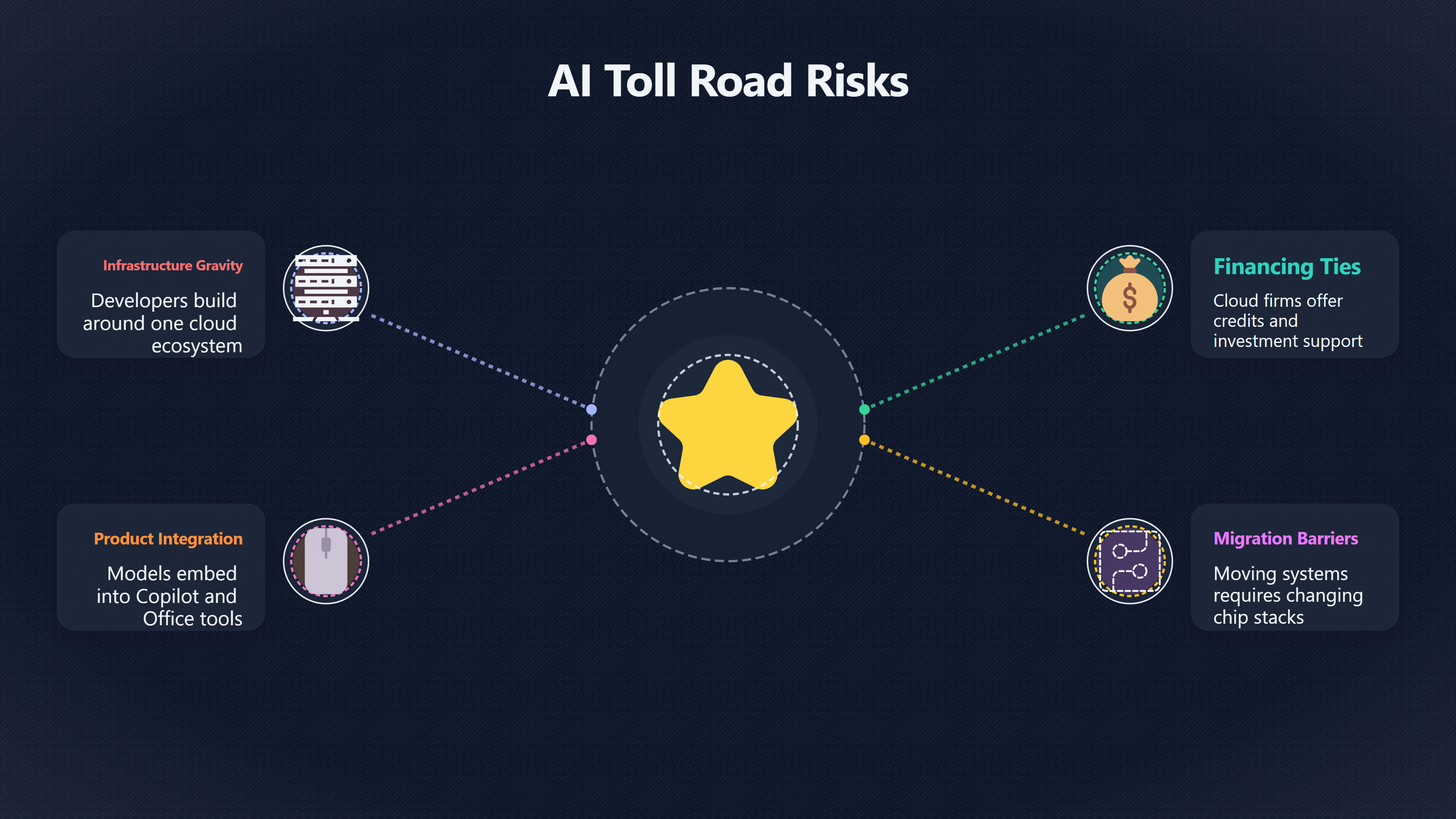
- Cloud firms offer financing, credits, investment, and engineering support.
- AI developers build around one cloud ecosystem.
- Switching later becomes expensive and technically disruptive.
The US Federal Trade Commission’s 2025 report on AI partnerships described how these arrangements can include cloud-spending commitments, revenue-sharing rights, exclusivity provisions, and operational influence over AI developers. The FTC also warned that specialised cloud architectures can create substantial switching costs once a developer becomes dependent on a provider’s tools and infrastructure. [Federal Trade Commission]ftc.govFederal Trade Commission | Protecting America's Consumers About the FTCOur mission is protecting the public from deceptive or unfair business practices and from unfair methods of competition through law enfor… [Federal Trade Commission]ftc.govFederal Trade Commission | Protecting America's Consumers About the FTCOur mission is protecting the public from deceptive or unfair business practices and from unfair methods of competition through law enfor…
This is not identical to a traditional monopoly. The cloud firms still compete with one another. But the danger is that competition happens between a very small number of gatekeepers while everyone else depends on them.
The Microsoft–OpenAI relationship as a model
The Microsoft–OpenAI partnership became the defining example because it combined investment, infrastructure, licensing, and product integration into one relationship.
Microsoft reportedly invested more than $13 billion into OpenAI while also becoming its primary cloud provider through Azure. Regulators in the UK, EU, and US examined whether the arrangement gave Microsoft excessive influence over a strategically important AI developer. [Forbes]forbes.comftc scrutinizing microsoft openai deal report saysForbesFTC Scrutinizing Microsoft-OpenAI Deal, Report SaysDec 8, 2023 — The FTC has begun preliminary inquiries into the Microsoft-OpenAI… [GOV.UK]GOV.UKmicrosoft slash openai partnership merger inquiry/ OpenAI partnership merger inquiry5 March 2025: The CMA has decided that Microsoft's partnership with OpenAI does not qualify for invest…
The partnership also showed how cloud dependency can spread through the wider economy. OpenAI’s models were integrated into Microsoft products including Copilot, Office, GitHub, and Azure services, strengthening Azure’s attractiveness to enterprise customers while making Microsoft more central to AI deployment across business software ecosystems. Reuters [TechRadar By 2026]techradar.comThis inquiry aims to evaluate whether Microsoft holds excessive market power in the UK, particularly in light of its more than 15 million…, OpenAI and Microsoft loosened parts of their exclusivity arrangement, allowing OpenAI to use additional cloud providers in some circumstances. Even then, Microsoft remained OpenAI’s “primary cloud partner”, retained long-term licensing rights, and preserved deep commercial integration. [Tom's Hardware]tomshardware.comDespite this shift, Microsoft remains OpenAI's primary cloud partner, with OpenAI products continuing to launch first on Azure unless Mic… [The Official Microsoft Blog]blogs.microsoft.comthe next phase of the microsoft openai partnershipThe Official Microsoft BlogThe next phase of the Microsoft-OpenAI partnershipApr 27, 2026 — The agreement spells out: Microsoft remains O… [Reuters]reuters.comBritain investigates Microsoft over business software dominanceThe probe—part of the CMA's broader "strategic market status" (SMS) framework—will assess whether Microsoft's bundling of products like W…
That partial unwinding itself revealed how powerful the dependency had become. Once an AI developer’s products, training systems, enterprise contracts, engineering workflows, and deployment pipelines are deeply tied to one provider, full separation becomes economically and operationally difficult.
Why switching clouds is harder in AI than ordinary software
Traditional cloud lock-in already existed before the AI boom. But AI intensifies it because compute infrastructure is unusually specialised.
Moving a frontier AI system between providers may require changes to:
- Chip architectures and optimisation stacks.
- Distributed training software.
- Data pipelines and storage systems.
- Security and compliance tooling.
- Inference serving infrastructure.
- Networking assumptions built into the training process.
The FTC noted that migration between AI-specialised cloud services can take substantial time and involve major technical barriers. [Federal Trade Commission]ftc.govFederal Trade Commission | Protecting America's Consumers About the FTCOur mission is protecting the public from deceptive or unfair business practices and from unfair methods of competition through law enfor…
This matters because frontier AI development increasingly depends on continuous scaling rather than one-off projects. If an AI company cannot easily move elsewhere without disrupting model training or product deployment, the cloud provider gains leverage even without formal exclusivity clauses.
In practice, dependence can emerge through infrastructure gravity rather than explicit coercion.
Why lock-in matters for public access and competition
The risk is not just higher prices
“Toll road” is partly an economic metaphor, but the deeper concern is political and civilisational.
If advanced AI becomes essential for scientific research, pharmaceutical development, engineering, education, and state capacity, then whoever controls the infrastructure layer may shape:
- Which organisations can experiment affordably.
- Which countries gain access to frontier capability.
- Which research directions are commercially viable.
- Which safety standards become defaults.
- Which institutions remain independent.
The danger is that intelligence itself becomes a rented service rather than a broadly distributed capability.
This does not necessarily mean deliberate abuse. Even ordinary commercial incentives can produce concentration. Cloud providers naturally prioritise large customers, profitable workloads, and integration into their own ecosystems. Over time, public institutions may become operationally dependent on infrastructure they do not control.
That pattern has historical precedents. Railroads, telecoms, operating systems, broadband networks, and mobile app stores all developed periods where infrastructure owners gained outsized power over downstream innovation.
The AI version may matter more because AI could become a general-purpose layer inside almost every knowledge-intensive activity.
Smaller researchers risk being locked out of frontier work
One argument for AI bloom is that intelligence could become dramatically more abundant, lowering barriers to invention and participation. Cloud concentration threatens that promise if frontier capability remains accessible only through expensive commercial infrastructure.
Universities already struggle to compete with major labs on compute access. Independent researchers and small firms often cannot afford large-scale training runs or sustained inference costs. Public-interest projects may find themselves dependent on grants, credits, or partnerships from the same firms dominating the market.
That can subtly shape research culture itself. If access to compute depends on maintaining good relationships with infrastructure providers, researchers may avoid lines of work that threaten dominant business models or require unusually expensive experimentation.
The result is not necessarily censorship. It is a narrowing of practical possibility.
National dependence becomes part of the problem
Cloud lock-in also has geopolitical implications.
A small number of mostly American firms dominate advanced AI cloud infrastructure. Countries without domestic compute capacity may become dependent on foreign providers for critical scientific, industrial, and administrative systems.
British parliamentary evidence submitted during AI infrastructure debates warned that vendor lock-in could increase costs, reduce incentives for challenger firms, and weaken national digital resilience. [UK Parliament Committees]committees.parliament.ukUK Parliament CommitteesWe use essential cookies to make our site work.Vendor lock-in will deepen, resulting in higher costs for taxpayer…
This matters especially if AI becomes deeply embedded in healthcare systems, energy grids, military planning, pharmaceutical research, or education platforms. Dependence on foreign-controlled infrastructure may limit strategic autonomy even for wealthy states.
For poorer countries, the imbalance could become larger still. AI abundance might increase global wealth overall while leaving many nations permanently downstream from infrastructure they neither own nor meaningfully influence.
What public compute can and cannot counterbalance
Public compute can widen access at critical layers
Public compute proposals try to prevent infrastructure dependence from becoming irreversible.
A serious public-compute ecosystem could provide:
- Shared GPU clusters for universities and public-interest research.
- National AI laboratories accessible beyond major corporations.
- Open scientific infrastructure for medicine and climate research.
- Compute grants for smaller firms and non-profits.
- Federated international infrastructure for countries lacking domestic scale.
This does not require governments to replace private clouds entirely. The goal is often closer to public universities or scientific supercomputers: creating non-commercial capability layers that preserve open research and broad participation.
Even modest public capacity can matter if it prevents total dependency. A university system with meaningful compute access may sustain independent research cultures that would otherwise disappear into corporate partnerships.

But public compute may struggle to match frontier scale
The counterargument is straightforward: frontier AI infrastructure is becoming staggeringly expensive.
Major technology firms are expected to spend hundreds of billions of dollars on AI infrastructure over the next several years. [Cloud Computing News]cloudcomputing-news.netCloud Computing News AI demand pushes companies to invest billions in cloudCloud Computing NewsAI demand pushes companies to invest billions in cloud…March 6, 2026 — AI adoption is pushing cloud spending highe…
Governments can fund important public systems, but keeping pace with frontier commercial scaling may prove politically difficult. Public procurement processes are slower. Public systems often face staffing constraints. State-backed infrastructure may also become vulnerable to political cycles and budget cuts.
There is another tension as well. Frontier AI increasingly depends not just on raw hardware, but on integrated ecosystems:
- Semiconductor supply chains.
- Proprietary optimisation software.
- Massive datasets.
- Global fibre and networking systems.
- Data-centre construction pipelines. [reuters.com]reuters.comBlackstone will initially contribute $5 billion in equity to develop 500 megawatts of data center capacity by 2027, with potential for fu…
- Energy procurement.
Public compute may therefore reduce dependency without fully eliminating it.
The realistic goal may be pluralism rather than full independence
The most plausible outcome may not be replacing private AI infrastructure, but preventing permanent single-channel dependence.
That could involve:
- Interoperability standards that reduce migration costs.
- Limits on exclusivity agreements. [engadget.com]engadget.comOpenAI breaks out of exclusivity agreements in its…16 hours ago — The two companies announced an amended partnership that lets OpenAI…
- Shared academic compute networks.
- Public procurement rules favouring portability.
- Open-source model ecosystems. [forbes.com]forbes.comftc scrutinizing microsoft openai deal report saysForbesFTC Scrutinizing Microsoft-OpenAI Deal, Report SaysDec 8, 2023 — The FTC has begun preliminary inquiries into the Microsoft-OpenAI…
- Regional compute alliances among governments and universities.
Some regulators are already moving in this direction. The FTC’s AI partnership investigations focused heavily on switching costs, exclusivity provisions, and access to critical infrastructure inputs. [Federal Trade Commission]ftc.govFederal Trade Commission | Protecting America's Consumers About the FTCOur mission is protecting the public from deceptive or unfair business practices and from unfair methods of competition through law enfor… [Federal Trade Commission]ftc.govFederal Trade Commission | Protecting America's Consumers About the FTCOur mission is protecting the public from deceptive or unfair business practices and from unfair methods of competition through law enfor…
The broader question inside the AI bloom debate is whether intelligence becomes more like public knowledge or more like privately metered infrastructure.
A world with superhuman AI assistants, accelerated science, radical medical advances, and automated abundance could still leave societies dependent on a handful of infrastructure owners. The existence of abundance alone does not determine who governs it.
Cloud lock-in matters because it sits precisely at that junction between technical progress and political power.
Endnotes
-
Source: ftc.gov
Title: issues staff report ai partnerships investments study
Link: https://www.ftc.gov/news-events/news/press-releases/2025/01/ftc-issues-staff-report-ai-partnerships-investments-studySource snippet
Federal Trade CommissionFTC Issues Staff Report on AI Partnerships & Investments...17 Jan 2025 — The report details key aspects regardin...
-
Source: ftc.gov
Title: behind ftcs 6b report large ai partnerships investments
Link: https://www.ftc.gov/policy/advocacy-research/tech-at-ftc/2025/01/behind-ftcs-6b-report-large-ai-partnerships-investmentsSource snippet
Federal Trade CommissionBehind the FTC's 6(b) Report on Large AI Partnerships &...17 Jan 2025 — For example, the partnerships all report...
-
Source: ftc.gov
Link: https://www.ftc.gov/system/files/ftc_gov/pdf/p246201_aipartnerships6breport_redacted_0.pdfSource snippet
Federal Trade CommissionPartnerships Between Cloud Service Providers and AI...4.5.1 - The partnerships offer CSP partners the ability to...
-
Source: forbes.com
Title: ftc scrutinizing [microsoft openai]({{ ‘ai-bloom-abun/ai-bloom-abun-98d3a6-shared-ai-gai-89312d-ai-platform-l-e1f9a1-microsoft-ope-846027/’ | relative_url }}) deal report says
Link: https://www.forbes.com/sites/zacharyfolk/2023/12/08/ftc-scrutinizing-microsoft-openai-deal-report-says/Source snippet
ForbesFTC Scrutinizing Microsoft-OpenAI Deal, Report SaysDec 8, 2023 — The FTC has begun preliminary inquiries into the Microsoft-OpenAI...
-
Source: GOV.UK
Title: microsoft slash openai partnership merger inquiry
Link: https://www.gov.uk/cma-cases/microsoft-slash-openai-partnership-merger-inquirySource snippet
/ OpenAI partnership merger inquiry5 March 2025: The CMA has decided that Microsoft's partnership with OpenAI does not qualify for invest...
Published: March 2025
-
Source: reuters.com
Title: Britain investigates Microsoft over business software dominance
Link: https://www.reuters.com/legal/litigation/uk-opens-antitrust-probe-into-microsofts-business-software-2026-05-14/Source snippet
The probe—part of the CMA's broader "strategic market status" (SMS) framework—will assess whether Microsoft's bundling of products like W...
-
Source: techradar.com
Link: https://www.techradar.com/pro/uk-opens-antitrust-enquiry-into-microsoft-dominance-of-business-softwareSource snippet
This inquiry aims to evaluate whether Microsoft holds excessive market power in the UK, particularly in light of its more than 15 million...
-
Source: blogs.microsoft.com
Title: the next phase of the microsoft openai partnership
Link: https://blogs.microsoft.com/blog/2026/04/27/the-next-phase-of-the-microsoft-openai-partnership/Source snippet
The Official Microsoft BlogThe next phase of the Microsoft-OpenAI partnershipApr 27, 2026 — The agreement spells out: Microsoft remains O...
-
Source: reuters.com
Link: https://www.reuters.com/legal/litigation/microsoft-end-exclusive-license-openais-technology-2026-04-27/Source snippet
ReutersMicrosoft, OpenAI change terms of deal so startup can...28 Apr 2026 — Ending the exclusivity pact may help Microsoft fight antitr...
-
Source: committees.parliament.uk
Link: https://committees.parliament.uk/writtenevidence/135012/html/Source snippet
UK Parliament CommitteesWe use essential cookies to make our site work.Vendor lock-in will deepen, resulting in higher costs for taxpayer...
-
Source: reuters.com
Link: https://www.reuters.com/business/google-blackstone-create-new-ai-cloud-company-wsj-reports-2026-05-19/Source snippet
Blackstone will initially contribute $5 billion in equity to develop 500 megawatts of data center capacity by 2027, with potential for fu...
-
Source: ftc.gov
Title: Federal Trade Commission | Protecting America’s Consumers About the FTC
Link: https://www.ftc.gov/Source snippet
Our mission is protecting the public from deceptive or unfair business practices and from unfair methods of competition through law enfor...
-
Source: tomshardware.com
Link: https://www.tomshardware.com/tech-industry/microsoft-and-openai-end-exclusivity-agreement-opening-up-potential-partnerships-with-amazon-and-google-microsoft-will-continue-to-receive-revenue-share-through-2030Source snippet
Despite this shift, Microsoft remains OpenAI's primary cloud partner, with OpenAI products continuing to launch first on Azure unless Mic...
-
Source: cloudcomputing-news.net
Title: Cloud Computing News AI demand pushes companies to invest billions in cloud
Link: https://www.cloudcomputing-news.net/news/ai-demand-pushes-companies-to-invest-billions-in-cloud-infrastructure/Source snippet
Cloud Computing NewsAI demand pushes companies to invest billions in cloud...March 6, 2026 — AI adoption is pushing cloud spending highe...
Published: March 6, 2026
-
Source: concurrences.com
Title: Part VIII
Link: https://www.concurrences.com/en/review/issues/no-8-2025/on-topic/cloud-and-competition-policy/cloud-and-competition-policy-part-viii-cloud-service-ai-partnerships-the-ftc-sSource snippet
Federal Trade Commission's Section 6(b) Report investigated three partnerships between major cloud service providers (Alphabet...Read more...
-
Source: troutman.com
Link: https://www.troutman.com/insights/cloud-and-competition-policy-part-viii-cloud-service-ai-partnerships-the-ftcs-section-6b-report-and-its-antitrust-implications-in-the-trump-20-administration/Source snippet
Federal Trade Commission's Section 6(b) Report investigated three partnerships between major cloud service providers (Alphabet/Google, Am...
-
Source: Wikipedia
Link: https://en.wikipedia.org/wiki/MicrosoftSource snippet
MicrosoftMicrosoft Corporation is an American multinational technology company headquartered in Redmond, Washington. The company becam...
Additional References
-
Source: warren.senate.gov
Link: https://www.warren.senate.gov/imo/media/doc/letter_from_senators_warren_wyden_to_openai_and_microsoft_on_anticompetitive_ai_partnerships.pdfSource snippet
Commission (FTC) reportedly issued new investigative requests regarding Microsoft's artificial intelligence (AI) operations...Read more...
-
Source: linkedin.com
Link: https://www.linkedin.com/posts/davesobel_managedservices-aiinfrastructure-itgovernance-activity-7459580865472475136-RZRxSource snippet
Vendor Lock-in Risk Intensifies with AI Infrastructure ShiftVendor lock-in risk is intensifying as Alphabet, Amazon, Microsoft, and Googl...
-
Source: jdsupra.com
Link: https://www.jdsupra.com/legalnews/what-does-the-aws-deal-with-openai-mean-5123504/Source snippet
What Does the AWS Deal with OpenAI Mean for...13 hours ago — According to the FTC's report, such partnerships may increase switching cos...
-
Source: linkedin.com
Link: https://www.linkedin.com/posts/davidlinthicum_us-ftc-report-warns-ai-partnerships-could-activity-7287167598708813825-fBv5 -
Source: arstechnica.com
Link: https://arstechnica.com/ai/2026/04/no-longer-exclusive-microsoft-agrees-to-let-openai-see-other-cloud-providers/Source snippet
OpenAI ends its exclusive partnership with Microsoft12 hours ago — But Microsoft's license “will now be non-exclusive,” the announcement...
-
Source: engadget.com
Link: https://www.engadget.com/big-tech/openai-breaks-out-of-exclusivity-agreements-in-its-partnership-with-microsoft-162829584.htmlSource snippet
OpenAI breaks out of exclusivity agreements in its...16 hours ago — The two companies announced an amended partnership that lets OpenAI...
-
Source: thebulldog.law
Link: https://www.thebulldog.law/legal-challenges-ai-data-center-development-how-ai-reshaping-infrastructure-investmentSource snippet
Legal Challenges in AI Data Center Development19 Jan 2026 — Global spending on new data center facilities now exceeds $1.4 trillion, driv...
-
Source: whitecase.com
Title: eyes ai looking ahead potential ai antitrust enforcement trump administration
Link: https://www.whitecase.com/insight-alert/eyes-ai-looking-ahead-potential-ai-antitrust-enforcement-trump-administrationSource snippet
Looking ahead to potential AI antitrust enforcement in the...15 Jan 2026 — On January 17, 2025, the FTC's Office of Technology published...
Published: January 17, 2025
-
Source: youtube.com
Link: https://www.youtube.com/watch?v=nmIv-xeFTBISource snippet
AI Under the Antitrust Lens: Enforcement Trends in the EU, UK...In this podcast we will delve into key merger control issues and current...
-
Source: law.stanford.edu
Title: ai partnerships beyond control lessons from the openai microsoft saga
Link: https://law.stanford.edu/2025/03/21/ai-partnerships-beyond-control-lessons-from-the-openai-microsoft-saga/Source snippet
Partnerships Beyond Control Lessons from the OpenAI...21 Mar 2025 — The partnership that began with a $1 billion investment in 2019 has...
Amazon book picks
Further Reading
Books and field guides related to Cloud lock in risks. Use these as the next step if you want deeper reading beyond the article.
Platform Capitalism
First published 2016. Subjects: Big Data, Accelerationism, Politics, Internet, Data.

The Oxford Handbook of AI Governance
As the capabilities of Artificial Intelligence (AI) have increased over recent years, so have the challenges of how to govern its usage....

Architectures of Global AI Governance
The impacts of artificial intelligence (AI) are often framed as an uncontrollable wave of technological change. But AI's trajectory is no...

Foundational Principles of AI Governance and Policy
This edited volume provides a structured analysis of AI governance principles, challenges, and implementation strategies. Drawing on inte...
eBay marketplace picks
Marketplace Samples
Example marketplace items related to this page. Use the search link to explore similar finds on eBay.

Example eBay listing
A.I. Artificial Intelligence Original Movie Poster Signed By Jude Law
USD 125.00 | Shipping USD 25.00 | US

Example eBay listing
Artificial Intelligence D/S Original Movie Poster - 27 x 40"
USD 19.50 | Shipping USD 13.65 | US

Example eBay listing
612388 Artificial Intelligence Movie Science Fiction Drama Wall Print Poster
USD 22.95 | Shipping USD 12.95 | JP

Example eBay listing
Companion - Artificial Intelligence Dark Comedy Cinema Film - POSTER 20"x30"
USD 23.99 | Free shipping | US

Example eBay listing
A.I. Artificial Intelligence Movie Film Poster Art Print
GBP 4.99 | Free shipping | GB

Example eBay listing
A I Artificial Intelligence 6 Movie Poster Art Print Print Classic Rare Gallery
GBP 49.00 | Free shipping | GB

Example eBay listing
AI - Artificial Intelligence (Poster + Slipcase) Blu-Ray
GBP 10.49 | Free shipping | GB

Example eBay listing
A. I. Artificial Intelligence. Jude Law. Original UK Video Poster.
GBP 8.11 | Shipping GBP 3.38 | GB
Topic Tree