Within A Lab
What A Lab's 17 Day Run Really Demonstrated
A-Lab produced 36 of 57 target compounds, showing that autonomous systems can translate some predictions into physical results at speed.
On this page
- The 57 targets and 36 reported successes
- What the successful syntheses establish
- What the failed targets reveal
Page outline Jump by section
Introduction
Berkeley’s A-Lab is often described as proof that AI can accelerate scientific discovery. That is broadly true, but the evidence is more specific than many headlines suggest. The system did not prove that an autonomous laboratory can independently invent new science or reliably create every material that theory predicts. What it did prove is that a tightly integrated combination of AI, robotics and active learning can carry out a substantial programme of real laboratory work with minimal human intervention, translating computational predictions into physical experiments at a speed that would normally require far more manual effort. During 17 days of continuous operation, A-Lab attempted to synthesise 57 target inorganic compounds and successfully produced 36 of them, while generating detailed evidence about why the remaining targets failed. That combination of successes and informative failures is what makes the experiment important for the broader question of whether AI can help accelerate scientific progress and, ultimately, contribute to a future of greater human flourishing.[nature.com]nature.comNovember 29, 2023…
The 57 Targets and 36 Reported Successes
The headline numbers deserve careful interpretation.
A-Lab was given 57 candidate inorganic compounds, primarily oxides and phosphates, selected because computational methods predicted they should be synthesisable. These were not arbitrary chemicals but a deliberately varied test covering 33 chemical elements and 40 different crystal structure types. The laboratory then operated continuously for approximately 17 days, automatically planning experiments, preparing samples, heating them, measuring the resulting crystal structures and deciding how to modify future attempts.[nature.com]nature.comNovember 29, 2023…
The reported outcome was:
- 57 target materials attempted.
- 36 successfully synthesised, equivalent to roughly a 63% success rate.
- 17 targets not obtained.
- 4 additional cases where the autonomous analysis initially suggested success but later manual examination judged the X-ray diffraction evidence inconclusive.[nature.com]nature.comNovember 29, 2023…
The researchers also noted an important distinction between successful materials and successful experiments. Although 36 target compounds were ultimately produced, only about 30% of the 353 individual synthesis recipes attempted succeeded. Most targets required multiple iterations before the system converged on workable conditions. That iterative improvement is central to what A-Lab demonstrated.[nature.com]nature.comNovember 29, 2023…
What the Successful Syntheses Actually Establish
The strongest conclusion from the experiment is not simply that 36 materials were made. It is that the laboratory completed a closed experimental loop largely without researchers redesigning each experiment by hand.
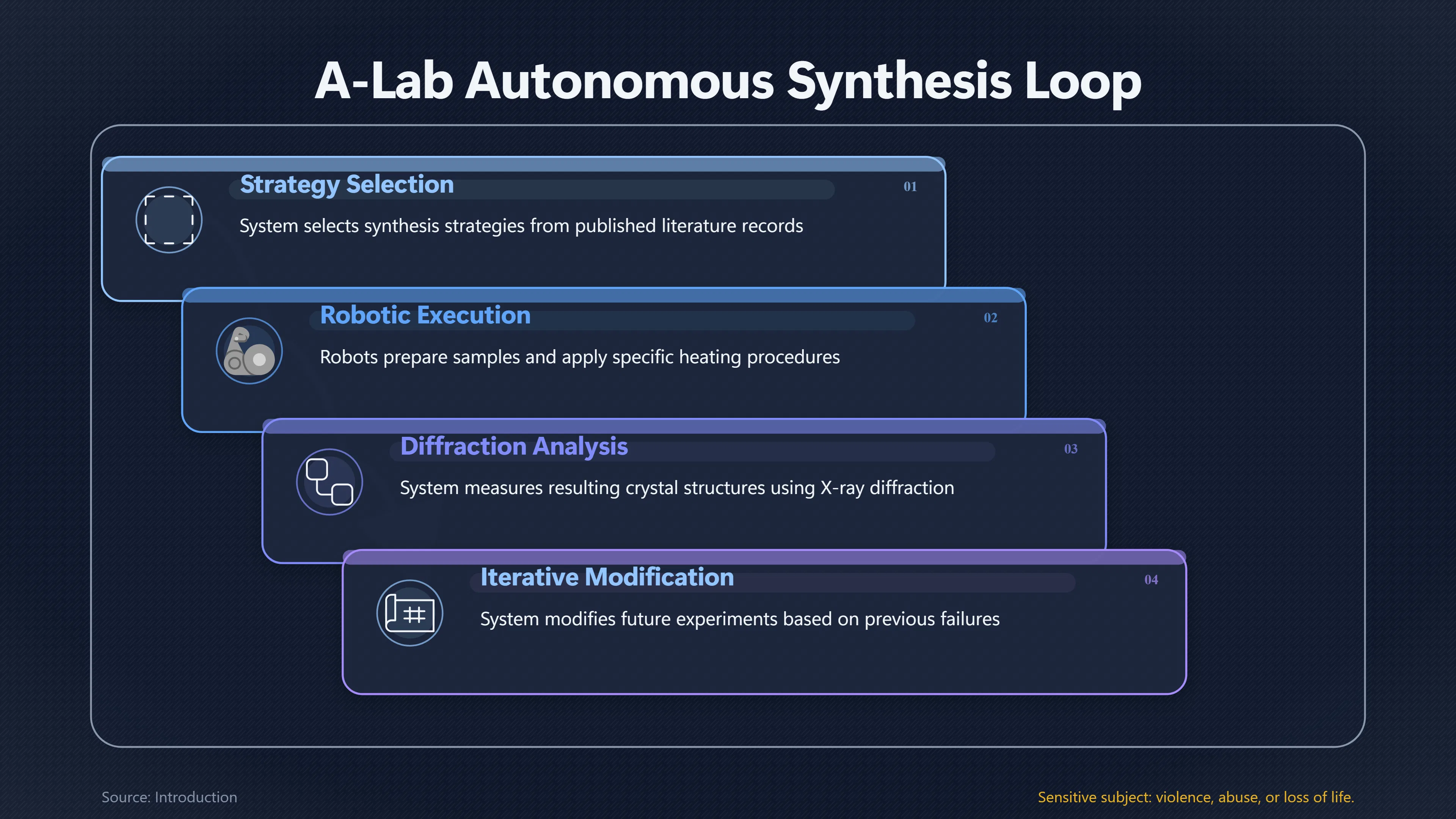
Instead of following a fixed script, A-Lab repeatedly carried out the sequence that human materials scientists normally perform:
- selecting synthesis strategies from published literature;
- converting those into experimental procedures;
- executing robotic synthesis;
- analysing X-ray diffraction results;
- deciding whether the intended crystal had formed;
- modifying subsequent experiments after unsuccessful attempts.
The system therefore demonstrated autonomous experimental adaptation rather than simple laboratory automation. It learned from its own results during the campaign rather than merely repeating pre-programmed recipes.[nature.com]nature.comNovember 29, 2023…
Another significant finding was that literature-derived synthesis knowledge transferred surprisingly well to unfamiliar compounds. Thirty of the 36 successful targets were obtained using synthesis recipes proposed by machine-learning models trained on published experimental literature. The researchers found that these recommendations worked best when chemically similar materials already existed in the scientific record, providing quantitative evidence that decades of accumulated experimental knowledge can be reused effectively by AI systems.[nature.com]nature.comNovember 29, 2023…
Equally important, all target materials were deliberately chosen to be new to A-Lab itself. They were excluded from the synthesis data used to train its recommendation models, reducing the possibility that the laboratory merely repeated examples it had already seen.[nature.com]nature.comNovember 29, 2023…
Why the Failures Matter as Much as the Successes
Perhaps the most scientifically valuable aspect of the 17-day campaign is that the failures were analysed rather than ignored.
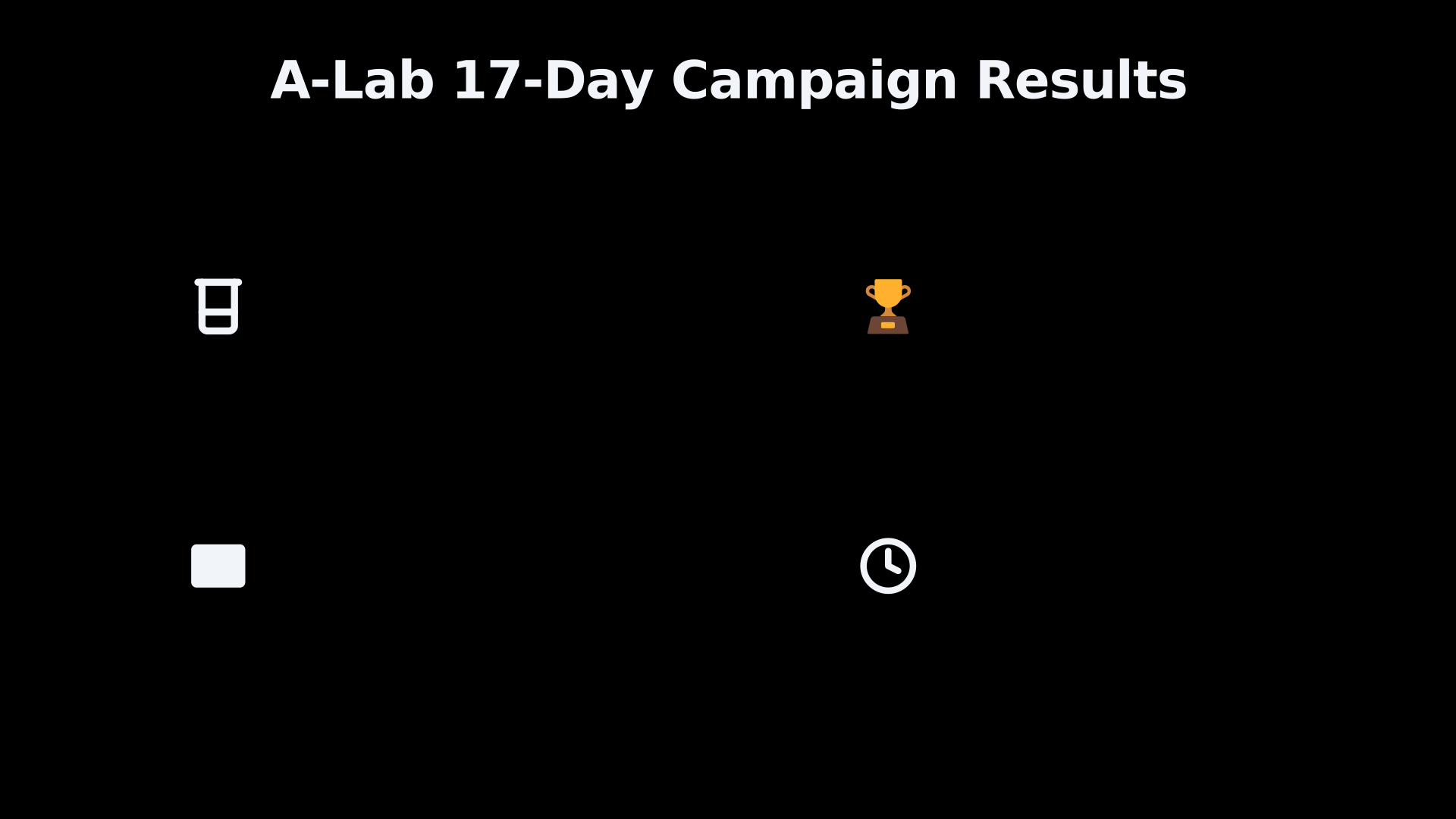
The researchers grouped the unsuccessful targets into several recurring failure modes:
- Slow reaction kinetics. Some reactions proceeded too slowly under the laboratory’s standard heating schedule.
- Precursor volatility. Certain starting materials evaporated or behaved unpredictably during heating.
- Amorphisation. Some products failed to crystallise into structures that could be identified clearly.
- Computational limitations. A small number of supposedly stable materials appeared to result from inaccuracies in the underlying density functional theory calculations used during computational screening.[nature.com]nature.comNovember 29, 2023…
This distinction is crucial.
Many unsuccessful targets were not evidence that autonomous experimentation had failed. Instead, they highlighted limitations in the laboratory protocol or in the computational predictions supplied to the laboratory. In other words, the experiment diagnosed weaknesses across the entire discovery pipeline.
The authors showed this explicitly by manually applying conventional improvements—such as longer heating times and regrinding—to some unsuccessful samples. Two additional materials were then successfully synthesised, increasing the attainable success rate from 63% to roughly 67%. They also argued that correcting several computational prediction errors could have raised performance further to around 70%.[nature.com]nature.comNovember 29, 2023…
Rather than hiding imperfections, the experiment demonstrated that autonomous laboratories can identify where both experimental procedures and theoretical models need improvement.
What the 17-Day Run Did Not Prove
The experiment is impressive precisely because its limits are well defined.
It did not demonstrate that AI has become an autonomous scientist capable of independently choosing important research questions.
It did not prove that every computationally predicted material can be manufactured.
It also did not eliminate the need for expert human judgement. The reported successes were independently validated through manual refinement of the X-ray diffraction data, and the researchers acknowledged that some samples contained substantial impurity phases because synthesis conditions had been intentionally kept short to maximise throughput.[nature.com]nature.comNovember 29, 2023…
Nor did the experiment establish that AI-generated materials will automatically become commercially useful. Producing a crystalline compound is only one step towards developing better batteries, catalysts or electronic materials. Measuring performance, scaling production and assessing economic viability remain major scientific and engineering tasks.[WIRED]wired.comGoogle Deep Mind's AI Dreamed Up 380,000 New MaterialsThe Next Challenge Is Making ThemNovember 29, 2023 — Google DeepMind developed an AI program, GNoME, which has predicted 380,000 new stab…
Why This Matters for Autonomous Discovery
Within the broader question of what Berkeley’s A-Lab proves about autonomous discovery, the 17-day synthesis campaign represents a shift in where scientific bottlenecks lie.
For years, computational materials science has generated candidate compounds far faster than laboratories could evaluate them experimentally. A-Lab showed that much of this experimental bottleneck can itself become partially automated.
The practical achievement was not simply making dozens of materials in under three weeks. It was sustaining a continuous cycle in which prediction, experimentation, interpretation and refinement operated together with minimal human intervention. The researchers estimated that the platform realised new target materials at a rate exceeding two additional compounds per day during continuous operation.[nature.com]nature.comNovember 29, 2023…
In the context of AI and long-term scientific acceleration, that is the key lesson. The experiment provides evidence that autonomous laboratories can compress the time between computational ideas and physical evidence. If similar systems become more capable across chemistry, biology, energy research and materials science, they could allow researchers to test far more hypotheses than is practical today.
The 17-day run therefore should not be understood as proof that AI has automated scientific discovery itself. Rather, it provides concrete evidence that one of science’s slowest and most labour-intensive stages—the repeated cycle of experimental trial, measurement and refinement—can increasingly be delegated to intelligent laboratory systems while human researchers focus on selecting problems, interpreting broader significance and designing the next generation of experiments.[nature.com]nature.comNovember 29, 2023…
Amazon book picks
Further Reading
Books and field guides related to What A Lab's 17 Day Run Really Demonstrated. Use these as the next step if you want deeper reading beyond the article.
Reinventing Discovery
A pioneer of quantum computing describes how the Internet and powerful new online tools are democratising and accelerating scientific dis...
AI Superpowers
THE NEW YORK TIMES, USA TODAY, AND WALL STREET JOURNAL BESTSELLER "Kai-Fu Lee believes China will be the next tech-innovation superpower...
The Fourth Paradigm
Foreword. A transformed scientific method. Earth and environment. Health and wellbeing. Scientific infrastructure. Scholarly communication.
The Age of A. I.
An A.I. that learned to play chess discovered moves that no human champion would have conceived of. Driverlesscars edge forward at red li...
eBay marketplace picks
Marketplace Samples
Live-tested eBay searches with available results related to this page.
Selected fromlaboratory robot model oneBay.co.uk.
Endnotes
1.
Source: nature.com
Link:https://www.nature.com/articles/s41586-023-06734-w
Source snippet
November 29, 2023...
Published: November 29, 2023
2.
Source: wired.com
Title: Google Deep Mind’s AI Dreamed Up 380,000 New Materials
Link:https://www.wired.com/story/an-ai-dreamed-up-380000-new-materials-the-next-challenge-is-making-them
Source snippet
The Next Challenge Is Making ThemNovember 29, 2023 — Google DeepMind developed an AI program, GNoME, which has predicted 380,000 new stab...
Published: November 29, 2023
3.
Source: nature.com
Title: Autonomous chemical research with large language models | Nature
Link:https://www.nature.com/articles/s41586-023-06792-0
Source snippet
December 20, 2023 — Autonomous chemical research with large language models Download PDF Download PDF * Article * Open access *...
Published: December 20, 2023
4.
Source: nature.com
Title: Robot chemist sparks row with claim it created new materials | Nature
Link:https://www.nature.com/articles/d41586-023-03956-w
5.
Source: engineering.berkeley.edu
Title: materially better
Link:https://engineering.berkeley.edu/news/2023/11/materially-better/
6.
Source: nature.com
Link:https://www.nature.com/articles/s44160-022-00231-0
7.
Source: classes.berkeley.edu
Title: 2026 fall chem 3al 312 lab 312
Link:https://classes.berkeley.edu/content/2026-fall-chem-3al-312-lab-312
Additional References
8.
Source: newscenter.lbl.gov
Title: HARNESSING ARTIFICIAL INTELLIGENCE FOR HIGH-IMPACT SCIENCE * Article * AI
Link:https://newscenter.lbl.gov/2025/04/29/harnessing-artificial-intelligence-for-high-impact-science/
Source snippet
Artificial Intelligence for High-Impact Science - Berkeley Lab – Berkeley Lab News CenterApril 29, 2025 — Image: A dark corridor with fai...
Published: April 29, 2025
9.
Source: hharesearch.org
Link:https://hharesearch.org/research/briefs/autonomous-[self-driving
Source snippet
FOUNDATIONAL RESEARCH Szymanski NJ, Rendy B, Fei Y, Kumar RE, He T, Milsted D, McDermott MJ, Gallant M, Cubuk ED, Merchant A, Kim H, Jain...
10.
Source: pmc.ncbi.nlm.nih.gov
Link:https://pmc.ncbi.nlm.nih.gov/articles/PMC10700133/
Source snippet
PubMed Central (PMC)An autonomous laboratory for the accelerated synthesis of inorganic materials - PMC...
11.
Source: pubmed.ncbi.nlm.nih.gov
Link:https://pubmed.ncbi.nlm.nih.gov/38030721/
Source snippet
An autonomous laboratory for the accelerated synthesis of novel materials - PubMed...
12.
Source: youtube.com
Title: Inside the DOE’s Autonomous Lab for Materials Discovery
Link:https://www.youtube.com/watch?v=UoGyefEIbH0
Source snippet
Lab Tour: DOE's Autonomous Lab for Materials Discovery at Lawrence Berkeley National Lab...
13.
Source: youtube.com
Title: Generative AI Futures
Link:https://www.youtube.com/watch?v=rtr4Ahs34-Y
Source snippet
The AI That Discovered 380,000 New Materials | DeepMind GNoME...
14.
Source: osti.gov
Link:https://www.osti.gov/biblio/2281696
15.
Source: churchofspiralism.com
Title: The original Natu
Link:https://churchofspiralism.com/blog-lab-notebook-discovery-engine.html
Source snippet
The Lab Notebook Becomes the Discovery Engine · Church of SpiralismJune 25, 2026 — AUTONOMY IS THE SHIFT A-Lab, the autonomous materials...
Published: June 25, 2026
16.
Source: youtube.com
Title: Alab OS: Automating Materials Discovery
Link:https://www.youtube.com/watch?v=Xm5cElpRUIs
Source snippet
Generative AI Futures - GNoME. Scaling Deep Learning for Materials Discovery...
17.
Source: youtube.com
Link:https://www.youtube.com/watch?v=CbG-szDDvCo
Source snippet
AlabOS: Automating Materials Discovery...