Within AI Tutoring
What Makes an AI Tutor Actually Teach?
The most effective AI tutors use questions, hints, retrieval and reflection to support thinking instead of simply supplying answers.
On this page
- Why general chatbots are not automatically good tutors
- Questioning, hints and retrieval as core design choices
- Balancing guidance with productive struggle
Page outline Jump by section
Introduction
If AI makes high-quality tutoring available to almost everyone, the central design question is no longer whether it can explain ideas. It is whether it can help people do the mental work that produces lasting learning. An AI tutor that immediately provides answers may feel helpful while quietly reducing the effort needed to remember, reason and solve problems independently. By contrast, the strongest evidence from learning science suggests that tutors are most effective when they make students think: asking questions, offering carefully calibrated hints, prompting retrieval from memory and encouraging reflection before revealing solutions.[oecd.org]oecd.org062a7394 en062a7394 en

This distinction matters for any vision of AI-enabled human flourishing. If AI merely automates explanation, instruction becomes cheap but genuine learning may not. If AI can reliably cultivate reasoning, curiosity and independent problem-solving across millions of learners, it could make human intellectual development substantially more abundant. That depends far more on educational design than on conversational fluency.
Why general chatbots are not automatically good tutors
A large language model is optimised to produce useful responses. A good tutor is optimised to produce learning. Those are related but different goals.
When a student asks, “What’s the answer?”, a general-purpose chatbot is often rewarded for giving the answer quickly and confidently. From an educational perspective, however, that can short-circuit the very thinking the learner needs. Educational psychologists have long distinguished between performance during practice and durable learning that transfers to new situations. Students who appear successful because they received extensive assistance may perform much worse when that support disappears.
This is why many education researchers now argue that AI tutoring should be judged by delayed learning, transfer to unfamiliar problems and independent performance rather than by how impressive the conversation appears. The OECD’s review of dialogue-based AI tutors concludes that outcomes vary widely because implementation matters more than conversational ability itself. Systems that scaffold reasoning produce different results from systems that simply complete tasks.[oecd.org]oecd.org062a7394 en062a7394 en
The practical implication is simple: an AI tutor should often resist being maximally helpful in the short term if that would undermine learning in the long term.
Questioning, hints and retrieval as core design choices
Research on intelligent tutoring systems predates generative AI by decades. Although today’s models are far more conversational, many of the most effective design principles remain surprisingly consistent.
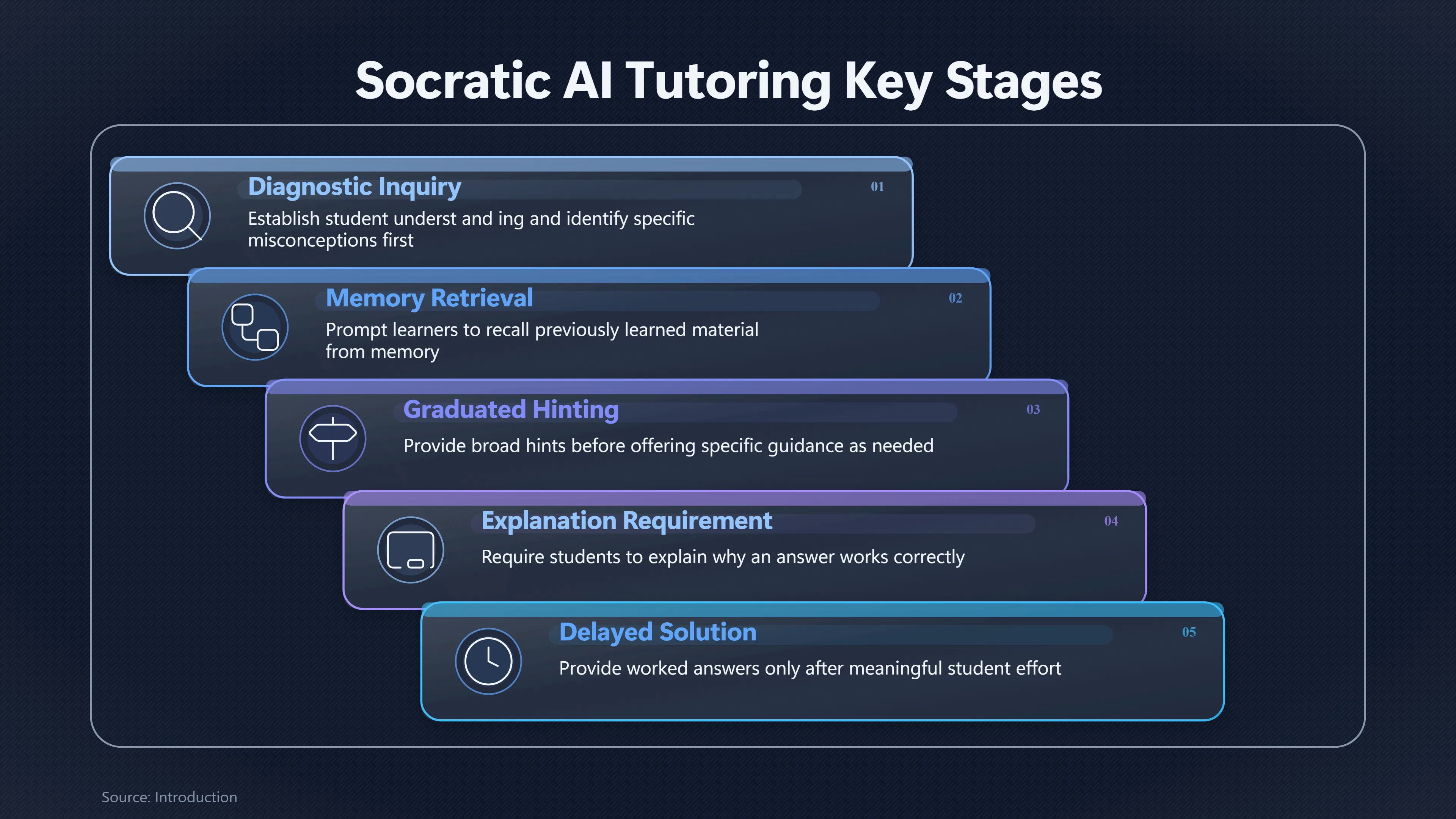
Rather than acting like an answer engine, an effective tutor typically moves through stages of support.
- Ask diagnostic questions first. Before explaining, the tutor establishes what the student already understands and where misconceptions lie.
- Prompt retrieval. Instead of repeating information, it encourages learners to recall previously learned material from memory, strengthening long-term retention.
- Offer graduated hints. Early hints remain broad. More specific guidance appears only if the learner continues to struggle.
- Require explanation. Students explain why an answer works instead of merely selecting it.
- Delay complete solutions. Worked answers are provided after meaningful effort rather than immediately.
Earlier intelligent tutoring systems often implemented this through structured hint sequences. OECD documentation describes tutors that begin with an open question, then progressively narrow hints before finally providing an explanation only if necessary. Modern language models can make these interactions much more natural while preserving the underlying educational structure.[oecd.org]oecd.orgs | OECDApril 28, 2023…
Retrieval practice deserves particular attention. Remembering information strengthens memory more effectively than repeatedly rereading it. An AI tutor can exploit this by asking learners to reconstruct ideas from memory, revisit earlier concepts or explain relationships between topics instead of continually supplying new explanations.
Balancing guidance with productive struggle
One of the hardest design problems is deciding how much help is enough.
Learning scientists use the phrase productive struggle to describe effort that is challenging enough to promote learning but not so frustrating that students give up. Good tutors continually adjust this balance.
Too little support leads to confusion.
Too much support creates dependency.
An AI tutor therefore needs to estimate whether the learner is:
- confused because they lack prerequisite knowledge;
- making a productive error that should be explored;
- stuck because a hint is needed; or
- ready to solve the problem independently.
This requires far more than generating fluent text. It requires modelling the learner’s current understanding and adapting assistance accordingly.
Recent research illustrates both the promise and the difficulty. A study of a Socratic AI programming tutor found that guided questioning generally supported productive struggle, but also identified a “Socratic gap”: students with stronger prior knowledge benefited more from indirect prompting, while complete beginners sometimes experienced cognitive overload from excessive questioning. The implication is that the same tutoring strategy should not be applied uniformly across all learners.[AIS eLibrary]aisel.aisnet.orgAIS e Library Socratic AI Tutors in Introductory ProgrammingAIS e Library Socratic AI Tutors in Introductory Programming
An effective tutor therefore becomes more direct when foundational knowledge is missing and more questioning when the learner is ready for independent reasoning.
Why withholding answers can improve learning
At first glance, refusing to answer appears unhelpful. In practice, carefully delaying answers can increase learning.
Several recent AI tutoring projects deliberately engineer systems that avoid immediately revealing solutions.
The OECD reviews experiments comparing unrestricted chatbots with pedagogically designed tutors. In one example, students learned to use a general AI assistant to bypass the cognitive effort needed for learning. A specially designed GPT tutor that intentionally withheld direct answers and instead prompted self-explanation reduced this problem, even though it no longer produced the appearance of effortless success.[oecd.org]oecd.org062a7394 en062a7394 en
This reflects a broader principle from educational psychology.
The objective is not to maximise:
- speed;
- convenience; or
- immediate correctness.
Instead, it is to maximise:
- independent reasoning;
- long-term retention;
- transfer to unfamiliar problems; and
- confidence without external assistance.
These goals often require slower conversations than users initially expect.
Case studies in pedagogical design
Several emerging AI tutoring systems explicitly incorporate these principles.
Khan Academy’s Khanmigo has consistently emphasised a Socratic approach rather than acting as a homework-answer machine. Its developers measure success not simply by conversation quality but by whether students correctly solve the next problem after tutoring, and they continually refine prompting strategies using classroom evidence rather than assuming any conversational improvement automatically improves learning.[Khan Academy Blog]blog.khanacademy.orgKhan Academy BlogHow Khan Academy Is Building a Better AI Tutor: Our Most Recent Learnings - Khan Academy BlogMay 1, 2026…
The OECD also highlights evidence that generative AI can improve the quality of novice human tutors by nudging them towards expert behaviours such as asking guiding questions instead of supplying answers. Rather than replacing teachers, AI can help spread stronger tutoring practices across much larger educational systems.[oecd.org]oecd.org062a7394 en062a7394 en
Experimental classroom work with pedagogically fine-tuned models similarly suggests that AI can draft effective Socratic questions for human tutors while supporting learning outcomes comparable to traditional tutoring under supervision. Although this evidence remains early, it points towards the importance of educational objectives being embedded directly into model behaviour rather than added afterwards.[arXiv]arxiv.orgAI tutoring can safely and effectively support students: An exploratory RCT in UK classroomsDecember 29, 2025…
The implementation challenges that remain
Designing an AI tutor is not simply a prompt-engineering exercise.
Several practical challenges remain unresolved.
Detecting genuine understanding. Students can produce convincing explanations without deep comprehension, while AI may incorrectly infer mastery from fluent responses.
Calibrating difficulty. Questions must remain within the learner’s “zone of proximal development”—challenging enough to promote growth but not so difficult that learning stalls.
Preventing over-reliance. If students habitually ask for help before attempting problems independently, even well-designed tutors may weaken self-regulation.
Supporting weaker learners. Beginners often require more explicit instruction before Socratic questioning becomes productive.
Measuring learning properly. Systems should be evaluated using delayed tests, transfer tasks and independent performance rather than immediate conversational satisfaction.
These challenges explain why educational researchers increasingly argue that evaluation should focus on learning outcomes rather than chatbot capability alone.[oecd.org]oecd.org062a7394 en062a7394 en
Why this matters for AI-enabled human flourishing
Within the broader vision of AI expanding human potential, education occupies a special place because it amplifies every other capability. Better learning supports scientific discovery, technological progress, creativity, entrepreneurship and informed democratic participation.
Yet this promise depends on avoiding a subtle trap. If AI simply performs thinking on behalf of learners, it may reduce the very cognitive capabilities that widespread access to intelligence was supposed to enhance. Cheap explanations alone do not create a more capable society.
The more optimistic path is different. AI tutors could make expert pedagogical practices—careful questioning, personalised hints, retrieval practice, formative feedback and reflective dialogue—available to hundreds of millions of learners who have never had access to individual tutoring. If those systems consistently cultivate independent reasoning rather than replacing it, they could help make high-quality learning, not merely instruction, dramatically more abundant. That would represent a meaningful contribution to the broader possibility of AI helping humanity flourish over the long term.
Amazon book picks
Further Reading
Books and field guides related to What Makes an AI Tutor Actually Teach?. Use these as the next step if you want deeper reading beyond the article.
Make It Stick
To most of us, learning something "the hard way" implies wasted time and effort. Good teaching, we believe, should be creatively tailored...
How Learning Works
Praise for How Learning Works "How Learning Works is the perfect title for this excellent book. Drawing upon new research in psychology,...
Why Don't Students Like School?
Research-based insights and practical advice about effective learning strategies In this new edition of the highly regarded Why Don't Stu...
The Art of Explanation
Your guide to becoming an explanation specialist. You've done the hard work. Your product or service works beautifully - but something is...
eBay marketplace picks
Marketplace Samples
Live-tested eBay searches with available results related to this page.
Selected fromrobotics kit oneBay.co.uk.
Endnotes
1.
Source: oecd.org
Title: 062a7394 en
Link:https://www.oecd.org/content/dam/oecd/en/publications/reports/2026/01/oecd-digital-education-outlook-2026_940e0dd8/062a7394-en.pdf
2.
Source: oecd.org
Link:https://www.oecd.org/en/publications/innovating-assessments-to-measure-and-support-complex-skills_e5f3e341-en/full-report/component-17.html
Source snippet
s | OECDApril 28, 2023...
Published: April 28, 2023
3.
Source: arxiv.org
Link:https://arxiv.org/abs/2512.23633
Source snippet
AI tutoring can safely and effectively support students: An exploratory RCT in UK classroomsDecember 29, 2025...
Published: December 29, 2025
4.
Source: oecd.org
Title: The Power of Feedback | OECD
Link:https://www.oecd.org/en/about/projects/the-power-of-feedback.html
5.
Source: oecd.org
Title: ensuring cognitive engagement 998c3147
Link:https://www.oecd.org/en/publications/unlocking-high-quality-teaching_f5b82176-en/full-report/ensuring-cognitive-engagement_998c3147.html
6.
Source: oecd.org
Title: component 18
Link:https://www.oecd.org/en/publications/developing-minds-in-the-digital-age_562a8659-en/full-report/component-18.html
7.
Source: oecd-ilibrary.org
Title: oecd digital education outlook 2026 062a7394 en
Link:https://www.oecd-ilibrary.org/en/publications/oecd-digital-education-outlook-2026_062a7394-en.html
Source snippet
OECD Digital Education Outlook 2026 | OECDJanuary 19, 2026 — OECD DIGITAL EDUCATION OUTLOOK 2026 Exploring Effective Uses of Generative A...
Published: January 19, 2026
8.
Source: aisel.aisnet.org
Title: AIS e Library Socratic AI Tutors in Introductory Programming
Link:https://aisel.aisnet.org/treos_amcis2026/74/
9.
Source: blog.khanacademy.org
Link:https://blog.khanacademy.org/how-khan-academy-is-building-a-better-ai-tutor-our-most-recent-learnings/
Source snippet
Khan Academy BlogHow Khan Academy Is Building a Better AI Tutor: Our Most Recent Learnings - Khan Academy BlogMay 1, 2026...
Published: May 1, 2026
10.
Source: blog.khanacademy.org
Title: khan academys 7 step approach to prompt engineering for khanmigo
Link:https://blog.khanacademy.org/khan-academys-7-step-approach-to-prompt-engineering-for-khanmigo/
Additional References
11.
Source: theverge.com
Link:https://www.theverge.com/decoder-podcast-with-nilay-patel/766082/khan-academy-ceo-sal-khan-ai-education-schoolhouse-hank-green-interview
Source snippet
He also details the companion nonprofit Schoolhouse.world, which provides peer-to-peer tutoring and innovative certification models now a...
12.
Source: sciety.org
Title: Sean Kao 2. Patricia Grant 3. Steven Woltering Read the ful
Link:https://sciety.org/articles/activity/10.21203/rs.3.rs-8118546/v1
Source snippet
Socratic AI in K–12 Science Classrooms: Effects on Critical Thinking, Motivation, and Self-Regulation in a Randomized Controlled Trial |...
13.
Source: youtube.com
Link:https://www.youtube.com/watch?v=Ia3CPhVkUtg
Source snippet
Unlocking the Future of Learning with AI | Sal Khan...
14.
Source: youtube.com
Title: Chat GPT vs Gemini For Studying and Learning (Ep. 527)
Link:https://www.youtube.com/watch?v=OkDOBJQW0Ws
Source snippet
ChatGPT is not for Learning | Socra AI Tutor - From Curiosity to Mastery...
15.
Source: youtube.com
Title: Ethan Mollick | The Wharton School
Link:https://www.youtube.com/watch?v=0VtM6n-nRK0
Source snippet
Meet Khanmigo: The student tutor AI being tested in school districts | 60 Minutes...
16.
Source: youtube.com
Title: Unlocking the Future of Learning with AI | Sal Khan
Link:https://www.youtube.com/watch?v=qX7L6AVdLog
Source snippet
ChatGPT vs Gemini For Studying and Learning (Ep. 527)...
17.
Source: researchgate.net
Link:https://www.researchgate.net/publication/403723578_From_Tool_to_Tutor_Socratic_AI_Tutoring_Metacognitive_Engagement_and_Prior_Knowledge_as_Determinants_of_Learning_Gains_in_Gateway_STEM_Courses
18.
Source: cdio.org
Link:https://cdio.org/knowledge-library/documents/ai-supported-socratic-tutoring-chatbot-manufacturing-education-theory
19.
Source: sciencedirect.com
Link:https://www.sciencedirect.com/science/article/pii/1041608094900108
20.
Source: sciencedirect.com
Link:https://www.sciencedirect.com/science/article/pii/S2666920X26000482