Within Scarce Essentials
Why AI Cannot Solve Housing Scarcity Alone
AI may lower some housing costs, but limited land, planning rules and concentrated ownership can keep homes unaffordable.
On this page
- What AI can improve in housing design and construction
- Why land and planning remain binding constraints
- How ownership shapes whether savings reach households
Page outline Jump by section
Introduction
AI could make housing cheaper to design, plan and build, but it cannot by itself create more desirable land or change who controls access to it. This is why housing is a critical test of whether AI-driven abundance can become a wider human bloom rather than simply cheaper services alongside persistent scarcity. AI tools may reduce waste in construction, help architects explore better designs, speed up approvals and improve the use of existing buildings. Yet homes are not only information products: they depend on physical space, infrastructure, local rules and ownership structures. Research on housing markets repeatedly finds that restrictions on where and how much housing can be built can raise costs even when construction technology improves.[GOV.UK]GOV.UKImpact of restricting housing supply on house prices12, 2010…
The key distinction is between making housing production more efficient and making housing access more abundant. AI can push down some costs of creating homes, but land scarcity and decisions about allocation determine whether those savings reach ordinary households or are absorbed into higher land values and asset prices.
What AI can improve in housing design and construction
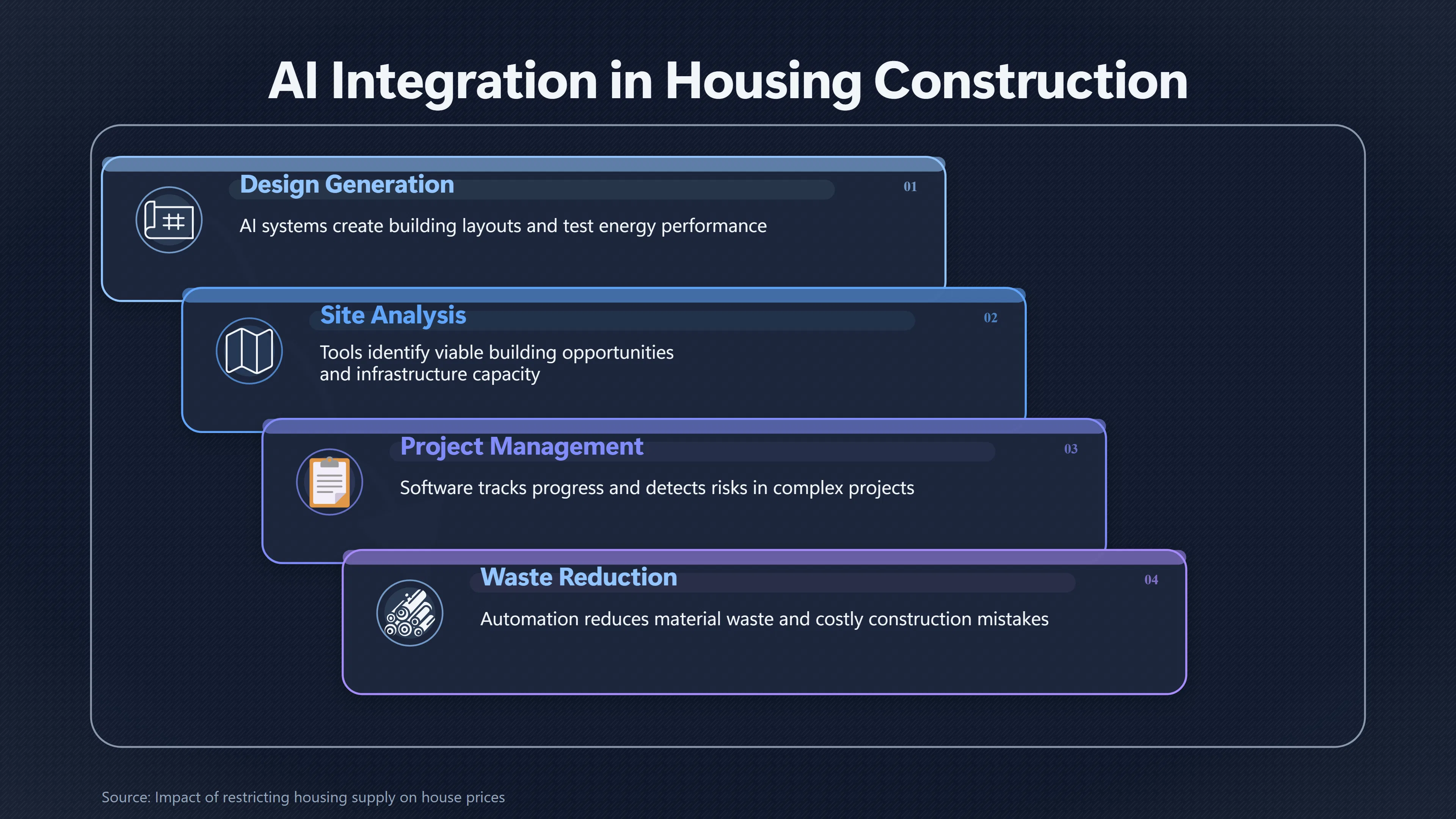
AI is well suited to the parts of housing that involve information, optimisation and coordination. Designers can use AI systems to generate building layouts, test energy performance, optimise materials and compare thousands of possible configurations faster than traditional workflows. Construction companies can use AI for scheduling, progress tracking, risk detection and better management of complex projects. Emerging construction robotics and AI systems are also being tested for tasks such as site monitoring and repetitive work, although fully autonomous building remains difficult because construction environments are constantly changing.[techradar.com]techradar.comSuch tasks are especially well-suited to structured, repetitive environments like data center builds, which are time-sensitive and demand…
These improvements matter because housing is not purely limited by land. Construction has its own bottlenecks: labour shortages, fragmented supply chains, planning delays, expensive materials and inefficient project management. If AI reduces these frictions, it could help societies build more homes with fewer resources.
A future with advanced AI could therefore support a form of housing abundance in several ways:
- Cheaper design and engineering: AI-assisted architecture could reduce the cost of producing plans, adapting designs to local conditions and meeting technical requirements.
- Faster development decisions: AI could analyse land parcels, transport links, environmental constraints and infrastructure capacity to identify viable building opportunities.
- Lower construction waste: Better prediction and automation could reduce delays, material waste and costly mistakes.
- More adaptable homes: Generative design could make it easier to create efficient housing suited to different climates, household sizes and accessibility needs.
However, these gains address the production process, not the deeper question of who gets access to scarce locations. A perfectly optimised building system cannot manufacture a central London neighbourhood, a San Francisco district or a well-connected urban location where demand exceeds available space.
Why land and planning remain binding constraints
Housing scarcity is often described as a shortage of buildings, but in many high-demand areas it is more accurately a shortage of permission to create enough homes in valuable places. Land itself is physically limited, but planning rules determine how intensively that land can be used.
A plot that can legally contain one house is economically very different from the same plot that can contain apartments, offices, shops and community facilities. Restrictions on height, density, building type and redevelopment can prevent cities from adapting to rising demand. The UK government’s research into housing affordability found evidence that regulatory constraints on supply have contributed to higher house prices and reduced affordability.[GOV.UK]GOV.UKImpact of restricting housing supply on house prices12, 2010…
This creates an important tension for AI optimism. Suppose AI cuts the cost of construction by 20 per cent. If a city still allows too few homes in the places people most want to live, the main beneficiary may not be renters or first-time buyers. Instead, the scarcity value of permitted land can rise, capturing some of the productivity gains.
Recent research on land-use reform illustrates both the opportunity and the limits. A study of zoning changes across US cities found that allowing greater density was associated with increased housing supply, but the effects took years to appear and were not automatically enough to solve affordability problems for lower-income households.[Urban Institute]urban.orgInstitute Land-Use Reforms and Housing Costs | Urban InstituteUrban InstituteLand-Use Reforms and Housing Costs | Urban Institute… Other research has found that larger increases in permitted density can significantly increase housing capacity, showing that rules about land use can be a major part of the supply equation.[sciencedirect.com]sciencedirect.comMaking housing affordable? The local effects of relaxing land-use regulationScienceDirect…
The lesson for AI and housing is not that technology is irrelevant. It is that technology operates inside a physical and legal system. If the system prevents expansion where housing demand is highest, smarter tools alone cannot deliver post-scarcity conditions.
How ownership shapes whether savings reach households
Even when AI lowers the cost of producing homes, the final effect depends on ownership and market structure. Housing is unusual because it is both a necessity and a financial asset. A home provides shelter, but land ownership can also generate wealth through rising property values.
If AI makes construction cheaper while the number of homes remains constrained, the benefits may flow partly into higher land prices. Existing owners of scarce property may gain from increased asset values, while households without property may see little improvement in affordability.
This is why debates about AI and abundance cannot focus only on technological capability. The same productivity improvement can have different outcomes depending on institutions:
- With expanded supply: AI-assisted construction could help create more homes and reduce pressure on prices over time.
- With restricted supply: AI may mainly make development more profitable without significantly increasing access.
- With concentrated ownership: Productivity gains may strengthen existing asset advantages rather than broadening opportunity.
Research into land-use restrictions has found that tighter constraints are associated with higher land values, especially in expensive housing markets where demand is strong.[National Bureau of Economic Research]nber.orgOpen source on nber.org. This does not mean every planning rule is harmful; regulations can protect safety, environmental quality and community interests. The challenge is distinguishing useful standards from restrictions that prevent cities from responding to genuine housing needs.
The housing lesson for the wider AI bloom
Housing shows why an AI-enabled future cannot be measured only by how cheap intelligence becomes. A world with abundant AI assistants, automated design and powerful scientific tools could still contain serious scarcity if essential physical systems remain limited or poorly governed.
The optimistic case is that AI can become part of a broader transformation: faster construction, better urban planning, more efficient infrastructure and improved decision-making. In combination with sensible land policies and fair access mechanisms, these tools could help societies move closer to genuine abundance.
But AI does not remove every constraint. Land, infrastructure and ownership rules remain examples of what economists call “binding constraints” — limits that continue to shape outcomes even when other inputs become cheaper. Housing therefore provides a practical warning for the AI bloom vision: abundance requires not only better tools, but institutions capable of turning those tools into widely shared improvements in human life.
Amazon book picks
Further Reading
Books and field guides related to Why AI Cannot Solve Housing Scarcity Alone. Use these as the next step if you want deeper reading beyond the article.
The Housing Boom and Bust
This is a plain-English explanation of how we got into the current economic disaster that developed out of the economics and politics of...
Golden Gates: Fighting for Housing in America
A Time 100 Must-Read Book of 2020 • A New York Times Book Review Editors' Choice • California Book Award Silver Medal in Nonfiction • Fin...

The Color of Law: A Forgotten History of How Our Government S...
Rating: 4.6/5 from 9 Google Books ratings
First published 2017. Subjects: Government policy, Discrimination in housing, POLITICAL SCIENCE / Public Policy / City Planning & Urban D...
Evicted: Poverty and Profit in the American City
NEW YORK TIMES BESTSELLER • WINNER OF THE PULITZER PRIZE • ONE OF TIME’S TEN BEST NONFICTION BOOKS OF THE DECADE • ONE OF THE NEW YORK TI...
eBay marketplace picks
Marketplace Samples
Live-tested eBay searches with available results related to this page.
Selected fromarchitecture model oneBay.co.uk.



Endnotes
1.
Source: GOV.UK
Title: Impact of restricting housing supply on house prices
Link:https://www.gov.uk/government/publications/impact-of-restricting-housing-supply-on-house-prices
Source snippet
12, 2010...
2.
Source: urban.org
Title: Institute Land-Use Reforms and Housing Costs | Urban Institute
Link:https://www.urban.org/research/publication/land-use-reforms-and-housing-costs
Source snippet
Urban InstituteLand-Use Reforms and Housing Costs | Urban Institute...
3.
Source: techradar.com
Link:https://www.techradar.com/pro/construction-sites-are-probably-one-of-the-hardest-environments-you-could-ask-an-autonomous-system-to-operate-in-are-autonomy-and-robotics-gaining-momentum-in-the-industry
Source snippet
Such tasks are especially well-suited to structured, repetitive environments like data center builds, which are time-sensitive and demand...
4.
Source: sciencedirect.com
Title: Making housing affordable? The local effects of relaxing land-use regulation
Link:https://www.sciencedirect.com/science/article/pii/S0094119024000597
Source snippet
ScienceDirect...
5.
Source: GOV.UK
Title: www.gov.uk Geospatial AI for Land Use, by The Alan Turing Institute
Link:https://www.gov.uk/government/publications/geospatial-ai-for-land-use-by-the-alan-turing-institute
6.
Source: sciencedirect.com
Link:https://www.sciencedirect.com/science/article/abs/pii/S0094119021000565
7.
Source: nber.org
Link:https://www.nber.org/papers/w28993
8.
Source: nber.org
Link:https://www.nber.org/papers/w33188
Additional References
9.
Source: houzz.co.uk
Title: Houzz Press: Media Resources and Press Releases
Link:https://www.houzz.co.uk/press/1016/Houzz-Releases-Inaugural-2026-UK-State-of-AI-in-Construction-and-Design-Report
Source snippet
May 13, 2026 — COMPANY NEWS 13 May 2026 Houzz Releases Inaugural 2026 UK State of AI in Construction and Design Report Early AI adopters...
Published: May 13, 2026
10.
Source: nonacademicresearch.org
Title: Housing Unaffordability and Land Use: What Restricts the Supply of Homes?
Link:https://www.nonacademicresearch.org/papers/kq39jmb89j473iiswv
Source snippet
Editorial Submitted May 9, 2026 Version v1 License CC-BY-4.0 Views 79 Identifier nar:syw4so7vfn...
Published: May 9, 2026
11.
Source: youtube.com
Title: WARNING: AI Is Transforming the Housing Crisis Faster Than Anyone Expected
Link:https://www.youtube.com/watch?v=qGB4nsT8qQI
Source snippet
Transforming Cities: AI for a Human-Centered Future | leticiai Izquiero | TEDxBoston...
12.
Source: youtube.com
Link:https://www.youtube.com/watch?v=yn4VoRG0WVk
Source snippet
AI Is Designing the Future of Sustainable Architecture...
13.
Source: youtube.com
Title: AI Data Centers And The Housing Market: The New Fight Over Land
Link:https://www.youtube.com/watch?v=dbrtco1bLpM
Source snippet
WARNING: AI Is Transforming the Housing Crisis Faster Than Anyone Expected...
14.
Source: nature.com
Link:https://www.nature.com/nature-index/topics/l4/land-use-regulation-and-housing-market-dynamics
15.
Source: hbf.co.uk
Title: Artificial Intelligence and skills in the home building industry
Link:https://www.hbf.co.uk/research-insight/ai-homebuilding/
Source snippet
March 24, 2026 — ARTIFICIAL INTELLIGENCE AND SKILLS IN THE HOME BUILDING INDUSTRY...
Published: March 24, 2026
16.
Source: youtube.com
Title: AI Is Designing the Future of Sustainable Architecture
Link:https://www.youtube.com/watch?v=s5lZHwDO7yE
Source snippet
AI technology uses robots to help speed up homebuilding | Here's how...
17.
Source: papers.ssrn.com
Link:https://papers.ssrn.com/sol3/papers.cfm?abstract_id=6531558
Source snippet
Housing Supply Constraints: Zoning Regulations and Hidden Barriers by Jaehee Song:: SSRNApril 20, 2026 — UNPACKING HOUSING SUPPLY CONSTR...
Published: April 20, 2026
18.
Source: researchgate.net
Link:https://www.researchgate.net/publication/400050854_AI-Driven_Automation_of_Construction_Cost_Estimation_Integrating_BIM_with_Large_Language_Models