Within Robotics
Do Autonomous Mines Really Protect Workers?
Driverless mining equipment can separate workers from heavy machinery, but poor traffic control or communication can create different and sometimes hidden
On this page
- Which mining hazards automation can remove
- How autonomous vehicles create new interaction risks
- The controls needed when people and machines share a mine
Page outline Jump by section
Introduction
Autonomous mining vehicles are often presented as one of the clearest examples of robotics making dangerous work safer. Driverless haul trucks, loaders and drilling equipment can remove people from some of the most hazardous parts of mining, reducing exposure to collisions with heavy machinery, dust, noise, rock falls and fatigue during long shifts. In that sense, they fit the broader vision behind AI-enabled robotics: separating human workers from tasks that routinely cause serious injury or death.
However, autonomous mines do not simply eliminate risk. They change where the risk lies. Instead of relying primarily on the judgement of individual vehicle operators, safety increasingly depends on software, traffic management, communications systems, sensors and carefully designed rules governing how people and machines interact. The key question is therefore not whether autonomous vehicles are safer in isolation, but whether the entire mining system has been redesigned to accommodate them. Experience from operating mines suggests that many of the remaining hazards arise not because autonomous trucks “go wrong”, but because humans and autonomous systems misunderstand one another or operate under inconsistent assumptions.[CDC Archive]archive.cdc.govCDC ArchiveHaul Truck Research Roadmap Report 2020 | Mining | NIOSH | CDCJanuary 7, 2025…
Which mining hazards can automation remove?
Mining remains one of the world’s most hazardous industries because workers routinely share space with extremely large mobile equipment while operating in dusty, noisy and low-visibility environments.
[autonomous haulage]ri.cmu.eduautonomous haulage systems can reduce several longstanding risks.
- Removing drivers from the largest vehicles. Modern haul trucks can weigh hundreds of tonnes when fully loaded. Eliminating the need for a driver inside the cab removes exposure to vehicle rollovers, collisions and long periods of vibration.
- Reducing fatigue-related accidents. Open-pit haulage often involves repetitive journeys over many hours. Automated driving does not become distracted or tired in the way human operators do, although the supporting systems still require human oversight.
- Keeping workers away from hazardous zones. Autonomous loaders and trucks allow fewer people to enter areas close to active blasting, unstable slopes or heavy traffic.
- Improving route consistency. Automated vehicles follow defined paths with predictable speeds and braking behaviour, reducing some of the variability associated with manual driving.[iso.org]iso.orgISO 17757:2019 - Earth-moving machinery and mining — Autonomous and semi-autonomous machine system safety…
These improvements matter because powered haulage and machinery remain among the leading causes of serious mining injuries. The US National Institute for Occupational Safety and Health (NIOSH) notes that over 40% of the most serious mining injuries involve workers being struck by or caught in machinery and powered haulage equipment.[cdc.gov]cdc.govmachinery struck by injuriesMining and Machinery Struck-by Injuries | Mining | CDCOctober 9, 2024…
How autonomous vehicles create new interaction risks
The removal of drivers does not remove people from mines altogether. Maintenance crews, surveyors, geologists, inspectors, light vehicles and contractors must still move around the site. The greatest safety challenge becomes managing interactions between autonomous machines and humans.
The danger shifts from driving to coordination
A human driver can make eye contact, wave another vehicle through an intersection or interpret unusual behaviour. An autonomous truck cannot.
Instead, autonomous vehicles operate according to predefined rules, digital maps, communications networks and traffic permissions. If those assumptions no longer match what people on site believe, unexpected situations emerge.
Examples include:
- temporary road changes that are not reflected in digital maps
- workers entering autonomous operating zones
- manually driven support vehicles crossing automated haul routes
- equipment failures that leave vehicles partially autonomous or operating under degraded conditions
- communications failures between fleet management systems and individual vehicles.
Rather than asking whether the vehicle “can drive”, modern mining increasingly asks whether every participant shares the same understanding of how traffic should behave.[iso.org]iso.orgISO 17757:2019 - Earth-moving machinery and mining — Autonomous and semi-autonomous machine system safety…
Predictability is not the same as communication
Ironically, autonomous vehicles are often more predictable than human drivers because they consistently follow programmed routes.
The problem is that people nearby may not understand those intentions.
NIOSH highlights this as an important human-centred design challenge. Workers need to know not only where an autonomous vehicle is, but what it intends to do next. Without clear communication of future movements, misunderstandings can lead to collisions even when every component is technically functioning as designed.[CDC Archive]archive.cdc.govCDC ArchiveHaul Truck Research Roadmap Report 2020 | Mining | NIOSH | CDCJanuary 7, 2025…
Why traffic management matters more than artificial intelligence
One lesson emerging from autonomous mining is that safe automation depends as much on infrastructure as on the vehicle itself.
Modern autonomous mines increasingly rely on integrated traffic management systems that:
- reserve sections of roadway for particular vehicles
- coordinate right-of-way automatically
- prevent conflicting travel permissions
- monitor both autonomous and manually driven equipment
- restrict human access to autonomous operating zones
- stop vehicles when unexpected obstacles appear.
Some underground automation platforms now coordinate multiple autonomous loaders and trucks simultaneously, preventing deadlocks while ensuring vehicles do not enter conflicting routes. Rather than each machine making isolated decisions, the wider traffic management system orchestrates movements across the mine.[epiroc.com]epiroc.comThe route to an autonomous mine | EpirocThe route to an autonomous mine | Epiroc
This is a reminder that AI-enabled robotics often succeeds because surrounding systems become more organised, not simply because individual machines become “smarter”.
A real example: when assumptions diverged
One frequently discussed incident involved an autonomous haul truck colliding with a manned water truck at an unmarked intersection during early deployment of autonomous haulage technology.
Subsequent analysis highlighted that the autonomous truck followed its programmed route, but the intersection had not been clearly marked or communicated to operators of manually driven vehicles. The water truck driver did not anticipate the autonomous vehicle’s intended movement, while the autonomous system was unable to avoid the collision once both vehicles committed to intersecting paths.
NIOSH uses this case to illustrate an important principle: human operators need reliable information about an autonomous vehicle’s intended future path, not merely its present location. The lesson was less about a failure of autonomous navigation than about deficiencies in traffic controls, communication and human-system design.[CDC Archive]archive.cdc.govCDC ArchiveHaul Truck Research Roadmap Report 2020 | Mining | NIOSH | CDCJanuary 7, 2025…
The controls needed when people and machines share a mine
Successful autonomous mines rely on multiple overlapping layers of protection rather than trusting autonomy alone.
Important safeguards include:
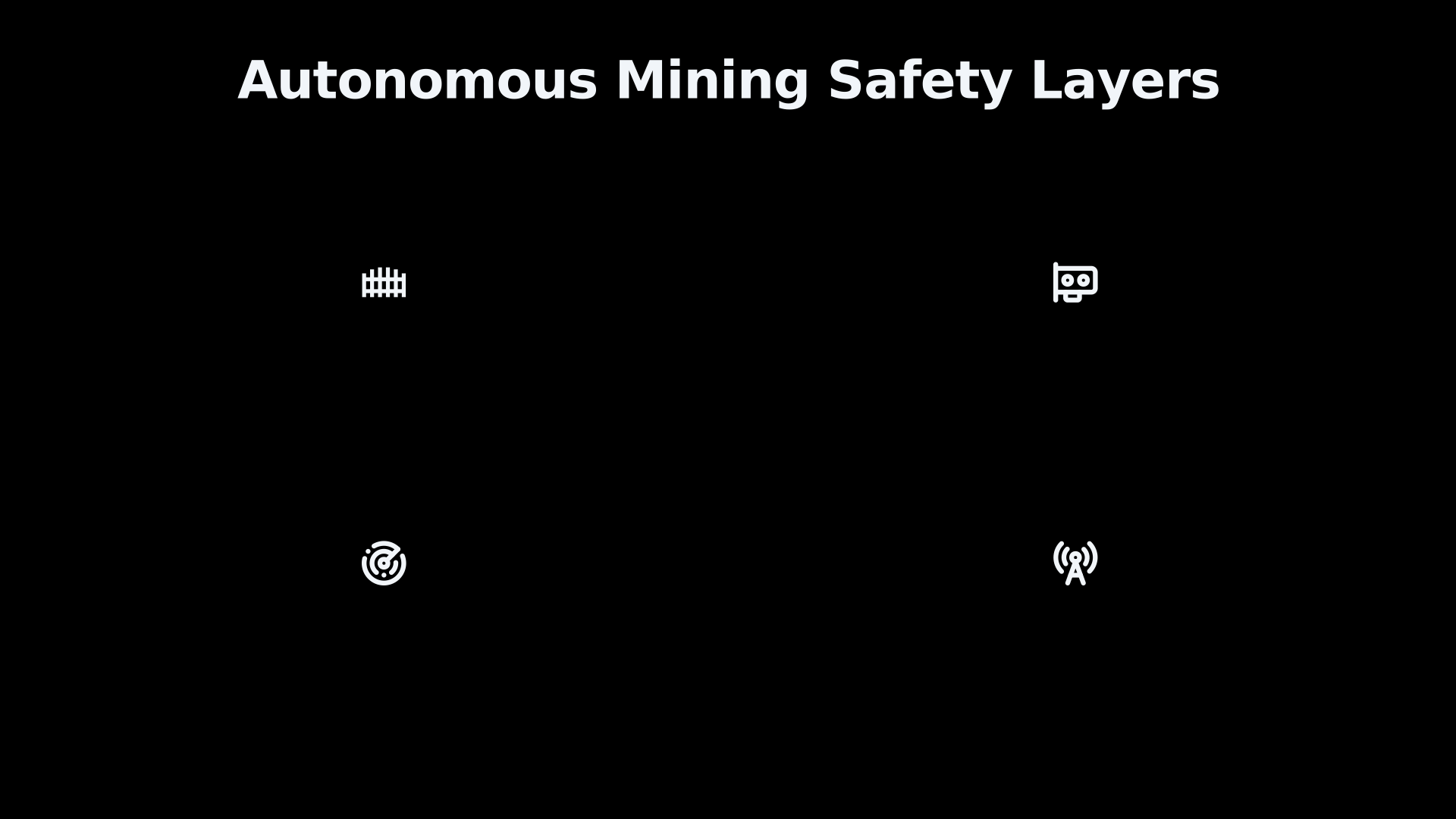
- Segregated operating zones, where only autonomous equipment is permitted unless access has been authorised.
- Digital geofencing, preventing vehicles from entering prohibited areas.
- Vehicle-to-infrastructure communications, allowing equipment and traffic management systems to exchange position and movement information.
- Proximity detection, warning or stopping vehicles when people or unexpected obstacles are detected.
- Clear operating rules, ensuring every worker understands how autonomous equipment behaves.
- Human intervention procedures, allowing safe recovery during maintenance, software faults or unexpected situations.
International Standard ISO 17757 formalises many of these requirements, treating autonomous mining safety as a property of the entire autonomous machine system—including software, communications infrastructure, operating procedures and lifecycle management—rather than the vehicle alone.[iso.org]iso.orgISO 17757:2019 - Earth-moving machinery and mining — Autonomous and semi-autonomous machine system safety…
New risks beyond collisions
As mining becomes increasingly digital, additional safety concerns emerge that would have been largely irrelevant for conventional haul trucks.
These include:
- software errors affecting vehicle behaviour
- failures in positioning or communications systems
- cybersecurity risks affecting connected mining infrastructure
- over-reliance on automation leading human supervisors to intervene too late
- maintenance personnel encountering vehicles in unexpected operating states.
Researchers have also noted that autonomous haulage systems increasingly resemble other cyber-physical systems, making reliable communications, resilient software and cybersecurity important components of physical safety rather than merely information technology concerns.[Prince Sattam bin Abdulaziz University]psau.sa.elsevierpure.comPrince Sattam bin Abdulaziz UniversityAutonomous haulage systems in the mining industry: Cybersecurity, communication and safety issues a…

What this means for AI and the end of dangerous labour
Autonomous mining illustrates both the promise and the limits of AI-enabled robotics within a broader vision of human flourishing.
The optimistic case is compelling. Removing workers from giant haul trucks, unstable pit walls and heavy traffic can substantially reduce exposure to some of mining’s most persistent hazards. If similar approaches spread across construction, ports, agriculture and heavy industry, many dangerous occupations could become significantly safer.
Yet autonomous mining also demonstrates that automation rarely eliminates risk outright. Instead, it redistributes responsibility from individual workers towards the design of the overall system. Safe autonomous mines depend on robust traffic management, clear communication, human-centred procedures, resilient software and continuous oversight. In other words, the future is unlikely to be one where intelligent machines simply replace dangerous work, but one where carefully engineered human-machine systems make dangerous work progressively rarer while introducing new forms of safety engineering that must be managed just as rigorously.
Amazon book picks
Further Reading
Books and field guides related to Do Autonomous Mines Really Protect Workers?. Use these as the next step if you want deeper reading beyond the article.
The Second Machine Age
A New York Times Bestseller A revolution is under way. In recent years, Google’s autonomous cars have logged thousands of miles on Americ...
Normal Accidents: Living with High-Risk Technologies
Normal Accidents analyzes the social side of technological risk. Charles Perrow argues that the conventional engineering approach to ensu...
Robot Ethics: The Ethical and Social Implications of Robotics
Prominent experts from science and the humanities explore issues in robot ethics that range from sex to war. Robots today serve in many r...
Human Factors in Aviation
Fully updated and expanded, the second edition of Human Factors in Aviation serves the needs of the widespread aviation community - stude...
eBay marketplace picks
Marketplace Samples
Live-tested eBay searches with available results related to this page.
Selected fromrobotics kit oneBay.co.uk.


Endnotes
1.
Source: archive.cdc.gov
Link:https://archive.cdc.gov/www_cdc_gov/niosh/mining/strategicplan/HaulTruckRoadmap2020.html
Source snippet
CDC ArchiveHaul Truck Research Roadmap Report 2020 | Mining | NIOSH | CDCJanuary 7, 2025...
Published: January 7, 2025
2.
Source: iso.org
Link:https://www.iso.org/standard/76126.html
Source snippet
ISO 17757:2019 - Earth-moving machinery and mining — Autonomous and semi-autonomous machine system safety...
3.
Source: epiroc.com
Title: The route to an autonomous mine | Epiroc
Link:https://www.epiroc.com/en-uk/newsroom/2020/the-route-to-an-autonomous-mine
4.
Source: cdc.gov
Title: machinery struck by injuries
Link:https://www.cdc.gov/niosh/mining/topics/machinery-struck-by-injuries.html
Source snippet
Mining and Machinery Struck-by Injuries | Mining | CDCOctober 9, 2024...
Published: October 9, 2024
5.
Source: epiroc.com
Link:https://www.epiroc.com/en-ca/newsroom/2026/epiroc-brings-autonomous-truck-haulage-into-3d-enabling-advanced-fleet-control-across-multi-level-ramps
Source snippet
Epiroc brings autonomous truck haulage into 3D, enabling advanced fleet control across multi-level ramps | Epiroc...
6.
Source: iso.org
Link:https://www.iso.org/cms/%20render/live/en/sites/isoorg/contents/data/standard/07/61/76126.html
Source snippet
ISO 17757:2019 - Earth-moving machinery and mining — Autonomous and semi-autonomous machine system safety...
7.
Source: epiroc.cn
Title: Link O A delivers at scale
Link:https://www.epiroc.cn/en-cn/newsroom/2026/linkoa-delivers-at-scale-300-million-tons-moved-autonomously
8.
Source: stacks.cdc.gov
Link:https://stacks.cdc.gov/view/cdc/207930
9.
Source: epiroc.cn
Title: sets the standard of loader automation | epiroc.com.cn
Link:https://www.epiroc.cn/en-cn/newsroom/2019/epiroc-sets-the-standard-of-loader-automation
10.
Source: iso.org
Link:https://www.iso.org/cms/%20render/live/en/sites/isoorg/contents/news/2017/11/Ref2244.html
11.
Source: archive.cdc.gov
Link:https://archive.cdc.gov/www_cdc_gov/niosh/mining/topics/interfacejobdesign.html
12.
Source: archive.cdc.gov
Title: Proximity Detection
Link:https://archive.cdc.gov/www_cdc_gov/niosh/mining/topics/ProximityDetection.html
13.
Source: iso.org
Link:https://www.iso.org/ru/standard/76126.html
14.
Source: iso.org
Link:https://www.iso.org/standard/60473.html?browse=ics
15.
Source: cdc.gov
Link:https://www.cdc.gov/niosh/docs/mining/works/coversheet1360.html
16.
Source: watch.youtube.com
Title: Autonomous Mining
Link:https://www.watch.youtube.com/watch?v=OM9EsJ5vUAY
Source snippet
Automation and electrification at Boliden: The power of Komatsu's Autonomous Haulage System (AHS)...
17.
Source: psau.sa.elsevierpure.com
Link:https://psau.sa.elsevierpure.com/en/publications/autonomous-haulage-systems-in-the-mining-industry-cybersecurity-c/
Source snippet
Prince Sattam bin Abdulaziz UniversityAutonomous haulage systems in the mining industry: Cybersecurity, communication and safety issues a...
18.
Source: mdpi.com
Link:https://www.mdpi.com/2079-9292/10/11/1357
19.
Source: nrec.ri.cmu.edu
Title: autonomous haulage system
Link:https://www.nrec.ri.cmu.edu/solutions/mining/autonomous-haulage-system/
20.
Source: ri.cmu.edu
Title: autonomous haulage
Link:https://www.ri.cmu.edu/project/autonomous-haulage/
Additional References
21.
Source: mdpi.com
Link:https://www.mdpi.com/2673-6489/6/3/45
Source snippet
June 26, 2026 — Open Access Review GEOMETRIC AND OPERATIONAL DESIGN PRINCIPLES FOR AUTONOMOUS HAULAGE SYSTEMS IN OPEN-PIT MINING: A SYSTE...
Published: June 26, 2026
22.
Source: watch.youtube.com
Title: The world’s first [self-driving]({{ ‘lab-access/’ | relative_url }}) truck in an underground mine
Link:https://www.watch.youtube.com/watch?v=uOlsTeNqtQ8
Source snippet
This video details how autonomous hauling systems and heavy robotic equipment are deployed in mining operations to manage safety risks an...
23.
Source: watch.youtube.com
Link:https://www.watch.youtube.com/watch?v=ImBv_m2fPrM
Source snippet
Self-driving haulage for mines & quarries by Volvo Autonomous Solutions...
24.
Source: arxiv.org
Link:https://arxiv.org/abs/2310.03392
25.
Source: watch.youtube.com
Title: Self-driving haulage for mines & quarries by Volvo Autonomous Solutions
Link:https://www.watch.youtube.com/watch?v=E0AxJQtjWbo
Source snippet
Scania and Rio Tinto test autonomous truck...
26.
Source: sciencedirect.com
Link:https://www.sciencedirect.com/science/article/abs/pii/S0968090X23000694
27.
Source: sciencedirect.com
Link:https://www.sciencedirect.com/science/article/pii/S0003687025002200
28.
Source: epirocgroup.com
Link:https://www.epirocgroup.com/en/media/corporate-press-releases/2023/20230112-epiroc-to-support-roy-hill-as-it-enters-final-stage-of-project-to-create-world-s-largest-autonomous-mine
29.
Source: epirocgroup.com
Link:https://www.epirocgroup.com/en/media/corporate-press-releases/2026/20260604-epiroc-wins-order-for-linkoa–extending-its-autonomous-haulage-system-to-aggregates-sector
30.
Source: wjaets.com
Link:https://wjaets.com/index.php/content/implementing-autonomous-haulage-trucks-mining-safety-benefits-and-management-challenges