Within Active Learning
When Active Learning Misses the Real Breakthrough
Poor uncertainty estimates can steer experiments away from genuinely novel regions while making a biased model appear more reliable than it is.
On this page
- How historical data creates blind spots
- Why model confidence can be badly calibrated
- How noise, constraints and expert judgement change decisions
Page outline Jump by section
Introduction
Active learning is often presented as a way for AI to choose the most valuable next experiment. In practice, however, its success depends on one assumption that is easy to overlook: the model must have a realistic understanding of what it does and does not know. When that assumption fails, active learning can become confidently wrong. Instead of directing scarce laboratory time towards genuinely informative experiments, it may repeatedly recommend measurements that reinforce existing biases while overlooking the regions where the next breakthrough actually lies. This limitation is especially important in the broader vision of AI accelerating scientific discovery. If autonomous laboratories are to help deliver faster medical advances, better materials or other foundations of long-term human flourishing, they must recognise uncertainty accurately rather than merely appearing confident. Research over the past decade has shown that poorly calibrated uncertainty, biased datasets and noisy experiments can all distort active learning, making careful uncertainty estimation as important as prediction accuracy itself.[nature.com]nature.comialsFebruary 18, 2019…
How historical data creates blind spots
Active learning learns from the experiments it has already seen. If those experiments cover only a narrow part of the scientific landscape, the model develops an incomplete picture of reality.
This creates a subtle problem. The system may not merely lack information about unexplored regions—it may underestimate how uncertain it should be there. As a result, it repeatedly recommends experiments close to familiar territory because those predictions appear reliable, while genuinely novel possibilities remain ignored.
This phenomenon is especially significant in scientific discovery because historical datasets are rarely representative of everything that could exist. Researchers naturally investigate compounds that are easy to synthesise, diseases that attract funding, or materials compatible with existing manufacturing methods. The resulting data reflects decades of practical constraints rather than the full design space.
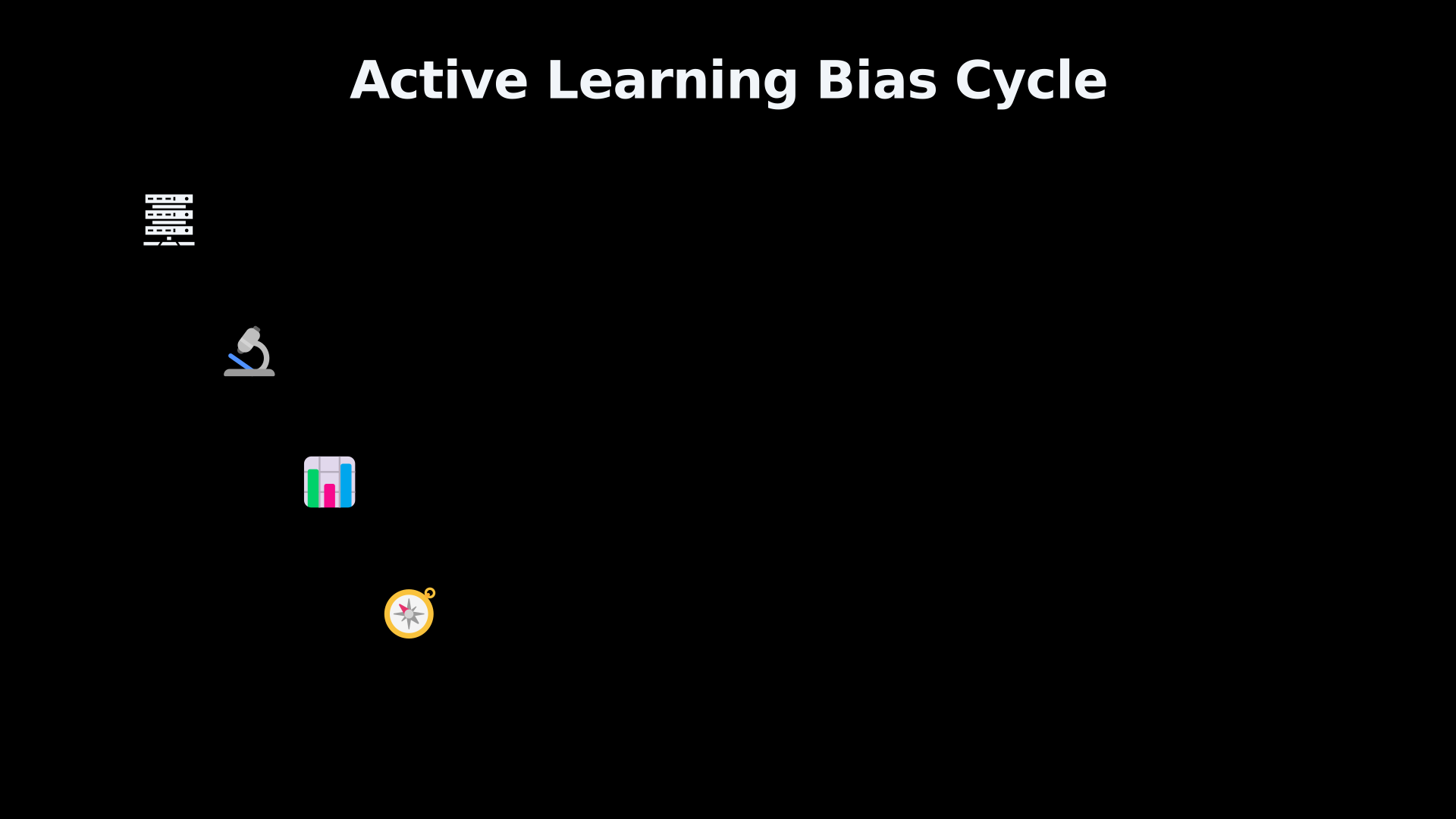
In active learning, these historical patterns can become self-reinforcing:
- familiar regions receive more experiments;
- the model becomes increasingly accurate only in those regions;
- uncertainty elsewhere remains poorly estimated;
- unexplored regions continue to be ignored.
Recent reviews describe this as active learning bias. Unlike conventional sampling bias, it emerges because the algorithm itself decides which observations enter the training set. The data therefore cease to be an independent sample of the wider problem, weakening many assumptions behind standard machine learning evaluation.[rsc.org]pubs.rsc.orgRoyal Society of Chemistry PublicationsA critical examination of active learning workflows in materials science - Digital Discovery (RSC…
For projects aimed at accelerating science, this matters because transformative discoveries often lie outside historically well-studied regions. A system that continually exploits familiar territory may improve existing technologies while missing entirely new scientific directions.
Why model confidence can be badly calibrated
A prediction and a confidence estimate are not the same thing.
An AI model might predict that a material has an 85% chance of succeeding, but that number is only useful if similar predictions have historically been correct about 85% of the time. This property is known as calibration.
Modern machine learning models, especially deep neural networks, frequently produce probabilities that look more certain than reality justifies. An active learning system relying on those probabilities can therefore make poor decisions even if its average predictive accuracy appears high.[OpenReview]openreview.netOpen Review Towards Well-Calibrated Active Learning | Open ReviewTowards Well-Calibrated Active Learning | OpenReviewMay 18, 2026…
Why overconfidence develops
Several mechanisms contribute to false confidence:
- Limited training coverage. The model has never encountered similar examples but still extrapolates confidently.
- Dataset imbalance. Common classes dominate uncertainty estimates while rare cases appear deceptively predictable.
- Distribution shift. Future experiments differ systematically from historical data.
- Model limitations. Some architectures naturally underestimate uncertainty, particularly outside the training distribution.
The result is an acquisition strategy that asks the wrong scientific question. Rather than identifying where knowledge is genuinely missing, it follows numerical confidence values that do not correspond to real uncertainty.
Recent research has increasingly focused on improving calibration itself before using uncertainty to choose experiments. Rather than assuming confidence scores are trustworthy, newer methods estimate calibration error directly and prioritise regions where the model’s confidence is least reliable.[OpenReview]openreview.netOpen Review Towards Well-Calibrated Active Learning | Open ReviewTowards Well-Calibrated Active Learning | OpenReviewMay 18, 2026…
When noisy measurements send the search in the wrong direction
Not every experimental result is correct.
Laboratory instruments have measurement error. Biological systems vary naturally. Human experts occasionally mislabel observations. Manufacturing processes introduce inconsistencies. Active learning can magnify these imperfections because every new experiment influences future decisions.
Suppose an early measurement incorrectly suggests that a particular chemical family performs exceptionally well. The active learner may then devote much of its remaining experimental budget exploring similar compounds, gradually building an increasingly detailed but fundamentally mistaken picture.
Noise therefore has two effects:
- it corrupts the prediction model itself;
- it alters which future experiments are selected.
Survey work on practical active learning identifies noisy labels as one of the major barriers to reliable deployment, particularly when labels come from multiple experts or inherently ambiguous observations. Unlike ordinary supervised learning, errors introduced early in an active learning cycle can continue shaping later sampling decisions.[mdpi.com]mdpi.comOpen source on mdpi.com.
For autonomous laboratories, this creates a strong argument for replication, quality control and occasional human review rather than assuming every measurement should immediately influence future planning.
Why constraints matter even when uncertainty is estimated correctly
Even perfectly estimated uncertainty cannot solve every problem.
Scientific experiments operate under practical constraints:
- expensive instruments;
- limited sample preparation;
- safety restrictions;
- scarce reagents;
- ethical limits;
- finite laboratory time.
The mathematically optimal experiment may simply be impossible to perform.
In addition, many scientific objectives involve several competing goals simultaneously. A new catalyst might maximise efficiency but require rare elements. A promising medicine may show excellent laboratory performance but prove difficult to manufacture. Active learning therefore operates within a constrained optimisation problem rather than an unrestricted search.
Modern materials discovery workflows increasingly combine uncertainty estimates with domain knowledge, physical laws and engineering constraints instead of allowing statistical uncertainty alone to determine every experiment. Benchmark studies have shown that incorporating scientific prior knowledge often improves both efficiency and robustness compared with purely data-driven selection.[NIST]nist.govBenchmarking Active Learning Strategies for Materials Optimization and Discovery | NIST…
Why expert judgement still changes the best decision
One common misconception is that active learning eventually replaces scientific intuition. In practice, expert judgement often becomes more valuable precisely when the model appears most certain.
Experienced researchers may recognise warning signs that statistical models overlook:
- measurements inconsistent with known physics;
- suspicious experimental artefacts;
- chemically implausible predictions;
- unexpected shifts in laboratory conditions;
- regions where historical datasets are known to be incomplete.
Rather than overriding experts, effective active learning increasingly functions as a decision-support system. Scientists may deliberately reject the algorithm’s top recommendation if broader evidence suggests the confidence estimate is misleading.
Recent critical reviews of autonomous materials discovery argue that many reported successes depend as much on careful workflow design, validation procedures and scientific oversight as on the acquisition algorithm itself. Hidden assumptions about sampling, evaluation and uncertainty can substantially influence reported performance.[Royal Society of Chemistry Publications]pubs.rsc.orgRoyal Society of Chemistry PublicationsA critical examination of active learning workflows in materials science - Digital Discovery (RSC…
Why false confidence matters for AI-enabled scientific acceleration
Within the broader vision of AI helping humanity achieve far faster scientific progress, active learning represents an attractive mechanism because it directs limited experimental resources where they should generate the greatest knowledge. However, its value depends less on choosing experiments quickly than on recognising uncertainty honestly.
An overconfident system may produce impressive short-term efficiency while gradually narrowing scientific exploration. A well-calibrated system is more willing to admit ignorance, investigate unfamiliar regions and revise its beliefs when evidence changes. Those qualities are essential if AI is to discover genuinely new medicines, materials, energy technologies and biological insights rather than merely optimising within familiar territory.
For the long-term AI bloom perspective, this distinction is important. Accelerating discovery requires not only faster experimentation but also reliable exploration of the unknown. Progress towards abundant clean energy, healthier lives and broader human flourishing depends on AI systems that know when they might be wrong—and treat that uncertainty as valuable information rather than something to conceal.
Amazon book picks
Further Reading
Books and field guides related to When Active Learning Misses the Real Breakthrough. Use these as the next step if you want deeper reading beyond the article.
The Book of Why
The hugely influential book on how the understanding of causality revolutionized science and the world, by the pioneer of artificial inte...
Thinking, Fast and Slow
Why is there more chance we'll believe something if it's in a bold type face? Why are judges more likely to deny parole before lunch? Why...
Superforecasting
The international bestseller 'A manual for thinking clearly in an uncertain world. Read it.' Daniel Kahneman, author of Thinking, Fast an...
The Elements of Statistical Learning
Rating: 4.5/5 from 13 Google Books ratings
This book describes the important ideas in a common conceptual framework. While the approach is statistical, the emphasis is on concepts...
eBay marketplace picks
Marketplace Samples
Live-tested eBay searches with available results related to this page.
Selected fromrobot model oneBay.co.uk.




Endnotes
1.
Source: nature.com
Link:https://www.nature.com/articles/s41524
Source snippet
ialsFebruary 18, 2019...
Published: February 18, 2019
2.
Source: mdpi.com
Link:https://www.mdpi.com/2227-7390/11/4/820
3.
Source: nist.gov
Link:https://www.nist.gov/publications/benchmarking-active-learning-strategies-materials-optimization-and-discovery
Source snippet
Benchmarking Active Learning Strategies for Materials Optimization and Discovery | NIST...
4.
Source: openreview.net
Title: Open Review Towards Well-Calibrated Active Learning | Open Review
Link:https://openreview.net/forum?id=PBKSZm9dQv
Source snippet
Towards Well-Calibrated Active Learning | OpenReviewMay 18, 2026...
Published: May 18, 2026
5.
Source: openreview.net
Title: Open Review Calibrated Uncertainty Sampling for Active Learning | Open Review
Link:https://openreview.net/forum?id=VShuGzpK61
6.
Source: nature.com
Link:https://www.nature.com/articles/s42256-026-01215-x
7.
Source: pubs.rsc.org
Link:https://pubs.rsc.org/en/content/articlehtml/2026/dd/d6dd00081a
Source snippet
Royal Society of Chemistry PublicationsA critical examination of active learning workflows in materials science - Digital Discovery (RSC...
8.
Source: frontiersin.org
Link:https://www.frontiersin.org/journals/artificial-intelligence/articles/10.3389/frai.2026.1844765/full
9.
Source: pubs.rsc.org
Link:https://pubs.rsc.org/en/content/articlelanding/2025/dd/d6dd00153j
10.
Source: pubs.rsc.org
Link:https://pubs.rsc.org/en/content/articlehtml/2025/dd/d5dd00027k
Additional References
11.
Source: sciencedirect.com
Link:https://www.sciencedirect.com/science/article/pii/S0031320324001365
Source snippet
BALQUE: Batch active learning by querying unstable examples with calibrated confidence - ScienceDirect...
12.
Source: sciencedirect.com
Link:https://www.sciencedirect.com/org/science/article/pii/S2635098X26001269
Source snippet
A critical examination of active learning workflows in materials science - ScienceDirect...
13.
Source: youtube.com
Link:https://www.youtube.com/watch?v=0yS8psNSkCo
Source snippet
Dr. Kevin Jablonka --- Why machine learning can find a new material but not a needle in a haystack...
14.
Source: youtube.com
Link:https://www.youtube.com/watch?v=91H07JIRqD8
Source snippet
Frequentist vs Bayesian probability, and the two kinds of uncertainty in ML...
15.
Source: youtube.com
Title: Roman Garnett: Active search for accelerating scientific discovery
Link:https://www.youtube.com/watch?v=d1JeP6BUhZQ
Source snippet
Research talk: Leveraging uncertainty in machine learning to bridge computation and experimentation...
16.
Source: doi.org
Link:https://doi.org/10.3389/frai.2026.1844765
Source snippet
"Frontiers | Beyond uncertainty in modern active learning for trustworthy AIJune 19, 2026 — Volume 9 - 2026 | [https://doi.org/10.3389/frai..."](https://doi.org/10.3389/frai...")...
Published: June 19, 2026
17.
Source: doi.org
Link:https://doi.org/10.1039/D6DD00081A
18.
Source: doi.org
Link:https://doi.org/10.1007/s11831-024-10064-z
19.
Source: doi.org
Link:https://doi.org/10.1145/3728716
20.
Source: sciencedirect.com
Link:https://www.sciencedirect.com/science/article/abs/pii/S0031320324001365