Within Rentosertib
How AI Took Rentosertib From Target to Molecule
Rentosertib matters because generative AI helped identify both the disease target TNIK and a molecule designed to inhibit it.
On this page
- Why finding the right drug target is so difficult
- How AI identified TNIK and designed candidate molecules
- Where human chemists and laboratory testing remained essential
Page outline Jump by section
Introduction
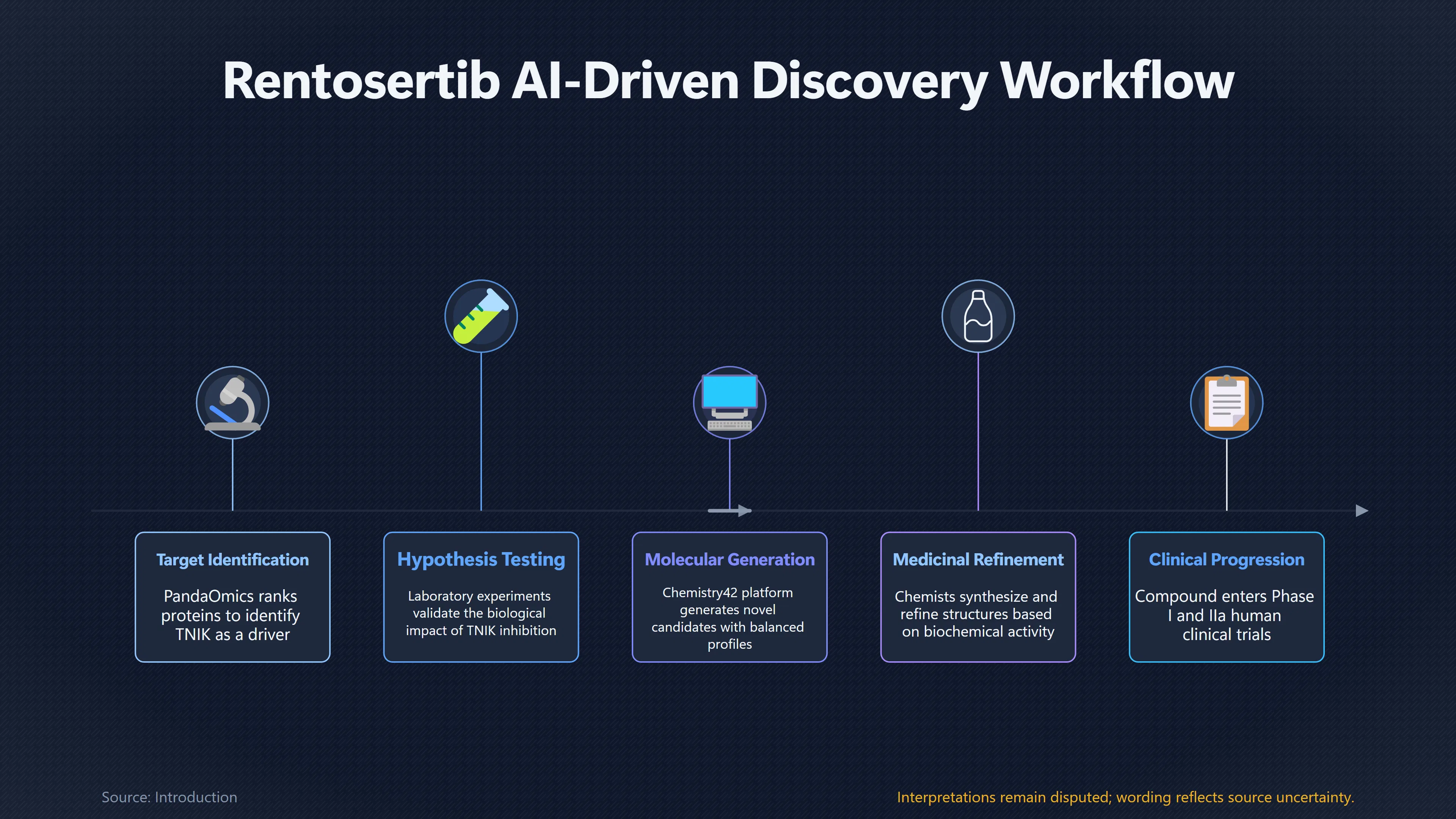
Rentosertib is unusual because artificial intelligence contributed to both of the hardest early decisions in drug discovery: identifying a promising disease target and designing a molecule to act on it. Most AI-assisted drug projects begin with a target that human researchers already know. Rentosertib instead followed a two-stage workflow in which AI first prioritised the protein TNIK (TRAF2- and NCK-interacting kinase) as a potential driver of idiopathic pulmonary fibrosis (IPF), and then generated candidate molecules capable of selectively inhibiting it. The resulting compound, originally known as INS018_055 or ISM001-055 and now called Rentosertib, progressed through laboratory validation into human clinical trials.[nature.com]nature.comJune 3, 2025…
This does not mean AI independently “invented” a medicine. Human biologists, medicinal chemists, structural biologists and clinicians designed experiments, interpreted results, refined molecules and decided which candidates deserved further development. The significance is that AI appears to have accelerated two bottlenecks that have traditionally consumed years of work: deciding what biological process to attack and what chemical structure might attack it successfully. That combination makes Rentosertib one of the clearest case studies in the broader question of whether AI can meaningfully accelerate scientific discovery.
Why finding the right drug target is so difficult
For most diseases, discovering a promising drug target is harder than designing a chemical once the target is known. A target must satisfy several demanding conditions simultaneously:
- It must genuinely influence the disease rather than merely correlate with it.
- Changing its activity must produce meaningful therapeutic effects.
- It must be possible to affect it safely with a drug.
- The benefits must outweigh unwanted effects elsewhere in the body.
Many drug programmes fail because researchers choose the wrong biological mechanism, not because they cannot synthesise molecules. Improving target selection could therefore have a much larger impact on research productivity than making chemistry alone more efficient.
Idiopathic pulmonary fibrosis illustrates this challenge. IPF involves chronic inflammation, abnormal wound healing, excessive scar formation and multiple interacting signalling pathways. Determining which proteins are central drivers rather than downstream consequences is difficult because no single pathway explains the disease completely.[nature.com]nature.comJune 3, 2025…
How AI identified TNIK as a promising target
Rather than beginning with a well-established fibrosis target, Insilico Medicine used its AI biology platform, PandaOmics, to analyse large collections of biological evidence.
According to published descriptions, the system integrated several different sources of information, including:
- multi-omics datasets comparing healthy and diseased tissues;
- gene-expression patterns;
- biological interaction networks;
- pathway and causal analyses;
- scientific publications and patent literature;
- assessments of how strongly particular proteins appeared connected with fibrosis and ageing biology.
Instead of searching for one decisive signal, the platform ranked proteins according to the combined evidence. TNIK emerged as a high-priority candidate despite receiving relatively little previous attention in IPF compared with targets pursued by existing antifibrotic drugs.[insilico.com]insilico.comInsilico Initiates Phase III Clinical Trial for Rentosertib, Its AI-Empowered TNIK Inhibitor for Idiopathic Pulmonary Fibrosis…
Importantly, this ranking was only the beginning of the process. Researchers still needed laboratory experiments to determine whether inhibiting TNIK actually influenced fibrosis. AI generated a biological hypothesis; experiments tested whether that hypothesis survived contact with reality.
How AI designed candidate molecules against TNIK
Once TNIK had been selected, the challenge changed completely. Researchers now needed a molecule that would bind strongly to the kinase while possessing properties suitable for becoming a medicine.
Traditional medicinal chemistry often proceeds through repeated cycles:
- Design a molecule.
- Synthesise it.
- Test it experimentally.
- Modify the structure.
- Repeat many hundreds or thousands of times.
Generative chemistry systems attempt to reduce this search. Instead of screening enormous libraries at random, they generate entirely new chemical structures predicted to satisfy multiple objectives simultaneously.
For Rentosertib, Insilico’s Chemistry42 platform generated novel TNIK inhibitor candidates while balancing competing requirements such as:
- predicted binding strength;
- selectivity against related kinases;
- chemical stability;
- absorption and metabolism characteristics;
- toxicity risk;
- practical synthesis.
Rather than optimising only one property, the platform searched for molecules with an overall profile suitable for progression through drug development. The resulting candidates then entered conventional medicinal chemistry, where scientists synthesised and experimentally evaluated them before selecting Rentosertib for further optimisation.[arXiv]arxiv.orgarXiv Chemistry42: An AI-based platform for de novo molecular designChemistry42: An AI-based platform for de novo molecular designJanuary 22, 2021…

Where human chemists and laboratory testing remained essential
The phrase “AI-designed drug” can create the misleading impression that computers replaced laboratory science. The Rentosertib programme demonstrates almost the opposite.
Human expertise remained indispensable throughout the project.
Experimental validation
AI predictions alone could not establish that TNIK truly influenced fibrosis.
Researchers performed laboratory studies to determine whether blocking TNIK altered fibrotic signalling pathways, affected fibroblast behaviour and produced favourable effects in animal models before advancing towards clinical development.[nature.com]nature.comJune 3, 2025…
Medicinal chemistry refinement
Although generative models proposed molecular structures, medicinal chemists still:
- synthesised candidate compounds;
- measured real biochemical activity;
- interpreted unexpected experimental results;
- refined structures based on laboratory evidence;
- selected the best compounds for further testing.
The published chemistry programme also relied on structural biology and co-crystal studies to understand how inhibitors interacted with TNIK, allowing iterative improvements beyond the original AI-generated proposals.[insilico.com]insilico.comInsilico Initiates Phase III Clinical Trial for Rentosertib, Its AI-Empowered TNIK Inhibitor for Idiopathic Pulmonary Fibrosis…
Preclinical and clinical development
No AI model could replace toxicology studies, pharmacology, manufacturing development or clinical trials.
Rentosertib progressed only after completing extensive laboratory assays, animal studies, Phase I safety testing and subsequently a randomised Phase IIa trial in patients with IPF. Those stages required conventional biomedical research governed by regulatory standards rather than algorithmic prediction.[nature.com]nature.comJune 3, 2025…
What makes this mechanism different from earlier AI drug discovery
Artificial intelligence has supported pharmaceutical research for decades through virtual screening, quantitative structure-activity relationship models and statistical prediction. What distinguishes Rentosertib is not simply that AI helped design a molecule.
Instead, the programme combined two linked AI workflows:
- AI proposed a previously underexplored disease target.
- AI generated novel chemical matter specifically against that target.
Many earlier AI projects accelerated only one stage of discovery, often beginning with a target already established by human researchers. Rentosertib therefore represents a more ambitious workflow in which computational systems contributed to generating both the biological hypothesis and the initial chemical solution before conventional experimental science took over.[nature.com]nature.comJune 3, 2025…

What this means for the wider AI bloom argument
Within the broader idea that advanced AI could accelerate scientific progress, Rentosertib is important less because it proves AI can discover medicines autonomously than because it demonstrates a potentially scalable research pattern.
Drug discovery contains many expensive search problems. Scientists must search through possible disease mechanisms, potential drug targets and an almost unimaginably large chemical space containing far more molecules than could ever be synthesised experimentally. If AI consistently narrows those searches while preserving scientific quality, researchers could spend more time testing the most promising ideas instead of exploring countless dead ends.
That possibility remains conditional rather than established. Rentosertib is one successful programme, not proof that AI has solved drug discovery. TNIK still requires validation through larger clinical trials, and no computational approach can eliminate the need for experimental biology or human judgement. Nevertheless, the programme provides one of the strongest real-world demonstrations so far that AI can contribute meaningfully to both finding the right biological target and designing a plausible therapeutic molecule before the long process of laboratory and clinical validation begins.[nature.com]nature.comJune 3, 2025…
Amazon book picks
Further Reading
Books and field guides related to How AI Took Rentosertib From Target to Molecule. Use these as the next step if you want deeper reading beyond the article.

Deep Medicine: How Artificial Intelligence Can Make Healthcar...
First published 2019. Subjects: Artificial intelligence, Medical informatics, Medical applications, Diagnosis, Data processing.
The AI Revolution in Medicine: GPT-4 and Beyond
AI is about to transform medicine. Here's what you need to know right now. ''The development of AI is as fundamental as the creation of t...
Drug Discovery: A History
Written by a leading authority with an excellent reputation and ability for writing a good narrative, Drug Discovery: A History is a far...
The Billion Dollar Molecule: One Company's Quest for the Perf...
First published 1994. Subjects: Pharmaceutical biotechnology, Pharmaceutical industry, United States, Vertex Pharmaceuticals Incorporated...
eBay marketplace picks
Marketplace Samples
Live-tested eBay searches with available results related to this page.
Selected frommolecular model oneBay.co.uk.
Current eBay listing
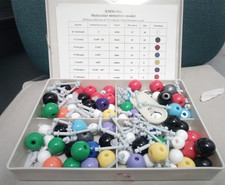
Molecular Models Set XMM-066 Model Kit Science Teaching Tool 240 PCs
Current eBay listing
Molecular Models Set XMM-066 Model Kit Science Teaching Tool 240 PCs

Endnotes
1.
Source: nature.com
Link:https://www.nature.com/articles/s41591-025-03743-2
Source snippet
June 3, 2025...
Published: June 3, 2025
2.
Source: insilico.com
Link:https://insilico.com/news/xmjsn4l091-insilico-initiates-phase-iii-clinical-tr
Source snippet
Insilico Initiates Phase III Clinical Trial for Rentosertib, Its AI-Empowered TNIK Inhibitor for Idiopathic Pulmonary Fibrosis...
3.
Source: insilico.com
Title: TNI K | Insilico Medicine
Link:https://insilico.com/pipeline_target_targetx
4.
Source: arxiv.org
Title: arXiv Chemistry42: An AI-based platform for de novo molecular design
Link:https://arxiv.org/abs/2101.09050
Source snippet
Chemistry42: An AI-based platform for de novo molecular designJanuary 22, 2021...
Published: January 22, 2021
5.
Source: insilico.com
Link:https://insilico.com/interactive/drugs/rentosertib
6.
Source: rentosertib.net
Title: It is a unusually transparent, peer-reviewed,
Link:https://rentosertib.net/
Source snippet
Rentosertib Encyclopedia — From Target Discovery and Generative Chemistry to Phase III Clinical TrialsJuly 7, 2026 — WHY THIS PROGRAM IS...
Published: July 7, 2026
8.
Source: insilico.com
Link:https://insilico.com/news/tnrecuxsc1-insilico-announces-nature-medicine-publi?amp=true
9.
Source: insilico.com
Link:https://insilico.com/pipeline/tnik_tc
10.
Source: insilico.com
Link:https://insilico.com/pipeline/tnik_sc
11.
Source: insilico.com
Link:https://insilico.com/casestudy
12.
Source: nature.com
Link:https://www.nature.com/articles/d43747-021-00039-5
13.
Source: pulmonaryfibrosis.org
Link:https://www.pulmonaryfibrosis.org/patients-caregivers/medical-and-support-resources/clinical-trials-[education
Additional References
14.
Source: thetimes.co.uk
Link:https://www.thetimes.co.uk/article/even-a-sceptic-can-see-ai-will-transform-the-discovery-of-drugs-80gb8wmh2
Source snippet
Although early trials of ISM001-055 showed modest efficacy, its true significance lies in its AI-driven design by the biotechnology compa...
15.
Source: morningstar.com
Link:https://www.morningstar.com/news/pr-newswire/20260707cn99425/insilico-initiates-phase-iii-clinical-trial-for-rentosertib-its-ai-empowered-tnik-inhibitor-for-idiopathic-pulmonary-fibrosis
Source snippet
July 7, 2026 — INSILICO INITIATES PHASE III CLINICAL TRIAL FOR RENTOSERTIB, ITS AI-EMPOWERED TNIK INHIBITOR FOR IDIOPATHIC PULMONARY FIBR...
Published: July 7, 2026
16.
Source: youtube.com
Title: Panda Omics 6.0: Hear from Alex Zhavoronkov, Ph D, and Frank Pun, Ph D
Link:https://www.youtube.com/watch?v=wKzmbWoHiTk
Source snippet
Generative AI in Drug Discovery and Pharma, with Insilico Medicine (CXOTalk #782)...
17.
Source: communities.springernature.com
Title: ai meets ipf taking an ai designed drug from target discovery to phase iia
Link:https://communities.springernature.com/posts/ai-meets-ipf-taking-an-ai-designed-drug-from-target-discovery-to-phase-iia
18.
Source: youtube.com
Title: AI Just Discovered a Drug in 18 Months
Link:https://www.youtube.com/watch?v=2QM98hZMm5k
Source snippet
PandaOmics 6.0: Hear from Alex Zhavoronkov, PhD, and Frank Pun, PhD...
19.
Source: researchgate.net
Link:https://www.researchgate.net/publication/392366960_A_generative_AI-discovered_TNIK_inhibitor_for_idiopathic_pulmonary_fibrosis_a_randomized_phase_2a_trial
20.
Source: mendeley.com
Link:https://www.mendeley.com/catalogue/52f3ce9f-2b60-3f60-a02c-b40cf15c1a89/
21.
Source: doi.org
Link:https://doi.org/10.1038/s41591-025-03743-2
22.
Source: vuink.com
Link:https://vuink.com/post/angher-d-dpbz/articles/s41591-025-03743-2
23.
Source: scilynk.com
Link:https://www.scilynk.com/paper/W4410974018