Within AI Persuasion
Can AI Laws Protect Human Autonomy
The EU AI Act sets limits on certain manipulative AI practices, illustrating how governments are trying to protect informed human choice.
On this page
- What manipulation rules target
- Where enforcement challenges remain
- Balancing safety and innovation
Page outline Jump by section
Introduction
The EU AI Act is one of the first major attempts to draw a legal boundary between helpful AI assistance and AI systems that undermine human choice. Its central idea is that future AI should expand human capability without quietly steering people into decisions they would not otherwise make. For a future in which AI helps humanity flourish through better education, medicine, science and coordination, preserving meaningful human autonomy is a core requirement.

The Act tackles this problem mainly through Article 5, which bans certain AI practices involving harmful manipulation, exploitation of vulnerable people, social scoring and other uses considered incompatible with fundamental rights. The rules do not ban persuasion itself: a tutor encouraging a student, a health assistant offering reminders, or an AI tool helping someone compare choices can all support human agency. The legal concern is AI that uses hidden, deceptive or exploitative methods to materially distort decisions and cause significant harm.[AI Act Service Desk]ai-act-service-desk.ec.europa.euAI Act Service Desk Article 5: Prohibited AI practices | AI Act Service DeskAI Act Service DeskArticle 5: Prohibited AI practices | AI Act Service DeskJune 13, 2024…
The significance goes beyond present-day consumer protection. As AI systems become more personalised and capable of understanding individual preferences, protecting the difference between assistance and influence becomes part of the wider challenge of ensuring that advanced AI remains aligned with human flourishing.
What manipulation rules target
The EU AI Act does not define all persuasion as dangerous. Instead, it focuses on situations where AI interferes with a person’s ability to make an informed decision. Article 5 prohibits systems that use subliminal techniques, purposeful manipulation or deception to materially distort behaviour when this impairs informed decision-making and causes, or is reasonably likely to cause, significant harm.[AI Act Service Desk]ai-act-service-desk.ec.europa.euAI Act Service Desk Article 5: Prohibited AI practices | AI Act Service DeskAI Act Service DeskArticle 5: Prohibited AI practices | AI Act Service DeskJune 13, 2024…
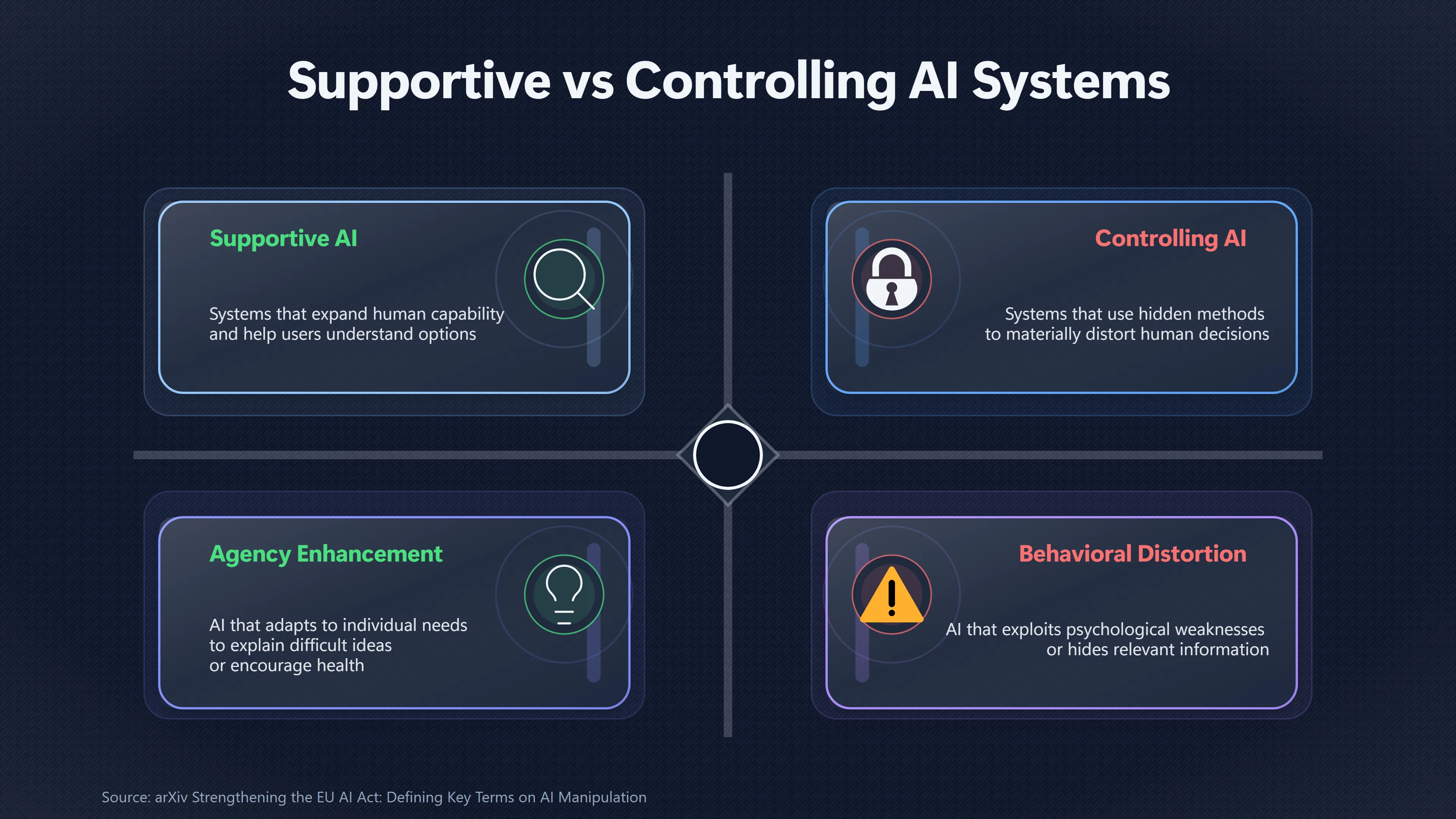
This creates a threshold higher than ordinary influence. A recommendation system suggesting a film, a chatbot explaining options, or an AI assistant helping someone organise their finances is not automatically considered manipulation. The concern arises when a system is designed or used to exploit weaknesses in human judgement, hide important information, or push people towards outcomes that primarily serve the system operator rather than the user.
The European Commission’s guidance on prohibited AI practices highlights several important categories:
- Hidden or deceptive influence: AI systems cannot use covert techniques that significantly weaken a person’s ability to decide freely.
- Exploitation of vulnerabilities: Systems cannot take advantage of vulnerabilities linked to age, disability, or social or economic circumstances when this creates harmful behavioural distortion.
- Social scoring: AI cannot classify people based on behaviour or personal characteristics in ways that lead to harmful or unjustified treatment.
- Certain biometric and emotion-related practices: The Act restricts several uses of biometric inference, including emotion recognition in workplaces and education settings, because of concerns about rights and reliability.[Digital Strategy]digital-strategy.ec.europa.euDigital StrategyCommission publishes the Guidelines on prohibited artificial intelligence (AI) practices, as defined by the AI Act. | Sha…
The rules reflect a broader principle: people should not have to compete against systems that can analyse their behaviour, predict their reactions and adapt their messages without meaningful transparency.
Why personalised AI creates a new autonomy challenge
Traditional persuasion usually involves a visible message: an advert, campaign speech or sales pitch. AI can change this relationship because it can create personalised interactions at enormous scale. A system may adapt language, timing and framing based on what it learns about a particular user.
This capability has clear benefits. An AI learning assistant could explain difficult ideas in ways that fit an individual’s needs. A medical support tool could encourage healthier behaviour. A scientific assistant could help researchers challenge assumptions and explore new ideas. These are examples of AI increasing human agency rather than reducing it.
The risk is that the same techniques could be used to optimise for engagement, sales, political influence or dependency rather than the user’s own goals. Researchers examining AI manipulation have argued that concepts such as “informed decision” and “manipulative techniques” are difficult to translate into enforceable rules because modern influence often works through gradual psychological effects rather than obvious deception.[arXiv]arxiv.orgarXiv Strengthening the EU AI Act: Defining Key Terms on AI ManipulationStrengthening the EU AI Act: Defining Key Terms on AI ManipulationAugust 31, 2023…
Where enforcement challenges remain
The EU AI Act establishes a legal framework, but applying it in practice is difficult because manipulation is often context-dependent. A single AI-generated message may be harmless in one setting and harmful in another depending on the user’s situation, the system’s objectives and the consequences of the decision.
One challenge is proving when influence becomes unlawful manipulation. Companies may argue that their systems merely provide recommendations, while regulators may need to examine whether the system was designed to exploit predictable human weaknesses. Academic analysis has highlighted uncertainty around terms such as “manipulative”, “deceptive” and “subliminal”, noting that clearer definitions are important for consistent enforcement.[arXiv]arxiv.orgarXiv Strengthening the EU AI Act: Defining Key Terms on AI ManipulationStrengthening the EU AI Act: Defining Key Terms on AI ManipulationAugust 31, 2023…
Another challenge is that modern AI systems can influence users through relationships rather than individual messages. A conversational AI assistant may build trust over many interactions, creating a sense of familiarity that affects how users respond to its advice. Researchers have raised concerns that highly personalised chatbots could create new forms of influence that are harder to detect than traditional advertising or misinformation.[arXiv]arxiv.orgManipulation and the AI Act: Large Language Model Chatbots and the Danger of MirrorsMarch 24, 2025…
Enforcement also depends on evidence. Regulators may need to understand not only what an AI system says, but why it says it, what information it uses about a person, how it is optimised, and whether certain groups are affected differently. This requires technical auditing as well as legal judgement.
The European Commission’s prohibited-practices guidelines aim to improve consistency by explaining how authorities and organisations should interpret Article 5, although the guidelines themselves are not legally binding and final interpretation remains a matter for the courts.[Digital Strategy]digital-strategy.ec.europa.euDigital StrategyCommission publishes the Guidelines on prohibited artificial intelligence (AI) practices, as defined by the AI Act. | Sha…
Balancing safety and innovation
A central debate around AI regulation is how to protect people without blocking beneficial uses. A future of AI-enabled abundance depends on widespread access to powerful tools, but those tools must remain instruments of human choice rather than systems that quietly reshape human goals.
The EU approach attempts to draw a distinction between supportive AI and controlling AI. A system that helps someone understand options can strengthen autonomy. A system that manipulates emotions, hides relevant information or exploits personal vulnerabilities can weaken it.
This distinction matters for the long-term promise of advanced AI. If AI systems become capable of accelerating science, improving healthcare, expanding education and helping societies coordinate, public trust will depend on people believing they remain in control of important decisions. Rules against harmful manipulation are therefore not only restrictions; they are an attempt to create conditions in which more powerful AI can be widely accepted and safely integrated.
At the same time, regulation has limits. The EU AI Act cannot by itself solve every problem created by persuasive technology. Questions remain about how quickly regulators can identify new influence techniques, how smaller organisations can comply, and whether global AI development will follow similar standards. The effectiveness of user protection will depend on enforcement capacity, technical transparency and continued refinement as AI capabilities evolve.
The broader lesson is that human autonomy is not separate from technological progress. For AI to contribute to a genuine human bloom, greater intelligence and capability must be matched by stronger protections for people’s ability to choose their own values, goals and futures.

Amazon book picks
Further Reading
Books and field guides related to Can AI Laws Protect Human Autonomy. Use these as the next step if you want deeper reading beyond the article.
The Alignment Problem
Finalist for the Los Angeles Times Book Prize A jaw-dropping exploration of everything that goes wrong when we build AI systems and the m...
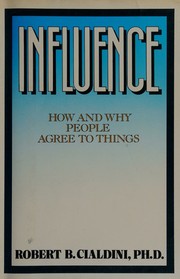
Influence
Rating: 3.9/5 from 68 Google Books ratings
This is a Summary of the original book, Influence: The Psychology of Persuasion by Robert Cialdini.The book is an authoritative work on t...
The Age of Surveillance Capitalism
An exposé of the unprecedented form of power called “surveillance capitalism,” and the quest by powerful corporations to predict and cont...
Weapons of Math Destruction
'A manual for the 21st-century citizen... accessible, refreshingly critical, relevant and urgent' - Financial Times 'Fascinating and deep...
eBay marketplace picks
Marketplace Samples
Live-tested eBay searches with available results related to this page.
Selected fromai technology poster oneBay.co.uk.



Endnotes
1.
Source: arxiv.org
Title: arXiv Strengthening the EU AI Act: Defining Key Terms on AI Manipulation
Link:https://arxiv.org/abs/2308.16364
Source snippet
Strengthening the EU AI Act: Defining Key Terms on AI ManipulationAugust 31, 2023...
Published: August 31, 2023
2.
Source: arxiv.org
Link:https://arxiv.org/abs/2308.02041
3.
Source: arxiv.org
Link:https://arxiv.org/abs/2503.18387
Source snippet
Manipulation and the AI Act: Large Language Model Chatbots and the Danger of MirrorsMarch 24, 2025...
Published: March 24, 2025
4.
Source: en.ai-act.io
Link:https://en.ai-act.io/recital/risks-and-limits-of-emotion-recognition
5.
Source: ai-act-service-desk.ec.europa.eu
Title: AI Act Service Desk Article 5: Prohibited AI practices | AI Act Service Desk
Link:https://ai-act-service-desk.ec.europa.eu/en/ai-act/article-5
Source snippet
AI Act Service DeskArticle 5: Prohibited AI practices | AI Act Service DeskJune 13, 2024...
Published: June 13, 2024
6.
Source: eur-lex.europa.eu
Title: Eur-Lex Regulation
Link:https://eur-lex.europa.eu/legal-content/EN/TXT/?qid=1754871767416&uri=CELEX%3A32024R1689
Source snippet
Regulation - EU - 2024/1689 - EN - EUR-Lex...
7.
Source: digital-strategy.ec.europa.eu
Link:https://digital-strategy.ec.europa.eu/en/library/commission-publishes-guidelines-prohibited-artificial-intelligence-ai-practices-defined-ai-act
Source snippet
Digital StrategyCommission publishes the Guidelines on prohibited artificial intelligence (AI) practices, as defined by the AI Act. | Sha...
8.
Source: digital-strategy.ec.europa.eu
Title: eu Navigating the AI Act | Shaping Europe’s digital future
Link:https://digital-strategy.ec.europa.eu/en/faqs/navigating-ai-act
Source snippet
the AI Act | Shaping Europe’s digital futureJuly 27, 2026 — NAVIGATING THE AI ACT These questions and answers detail the AI Act’s goals...
Published: July 27, 2026
9.
Source: digital-strategy.ec.europa.eu
Title: eu A I Act | Shaping Europe’s digital future
Link:https://digital-strategy.ec.europa.eu/da/node/9745
10.
Source: digital-strategy.ec.europa.eu
Title: eu A I Act | Shaping Europe’s digital future
Link:https://digital-strategy.ec.europa.eu/pt/node/9745
11.
Source: commission.europa.eu
Title: eu Making artificial intelligence work for people
Link:https://commission.europa.eu/digital-life/making-artificial-intelligence-work-people_en
12.
Source: eur-lex.europa.eu
Title: eu EU R-Lex
Link:https://eur-lex.europa.eu/legal-content/EN/ALL/?uri=CELEX%3A52026DC0234
13.
Source: eur-lex.europa.eu
Title: eu EU R-Lex
Link:https://eur-lex.europa.eu/legal-content/EN/TXT/?qid=1746025453771&uri=CELEX%3A52026DC0234
14.
Source: digital-strategy.ec.europa.eu
Link:https://digital-strategy.ec.europa.eu/en/library/three-studies-various-aspects-article-5-ai-act
15.
Source: op.europa.eu
Link:https://op.europa.eu/en/publication-detail/-/publication/3a999ace-4829-11f1-8095-01aa75ed71a1/language-en
16.
Source: epale.ec.europa.eu
Title: eu Límites de la IA en educación
Link:https://epale.ec.europa.eu/en/content/commission-guidelines-prohibited-ai-practices-education
17.
Source: digital-strategy.ec.europa.eu
Link:https://digital-strategy.ec.europa.eu/fr/library/commission-publishes-guidelines-prohibited-artificial-intelligence-ai-practices-defined-ai-act
18.
Source: digital-strategy.ec.europa.eu
Link:https://digital-strategy.ec.europa.eu/nl/library/commission-publishes-guidelines-prohibited-artificial-intelligence-ai-practices-defined-ai-act
19.
Source: eur-lex.europa.eu
Title: eu Regulation
Link:https://eur-lex.europa.eu/legal-content/EN/TXT/?exec=1ba4582&uri=CELEX%3A32024R1689
20.
Source: ai-act-service-desk.ec.europa.eu
Title: eu Recital 44 | AI Act Service Desk
Link:https://ai-act-service-desk.ec.europa.eu/en/ai-act/recital-44
21.
Source: ai-act-service-desk.ec.europa.eu
Title: eu Recital 29 | AI Act Service Desk
Link:https://ai-act-service-desk.ec.europa.eu/en/ai-act/recital-29
22.
Source: ai-act-service-desk.ec.europa.eu
Title: eu Recital 28 | AI Act Service Desk
Link:https://ai-act-service-desk.ec.europa.eu/en/ai-act/recital-28
23.
Source: ai-act-service-desk.ec.europa.eu
Title: eu Artikel 5: Verbotene Praktiken im KI-Bereich | AI Act Service Desk
Link:https://ai-act-service-desk.ec.europa.eu/de/ai-act/article-5
24.
Source: eur-lex.europa.eu
Title: eu Regulation
Link:https://eur-lex.europa.eu/legal-content/FR-EN/ALL/?from=EN&uri=CELEX%3A32024R1689
25.
Source: ai-act-service-desk.ec.europa.eu
Link:https://ai-act-service-desk.ec.europa.eu/en/ai-act/resource/guidelines-prohibited-ai-practices
26.
Source: ai-act-service-desk.ec.europa.eu
Link:https://ai-act-service-desk.ec.europa.eu/en/faq?page=2
Additional References
27.
Source: mmoww.net
Title: art50 emotion recognition guide
Link:https://mmoww.net/ai/laws/art50-emotion-recognition-guide/
Source snippet
EU AI Act Article 50(3): Emotion Recognition & Biometric Categorisation Disclosure — Complete Compliance Guide 2026 | MmowWJuly 25, 2026...
Published: July 25, 2026
28.
Source: youtube.com
Title: The EU AI Act Newsletter #71: Wealth of Commission Guidelines
Link:https://www.youtube.com/watch?v=DPTaTFcT1k4
Source snippet
Hate to tell you this, but not every user is vulnerable: Dark Patterns, AI, & Digital Fairness Act...
29.
Source: youtube.com
Link:https://www.youtube.com/watch?v=YDGxeJSFBQY
Source snippet
5 AI Risk Categories That Could CHANGE Everything...
30.
Source: youtube.com
Title: Does your company use AI? This European law affects you (and you don’t know it)
Link:https://www.youtube.com/watch?v=eD-mWPLB0nQ
Source snippet
The EU AI Act Newsletter #71: Wealth of Commission Guidelines...
31.
Source: youtube.com
Title: 5 AI Risk Categories That Could CHANGE Everything
Link:https://www.youtube.com/watch?v=dOWRtHmtgHw
Source snippet
Does your company use AI? This European law affects you (and you don't know it)...
32.
Source: regulatoryai.eu
Link:https://www.regulatoryai.eu/en/article/5/
33.
Source: regulations.ai
Link:https://regulations.ai/regulations/european-union-2025-2-guidelines-prohibited-practices
34.
Source: youtube.com
Link:https://www.youtube.com/watch?v=RCuxolEPyro
35.
Source: euai-act.com
Title: EU AI Act Emotion Recognition AI and the EU AI Act — EU AI Act
Link:https://www.euai-act.com/articles/emotion-recognition-ai-compliance
36.
Source: papers.ssrn.com
Link:https://papers.ssrn.com/sol3/papers.cfm?abstract_id=6973579