Within Accessible Tutors
Can AI Make Reading Less Exhausting?
Text-to-speech, highlighting and adjustable layouts can reduce decoding effort while keeping learners engaged with the original material.
On this page
- How decoding effort can crowd out comprehension
- Which reading adjustments offer practical support
- Why personal control matters more than one dyslexia mode
Page outline Jump by section
Introduction
AI can make reading less exhausting for many people with dyslexia, but not by “curing” dyslexia or replacing the need to learn to read. Instead, it reduces the mental effort spent decoding written words so that more attention is available for understanding ideas. The most useful AI-supported reading tools combine natural-sounding text-to-speech, synchronised word highlighting, adjustable text layouts, vocabulary support and personalised reading settings. Rather than lowering the intellectual level of a lesson, they aim to preserve challenging content while making it more accessible. This matters within the broader vision of AI-enabled human flourishing because easier access to knowledge allows more people to participate in education, scientific learning and lifelong skill development, provided these technologies remain widely available and are designed around users’ real needs rather than one-size-fits-all assumptions.[Microsoft Learn]learn.microsoft.comLearn What is Azure AI Immersive Reader?Microsoft LearnWhat is Azure AI Immersive Reader? - Azure AI services | Microsoft LearnAugust 28, 2024…
How decoding effort can crowd out comprehension
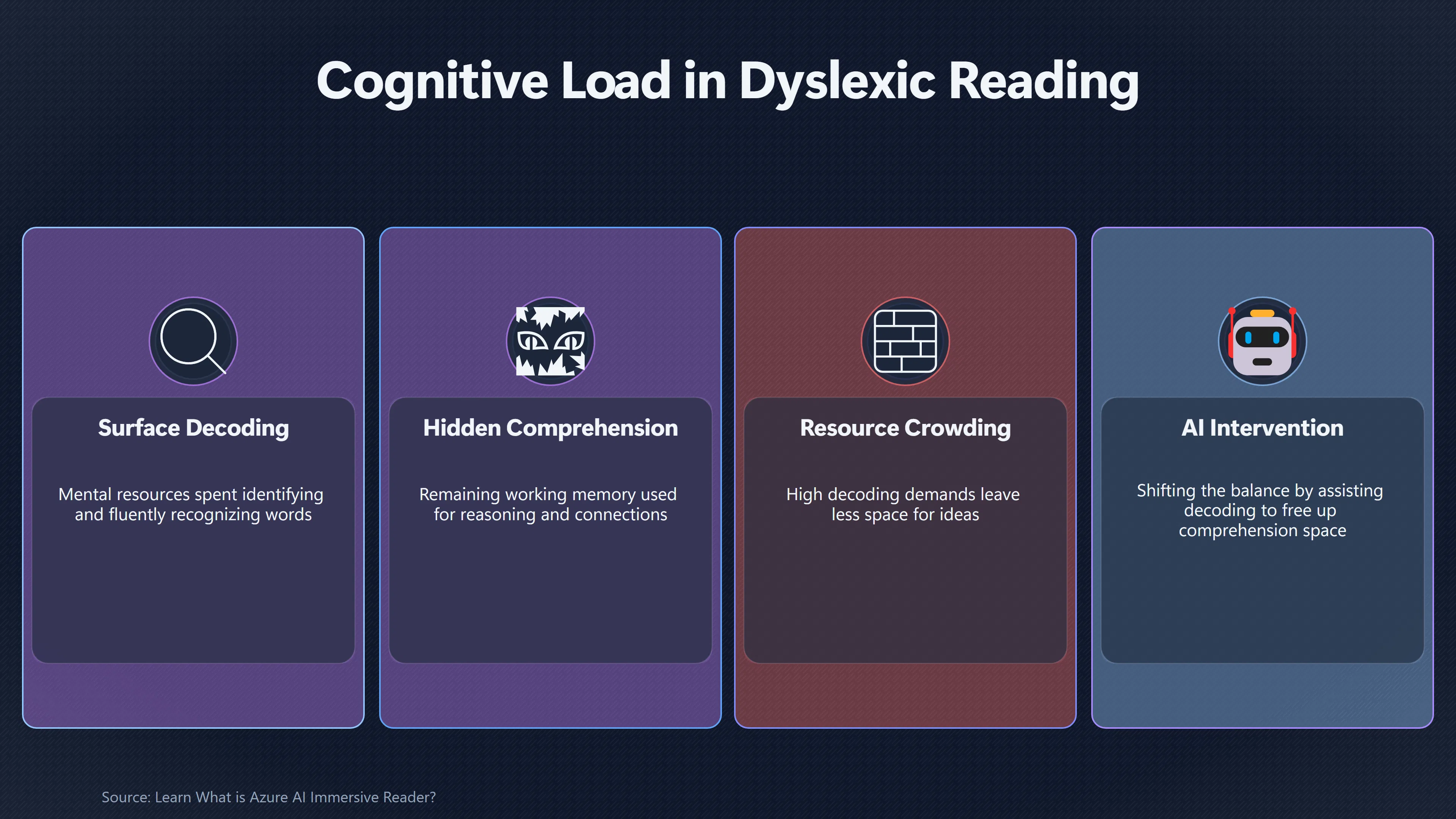
For many people with dyslexia, reading is not primarily limited by intelligence or curiosity but by the effort required to identify words accurately and fluently. Every sentence can consume mental resources that fluent readers devote to following arguments, making connections or remembering new information.
Psychologists often describe this as a problem of cognitive load. When decoding demands most of a learner’s attention, less working memory remains for understanding the text. As a result, someone may finish a page while remembering very little of what they have read, despite understanding the topic perfectly when it is explained aloud.
AI-supported reading tools attempt to shift that balance. By assisting with decoding rather than replacing thinking, they help learners spend more of their attention on comprehension, reasoning and discussion. This distinction is important: the goal is not to simplify the subject matter but to reduce unnecessary barriers between the learner and the ideas being taught.[Microsoft Learn]learn.microsoft.comLearn What is Azure AI Immersive Reader?Microsoft LearnWhat is Azure AI Immersive Reader? - Azure AI services | Microsoft LearnAugust 28, 2024…
Which reading adjustments offer practical support?
No single feature works for everyone with dyslexia because reading difficulties vary considerably. Modern AI systems are therefore most useful when they combine several adjustments that users can mix and match.
The strongest evidence supports a collection of complementary features rather than any single intervention.
- Natural text-to-speech allows learners to hear the text while following the written words, reducing the effort required for decoding without removing exposure to print.
- Word or line highlighting synchronises spoken and written language, helping readers keep their place and connect sounds with written words.
- Adjustable spacing and shorter line lengths can reduce visual crowding for some readers, making text easier to track across a page.
- Syllable segmentation breaks longer words into more manageable units, supporting pronunciation and word recognition.
- Picture dictionaries and vocabulary support provide quick explanations without interrupting reading with repeated web searches.
- Translation and language simplification can assist learners who face both dyslexia and language barriers, while keeping the original text available for comparison.
These features increasingly appear together inside AI tutoring systems instead of existing as separate accessibility tools. The AI can also remember preferred settings, recognise where a learner repeatedly struggles and suggest adjustments without requiring constant manual configuration.[Microsoft Learn]learn.microsoft.comLearn What is Azure AI Immersive Reader?Microsoft LearnWhat is Azure AI Immersive Reader? - Azure AI services | Microsoft LearnAugust 28, 2024…
Why personal control matters more than one dyslexia mode
One of the biggest misconceptions is that there is a single “dyslexia setting” that works for everyone.
Research suggests the opposite. Some learners benefit from wider letter spacing, while others notice little difference. Some prefer listening at the same time as reading, whereas others find simultaneous audio distracting. Colour overlays appear helpful for a subset of readers who experience visual discomfort but are not a universal treatment for dyslexia itself. Personalisation therefore matters more than any individual accessibility feature.[Microsoft Learn]learn.microsoft.comLearn Immersive Reader research and case studiesMicrosoft LearnImmersive Reader research and case studies - Microsoft Educator Center | Microsoft Learn…
AI can support this personalisation by observing patterns rather than making assumptions. For example, it might notice that a learner consistently slows down on long compound words and automatically enable syllable segmentation, or detect repeated pauses on technical vocabulary and offer brief contextual definitions before frustration builds.
This adaptive approach fits a broader shift in accessibility: instead of asking learners to adapt to software, the software gradually adapts to individual reading behaviour.

What does the evidence actually show?
Evidence for individual accessibility techniques is stronger than evidence for AI tutoring as a whole.
A widely cited meta-analysis found that text-to-speech and related read-aloud tools produce a modest but statistically significant improvement in reading comprehension for students with reading disabilities. The average effect was meaningful, although results varied between learners and study designs, indicating that text-to-speech helps many—but not all—students.[PubMed]pubmed.ncbi.nlm.nih.govDoes Use of Text-to-Speech and Related Read-Aloud Tools Improve Reading Comprehension for Students With Reading Disabilities? A Met…
Research underpinning Microsoft’s Immersive Reader highlights several design choices associated with improved reading performance, including optimised spacing, shorter line lengths, syllable segmentation and synchronised read-aloud features. These findings informed practical accessibility tools now used in education rather than remaining laboratory experiments.[Microsoft Learn]learn.microsoft.comLearn Immersive Reader research and case studiesMicrosoft LearnImmersive Reader research and case studies - Microsoft Educator Center | Microsoft Learn…
More recent reviews of AI-based interventions for learning disabilities are encouraging but also more cautious. A 2025 systematic review found positive outcomes across the available studies, including work on dyslexia, yet concluded that many studies suffer from moderate or high risks of bias and that larger, longer-term randomised trials are still needed before strong conclusions can be drawn about AI’s effectiveness.[PubMed]pubmed.ncbi.nlm.nih.govThe Effectiveness of Artificial Intelligence-Based Interventions for Students with Learning Disabilities: A Systematic Review - PubMed…
The current evidence therefore supports a balanced conclusion: AI-assisted reading tools appear genuinely useful, but claims that AI alone can transform dyslexia remain ahead of the available research.
AI changes support from static tools to responsive assistance
Traditional assistive technologies often behaved like fixed utilities: a screen reader either read everything aloud or it did not. AI enables more responsive forms of support.
Instead of merely converting text into speech, an AI reading assistant can:
- explain unfamiliar words in plain language without leaving the page;
- adjust reading speed to match the learner’s pace;
- identify sentences that appear unusually complex and offer optional clarification;
- preserve the original academic wording while providing a simpler parallel explanation;
- answer follow-up questions about the passage immediately after it is read.
This creates a more conversational learning experience. Rather than stopping every few sentences to search for definitions or ask a teacher, learners can resolve misunderstandings immediately while staying engaged with the original material.
Experimental systems are beginning to explore even more adaptive approaches, such as adjusting read-aloud pacing based on a reader’s attention or using large language models to annotate difficult passages while preserving the original text. These ideas are promising but remain at an earlier stage of research than established accessibility features.[arXiv]arxiv.orgAttention-driven read-aloud technology increases reading comprehension in children with reading disabilitiesMarch 9, 2021…
Why this matters for AI-enabled human flourishing
Within the wider AI Bloom perspective, reading support is significant not because it makes reading slightly faster, but because it broadens access to knowledge.
If AI reduces the effort required to engage with textbooks, research papers, workplace training and public information, more people can participate in education throughout their lives. Someone who previously avoided lengthy documents because reading was exhausting may become able to study advanced science, complete professional qualifications or explore subjects for personal interest.
That is a small but meaningful example of a broader principle: advanced AI has the potential to increase the effective availability of human knowledge, provided accessibility remains a design priority rather than an afterthought.
The optimistic vision depends on more than technological capability. Schools need affordable access, teachers need appropriate training, privacy must be protected, and learners should retain opportunities to develop their own reading skills rather than becoming dependent on AI for every written task. When used as scaffolding rather than substitution, AI reading support offers a practical example of how intelligent systems can remove barriers without lowering expectations, allowing more people to participate fully in learning and, ultimately, in the long-term expansion of human knowledge and creativity.[PubMed]pubmed.ncbi.nlm.nih.govThe Effectiveness of Artificial Intelligence-Based Interventions for Students with Learning Disabilities: A Systematic Review - PubMed…
Amazon book picks
Further Reading
Books and field guides related to Can AI Make Reading Less Exhausting?. Use these as the next step if you want deeper reading beyond the article.
The Dyslexia Empowerment Plan
Finally, a groundbreaking book that reveals what your dyslexic child is experiencing—and what you can do so that he or she will thrive Mo...
Proust and the Squid: The Story and Science of the Reading Brain
"Human beings were never born to read," writes Tufts University cognitive neuroscientist and child development expert Maryanne Wolf. Read...
Reader, Come Home: The Reading Brain in a Digital World
The author of the acclaimed Proust and the Squid follows up with a lively, ambitious, and deeply informative book that considers the futu...
eBay marketplace picks
Marketplace Samples
Live-tested eBay searches with available results related to this page.
Selected fromteacher mug oneBay.co.uk.


Current eBay listing
Personalized Teacher Mug: Custom Name Gift, End of Year Appreciation

Current eBay listing
Wholesale Pack Of 10 ‘Best teacher Ever’ Mugs End If Term Gift

Endnotes
1.
Source: learn.microsoft.com
Title: Learn What is Azure AI Immersive Reader?
Link:https://learn.microsoft.com/en-us/azure/ai-services/immersive-reader/overview
Source snippet
Microsoft LearnWhat is Azure AI Immersive Reader? - Azure AI services | Microsoft LearnAugust 28, 2024...
Published: August 28, 2024
2.
Source: learn.microsoft.com
Title: Learn Immersive Reader research and case studies
Link:https://learn.microsoft.com/en-us/training/educator-center/product-guides/immersive-reader/research
Source snippet
Microsoft LearnImmersive Reader research and case studies - Microsoft Educator Center | Microsoft Learn...
3.
Source: azure.microsoft.com
Title: Azure Azure AI Immersive Reader | Microsoft Azure
Link:https://azure.microsoft.com/en-us/products/ai-services/ai-immersive-reader
Source snippet
Microsoft AzureAzure AI Immersive Reader | Microsoft Azure...
4.
Source: arxiv.org
Link:https://arxiv.org/abs/2103.05296
Source snippet
Attention-driven read-aloud technology increases reading comprehension in children with reading disabilitiesMarch 9, 2021...
Published: March 9, 2021
5.
Source: arxiv.org
Link:https://arxiv.org/abs/2504.00941
7.
Source: pubmed.ncbi.nlm.nih.gov
Link:https://pubmed.ncbi.nlm.nih.gov/40867139/
Source snippet
The Effectiveness of Artificial Intelligence-Based Interventions for Students with Learning Disabilities: A Systematic Review - PubMed...
8.
Source: pubmed.ncbi.nlm.nih.gov
Link:https://pubmed.ncbi.nlm.nih.gov/28112580/
Source snippet
Does Use of Text-to-Speech and Related Read-Aloud Tools Improve Reading Comprehension for Students With Reading Disabilities? A Met...
9.
Source: pmc.ncbi.nlm.nih.gov
Link:https://pmc.ncbi.nlm.nih.gov/articles/PMC5494021/
Source snippet
PubMed Central (PMC)Does Use of Text-to-Speech and Related Read-Aloud Tools Improve Reading Comprehension for Students with Reading Disab...
10.
Source: pmc.ncbi.nlm.nih.gov
Link:https://pmc.ncbi.nlm.nih.gov/articles/PMC12385150/
Source snippet
2025 Jul 28;15(8):806. doi: 10.3390/brainsci15080806 THE EFFECTIVENESS OF ARTIFICIAL INTELLIGENCE-BASED INTERVENTIONS FOR STUDENTS WITH L...
11.
Source: pmc.ncbi.nlm.nih.gov
Link:https://pmc.ncbi.nlm.nih.gov/articles/PMC8764483/
12.
Source: pmc.ncbi.nlm.nih.gov
Link:https://pmc.ncbi.nlm.nih.gov/articles/PMC5736156/
13.
Source: pubmed.ncbi.nlm.nih.gov
Link:https://pubmed.ncbi.nlm.nih.gov/28112580/?dopt=AbstractPlus
Additional References
14.
Source: youtube.com
Link:https://www.youtube.com/watch?v=nz9eU13DXDM
Source snippet
How to Use Speechify 2025 (Tutorial & Review)...
15.
Source: youtube.com
Link:https://www.youtube.com/watch?v=ZahG-hOk1SM
Source snippet
Microsoft Immersive Reader - Great free reading tool for Dyslexic / SEND / EAL Students in Office 365...
16.
Source: youtube.com
Title: Microsoft Immersive Reader
Link:https://www.youtube.com/watch?v=Ts9takznE5o
17.
Source: youtube.com
Link:https://www.youtube.com/watch?p=lTEoKQ3mUMk&v=lTEoKQ3mUMk
Source snippet
NEW! How to Use Immersive Reader in Microsoft Word (2025) | Read Aloud, Focus Mode & Accessibility...
18.
Source: youtube.com
Title: Using AI to support learners with dyslexia
Link:https://www.youtube.com/watch?v=sV7n1QeLOm8
19.
Source: eric.ed.gov
Link:https://eric.ed.gov/?id=EJ1164251