Within Housing Limits
Can Faster Planning Software Fix Housing Shortages?
AI can process applications faster, but elected authorities must still decide density, environmental limits and whose housing needs take priority.
On this page
- Administrative delays AI can reduce
- Political choices software cannot settle
- Safeguards for accountable AI assisted planning
Page outline Jump by section
Introduction
Artificial intelligence can make planning systems faster, but it cannot decide what a community ought to become. That distinction matters when asking whether cheap AI could make housing effectively post-scarcity. Planning departments spend huge amounts of time processing documents, checking rules, mapping sites and preparing reports. AI can reduce much of that administrative burden. Yet the hardest questions in planning are not computational. They involve competing values: how many homes should be built, where they should go, how environmental harms should be weighed against affordability, and whose interests deserve priority.

For that reason, AI planning tools are best understood as decision-support systems rather than decision-makers. They may help governments process applications more quickly, but elected representatives, planning authorities and courts remain responsible for the policy choices that shape housing supply and local development. Faster administration can improve planning, but it cannot settle political disagreements about land use.
Administrative delays AI can reduce
Planning authorities often manage thousands of pages of reports, maps, environmental assessments, consultation responses and local policy documents for every significant development. Much of this work is repetitive and information-heavy, making it well suited to AI-assisted automation.
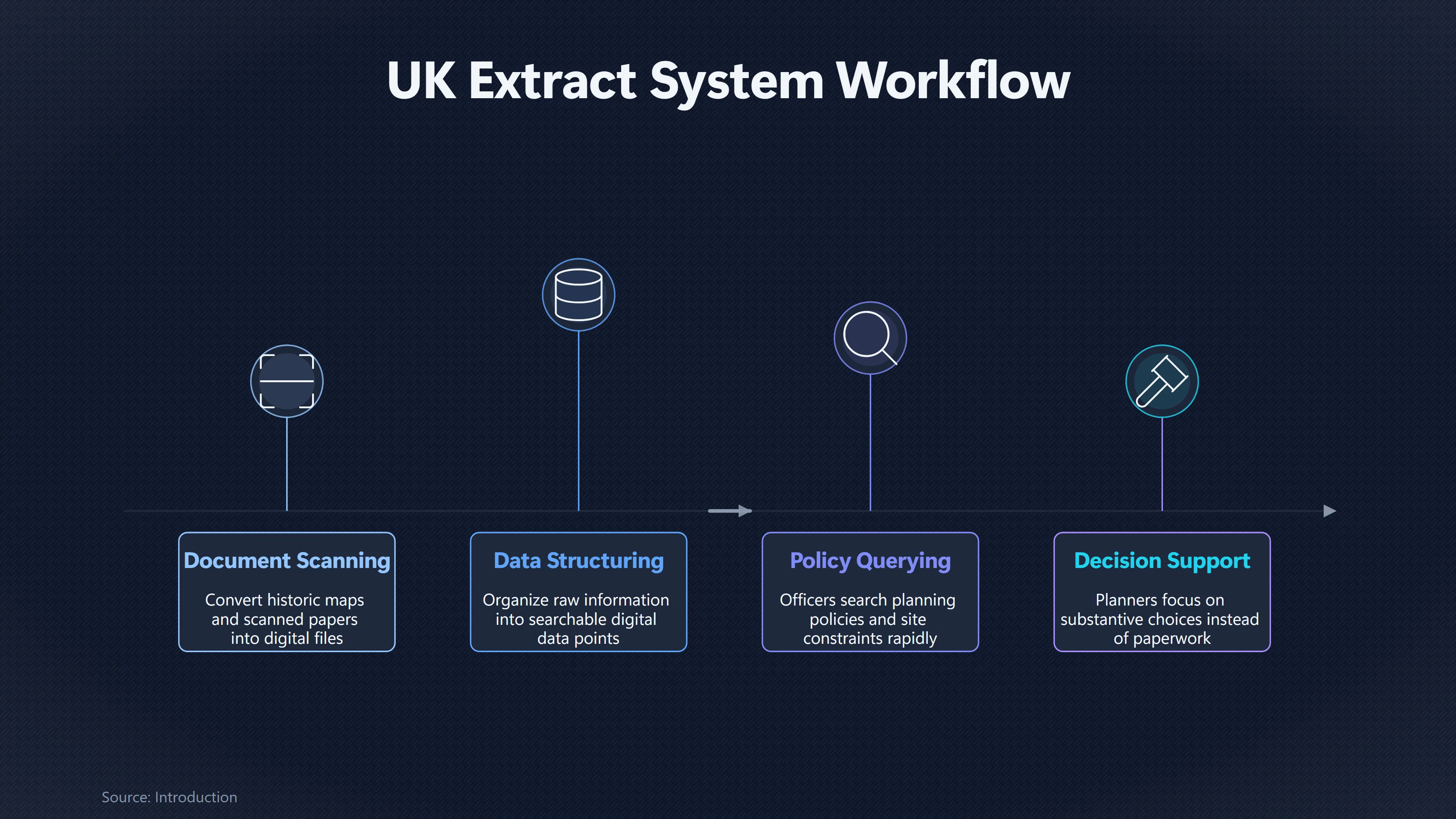
Recent government projects in England illustrate this distinction. The UK’s “Extract” system converts scanned planning documents and historic maps into structured digital data, allowing officers to search planning policies and site constraints far more quickly. Government estimates suggest this could save around 250,000 hours of manual document checking each year, allowing planners to spend more time on substantive decisions rather than paperwork.[GOV.UK]GOV.UKAI tool to slash planning decision times as government accelerates push to build 1.5 million homes - GOV.UKJune 16, 2026…
AI can also assist by:
- identifying which planning policies apply to a site;
- checking applications for missing information;
- summarising lengthy technical reports;
- comparing proposals with local planning rules;
- producing draft officer reports for human review;
- highlighting potential conflicts with heritage, flood-risk or environmental designations.
None of these functions determines whether additional housing should ultimately be approved. They simply reduce the cost of processing information.
Governments increasingly describe these systems as tools that support planners rather than replace them. Recent UK guidance on digital planning similarly emphasises that digital tools improve consistency and efficiency but do not replace professional planning judgement.[GOV.UK]GOV.UKUsing digital tools to support site identification and assessment21, 2026…
Political choices software cannot settle
The largest obstacles to housing development frequently arise from disagreements over public priorities rather than missing information.
Planning systems exist because societies must balance competing objectives, including:
- increasing housing affordability;
- protecting countryside or biodiversity;
- preserving historic neighbourhoods;
- limiting flood and environmental risks;
- funding roads, schools and utilities;
- respecting local democratic participation;
- supporting economic growth.
These are normative questions about what communities value. AI has no objective way to determine the “correct” balance between them because the answer depends on political preferences rather than factual optimisation.
Consider several common planning disputes.
Housing versus environmental protection. A proposed housing estate may reduce local shortages while removing wildlife habitat. Scientific models can estimate environmental impacts, but deciding whether the benefits justify the costs remains a political judgement.
Density versus neighbourhood character. AI may calculate that taller apartment buildings maximise housing supply near transport links. Residents and elected councillors may instead prefer lower-density development to preserve existing streetscapes. Neither outcome is mathematically “right”.
National need versus local consent. Governments may conclude that a region needs substantially more housing to reduce prices, while nearby residents oppose specific developments. AI cannot determine whose preferences deserve greater weight because that depends on democratic institutions and planning law rather than computation.
Even if future AI systems become vastly better at modelling consequences, they would still describe trade-offs rather than eliminate them.
Why better optimisation is not the same as better policy
Supporters of AI sometimes argue that sufficiently advanced systems could identify the objectively optimal planning solution. In practice, optimisation only works after someone specifies the objective.
Suppose a planning system is instructed to maximise new homes. It may recommend much higher densities.
If instead it is instructed to minimise traffic congestion, it may recommend fewer developments.
If biodiversity receives the highest weighting, recommendations change again.
The software is not discovering society’s goals; it is applying goals chosen by humans.
Urban planning researchers increasingly distinguish between descriptive AI and normative decision-making. AI can generate alternative development scenarios, evaluate infrastructure constraints and estimate likely outcomes, but choosing among competing futures requires explicit value judgements and accountable governance.[arXiv]arxiv.orgTowards Automated Urban Planning: When Generative and ChatGPT-like AI Meets Urban PlanningApril 8, 2023…
This distinction is particularly important within the broader AI abundance debate. Cheap intelligence may make planning analysis abundant, but it does not remove disagreements over property rights, environmental protection or democratic legitimacy.
Democratic accountability cannot be automated
Planning decisions often have consequences lasting decades.
Approving a new settlement, expanding a city boundary or rezoning farmland affects existing residents, future households, infrastructure investment and local ecosystems. Because these decisions redistribute benefits and costs across different groups, democratic accountability remains central.
Most planning systems therefore assign final authority to institutions that can be challenged through elections, public consultation or judicial review.
If an AI system recommended rejecting affordable housing because of a statistical pattern in historical approvals, who would be responsible?
If a planning algorithm consistently disadvantaged certain neighbourhoods because of biased historical data, who could be held accountable?
These questions explain why governments typically frame AI planning systems as advisory. Human officers remain responsible for recommendations, while elected planning committees or authorised officials retain legal authority over significant applications. Recent UK parliamentary responses regarding AI planning tools likewise stress that the technology is being evaluated to support local planning authorities rather than replace their responsibility to communities.[UK Parliament]questions-statements.parliament.ukUK Parliament Written questions and answersUK ParliamentWritten questions and answers - Written questions, answers and statements - UK ParliamentJuly 14, 2026…
AI may also create new governance problems
The same generative AI that helps planning departments could also increase pressure on them.
Planning authorities have reported growing numbers of AI-assisted public submissions during consultations. While this can lower barriers to participation, it may also produce large volumes of repetitive, low-quality or inaccurate representations that increase officer workloads rather than reduce them. Guidance from the Local Government Association notes both the opportunities and the challenges created by AI-generated planning representations.[Local Government Association]local.gov.ukOpen source on local.gov.uk.
This creates the possibility of an “AI arms race”:
- developers use AI to prepare applications faster;
- objectors use AI to generate sophisticated objections;
- councils use AI to summarise both;
- human decision-makers still have to determine which arguments should prevail.
In that scenario, computation becomes cheaper for everyone, but the underlying political conflict remains.

Safeguards for accountable AI-assisted planning
If AI becomes a routine part of planning systems, several safeguards help preserve public legitimacy.
Human responsibility. Officials should remain legally accountable for planning decisions, particularly where applications involve significant public controversy.
Transparent reasoning. AI-generated analyses should explain which planning policies, datasets and assumptions informed their recommendations rather than presenting opaque conclusions.
Public challenge. Applicants and residents should be able to question factual errors, challenge interpretations and appeal decisions through established legal processes.
Bias monitoring. Authorities should regularly evaluate whether AI systems systematically disadvantage particular neighbourhoods, housing types or groups because of biased training data or flawed assumptions.
Policy set by elected institutions. Legislatures and planning authorities—not software developers or AI models—should define planning objectives, density targets and environmental standards.
These safeguards recognise that planning is not simply an engineering problem but an exercise in democratic governance.
What this means for AI and housing abundance
Within the wider question of whether advanced AI could help create material abundance, planning illustrates an important limit.
AI can dramatically reduce the cost of processing planning information. It can shorten queues, improve consistency, identify relevant policies and free planners from repetitive administrative work. Those gains may contribute to faster housing delivery.
But housing shortages often persist because societies disagree about land use, density, infrastructure, environmental protection and local priorities. Those disagreements are resolved through political institutions, planning law and public accountability rather than computational power alone.
As AI becomes more capable, it may improve the quality of evidence available to decision-makers and help them explore the consequences of different choices. What it cannot do is determine which collective values a society should adopt. Faster planning software can support better governance, but it cannot make policy on behalf of the public.
Amazon book picks
Further Reading
Books and field guides related to Can Faster Planning Software Fix Housing Shortages?. Use these as the next step if you want deeper reading beyond the article.
The Death and Life of Great American Cities
A direct and fundamentally optimistic indictment of the short-sightedness and intellectual arrogance that has characterized much of urban...
The Color of Law
New York Times Bestseller • Notable Book of the Year • Editors' Choice Selection One of Bill Gates’ “Amazing Books” of the Year One of Pu...
A Pattern Language
In this volume, 253 archetypal patterns consisting of problem statements, discussions, illustrations, and solutions provide lay persons w...
Walkable City
Jeff Speck has dedicated his career to determining what makes cities thrive. And he has boiled it down to one key factor: walkability. Th...
eBay marketplace picks
Marketplace Samples
Live-tested eBay searches with available results related to this page.
Selected fromarchitecture model oneBay.co.uk.



Endnotes
1.
Source: GOV.UK
Link:https://www.gov.uk/government/news/ai-tool-to-slash-planning-decision-times-as-government-accelerates-push-to-build-15-million-homes
Source snippet
AI tool to slash planning decision times as government accelerates push to build 1.5 million homes - GOV.UKJune 16, 2026...
Published: June 16, 2026
2.
Source: GOV.UK
Link:https://www.gov.uk/government/news/pm-unveils-ai-breakthrough-to-slash-planning-delays-and-help-build-15-million-homes-6-june-2025
Source snippet
PM unveils AI breakthrough to slash planning delays and help build 1.5 million homes: 9 June 2025 - GOV.UK...
Published: june 2025
3.
Source: GOV.UK
Title: Using digital tools to support site identification and assessment
Link:https://www.gov.uk/guidance/using-digital-tools-to-support-site-identification-and-assessment
Source snippet
21, 2026...
4.
Source: GOV.UK
Title: Experimental AI could help councils meet housing targets by digitising records
Link:https://www.gov.uk/government/news/experimental-ai-could-help-councils-meet-housing-targets-by-digitising-records
5.
Source: arxiv.org
Link:https://arxiv.org/abs/2304.03892
Source snippet
Towards [Automated]({{ 'auto-experiments/' | relative_url }}) Urban Planning: When Generative and ChatGPT-like AI Meets Urban PlanningApril 8, 2023...
Published: April 8, 2023
6.
Source: arxiv.org
Title: arXiv Reasoning Is All You Need for Urban Planning AI
Link:https://arxiv.org/abs/2511.05375
7.
Source: questions-statements.parliament.uk
Title: UK Parliament Written questions and answers
Link:https://questions-statements.parliament.uk/written-questions/detail/2026-07-06/15984
Source snippet
UK ParliamentWritten questions and answers - Written questions, answers and statements - UK ParliamentJuly 14, 2026...
Published: July 14, 2026
8.
Source: local.gov.uk
Link:https://www.local.gov.uk/pas/topics/digital-planning/digital-development-management/ai-and-planning-representations
9.
Source: mhclgdigital.blog.gov.uk
Link:https://mhclgdigital.blog.gov.uk/2026/06/19/using-ai-to-support-planning-decisions-what-it-means-for-planners-and-residents/
10.
Source: mhclgmedia.blog.gov.uk
Title: blog.gov.uk Coverage of AI planning tools announcement – MHCLG in the Media
Link:https://mhclgmedia.blog.gov.uk/2026/06/17/coverage-of-ai-planning-tools-announcement/
11.
Source: barnet.gov.uk
Link:https://www.barnet.gov.uk/news/barnet-council-pilots-national-ai-assisted-prototype-speed-planning-applications
12.
Source: highland.gov.uk
Title: A I in planning applications
Link:https://www.highland.gov.uk/policies-strategy/artificial-intelligence-ai-policy/2
13.
Source: GOV.UK
Title: www.gov.uk Plymouth, South Hams and West Devon improve analysis with AI
Link:https://www.gov.uk/government/case-studies/plymouth-south-hams-and-west-devon-improve-analysis-with-ai
14.
Source: questions-statements.parliament.uk
Title: uk Written questions and answers
Link:https://questions-statements.parliament.uk/written-questions/detail/2025-11-10/hl11773
15.
Source: questions-statements.parliament.uk
Title: uk Written questions and answers
Link:https://questions-statements.parliament.uk/written-questions/detail/2025-10-23/HL11268/
16.
Source: questions-statements.parliament.uk
Title: uk Written questions and answers
Link:https://questions-statements.parliament.uk/written-questions/detail/2025-06-03/56967/
17.
Source: GOV.UK
Title: www.gov.uk Planning for the future
Link:https://www.gov.uk/government/consultations/planning-for-the-future/planning-for-the-future
18.
Source: mhclgdigital.blog.gov.uk
Link:https://mhclgdigital.blog.gov.uk/category/digital-planning/
Additional References
19.
Source: ft.com
Link:https://www.ft.com/content/91ce4475-d325-4d65-babb-4214996bc0f6
Source snippet
While government officials emphasize time savings and report generation, experts like Daniel Slade of the Royal Town Planning Institute w...
20.
Source: oecd.org
Link:https://www.oecd.org/content/dam/oecd/en/about/programmes/cfe/the-oecd-programme-on-smart-cities-and-inclusive-growth/Issues-Note-AI-for-advancing-smart-cities.pdf
Source snippet
Issues NoteArtificial Intelligence for...
21.
Source: youtube.com
Title: Google Deep Mind Gemini Planning AI: Cutting UK Housing Approval Time in Half
Link:https://www.youtube.com/watch?v=w8VU-92N89Y
Source snippet
Algorithmic democracy or democratise the algorithm...
22.
Source: youtube.com
Title: Planning, policy, and public trust in energy development
Link:https://www.youtube.com/watch?v=pJMAoOXTMxA
Source snippet
Incorporating AI into Housing and Community Development...
23.
Source: youtube.com
Title: Can AI Make Better Policy Decisions Than Humans?
Link:https://www.youtube.com/watch?v=0DjDx2noeJE
Source snippet
Planning, policy, and public trust in energy development...
24.
Source: youtube.com
Title: Algorithmic democracy or democratise the algorithm
Link:https://www.youtube.com/watch?v=4xTdLdLWrjQ
Source snippet
Can AI Make Better Policy Decisions Than Humans?...
25.
Source: oecd.org
Title: adopting and governing ai in government 7ef312a9
Link:https://www.oecd.org/en/publications/2026/06/digital-government-outlook_4585678e/full-report/adopting-and-governing-ai-in-government_7ef312a9.html
26.
Source: ucl.ac.uk
Title: Can AI help the government overcome the planning backlog? | UCL Policy Lab
Link:https://www.ucl.ac.uk/policy-lab/news/2025/jun/can-ai-help-government-overcome-planning-backlog
27.
Source: oecd.ai
Title: A I in Government: Issues > Regulatory design & delivery
Link:https://oecd.ai/en/gov/issues/regulatory-design-delivery
28.
Source: youtube.com
Title: Incorporating AI into Housing and Community Development
Link:https://www.youtube.com/watch?v=oPCOF2bpc_c