Within Accessible Tutors
Why AI Tutors Still Fail Many Languages
Learners who most need multilingual support often receive the least accurate translation, speech recognition and specialist vocabulary.
On this page
- Where translation and speech recognition break down
- Why limited data creates unequal educational quality
- Offline and local systems for underserved communities
Page outline Jump by section
Introduction
AI tutors promise to make high-quality education available in almost any language, allowing learners to study in the language they know best while gradually acquiring new vocabulary and specialist knowledge. Yet this promise is distributed unevenly. Learners who speak widely used languages such as English, Spanish or Mandarin generally receive more accurate translations, smoother speech recognition and better explanations than learners who speak low-resource languages. The result is a paradox: the communities that could benefit most from multilingual AI often receive the weakest tutoring.
Within the broader vision of AI-enabled human flourishing, this matters because educational opportunity depends not only on whether AI becomes more capable, but on whether those capabilities reach people outside the world’s largest language markets. If advanced AI is to expand access to knowledge rather than deepen existing inequalities, improving support for low-resource languages is a central challenge rather than a niche technical problem.[UNESCO]unesco.orgGlobal Roadmap for Multilingualism in the Digital Era: Advancing theFebruary 13, 2026…
Where Translation and Speech Recognition Break Down
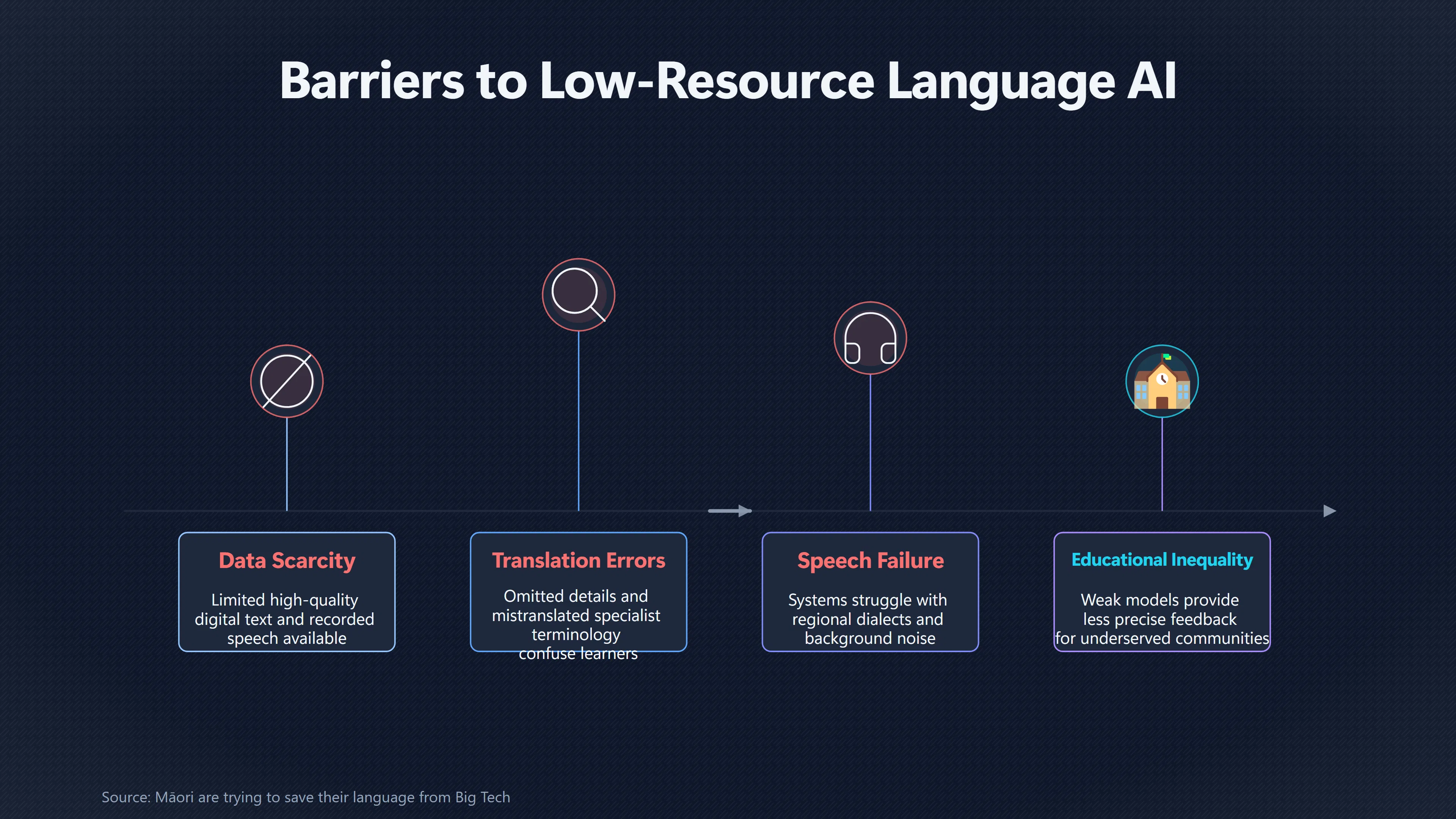
The phrase low-resource language does not refer to the number of speakers alone. It describes languages for which relatively little high-quality digital text, recorded speech and annotated training data are available. Some languages with millions of speakers still fall into this category because they have limited online content, few digitised books, or little investment in language technology.
For AI tutors, this shortage creates several practical problems:
- Less accurate translation. Educational explanations may omit important details, mistranslate specialist terminology or produce unnatural sentences that confuse learners.
- Poor speech recognition. Learners may be marked as incorrect simply because the system struggles with regional pronunciation, dialects or background noise.
- Weak subject vocabulary. Scientific, medical and technical terms are often translated inconsistently because suitable training material is scarce.
- Limited conversational ability. AI tutors may switch unexpectedly into a dominant language or provide fragmented answers instead of sustained dialogue.
These weaknesses matter more in education than in casual translation. A small translation error in a chemistry lesson, mathematics explanation or legal training course can change the meaning enough to mislead the learner, especially when there is no teacher available to detect the mistake. Research on the FLORES multilingual evaluation benchmark consistently shows that translation quality declines as available training data decreases, particularly when translating into very low-resource languages.[MIT Press Direct]direct.mit.eduMIT Press DirectThe Flores-101 Evaluation Benchmark for Low-Resource and Multilingual Machine Translation | Transactions of the Associati…
Speech technology follows a similar pattern. Automatic speech recognition systems improve dramatically when trained on thousands of hours of labelled speech. Many underserved languages have only a tiny fraction of that data, making pronunciation assessment and spoken tutoring substantially less reliable.[microsoft.com]microsoft.comMicrosoft ResearchFebruary 4, 2026…
Why Limited Data Creates Unequal Educational Quality
The gap between high-resource and low-resource AI tutors is not caused by a single technical limitation. Instead, several reinforcing factors combine to reduce educational quality.
First, commercial incentives matter. AI developers naturally invest most heavily in languages serving large markets, where improvements benefit hundreds of millions of users and generate greater commercial returns. Smaller language communities receive less dedicated engineering effort and fewer evaluation resources.
Second, educational material itself is unevenly digitised. Large collections of textbooks, examination papers and reference works exist in a handful of global languages. Equivalent material may not exist digitally for minority languages, limiting an AI tutor’s ability to explain school subjects naturally.
Third, evaluation is harder. Developers cannot improve systems if they cannot measure quality reliably. The creation of multilingual benchmarks such as FLORES has been an important step because it provides professionally translated reference material across many languages, making weaknesses easier to identify instead of remaining hidden.[ACL Anthology]aclanthology.orgACL AnthologyThe Flores-101 Evaluation Benchmark for Low-Resource and Multilingual Machine Translation - ACL Anthology…
Finally, many languages contain substantial dialect variation, code-switching and regional vocabulary. A tutor trained primarily on one written standard may struggle when learners speak everyday local varieties, reducing trust even if the underlying educational content is correct.
These technical inequalities can translate directly into educational inequalities. Learners using weaker language models may receive less precise feedback, poorer explanations and fewer opportunities to ask follow-up questions, making AI-assisted learning less effective precisely where educational resources are already scarce.
The Hidden Cost of Missing Cultural Context
Translation quality is only part of the problem. Effective teaching also depends on cultural context.
Educational examples often assume familiar foods, occupations, sports or social situations. An AI tutor trained mainly on material from wealthier countries may generate examples that feel unfamiliar or irrelevant to learners elsewhere. Even when the translation itself is correct, the explanation may fail because it assumes background knowledge the learner does not share.
This becomes particularly important in subjects such as history, civics or health education, where examples, metaphors and everyday references influence understanding. Culturally appropriate tutoring therefore requires more than multilingual translation: it requires locally relevant educational content created with participation from educators and language communities themselves.
For Indigenous and minority languages, another concern is data governance. Communities may wish to preserve control over recordings, dictionaries and oral traditions rather than allowing unrestricted commercial use. The challenge is therefore twofold: building stronger language technology while respecting cultural ownership and community consent. Efforts led by Māori organisations, for example, have demonstrated that locally governed speech datasets can improve language technology while maintaining community control over linguistic resources.[wired.com]wired.comMāori are trying to save their language from Big TechThe station launched a competition in 2018 that resulted in over 300 hours of annotated Māori audio, which they used to create a speech-t…
Offline and Local Systems for Underserved Communities
Language barriers often overlap with infrastructure barriers. Many communities that speak low-resource languages also experience unreliable internet access, limited computing resources or expensive mobile data.
This has encouraged interest in lighter, locally deployable AI systems that can operate without continuous cloud connectivity. Although these models are usually less capable than the largest online systems, they offer several advantages:
- They can function in schools with unreliable internet connections.
- Sensitive educational data can remain on local devices.
- Models can be adapted to local curricula and vocabulary.
- Community organisations can update dictionaries and terminology without waiting for large commercial providers.
Recent research suggests that carefully adapted smaller language models, combined with targeted training on local language resources, can significantly improve performance compared with generic multilingual systems, although they still face substantial limitations for the lowest-resource languages.[ACL Anthology]aclanthology.orgACL AnthologyAre Small Language Models the Silver Bullet to Low-Resource Languages Machine Translation? - ACL Anthology…
Alongside this, projects focused on African and Indigenous languages increasingly emphasise community partnerships, shared benchmarks and locally curated datasets rather than assuming that larger general-purpose models alone will solve the problem. Microsoft’s recent work on the Paza speech recognition benchmarks for African languages illustrates this shift towards building evaluation tools and speech datasets specifically for historically underserved languages.[microsoft.com]microsoft.comMicrosoft ResearchFebruary 4, 2026…
Why This Matters for AI Bloom
The optimistic case for AI-driven educational abundance assumes that access to expert explanation becomes dramatically cheaper and more widely available. That vision depends on linguistic inclusion as much as raw model capability.
If only speakers of major world languages receive accurate, patient and personalised AI tutors, educational inequality may narrow within wealthy countries while remaining wide across much of the world. Conversely, if translation, speech recognition and culturally appropriate tutoring become reliable across thousands of languages, AI could help preserve linguistic diversity while expanding access to scientific, technical and professional knowledge.
This is why multilingual capability is more than a convenience feature. It is part of the broader question of whether advanced AI distributes cognitive opportunity widely enough to support genuine human flourishing rather than concentrating its benefits among already well-served populations.
The current evidence suggests cautious optimism. Multilingual AI has improved rapidly, but systematic performance gaps remain for low-resource languages. Closing those gaps will require continued investment in community-created datasets, better evaluation benchmarks, culturally grounded educational content, open research collaboration and deployment models designed for regions where connectivity and computing resources remain limited.[unesco.org]unesco.orgGlobal Roadmap for Multilingualism in the Digital Era: Advancing theFebruary 13, 2026…
Amazon book picks
Further Reading
Books and field guides related to Why AI Tutors Still Fail Many Languages. Use these as the next step if you want deeper reading beyond the article.
The Language Instinct
In this exhilarating book, Steven Pinker asserts that language should not be seen as a cultural artefact that we learn in the way we lear...
Because Internet: Understanding the New Rules of Language
AN INSTANT NEW YORK TIMES BESTSELLER!! Named a Best Book of 2019 by TIME, Amazon, and The Washington Post A Wired Must-Read Book of Summe...
Words and Rules: The Ingredients of Language
This is a sparkling, eye-opening and utterly original book by one of the world's leading cognitive scientists.
eBay marketplace picks
Marketplace Samples
Live-tested eBay searches with available results related to this page.
Selected fromteacher mug oneBay.co.uk.

Current eBay listing
Personalized Teacher Mug: Custom Name Gift, End of Year Appreciation



Current eBay listing
Wholesale Pack Of 10 ‘Best teacher Ever’ Mugs End If Term Gift
Endnotes
1.
Source: unesco.org
Link:https://www.unesco.org/en/global-roadmap-multilingualism?hub=747
Source snippet
Global Roadmap for Multilingualism in the Digital Era: Advancing theFebruary 13, 2026...
Published: February 13, 2026
2.
Source: direct.mit.edu
Link:https://direct.mit.edu/tacl/article/doi/10.1162/tacl_a_00474/110993/The-Flores-101-Evaluation-Benchmark-for-Low
Source snippet
MIT Press DirectThe Flores-101 Evaluation Benchmark for Low-Resource and Multilingual Machine Translation | Transactions of the Associati...
3.
Source: microsoft.com
Link:https://www.microsoft.com/en-us/research/blog/paza-introducing-automatic-speech-recognition-benchmarks-and-models-for-low-resource-languages/
Source snippet
Microsoft ResearchFebruary 4, 2026...
Published: February 4, 2026
4.
Source: wired.com
Title: Māori are trying to save their language from Big Tech
Link:https://www.wired.com/story/maori-language-tech
Source snippet
The station launched a competition in 2018 that resulted in over 300 hours of annotated Māori audio, which they used to create a speech-t...
5.
Source: microsoft.com
Title: A I for Low-Resource Languages
Link:https://www.microsoft.com/en-us/research/project/ai-for-low-resource-languages/
Source snippet
AI for Low-Resource Languages - Microsoft Research...
6.
Source: unesco.org
Link:https://www.unesco.org/sdg4education2030/en/knowledge-hub/promise-practice-harnessing-generative-ai-improve-foundational-learning-sub-saharan-africa
7.
Source: aclanthology.org
Link:https://aclanthology.org/2022.tacl-1.30/
Source snippet
ACL AnthologyThe Flores-101 Evaluation Benchmark for Low-Resource and Multilingual Machine Translation - ACL Anthology...
8.
Source: aclanthology.org
Link:https://aclanthology.org/2026.loresmt-1.1/
Source snippet
ACL AnthologyAre Small Language Models the Silver Bullet to Low-Resource Languages Machine Translation? - ACL Anthology...
9.
Source: aclanthology.org
Title: 2026.loresmt 1
Link:https://aclanthology.org/volumes/2026.loresmt-1/
Source snippet
ACL AnthologyProceedings for the Ninth Workshop on Technologies for Machine Translation of Low Resource Languages (LoResMT 2026) - ACL An...
10.
Source: aclanthology.org
Title: Benchmarking Low-Resource Machine Translation Systems
Link:https://aclanthology.org/2024.loresmt-1.18/
Additional References
11.
Source: youtube.com
Title: Empowering Low Resource Languages with Subha Vadlamannati of Open NLPLabs
Link:https://www.youtube.com/watch?v=UbKGt_tQaaY
Source snippet
Building AI for Low-Resource Languages: Bezoku's Innovative Approach | Intel...
12.
Source: arxiv.org
Link:https://arxiv.org/abs/2205.12446
13.
Source: youtube.com
Title: How to Build AI for Low-Resource Languages
Link:https://www.youtube.com/watch?v=XUM1nL0sFQU
Source snippet
Low Resource Languages, AI Safety, and Alana AI: Verena Rieser on Indaba Insights...
14.
Source: arxiv.org
Title: arXiv Chat GPT MT: Competitive for High- (but not Low-) Resource Languages
Link:https://arxiv.org/abs/2309.07423
15.
Source: research.google
Link:https://research.google/pubs/fleurs-few-shot-learning-evaluation-of-universal-representations-of-speech/
16.
Source: transacl.org
Link:https://transacl.org/index.php/tacl/article/view/3377
17.
Source: ai.meta.com
Link:https://ai.meta.com/research/publications/the-flores-101-evaluation-benchmark-for-low-resource-and-multilingual-machine-translation/
18.
Source: youtube.com
Title: Low-Resource Language NLP
Link:https://www.youtube.com/watch?v=Ipi7ny5oOBU
Source snippet
Empowering Low Resource Languages with Subha Vadlamannati of OpenNLPLabs...
19.
Source: youtube.com
Link:https://www.youtube.com/watch?v=cHnPQ8jD_ME
Source snippet
Low-Resource Language NLP...
20.
Source: youtube.com
Title: Building AI for Low-Resource Languages: Bezoku’s Innovative Approach | Intel
Link:https://www.youtube.com/watch?v=-u5sk5YweuE