Within AI Bloom
Can AI Add Healthy Years to Human Life?
AI could speed drug discovery, diagnosis and prevention, yet longer healthy lives still depend on trials, delivery systems and fair access.
On this page
- From protein prediction to drug design
- Earlier diagnosis and personalised prevention
- Clinical proof, safety and equal access
Page outline Jump by section
Introduction
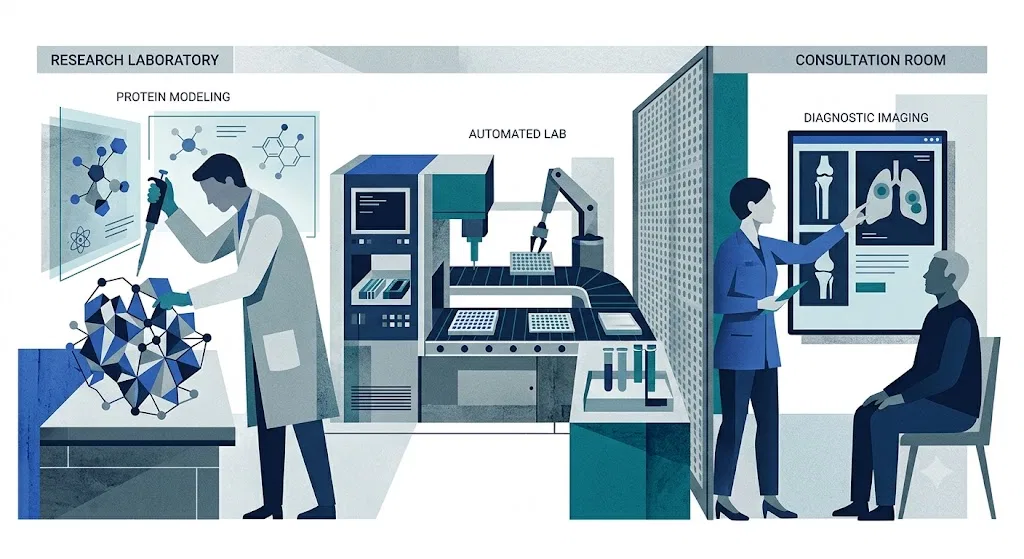
Artificial intelligence could add healthy years to human life, but the most credible route is not a sudden “cure for ageing”. It is a chain of practical advances: understanding biology more quickly, designing better drugs, detecting disease earlier, matching treatments to patients and making scarce clinical expertise more widely available. Early evidence is encouraging. AI has produced useful protein models at vast scale, helped a newly designed drug reach a mid-stage human trial and improved outcomes in randomised medical-screening studies.[ebi.ac.uk]alphafold.ebi.ac.ukThe latest database release contains over 200 million entries, providing broad coverage of UniProt (the standard repository of protein se…
Yet a computer prediction is not a medicine, and detecting more abnormalities is not automatically the same as helping people live longer or better. Promising systems must still survive laboratory experiments, representative clinical trials, regulation, integration into health services and long-term monitoring. Their benefits must also reach people who lack specialists, insurance, reliable clinics or access to essential medicines. Medicine is therefore one of the clearest tests of the wider AI-bloom thesis: can faster intelligence be converted into safe, affordable and broadly shared human flourishing?
From protein prediction to drug design
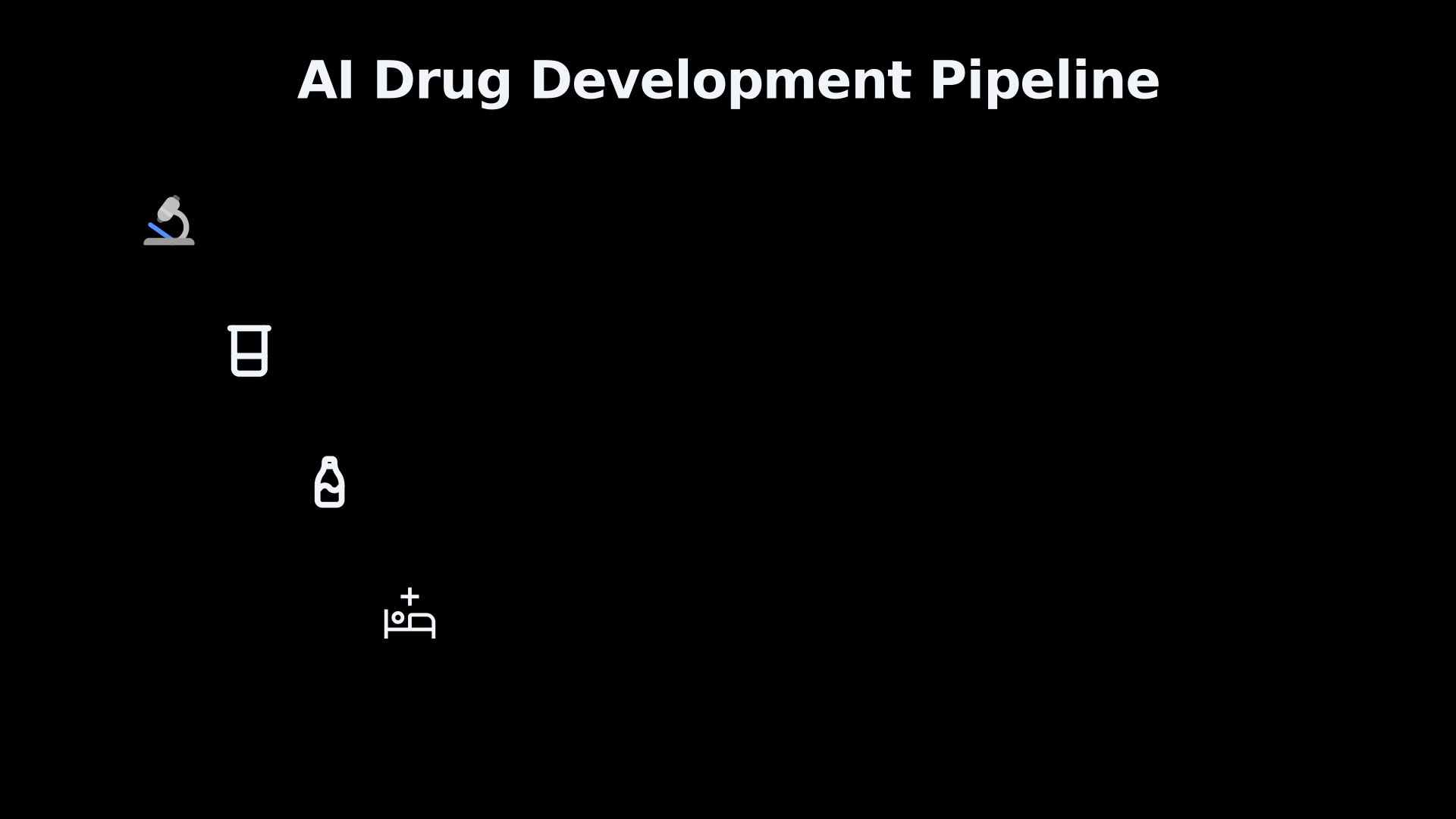
Drug development is slow partly because biology is extraordinarily complicated. Researchers must identify a disease mechanism, find a biological target, design a compound that affects it, test toxicity and dosage, and then show that it actually benefits patients. Many apparently promising ideas fail because laboratory models do not capture the full behaviour of a human body.
AI can help at several points in this chain. It can search biomedical literature, analyse genomic and cellular data, predict molecular interactions, generate possible drug structures and optimise candidates across competing requirements such as potency, toxicity, stability and ease of manufacture. It can also identify patterns that would be difficult for researchers to find by examining one experiment at a time. A major review in Nature Medicine describes applications spanning target identification, preclinical studies, clinical trials and post-market safety, while stressing that weak data and biological complexity remain fundamental constraints.[Nature]preview-nature.comNatureArtificial intelligence in drug developmentin AI applications across the entire drug development workflow, encompassing the identif…
AlphaFold shows the scale of the opportunity. A protein’s three-dimensional shape strongly influences what it does and how a medicine might interact with it. Experimental structure determination remains indispensable, but it can take substantial time and specialist effort. The open AlphaFold database now provides predictions for more than 200 million proteins, covering much of the known protein-sequence catalogue and giving researchers a starting point that previously did not exist for many targets.[AlphaFold]alphafold.ebi.ac.ukThe latest database release contains over 200 million entries, providing broad coverage of UniProt (the standard repository of protein se…
This does not mean that AlphaFold has “solved biology”. Predicted structures can be uncertain, proteins change shape, and living cells contain dynamic networks rather than isolated molecular parts. A structure prediction may suggest an experiment or narrow a search without proving that a target causes disease or that a proposed medicine will work. The real gain is leverage: researchers can eliminate some unpromising paths earlier and concentrate physical experiments on more plausible ones.
A drug designed with generative AI reaches patients
Rentosertib offers a more demanding proof point. The drug was developed for idiopathic pulmonary fibrosis, a serious disease in which lung tissue becomes scarred. Its biological target and small-molecule design were identified using generative-AI methods. In 2025, researchers reported a multicentre, double-blind, randomised phase 2a trial in Nature Medicine. The study evaluated safety and preliminary efficacy rather than providing the large, definitive evidence required for routine treatment.[nature.com]nature.comOpen source on nature.com.
The case matters because it moves the argument beyond virtual screening. A molecule selected by an AI-assisted process was manufactured, given to patients and assessed under controlled clinical conditions. But it also shows why claims that AI has already transformed pharmaceutical productivity are premature. One encouraging mid-stage trial cannot establish that AI-generated drugs will succeed more often, prove safer or reduce total development costs across the industry.
Clinical failure usually occurs after the comparatively cheap computational stages. A model may generate a candidate in weeks, yet toxicology, manufacturing, recruitment, dosing studies and outcome trials can still take years. Current industry investment is substantial, but analysts and pharmaceutical researchers continue to debate whether AI has yet produced a measurable improvement in overall clinical success rates.[wsj.com]wsj.comCompanies like Recursion Pharmaceuticals have made strides using AI for disease understanding and drug targeting, although commercial suc…
The strongest near-term case is therefore not that AI abolishes the drug-development pipeline, but that it makes each round of learning more informative. Better target selection could reduce avoidable failures. Generative models could propose compounds that satisfy several design constraints at once. Automated laboratories could test them rapidly, feed the results back into models and repeat the cycle. Advanced systems might eventually coordinate literature analysis, simulation and robotic experimentation as a continuous research process.
For healthy longevity, this capability could be used in two related ways. The first is to treat individual diseases that shorten or diminish later life, including cancer, cardiovascular disease, dementia, diabetes and organ fibrosis. The second, more speculative aim is to target biological processes that contribute to several age-related conditions at once. The US National Institute on Aging supports research into interventions that may influence multiple predictors of lifespan or healthspan, meaning the years lived in good health rather than simply years alive.[National Institute on Aging]nia.nih.govOpen source on nih.gov.
AI could help disentangle these mechanisms by integrating genetic, molecular, imaging and longitudinal health data. However, it cannot bypass the central evidential problem: an intervention intended to alter ageing must eventually demonstrate meaningful human outcomes. Improvements in a laboratory marker or an “ageing clock” do not necessarily mean fewer disabilities, preserved cognition or longer life. Researchers themselves continue to dispute how much such clocks add beyond direct prediction of disease and mortality risk.[nature.com]nature.comDo we actually need aging clocks?Do we actually need aging clocks?
Earlier diagnosis and personalised prevention
The medical value of AI may arrive earlier through prevention than through radical lifespan extension. Health systems already collect images, laboratory results, clinical notes, genetic information and data from monitoring devices. AI can search these records for patterns associated with disease risk or subtle signs that a clinician might otherwise miss.
The central promise is a shift from reactive medicine towards earlier intervention. Instead of waiting for advanced disease to produce obvious symptoms, clinicians could identify people whose risk is rising and offer additional tests, lifestyle support or preventive treatment. In principle, a system could combine family history, blood markers, scans and changes over time rather than relying on a single population-wide threshold.
Breast screening provides unusually strong evidence because AI has been tested prospectively rather than only on archived images. In the Swedish MASAI trial, women were randomly assigned to AI-supported mammography screening or standard double reading by radiologists. Follow-up results reported in The Lancet found that AI-supported screening reduced interval cancers—cancers diagnosed between scheduled screens—while maintaining screening accuracy. This is more clinically meaningful than showing that an algorithm can label a test set correctly, because interval cancers are precisely the cases a screening programme hopes not to miss.[PubMed]pubmed.ncbi.nlm.nih.gov* ^{5} Division of Oncology, Department of Clinical Sciences Lund, Lund University, Lund, Sweden…. Lancet…. Background: Evidence in…
Even so, screening creates difficult trade-offs. Finding more abnormalities can lead to earlier treatment, but it can also produce false alarms, unnecessary biopsies and overdiagnosis of disease that would never have caused serious harm. The essential question is not simply whether AI detects more, but whether it reduces advanced disease, disability and mortality without creating disproportionate burdens. Those outcomes may require years of follow-up.
Diabetic eye disease illustrates another route to longer healthy life: bringing diagnosis closer to the patient. Retinal damage can be treated more effectively when found early, yet screening often requires access to an eye specialist. Autonomous systems can analyse retinal photographs in primary-care or diabetes clinics and recommend referral without waiting for a specialist to interpret every image.
In the ACCESS randomised trial, offering an autonomous AI eye examination during a paediatric diabetes visit substantially increased completion of diabetic-eye screening and subsequent follow-up compared with referral and education alone. The improvement came not merely from diagnostic accuracy but from changing the care pathway: the examination happened while the patient was already present.[PubMed]pubmed.ncbi.nlm.nih.govOpen source on nih.gov.
That distinction is crucial. An AI tool can perform well technically and still fail to improve health if patients cannot act on its recommendation. Screening must connect to confirmatory testing, treatment and continuing care. Conversely, a moderately capable system may produce large benefits when it removes a bottleneck that causes many people to miss screening altogether.
Personalisation needs repeated, representative evidence
“Personalised medicine” is sometimes presented as though enough data will allow a model to discover the perfect treatment for each individual. In reality, most clinical decisions involve uncertainty, incomplete records and groups of patients rather than a unique answer for one person.
AI can still make treatment more precise. It may help identify which patients are most likely to respond to a medicine, estimate the risk of side-effects or distinguish between diseases with similar symptoms. In trials, it could find eligible participants more efficiently and identify subgroups whose different responses would otherwise be hidden in an overall average. Reviews of precision medicine describe growing use of AI across imaging, genomics, treatment selection and monitoring, alongside persistent problems with data quality, interpretability and deployment in resource-constrained settings.[Frontiers]frontiersin.orgOpen source on frontiersin.org.
The danger is that models learn the irregularities of the health system rather than biology itself. A hospital record reflects who obtained care, which tests clinicians ordered and how information was documented. If poorer or minority patients historically received fewer investigations, an algorithm trained on those records may treat lower levels of care as normal or appropriate.
This is not only theoretical. Studies of clinical language models have found that recommendations can change when demographic or socioeconomic details are altered while the underlying medical facts remain the same. Systematic reviews also identify performance disparities involving race, sex, age, disability and language.[reuters.com]reuters.comHealth Rounds: AI can have medical care biases too, a study revealsHealth Rounds: AI can have medical care biases too, a study reveals
Representative evaluation is therefore a medical requirement, not merely an ethical addition. A diagnostic tool should be tested across relevant ages, ethnic groups, equipment types, hospitals and disease prevalence. It must also be checked after deployment, because changing populations or clinical practices can degrade performance. A model that works in a specialist research hospital may not transfer reliably to a community clinic using different scanners or serving patients with different conditions.
Clinical proof, safety and equal access
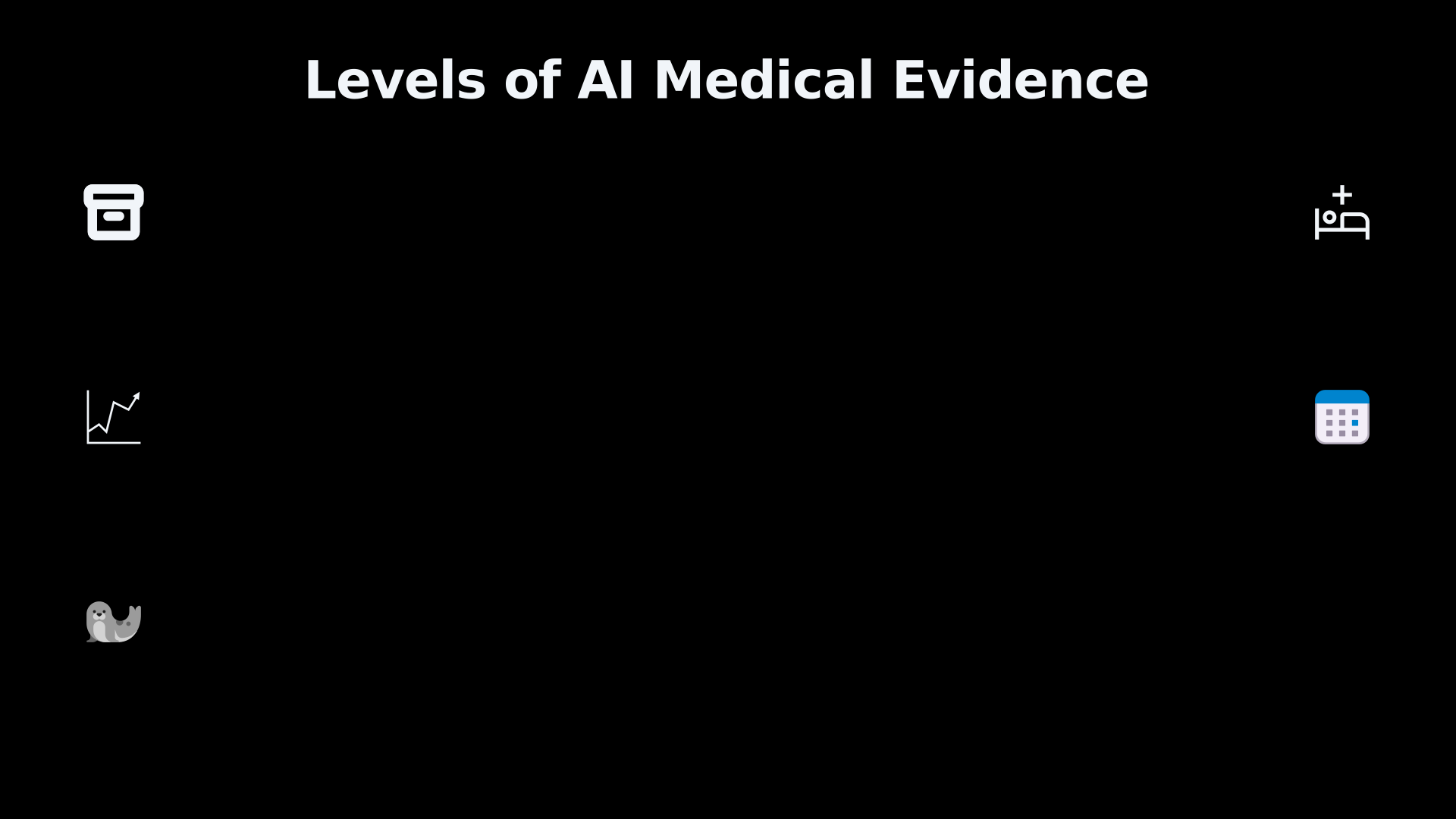
The distance between an accurate model and a healthier population is often underestimated. Medical evidence has several levels. A retrospective study may show that AI performs well on existing data. A prospective study tests it on new patients. A randomised trial asks whether adding it to care improves a defined outcome compared with current practice. Longer follow-up is then needed to reveal delayed harms, changes in clinician behaviour and effects on survival or quality of life.
Much medical AI remains concentrated near the earlier end of this ladder. The US Food and Drug Administration maintains a growing list of authorised AI-enabled medical devices, particularly in radiology, but authorisation applies to defined uses and is not a general endorsement of AI medicine. The agency notes that devices undergo applicable premarket review while also acknowledging that its public list is not comprehensive.[fda.gov]fda.govartificial intelligence enabled medical devicesartificial intelligence enabled medical devices
AI systems also raise unusual regulatory questions because they may be updated after release. A conventional device is expected to behave consistently, whereas a learning system may change as its model, data or intended use evolves. Regulators must determine which changes require new evidence, how performance should be monitored and who is accountable when a model’s recommendation contributes to harm. The FDA has consequently emphasised lifecycle management, robustness, bias, transparency and plans for controlled software changes.[fda.gov]fda.govOpen source on fda.gov.
Clinical safety also depends on human interaction. Automation bias can cause clinicians to accept an incorrect recommendation because it appears mathematically authoritative. The opposite problem is alert fatigue: if a system generates too many warnings, users learn to ignore it. Good deployment therefore requires clear limits, usable explanations, escalation routes and evidence about how the combined human–AI team performs—not just the model in isolation.
For longevity medicine, the evidential standard should be especially demanding. People may take preventive interventions for years while feeling well, so even uncommon adverse effects can outweigh uncertain future benefits. Commercial enthusiasm around anti-ageing treatments already exceeds the quality of human evidence for many products and procedures. AI-generated hypotheses should not be allowed to turn that market into faster, more personalised speculation.[washingtonpost.com]washingtonpost.comThese are the treatments dominating the business of living longerMany consumers, disillusioned with the U.S. healthcare system, are willing to pay tens of thousands of dollars and try experimental proce…

Abundance is a delivery problem too
AI could reduce the cost of some expertise, but it does not manufacture medicines, staff clinics, finance public health systems or guarantee that patients can obtain treatment. More than 4.5 billion people still lack full access to essential health services, according to the World Health Organization, while billions face financial hardship from direct health spending. These gaps exist despite many effective treatments already being known.[World Health Organization]who.intOpen source on who.int.
This is the central distribution test. A breakthrough therapy that costs hundreds of thousands of pounds and is delivered only in elite centres may extend healthy life for a fortunate minority while widening health inequality. A less dramatic AI system that enables inexpensive screening in ordinary primary care could produce a larger population benefit.
Broad access would require several choices:
- Public-interest data infrastructure. Health data can support discovery, but patients need privacy protections, meaningful governance and safeguards against exclusion or commercial exploitation.
- Trials that reflect the intended population. Age, ethnicity, sex, disability, income and geography can all affect whether an intervention works or can realistically be delivered.
- Affordable production and procurement. Lower discovery costs will not automatically become lower prices where patents, manufacturing capacity or market power remain binding constraints.
- Investment in ordinary care. Screening only helps when referral, treatment, rehabilitation and follow-up are available.
- Shared scientific resources. Open tools such as the AlphaFold database allow researchers outside the wealthiest companies and universities to build on expensive computational work.[AlphaFold]alphafold.ebi.ac.ukThe AlphaFold Protein Structure Database will continue to be improved and expanded in the future, adding more protein structures and func…
- International governance. The WHO argues that medical AI should protect autonomy, promote safety, ensure transparency and accountability, and be designed for inclusiveness and equity.[World Health Organization]who.intOpen source on who.int.
These conditions are not obstacles external to innovation. They determine what kind of innovation occurs. Developers optimise for the incentives and health systems around them. Payment arrangements that reward expensive procedures may produce different AI tools from systems that reward prevention and population health.
How much healthy longevity could AI deliver?
The defensible optimistic case has several layers. The first is already visible: AI can reduce specific bottlenecks in research and diagnosis. The second is plausible but not yet established at scale: repeated improvements across discovery, trial design, prevention and care delivery could lower the burden of many major diseases. The third is genuinely speculative: sufficiently advanced AI might discover interventions that slow or reverse several processes of biological ageing, producing much larger gains in healthspan.
Even without a general anti-ageing therapy, progress against multiple diseases could have a powerful cumulative effect. Preventing a heart attack at 60, detecting cancer earlier at 68, preserving sight in diabetes and delaying dementia could add years of independent, capable life. Healthy longevity is likely to emerge from many such gains rather than one cinematic breakthrough.
More capable AI could accelerate this process by operating across scales. One system might analyse molecular mechanisms; another could design experiments; automated laboratories could run them; clinical models could identify suitable trial participants; and health-service tools could track outcomes after deployment. Faster feedback between these stages could turn medicine from a sequence of isolated projects into a more continuous learning system.
But intelligence is not the only bottleneck. Human biology remains difficult to measure, experiments take real time and some outcomes cannot be safely compressed. A five-year survival result still requires patients to be followed, however quickly the original molecule was designed. Social conditions also shape health: housing, nutrition, pollution, education, income and loneliness cannot be repaired by precision medicine alone.
The most meaningful measure of an AI medical bloom would therefore not be the number of generated molecules, published models or authorised devices. It would be whether people across different regions and income groups experience later onset of disease, less disability, more years of independent life and a smaller gap in healthy life expectancy.
The real test of medical progress
AI medicine could become one of the strongest foundations for a flourishing long-term future. Longer healthy lives would allow people more time for relationships, learning, creativity and contribution. They could reduce the fear and economic loss caused by disease and preserve knowledge and experience across generations.
The evidence so far supports serious optimism, not certainty. Protein prediction has become dramatically more abundant. AI-assisted drug design has crossed into controlled human testing. Randomised studies show that carefully chosen diagnostic systems can improve screening pathways and find clinically important disease earlier.[ebi.ac.uk]alphafold.ebi.ac.ukThe latest database release contains over 200 million entries, providing broad coverage of UniProt (the standard repository of protein se…
The larger promise depends on what happens next: whether models generate reproducible biological insight, whether therapies succeed in large trials, whether safety systems keep pace, and whether health services can deliver the results fairly. AI may make medical discovery faster. Turning that speed into widely shared healthy longevity remains a scientific, institutional and political achievement.
Amazon book picks
Further Reading
Books and field guides related to Can AI Add Healthy Years to Human Life?. Use these as the next step if you want deeper reading beyond the article.
Deep Medicine: How Artificial Intelligence Can Make Healthcar...
One of America's top doctors reveals how AI will empower physicians and revolutionize patient care Medicine has become inhuman, to disast...
Lifespan: Why We Age—and Why We Don't Have To
A NEW YORK TIMES BESTSELLER “Brilliant and enthralling.” —The Wall Street Journal A paradigm-shifting book from an acclaimed Harvard Med...
The Gene: An Intimate History
Prologue: Families -- "The missing science of heredity" 1865-1935 -- "In the sum of the parts, there are only the parts" 1930-1970 -- "Th...
eBay marketplace picks
Marketplace Samples
Live-tested eBay searches with available results related to this page.
Selected frommedical robot model oneBay.co.uk.


Endnotes
1.
Source: nature.com
Link:https://www.nature.com/articles/s41591-025-03743-2
2.
Source: nature.com
Link:https://www.nature.com/articles/s41467-023-44676-z
Source snippet
The regulatory approval of the first diagnostic autonomous AI system for diabetic [eye exams]({{ 'eye-exams/' | relative_url }}) was based on a pivotal trial against a progno...
3.
Source: wsj.com
Link:https://www.wsj.com/health/pharma/the-quest-to-use-ai-to-help-find-new-drugs-a754fdc3
Source snippet
Companies like Recursion Pharmaceuticals have made strides using AI for disease understanding and drug targeting, although commercial suc...
4.
Source: nature.com
Title: Artificial intelligence in drug development | Nature Medicine
Link:https://www.nature.com/articles/s41591-024-03434-4
5.
Source: nature.com
Title: Do we actually need aging clocks?
Link:https://www.nature.com/articles/s41514-025-00312-2.pdf
6.
Source: nature.com
Title: Do we actually need aging clocks? | npj Aging
Link:https://www.nature.com/articles/s41514-025-00312-2
7.
Source: reuters.com
Title: Health Rounds: AI can have medical care biases too, a study reveals
Link:https://www.reuters.com/business/[healthcare
8.
Source: fda.gov
Title: artificial intelligence enabled medical devices
Link:https://www.fda.gov/medical-devices/software-medical-device-samd/artificial-intelligence-enabled-medical-devices
9.
Source: fda.gov
Link:https://www.fda.gov/media/177030/download?_hsenc=p2ANqtz–aYvLxwXrefGuGd38X03MSU25IHBeEdyjaLG5ljr_lBBO_loBZKBRMofFtukvv6wLjX-OJ
10.
Source: washingtonpost.com
Title: These are the treatments dominating the business of living longer
Link:https://www.washingtonpost.com/health/2026/01/12/longevity-maha-antiaging-health-rfk/
Source snippet
Many consumers, disillusioned with the U.S. healthcare system, are willing to pay tens of thousands of dollars and try experimental proce...
11.
Source: who.int
Link:https://www.who.int/news/item/17-05-2025-who-advances-access-and-equity-at-the-un-commission-on-population-and-development
12.
Source: who.int
Link:https://www.who.int/publications/i/item/9789240029200
13.
Source: who.int
Link:https://www.who.int/publications/i/item/9789240037403
14.
Source: who.int
Link:https://www.who.int/news/item/02-06-2026-new-who-discussion-paper-sets-out-opportunities-and-risks-of-ai-in-evidence-informed-health-policy
15.
Source: fda.gov
Title: artificial intelligence drug development
Link:https://www.fda.gov/about-fda/center-drug-evaluation-and-research-cder/artificial-intelligence-drug-development
16.
Source: nature.com
Link:https://www.nature.com/articles/s41746-026-02460-5
17.
Source: nature.com
Link:https://www.nature.com/nature-index/article/10.1016/s0140-6736%2825%2902464-x
18.
Source: who.int
Link:https://www.who.int/europe/news/item/18-12-2025-new-who-europe-briefs-show-how-countries-are-improving-affordable-access-to-health-care
19.
Source: GOV.UK
Title: www.gov.uk Regulation of AI in Healthcare
Link:https://www.gov.uk/government/calls-for-evidence/regulation-of-ai-in-healthcare
20.
Source: nature.com
Link:https://www.nature.com/articles/s41746-025-02119-7
21.
Source: who.int
Link:https://www.who.int/news/item/06-12-2025-most-countries-make-progress-towards-universal-health-coverage-but-major-challenges-remain-who-world-bank-report-finds
22.
Source: nature.com
Title: A I and innovation in clinical trials | npj Digital Medicine
Link:https://www.nature.com/articles/s41746-025-02048-5
23.
Source: GOV.UK
Title: www.gov.uk A I to be trialled at unprecedented scale across NHS screening
Link:https://www.gov.uk/government/news/ai-to-be-trialled-at-unprecedented-scale-across-nhs-screening
24.
Source: who.int
Link:https://www.who.int/news/item/19-09-2025-who-publishes-full-guideline-report-to-help-countries-ensure-safe–equitable-access-to-controlled-medicines
25.
Source: nature.com
Link:https://www.nature.com/articles/s41746-025-01886-7
26.
Source: nature.com
Title: Clinical trials gain intelligence | Nature Biotechnology
Link:https://www.nature.com/articles/s41587-025-02754-1
27.
Source: nature.com
Title: A I-enabled drug discovery reaches clinical milestone | Nature Medicine
Link:https://www.nature.com/articles/s41591-025-03832-2
28.
Source: GOV.UK
Title: www.gov.uk World-first AI system to warn of NHS patient safety concerns
Link:https://www.gov.uk/government/news/world-first-ai-system-to-warn-of-nhs-patient-safety-concerns
29.
Source: nature.com
Link:https://www.nature.com/nature-index/article/10.1038/s41591-025-03743-2
30.
Source: fda.gov
Link:https://www.fda.gov/news-events/press-announcements/fda-issues-comprehensive-draft-guidance-developers-artificial-intelligence-enabled-medical-devices
31.
Source: who.int
Title: WH O unveils new guideline to improve global access to controlled medicines
Link:https://www.who.int/news/item/26-05-2025-who-unveils-new-guideline-to-improve-global-access-to-controlled-medicines
32.
Source: who.int
Link:https://www.who.int/publications/i/item/9789240104181
33.
Source: nature.com
Link:https://www.nature.com/articles/s41514-025-00221-4
34.
Source: who.int
Link:https://www.who.int/news-room/commentaries/detail/ensuring-equitable-access-to-essential-medicines-and-health-technologies-for-noncommunicable-diseases
35.
Source: fda.gov
Title: artificial intelligence drug development
Link:https://www.fda.gov/about-fda/center-drug-evaluation-and-research-cder/artificial-intelligence-drug-development?trk=article-ssr-frontend-pulse_x-social-details_comments-action_comment-text
36.
Source: nature.com
Link:https://www.nature.com/articles/s44385-024-00003-9
37.
Source: nature.com
Link:https://www.nature.com/articles/s41576-024-00807-w
38.
Source: fda.gov
Link:https://www.fda.gov/news-events/press-announcements/fda-proposes-framework-advance-credibility-ai-models-used-drug-and-biological-product-submissions
39.
Source: nature.com
Title: [Alpha Fold]({{ ‘alpha-fold/’ | relative_url }}) gets an upgrade (and a Nobel) | Nature Medicine
Link:https://www.nature.com/articles/s41591-024-03392-x
40.
Source: nature.com
Link:https://www.nature.com/articles/s41392-024-02036-3
41.
Source: nature.com
Link:https://www.nature.com/articles/s41586-024-08416-7
42.
Source: nature.com
Title: A I Approaches in Drug Design
Link:https://www.nature.com/collections/acaibijcea
43.
Source: nature.com
Title: A I protein-prediction tool Alpha Fold3 is now more open | Nature
Link:https://www.nature.com/articles/d41586-024-03708-4
44.
Source: nature.com
Link:https://www.nature.com/articles/d41586-024-03214-7
45.
Source: nature.com
Link:https://www.nature.com/articles/s41746-024-01197-3
46.
Source: nature.com
Link:https://www.nature.com/articles/s41594-024-01350-2
47.
Source: who.int
Title: Artificial Intelligence for Health
Link:https://www.who.int/publications/m/item/artificial-intelligence-for-health
48.
Source: nature.com
Title: Alpha Fold3 — why did Nature publish it without its code?
Link:https://www.nature.com/articles/d41586-024-01463-0
49.
Source: nature.com
Link:https://www.nature.com/articles/s41586-024-07487-w
50.
Source: nature.com
Title: Alphafold 3.0: the AI protein predictor gets an upgrade | Nature
Link:https://www.nature.com/articles/d41586-024-01385-x
51.
Source: nature.com
Title: Major Alpha Fold upgrade offers boost for drug discovery | Nature
Link:https://www.nature.com/articles/d41586-024-01383-z
52.
Source: nature.com
Link:https://www.nature.com/articles/d41586-024-00206-5
53.
Source: nature.com
Link:https://www.nature.com/articles/d41586-024-00130-8
54.
Source: who.int
Title: WH O releases AI ethics and governance guidance for large multi-modal models
Link:https://www.who.int/news/item/18-01-2024-who-releases-ai-ethics-and-governance-guidance-for-large-multi-modal-models
55.
Source: who.int
Title: Health Ethics & Governance
Link:https://www.who.int/teams/health-ethics-governance/emerging-technologies/big-data-and-artificial-intelligence
56.
Source: nature.com
Link:https://www.nature.com/articles/s41746
57.
Source: nature.com
Title: Artificial intelligence in drug development
Link:https://www.nature.com/articles/s41591-024-03434-4.pdf
58.
Source: nature.com
Title: Clinical trials gain intelligence
Link:https://www.nature.com/articles/s41587-025-02754-1.pdf
59.
Source: nature.com
Link:https://www.nature.com/articles/s41401-025-01591-x.pdf
60.
Source: nature.com
Link:https://www.nature.com/articles/s41746-025-01667-2
61.
Source: nature.com
Link:https://www.nature.com/articles/s43587-025-00928-9.pdf
62.
Source: nature.com
Title: A scoping review and evidence gap analysis of clinical AI fairness
Link:https://www.nature.com/articles/s41746-025-01667-2.pdf
63.
Source: nature.com
Link:https://www.nature.com/articles/s41467-025-66106-y.pdf
64.
Source: nature.com
Link:https://www.nature.com/articles/s41576-024-00807-w.pdf
65.
Source: nature.com
Title: Biological aging clocks in health and disease
Link:https://www.nature.com/articles/s41591-026-04495-3.pdf
66.
Source: nature.com
Title: The AI drug revolution needs a revolution
Link:https://www.nature.com/articles/s44386-025-00013-6.pdf
67.
Source: nature.com
Link:https://www.nature.com/articles/s43587-026-01118-x.pdf
68.
Source: nature.com
Link:https://www.nature.com/articles/s43587-025-01016-8.pdf
69.
Source: who.int
Link:https://www.who.int/publications/b/70584
70.
Source: cdn.who.int
Title: brochure ai web
Link:https://cdn.who.int/media/docs/default-source/digital-health-documents/who_brochure_ai_web.pdf?download=true&sfvrsn=aa4f4e3b_3
71.
Source: iris.who.int
Link:https://iris.who.int/bitstreams/e9e62c65-6045-481e-bd04-20e206bc5039/download
72.
Source: iris.who.int
Link:https://iris.who.int/server/api/core/bitstreams/f780d926-4ae3-42ce-a6d6-e898a5562621/content
73.
Source: iris.who.int
Link:https://iris.who.int/server/api/core/bitstreams/4f2c477c-4b72-4ca1-9a78-a1e73af64e50/content
74.
Source: who.int
Link:https://www.who.int/teams/digital-health-and-innovation/harnessing-artificial-intelligence-for-health
75.
Source: apps.who.int
Link:https://apps.who.int/gb/MSPI/pdf_files/2025/09/Item1_03-09.pdf
76.
Source: who.int
Link:https://www.who.int/publications/b/71385
77.
Source: who.int
Link:https://www.who.int/publications/b/74762
78.
Source: iris.who.int
Link:https://iris.who.int/bitstreams/f788fb7a-851c-4719-8cac-ea67bb8e2168/download
79.
Source: who.int
Link:https://www.who.int/publications/b/67293
80.
Source: fda.gov
Link:https://www.fda.gov/science-research/focus-areas-regulatory-science-report/focus-area-artificial-intelligence
81.
Source: fda.gov
Link:https://www.fda.gov/media/177030/download?attachment%EF%BF%BD=
82.
Source: fda.gov
Link:https://www.fda.gov/media/167973/download
83.
Source: fda.gov
Link:https://www.fda.gov/medical-devices/medical-device-regulatory-science-research-programs-conducted-osel/artificial-intelligence-program-research-aiml-based-medical-devices
84.
Source: fda.gov
Link:https://www.fda.gov/medical-devices/software-medical-device-samd/artificial-intelligence-software-medical-device
85.
Source: fda.gov
Link:https://www.fda.gov/media/189581/download
86.
Source: alphafold.ebi.ac.uk
Link:https://www.alphafold.ebi.ac.uk/
Source snippet
The latest database release contains over 200 million entries, providing broad coverage of UniProt (the standard repository of protein se...
87.
Source: pubmed.ncbi.nlm.nih.gov
Link:https://pubmed.ncbi.nlm.nih.gov/41620232/
Source snippet
* ^{5} Division of Oncology, Department of Clinical Sciences Lund, Lund University, Lund, Sweden.... Lancet.... Background: Evidence in...
88.
Source: preview-nature.com
Link:https://preview-www.nature.com/articles/s41591-024-03434-4.pdf
Source snippet
NatureArtificial intelligence in drug developmentin AI applications across the entire drug development workflow, encompassing the identif...
89.
Source: alphafold.ebi.ac.uk
Link:https://www.alphafold.ebi.ac.uk/about
Source snippet
The AlphaFold Protein Structure Database will continue to be improved and expanded in the future, adding more protein structures and func...
90.
Source: nia.nih.gov
Link:https://www.nia.nih.gov/research/dgcg/clinical-trials-branch
91.
Source: nia.nih.gov
Link:https://www.nia.nih.gov/research/dgcg/clinical-gerontology-branch
92.
Source: pubmed.ncbi.nlm.nih.gov
Link:https://pubmed.ncbi.nlm.nih.gov/38212308/
93.
Source: frontiersin.org
Link:https://www.frontiersin.org/journals/public-health/articles/10.3389/fpubh.2025.1656603/pdf
94.
Source: frontiersin.org
Link:https://www.frontiersin.org/journals/aging/articles/10.3389/fragi.2026.1868486/full
95.
Source: nia.nih.gov
Title: translational research branch and programs
Link:https://www.nia.nih.gov/research/dab/translational-research-branch-and-programs
96.
Source: nia.nih.gov
Link:https://www.nia.nih.gov/gsig
97.
Source: nia.nih.gov
Title: about itp
Link:https://www.nia.nih.gov/research/dab/interventions-testing-program-itp/about-itp
98.
Source: pmc.ncbi.nlm.nih.gov
Link:https://pmc.ncbi.nlm.nih.gov/articles/PMC13036691/
99.
Source: ebi.ac.uk
Title: first complexes alphafold database
Link:https://www.ebi.ac.uk/about/news/technology-and-innovation/first-complexes-alphafold-database/
100.
Source: ebi.ac.uk
Title: alphafold database community datasets
Link:https://www.ebi.ac.uk/about/news/updates-from-data-resources/alphafold-database-community-datasets/
101.
Source: ebi.ac.uk
Title: Alpha Fold Database release notes | Protein Data Bank in Europe
Link:https://www.ebi.ac.uk/pdbe/news/alphafold-database-release-notes
102.
Source: frontiersin.org
Link:https://www.frontiersin.org/journals/digital-health/articles/10.3389/fdgth.2025.1666415/full
103.
Source: nia.nih.gov
Link:https://www.nia.nih.gov/
104.
Source: ebi.ac.uk
Title: new alphafold database entry pages
Link:https://www.ebi.ac.uk/about/news/updates-from-data-resources/new-alphafold-database-entry-pages/
105.
Source: pubmed.ncbi.nlm.nih.gov
Link:https://pubmed.ncbi.nlm.nih.gov/40461817/?dopt=Abstract
106.
Source: pmc.ncbi.nlm.nih.gov
Link:https://pmc.ncbi.nlm.nih.gov/articles/PMC12353801/
107.
Source: pubmed.ncbi.nlm.nih.gov
Link:https://pubmed.ncbi.nlm.nih.gov/40461817/
108.
Source: nia.nih.gov
Title: clinical research
Link:https://www.nia.nih.gov/news/topics/clinical-research
109.
Source: pubmed.ncbi.nlm.nih.gov
Link:https://pubmed.ncbi.nlm.nih.gov/39904652/
110.
Source: pubmed.ncbi.nlm.nih.gov
Link:https://pubmed.ncbi.nlm.nih.gov/39039218/
111.
Source: nia.nih.gov
Title: shaping future geriatrics and clinical gerontology research nia
Link:https://www.nia.nih.gov/research/blog/2024/06/shaping-future-geriatrics-and-clinical-gerontology-research-nia
112.
Source: nia.nih.gov
Link:https://www.nia.nih.gov/news/topics/geroscience
113.
Source: pmc.ncbi.nlm.nih.gov
Link:https://pmc.ncbi.nlm.nih.gov/articles/PMC10784572/
114.
Source: ebi.ac.uk
Title: alphafold database update sequence based search
Link:https://www.ebi.ac.uk/about/news/updates-from-data-resources/alphafold-database-update-sequence-based-search/
115.
Source: ebi.ac.uk
Title: alphafold using open data and ai to discover the 3d protein universe
Link:https://www.ebi.ac.uk/about/news/perspectives/alphafold-using-open-data-and-ai-to-discover-the-3d-protein-universe
116.
Source: ebi.ac.uk
Title: alphafold 200 million
Link:https://www.ebi.ac.uk/about/news/technology-and-innovation/alphafold-200-million
118.
Source: nia.nih.gov
Title: search better biomarkers aging
Link:https://www.nia.nih.gov/research/blog/2021/11/search-better-biomarkers-aging
119.
Source: pubmed.ncbi.nlm.nih.gov
Link:https://pubmed.ncbi.nlm.nih.gov/31304320/
120.
Source: preview-nature.com
Link:https://preview-www.nature.com/articles/s41591-025-03832-2.pdf
121.
Source: preview-nature.com
Link:https://preview-www.nature.com/articles/s41514-025-00312-2.pdf
122.
Source: preview-nature.com
Link:https://preview-www.nature.com/articles/s43587-025-00987-y.pdf
123.
Source: pubmed.ncbi.nlm.nih.gov
Link:https://pubmed.ncbi.nlm.nih.gov/40346277/
124.
Source: nia.nih.gov
Link:https://www.nia.nih.gov/comment/3648
125.
Source: pubmed.ncbi.nlm.nih.gov
Link:https://pubmed.ncbi.nlm.nih.gov/40517148/
126.
Source: nia.nih.gov
Link:https://www.nia.nih.gov/comment/3650
127.
Source: alphafold.ebi.ac.uk
Link:https://alphafold.ebi.ac.uk/?source_type=web
128.
Source: alphafold.ebi.ac.uk
Link:https://www.alphafold.ebi.ac.uk/download
129.
Source: publications.ersnet.org
Link:https://publications.ersnet.org/highwire_display/entity_view/node/708745/full
Additional References
130.
Source: youtube.com
Link:https://www.youtube.com/watch?v=zTK1O4e-pwI
Source snippet
How AI Is Unlocking the Secrets of Nature and the Universe | Demis Hassabis | TED...
131.
Source: youtube.com
Link:https://www.youtube.com/watch?v=0_M_syPuFos
Source snippet
AI Drug Discovery Is Real: Insilico CEO on Living Longer with AI...
132.
Source: youtube.com
Title: AI Drug Discovery Is Real: Insilico CEO on Living Longer with AI
Link:https://www.youtube.com/watch?v=mFQP0jmvCtU
Source snippet
AI & Quantum Computing for Longevity: Ivan de Weber on Cortex Discovery's Breakthroughs...
133.
Source: youtube.com
Link:https://www.youtube.com/watch?v=_Lk1D1uQZl0
Source snippet
How David Sinclair uses AI to reverse the effects of ageing and develop life-extending drugs...
134.
Source: arxiv.org
Link:https://arxiv.org/abs/2504.02917
135.
Source: researchgate.net
Link:https://www.researchgate.net/publication/392366960_A_generative_AI-discovered_TNIK_inhibitor_for_idiopathic_pulmonary_fibrosis_a_randomized_phase_2a_trial
136.
Source: sciencedirect.com
Link:https://www.sciencedirect.com/science/article/abs/pii/S0755498226000254
137.
Source: sciencedirect.com
Link:https://www.sciencedirect.com/science/article/pii/S0755498226000254
138.
Source: mdpi.com
Link:https://www.mdpi.com/1424-8247/19/6/916
139.
Source: yazamaz.com
Link:https://yazamaz.com/en/drug-genomics/ai-in-drug-discovery